
Patient Lifting Equipment Market Size and Share
Market Overview
| Study Period | 2020 - 2031 |
|---|---|
| Market Size (2026) | USD 4.76 Billion |
| Market Size (2031) | USD 7.73 Billion |
| Growth Rate (2026 - 2031) | 10.18 % |
| Fastest Growing Market | Asia-Pacific |
| Largest Market | North America |
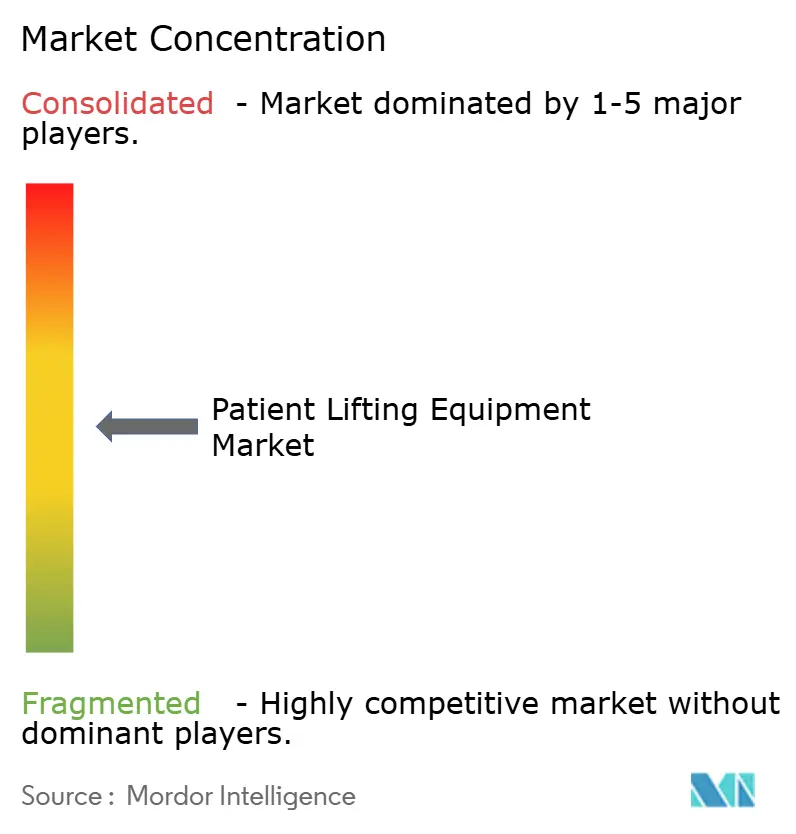
| Market Concentration | Medium |
Major Players *Disclaimer: Major Players sorted in no particular order Image © Mordor Intelligence. Reuse requires attribution under CC BY 4.0. | |
Patient Lifting Equipment Market Analysis by Mordor Intelligence
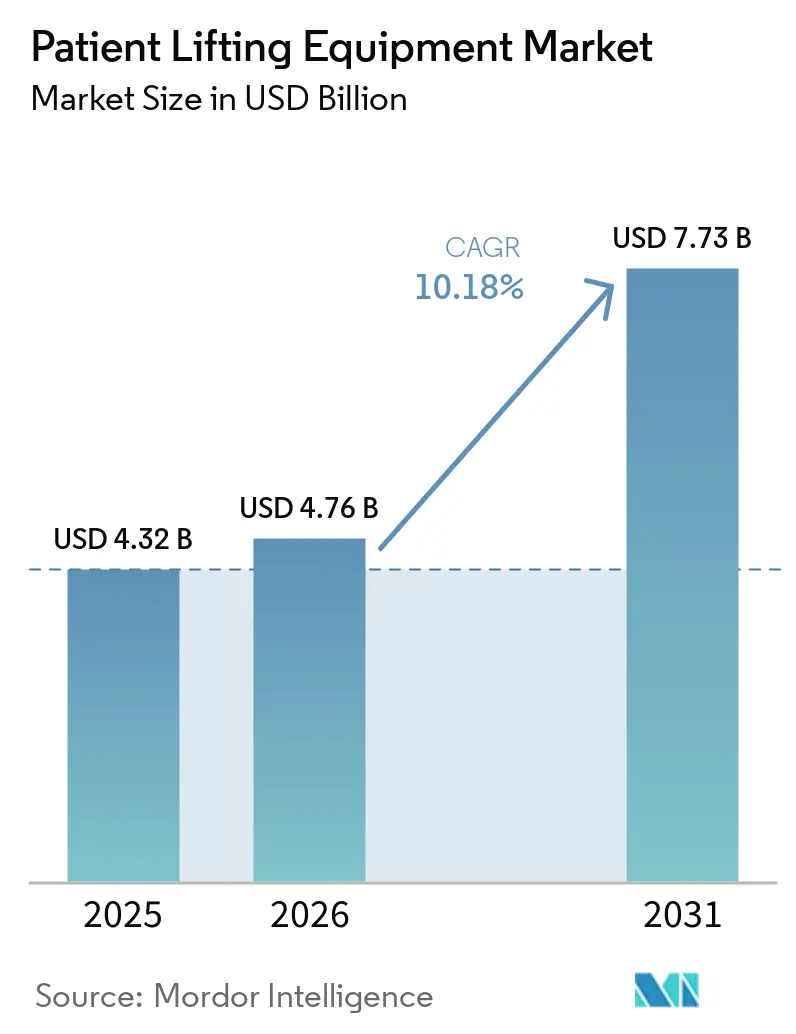
The Patient Lifting Equipment Market size was valued at USD 4.32 billion in 2025 and estimated to grow from USD 4.76 billion in 2026 to reach USD 7.73 billion by 2031, at a CAGR of 10.18% during the forecast period (2026-2031).
The expansion reflects widespread zero-lift mandates, rapid technology upgrades, and demographic aging that collectively reshape acute and long-term care delivery. Capital investments flow toward powered and IoT-ready devices that lower caregiver injury rates, align with infection-control protocols, and integrate with digital records. Asia-Pacific registers the fastest regional acceleration as hospital build-outs, domestic manufacturing incentives, and bariatric care needs converge. At the same time, rental and “equipment-as-a-service” models unlock access for cost-sensitive buyers, particularly in home settings. Competitive intensity rises as global incumbents absorb specialists, deploy smart-sensor platforms, and bundle post-sale services to secure multiyear contracts.
Key Report Takeaways
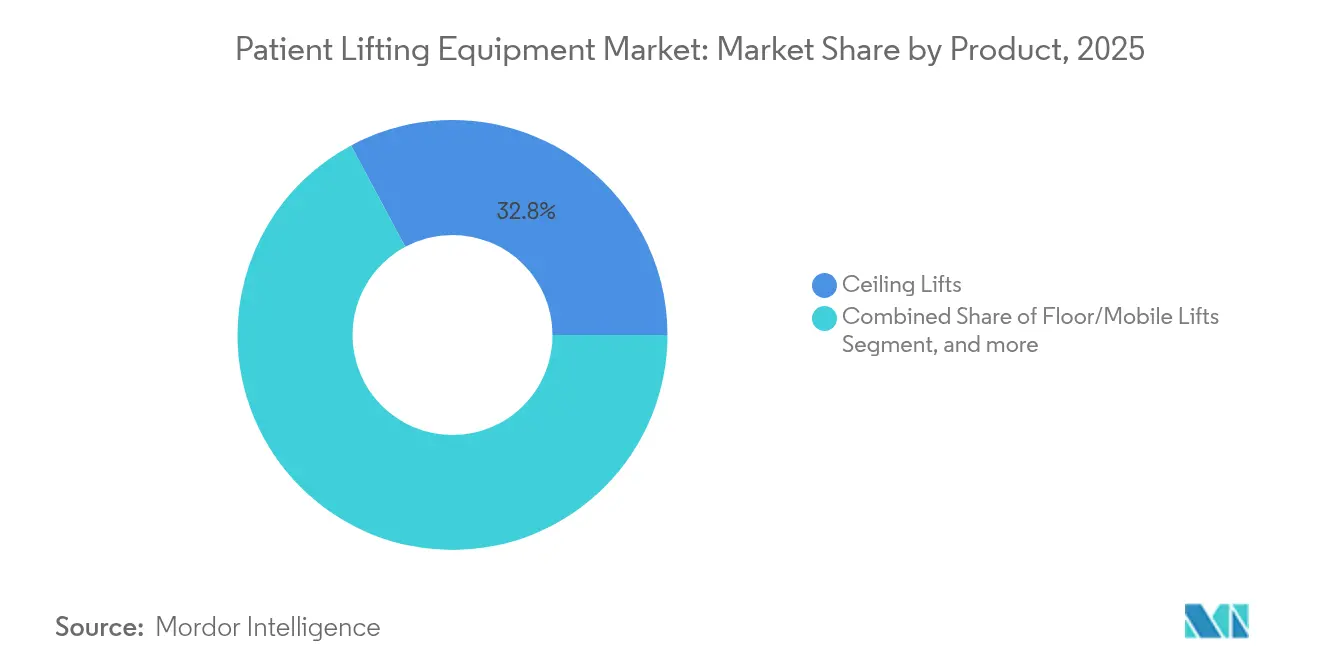
- By product category, ceiling lifts captured 32.82% revenue share of the patient lifting equipment market in 2025, while stair and wheelchair platform lifts are projected to expand at a 14.55% CAGR through 2031.
- By mechanism, powered systems held 79.53% of the patient lifting equipment market share in 2025 and are forecast to increase at a 13.21% CAGR to 2031.
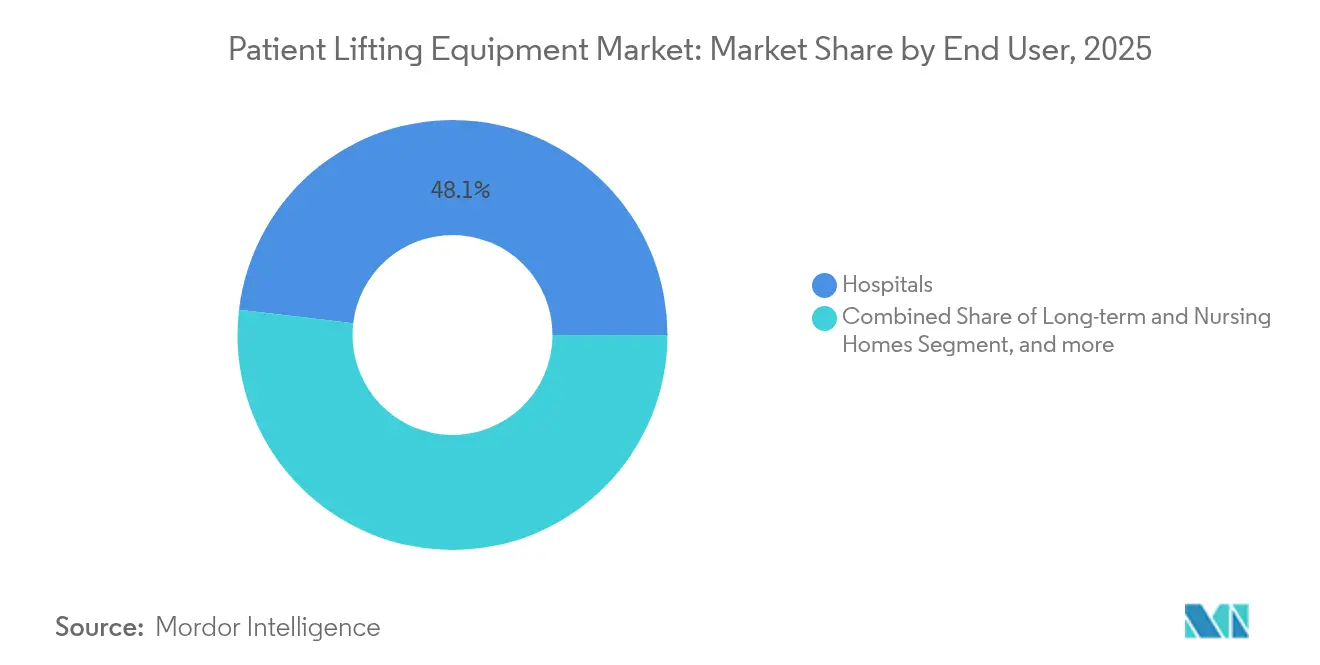
- By end user, hospitals accounted for 48.12% share of the patient lifting equipment market size in 2025, whereas home-care settings are advancing at a 17.21% CAGR during 2026-2031.
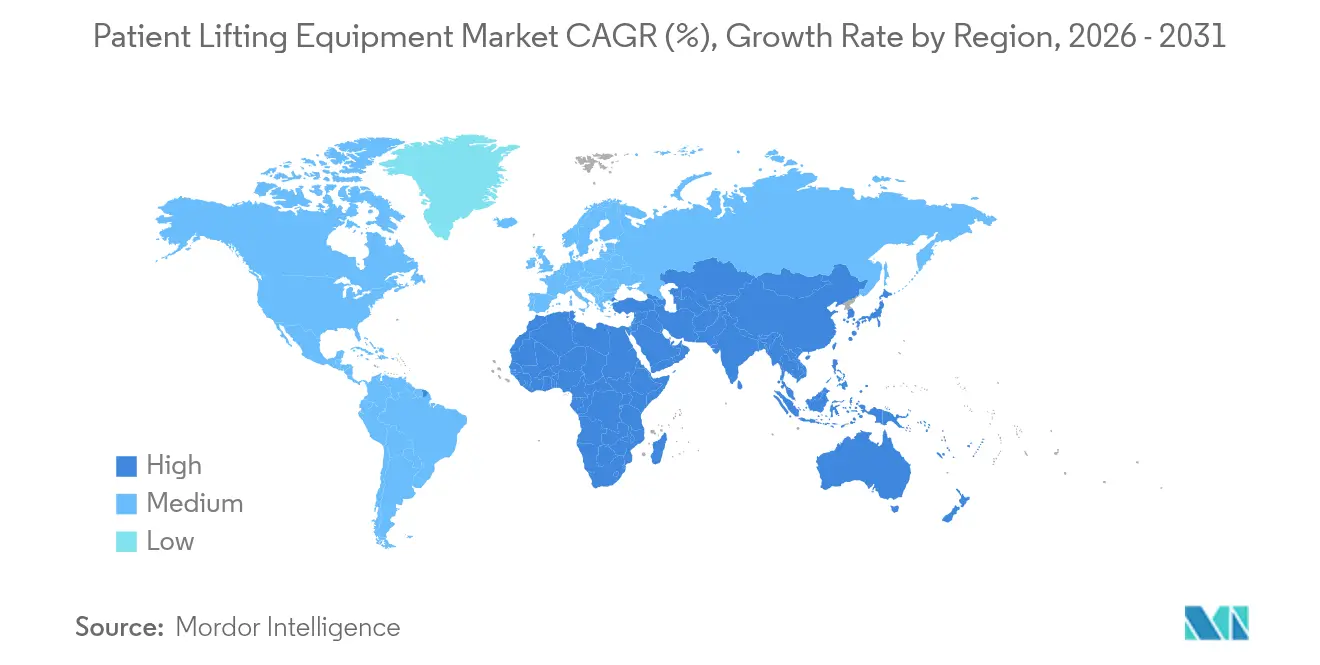
- By geography, North America led with 38.52% share in 2025; Asia-Pacific is set to register the fastest 15.29% CAGR to 2031.
Note: Market size and forecast figures in this report are generated using Mordor Intelligence’s proprietary estimation framework, updated with the latest available data and insights as of 2026.
Market Trends and Insights
Drivers Impact Analysis of Patient Lifting Equipment Market*
| Driver | (~) % Impact on CAGR Forecast | Geographic Relevance | Impact Timeline |
|---|---|---|---|
| Growing Geriatric & Bariatric Population | +2.8% | Global, with highest impact in North America & Europe | Long term (≥ 4 years) |
| Mandatory "Safe-Patient-Handling" Regulations | +2.1% | North America & EU leading, expanding to APAC | Medium term (2-4 years) |
| Rise In Home-Based Long-Term Care | +1.9% | Global, accelerated in developed markets | Medium term (2-4 years) |
| Technology Shift to Powered & IoT-Enabled Lifts | +1.6% | North America & Europe early adoption, APAC following | Long term (≥ 4 years) |
| Hospital "Zero-Lift" Policies to Curb Staff MSD Claims | +1.4% | Primarily North America, expanding globally | Short term (≤ 2 years) |
| Emerging Rental & As-A-Service Business Models | +0.9% | North America & Europe, emerging in APAC | Medium term (2-4 years) |
| Source: Mordor Intelligence | |||
Growing Geriatric & Bariatric Population
By 2050, the United States will support more than 88 million older adults who require long-term assistance, with the fastest growth among those aged 85 plus. Obesity prevalence compounds mobility limitations, prompting demand for bariatric-capable devices such as Arjo’s Citadel Plus, which handles up to 454 kg.[1] Manual handling currently causes 52% of caregiver back injuries, so hospitals treat lifting systems as essential safety infrastructure rather than discretionary capital. The longevity of demographic pressure underpins sustained procurement even through budgetary cycles, thereby anchoring a long-run growth floor for the patient lifting equipment market. Product roadmaps increasingly prioritize higher safe-working loads and wider sling geometries to serve this cohort.
Mandatory Safe-Patient-Handling Regulations
Updated 2024 AORN guidelines instruct surgical and perioperative units to adopt ceiling or boom lifts tailored to individualized transfer plans.[2] California’s AB 1136 law exemplifies U.S. legislation demanding comprehensive safe-patient-handling frameworks, supported by UCLA Health’s Lift Champion program that monitors compliance at the unit level. OSHA advisories for nursing homes further recommend mechanical lifts, turning voluntary norms into enforceable occupational-safety commands.[3] Equivalent policies gain momentum across Europe and start to surface in APAC, collectively widening the addressable base for the patient lifting equipment market. Penalties tied to reimbursement and worker-compensation claims reinforce procurement urgency, accelerating the replacement of legacy manual hoists.
Rise in Home-Based Long-Term Care
AdaptHealth generated USD 3.2 billion in revenue in 2023 while serving 4.1 million home patients, illustrating the scale of domicile-centered care. U.S. Medicare’s capped rental structure allows beneficiaries to assume ownership after 13 months, smoothing adoption costs and creating recurring income for suppliers. Lightweight products such as the portable Mangar Camel Lift accept 705-pound loads and fit residential doorways, aligning with aging-in-place preferences. Pandemic-era policy waivers normalized tele-rehab and remote monitoring, further embedding lifts into home-care packages. Consequently, the home segment advances faster than institutional channels, lifting the overall patient lifting equipment market growth trajectory.
Technology Shift to Powered & IoT-Enabled Lifts
Smart sensors embedded in ceiling tracks transmit usage logs that inform preventive maintenance and caregiver training. Early pilot studies on IoT-integrated smart mattresses revealed nurse acceptance scores of 12.5/15 for workload reduction and ulcer prevention. Digital-twin analytics monitor lift cycles, battery health, and patient weight changes, feeding electronic health records to support falls analytics. Manufacturers bundle SafeSet alerts and skin microclimate modules, converting lifts into holistic mobility-and-monitoring hubs. These upgrades justify price premiums, raise switching costs, and underpin double-digit expansion of the powered segment within the patient lifting equipment market.
Restraints Impact Analysis of Patient Lifting Equipment Market*
| Restraint | (~) % Impact on CAGR Forecast | Geographic Relevance | Impact Timeline |
|---|---|---|---|
| Insufficient Caregiver Training & Compliance Gaps | -1.8% | Global, more pronounced in developing markets | Short term (≤ 2 years) |
| High Capex and Fragmented Reimbursement in Developing Economies | -2.3% | APAC emerging markets, Latin America, MEA | Medium term (2-4 years) |
| Device-Related Patient Safety Recalls & Litigation | -1.2% | Global, heightened impact in North America & Europe | Short term (≤ 2 years) |
| Short Product-Replacement Cycles Causing Budget Strain | -0.9% | Global, particularly acute in cost-sensitive markets | Medium term (2-4 years) |
| Source: Mordor Intelligence | |||
Insufficient Caregiver Training & Compliance Gaps
Even after equipment rollout, many hospitals record persistent musculoskeletal injury rates because staff revert to manual lifting when pressed for time. The skill deficit is acute in smaller facilities lacking dedicated ergonomics educators, which curtails the realized value of installed systems. Complex powered lifts require familiarity with programmable settings, battery checks, and sling selection to operate safely. Without continuous audits, underutilization erodes return on investment and slows uptake across the patient lifting equipment market.
High Capex and Fragmented Reimbursement in Developing Economies
Comprehensive ceiling-track installations involve structural bracing, electrical wiring, and certification, pushing project budgets beyond cash-strapped hospital thresholds in emerging economies. Reimbursement rules differ by province or insurer, delaying payback calculations and lengthening procurement cycles. Currency volatility and customs duties inflate import costs, narrowing margins for distributors. As a result, buyers gravitate toward refurbished imports or local low-spec manual devices, tempering penetration of premium solutions in parts of Asia, Latin America, and Africa within the broader patient lifting equipment market.
*Our forecasts treat driver/restraint impacts as directional, not additive. The impact forecasts reflect baseline growth, mix effects, and variable interactions.
Patient Lifting Equipment Market Segment Analysis
By Product:
Ceiling Lifts Lead Infrastructure IntegrationCeiling lifts secured 32.82% of the patient lifting equipment market share in 2025 owing to seamless rail-mount integration that frees floor space and standardizes transfer routes. Their anchored presence supports infection-control zoning and minimizes trip hazards, making them default choices in new hospital construction. Floor/mobile lifts remain indispensable where retrofitting ceiling tracks is infeasible, while sit-to-stand aids provide active-mobility support in rehabilitation wards. Rapidly aging residential stock propels stair and wheelchair platform lifts at a 14.55% CAGR to 2031, reflecting accessibility retrofits under building-code revisions. Manufacturers diversify sling ecosystems; Savaria’s Silvalea line offers fabric variants for bariatric, amputee, and toileting applications.
The evolving product roadmap emphasizes modularity, enabling chassis upgrades or motor swaps without replacing rails. Bariatric payload options are spreading beyond top-tier models, signaling a design convergence that makes heavy-duty capability standard. Smart user interfaces with touch-free pendant controls address infection-prevention imperatives, while onboard diagnostics cut downtime. Collectively, these advances maintain the ceiling-lift franchise and support steady value capture across the patient lifting equipment market.

By Mechanism:
Powered Systems Dominate Clinical PreferencePowered units delivered 79.53% of 2025 revenue and are projected to enlarge their lead at a 13.21% CAGR. Uniform motor output reduces caregiver exertion, curbs variance in lift technique, and limits liability exposure from over-exertion injuries. Battery chemistry advances lengthen operational cycles, and quick-swap modules ensure continuous readiness in critical-care environments. Manual hoists still fill budget-constrained or off-grid applications, yet their share erodes as smaller facilities adopt low-voltage powered models introduced at entry-level price points. Predictive maintenance algorithms embedded in powered devices transmit runtime diagnostics, enabling contract-service providers to schedule repairs before failures disrupt continuity of care. These attributes cement powered systems as the clinical gold standard within the patient lifting equipment market.
Manual devices retain a tactical niche in disaster relief, remote clinics, and home settings where simplicity and low acquisition costs outweigh efficiency gains. Manufacturers now market hybrid kits that allow field conversion from manual to powered through bolt-on motor packs, providing upgrade flexibility and reducing lifecycle cost barriers. Despite niche retention, the volume migration trend clearly favors powered technology across all care settings, sustaining upward pricing power in the patient lifting equipment market.
By End User:
Hospitals Lead While Home Care AcceleratesHospitals commanded 48.12% of 2025 revenue owing to concentrated caseloads and mandated safe-handling protocols. Capital budgets earmark lifts within broader patient-room modernization, and group purchasing contracts standardize specifications. Yet the home-care channel registers the fastest 17.21% CAGR as payers reward lower-cost community settings and families choose aging-in-place solutions. Long-term-care and nursing homes represent a stable mid-single-digit growth opportunity driven by routine upgrade cycles and stringent worker-safety inspections. End users of patient mechanical lift handling equipment include nursing homes, assisted living facilities, and long-term care facilities.
Regulatory reforms such as CMS’s 2.7% home-health payment boost in 2025 elevate reimbursement certainty, encouraging durable-medical-equipment suppliers to expand rental fleets. Portable ceiling tracks and foldable floor lifts specifically address doorframe clearances typical in residential architecture. Service models bundle periodic safety checks and sling laundering, further professionalizing home-care logistics. These dynamics reinforce multi-channel expansion of the patient lifting equipment market, with hospitals anchoring baseline volume and home environments supplying incremental acceleration.
Geography Analysis
North America Patient Lifting Equipment Market
North America’s 38.52% revenue leadership rests on robust safe-handling regulations, reimbursement frameworks, and a well-organized supply chain. Encompass Health operates 161 rehabilitation hospitals whose standard lift protocols set benchmarks for regional procurement. U.S. healthcare employment is projected to add 2.1 million jobs by 2032, heightening demand for injury-mitigation tools. The patient lifting equipment market benefits from integrated worker-safety metrics tied to reimbursement, embedding lifts in capital-planning templates of both public and private hospitals.
APAC Patient Lifting Equipment Market
Asia-Pacific represents the fastest-growing corridor, with a 15.29% CAGR forecast driven by aging demographics, expanded insurance coverage, and government pushes to localize device production. China’s July 2024 policy on medical-equipment upgrades accelerates procurement of advanced lifts in county-level hospitals. Japan, grappling with population aging, directs innovation grants toward robotics-assisted mobility devices, reinforcing demand for high-specification ceiling tracks.
EMEA and South America Patient Lifting Equipment Market
Europe maintains stable, regulation-driven growth as occupational-safety directives harmonize equipment standards across member states. Sustainability rules incentivize recyclable materials and energy-efficient motor platforms. Middle East & Africa and South America remain emerging frontiers where hospital-construction pipelines and clinical-quality accreditation spur initial purchases, yet currency swings and procurement bureaucracy slow large-scale rollouts. Collectively, regional variances amplify the strategic need for adaptable go-to-market models within the patient lifting equipment market.
Regulatory Landscape
Patient lifting equipment is shaped by medical-device and occupational-safety frameworks that affect market access and purchasing requirements. In the United States, many non-AC-powered patient lifts fall under FDA Class I general hospital devices (21 CFR 880.5510, product code FSA) and are generally exempt from 510(k) premarket notification, while still subject to general controls such as labeling and quality system expectations. OSHA guidance for healthcare settings and NIOSH safe patient handling work, including the widely cited 35-pound recommended upper limit for manual patient transfers, further supports the case for mechanical-lift adoption in facilities trying to reduce musculoskeletal disorder risk.
In Europe, patient transfer devices with a medical intended purpose fall under the EU Medical Device Regulation (MDR 2017/745), which requires technical documentation and post-market surveillance, with the consolidated text current as of January 1, 2026. Across major geographies, ISO 10535:2021 functions as a key safety and performance benchmark for mobile and stationary hoists and body-support units used for transferring disabled persons, influencing product testing, procurement specifications, and conformity claims for both institutional and home-care use cases.
Competitive Landscape
The patient lifting equipment market shows moderate concentration, with global multinationals expanding through M&A and adjacency plays. Baxter’s USD 12.4 billion acquisition of Hillrom in 2024 created a combined portfolio that spans beds, lifts, and connected monitoring, generating USD 350 million annual synergy potential. Arjo increased European scale by acquiring diagnostic and rental specialists, integrating service contracts that lock in long-term revenue. Invacare divested its North American business to MIGA Holdings, allowing capital restructuring and renewed R&D focus on next-gen mobility aids.
White-space opportunities surface where private-equity consolidation in adjacent wheelchair markets burdens operators with high leverage, opening share gains for lift manufacturers offering bundled mobility ecosystems. IoT-first entrants develop cloud portals that aggregate equipment health, usage analytics, and compliance dashboards, appealing to health-system procurement teams seeking integrated reporting. Companies compete on post-sale value, emphasizing lift-as-a-service models, sling subscription programs, and predictive maintenance guarantees. Safety recalls, such as Permobil’s SmartDrive motor update covering 781 units in 2024, underscore the importance of ISO-aligned quality systems and rapid field-service networks.
Patient Lifting Equipment Industry Leaders
-
GF Health Products
-
Enovis (DJO Global)
-
Invacare Corporation
-
Benmor Medical
-
Savaria (Handicare)
- *Disclaimer: Major Players sorted in no particular order
Patient Lifting Equipment Market Companies Covered in this Report
- Arjo AB
- Baxter
- Invacare
- Savaria (HANDICARE)
- Enovis
- Joerns Healthcare
- GF Health Products
- Benmor Medical
- V. Guldmann A/S
- Drive DeVilbiss Healthcare
- Prism Medical
- Medline Industries
- Getinge
- Stryker (MedSurg / Safe-patient-handling)
- Stiegelmeyer GmbH
- Vancare Inc.
- Etac AB (Molift)
- Handi-Move International
- HumanCare Group
- HoverTech International
- Sizewise
Market Opportunities and Future Outlook
A key opportunity is emerging where safe-patient-handling compliance intersects with workflow digitization. Providers increasingly want evidence on utilization, maintenance, and caregiver adherence, not only device availability. IoT-enabled lifts and connected service layers that log usage, support preventive maintenance, and simplify audits align with facility programs built around OSHA guidance and NIOSH ergonomics recommendations, and they help support multi-year service contracts rather than one-time capital purchases. In home-care and post-acute channels, rental and capped-rental reimbursement structures, including Medicare ownership after 13 months, improve access to powered lifts and compatible sling ecosystems, which supports suppliers and DME providers in expanding fleets and service coverage.
Technology whitespace is also widening around transfer automation that reduces staffing requirements for transfers and bed mobility in high-acuity settings. Real deployments and commercial moves point to this shift: Able Innovations deployed its robotic ALTA Platform for lateral patient transfers at Lahey Hospital & Medical Center (U.S.) in 2026, and Agiliti announced an exclusive agreement to serve as the U.S. provider of the Total Lift Bed, which supports early mobilization with supine-to-standing transitions. Consolidation can also create cross-selling and portfolio-bundling openings for players spanning pressure care, beds, and lift platforms, as seen in the formation of DHCare through the combination of Invacare Europe/APAC with Direct Healthcare Group in 2026.
Recent Industry Developments in Patient Lifting Equipment Market
- June 2026: Agiliti announced an exclusive agreement to become the U.S. provider of the Total Lift Bed, an ICU bed that enables supine-to-standing transitions to support early mobilization. The move expands Agiliti's footprint in integrated patient mobility solutions that sit adjacent to traditional lifts and repositioning aids, strengthening its ability to bundle equipment delivery, service, and clinical workflow support.
- June 2025: Winncare introduced the Luna X5, an all-in-one ceiling lift designed for both residential and institutional environments, including sites with architectural constraints. The launch reinforces the shift toward flexible ceiling-track solutions that reduce floor clutter and standardize transfers across mixed-acuity care settings.
- November 2024: Winncare announced the acquisition of Five Mobility, adding another UK-based asset to broaden its acute-care channel presence. The acquisition supports deeper local coverage for installation, service, and rental-led models, which are increasingly important for health systems standardizing safe patient handling programs.
Patient Lifting Equipment Market Report Scope and Research Methodology
Market Definition and Coverage
The patient lifting equipment market covers devices and related accessories that help lift, reposition, and transfer patients safely across care settings, including hospitals, long-term care facilities, rehab centers, and home care.
Scope exclusions: Excludes general patient-handling items that are not primarily used for lifting or transfer support, such as hospital beds, stretchers, and most mobility aids.
Segments Covered in This Report
- By Product
- Ceiling Lifts
- Floor/Mobile Lifts
- Sit-to-Stand & Transfer Aids
- Bath & Pool Lifts
- Stair & Wheelchair Platform Lifts
- Lifting Slings
- Accessories
- By Mechanism
- Powered
- Manual
- By End User
- Hospitals
- Long-term & Nursing Homes
- Home-care Settings
- Rehabilitation Centers
- By Geography
- North America
- United States
- Canada
- Mexico
- Europe
- Germany
- United Kingdom
- France
- Italy
- Spain
- Rest of Europe
- Asia-Pacific
- China
- Japan
- India
- Australia
- South Korea
- Rest of Asia-Pacific
- Middle East & Africa
- GCC
- South Africa
- Rest of Middle East & Africa
- South America
- Brazil
- Argentina
- Rest of South America
- North America
Data Sources, Market Sizing, and Validation
Desk Research
Desk work started with building a clear scope, product mapping, and regional structure for this market, and then aligning it with available public signals. We referenced sources such as the US CDC injury and healthcare utilization releases, US FDA device databases, OECD health statistics, World Bank population and aging indicators, and selected peer-reviewed journals that track patient transfer safety and caregiver injury patterns.
To translate those signals into market logic, we also reviewed company annual reports, investor presentations, and credible press coverage on product launches and facility procurement. Where it helped with consistency, we used paid subscriptions for company financials and intelligence, and for patent databases to understand technology direction (for example, powered lift features and sling materials). The sources listed here are illustrative, and other public and paid references were used to collect data, validate assumptions, and clarify gaps.
Primary Interviews and Surveys
Primary discussions were used to pressure-test adoption rates by care setting, typical replacement cycles, and the split between powered and manual systems, which are not always visible in public data. We spoke with a mix of manufacturers, distributors, and procurement and clinical stakeholders across major regions so that pricing, channel mix, and demand drivers could be checked and then triangulated against desk findings.
Distribution of primary research fieldwork respondents
| Company type | Respondent position | Region |
|---|---|---|
| Top tier: 33% | CXOs: 14% | APAC: 42% |
| Mid tier: 51% | Functional/Unit leaders: 40% | EMEA: 36% |
| Smaller Players: 16% | Managers: 46% | Americas: 22% |
Market-Sizing & Forecasting
Sizing was constructed using a top-down approach where the demand pool is rebuilt from care setting capacity and usage patterns, and then translated into equipment needs through penetration and replacement assumptions. The model was then checked with selective bottom-up approximations, including sampled price band checks by product type, channel markups, and supplier and distributor feedback to avoid over-counting.
Key inputs used in the model included the age 65+ population trend, long-term care and hospital bed capacity indicators, caregiver injury and safe handling compliance signals, powered versus manual mix shifts, average selling price movement by lift category, and replacement cycle ranges for lifts and slings. Where local price points were missing, gaps were handled through regional price proxies validated with interviews, followed by currency conversion using consistent yearly averages.
For forecasting, we used scenario analysis supported by expert views on facility capex cycles, home care growth, and the pace of safer patient handling adoption. The scenarios were converted into yearly market values by adjusting unit demand and ASP progression in parallel, and then re-checked against observed procurement and product mix changes.
Data Validation & Update Cycle
Outputs were checked in multiple steps so that unusual jumps in volume, pricing, or regional shares could be explained before sign-off. We compared results against independent signals such as care capacity trends, product mix direction (powered versus manual), and reported revenue exposure where it was available, and then reconciled variances through follow-up calls when needed.
Before delivery, assumptions and calculations are reviewed by another analyst to reduce simple modeling errors and inconsistent definitions. Reports are refreshed annually, and interim updates are triggered when material events occur, such as major regulatory changes, large acquisitions, or sharp pricing shifts in key lift categories. A final pre-release pass is completed so clients receive the latest updated view.
Mordor Intelligence's Patient Lifting Equipment Market Size Compared With Other Published Estimates
Published market values for patient lifting equipment often differ because the product list and end-market boundaries are not the same across studies, and because the base year and currency timing can shift results. Differences also show up when one estimate emphasizes a single growth narrative, while another uses mixed demand signals from hospitals, long-term care, and home care.
In this market, the biggest gap driver is usually whether the estimate stays focused on lifting and transfer devices and slings, or whether it also folds in broader patient-handling items like beds, stretchers, and mobility aids, which expands the total quickly. Another common reason is how powered lift penetration and ASP progression are treated, since a small change in assumed mix shift can move the value materially, especially when regional procurement cycles are uneven.
Benchmark comparison
| Source | Market Size | Gaps in Research Methodology |
|---|---|---|
| Mordor Intelligence | USD 4.76 B (2026) | |
| Industry Publisher A | USD 12.69 B (2024) | Uses a wider patient handling equipment scope that includes categories such as hospital beds and stretchers, and the larger basket inflates the total versus a lift-focused view. |
| Industry Publisher B | USD 3.00 B (2019) | Uses an older base year and a shorter horizon, and the value can be understated today if powered lift adoption and current price bands are not refreshed with recent channel checks. |
The table shows a spread that is mainly explained by scope breadth and timing, rather than a single modeling trick. By keeping the count limited to lifting and transfer equipment (plus slings and accessories) and rechecking powered mix and regional pricing assumptions through primary calls, the estimate stays closer to a repeatable demand pool, a modeling choice applied by Mordor Intelligence.
Key Questions Answered in the Report
What is the projected value of the patient lifting equipment market in 2031?
It is expected to reach USD 7.73 billion, rising from USD 4.76 billion in 2026.
Which product category currently leads sales?
Ceiling lifts lead with 32.82% revenue share of the patient lifting equipment market in 2025.
Why is Asia-Pacific growing the fastest?
Hospital build-outs, aging populations, and supportive device-localization policies drive a 15.29% CAGR through 2031.
How fast are powered systems expanding?
Powered lifts are forecast to grow at a 13.21% CAGR, reinforcing their 79.53% revenue share.
What regulatory factors influence adoption?
Safe-patient-handling laws and reimbursement penalties for manual lifting propel equipment purchases in North America and Europe.