
Paper Straw Market Size and Share
Market Overview
| Study Period | 2020 - 2031 |
|---|---|
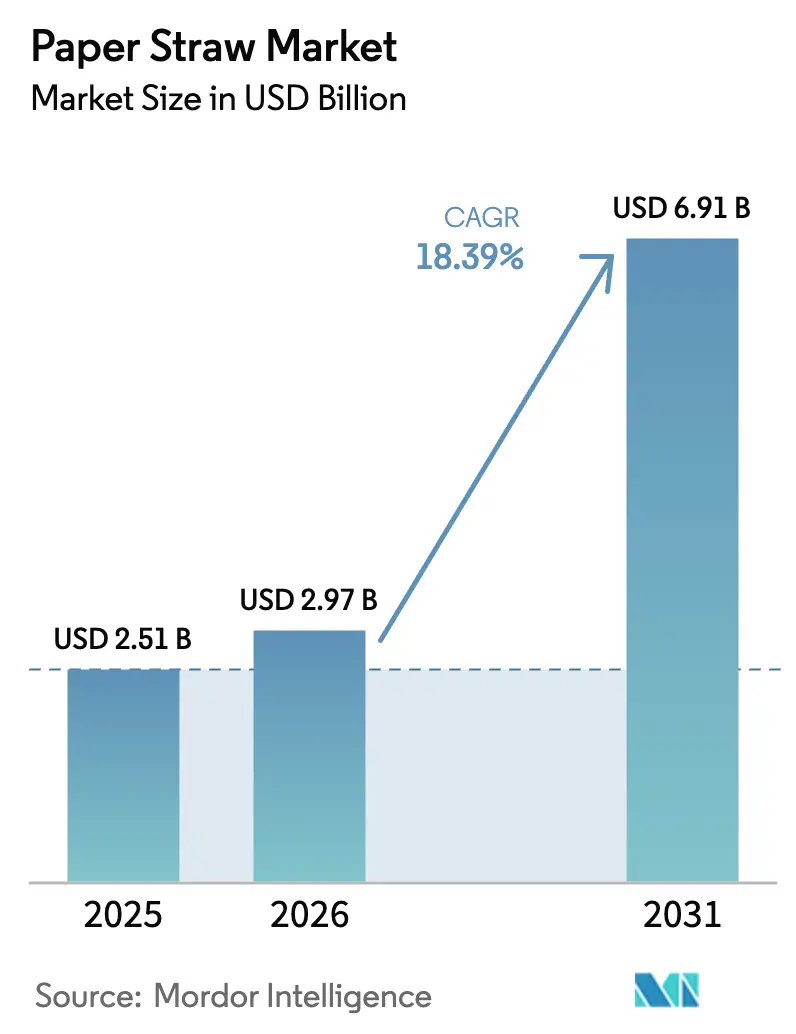
| Market Size (2026) | USD 2.97 Billion |
| Market Size (2031) | USD 6.91 Billion |
| Growth Rate (2026 - 2031) | 18.39 % |
| Fastest Growing Market | Asia Pacific |
| Largest Market | Europe |
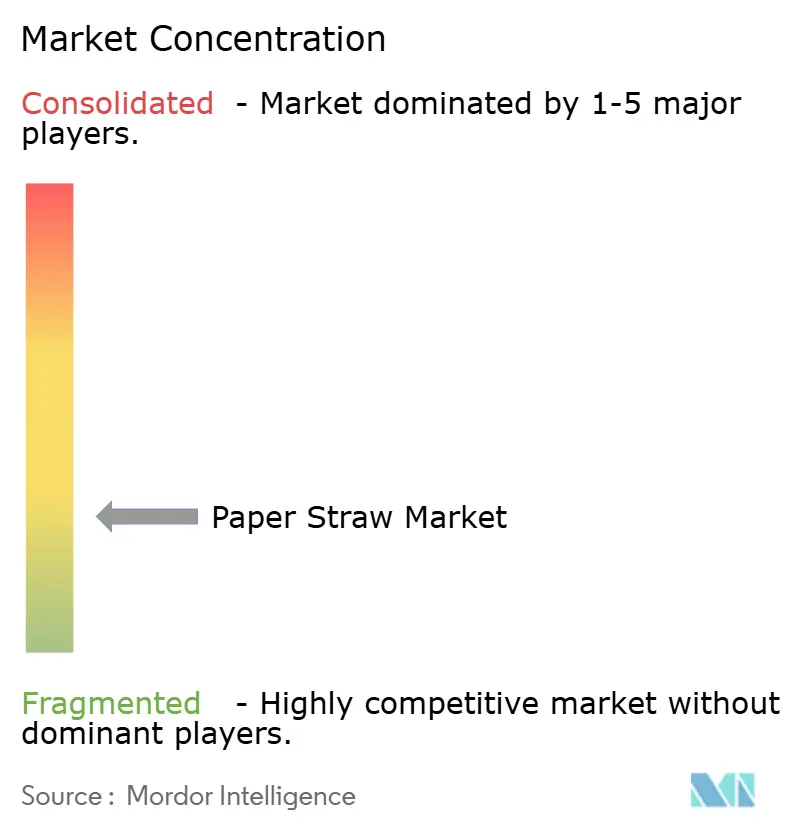
| Market Concentration | Low |
Major Players *Disclaimer: Major Players sorted in no particular order Image © Mordor Intelligence. Reuse requires attribution under CC BY 4.0. | |
Paper Straw Market Analysis by Mordor Intelligence
Paper straw market size in 2026 is estimated at USD 2.97 billion, growing from 2025 value of USD 2.51 billion with 2031 projections showing USD 6.91 billion, growing at 18.39% CAGR over 2026-2031. Heightened regulation, rapid advances in hydrophobic coatings, and large-scale procurement commitments from foodservice chains have moved sustainable drinking straws from a niche substitute to a mainstream packaging component. Global bans on single-use plastics now carry financial penalties rather than voluntary targets, enabling manufacturers to plan multi-year capacity expansions with greater certainty. Institutional buyers are standardizing forest-certified materials, which rewards vertically integrated suppliers that can guarantee traceability and end-of-life compliance. At the same time, mergers between packaging majors are consolidating scale advantages and unlocking larger R&D budgets that accelerate coating and forming breakthroughs. These shifts increase switching costs for plastic incumbents and create a durable growth runway for the paper straw market.
Key Report Takeaways
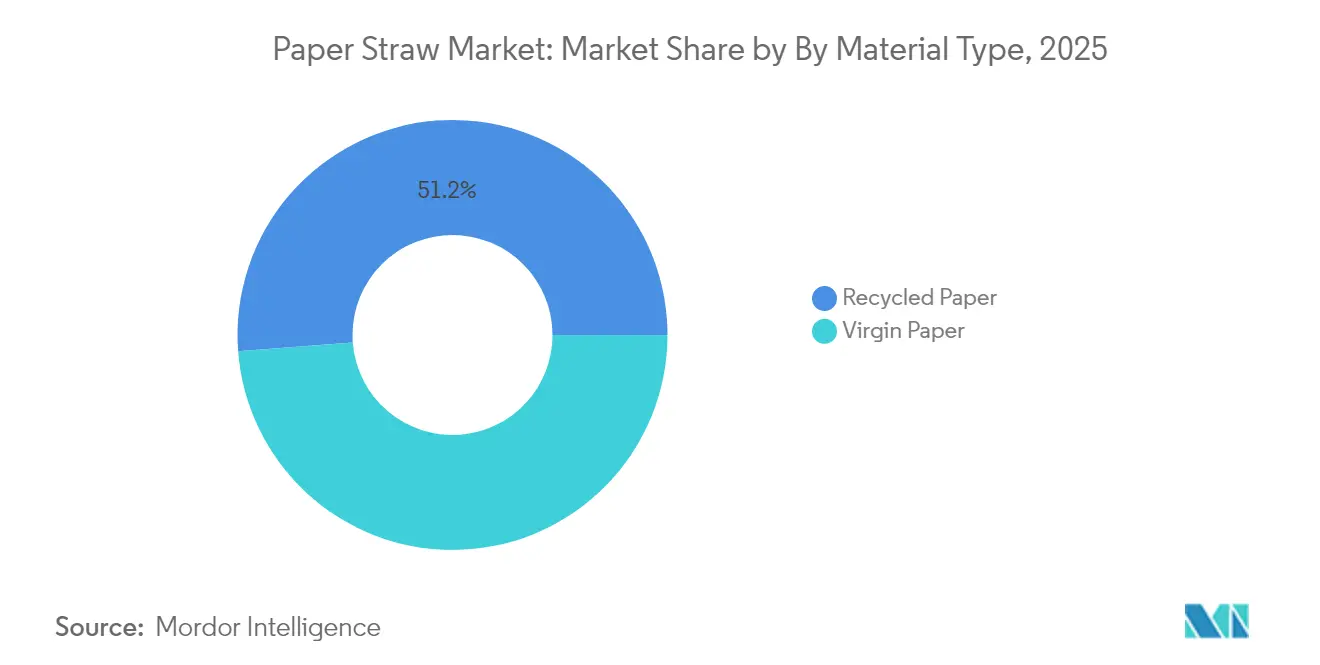
- By material type, recycled paper held 51.20% of paper straw market share in 2025, while virgin paper lagged; recycled grades are expanding at a 22.96% CAGR to 2031.
- By straw product type, non-printed variants captured 56.12% revenue share in 2025, yet printed/branded straws are advancing at a 24.12% CAGR through 2031.
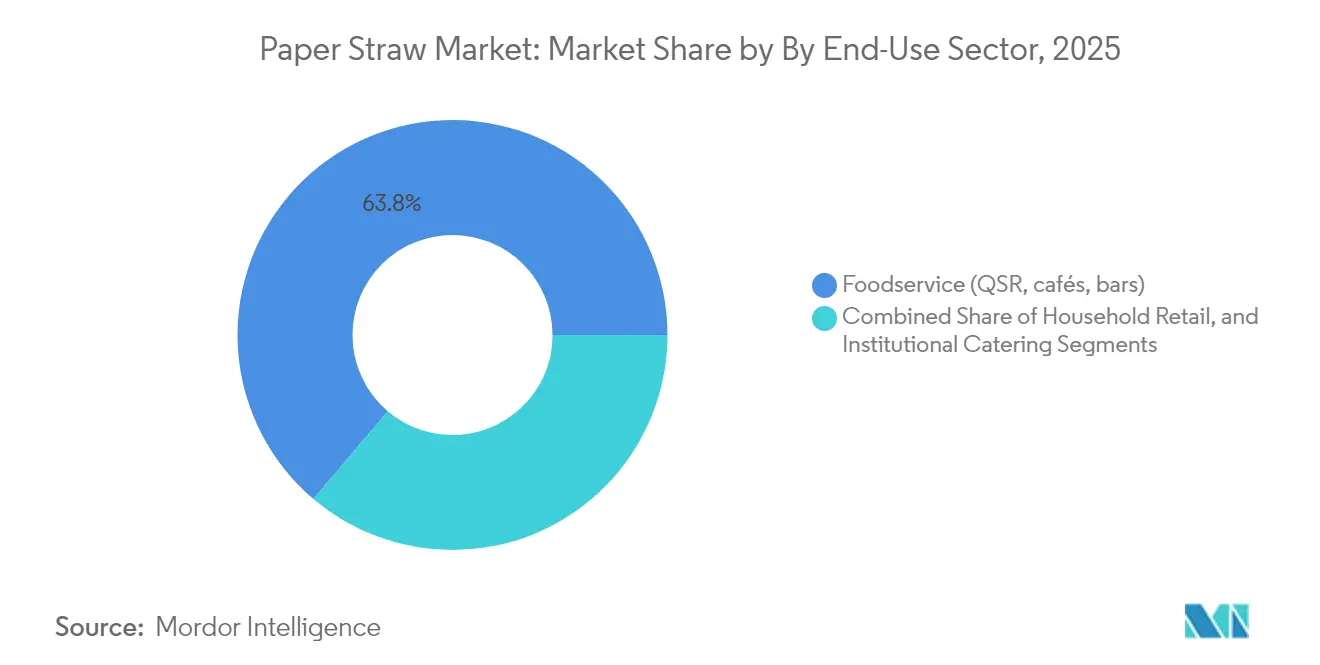
- By end-use sector, foodservice dominated with 63.80% of the paper straw market size in 2025; household retail is forecast to expand at a 21.63% CAGR.
- By diameter, standard 6-7 mm straws represented 47.10% of paper straw market size in 2025, while wide/bubble-tea versions are registering a 25.68% CAGR.
- By sales channel, offline B2B distribution accounted for 67.10% share of the paper straw market in 2025, and the e-commerce channel is growing at 27.92% CAGR.
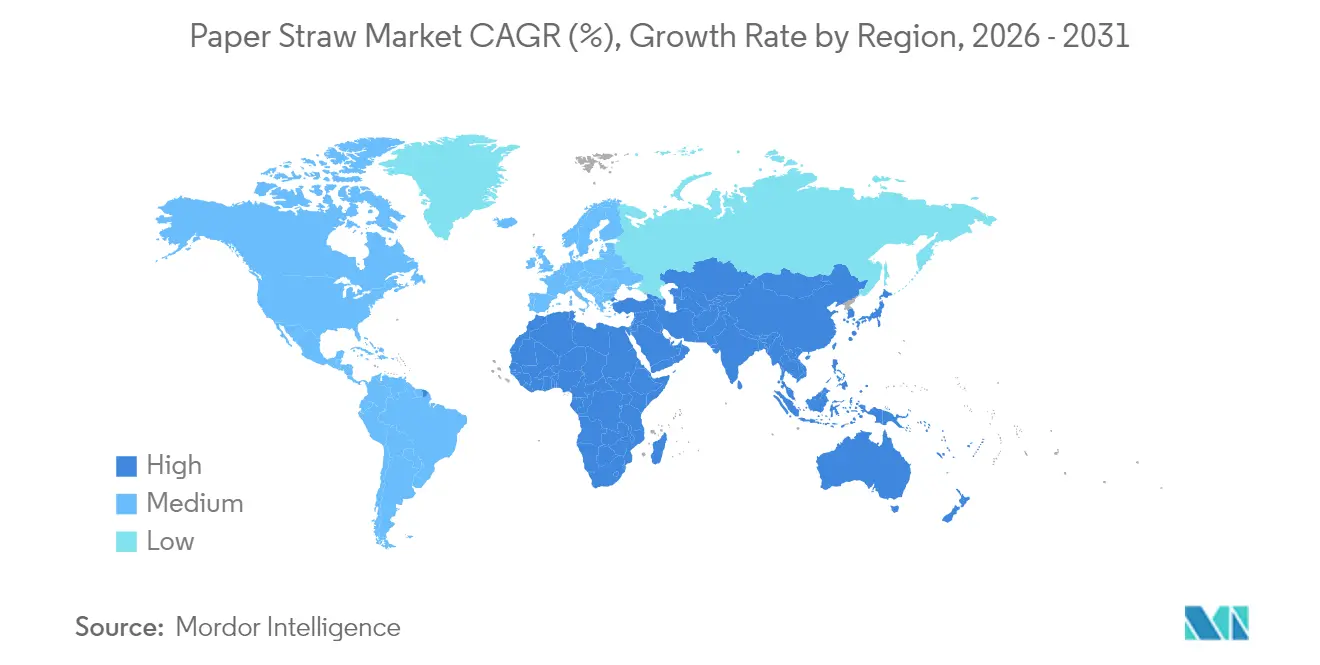
- By geography, Europe led with 30.40% share of the paper straw market in 2025; Asia-Pacific is projected to post the fastest 20.58% CAGR to 2031.
Note: Market size and forecast figures in this report are generated using Mordor Intelligence’s proprietary estimation framework, updated with the latest available data and insights as of 2026.
Market Trends and Insights
Drivers Impact Analysis of Paper Straw Market*
| DRIVER | (~) % IMPACT ON CAGR FORECAST | GEOGRAPHIC RELEVANCE | IMPACT TIMELINE |
|---|---|---|---|
| Global bans on single-use plastics | +4.2% | Global, with early adoption in EU, China, Hong Kong | Medium term (2-4 years) |
| Growing consumer preference for eco-friendly products | +3.1% | North America & EU, expanding to APAC | Long term (≥ 4 years) |
| Fast-food & QSR sustainability pledges | +2.8% | Global, led by McDonald's, Starbucks deployment | Short term (≤ 2 years) |
| Extended Producer Responsibility (EPR) mandates | +2.3% | EU core, expanding to North America | Medium term (2-4 years) |
| Breakthrough hydrophobic paper-coating technologies | +1.9% | Global, with R&D concentration in EU, Japan | Long term (≥ 4 years) |
| Retail private-label "green branding" initiatives | +1.4% | North America & EU, selective APAC markets | Medium term (2-4 years) |
| Source: Mordor Intelligence | |||
Global bans on single-use plastics drive market transformation
Coordinated restrictions now cover major economies, obligating retailers and food outlets to remove non-degradable plastic straws from service. China’s Plastic Pollution Control Action Plan and Hong Kong’s 2024 prohibition have tightened compliance windows, while the EU Single-Use Plastics Directive supplies the enforcement template used by emerging markets. These statutes impose measurable waste-reduction targets, giving converters the confidence to finance new paper machines and coating lines. Regulatory visibility also reassures investors that long-term volumes in the paper straw market will rise even in low-margin quick-service segments.[1]G20 Marine Plastic Litter Partnership, “Annual Progress Update 2024,” g20mpl.org
Growing consumer preference for eco-friendly products reshapes procurement
Generation Z demands packaging that blends environmental credibility with functional rigor. Surveys show that this cohort rejects soggy or taste-altering straws, so converters are developing cellulose-nanocrystal and bio-polyester coatings to meet higher performance thresholds. Catering giants such as Compass Group integrate these specifications into contract bids, forcing suppliers across the paper straw industry to raise barrier standards. As QSR chains publicize renewable-content milestones, the consumer expectation loop tightens, accelerating innovation and uptake.
Fast-food and QSR sustainability pledges create demand anchors
Chains including McDonald’s and Starbucks have replaced plastic in more than 50 national markets, generating predictable order flows that justify new regional production hubs. The resulting volume guarantees help small and mid-size converters secure financing, while distribution groups like Sysco launch proprietary biodegradable lines to capture incremental restaurant sales. These influential buyers now specify FSC certification and compostability, raising the baseline entry criteria for the paper straw market.
Extended Producer Responsibility mandates accelerate supply chain integration
Under EU law, brand owners must fund post-consumer recycling for drinking-straw packaging, converting sustainability goals into ledger costs. Similar frameworks under debate in the United States would levy differentiated fees based on recyclability scores, making paper straws less expensive to steward than plastic. Suppliers that combine substrate production, converting, and recovery analytics gain an advantage because their integrated reporting reduces compliance friction for multinational retailers.
Restraints Impact Analysis of Paper Straw Market*
| RESTRAINTS | (~) % IMPACT ON CAGR FORECAST | GEOGRAPHIC RELEVANCE | IMPACT TIMELINE |
|---|---|---|---|
| Higher unit cost than plastic straws | -2.7% | Global, with acute impact in price-sensitive markets | Short term (≤ 2 years) |
| Functional performance (sogginess, taste) | -1.8% | Global, particularly in premium beverage segments | Medium term (2-4 years) |
| PFAS contamination scrutiny | -1.3% | EU, North America, expanding to APAC | Medium term (2-4 years) |
| Sustainable fiber supply bottlenecks | -1.1% | Global, with concentration in virgin fiber regions | Long term (≥ 4 years) |
| Source: Mordor Intelligence | |||
Higher unit cost than plastic straws constrains penetration
Plastic machines benefit from higher production speeds and cheaper feedstocks, keeping unit economics in their favor. When inflation lifts input costs for foodservice operators, procurement teams still scrutinize cents-per-serving, especially in emerging markets. The closure of a Fort Wayne paper straw plant underscores how tight margins can trigger capacity cuts. However, landfill levies and reputational risks tied to plastic are narrowing the gap, while new raw-material pathways such as reed-based substrates promise further cost relief.[2] 21Alive News, “Paper straw plant closure impacts Fort Wayne jobs,” 21alivenews.com
Functional performance limitations drive technology innovation
Extended immersion can weaken fiber walls, causing premium drink makers to doubt product suitability. Coatings based on poly(butylene succinate) and seaweed-derived polymers now improve rigidity without compromising compostability. As patent filings increase for barrier-coated paper straws, producers are capturing intellectual-property positions that differentiate them in bids for airline and specialty café contracts. Bio-indicator pigments that change color with beverage acidity hint at the next wave of functional enhancements waiting to reach mass scale.
*Our forecasts treat driver/restraint impacts as directional, not additive. The impact forecasts reflect baseline growth, mix effects, and variable interactions.
Paper Straw Market Segment Analysis
By Material Type:
recycled paper outpaces virgin gradesRecycled paper generated 51.20% of paper straw market size in 2025 and is forecast to climb faster than any other substrate, posting a 22.96% CAGR through 2031. Cost advantages arise from maturing collection networks that now divert higher-quality recovered fiber into food-grade applications. EPR surcharges for virgin packaging further tilt procurement toward recycled input. Virgin paper retains relevance for premium aesthetics and complicated print colors, yet new soot-removal processes are closing that gap and making high-grade recycled pulp fit for upscale brand channels.
Conversion investments reflect this momentum. Stora Enso allocated EUR 1 billion to retrofit its Oulu mill for folding box board and coated kraft, supplies that can also feed food-contact straw laminations. As line speeds rise, throughput for recycled rolls is matching virgin lines, easing concerns on output differentials. Manufacturer alliances with municipal waste authorities secure stable fiber inflows, insulating plants from spot price volatility. Such integration raises entry barriers for late entrants and reinforces the advantage held by early recyclers in the paper straw market.



By Straw Product Type:
printed variants create brand real estateUnprinted straws kept 56.12% of market revenue in 2025 because quick-service restaurants prioritize unit cost. Printed designs, however, are growing at 24.12% CAGR as retailers treat straws as miniature billboards. Digital presses that handle water-based inks now allow sub-10,000-piece runs while retaining food-contact compliance, opening the customization field to boutique cafés. Mass chains use recurring campaigns tied to movie releases or sporting events to create collectable straw sets, a tactic that increases beverage attachment rates and captures premium pricing.
Printed-straw converters invest in seven-color flexo modules and automated plate-mounting to satisfy these briefs without excessive setup waste. The transition from petroleum-based inks to vegetable formulations also advances environmental credentials, harmonizing messaging across straw graphics and sustainability branding. As printing economics improve, market analysts expect printed options to narrow the price delta with plain white counterparts, amplifying their share of the paper straw market over the decade.
By End-Use Sector:
household retail gains groundFoodservice commanded 63.80% of the paper straw market in 2025, anchored by binding sustainability policies at global QSR chains. Household retail is projected to expand at a 21.63% CAGR as e-commerce removes shelf-space bottlenecks. Subscription packs ship mixed-diameter assortments direct to consumers, reducing per-unit costs and building brand loyalty. Private-label launches on major grocery platforms further democratize access, pushing paper straw market size for home use toward parity with traditional catering channels.
Institutional catering—schools, hospitals, airlines—presents steady growth because administrators face public scrutiny over waste statistics. Distributor catalogs now feature FSC-certified paper straws alongside compostable cutlery, simplifying compliance for procurement officers. As medical facilities mandate latex-free environments, paper straws with hypoallergenic coatings offer an added benefit that plastic cannot match, carving out another niche within the broader paper straw industry.
By Straw Diameter/Size:
bubble-tea demand reshapes profilesStandard 6-7 mm straws retained 47.10% of paper straw market size in 2025, but wider 8-12 mm formats are advancing at 25.68% CAGR. The global diffusion of bubble tea requires diameters large enough to pass tapioca pearls without clogging. Asian café chains entering Europe and North America specify high burst strength and beveled tips, prompting converters to develop multilayer wraps that hold shape for the duration of a 500 ml serving. Specialty straws above 12 mm, though niche, command premium pricing for smoothie bowls and frozen coffee drinks.
Material scientists focus on wide-diameter rigidity because larger bore magnifies bending stress. Reinforced helically-wound constructions and hybrid paper-PLA composite layers emerge as leading approaches. These advances reduce wall thickness, saving fiber, and keeping costs controlled even as performance rises. Success in this segment signals the market’s ability to diversify beyond soda and water channels.
Geography Analysis
Europe Paper Straw Market
Europe led with a 30.40% paper straw market share in 2025 thanks to an enforcement-heavy policy environment and mature recycling logistics. Germany, France, and the United Kingdom anchor demand as public institutions align procurement with the EU Single-Use Plastics Directive. Mill upgrades at Oulu, Finland, and dry-forming investments in Skene, Sweden, demonstrate European producers’ confidence in long-term domestic consumption. Retailers favor regionally supplied straws to avoid carbon emissions from transcontinental shipping, reinforcing intra-European sourcing.
APAC Paper Straw Market
Asia-Pacific is growing at 20.58% CAGR to 2031, propelled by synchronized regulatory acts in China, Hong Kong, and Japan. Combined with the runaway popularity of bubble tea, these measures lock in multi-year demand for wide-diameter products. Lower conversion costs due to abundant fiber and labor pools allow Asian plants to compete on export tenders, positioning the region to surpass Europe in absolute volume during the forecast. Manufacturers are rapidly integrating automated inspection to meet Western food-contact standards, accelerating acceptance in premium markets.
North America Paper Straw Market
North America delivers steady expansion as state-level bans spread from coastal regions toward the Midwest. McDonald’s and Sysco’s commitments guarantee baseline volume even where regulation remains patchwork. Large integrated producers like Packaging Corporation of America reported record 2025 revenue of USD 2.1 billion, spotlighting sustained end-market health. Venture funding targets niche materials such as seaweed or reed, underlining a diverse innovation scene that complements scaled paper assets.

Regulatory Landscape
Regulation remains the primary demand enabler for paper straws. Under the EU Single-Use Plastics (SUP) Directive (Directive (EU) 2019/904), plastic straws face prohibitions with limited exemptions (such as certain medical uses), which creates a durable compliance pull for fiber-based alternatives in foodservice and retail. In Asia-Pacific, coordinated restrictions including China’s Plastic Pollution Control Action Plan and Hong Kong’s 2024 prohibition have shortened substitution timelines and pushed multinational chains to standardize straw specifications across markets.
In the United States, the policy environment stays fragmented, with no nationwide ban and adoption driven by state and local measures (including by-request-only approaches). Federal procurement policy has also become a reference point for performance requirements. Following Executive Order 14208 (February 10, 2025), the FAR Council initiated a rulemaking approach that emphasizes that federally procured straws must meet performance standards equivalent to plastic, which raises the focus on coating and forming technologies for paper straw suppliers selling into institutional channels.
Value Chain Analysis
The paper straw value chain starts with certified fiber and pulp (virgin and recycled), then moves into specialty straw paper and converting inputs such as water-based inks and hydrophobic or mineral-barrier coatings designed to address sogginess and taste transfer. Converting centers on spiral winding or forming, cutting, and printing, with QA for food-contact and functional performance, before products are sold through offline B2B distribution to QSRs, cafes, bars, and institutional catering. For household use, direct-to-consumer packs and e-commerce channels are also growing.
Supply chain strategies increasingly emphasize traceability and certification alignment. Huhtamaki, for example, highlights PEFC-certified fiber in its paper straw offerings and purpose-built machinery to support consistent performance. Capacity rationalization and consolidation also affect the downstream chain: Hoffmaster Group’s closure of its Aardvark Straws facility in Fort Wayne, Indiana (late 2025) and consolidation into Oconto, Wisconsin reflects a move toward fewer, higher-utilization hubs to protect margins and service large national accounts. End-of-life claims and buyer requirements add another compliance layer, with compostability-related standards (for example, BPI and CMA-S referenced by Aardvark Straws) reinforcing the role of testing and documentation in day-to-day commercial workflow.
Competitive Landscape
Competition remains moderate in concentration but high in technological differentiation. The Smurfit WestRock merger valued at USD 11.2 billion created a top-tier player with global reach and robust R&D, while the USD 6.7 billion Novolex-Pactiv Evergreen tie-up added a portfolio exceeding 250 brands. These unions raise the hurdle rate for mid-size firms yet also establish toll-manufacturing opportunities for specialty innovators lacking distribution muscle.
Innovation revolves around hydrophobic coatings and multilayer constructions. Huhtamaki’s blueloop platform, paired with a EUR 100 million cost-savings plan, shows that incumbents seek both sustainability credentials and leaner cost structures. Patent race dynamics are shifting as cellulose-nanocellulose hybrids mature, prompting cross-licensing talks that may prevent litigation stalemates. Emerging firms like Reedest enter with distinct raw-material angles such as reed pulp, broadening the fiber basket and supplying regional authenticity narratives that resonate with conscious consumers.
White-space persists in high-function segments. Airlines want straws that sustain carbonation integrity for several hours, while premium cocktail bars look for color-stable options under acidic conditions. Start-ups working on pH-responsive pigments or thermally embossed branding tackle these needs and could become acquisition targets as conglomerates pursue niche growth pools within the paper straw market. Strategic investments that blend minority stakes with supply agreements are increasingly common because they hedge technology bets without immediate full acquisitions.
Paper Straw Industry Leaders
Aardvark Straws LLC (Hoffmaster Group Inc.)
Huhtamaki Oyj
Transcend Packaging Ltd
Tetra Pak International SA
Fuling Global Inc.
- *Disclaimer: Major Players sorted in no particular order
Paper Straw Market Companies Covered in this Report
- Aardvark Straws LLC (Hoffmaster Group Inc.)
- Huhtamaki Oyj
- Transcend Packaging Ltd
- Tembo Paper B.V.
- Tetra Pak International SA
- Fuling Global Inc.
- Uflex Ltd
- Canada Brown Eco Products Ltd
- Karat Packaging Inc.
- IPI Srl
- Footprint International Holdings Inc.
- Biopac UK Ltd
- Lollicup USA Inc.
- OkStraw Paper Straws
- Strawland Packaging Co. Ltd
- Vegware Ltd
- Ningbo Henvcon Package Co. Ltd
- Soton Daily Necessities Co. Ltd
- GP PRO (Georgia-Pacific LLC)
- U.S. Paper Straw

Market Opportunities and Future Outlook
Performance-compliant paper straws and adjacent fiber-based drink-through components represent a key whitespace as regulators and large buyers shift from material substitution to functional equivalence. The US federal procurement discussion under the FAR Council, tied to Executive Order 14208 (February 2025), explicitly elevates performance parity with plastic as a purchasing condition. That focus rewards suppliers that can demonstrate durability through improved coatings and forming rather than relying only on sustainability claims. At the same time, the EU SUP framework continues to pressure plastic-lined and plastic-classified components, which pushes material and barrier innovation in fiber-based foodservice packaging that can be paired with paper straws in bundled bids.
Capacity and footprint moves by established suppliers point to practical scaling routes and unit-economics improvements. In July 2026, Hoffmaster Group broke ground on an 86,000-square-foot expansion in Clintonville, Wisconsin to increase manufacturing capacity and create over 100 jobs, supporting broader availability for foodservice accounts and private-label programs. On the distribution and customer-access side, platforms with multi-country reach (for example, Huhtamaki’s global operating network) provide a pathway to standardize straw specifications for QSR and institutional catering customers across regions. Partnerships that expand fiber-based packaging availability in the UK and Ireland also indicate continuing commercialization channels for compliant, higher-performing paper formats.
Recent Industry Developments in Paper Straw Market
- June 2026: Transcend Packaging Ltd announced a long-term manufacturing and commercial partnership with REEL Group to expand the availability of fibre-based packaging across the UK and Ireland. The collaboration strengthens Transcend's fibre-based foodservice packaging footprint in core markets. The partnership expands regional capacity and distribution, enabling scale and supply-chain resilience.
- May 2026: Huhtamaki Oyj published an investor roadshow presentation affirming its global strategy for sustainable packaging, focusing on paper-based foodservice solutions and transition from traditional plastic containers to recyclable paper-based alternatives. The shift signals a strategic move toward recyclable paper-based packaging in foodservice. It signals accelerated transition and capacity reorientation toward paper-based offerings.
- March 2026: Transcend Packaging Ltd introduced the Rubicon range of PE-free paper cups, which utilize a mineral barrier and are not classified as plastic under the EU Single-Use Plastics Directive SUPD. The regulatory-compliant PE-free cups enable plastic-free consumer packaging. The initiative supports regulatory compliance and broader adoption of mineral-barrier packaging in foodservice.


Paper Straw Market Report Scope and Research Methodology
Market Definition and Coverage
This market covers the revenue generated from selling paper straws used for drinking in foodservice, institutional, and household settings, across online and offline channels. Values are counted at the point where finished paper straws are sold into the market.
Scope exclusions: Plastic, metal, silicone, bamboo, and other non-paper straws are excluded, and paper used mainly for stirrers or cutlery is not counted.
Segments Covered in This Report
- By Material Type
- Virgin Paper
- Recycled Paper
- By Straw Product Type
- Non-printed
- Printed / Branded
- By End-Use Sector
- Foodservice (QSR, cafes, bars)
- Household Retail
- Institutional Catering (schools, hospitals, airlines)
- By Straw Diameter / Size
- Standard (6-7 mm)
- Wide / Bubble-tea (8-12 mm)
- Specialty (greater than 12 mm)
- By Sales Channel
- Offline B2B Distribution
- Online / E-commerce
- By Geography
- North America
- United States
- Canada
- Mexico
- Europe
- United Kingdom
- Germany
- France
- Italy
- Rest of Europe
- Asia-Pacific
- China
- Japan
- India
- South Korea
- Rest of Asia-Pacific
- Middle East
- Israel
- Saudi Arabia
- United Arab Emirates
- Turkey
- Rest of Middle East
- Africa
- South Africa
- Egypt
- Rest of Africa
- South America
- Brazil
- Argentina
- Rest of South America
- North America
Data Sources, Market Sizing, and Validation
Desk Research
Desk research starts with public signals that show how quickly end users are moving away from plastic straws, and what that shift implies for paper alternatives. We review government and regulator materials on single-use plastics, along with packaging and waste guidance from sources such as the European Commission, the US EPA, and UN Environment Programme resources where it is available.
To anchor volumes and trade direction, we also use sources such as UN Comtrade, national customs statistics, and trade association releases related to paper, pulp, and packaging. These are then triangulated with company filings, investor presentations, and reputable press coverage to understand capacity additions, product positioning, and pricing moves. In a few cases, paid subscriptions for company financials, patent databases, and shipment-level import/export datasets are used to cross-check what is publicly disclosed. The sources listed here are illustrative only, and we relied on additional references to collect, validate, and clarify specific data points.
Primary Interviews and Surveys
Primary work is used to translate broad public indicators into assumptions that match what buyers and suppliers are observing. We speak with converters, distributors, foodservice procurement teams, and packaging specialists across major regions to validate demand timing, typical pricing, and how product performance requirements affect adoption.
These discussions also help clarify what is counted as a paper straw sale, how private label volumes show up across channels, and where import reliance remains high. This reduces gaps that can result from limited public reporting.
Distribution of primary research fieldwork respondents
| Company type | Respondent position | Region |
|---|---|---|
| Top tier: 31% | CXOs: 19% | APAC: 47% |
| Mid tier: 47% | Functional/Unit leaders: 38% | EMEA: 35% |
| Smaller Players: 22% | Managers: 43% | Americas: 18% |
Market-Sizing & Forecasting
Sizing starts with a top-down reconstruction of the demand pool, where foodservice beverage occasions and straw attachment rates are translated into expected paper straw consumption, and then converted to value using observed price bands. To keep totals realistic, outputs are checked using selective bottom-up approximations, including supplier revenue ranges, sampled price per straw by channel, and distributor feedback on shipment cadence.
Key inputs include the pace of single-use plastic restrictions and enforcement, adoption by QSRs and beverage chains, import versus local production share, coating and wet-strength performance requirements (which can shift ASP), and fiber and kraft paper cost trends that influence pricing pass-through. Where bottom-up views are incomplete, we apply conservative penetration bands linked to region and end-use maturity, then review the resulting totals with interview feedback.
For forecasting, scenario analysis reflects different speeds of regulation rollout, corporate procurement commitments, and capacity expansion timing, and then the path is smoothed using short-run time series checks where historical points are available. Assumptions are finalized only after interview-based confirmation on lead times, utilization, and expected pricing behavior over the next few years.
Data Validation & Update Cycle
Validation is done through cross-checks so the final number is consistent with independent market signals. We compare implied volumes and prices against trade flows, public capacity announcements, and channel feedback, then investigate outliers before finalization.
A multi-step internal review is used to keep calculations, units, and currency handling consistent across regions and years. If a major variance shows up, experts are re-contacted to confirm whether it reflects a data issue or a real market shift. Reports are refreshed annually, and interim updates are made when material events occur. After that, a final pre-delivery review is completed to ensure the latest inputs are reflected.
Mordor Intelligence's Paper Straw Market Size Compared With Other Published Estimates
Published market sizes for paper straws often differ because the counted product set and the pricing basis are not always aligned, and the gap can widen when high growth is projected. In this market, small changes in what is included, how ASP is defined, and how quickly regulations are assumed to affect purchasing can shift the total by a meaningful amount.
Non-paper substitutes, private label treatment, and whether prices are modeled as factory-level or closer to distributor selling prices are common gap drivers, followed by how often the model is refreshed for raw material swings and capacity additions. Metal, silicone, or bamboo straws sit outside Mordor Intelligence's scope, which prevents inflating the value when buyers switch across multiple non-plastic options in parallel.
Benchmark comparison
| Source | Market Size | Gaps in Research Methodology |
|---|---|---|
| Mordor Intelligence | USD 2.97 B (2026) | |
| Trade Journal A | USD 1.84 B (2024) | Uses an earlier base year and a narrower set of end users, and reported values appear closer to factory-level pricing, which lowers the total versus a channel-inclusive view. |
| Industry Portal B | USD 2.11 B (2024) | Keeps the time window shorter and relies on generalized growth rates, with limited adjustment for regulation timing by region and for coating-driven ASP differences across product types. |
The spread in the table is mostly explained by year alignment and by what level of pricing is being captured, followed by how regulation timing is translated into adoption. By tying the model to clear demand indicators and then re-checking with supplier and channel inputs, the final estimate stays traceable and repeatable for planning.


Key Questions Answered in the Report
What is the current size of the paper straw market?
The global paper straw market generated USD 2.97 billion in 2026.
How fast is the paper straw market expected to grow?
The market is projected to advance at an 18.39% CAGR, reaching USD 6.91 billion by 2031.
Which region is growing the fastest?
Asia-Pacific is forecast to post the highest 20.58% CAGR, driven by regulatory convergence and bubble tea expansion.
What segment holds the largest paper straw market share?
Foodservice applications led with 63.80% revenue share in 2025.
Why are recycled paper straws gaining popularity?
Recycled content satisfies Extended Producer Responsibility rules and offers cost advantages as collection infrastructure matures.
What are the main challenges facing the market?
Higher unit costs versus plastic and performance concerns like sogginess continue to restrain adoption, though coating innovations are narrowing both gaps.
Page last updated on:


 Your data is secure and never sold or shared.


