
GCC Paper Bags Market Size and Share
Market Overview
| Study Period | 2020 - 2031 |
|---|---|
| Forecast Data Period | 2026 - 2031 |
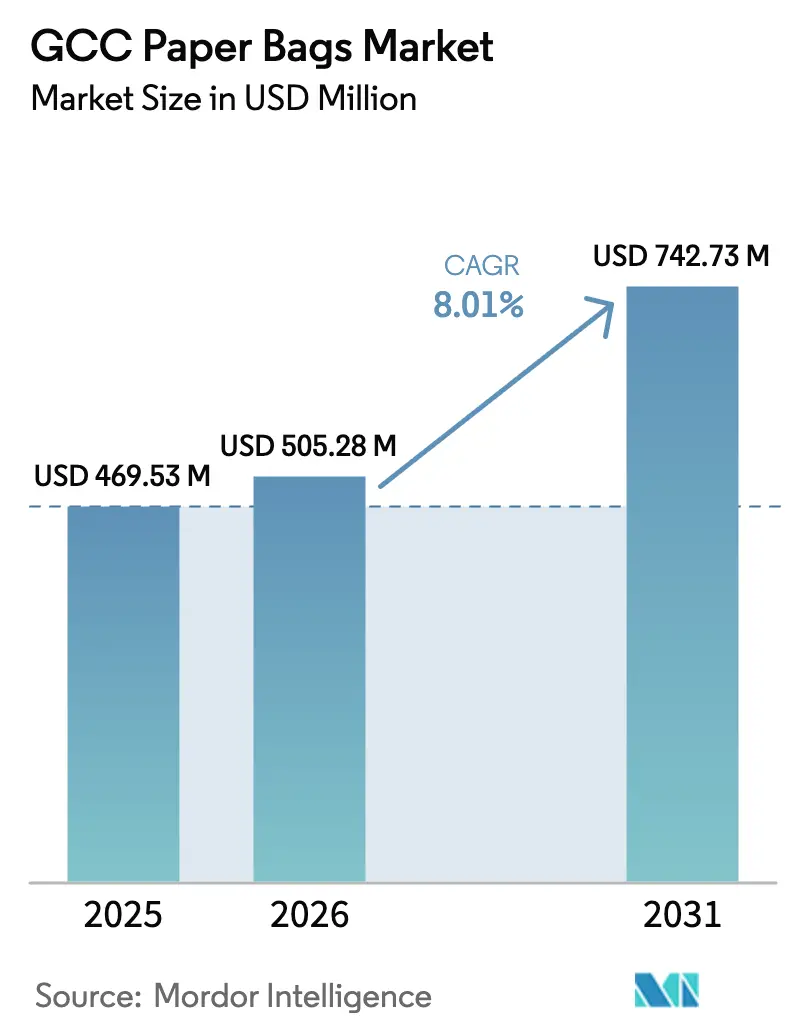
| Base Year Market Size (2025) | USD 469.53 Million |
| Market Size (2026) | USD 505.28 Million |
| Market Size (2031) | USD 742.73 Million |
| Growth Rate (2026 - 2031) | 8.01 % |
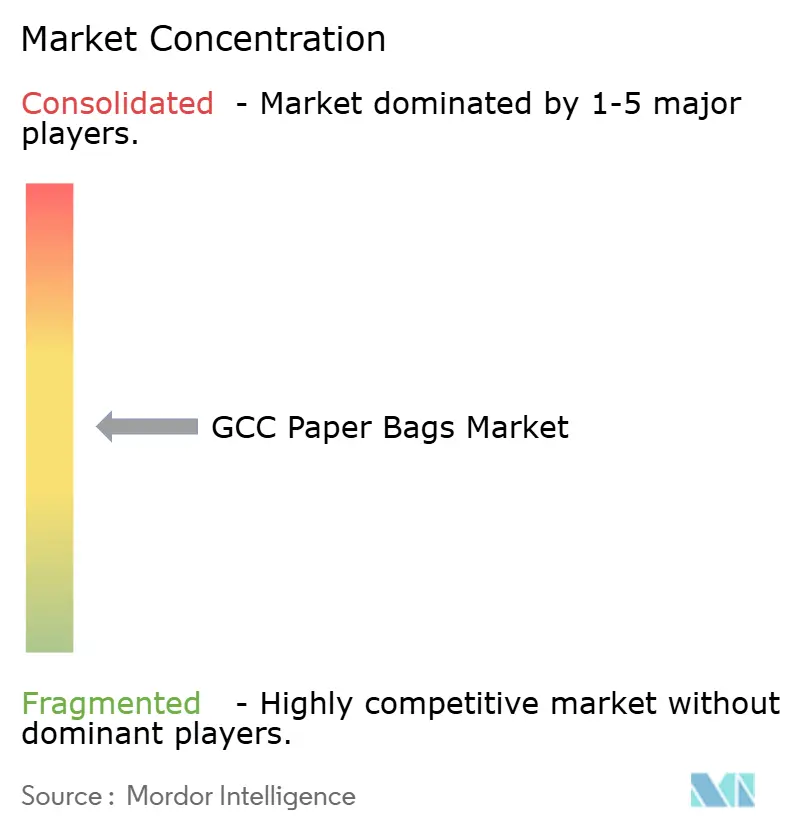
| Market Concentration | Medium |
Major Players *Disclaimer: Major Players sorted in no particular order Image © Mordor Intelligence. Reuse requires attribution under CC BY 4.0. | |
GCC Paper Bags Market Analysis by Mordor Intelligence
The GCC paper bags market size was valued at USD 469.53 million in 2025 and is estimated to grow from USD 505.28 million in 2026 to reach USD 742.73 million by 2031, at a CAGR of 8.01% during the forecast period (2026-2031). Rising regulatory pressure on single-use plastics, together with retailers’ and food-service operators’ search for easily recyclable packaging, is redirecting bulk purchasing budgets toward kraft paper. Accelerated capacity additions at regional mills are shortening lead times for converters, while integrated e-commerce platforms insist on parcel formats that withstand the humid Gulf climate without compromising brand aesthetics. Brand owners also favor paper substrates that help them meet forthcoming Extended Producer Responsibility targets, pushing converters to differentiate through barrier coatings, multi-ply designs, and ISO-certified quality controls. Capital inflows triggered by Saudi Vision 2030 incentives and the United Arab Emirates’ fast-tracked plastic phase-out timeline compress the investment window, forcing converters to upgrade machinery, secure long-term pulp contracts, and strengthen backward integration. Together, these shifts signal that the GCC paper bags market will remain on a robust growth path, supported by consistent demand from construction, retail, e-commerce, and food-delivery channels.
Key Report Takeaways
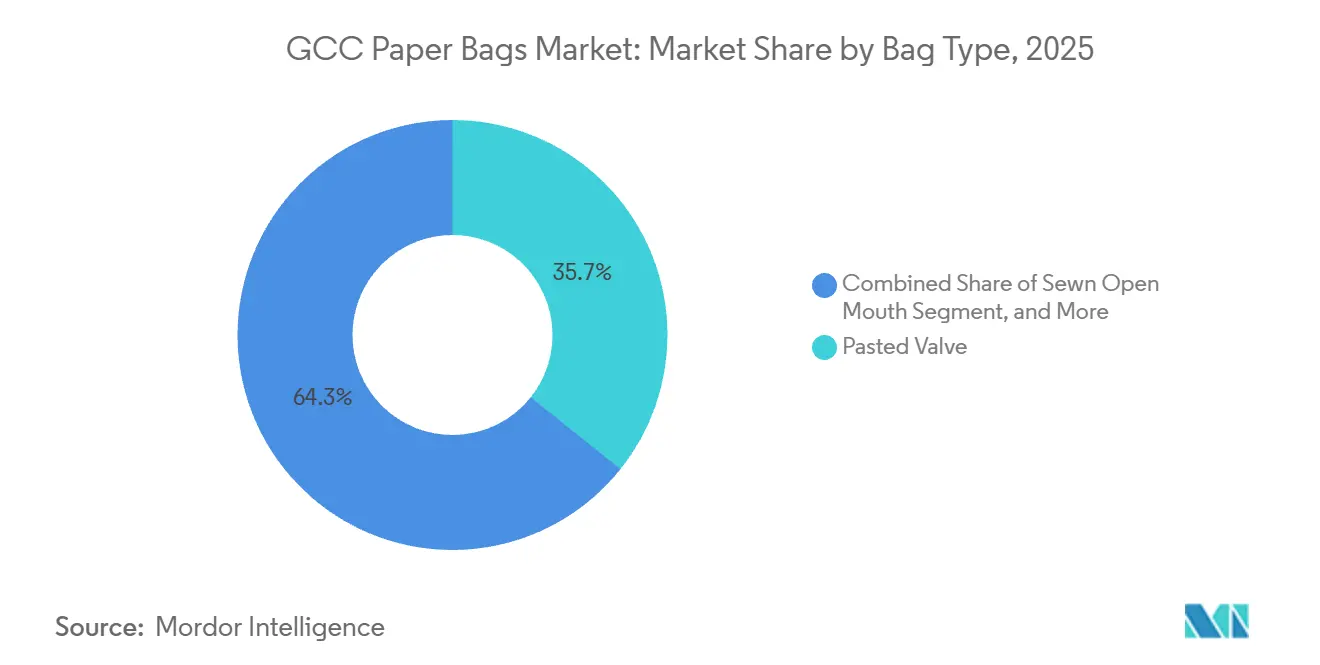
- By bag type, pasted valve bags led with 35.72% of GCC paper bags market share in 2025, while sewn open-mouth bags are projected to expand at a 9.31% CAGR through 2031.
- By material type, brown kraft accounted for 46.79% market share in 2025, whereas coated kraft is forecast to register a 9.57% CAGR to 2031.
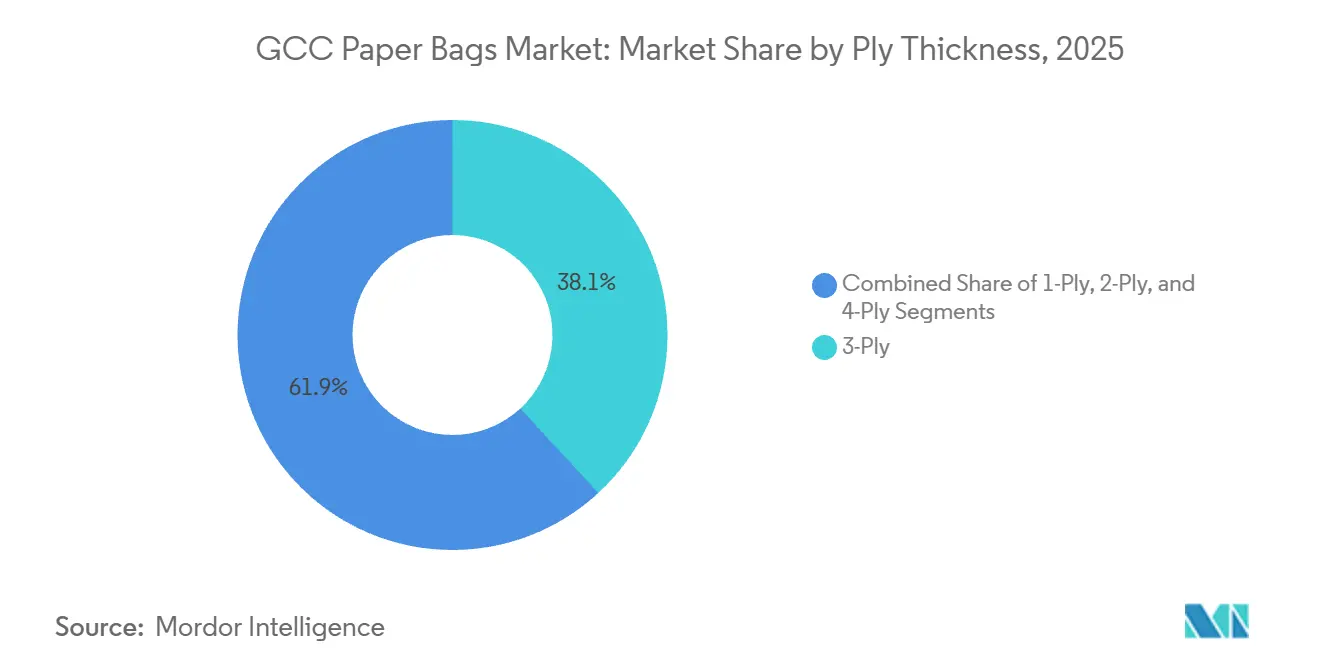
- By ply thickness, the 3-ply segment captured 38.14% of the GCC paper bags market size in 2025, and 4-ply bags are advancing at a 9.22% CAGR during the same period.
- By end user, retail accounted for 32.62% of GCC paper bags market share in 2025, while e-commerce is expected to post the fastest 9.84% CAGR through 2031.
- By geography, Saudi Arabia controlled 42.76% of the GCC paper bags market share in 2025, but the United Arab Emirates is projected to log a 10.08% CAGR, the highest in the region.
Note: Market size and forecast figures in this report are generated using Mordor Intelligence’s proprietary estimation framework, updated with the latest available data and insights as of 2026.
Market Trends and Insights
Drivers Impact Analysis of GCC Paper Bags Market*
| Driver | (~) % Impact on CAGR Forecast | Geographic Relevance | Impact Timeline |
|---|---|---|---|
| Sustainable-Packaging Regulations Spur Paper Adoption | +2.1% | UAE, Saudi Arabia, Oman | Short term (≤ 2 years) |
| E-Commerce Parcel Growth Fuels Protective Paper Mailers | +1.8% | Saudi Arabia, UAE, Qatar | Medium term (2-4 years) |
| Vision 2030 Manufacturing Diversification Incentives | +1.4% | Saudi Arabia, spillover to the GCC | Long term (≥ 4 years) |
| Food-Delivery Boom Boosts Takeaway Paper Bags | +1.2% | UAE, Saudi Arabia, Kuwait | Medium term (2-4 years) |
| Date-Palm Fibre-Based Kraft Pulp Pilot Projects | +0.7% | Saudi Arabia, UAE | Long term (≥ 4 years) |
| Regional Recycled-Containerboard Capacity Expansions | +0.9% | GCC-wide, led by the UAE and Saudi Arabia | Medium term (2-4 years) |
| Source: Mordor Intelligence | |||
Sustainable-Packaging Regulations Spur Paper Adoption
The United Arab Emirates enforced a federal ban on single-use plastic bags in January 2024, compelling retailers and food-service chains to shift procurement to paper carriers. Dubai’s Resolution 124 of 2023 added local penalties that further accelerated conversion timelines. Oman tightened the regional regime through Decision 8/2024, which blocks imports of single-use plastic bags from September 2024.[1]Oman Ministry of Commerce, “Decision 8/2024 on Single-Use Plastic Ban,” moci.gov.om Because implementation windows were short, converters with existing multi-wall capacity captured sudden order spikes while plastic-film specialists lost shelf space.
E-Commerce Parcel Growth Fuels Protective Paper Mailers
Parcel volumes handled by regional fulfillment centers are rising double-digit annually as smartphone adoption, digital payments, and last-mile footprint expand. Online platforms are piloting fully recyclable padded mailers that combine kraft outer layers with cushioning inserts, replacing traditional plastic bubble envelopes. Retrofit programs for automatic mailer-loading equipment are progressing, and several logistics providers are testing humidity-controlled depots to protect paper parcels. Brand owners view curbside recyclability as a marketing edge, increasing willingness to pay a premium for advanced barrier coatings. The result is a virtuous cycle in which higher-value mailer formats elevate both revenue and margin per unit for converters engaged in the GCC paper bags market.
Vision 2030 Manufacturing Diversification Incentives
Saudi Arabia’s Public Investment Fund committed SAR 1.8 billion (USD 480 million) to Middle East Paper Company’s PM5 recycled-containerboard machine, anchoring upstream fiber supply within the Kingdom.[2]Middle East Paper Company, “PM5 Project Announcement,” mepco.com.saThe project supports Vision 2030 goals to localize industrial inputs and trim import exposure.As new tonnage ramps, converters expect shorter lead times and lower freight costs for kraft linerboard moving into the wider Gulf.
Food-Delivery Boom Boosts Takeaway Paper Bags
Cloud kitchens and aggregator platforms are multiplying order frequency, demanding grease-resistant, brandable bags that survive 30-minute rides in 40 °C coastal heat. Quick-service restaurants are standardizing on coated kraft grades that block oil stains yet remain fully recyclable. Fold-over handles and reinforced bottoms are now specified to avoid accidental spillage during motorcycle delivery. As platform algorithms reward outlets with higher packaging quality scores, restaurants treat premium paper bags as part of customer-experience budgets rather than expendable costs. The near-term result is a sales surge for converters offering moisture-barrier coatings certified for direct food contact.
Restraints Impact Analysis of GCC Paper Bags Market*
| Restraint | (~) % Impact on CAGR Forecast | Geographic Relevance | Impact Timeline |
|---|---|---|---|
| Volatile Wood-Pulp Prices and Import Dependence | -1.4% | GCC-wide, with acute exposure in UAE and Qatar | Short term (≤ 2 years) |
| Competition from Reusable PP and Cotton Tote Bags | -0.9% | UAE and Saudi Arabia premium retail channels | Medium term (2-4 years) |
| Weak GCC Paper-Recycling Logistics Network | -0.5% | GCC-wide, most acute in Oman and Qatar | Medium term (2-4 years) |
| Gulf Humidity Challenges Bag Integrity in Wet Uses | -0.3% | UAE, Qatar, coastal Saudi Arabia, Oman | Short term (≤ 2 years) |
| Source: Mordor Intelligence | |||
Volatile Wood-Pulp Prices and Import Dependence
Regional converters still import the bulk of virgin fiber, tying their cost base to global commodity cycles. Recent mill closures in North America tightened supply, pushing spot kraft prices to multi-year highs just as converters quoted fixed-price tenders for supermarket chains. Freight surcharges from Asia added further pressure, and not all customers accept quarterly price escalators. Smaller converters with limited inventory buffers face working-capital strain, occasionally resorting to short-weighting or delayed deliveries that erode buyer trust. Unless upstream pulp self-sufficiency accelerates, margin volatility will continue to cap near-term profitability in the GCC paper bags market.
Competition from Reusable PP and Cotton Tote Bags
Abu Dhabi’s awareness campaign helped slash single-use plastic bag consumption by 95% since 2022 and spurred a 2 000% increase in reusable bag adoption.[3]Abu Dhabi Government, “Sustainability Initiatives,” abudhabi.aeA 2024 knowledge, attitude, practice survey found 47.1% of UAE consumers would switch to reusable bags if incentives were offered. Major supermarket chains such as Lulu and Carrefour now promote branded polypropylene totes at checkout and award extra loyalty points to customers who bring them back on subsequent visits. Retail buyers note that monthly paper-bag orders for premium outlets fell by 12% after tote-bag promotions launched in mid-2025, signaling a measurable channel shift toward durable carriers.
*Our forecasts treat driver/restraint impacts as directional, not additive. The impact forecasts reflect baseline growth, mix effects, and variable interactions.
GCC Paper Bags Market Segment Analysis
By Bag Type:
Performance-Driven Shift Toward Multi-Function FormatsPasted valve formats, holding 35.72% of GCC paper bags market share in 2025, stayed dominant because cement producers require dust-tight seals compatible with rotary packers. Construction mega-projects such as NEOM and The Red Sea Project consume millions of 50-kilogram units monthly, anchoring baseline volumes. Downstream, the sewn open mouth segment is forecast to post a 9.31% CAGR, propelled by animal-feed and grain processors that value tamper-evident stitching for traceability audits. Flat bottom variants, which stand upright on retail shelves, are carving out niche demand from premium coffee roasters and specialty pet food. Pinched bottom open mouth bags serve dry commodities like flour and sugar, offering a compromise between cost and burst strength. The proliferation of bag-type SKUs encourages converters to invest in modular lines that switch quickly among sealing options, improving asset utilization.
Second-generation equipment imported from Europe allows one plant to alternate between pasted valve and pinch-bottom designs within a single shift, smoothing order peaks. Digital die-cutting combined with inline flexographic presses accelerates custom branding for mid-volume jobs, a feature appreciated by e-commerce sellers launching limited-edition merchandise. In parallel, quality inspectors deploy machine-vision cameras to verify glue application and stitch density, reducing rejection rates. These productivity gains help cushion raw-material price shocks. Market awareness campaigns by packaging institutes also underline the dust-emission benefits of valve bags, persuading regulators to include minimum performance thresholds in new cement-logistics guidelines. All told, evolutionary improvements in bag-type engineering underpin diversified revenue streams for participants in the GCC paper bags market.



By Material Type:
Cost Leadership Meets Functional InnovationBrown kraft retained 46.79% market share in 2025 as its unbleached fibers offer the lowest delivered-cost profile and adequate printability for mass retail. Nevertheless, coated kraft is projected to clock a 9.57% CAGR up to 2031, thanks to proprietary barrier layers that repel grease, moisture, and even oxygen. Quick-service restaurants now specify water-based dispersion coatings, avoiding polyethylene laminations that complicate recycling. Bleached kraft, bright and smooth, remains the substrate of choice for cosmetics gift packs and luxury apparel, but price premiums constrain adoption in grocery carry-outs. Recycled brown kraft sourced from new containerboard machines offsets virgin fiber exposure, soothing ESG scrutiny from corporate buyers.
Converters fine-tune basis weights between 70 g m⁻² and 120 g m⁻² to balance stiffness with foldability in high-speed form-fill-seal systems. Extrusion coaters recently installed in Jeddah can apply dual-layer barriers in one pass, shaving energy consumption by double-digit percentages. Meanwhile, pilot trials for date-palm fiber pulping show early promise, although variability in lignin content complicates bleaching sequences. Intellectual-property filings on bio-based resins further suggest that functional performance and circularity are no longer mutually exclusive. These material-type breakthroughs keep the GCC paper bags market in the spotlight for brand owners chasing both legislative compliance and differentiated shelf presence.
By Ply Thickness:
Structural Integrity Drives Premium UpsellThree-ply constructions captured 38.14% of GCC paper bags market size in 2025, providing the sweet spot between cost and tensile strength for general retail. Four-ply bags, however, are forecast to advance at a 9.22% CAGR as industrial fillers migrate toward higher burst thresholds to mitigate losses from automated palletizers. Two-ply variants still populate the apparel and pharmacy segments where loads are light, but the one-ply category is increasingly relegated to promotional giveaways. Petrochemical players now mandate four-ply multi-wall sacks for polymer granules after field testing showed 18% fewer split seams than three-ply alternatives.
Investment in multi-head slitters and precision pasting units helped regional converters maintain tight ply-weight tolerances, crucial for preventing sheet-curl and lay-flat issues on filling lines. Adhesive suppliers introduced starch blends with faster set-times, boosting line throughput by 10-15% without sacrificing delamination resistance. Parallel R and D explores integrating micro-perforations that allow trapped air to escape during valve-bag filling, further reducing line stoppages. Customers that once balked at the price delta now recognize lifecycle savings from reduced product spillage and fewer downtime incidents. Premiumization by ply thickness thus deepens margin pools across the GCC paper bags market.
By End User:
Channel Realignment Favors Digital and Delivery ModelsTraditional retail still delivered 32.62% of market share in 2025 as supermarket checkout lanes shifted swiftly from plastic to paper. Volume multipliers include loyalty-card promotions that reward patrons for choosing paper over plastic. The e-commerce cohort is poised for the strongest 9.84% CAGR to 2031 as fashion, electronics, and online grocery scale beyond early-adopter phases. Agricultural and feed operators prefer sewn open mouth and four-ply sacks that guard against humidity in outdoor depots. Food-service brands, facing intense aggregator ratings scrutiny, pay extra for coated Kraft with anti-skid exteriors that reduce delivery bag slippage on scooter racks.
Meanwhile, cosmetics and personal-care boutiques emphasize unboxing theatrics, selecting bleached kraft with ribbon handles to convey premium positioning. Pharmaceutical and specialty-chemical makers rely on pasted open-mouth bags certified under Good Manufacturing Practice, ensuring zero fiber shedding. Each vertical issues distinct technical datasheets, pressuring converters to maintain broad SKU catalogs and rapid artwork changeovers. As omnichannel retail matures, cross-channel brand consistency in material appearance becomes a new purchasing criterion, adding complexity and opportunity to the GCC paper bags market.
Geography Analysis
Saudi Arabia Paper Bags Market
Saudi Arabia controlled 42.76% of market share in 2025, reflecting unmatched scale in cement, petrochemical, and food-service sectors. Public Investment Fund backing for a new 450,000 t y⁻¹ recycled-containerboard line guarantees domestic kraft liner supply, reducing foreign-exchange leakage and bolstering converter margins. Mega-infrastructure programs funnel predictable order books for pasted valve sacks, while retail chains roll out voluntary plastic-reduction pledges ahead of formal legislation. Rising quick-service restaurant footprints in Riyadh and Jeddah reinforce coated-kraft uptake, and Vision 2030 certifications encourage private investors to fund high-efficiency bag-making lines. Collectively, these developments ensure Saudi Arabia remains the volume anchor for the GCC paper bags market.
United Arab Emirates Paper Bags Market
The United Arab Emirates is forecast to deliver a rapid 10.08% CAGR through 2031, the highest regional clip. Federal and emirate decrees banning single-use plastic pushed every major retailer into emergency sourcing rounds, sparking a wave of long-term procurement contracts for paper alternatives. E-commerce parcel counts in Dubai soared alongside last-mile hubs installed for Expo 2020 legacy logistics, driving mailer adoption. Abu Dhabi records a 95% plastic-bag usage reduction, yet paper demand persists because home-delivery and tourism channels still require disposable carriers. Converters with ISO-certified plants near Jebel Ali Free Zone benefit from duty-free upstream pulp imports, underscoring the regulatory-driven dynamics fueling the GCC paper bags market.
Peripheral Gulf States Paper Bags Market
Qatar, Oman, Kuwait, and Bahrain form a secondary growth cluster, lifted by synchronized sustainability agendas but constrained by smaller populations. Oman’s ban on plastic-bag imports effective September 2024 opened an immediate supply gap that paper makers quickly filled, though local converting capacity remains limited. Qatar leverages liquefied natural gas revenues to modernize retail and hospitality venues, translating into upgraded packaging specifications. Kuwait and Bahrain follow suit, aligning standards with regional peers to streamline cross-border trade. Given these trends, converters operating dual hubs in Saudi Arabia and the United Arab Emirates can serve peripheral Gulf states via consolidated distribution centers, ensuring that geography-based demand fragmentation does not erode economies of scale for the GCC paper bags market.
Regulatory Landscape
Single-use plastics restrictions across the GCC remain the primary policy lever accelerating paper-bag substitution, with the UAE as the most visible enforcement anchor. The UAE Ministry of Climate Change and Environment (MOCCAE) regulates single-use products under Ministerial Resolution No. 380 of 2022, implemented in phases from January 1, 2024 and expanding from January 1, 2026. This expansion has been communicated as widening the list of restricted single-use items and tightening compliance expectations across retail and food service. In Oman, Decision 8/2024 blocks imports of single-use plastic bags from September 2024, creating cross-border compliance and sourcing considerations for GCC-wide retailers and distributors.
Beyond country rules, GCC suppliers align specifications to regional standards issued by the Gulf Standardization Organization (GSO), including GSO 458:2021 for wrapping paper and paper bags. This shapes baseline requirements for kraft grades, converting quality, and labeling practices in tenders. For food-contact and takeaway applications, buyers often require recognized compliance documentation for inks, coatings, and paper substrates, and the regulatory shift toward clearer labeling and verified sustainability claims raises the importance of traceability, certification, and audit readiness across the paper-bag supply chain.
Value Chain Analysis
The GCC paper bags value chain starts with fiber sourcing (virgin pulp and recycled fiber), moves into papermaking (kraft and containerboard), and then to converting (printing, forming, handle application, and multiwall construction). After converting, product flows to brand owners and retailers, followed by end-of-life collection and recycling. Import dependence for virgin pulp remains a key upstream feature for many converters, while recycled containerboard capacity additions in Saudi Arabia and the UAE are improving local availability of recycled-based paper grades for bag manufacturing. Converting and finishing are largely handled by regional packaging players including Hotpack Packaging Industries LLC, Gulf East Paper & Plastic Industries LLC, Al Zaini Converting Industries, Falcon Pack Industries LLC, and Huhtamaki Flexibles UAE, with portfolios spanning retail carriers and food-service formats.
Compliance and quality assurance functions are increasingly embedded across the chain due to buyer requirements linked to plastic phase-outs and sustainability policies. These include proof of material conformity, food-contact suitability where applicable, and standardized specifications aligned to GSO requirements, such as GSO 458:2021. Value creation is also shifting toward functional paper, including coated and barrier-treated kraft for humidity and grease resistance, and toward supply security through longer-term fiber contracting, more localized recycled feedstock, and manufacturing footprint optimization to handle peak retail and e-commerce cycles with shorter lead times.
Competitive Landscape
The GCC paper bags market is moderately fragmented. Global packaging majors such as Mondi, Smurfit Westrock, and International Paper compete head-to-head with regional specialists such as Hotpack, Gulf East Paper, and Middle East Paper Company. Multinationals leverage vertical integration, owning pulp, paper, and converting assets that safeguard raw-material flow and stabilize unit economics. For instance, Mondi’s EUR 1.2 billion (USD 1.36 billion) expansion in Czechia added 210,000 t y⁻¹ of kraft capacity, enabling one-stop sourcing for Gulf importers. Smurfit Westrock’s 2024 mega-merger pooled 63 mills and more than 500 converting plants, promising standardized ESG audits that appeal to multinational brand owners.
Regional champions counter by embedding localized service, faster turnaround, and Arabic-language artwork capabilities. Hotpack’s AED 350 million (USD 95 million) plant in Malaysia hedges pulp supply risk and creates a cost-competitive export base, while its planned SAR 1 billion (USD 267 million) Saudi unit shortens delivery cycles to inland projects. Middle East Paper Company’s recycled-containerboard line secures feedstock for captive bag plants, compressing lead times and insulating against pulp volatility. Smaller converters differentiate through digital printing for limited runs and boutique designs targeting cosmetics shops.
Asian pulp surpluses threaten to unleash a wave of discounted containerboard into the Gulf, pressuring converters without backward integration. Consequently, several mid-tier players court private-equity funding to acquire minority stakes in pulp mills or negotiate long-term supply agreements. Technology adoption accelerates as machine-vision quality control, real-time moisture monitoring, and automated palletizers migrate from European benchmarks into Gulf plants. Compliance certificates under ISO-9001 and ISO-14001 are now table stakes for government and multinational tenders, erecting formal entry barriers. Overall, rivalry centers on cost leadership versus functional specialization, positioning the GCC paper bags market firmly in the moderate-fragmentation zone.
GCC Paper Bags Industry Leaders
Huhtamaki Flexibles UAE
Hotpack Packaging Industries LLC
Gulf East Paper & Plastic Industries LLC
Al Zaini Converting Industries
Falcon Pack Industries LLC
- *Disclaimer: Major Players sorted in no particular order
GCC Paper Bags Market Companies Covered in this Report
- Huhtamaki Flexibles UAE
- Gulf East Paper & Plastic Industries LLC
- Hotpack Packaging Industries LLC
- Falcon Pack Industries LLC
- Al Zaini Converting Industries
- Mondi plc
- BreezPack FZ-LLC
- Middle East Paper Company (MEPCO)
- Segezha Group PJSC
- Novolex Holdings LLC
- Gascogne SA
- Unipack Containers and Carton Products LLC
- Union Paper Mills LLC
- Smurfit Westrock
- Klabin S.A.
- Ronpak Inc.
- Detpak Manufacturing LLC
- Star Paper Mill Paper Industry LLC
- International Paper Company
- Billerud AB
- Printpack Packaging Industries LLC

Market Opportunities and Future Outlook
The most immediate whitespace sits in compliant substitution programs created by phased single-use plastics controls, particularly in the UAE where Ministerial Resolution No. 380 of 2022 advanced restrictions from January 1, 2024 and expanded further from January 1, 2026. This supports demand for paper-bag formats that can pass retailer audits and perform under Gulf humidity, which favors converters that can supply coated kraft, reinforced bottoms, and consistent print quality at scale for grocery, food delivery, and parcel shipments. Regional standard alignment, including GSO 458:2021 for wrapping paper and paper bags, also supports cross-border harmonization of specifications, creating scope for suppliers to standardize SKUs and documentation for multi-country retail groups.
Upstream and midstream opportunities focus on reducing fiber and lead-time risk while improving circularity economics, since converters still carry cost exposure from imported pulp and uneven recycling logistics across the GCC. Investments and partnerships that expand local paper-based packaging capacity and broaden paper substrate options can shorten procurement cycles and reduce volatility for high-volume buyers. For example, Hotpack disclosed in 2026 a funding-backed expansion agenda in Saudi Arabia and a joint venture focused on paper-based packaging. A parallel opportunity is the commercialization of verified, clearly labeled sustainable packaging, including PFAS-free or easier-to-recycle barrier solutions, that meets food-service performance needs without undermining recyclability. This helps brand owners align with internal sustainability targets while navigating tighter scrutiny on environmental claims.
Recent Industry Developments in GCC Paper Bags Market
- June 2026: Hotpack announced a joint venture with Malaysia-based HZ Corporation to establish HZP Eco Packaging, focused on paper-based foodservice packaging including paper bags. The move broadens Hotpack's capability set in paper formats and adds another lever for securing supply for high-throughput food-service customers that are shifting away from single-use plastics.
- May 2026: Hotpack announced a minority equity investment by Gulf Islamic Investments (GII) to support manufacturing capacity expansion, including a new facility in Al Kharj, Saudi Arabia. The investment strengthens localized production capacity within the GCC, supporting shorter lead times and improved resilience against imported raw-material and finished-goods supply constraints.
- May 2024: Huhtamaki announced the consolidation of its three flexible packaging manufacturing sites in the UAE, retaining its Jebel Ali factory and expanding its Ras Al Khaimah facility. The footprint optimization supports higher-throughput operations and improves service responsiveness for regional customers that are tightening packaging specifications under sustainability and single-use plastic substitution programs.


GCC Paper Bags Market Report Scope and Research Methodology
Market Definition and Coverage
This market covers revenues generated from the sale of paper bags used for carrying, packing, and secondary packaging across GCC countries, counted at the point of sale by bag converters and suppliers, and reported in USD.
Scope exclusions: We exclude plastic bags, reusable fabric bags, and paper packaging formats that are not bags (such as corrugated boxes and cartons).
Segments Covered in This Report
- By Bag Type
- Flat Bottom
- Pasted Valve
- Pinched Bottom Open Mouth
- Pasted Open Mouth
- Sewn Open Mouth
- By Material Type
- Brown Kraft
- Bleached/White Kraft
- Coated Kraft
- Recycled Brown Kraft
- By Ply Thickness
- 1-Ply
- 2-Ply
- 3-Ply
- 4-Ply
- By End User
- Retail
- Agriculture and Animal Feed
- Food Service
- Cosmetics and Personal Care
- E-Commerce
- Other End Users
- By Country
- Saudi Arabia
- Oman
- United Arab Emirates
- Qatar
- Rest of GCC
Data Sources, Market Sizing, and Validation
Desk Research
Desk research was used to build the factual base for the GCC paper bags demand pool, and then to pressure test early assumptions on how fast users are switching away from single use plastics. We reviewed public policy updates and compliance timelines, since these directly change paper bag adoption across retail and foodservice.
Key public sources included materials and waste policy portals and statistics offices in GCC countries, customs and trade statistics for paper and paper articles, and publications from packaging and paper industry associations and standards bodies. We also used company annual reports, investor presentations, and reputable business press to understand capacity additions and product mix. Where needed, we referenced paid subscriptions for company financials and intelligence, import and export shipment level views, and patent databases to validate technology and product trends. This list is illustrative only, and many other sources were also used to collect data, validate it, and clarify assumptions.
Primary Interviews and Surveys
Primary work focused on interviews and short surveys with paper bag converters, distributors, packaging buyers in retail and foodservice, and a few logistics and procurement specialists who see unit demand changes early. Since this is a regional market, responses were balanced across the GCC so we could confirm country level differences in regulation timing, pricing, and end user adoption, and then align those checks with what was found in desk research.
Distribution of primary research fieldwork respondents
| Company type | Respondent position |
|---|---|
| Top tier: 37% | CXOs: 13% |
| Mid tier: 41% | Functional/Unit leaders: 34% |
| Smaller Players: 22% | Managers: 53% |
Market-Sizing & Forecasting
Sizing was built using a top-down demand pool approach, where packaging consumption signals are reconstructed by country and then translated into paper bag value using realistic unit usage and pricing. To keep the outputs grounded, we then cross-checked totals with selective bottom-up approximations, such as sampled converter capacity and utilization checks, plus ASP times volume builds for a few high-usage end users.
Inputs used in the model included kraft paper price movements, conversion capacity additions and downtime patterns, typical order sizes by retail and foodservice outlets, the pace of plastic restriction enforcement, and the mix shift across bag materials and ply thickness that changes average pricing. Where local data points were patchy, gaps were handled by using proxy ratios from comparable GCC countries, followed by interview-led adjustments until the numbers aligned with observed trade and demand signals.
For forecasting, scenario analysis was used so adoption could be flexed under different policy enforcement and consumer uptake paths, and then smoothed into a single base case using short time-series trend checks on import and production indicators. Assumptions for price progression and mix were validated with suppliers and buyers so the final forecast reflects what is actually being contracted and replenished.
Data Validation & Update Cycle
Model outputs were validated through repeated triangulation across independent signals, including trade flows, capacity utilization direction, and end user purchase behavior shared in interviews. When a variance was too high, the underlying driver was revisited, and follow-up calls were triggered to confirm whether it was a one-off event or a structural change.
Before sign-off, the model is reviewed in multiple steps, with checks for unit consistency, pricing logic, and country totals adding up correctly. Reports are refreshed annually, and interim updates are made when material events occur, such as major regulation changes, large capacity additions, or sharp raw material price shifts. Right before delivery, a final review pass is completed so clients receive the most current view available.
Mordor Intelligence's Gcc Paper Bags Market Size Measured Against Other Published Estimates
It is common to see different market size figures for GCC paper bags because publishers do not always define the product boundary the same way, and they may apply different pricing logic or update timing. Differences also come from how each model treats cross-border trade inside the GCC and whether values are captured at the converter level or at a later point in the distribution chain.
In practice, the biggest gap drivers are usually scope choices (for example, whether sacks and industrial paper packaging are mixed into the same total), how average selling prices are updated when kraft paper costs move quickly, and whether a base case is reported versus a more aggressive adoption scenario tied to plastic restriction enforcement. The spread is also influenced by currency conversion timing and how often the dataset is refreshed, since this market reacts fast to policy and procurement cycles, which is handled through a 2025 base of USD 469.53 M and a 2026 estimate of USD 505.28 M in the GCC paper bags model published by Mordor Intelligence.
Benchmark comparison
| Source | Market Size | Gaps in Research Methodology |
|---|---|---|
| Mordor Intelligence | USD 505.28 M (2026) | |
| Regional Consultancy A | USD 532.50 M (2026) | Often reflects a wider packaging scope, where some industrial sacks and adjacent paper packaging formats are counted, which lifts the total beyond carry bag demand alone. |
| Trade Publisher B | USD 434.11 M (2022) | Uses an older base year and may apply conservative price assumptions without fully capturing recent mix upgrades in retail and foodservice that increase average realized prices. |
Across the three figures, the differences mainly trace back to what gets counted as a paper bag, which year is used as the reference point, and how pricing and mix are carried forward. By keeping the inputs tied to observable demand signals and then checking them against supply-side reality, the estimate stays repeatable and easier to reconcile with real GCC buying patterns.


Key Questions Answered in the Report
How large is the GCC paper bags market in 2026?
The GCC paper bags market size is estimated at USD 505.28 million in 2026.
What growth rate is forecast for GCC paper bags through 2031?
The market is projected to advance at an 8.01% CAGR between 2026 and 2031.
Which bag type currently commands the greatest share?
Pasted valve designs led with 35.72% of 2025 shipments, anchored by cement logistics.
Why is coated kraft demand rising quickly?
Quick-service restaurants and parcel shippers need grease- and moisture-resistant barriers that coated kraft provides, fueling a forecast 9.57% CAGR.
Which country will expand the fastest?
The United Arab Emirates is set to grow at a 10.08% CAGR through 2031, propelled by stringent plastic bans and booming e-commerce.
What is the principal restraint facing converters?
Volatile imported wood-pulp prices compress margins for firms lacking backward integration.
Page last updated on:


 Your data is secure and never sold or shared.


