
Panel Level Packaging Market Size and Share
Market Overview
| Study Period | 2020 - 2031 |
|---|---|
| Market Size (2026) | USD 0.44 Billion |
| Market Size (2031) | USD 1.37 Billion |
| Growth Rate (2026 - 2031) | 25.58 % |
| Fastest Growing Market | Asia Pacific |
| Largest Market | Asia Pacific |
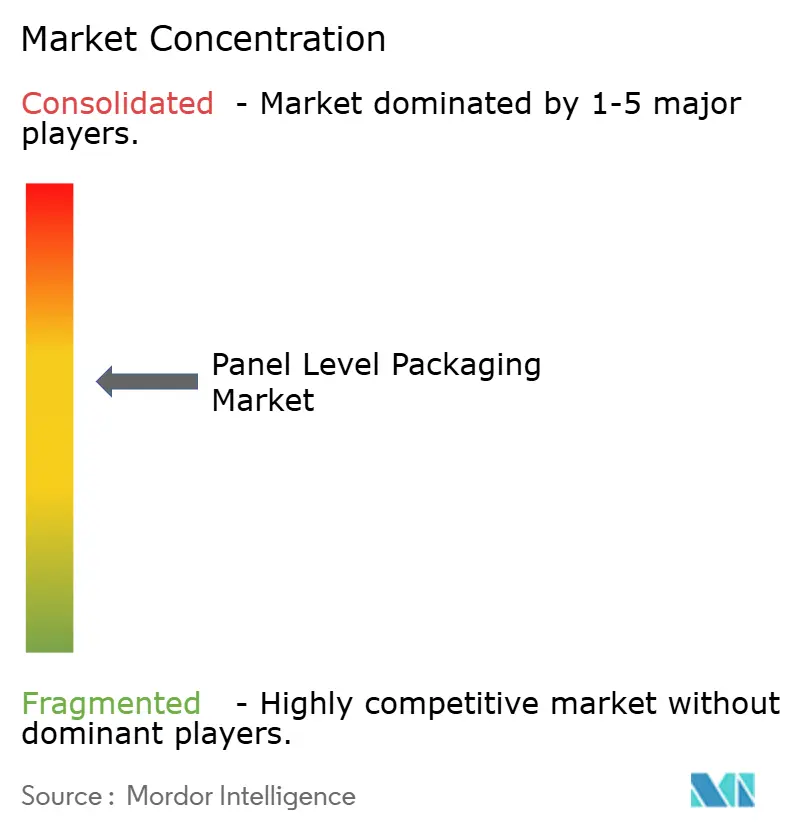
| Market Concentration | Medium |
Major Players *Disclaimer: Major Players sorted in no particular order Image © Mordor Intelligence. Reuse requires attribution under CC BY 4.0. | |
Panel Level Packaging Market Analysis by Mordor Intelligence
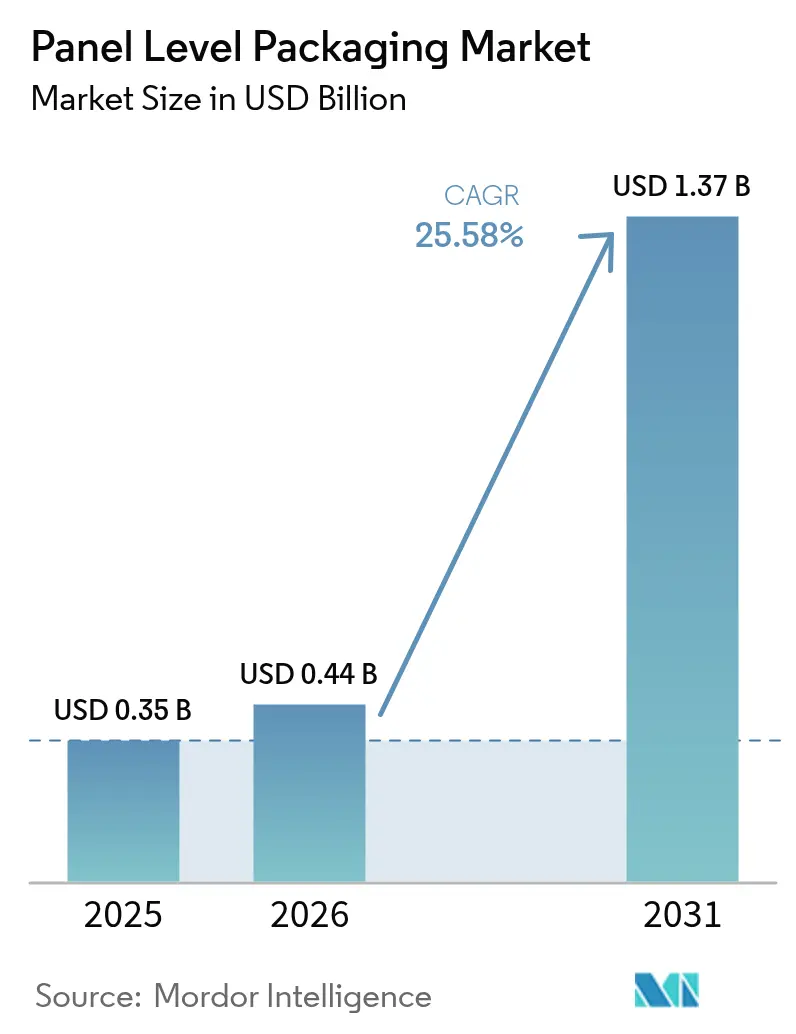
The panel-level packaging market size is expected to grow from USD 0.35 billion in 2025 to USD 0.44 billion in 2026 and is forecast to reach USD 1.37 billion by 2031 at 25.58% CAGR over 2026-2031. The steep trajectory mirrors the semiconductor sector’s shift from wafer-centric to panel-centric architectures, a move that unlocks scale advantages and aligns with burgeoning AI and high-performance computing demand. Panel formats deliver up to 40% better substrate utilization for multi-die designs, easing cost pressure as logic and memory nodes scale below 5 nm. Substrate innovation, notably the transition toward glass cores, promises tighter dimensional control and improved thermal stability, which together support rising input/output counts. Equipment vendors have responded with 600 mm × 600 mm lithography systems capable of sub-10 µm features, erasing a former resolution ceiling and widening the addressable market for next-generation integration. Supply-chain coordination is intensifying, illustrated by vertically integrated strategies from leading foundries and by cooperative capacity expansions between foundry and OSAT partners.
Key Report Takeaways
- By packaging technology, fan-out panel level packaging held 44.60% of the panel level packaging market share in 2025; 2.5D/3D panel integration is projected to grow at a 29.20% CAGR to 2031.
- By industry application, consumer electronics accounted for 40.30% of the panel-level packaging market size in 2025, while automotive ADAS and EV power applications are advancing at a 27.90% CAGR through 2031.
- By geography, Asia-Pacific captured 69.20% revenue share in 2025, and the region is set to expand at a 27.60% CAGR through 2031.
- By panel size, ≤300 mm × 300 mm commanded 58.90% of the panel level packaging market size in 2025, whereas panels ≥511 mm × 600 mm are forecast to post a 28.60% CAGR to 2031.
- By substrate material, Organic Laminate commanded 56.10% of the panel-level packaging market size in 2025, whereas Glass Core is forecast to post a 28.90% CAGR to 2031.
Note: Market size and forecast figures in this report are generated using Mordor Intelligence’s proprietary estimation framework, updated with the latest available data and insights as of 2026.
Market Trends and Insights
Drivers Impact Analysis of Panel Level Packaging Market*
| Driver | (~) % Impact on CAGR Forecast | Geographic Relevance | Impact Timeline |
|---|---|---|---|
| Cost reduction versus wafer-level packaging | +4.2% | Global, APAC hubs | Medium term (2–4 years) |
| AI/HPC chip demand surge | +6.8% | North America, Asia-Pacific | Short term (≤2 years) |
| 5G/6G and edge-device proliferation | +5.1% | Global | Medium term (2–4 years) |
| Adoption of 600 mm × 600 mm digital lithography | +2.9% | Asia-Pacific, North America | Long term (≥4 years) |
| Transition to glass-core substrates ≥2026 | +3.7% | Taiwan, South Korea, U.S. | Long term (≥4 years) |
| EU/US reshoring subsidies for advanced packaging | +2.4% | North America, Europe | Medium term (2–4 years) |
| Source: Mordor Intelligence | |||


Cost Reduction Versus Wafer-Level Packaging
Moving to panel formats yields up to 40% better substrate utilization for multi-die designs, cutting cost per placement even after accounting for expensive tooling. ASE’s USD 200 million investment in 310 mm × 310 mm lines signals a commitment to volume scaling, and high-volume consumer devices supply the wafer starts needed to amortize tools across short life cycles. Asian contract manufacturers gain further leverage by clustering substrate fabrication, redistribution-layer processing, and final test inside single campuses, reducing logistics overhead. Western houses with lower volumes face a steeper cost curve, widening the competitiveness gap. As a result, panel-first strategies increasingly determine win rates in turnkey package bids[1]Norio Tanaka, “Fan-Out Panel Production Lines,” ASE Technology Holding, aseglobal.com .
Surge of AI/HPC Chip Demand
Large language-model inference and training floors require ever-denser GPU clusters, driving packaging toward larger interposer-free footprints that sustain bandwidth. TSMC’s Chip-on-Panel-on-Substrate (CoPoS) roadmap, slated for 2027 risk production, doubles reticle-limited dimensions of CoWoS while holding thermal resistance steady[2]T. Liu, “CoPoS Integration Strategy,” Taiwan Semiconductor Manufacturing Company, tsmc.com. The foundry is expanding CoWoS capacity more than 60% annually through 2026, yet still projects backlog in high-bandwidth memory (HBM) lines, pushing Tier-1 customers to evaluate panel-level packaging market alternatives for next-generation accelerator cards. Early movers able to demonstrate >20 kW shelf-level cooling in panel packages are best positioned to secure multi-year supply agreements.
Proliferation of 5G/6G and Edge Devices
Emerging radios integrate mm-wave front-ends with digital baseband and power-management units on shared substrates. Panel architectures better dissipate localized hotspots while supporting the ultra-tight pitch needed for co-packaged optics. For edge servers, designers embrace heterogeneous die layouts that fuse low-power AI cores with memory and SerDes in space-constrained enclosures; panel fan-out improves thermal spread and signal integrity, boosting field reliability when deployed in industrial or outdoor settings.
Nikon 600 × 600 mm digital lithography adoption
The DSP-100 tool brings maskless digital lithography to full 600 mm × 600 mm substrates, printing sub-10 µm lines while trimming cycle time versus step-and-repeat scanners[3]Nikon 600 × 600 mm digital lithography adoption Nikon 600 × 600 mm digital lithography adoption . OSATs that install first-wave systems gain the capacity to fabricate ultra-high-I/O redistribution layers in a single shot, removing stitch errors that plagued earlier panel experiments. Capital outlay remains heavy, topping USD 80 million per chamber, and only top-tier packaging houses with AI-grade order books can clear hurdle rates. Nevertheless, pilot yields above 95% after three months of ramp point to a durable learning curve advantage for adopters.
Restraints Impact Analysis of Panel Level Packaging Market*
| Restraint | (~) % Impact on CAGR Forecast | Geographic Relevance | Impact Timeline |
|---|---|---|---|
| High capital intensity and warpage issues | -3.1% | Global, small OSATs | Short term (≤2 years) |
| Process-integration complexity beyond 300 mm | -2.8% | Asia-Pacific, Global | Medium term (2–4 years) |
| Sub-1 µm lithography yield cliff on large panels | -2.4% | Advanced foundries | Medium term (2–4 years) |
| ABF-GCP dielectric film bottleneck | -1.9% | High-volume fabs | Short term (≤2 years) |
| Source: Mordor Intelligence | |||
High Capital Intensity and Warpage Issues
A full 600 mm line demands more than USD 500 million in deposition, patterning, and metrology gear. Panel substrates expand under thermal load, generating a bow that can exceed 2 mm if not compensated. SK Key Foundry and LB Semicon’s Direct-RDL flow clamps panel edges during cure to limit deflection, but equipment retrofits add 15% to tool cost.[4]Dr. Y. C. Kim, “Direct-RDL for Automotive,” SK Key Foundry, skkeyfoundry.com Smaller OSATs struggle to finance those upgrades, constraining global supply expansion. Until low-modulus dielectrics or active warp-compensation chucks mature, yield drag remains a check on near-term penetration of the panel-level packaging market.
Process-Integration Complexity Beyond 300 mm
Uniformity windows tighten sharply as panels grow. Temperature gradients as small as 2 °C can skew copper thickness by 8%, driving impedance drift. Tool vendors now pair multi-zone heaters with laser-based thickness monitors, but recipe qualification stretches over quarters rather than weeks. Firms with deep process-engineering benches can tune dozens of parameters in parallel; second-tier players must accept lower throughput or outsource early learning to equipment partners, blunting margins. The result is a steep capability hierarchy that hinders ecosystem diversity and slows the diffusion rate of panel-level packaging industry know-how.
*Our forecasts treat driver/restraint impacts as directional, not additive. The impact forecasts reflect baseline growth, mix effects, and variable interactions.
Panel Level Packaging Market Segment Analysis
By Packaging Technology:
Balancing Fan-Out Scale and 3D BandwidthFan-Out Panel Level Packaging commanded 44.60% of 2025 revenue, making it the workhorse for consumer and mobile devices where moderate I/O density is sufficient. The panel-level packaging market size for this segment reached USD 0.16 billion and is projected to grow at 19.80% through 2031. Large OSATs leverage mature die-face-down flows to drive yields above 97%, beating wafer fan-out costs by double-digit margins on runs above 20,000 panels per month. Nevertheless, bandwidth-hungry accelerators are stretching the approach’s pad pitch limits, pressing innovators toward 2.5D/3D panel solutions.
2.5D/3D panel integration, while holding only 19.10% of 2025 sales, is the fastest mover at a 29.20% CAGR. Heterogeneous stacking places compute, memory, and analog tiles on passive glass carriers, cutting interconnect length by up to 70%. Early commercial wins center on AI inference cards where a single package hosts >16 chiplets. The panel-level packaging market share for 2.5D/3D approaches is expected to hit 31.80% by 2031 as the technique escapes datacenter niches and filters into automotive domain controllers.



By Substrate Material:
Organic Leadership Faces Glass MomentumOrganic laminate retained a 56.10% share in 2025, valued at USD 0.20 billion, benefiting from low-cost resin systems and entrenched supply chains. However, the segment’s 20.40% CAGR lags the overall panel-level packaging market, reflecting physical limits on layer count and CTE mismatch. Glass cores, in contrast, posted only an 12.30% share last year but will grow at a 28.90% CAGR to 2031. Samsung’s H-glass roadmap targets volume ramp in 2026, offering 0.3 ppm/°C dimensional drift, one-tenth that of organics, unlocking sub-5 µm line-width redistribution layers. Silicon and molded reconstituted panels remain niche, serving high-power or ultra-low-cost corners.
By Panel Size:
Small-Format Maturity Meets Large-Panel UpsidePanels ≤300 mm × 300 mm account for 58.90% of revenue yet trail in growth at 18.60% CAGR. The widely available 320 mm exposure tools and standard pick-and-place heads favor this footprint for smartphones and wearables. The panel-level packaging market size for large-format ≥511 mm × 600 mm panels, though minor today, is climbing 28.60% annually as HPC firms chase more dies per substrate. Nikon’s DSP-100 removes lithography bottlenecks, while new laser-dicing systems keep singulation yield above 99% even on 600 mm glass.

By Industry Application:
Consumer Base Anchors, Automotive Gains VelocityConsumer electronics led with a 40.30% share in 2025, translating to USD 0.14 billion. Smartphones, tablets, and AR headsets adopt a fan-out panel to shave the motherboard area and thickness. The automotive slice, covering ADAS radars and SiC power modules, is on course for a 27.90% CAGR as OEMs electrify fleets and demand 15-year reliability. Telecommunications infrastructure holds a mid-teens share, buoyed by massive MIMO radios that require integrated RF-digital modules. Aerospace, defense, industrial, and IoT applications together occupy the remainder, each valuing specific thermal or ruggedization benefits.
Geography Analysis
APAC Panel Level Packaging Market
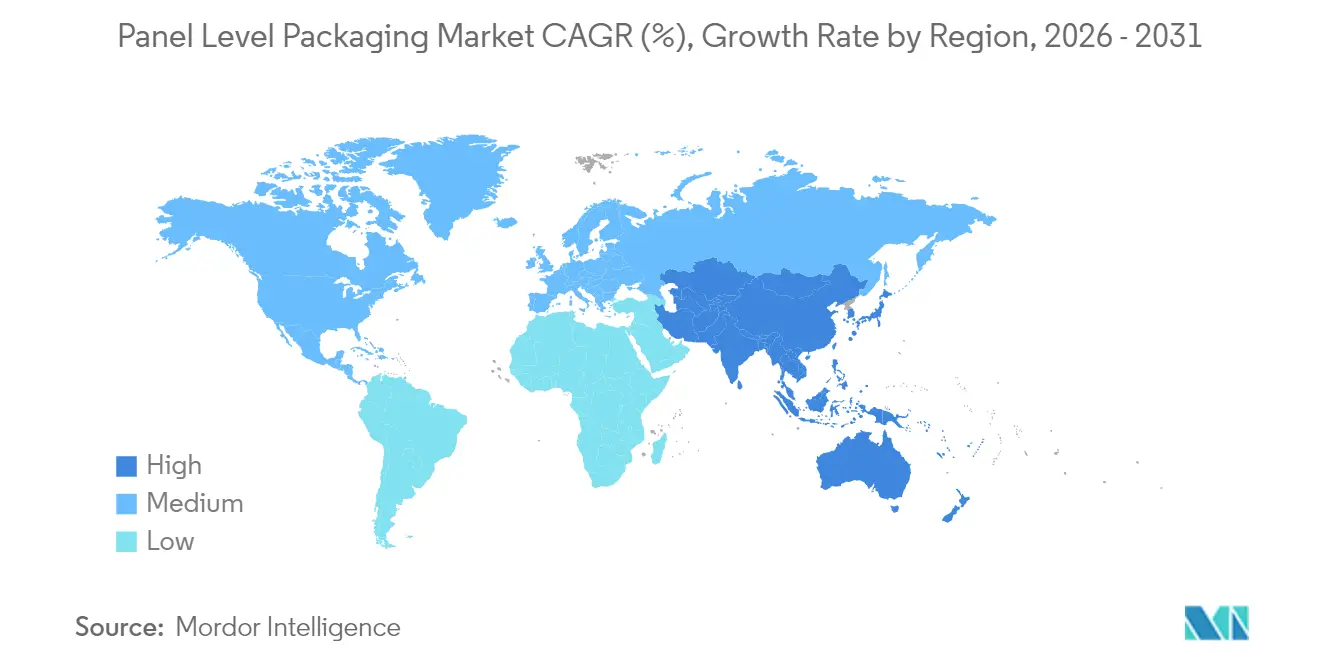
Asia-Pacific captured 69.20% of 2025 revenue and continues to lead the panel-level packaging market at a 27.60% CAGR through 2031. China funnels state incentives toward panel packaging lines aligned with sovereign AI chip programs, and Japan’s equipment outlays rose 82% in 2024 to USD 7 billion, underpinning domestic process capability. South Korea advances glass-core substrates, while Taiwan’s TSMC pushes integrated foundry-packaging flows that bundle CoWoS, CoPoS, and testing in a single fab cluster.
North America Panel Level Packaging Market
North America follows, anchored by CHIPS-Act funding of USD 1.6 billion earmarked for advanced packaging. Amkor’s USD 400 million Arizona plant comes online in 2026, co-located with TSMC’s new Fab 21 to shorten cycle times for U.S. customers. SK Hynix likewise has earmarked USD 450 million for HBM packaging in Indiana, demonstrating that states are bidding aggressively for high-value backend operations.
EMEA and South America Panel Level Packaging Market
Europe’s share remains single-digit but is rising as sovereignty concerns spur local OSAT formation. Foxconn and Thales committed EUR 250 million to a new fan-out facility aimed at aerospace and defense, while Infineon partnered with Amkor to add panel capacity in Portugal that comes online mid-2025. Middle East and Africa and South America remain consumption-centric, with limited assembly footprints yet, though incentive schemes in Saudi Arabia and Brazil could shift that balance later in the decade.

Regulatory Landscape
Regulation affecting panel level packaging is shaped less by PLP-specific rules and more by trade controls, cross-border customs compliance, and packaging reliability and handling standards used in semiconductor supply chains. In the United States, a Section 232 action published in the Federal Register introduced a 25% ad valorem duty on certain semiconductor and derivative products, effective January 15, 2026, increasing the need for accurate tariff classification and supporting documentation as packaged-device flows move across borders.
On standards, industry adoption continues to align with qualification and digital-interoperability frameworks used by OEMs, foundries, and OSATs. JEDEC published JEP30G.01 in December 2025 to standardize exchange of part data for electronic-device packages. In 2026, CENELEC/IEC published EN IEC 60749-20-1:2026 (handling and shipping of moisture-sensitive surface-mount devices) and EN IEC 63378-6:2026 (DXRC thermal model for transient temperature prediction in semiconductor packages), supporting more consistent logistics, thermal characterization, and customer-qualification requirements.
Value Chain Analysis
The panel-level packaging value chain starts with substrate and materials inputs, including organic laminates and emerging glass cores, ABF-GCP dielectric films, copper chemistries, mold compounds, adhesives, and temporary carriers. It then moves through equipment and process modules for panel handling, deposition, lithography, plating, metrology, and singulation. Manufacturing flows are carried out by foundries and OSATs that integrate RDL formation, die placement, molding, and test, with downstream customers across consumer electronics, AI/HPC, telecom infrastructure, and automotive applications that demand tighter pitch, warpage control, and thermal-performance discipline.
Friction points concentrate on large-area process control and ecosystem standardization, especially warpage management, lithography uniformity, die shift, and thickness variation across rectangular panels. The lack of universally standardized panel sizes also complicates equipment roadmaps and automation, including panel-specific handling that is not a one-to-one substitute for wafer FOUPs and robots. This is driving more co-development across the chain, illustrated by TSMC and ASE aligning on a 310 mm x 310 mm panel flow for AI-oriented layouts, while OSATs and materials suppliers iterate on low-warpage dielectrics, multi-zone thermal control, and contamination management needed for tight-pitch RDL and hybrid-bonding scale-up.
Competitive Landscape
Competition is intensifying as foundries integrate downstream processes and OSATs move upstream. TSMC’s Wafer Manufacturing 2.0 program unites lithography, packaging, and final test under a single scheduling system to shave weeks off delivery windows. Samsung counters via internal glass-substrate production to secure a materials moat, while Intel applies its embedded multi-die interconnect bridge (EMIB) to compete on system-level performance.
Equipment vendors carve out defensible niches: Applied Materials leads in copper-barrier deposition for 1 µm redistribution layers, whereas Tokyo Electron ships spin-on dielectric coaters optimized for low-warpage glass. Nikon’s first-mover maskless lithography expands its influence beyond wafer fabs into the panel-level packaging industry. Vertical tie-ups are growing: ASE’s strategic alignment with TSMC on 310 mm panels pools capex to accelerate learning curves, foreshadowing more collaborative megaprojects.
White-space opportunities persist in ultra-reliable sectors. Micro-System Engineering exploits its medical-device pedigree to deliver hermetic ceramic-glass hybrids, and Micross has bolstered defense offerings via strategic acquisitions. Nonetheless, high capex thresholds deter greenfield entrants, setting the stage for gradual consolidation once initial demand spikes normalize.
Panel Level Packaging Industry Leaders
ASE Technology Holding Co., Ltd.
Taiwan Semiconductor Manufacturing Company Limited (TSMC)
Samsung Electronics Co., Ltd.
Amkor Technology, Inc.
Intel Corporation
- *Disclaimer: Major Players sorted in no particular order
Panel Level Packaging Market Companies Covered in this Report
- Samsung Electronics Co., Ltd.
- Taiwan Semiconductor Manufacturing Company Limited (TSMC)
- Intel Corporation
- ASE Technology Holding Co., Ltd.
- Amkor Technology, Inc.
- Powertech Technology Inc.
- Nepes Corporation
- Unimicron Technology Corp.
- DECA Technologies, Inc.
- JCET Group Co., Ltd.
- Fraunhofer Institute for Reliability and Microintegration IZM
- Nikon Corporation
- Ajinomoto Fine-Techno Co., Inc.
- Shinko Electric Industries Co., Ltd.
- LG Innotek Co., Ltd.
- K&S (Kulicke & Soffa Industries, Inc.)
- Veeco Instruments Inc.
- Applied Materials, Inc.
- Ultratech (Veeco)
- Tokyo Electron Limited
- Brewer Science, Inc.

Market Opportunities and Future Outlook
Near-term whitespace centers on scaling panel formats and qualifying panel-level flows for higher-value AI/HPC and automotive programs as wafer-reticle and interposer economics tighten. Market signals include TSMC standardizing its CoPoS architecture around a 310 mm x 310 mm panel format and running dual-track pilot-line evaluation, global versus local equipment, as part of its panel packaging development. ASE also announced an automated 310 mm x 310 mm PLP production line. These moves create concrete opportunities for equipment makers in panel lithography, metrology, and handling automation, along with materials suppliers focused on low-warpage dielectrics, temporary bonding solutions, and glass-core supply, as they can align offerings with reference flows tied to major customer qualification cycles.
Geographically, industrial-policy programs and new pilot lines are widening entry points outside Asia-centric OSAT clusters, especially where governments are funding advanced packaging capability and security-of-supply. STMicroelectronics announced a USD 60 million PLP pilot line at its Tours facility in France targeted for operational status in Q3 2026, and North American capacity additions are supported by dedicated advanced-packaging incentives cited in the report context. Across these initiatives, adoption still depends on solving warpage and panel-uniformity constraints beyond 300 mm, and on easing bottlenecks such as ABF-GCP dielectric film availability, which elevates the role of qualified materials vendors and panel-tool suppliers that can demonstrate stable yields at larger formats.
Recent Industry Developments in Panel Level Packaging Market
- June 2026: TSMC confirmed ongoing evaluation of its Chip-on-Panel-on-Substrate (CoPoS) pilot line and standardized the architecture around a 310 mm x 310 mm panel format. The move strengthens a common target for equipment and OSAT process alignment, while positioning panel approaches as a complement to CoWoS for area-intensive AI packages rather than a direct replacement.
- May 2026: ASE Technology Holding announced development of an automated 310 mm x 310 mm panel-level packaging production line, with production targeted for the first half of 2027. The automation focus addresses throughput and consistency requirements that become acute as panel sizes scale, and it raises competitive pressure on OSAT peers to match panel-handling and yield-learning curves.
- July 2025: Nikon released the DSP-100 direct-write lithography platform for 600 mm x 600 mm panels with sub-10 micrometer resolution. By enabling high-I/O redistribution layers without step-and-repeat stitching constraints, the tool expanded the feasible panel-size envelope for early adopters pursuing large-format fan-out and advanced integration.


Panel Level Packaging Market Report Scope and Research Methodology
Market Definition and Coverage
Panel level packaging (PLP) is defined as semiconductor packaging activity where redistribution, interconnect build-up, and singulation are done on rectangular panels instead of round wafers, and revenue is counted in value terms for PLP services and related packaging output.
Scope exclusions: This sizing excludes front-end wafer fabrication, standalone IC assembly formats that remain wafer-based, and downstream electronics assembly beyond the packaged device.
Segments Covered in This Report
- By Packaging Technology
- Fan-Out Panel Level Packaging (FOPLP)
- Embedded Bridge (eBridge)
- 2.5D/3D Panel Integration
- Fan-In Panel Level Packaging
- By Substrate Material
- Organic Laminate
- Glass Core
- Silicon
- Molded Reconstituted Panel
- By Panel Size
- ≤300 mm × 300 mm
- 301 – 510 mm × 510 mm
- ≥511 mm × 600 mm
- By Industry Application
- Consumer Electronics
- Automotive (ADAS, EV Power)
- Telecommunications (5G/6G Infrastructure)
- Aerospace and Defense
- Industrial and IoT
- By Geography
- North America
- United States
- Canada
- Mexico
- South America
- Brazil
- Argentina
- Rest of South America
- Europe
- Germany
- United Kingdom
- France
- Italy
- Rest of Europe
- Asia-Pacific
- China
- Japan
- South Korea
- India
- Rest of Asia-Pacific
- Middle East
- Saudi Arabia
- United Arab Emirates
- Rest of Middle East
- Africa
- South Africa
- Rest of Africa
- North America
Data Sources, Market Sizing, and Validation
Desk Research
Desk research starts with public signals that describe how advanced packaging demand is moving, and how quickly panel-based lines are being added. We leaned on sources such as SEMI publications, USITC trade statistics for semiconductor-related flows, World Semiconductor Trade Statistics (WSTS) releases, OECD industrial indicators, and USPTO patent filings to understand the pace of equipment and process evolution.
Along with that, we reviewed company annual reports, investor presentations, conference slide decks, and credible press coverage to track capacity additions and qualification timelines for panel programs. Where needed, paid subscriptions for company financials and patent databases were used to cross-check the reported revenue exposure and technology claims, then reconciled them back to public facts. These desk sources are not exhaustive, and additional public references were also used for data collection, validation, and clarification.
Primary Interviews and Surveys
Primary work was used to confirm what share of advanced packaging is realistically running on panel formats today, and what conversion looks like over the forecast window. We spoke with a mix of OSAT-side packaging leaders, substrate and materials contacts, and equipment-focused specialists across APAC, EMEA, and the Americas, so gaps from desk research could be closed and assumptions stress-tested before final sign-off.
Distribution of primary research fieldwork respondents
| Company type | Respondent position | Region |
|---|---|---|
| Top tier: 37% | CXOs: 13% | APAC: 40% |
| Mid tier: 45% | Functional/Unit leaders: 41% | EMEA: 33% |
| Smaller Players: 18% | Managers: 46% | Americas: 27% |
Market-Sizing & Forecasting
Sizing is built using both top-down and bottom-up logic, but the backbone is a top-down demand pool built from advanced packaging output and then narrowed to panel-format adoption. To keep the math traceable, we tie value to measurable drivers such as panel line capacity announcements, estimated throughput per panel format, package mix shifting toward fan-out style structures, yield and scrap learning curves, and average selling price movement as volumes scale.
Those results are then checked with selective bottom-up approximations, including sample roll-ups of packaging revenues tied to panel programs, plus channel checks on equipment placements and utilization. When a bottom-up view is incomplete, such as early stage lines that do not disclose utilization, we gap-fill using conservative utilization ramps validated through interview feedback. For forecasting, scenario analysis is used so adoption speed, panel size standardization, and qualification timing can be flexed, and the final trajectory is selected where multiple interview views and desk signals align.
Data Validation & Update Cycle
Model outputs are validated by comparing implied PLP penetration against independent signals such as advanced packaging investment cycles, patenting intensity, and reported ramp timelines for new panel lines. Variance checks are run across regions and end markets, and outliers are re-opened until a clear explanation is found, followed by a second analyst review before internal sign-off.
The study is refreshed annually, and interim updates are triggered when material events occur, such as major panel line commissioning delays, policy shifts that affect supply chains, or step changes in panel tool availability. Before delivery, we do a last data pass so the numbers reflect the most recent public releases and interview feedback.
Mordor Intelligence's Panel Level Packaging Market Size Measured Against Other Published Estimates
It is normal to see different market sizes for PLP because publishers do not always count the same revenue pool, and they also use different starting years and ramp assumptions. Differences become larger in early stage technologies, since small changes in adoption timing can shift the base year value meaningfully.
Wafer-level fan-out revenues are kept outside Mordor Intelligence's scope here, which is why some broader advanced packaging views land at a higher 2024 value even when they use similar growth language. Another frequent gap comes from how quickly the model assumes panel lines move from pilot runs to stable, high yield production, and whether price erosion is applied early or later as volumes rise.
Benchmark comparison
| Source | Market Size | Gaps in Research Methodology |
|---|---|---|
| Mordor Intelligence | USD 0.44 B (2026) | |
| Industry Research Publisher A | USD 2.18 B (2024) | Uses a wider revenue definition that can blend PLP with adjacent advanced packaging activity, and its longer forecast window to 2032 relies on slower adoption and price changes that are not tied back to panel capacity signals. |
| Industry Research Publisher B | USD 0.17 B (2024) | Focuses on a narrower PLP-only demand set and often reflects early commercialization volumes, which can understate near-term revenue when pilot-to-volume ramps and regional build-outs accelerate. |
Taken together, the spread mainly comes from what is counted as PLP, plus how quickly utilization and yields are assumed to improve after qualification. Our view stays reproducible by tying the total to clear capacity, throughput, and adoption variables, and then rechecking the result against interview-based ramp expectations and public market signals.


Key Questions Answered in the Report
How fast is the panel level packaging market expected to grow to 2031?
It is forecast to post a 25.58% CAGR, rising from USD 0.35 billion in 2025 to USD 1.37 billion by 2031.
Which region leads panel level packaging revenue today?
Asia-Pacific holds 69.20% of 2025 revenue and remains the fastest-expanding area through 2031.
What application segment shows the highest future growth?
Automotive ADAS and EV power modules are projected to advance at a 27.90% CAGR to 2031.
Why are glass substrates gaining attention in packaging?
Glass cores offer superior dimensional stability and lower dielectric loss, enabling tighter routing for AI and 6G devices.
What is the biggest technical hurdle for very-large panels?
Warpage control and sub-micron lithography yield cliffs present the main manufacturing challenges above 300 mm formats.
How will U.S. CHIPS Act funding influence the sector?
Federal incentives accelerate domestic panel capacity, tightening supply resilience for North American defense and cloud customers.
Page last updated on:





