
Palliative Care Market Size and Share
Market Overview
| Study Period | 2020 - 2031 |
|---|---|
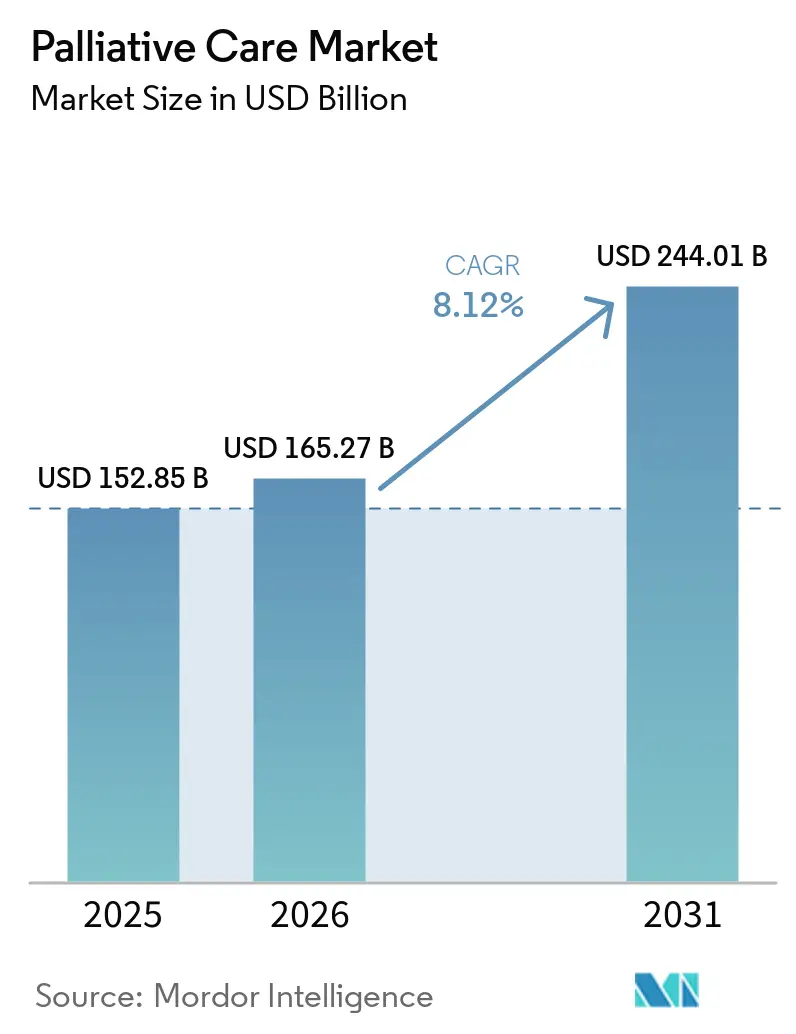
| Market Size (2026) | USD 165.27 Billion |
| Market Size (2031) | USD 244.01 Billion |
| Growth Rate (2026 - 2031) | 8.12 % |
| Fastest Growing Market | Asia-Pacific |
| Largest Market | North America |
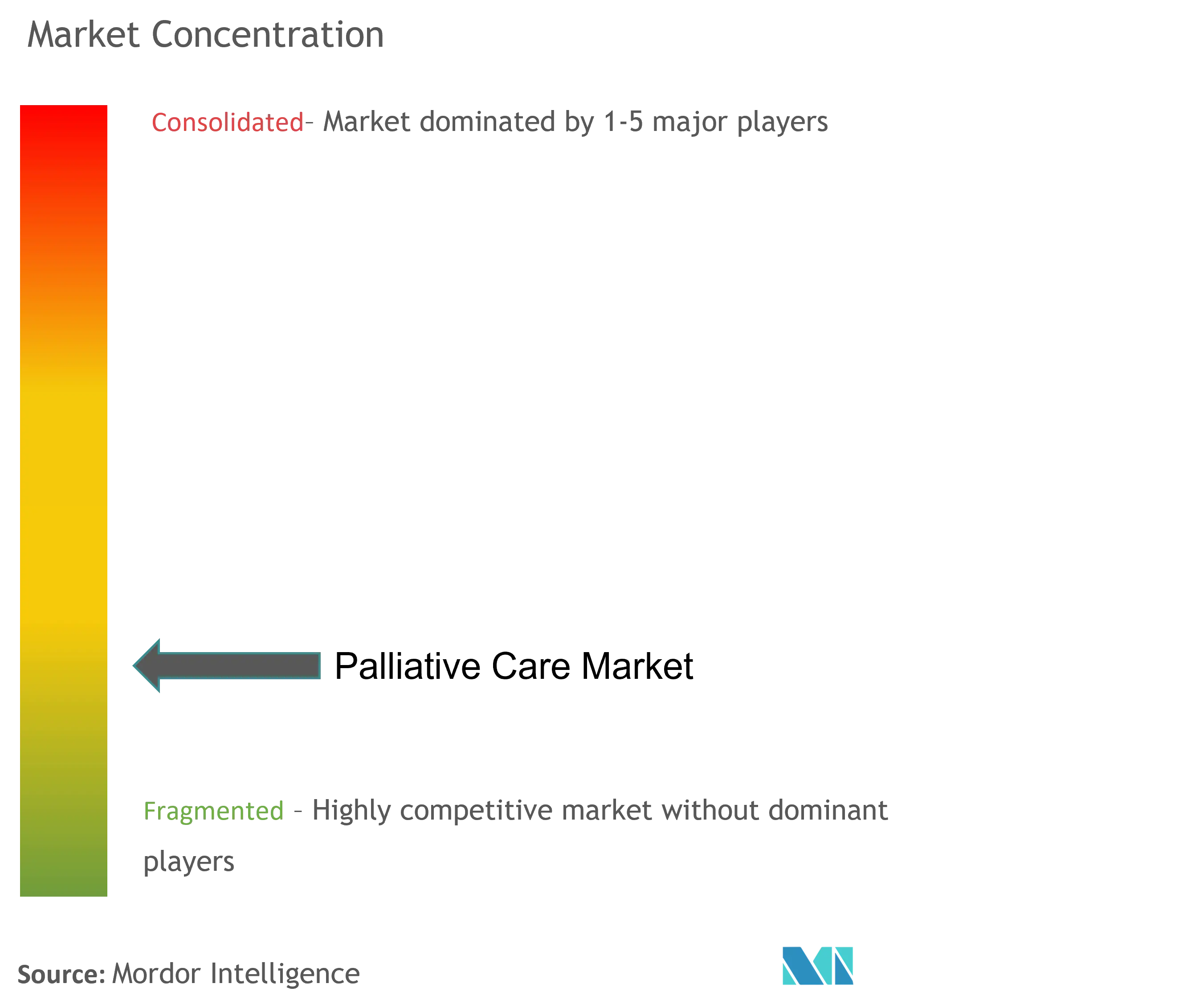
| Market Concentration | Medium |
Major Players *Disclaimer: Major Players sorted in no particular order Image © Mordor Intelligence. Reuse requires attribution under CC BY 4.0. | |
Palliative Care Market Analysis by Mordor Intelligence
palliative care market size in 2026 is estimated at USD 165.27 billion, growing from 2025 value of USD 152.85 billion with 2031 projections showing USD 244.01 billion, growing at 8.12% CAGR over 2026-2031. Growth reflects demographic aging, surging chronic-disease prevalence, and shifting care models that prioritise quality-of-life outcomes. Cost-saving evidence from the Medicare Care Choices Model, which cut per-person spending by 13% while achieving 83% hospice uptake, has moved payers and providers to treat palliative care as mainstream rather than end-of-life support. Technology adds momentum: AI-enabled early-referral tools raised consultation rates by 8.5% without increasing overall visit volumes. Consolidation among home health and hospice operators further amplifies scale efficiencies, while reimbursement updates reward value-based delivery. Workforce shortages and high multi-disciplinary programme costs in low-income regions remain headwinds.
Key Report Takeaways
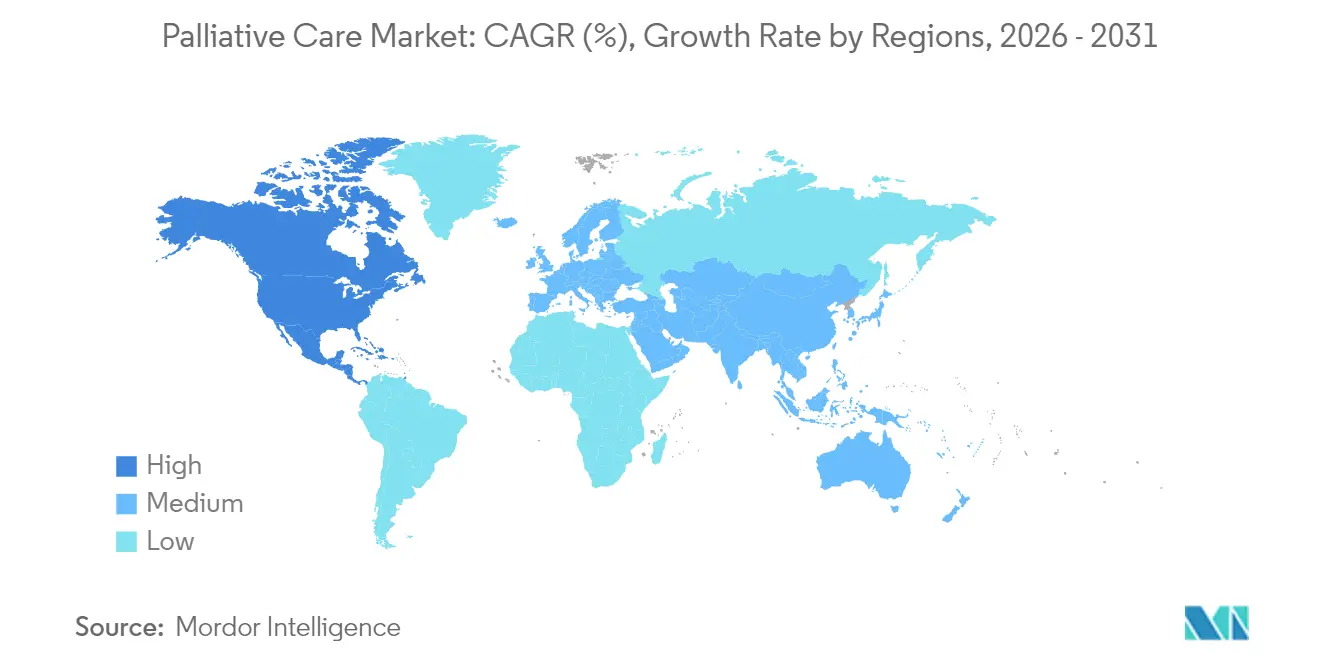
- By geography, North America led with 43.35% of the palliative care market share in 2025; Asia-Pacific is forecast to expand at an 10.98% CAGR to 2031.
- By provider, hospitals and clinics held 45.78% of the palliative care market size in 2025, while home health and hospice agencies are advancing at a 9.18% CAGR through 2031.
- By care setting, routine home care accounted for 55.05% of the palliative care market share in 2025; tele-palliative and virtual care is projected to grow at a 9.92% CAGR to 2031.
- By service type, pain and symptom management represented 31.92% of the palliative care market size in 2025, whereas psychosocial and spiritual support is progressing at a 9.05% CAGR through 2031.
- By application, cancer maintained 38.32% of the palliative care market share in 2025; dementia and neuro-degenerative disorders are poised to increase at a 9.49% CAGR through 2031.
- By age group, adults commanded 84.10% of the palliative care market size in 2025, while paediatric and adolescent services are set to rise at a 9.29% CAGR to 2031.
Note: Market size and forecast figures in this report are generated using Mordor Intelligence’s proprietary estimation framework, updated with the latest available data and insights as of 2026.
Market Trends and Insights
Drivers Impact Analysis of Palliative Care Market*
| Driver | (~ ) % Impact on CAGR Forecast | Geographic Relevance | Impact Timeline |
|---|---|---|---|
| Aging population & rising chronic disease | +2.1% | Global; highest in North America & Europe | Long term (≥ 4 years) |
| Expansion of hospice & palliative centres | +1.8% | North America & APAC core; spill-over to MEA | Medium term (2-4 years) |
| Favourable reimbursement & value-based care | +1.4% | North America & EU; early adoption in Australia | Short term (≤ 2 years) |
| Integration into accreditation & quality | +1.2% | Global; led by North American regulators | Medium term (2-4 years) |
| AI-enabled early-referral algorithms | +0.9% | North America & EU; pilots in APAC | Short term (≤ 2 years) |
| Employer-funded serious-illness benefits | +0.7% | North America; emerging in Europe | Long term (≥ 4 years) |
| Source: Mordor Intelligence | |||
Aging Population & Rising Chronic Disease Burden
Worldwide, 48 million people are expected to die each year with serious health-related suffering by 2060, most in low- and middle-income nations [1]Katherine Sleeman, “Future Global Need for Palliative Care,” BMJ, bmj.com. Cancer incidence among those aged ≥65 is forecast to rise 70% by 2030, deepening demand for complex symptom control. Chinese studies report home-hospice patients scoring 115.7 on composite need scales, underscoring social and spiritual support gaps. In Europe, only 0.3% of older adults in Slovenia versus 30.4% in France die under palliative care, reflecting uneven capacity. Machine-learning frailty models predict palliative eligibility in elderly COPD patients with 92% accuracy, enabling earlier intervention.
Expansion of Hospice & Palliative Care Centers
Large operators are scaling; VITAS is entering 12 new US states as part of a multi-year build-out. Western Sydney’s new hospital-based unit illustrates similar capacity building in Australia. In Colombia, 504 palliative-care services now provide 1.8 facilities per 100,000 residents for primary care, yet specialised coverage averages only 0.4 per 100,000, highlighting urban–rural gaps. Cameroon counts 21 mainly faith-based organisations, but limited morphine supply and policy voids inhibit reach. Accreditation reinforces quality: the Joint Commission’s certification programme formalises interdisciplinary standards for inpatient units [2]Advanced Certification in Palliative Care,” Joint Commission, jointcommission.org .
Favourable Reimbursement & Value-Based-Care Incentives
Hospice care payment rates climb 2.9% for fiscal-2025, adding USD 790 million to the payer pool. Each inpatient palliative consult reduces hospital costs by USD 1,310, a 13.6% saving that strengthens the business case. Home-health providers receive a 2.7% rate lift and recalibrated outlier payments in calendar-2025, supporting complex home-based cases. Alberta covers drugs, supplies and ambulances for registered palliative patients at no premium, showing provincial momentum. Quality reporting will tighten from October 2025 when the Hospice Outcomes and Patient Evaluation tool replaces legacy metrics.
Integration into Hospital Accreditation & Quality Metrics
The Joint Commission now measures pain screening, dyspnoea screening, goal-of-care discussions, and discharge documentation for certified programmes. Germany’s new specialist typology supports benchmarking across service models. Portugal identifies access inequity and coordination shortfalls, prompting indicator-based evaluations. In comparative audits, 20.5% of German nursing-home residents died in hospital versus 5.9% in the Netherlands, demonstrating metric impact on care location.
Restraints Impact Analysis of Palliative Care Market*
| Restraint | (~) % Impact on CAGR Forecast | Geographic Relevance | Impact Timeline |
|---|---|---|---|
| High cost of multidisciplinary programs in LMICs | -1.6% | Sub-Saharan Africa, Latin America, South Asia | Long term (≥ 4 years) |
| Shortage of certified palliative specialists | -1.3% | Global, acute in rural North America & APAC | Medium term (2-4 years) |
| Opioid-stewardship regulations limiting pain protocols | -1.0% | North America & EU, emerging in APAC regulatory frameworks | Short term (≤ 2 years) |
| Cultural taboos delaying pediatric enrollment | -0.8% | APAC, MEA, Latin America with traditional family structures | Long term (≥ 4 years) |
| Source: Mordor Intelligence | |||
High Cost of Multidisciplinary Programmes in LMICs
Cost-effectiveness studies show average monthly spend for home-based palliative care of USD 1,095 in the United States, USD 1,941 in Europe and USD 2,192 across Asian programmes, figures well beyond many low-income-country budgets. Zimbabwe’s need for cost-controlled home initiatives remains unmet despite compelling economic data. Latin American reviews cite accessibility, cultural perceptions and fragmented policy as persistent barriers. Training programmes for informal caregivers in Honduras were feasible but strained existing health budgets. A review of community-based models in Malawi, Uganda and Rwanda found evidence thin and funding unstable, limiting scalability.
Shortage of Certified Palliative Specialists
Healthcare executives rank workforce adequacy as their top 2025 risk, citing specialist scarcity. Pain-medicine fellowship applications have declined for five consecutive years, with widening gender disparity. In a US survey, 53.8% of advanced-practice nurses had five or fewer years’ palliative experience and 41% judged their formal education insufficient [3]Katherine Woltmann, “APRN Competencies,” Journal of Hospice & Palliative Nursing, journals.lww.com . Hybrid staffing models that pool social workers and chaplains between inpatient and home programmes are growing but remain resource constrained. The End-of-Life Nursing Education Consortium has trained 47,532 clinicians worldwide, yet demand continues to outpace supply. Rural communities lean on tele-health and expanded nursing scopes of practice, though cultural adaptation and paediatric cover remain obstacles.
*Our forecasts treat driver/restraint impacts as directional, not additive. The impact forecasts reflect baseline growth, mix effects, and variable interactions.
Palliative Care Market Segment Analysis
By Provider:
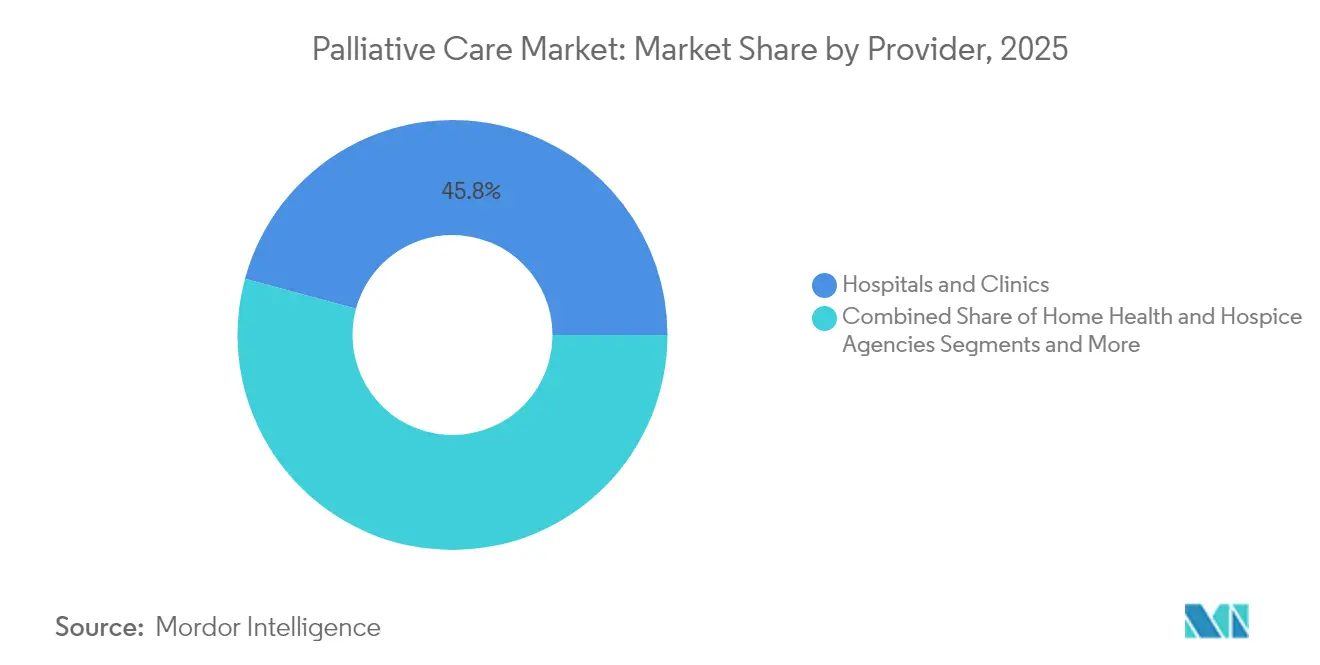
Hospitals Drive Volume While Home Agencies Capture GrowthHospitals and clinics accounted for 45.78% of the palliative care market share in 2025 by virtue of established referral pathways and inpatient consult teams. Their programmes reduce average hospital costs, improve patient satisfaction, and operate as feeder channels to hospice services. Integration of AI-driven referral alerts is sharpening patient selection, enhancing financial returns and care quality. Home health and hospice agencies, while currently smaller, are forecast to post a 9.18% CAGR to 2031 as payment reforms shift incentives toward community settings. The palliative care market size for home-based providers benefits directly from a 2.7% uplift in the US Home Health Prospective Payment System, boosting margins for complex home visits.
Hospitals are leveraging interdisciplinary models to stabilise high-acuity patients then transition them to lower-cost venues. Leading systems have documented one avoidable admission per 1,000 resident-years in partner nursing homes after deploying dedicated palliative care teams. Home agencies are diversifying through mergers: Optum’s USD 3.3 billion Amedisys deal consolidates capabilities across 522 care sites, giving the buyer scale in 37 states. Community and faith-based NGOs continue to fill gaps in low-resource regions, as evidenced by Cameroon’s 21 grass-roots organisations that extend essential services where state coverage remains thin.



By Care Setting:
Home Care Dominance Meets Virtual InnovationRoutine home care controlled 55.05% of the palliative care market in 2025, underscoring patient preference for familiar surroundings. Evidence shows each home-based plan of care can avert USD 10,000 annually in heart-failure costs by reducing hospitalisations. Tele-palliative and virtual visits represent the fastest-growing niche, with a projected 9.92% CAGR, as broadband penetration and remote-monitoring tools expand. Several large payers now reimburse video-based pain-management sessions at parity with in-office consultations, accelerating adoption.
In-patient settings remain crucial for complex symptom crises, yet many hospital teams now conduct an initial bedside evaluation then pivot to video follow-ups, minimising bed days. Out-patient clinics operate structured day programmes for infusion support and caregiver respite. Digital pilots such as Convoy-Pal have proven feasible among frail, multi-morbid seniors by combining asynchronous symptom tracking with scheduled nurse touchpoints. Wearable sensors tested in oncology wards successfully relayed continuous vital signs but require refinement in data fidelity before widespread roll-out.
By Service Type:
Pain Management Leadership Faces Holistic CompetitionPain and symptom control held 31.92% of the palliative care market share in 2025, rooted in WHO analgesic ladder guidelines. German hospice audits found 89% adherence to stepwise protocols using drugs such as hydromorphone and pregabalin. Yet demand for psychosocial and spiritual interventions is climbing at a 9.05% CAGR as families seek emotional and existential support alongside pharmacologic relief. The palliative care market size for counselling services benefits from bundled payment pilots that reward holistic outcomes.
New e-health apps deliver real-time coaching on breathwork, guided imagery and medication titration. Physiotherapy, particularly respiratory therapy and gentle massage, is frequently prescribed but hampered by staff shortages and limited session time. Conversational AI agents help triage uncomplicated cases, escalating complex issues to human teams. Culturally tailored practice manuals have emerged for Korean American and Filipino American patients, emphasising values-based goal setting and family inclusion, broadening the service mix beyond Western norms.
By Application:
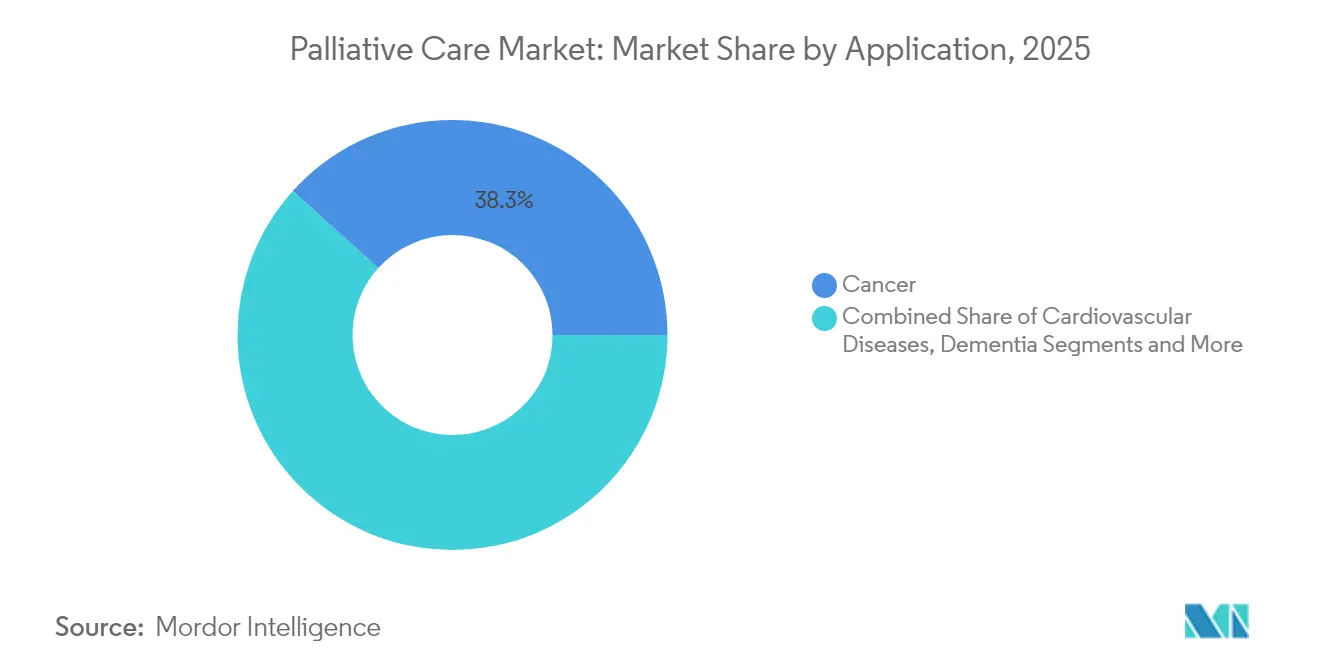
Cancer Dominance Challenged by Neurological GrowthCancer accounted for 38.32% of the palliative care market size in 2025, reflecting oncology’s early adoption of supportive care pathways. Predictive analytics within electronic health records now flag advanced cancer patients at risk of 12-month mortality with 0.861 AUROC, prompting earlier referrals and smoother transitions to hospice. Utilisation among metastatic breast-cancer cases climbed to 21% in 2024, though disparities persist for minority groups.
Dementia and other neuro-degenerative disorders are the fastest-rising application segment, set to grow 9.49% annually, driven by ageing populations and mounting caregiver burden. Japanese home-based studies show palliative sedation remains rare for non-cancer patients, suggesting under-served need. Chile projects overall palliative candidates will increase from 117,000 in 2021 to 209,000 by 2050, with non-cancer conditions driving the bulk of growth. Cardiovascular, respiratory, and renal failures follow closely, backed by evidence that palliative engagement is cost-neutral or cost-saving outside oncology as well.
By Age Group:
Adult Focus Shifts Toward Pediatric InnovationAdults represented 84.10% of the palliative care market share in 2025, consistent with chronic-disease prevalence in older cohorts. However, paediatric and adolescent services are advancing at a 9.29% CAGR as hospitals recognise unmet needs. Neonatal registries in Latin America cite trisomy 21 and complex congenital heart disease as leading diagnoses among infants receiving specialised palliation.
Early advance-care planning discussions improve alignment with family goals, yet cultural norms often delay conversations. Technology for home-based paediatric support raises questions of privacy, equitable access and role shifts within families. A four-theme model—child condition, service availability, parental capacity and overall family wellbeing—guides place-of-death decisions. Barriers to paediatric pain control include provider knowledge gaps and organisational inertia, while facilitators range from simulation training to family engagement and medication-delivery innovations.
Geography Analysis
North America Palliative Care Market
North America commanded 43.35% of the palliative care market in 2025, propelled by Medicare coverage, extensive hospital consult services and active private-equity investment. US policy incentives such as a 2.9% hospice payment increase and quality-measure reporting strengthen financial sustainability. Canada’s provincial drug-and-transport coverage enhances cross-setting continuity, while employer-funded serious-illness benefits broaden access in commercial insurance lines. The palliative care market size for North America is further enlarged by consolidation, as large payers integrate home-health subsidiaries into coordinated networks.
Europe Palliative Care Market
Europe shows mature yet heterogeneous uptake. France records 30.4% of older adults receiving palliative services at end of life, whereas Slovenia remains at 0.3%. Germany’s typology project supports national benchmarking, and the Netherlands demonstrates low hospital-death rates after robust integration of home-based palliation. The European market’s steady 5.74% CAGR reflects alignment of accreditation standards, though specialist shortages in rural regions temper pace. Cross-border datasets fuel research and inform EU-level workforce planning initiatives.
APAC and Oceania Palliative Care Market
Asia-Pacific is the fastest-expanding territory, expected to grow 10.98% through 2031 as demographic ageing accelerates and governments invest in hospice infrastructure. Japan refines non-cancer sedation protocols, while China pilots home-based models despite regulatory and cultural friction over family decision-making. Australia’s Western Sydney build-out exemplifies regional capital spend, and the Asia Pacific Hospice Palliative Care Network coordinates training and knowledge exchange. Market penetration remains uneven, especially in South-East Asia’s rural areas, but tele-health and NGO partnerships narrow some gaps.
LATAM Palliative Care Market
Latin America is at an inflection point. Colombia now offers 1.8 primary palliative services per 100,000 residents yet struggles with geographic inequity; Amazonia and Orinoquia regions remain under-served. Chile projects doubling of serious-illness cases by 2050, and Brazil is rolling out national guidelines aimed at peri-urban clinics. Payment models remain largely fee-for-service, although Peru and Argentina are piloting bundled reimbursements tied to symptom-control metrics.
MEA Palliative Care Market
The Middle East and Africa face resource constraints. South Africa’s hospice network is sizeable but financing relies heavily on charitable donations. Zimbabwe evaluates cost-per-suffering-day averted, but scale-up is limited by drug availability. Nigeria and Kenya experiment with community-health-worker-led approaches, supported by international NGOs. Tele-palliative care via mobile platforms shows promise in remote desert and savannah regions, though connectivity and power stability issues persist.

Regulatory Landscape
Regulation is increasingly focused on expanding access beyond hospice while tightening quality measurement and controlled-medicine governance. In the United States, the Centers for Medicare & Medicaid Services (CMS) issued an April 2026 proposed rule (FY 2027 hospice updates) seeking input on expanding community-based palliative care and updating hospice quality reporting expectations, reinforcing the shift toward measurable outcomes and reporting infrastructure.
Global policy alignment is also strengthening. In September 2025, the World Health Organization (WHO) issued national policy guidance to help Member States balance opioid stewardship with equitable access to controlled medicines used in palliative pain management. The ATLANTES Global Observatory launched a 2025 global ranking using the WHO "house of palliative care" framework (14 indicators), pushing governments and providers toward comparable benchmarks. Ethiopia's Ministry of Health advanced a national palliative care strategic plan (2025-2029), supporting integration into national health agendas and essential medicine access priorities.
Value Chain Analysis
The palliative care value chain starts with patient identification and referral (primary care, oncology, cardiology, neurology, hospitals, and nursing facilities), followed by interdisciplinary assessment and care planning, and then delivery across inpatient consults, outpatient/day-care clinics, routine home care, and tele-palliative services. Key inputs include specialist labor (physicians, nurses, social workers, chaplains, therapists), access to essential medicines such as opioids (morphine and hydromorphone), and enabling infrastructure like EHRs, care coordination platforms, and remote-monitoring tools that support transitions from hospital to home.
Bottlenecks tend to cluster around workforce scarcity and medicine availability and distribution. Sector evidence points to fragile supply for low-margin essential pain medicines and recurring shortages, prompting efforts such as Palliative Care Australia's 2025 "11 Point Plan" for national medicine stockpiles, stronger domestic manufacturing, and regulatory mechanisms to stabilize access, including TGA-supported pathways. Downstream, payers and program operators act as the monetization gate, with reimbursement and quality-reporting requirements shaping documentation workflows, technology adoption, and partner selection across home health, hospice, pharmacies, and community providers.
Competitive Landscape
The palliative care market is moderately fragmented, yet consolidation is accelerating. UnitedHealth’s USD 3.3 billion acquisition of Amedisys places Optum at the vanguard of integrated home health and hospice services, reshaping competitive boundaries. Gentiva’s purchase of ProMedica’s home-health unit for USD 710 million signals continued private-equity interest in scale assets. Publicly reported quality scores show not-for-profit hospices outperforming for-profit and private-equity-backed peers, a reputational lever in hospital referral contracts.
Technology adoption is a key differentiator. Systems implementing AI-based referral algorithms reported an 8.5% increase in consults without raising staffing levels, enhancing return on investment. Start-ups in symptom-tracking, pain-app management and virtual support secure contracts with payers seeking outcome-based payment models. Established players partner with technology vendors to integrate wearables and remote monitoring into care pathways.
Regulatory compliance shapes risk profiles. Gentiva’s USD 19.4 million False Claims Act settlement underscores the cost of documentation lapses. Certified programmes must now meet Joint Commission metrics, prompting investment in data platforms capable of automated reporting. White-space remains in paediatric services, rural outreach and low-income-country expansion, where first movers can lock in referral relationships and build local brand equity.
Palliative Care Industry Leaders
Genesis Healthcare Corporation
VITAS Healthcare
Sunrise Senior Living LLC (Revera)
Amedisys
Lifepoint Health, Inc (Kindred Healthcare)
- *Disclaimer: Major Players sorted in no particular order
Palliative Care Market Companies Covered in this Report
- Amedisys Inc.
- Chemed Corp. (VITAS Healthcare)
- AccentCare Inc.
- LHC Group
- Genesis HealthCare
- Honor Technology Inc. (Honor Hospice)
- ProMedica Health System
- Enhabit Home Health & Hospice
- Seasons Hospice & Palliative Care
- Kindred at Home (Humana)
- Crossroads Hospice & Palliative Care
- Cornerstone Hospice & Palliative Care
- Blue Ridge Hospice
- Hospice of the Valley
- Cipla Palliative Care & Training Centre
- Seymour Health
- Lifepoint Health
- Medio Home Health & Hospice
- Care Hospice
- NHPCO (industry association profile)

Market Opportunities and Future Outlook
Community-based palliative care integration stands out as a whitespace where reimbursement design, staffing standards, and measurable outcomes can broaden utilization beyond traditional hospice pathways. In the United States, development work led by the National Partnership for Healthcare and Hospice Innovation (NPHI) with C-TAC in May 2026 toward a federal fee-for-service community-based palliative care model points to momentum for standardized quality and cost measurement that can be operationalized by health systems, home health and hospice agencies, and technology partners. Parallel state activity also offers an implementation reference, including Hawaii operating a Community Palliative Care benefit under a Section 1115 Medicaid Demonstration waiver (reported in 2026), with implications for eligibility criteria and interdisciplinary staffing models.
Digitally enabled early identification and hospital-to-home transitions are another high-impact deployment area for providers constrained by specialist capacity and documentation demands. Evidence from a February 2026 meta-analysis on EHR-embedded automated decision support linked such tools to increased palliative consults and advance care planning, supporting investment in workflow-integrated capabilities rather than stand-alone point solutions. Capacity-building opportunities also remain relevant across emerging markets and under-served urban-rural corridors, for example through the May 2026 inauguration of a palliative care unit at K.C. General Hospital in Bengaluru (in collaboration with Saranam India), which bundles inpatient, outpatient, day-care, and home-based mobile services in a single service line.
Recent Industry Developments in Palliative Care Market
- June 2026: Lifepoint Health completed its acquisition of eight community hospitals from ScionHealth. The deal expands Lifepoint's footprint across multiple US states and can broaden downstream referral networks into serious-illness and end-of-life service lines supported by hospital discharge planning.
- March 2026: VITAS Healthcare opened a new inpatient hospice center at Oak Manor in Largo, Florida, adding around-the-clock clinical support capacity in Pinellas County. The opening strengthens inpatient access for complex symptom crises and supports continuity with VITAS home hospice operations in the region.
- March 2024: VITAS Healthcare announced an agreement to buy hospice assets of Covenant Care in Florida and Alabama. The transaction expands VITAS's regional presence and adds scale in markets where payer contracting and hospital referral relationships drive provider growth.


Palliative Care Market Report Scope and Research Methodology
Market Definition and Coverage
In this methodology, the palliative care market covers paid services that aim to improve quality of life for people with serious illness, including symptom relief, care coordination, and psychosocial support delivered across formal care settings.
Scope exclusions: We exclude informal unpaid caregiving, non-clinical community support provided fully by volunteers, and any bereavement or funeral services sold as standalone offerings.
Segments Covered in This Report
- By Provider
- Hospitals & Clinics
- Nursing Homes & Skilled-Nursing Facilities
- Rehabilitation & Long-Term Care Centers
- Home Health & Hospice Agencies
- Community & NGO-run Centers
- By Care Setting
- In-patient Hospital
- Routine Home Care
- Out-patient / Day-care Clinics
- Tele-palliative / Virtual Care
- By Service Type
- Pain & Symptom Management
- Psychosocial & Spiritual Support
- Care Coordination & Case Management
- Bereavement & Family Support
- By Application
- Cancer
- Cardiovascular Diseases
- Chronic Respiratory Diseases (COPD, etc.)
- Dementia & Neuro-degenerative Disorders
- Renal & Hepatic Failure
- Other Life-limiting Conditions
- By Age Group
- Adult
- Pediatric & Adolescent
- By Geography
- North America
- United States
- Canada
- Mexico
- Europe
- Germany
- United Kingdom
- France
- Italy
- Spain
- Rest of Europe
- Asia-Pacific
- China
- Japan
- India
- Australia
- South Korea
- Rest of Asia-Pacific
- Middle East & Africa
- GCC
- South Africa
- Rest of Middle East & Africa
- South America
- Brazil
- Argentina
- Rest of South America
- North America
Data Sources, Market Sizing, and Validation
Desk Research
Desk research starts by mapping where palliative care is delivered and paid for, and then aligning that picture with observable health system indicators. We rely on public sources such as the World Health Organization, the World Bank, the OECD, and the United Nations population statistics to anchor demographics, disease burden, and health spend context.
To keep assumptions realistic, we also review sources such as national health agencies and health ministries, payer and reimbursement guidance that is publicly available, and peer reviewed clinical and health economics literature on utilization patterns. Company filings, annual reports, investor presentations, and reputable healthcare press are used to understand service mix shifts, for example movement toward home-based programs and telehealth-supported care. In addition, we use a paid subscription database for company financials and another for patent and innovation signals when product and care delivery enablers need to be validated. These desk sources are illustrative and not exhaustive, and many other references are used to cross-check, clarify, and validate data points during the research process.
Primary Interviews and Surveys
Primary interviews and surveys are used to test what desk research cannot confirm cleanly, especially care setting mix, typical care intensity, and how programs are funded in different systems. We spoke with a spread of providers, administrators, clinicians, and payer-side stakeholders across major regions so that utilization and pricing assumptions reflect on-the-ground practice rather than only published averages.
Distribution of primary research fieldwork respondents
| Company type | Respondent position | Region |
|---|---|---|
| Top tier: 26% | CXOs: 13% | APAC: 49% |
| Mid tier: 60% | Functional/Unit leaders: 38% | EMEA: 29% |
| Smaller Players: 14% | Managers: 49% | Americas: 22% |
Market-Sizing & Forecasting
The core model uses a top-down approach where health expenditure, eligible patient pools, and care delivery penetration rates are used to reconstruct the paid demand for palliative services by region, and then rolled up to a global value. To keep the totals grounded, we corroborate results with selective bottom-up approximations such as sampled provider revenue benchmarks, typical caseload per program, and a reasonableness check using average cost per patient episode in key care settings.
Inputs that matter most include aging population levels, prevalence of serious chronic conditions that commonly trigger palliative involvement, share of patients receiving home-based services versus facility-based services, reimbursement coverage direction, including telehealth reimbursement signals where applicable, and staffing availability that limits capacity in some markets. Where data is missing for smaller countries or niche settings, gaps are filled through proxy ratios from comparable health systems, followed by adjustments from expert feedback.
For forecasting, scenario analysis is used so adoption of palliative pathways, home-based care expansion, and policy-led reimbursement changes can be reflected without forcing one single trend line. The scenarios are kept practical, then the final forecast is selected based on where primary respondents show the strongest consensus on utilization growth and pricing movement.
Data Validation & Update Cycle
Validation is done through repeated cross-checks between model outputs and independent signals such as health spend direction, reported utilization trends by setting, and observed program expansion patterns. When a country or segment shows an unusual jump, we re-check the input series, revisit conversion assumptions, and re-contact relevant primary sources to confirm whether a real market event explains the change.
Before sign-off, the model goes through multi-step analyst reviews so arithmetic, logic, and scope alignment issues are caught early. Reports are refreshed annually, and interim updates are triggered if a material policy or reimbursement change is seen that can move near-term adoption. Right before delivery, we do a final pass to ensure the latest publicly available data and the most recent interview learnings are reflected.
Mordor Intelligence's Palliative Care Market Size Measured Against Other Published Estimates
Published market size numbers for palliative care can look far apart because the service scope is not described the same way across sources, and payment flows are not always counted consistently. Differences usually come from what gets included as palliative care, for example hospice-only views versus broader symptom management programs, which care settings are counted, and the year and currency timing used for conversion.
Some estimates stay narrow by focusing on hospice programs or only one care site, and others present a wider number by blending adjacent services that are not always billed or tracked as palliative care. In Mordor Intelligence's model, value is counted only when services are delivered through formal provider settings and linked to reimbursed or paid care delivery, which keeps tele-palliative visits included when they are billed, but excludes unpaid informal care and standalone bereavement offerings.
Benchmark comparison
| Source | Market Size | Gaps in Research Methodology |
|---|---|---|
| Mordor Intelligence | USD 165.27 B (2026) | |
| Industry Outlook Publisher A | USD 13.48 B (2024) | Uses a much smaller captured spend pool and appears to reflect a narrower revenue definition, which can undercount facility-based programs and reimbursed multidisciplinary care delivered outside labeled hospice lines. |
| Industry Report Publisher B | USD 21.60 B (2025) | Uses an adjacent category label (palliative services) with different forecast framing and payer capture, and the published total does not clearly show how setting mix and telemedicine billing are treated year to year. |
The spread is mainly explained by what each publisher counts as paid palliative activity and how consistently care settings are captured in the revenue pool. By tying the calculation to observable demand indicators, checked pricing assumptions, and repeatable inclusion rules, the final number stays traceable and easier for decision-makers to reconcile across regions.


Key Questions Answered in the Report
What is the current Palliative Care Market size?
The palliative care market is valued at USD 165.27 billion in 2026 with an 8.12% growth trajectory to 2031.
Who are the key players in Palliative Care Market?
Genesis Healthcare Corporation, VITAS Healthcare, Sunrise Senior Living LLC (Revera), Amedisys and Lifepoint Health, Inc (Kindred Healthcare) are the major companies operating in the Palliative Care Market.
Which is the fastest growing region in Palliative Care Market?
Asia-Pacific is estimated to grow at the highest CAGR over the forecast period (2026-2031).
Which region has the biggest share in Palliative Care Market?
North America holds 43.35% of global revenue, driven by Medicare reimbursement and mature hospital consult programmes.
What is the main barrier to palliative care expansion in low-income countries?
High costs of multidisciplinary teams and limited drug availability hinder scale-up, reducing service penetration despite rising disease burden.
Page last updated on:


 Your data is secure and never sold or shared.


