
North America Wheat Market Analysis by Mordor Intelligence
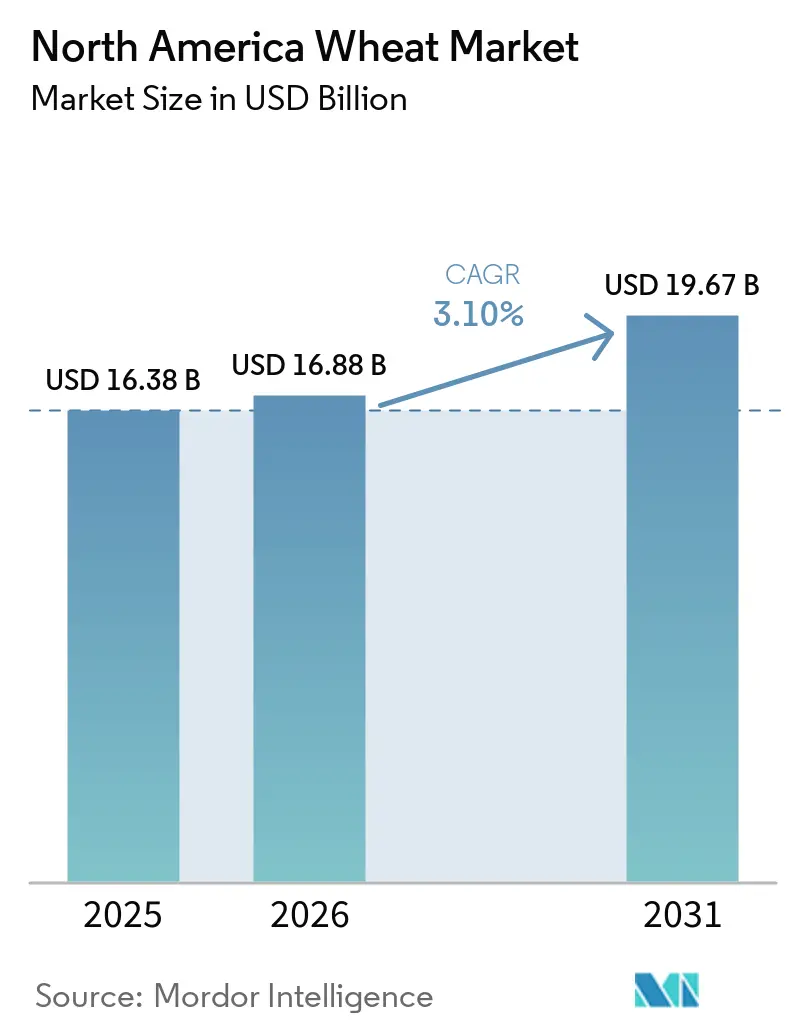
The North America wheat market size is projected to grow from USD 16.38 billion in 2025 to USD 16.88 billion in 2026, reaching USD 19.67 billion by 2031, with a CAGR of 3.1% during 2026-2031. The market is supported by the growing adoption of regenerative agriculture, steady demand from packaged-food manufacturers, and technological advancements that enhance efficiency. These factors help mitigate challenges such as recurring droughts, rail congestion, and the reallocation of acreage to oilseeds. Export competitiveness relies on resolving Gulf rail bottlenecks and fostering varietal innovation. Domestically, consumption trends are mixed, with rising sales of premium bakery products offset by the increasing popularity of low-carb diets. Government initiatives, including the United States Department of Agriculture’s Climate-Smart Commodities program in 2024, provide support to wheat growers through funding for sustainable farming practices, soil carbon sequestration, and climate-resilient crop production. Additionally, increasing renewable diesel mandates are intensifying land competition with soybeans and canola, further tightening wheat supply and maintaining price levels.
Key Report Takeaways
By geography, the United States led with the largest 64% of the North America wheat market share in 2025, while Mexico market size is projected to grow at the fastest CAGR at 5.4% from 2026 to 2031.
Note: Market size and forecast figures in this report are generated using Mordor Intelligence’s proprietary estimation framework, updated with the latest available data and insights as of January 2026.
Market Trends and Insights
Drivers Impact Analysis of North America Wheat Market*
| Driver | (~) % Impact on CAGR Forecast | Geographic Relevance | Impact Timeline |
|---|---|---|---|
| Strong demand for diverse wheat in packaged foods | +0.6% | United States, Canada, and Mexico | Medium term (2-4 years) |
| Expansion of regenerative agriculture supported by government programs | +0.5% | United States and Canada | Long term (≥ 4 years) |
| Adoption of precision farming technologies | +0.4% | United States and Canada | Medium term (2-4 years) |
| Rising bioethanol mandates | +0.3% | United States | Short term (≤ 2 years) |
| Growth of premium and organic bakery products | +0.4% | United States and Canada | Medium term (2-4 years) |
| Re-shoring of animal feed milling capacity | +0.3% | United States and Mexico | Long term (≥ 4 years) |
| Source: Mordor Intelligence | |||
Strong Demand for Diverse Wheat in Packaged Foods
Packaged food manufacturers in North America are increasingly utilizing multiple wheat classes to optimize protein content, texture, and shelf stability for bakery, snack, and pasta products. According to the United States Department of Agriculture Economic Research Service, per capita wheat flour consumption in the United States is projected to reach 128.9 pounds in 2024, slightly higher (0.5%) than the previous year, indicating sustained demand in processed and packaged food categories [1]. This growing demand is driving the need for identity-preserved sourcing and specialty wheat streams, as processors focus on ensuring consistent functional characteristics. Continued innovation in tortillas, baked goods, and ready-to-eat foods supports the stable use of diverse wheat varieties across North America.
Expansion of Regenerative Agriculture Supported by Government Programs
Expansion of regenerative agriculture programs is supporting sustainable wheat production across North America. According to the United States Department of Agriculture’s September 2024 Partnerships for Climate-Smart Commodities progress report, the initiative continues to support the adoption of climate-smart farming practices, such as reduced tillage, cover cropping, and soil carbon management, across major agricultural regions. Wheat growers participating in these projects are increasingly adopting regenerative practices to improve soil moisture retention, enhance resilience to drought, and strengthen long-term productivity [2]. These sustainability-focused farming initiatives are also supporting access to premium grain procurement programs and lower-carbon agricultural supply chains across the North American wheat industry.
Adoption of Precision Farming Technologies
Precision agriculture technologies are increasingly being adopted to improve wheat productivity and input efficiency in North America. According to the United States Government Accountability Office's 2024 report on precision agriculture, farmers are increasingly adopting data-driven farming methods that leverage satellite imagery, sensors, and artificial intelligence [3]. These technologies enable optimized fertilizer application, yield forecasting, and resource management in large-scale wheat-producing areas. Additionally, precision agriculture tools enhance operational efficiency, minimize input waste, and help farmers address weather-related risks, thereby promoting sustainable wheat production practices across the region.
Rising Bioethanol Mandates
According to the United States Environmental Protection Agency, proposed Renewable Fuel Standard requirements increase total renewable fuel blending volumes from 22.33 billion gallons in 2025 to 24.02 billion gallons in 2026 and 24.46 billion gallons in 2027. Rising renewable fuel mandates continue encouraging higher corn and oilseed cultivation for ethanol and renewable diesel production across North America. This cross-commodity acreage competition can tighten wheat planting availability, supporting wheat prices and encouraging producers to invest in productivity-enhancing technologies and efficient farm management practices across major wheat-producing regions.
Restraints Impact Analysis of North America Wheat Market*
| Restraint | (~) % Impact on CAGR Forecast | Geographic Relevance | Impact Timeline |
|---|---|---|---|
| Frequent heat and drought reducing yield stability | -0.7% | United States, Canada, and Mexico | Short term (≤ 2 years) |
| Shift toward higher-margin oilseeds | -0.5% | United States and Canada | Medium term (2-4 years) |
| Rail freight bottlenecks to Gulf export routes | -0.3% | United States and Canada | Short term (≤ 2 years) |
| Rising low-carb diets reducing wheat consumption | -0.2% | United States and Canada | Long term (≥ 4 years) |
| Source: Mordor Intelligence | |||
Frequent Heat and Drought Reducing Yield Stability
Climate variability poses ongoing challenges to wheat yield stability in North America, with increasing heatwaves and prolonged droughts adversely affecting crop development and harvest reliability. These environmental stresses disrupt key growth stages, reducing productivity and heightening uncertainty for wheat producers. According to the United States Department of Agriculture, as of April 2025, approximately 32% of United States winter wheat production was affected by drought conditions, underscoring the persistent impact of adverse weather on wheat-growing regions. Rising production risks and uncertainty surrounding harvest outcomes continue to influence planting decisions, restricting stable supply growth and contributing to volatility in the North America wheat market.
Shift Toward Higher-Margin Oilseeds
Farmers in North America are increasingly dedicating more acreage to higher-margin oilseed crops due to greater profitability and rising processing demand, which is constraining the long-term growth potential of wheat production. Statistics Canada projects that the canola-seeded area in Canada will grow by 1% from 2025 to 21.8 million acres in 2026. The expansion of oilseed cultivation is reducing the relative appeal of wheat farming in regions with flexible crop rotation systems, thereby tightening wheat supply conditions across North America.
*Our forecasts treat driver/restraint impacts as directional, not additive. The impact forecasts reflect baseline growth, mix effects, and variable interactions.
Geography Analysis
United States Wheat Market
The United States led the North America wheat market with a 64% share in 2025, due to its extensive acreage, advanced farming systems, and established export infrastructure. Strong domestic demand from food processing industries drives wheat utilization across bakery, snack, and foodservice segments. Productivity gains are bolstered by the widespread adoption of precision agriculture practices, such as satellite monitoring and variable-rate inputs. Export competitiveness is significantly influenced by logistics efficiency, particularly rail transport to Gulf ports. Market performance is increasingly determined by yield improvements rather than acreage expansion, as farmers focus on optimizing output within land and cost constraints.
Canada Wheat Market
Canada plays a critical role in high-protein wheat exports, supported by favorable climatic conditions and strong international demand. The country benefits from established trade routes to Asia and Europe, as well as efficient bulk-handling systems at major ports. Investments in grain handling infrastructure and milling capacity enhance value-added processing alongside raw exports. Farmers continue to balance wheat cultivation with alternative crops, such as canola, which offer competitive returns. Transportation efficiency, particularly the reliability of rail services, remains vital for maintaining export competitiveness and ensuring timely delivery to global buyers.
Mexico Wheat Market
Mexico is projected to grow at a CAGR of 5.4% from 2026 to 2031 in the North America wheat market, the fastest rate in the region. This growth is attributed to the expansion of the food processing sector and increasing wheat consumption in the country. According to the Food and Agriculture Organization, Mexico imported 4,277,847 metric tons of wheat in 2024, reflecting a strong reliance on external supply [4]. Domestic production is constrained by water availability and climatic variability, leading to greater dependence on imports from the United States and Canada. Investments in milling modernization and processing efficiency continue to support demand growth.
Competitive Landscape
The wheat market in North America operates within a structured competitive environment encompassing farming, trading, and processing segments. Large agribusiness firms integrate sourcing, storage, and distribution processes to ensure consistent supply and cost efficiency. Companies such as Archer Daniels Midland Company and Cargill Inc. utilize their scale to secure procurement channels and manage extensive logistics networks. Milling companies prioritize the production of specialized flours tailored to the needs of food manufacturers, adhering to strict quality and traceability standards required by both commercial buyers and export markets.
Mid-sized firms and cooperatives compete by offering flexibility and focusing on niche product differentiation. These entities emphasize identity-preserved wheat, non-genetically modified organism (non-GMO) certification, and specialty grains catering to artisanal and premium food segments. Strategic investments in processing capabilities enable the production of customized flour blends and value-added products. Partnerships with regional growers enhance supply chain transparency and reliability. Competitive positioning increasingly hinges on the ability to respond to evolving consumer preferences, particularly in health-focused and clean-label food applications for both domestic and export markets.
Innovation in seed technology and sustainable practices continues to shape competitive dynamics in the North America wheat market. Companies are investing in advanced wheat varieties with improved yield stability and functional properties suited for food processing. Sustainability initiatives, such as regenerative agriculture and carbon tracking, are becoming critical factors in supplier selection. While smaller firms focus on specialized market segments, larger players leverage technology and scale to maintain operational efficiency. The competitive landscape is increasingly defined by the integration of innovation, sustainability, and operational excellence throughout the supply chain.
Recent Industry Developments in North America Wheat Market
- January 2026: Golden Waves Grain has announced plans for a USD 200 million integrated wheat milling and bakery campus in Kansas. This project will encompass grain processing, flour milling, and the production of finished baked goods, aiming to strengthen regional supply chains and improve the value-added utilization of wheat in the United States.
- July 2025: Bunge North America Inc. has finalized its merger with Viterra Limited, creating a larger, integrated agribusiness. This merger enhances the company's grain origination, storage, merchandising, and export capabilities across key wheat-producing regions, including the United States and Canada. The transaction strengthens Bunge's wheat supply chain and enhances access to major global grain export markets.
- September 2024: P&H Milling Group, a division of Parrish & Heimbecker, announced plans to construct a USD 241 million wheat flour milling facility in Red Deer County, Alberta. The facility is likely to process approximately 750 metric tons of wheat per day, utilizing advanced milling technology and logistics infrastructure.
North America Wheat Market Report Scope
Wheat is a cereal grain grown globally and is among the most significant staple crops for human consumption. It is mainly used to produce flour for bread, pasta, noodles, and various other food products. Wheat is valued for its high carbohydrate content and functional properties, particularly gluten, which provides structure and elasticity to baked goods. The North America wheat market is segmented by country (United States, Canada, and Mexico). The report includes production analysis (volume), consumption analysis (value and volume), import analysis (value and volume), export analysis (value and volume), wholesale price trend analysis and forecast, a list of key players, logistics and infrastructure, and seasonality analysis. The market forecasts are provided in terms of value (USD) and volume (metric tons).
Segmentation Overview
By Geography
| North America | United States | Production Analysis (Area Harvested, Yield, and Production Volume) |
| Consumption Analysis (Consumption Value and Volume) | ||
| Import Market Analysis (Import Value, Volume, and Key Supplying Markets) | ||
| Export Market Analysis (Export Value, Volume, and Key Destination Markets) | ||
| Wholesale Price Trend Analysis and Forecast | ||
| Regulatory Framework | ||
| List of Key Players | ||
| Logistics and Infrastructure | ||
| Seasonality Analysis | ||
| Canada | Production Analysis (Area Harvested, Yield, and Production Volume) | |
| Consumption Analysis (Consumption Value and Volume) | ||
| Import Market Analysis (Import Value, Volume, and Key Supplying Markets) | ||
| Export Market Analysis (Export Value, Volume, and Key Destination Markets) | ||
| Wholesale Price Trend Analysis and Forecast | ||
| Regulatory Framework | ||
| List of Key Players | ||
| Logistics and Infrastructure | ||
| Seasonality Analysis | ||
| Mexico | Production Analysis (Area Harvested, Yield, and Production Volume) | |
| Consumption Analysis (Consumption Value and Volume) | ||
| Import Market Analysis (Import Value, Volume, and Key Supplying Markets) | ||
| Export Market Analysis (Export Value, Volume, and Key Destination Markets) | ||
| Wholesale Price Trend Analysis and Forecast | ||
| Regulatory Framework | ||
| List of Key Players | ||
| Logistics and Infrastructure | ||
| Seasonality Analysis | ||
| By Geography | North America | United States | Production Analysis (Area Harvested, Yield, and Production Volume) |
| Consumption Analysis (Consumption Value and Volume) | |||
| Import Market Analysis (Import Value, Volume, and Key Supplying Markets) | |||
| Export Market Analysis (Export Value, Volume, and Key Destination Markets) | |||
| Wholesale Price Trend Analysis and Forecast | |||
| Regulatory Framework | |||
| List of Key Players | |||
| Logistics and Infrastructure | |||
| Seasonality Analysis | |||
| Canada | Production Analysis (Area Harvested, Yield, and Production Volume) | ||
| Consumption Analysis (Consumption Value and Volume) | |||
| Import Market Analysis (Import Value, Volume, and Key Supplying Markets) | |||
| Export Market Analysis (Export Value, Volume, and Key Destination Markets) | |||
| Wholesale Price Trend Analysis and Forecast | |||
| Regulatory Framework | |||
| List of Key Players | |||
| Logistics and Infrastructure | |||
| Seasonality Analysis | |||
| Mexico | Production Analysis (Area Harvested, Yield, and Production Volume) | ||
| Consumption Analysis (Consumption Value and Volume) | |||
| Import Market Analysis (Import Value, Volume, and Key Supplying Markets) | |||
| Export Market Analysis (Export Value, Volume, and Key Destination Markets) | |||
| Wholesale Price Trend Analysis and Forecast | |||
| Regulatory Framework | |||
| List of Key Players | |||
| Logistics and Infrastructure | |||
| Seasonality Analysis | |||
Key Questions Answered in the Report
How large is the North America wheat market in 2026?
The North America wheat market size stands at USD 16.88 billion in 2026.
What is the projected CAGR for North America wheat between 2026 and 2031?
The market is forecast to grow at the fastest 3.1% CAGR over the 2026-2031 period.
Which country drives most production in North America?
The United States contributes the largest 64% of regional value in 2025, anchoring production and export flows.
Why is wheat acreage declining in the United States and Canada?
Renewable diesel incentives make soybeans and canola more profitable, shifting land away from wheat.