
Paraguay Grain Market Analysis by Mordor Intelligence
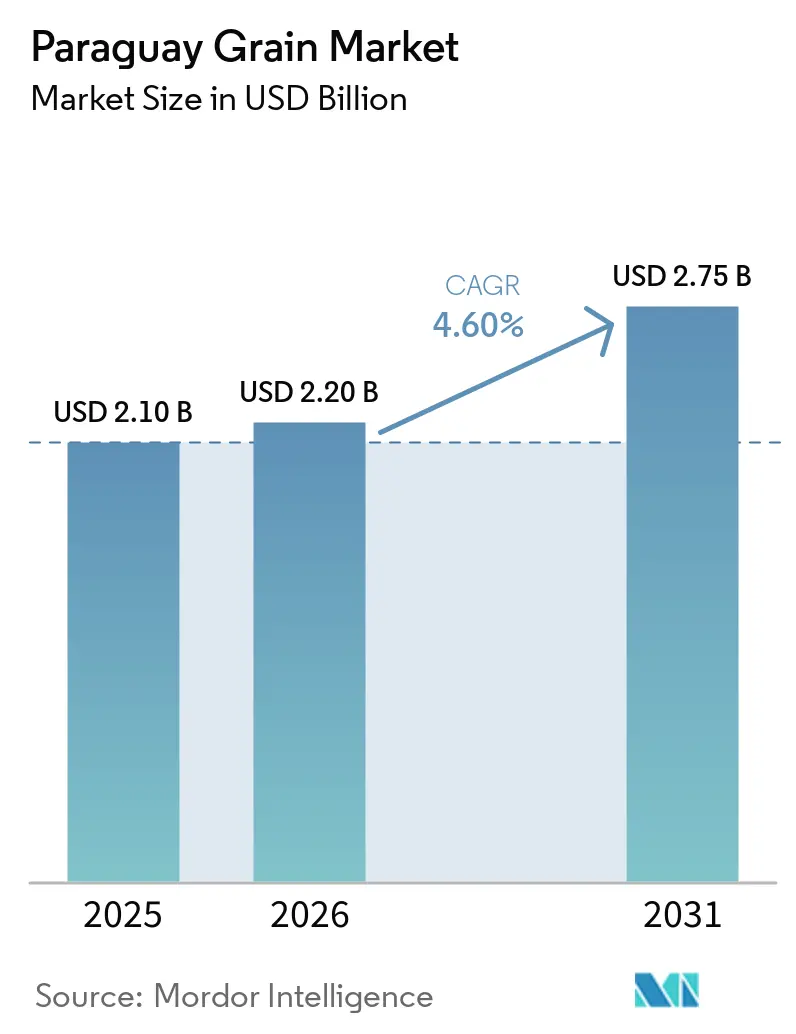
The Paraguay grain market was valued at USD 2.10 billion in 2025 and is projected to grow from USD 2.20 billion in 2026 to USD 2.75 billion by 2031, registering a CAGR of 4.6% during the forecast period (2026-2031). Paraguay's grain market benefits from abundant arable land, competitive input costs, and an improving logistics network, which support export performance despite fluctuations in inland freight costs due to varying river depths. Increasing domestic feed demand from poultry, hog, and cattle operations is reducing the local availability of maize, while drought-tolerant sorghum is gaining popularity on less fertile soils. Multinational traders maintain control over barge and terminal assets. Infrastructure developments associated with the Bioceanic Corridor and investments in the electricity grid are projected to enhance storage and processing capacity, reducing the impact of waterway disruptions on market participants.
Key Report Takeaways
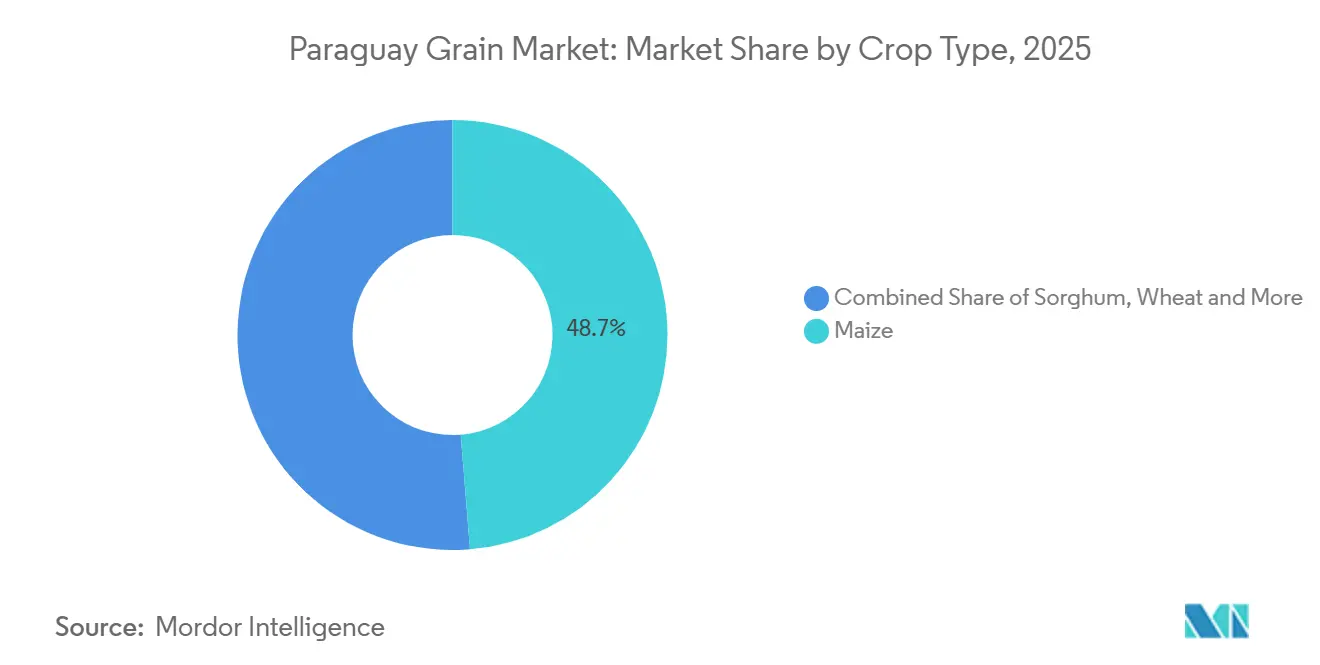
- By crop type, maize accounted for the largest 48.7% of the Paraguay grain market share in 2025, and the sorghum market size is projected to grow at the fastest 6.5% CAGR from 2026 to 2031.
Note: Market size and forecast figures in this report are generated using Mordor Intelligence’s proprietary estimation framework, updated with the latest available data and insights as of January 2026.
Paraguay Grain Market Trends and Insights
Drivers Impact Analysis*
| Driver | (~) % Impact on CAGR Forecast | Geographic Relevance | Impact Timeline |
|---|---|---|---|
| Rising domestic feed demand from livestock growth | +1.2% | Nationwide with hubs in Caaguazu, Alto Paranu, and San Pedro | Medium term (2–4 years) |
| Expanding grain trade via Paraguay–Parana waterway | +0.9% | Asuncion, Villeta, and Encarnacion export corridor | Long term (≥ 4 years) |
| Expansion of irrigated acreage through public-private partnerships (PPP) | +0.7% | Neembucu, Misiones, and Presidente Hayes | Long term (≥ 4 years) |
| Surge in Chinese investment under prospective bilateral agreements | +0.5% | Nationwide spillover to Alto Parana and Itapua | Medium term (2–4 years) |
| Rapid adoption of drone-enabled variable-rate spraying on medium farms | +0.6% | Alto Parana, Itapua, and Canindeyu | Short term (≤ 2 years) |
| Government carbon-credit pilot rewarding soil-health practices | +0.4% | Chaco and Eastern regions | Long term (≥ 4 years) |
| Source: Mordor Intelligence | |||
Rising Domestic Feed Demand From Livestock Growth
Paraguay's growing livestock industry is driving increased structural demand for feed grains, particularly corn and soybeans. According to the Food and Agriculture Organization (FAO), Paraguay's poultry production reached 81,138 metric tons in 2024, which is high compared to other species, indicating intensive farming systems that depend heavily on compound feed[1]Source: Food and Agriculture Organization, “FAOSTAT Poultry Meat Production Data,” fao.org. This rising demand for feed is boosting domestic grain consumption and contributing to market stability, though it also puts pressure on supply during adverse weather.
Expanding Grain Trade Via Paraguay–Parana Waterway
The Paraguay–Paraná waterway is a key component of Paraguay’s grain export logistics, facilitating cost-effective bulk transportation. According to the Inter-American Development Bank, the waterway accounts for approximately 80% of Paraguay’s foreign trade volume, underscoring its importance in maintaining export competitiveness[2]Source: International Trade Administration, “Paraguay–Paraná Waterway System,” trade.gov. Ongoing investments in infrastructure and fleet expansion are enhancing capacity utilization. However, seasonal fluctuations in river levels continue to impact operational efficiency.
Expansion of Irrigated Acreage Through Public-Private Partnerships (PPP)
The expansion of irrigated acreage through public-private investment initiatives is contributing to production stability and promoting crop diversification within Paraguay's grain market. According to the Food and Agriculture Organization Hand-in-Hand Investment Forum in 2024, Paraguay is focusing on investments in sustainable irrigation infrastructure, water management systems, and climate-resilient agricultural practices to enhance productivity and export competitiveness. Improved irrigation access mitigates reliance on rainfall variability, enabling more consistent grain cultivation in key farming regions. These advancements improve resource efficiency, bolster resilience to climate risks, and support the long-term growth of Paraguay's export-driven grain sector.
Surge in Chinese Investment Under Prospective Bilateral Agreements
Aligning with Chinese investment and trade agreements is shaping Paraguay's long-term export strategies and logistics development. Paraguay has demonstrated a growing willingness to engage with China through regional frameworks, particularly within Mercosur negotiations. As reported in August 2024, official statements indicated Paraguay's "total openness" to advancing trade agreements with China, reflecting policy flexibility that could facilitate future agricultural exports, including grains, if diplomatic and trade barriers are resolved[3]Source: Bilaterals.org, “Paraguay Open to China Trade Deals,” bilaterals.org.
Restraints Impact Analysis*
| Restraint | (~) % Impact on CAGR Forecast | Geographic Relevance | Impact Timeline |
|---|---|---|---|
| High risk of pest and disease outbreaks | -0.5% | Itapua, Alto Parana rust zones | Short term (≤ 2 years) |
| Increasing climate volatility curbing yield stability | -0.8% | Rain-fed areas of Presidente Hayes, Boqueron | Medium term (2–4 years) |
| Rising inland freight costs due to low river levels | -1.0% | Asuncion, Villeta, Encarnacion corridors | Short term (≤ 2 years) |
| Slow digitization among smallholder cooperatives | -0.3% | Caaguazu, San Pedro, and Concepcion | Long term (≥ 4 years) |
| Source: Mordor Intelligence | |||
Increasing Climate Volatility Curbing Yield Stability
Paraguay's wheat production experienced a notable decline in 2024, highlighting the increasing impact of climate variability on the stability of grain production. According to the Food and Agriculture Organization, wheat output in 2024 totaled 767,700 metric tons, a reduction of 20.8% compared to the previous year. This decline was primarily attributed to adverse weather conditions, including irregular rainfall and temperature fluctuations, which disrupted crop development and lowered harvest productivity. Such production instability creates challenges for farmers in planning cultivation cycles and managing input investments. Additionally, it undermines supply reliability, heightens operational risks, and constrains long-term profitability in Paraguay's grain market.
Rising inland freight costs due to low river levels
Persistently low river levels are causing significant transportation challenges for Paraguay's grain market, leading to higher inland freight costs and slower export operations. The reduced water depth restricts barge loading capacity and disrupts cargo movement along the Paraguay-Paraná waterway, the main export route for the country's grain. In April 2024, Paraguay's Directorate of Meteorology and Hydrology reported that the Paraguay River's level near the Port of Villeta had fallen to just 0.74 meters, well below the standard navigation levels. This limited navigability has resulted in logistical inefficiencies and export delays, undermining supply chain reliability and constraining the competitiveness and growth prospects of Paraguay's grain market.
*Our forecasts treat driver/restraint impacts as directional, not additive. The impact forecasts reflect baseline growth, mix effects, and variable interactions.
Segment Analysis
By Crop Type: Maize Dominance Meets Sorghum Resilience
Maize accounted for the largest 48.7% of the Paraguay grain market share in 2025. The segment maintains a dominant position due to strong integration with Paraguay’s livestock feed, ethanol production, and export-oriented agricultural economy. Large cultivation areas, established storage infrastructure, and widespread adoption of high-yield seed varieties continue supporting maize production across major farming regions. Demand from poultry, swine, and cattle industries also strengthens domestic consumption stability alongside export opportunities. Favorable climatic conditions and expanding mechanized farming practices further support maize cultivation efficiency, reinforcing its importance within Paraguay’s commercial grain production landscape and long-term agricultural development strategies.
Paraguay grain market size for sorghum is projected to grow at the fastest 6.5% CAGR from 2026 to 2031. Growth is supported by rising farmer preference for drought-tolerant crops capable of maintaining productivity under variable weather conditions and lower water availability. Increasing adoption of resilient crop rotation practices is encouraging sorghum cultivation across marginal agricultural land unsuitable for high-input grain production. Expanding feed demand from livestock operations and growing interest in climate-resilient farming systems are also strengthening commercial opportunities for sorghum producers. Improvements in hybrid seed technology and broader agronomic support programs continue enhancing production potential and encouraging wider adoption across Paraguay grain market.



Geography Analysis
Alto Paraná continues to be a prominent grain-producing region in Paraguay, attributed to its fertile soils, robust agribusiness presence, and well-established export infrastructure. The department is supported by integrated networks for storage, processing, and logistics, managed by major cooperatives and grain traders, ensuring efficient handling of corn and wheat production. The increasing use of precision agriculture and traceability systems is enhancing productivity and facilitating access to international export markets. However, the region faces challenges from logistics disruptions caused by fluctuating river levels, which can lead to shipment delays, higher transportation costs, and storage constraints during peak harvest periods.
San Pedro is rapidly developing as a significant grain-producing region, driven by growing maize demand from the livestock and ethanol industries. Farmers in the department are increasingly adopting modern agronomic practices, such as improved seed varieties and digital farm management techniques, to boost productivity and crop quality. The region also benefits from advancements in rural infrastructure and improved connectivity to storage and trading facilities, enabling more efficient grain transportation during harvest periods. Collaborative efforts between producer associations and agricultural research institutions are further promoting sustainable production growth in the region.
Itapúa, Canindeyú, and Caaguazú remain key contributors to Paraguay's grain production, supported by diversified cropping systems and robust cooperative-based farming networks. These regions benefit from favorable agro-climatic conditions and the growing adoption of advanced farming technologies, such as precision agriculture and digital crop monitoring systems. According to the United States Department of Agriculture’s Grain and Feed Annual 2025 report, timely rainfall during the 2024/25 season enhanced corn crop conditions in major producing departments, including Alto Paraná, Itapúa, San Pedro, and Caaguazú, ensuring stable grain productivity. These favorable production conditions, combined with technological advancements, are bolstering Paraguay's grain supply capabilities and export competitiveness.
Competitive Landscape
The grain market in Paraguay is characterized by competition between multinational traders and local cooperatives in areas such as sourcing, storage, and export activities. Major companies like Bunge Limited, Cargill Incorporated, and Louis Dreyfus Company B.V. hold substantial control over logistics infrastructure, including river terminals and barge fleets. Their large-scale operations allow for cost efficiencies in transportation and inventory management. Meanwhile, growing competition from cooperatives is altering market dynamics by offering localized sourcing and traceability benefits that meet changing buyer demands.
Cooperatives are gaining market share by leveraging direct relationships with farmers and adopting certified sustainable practices. Organizations such as Cooperativa Pindo focus on traceability, certification, and compliance with international sustainability standards, which are increasingly appealing to global food and feed manufacturers. The expansion of farmgate collection centers and improvements in storage infrastructure enhance their sourcing capabilities. These developments reduce reliance on multinational intermediaries, increase producers' bargaining power, and enable greater participation in value-added supply chains, particularly in premium export segments that demand strict environmental and quality compliance.
Processing integration is intensifying competition as companies expand into downstream value chains to capture higher margins. Grain is increasingly being processed into ethanol, animal feed, and meat products, enhancing resilience against export market volatility. Investments in processing facilities and digital agriculture technologies are lowering entry barriers for mid-sized players. This trend is gradually redistributing market power toward integrated operators capable of balancing domestic demand with export opportunities.
Recent Industry Developments
- May 2026: Paraguay and the Philippines have signed trade cooperation agreements aimed at enhancing the exchange of agricultural commodities and expanding Paraguayan grain export opportunities in Southeast Asia. This initiative aligns with Paraguay's efforts to boost maize and agro-industrial exports by strengthening trade linkages between ASEAN and Mercosur.
- May 2025: Louis Dreyfus Company Paraguay S.A. expanded its river logistics capabilities in Paraguay by incorporating 14 locally constructed jumbo barges into its fluvial fleet. This initiative aimed to enhance the efficiency of lower-carbon agricultural export transportation along the Paraguay-Paraná waterway network.
- February 2024: Paraguay has resumed rice exports to Mexico following the resolution of phytosanitary concerns regarding pest detection. This development has reinstated access to a significant export market.


Paraguay Grain Market Report Scope
In Paraguay, grains are the most important staple food. Grain is the harvested seed of grasses such as wheat, oats, rice, and corn. Other important grains include sorghum, millet, rye, and barley. The Paraguay grain market report is segmented by crop type (rice, wheat, maize, sorghum). The report includes production analysis (volume), consumption analysis (value and volume), import market analysis (value and volume), export market analysis (value and volume), wholesale price trend analysis and forecast, and seasonality analysis. The market forecasts are provided in terms of value (USD) and volume (metric tons) for all the above segments.
By Crop Type
| Rice | Production Analysis | Production Volume | |
| Area Harvested and Yield | |||
| Consumption Analysis (Value and Volume) | |||
| Trade Analysis (Value and Volume) | Import Market Analysis | Import Value and Volume | |
| Key Supplying Markets | |||
| Export Market Analysis | Export Value and Volume | ||
| Key Destinations Markets | |||
| Wholesale Price Trend Analysis and Forecast | |||
| Seasonality Analysis | |||
| Wheat | Production Analysis | Production Volume | |
| Area Harvested and Yield | |||
| Consumption Analysis (Value and Volume) | |||
| Import Value and Volume | |||
| Key Supplying Markets | |||
| Export Value and Volume | |||
| Key Destinations Markets | |||
| Wholesale Price Trend Analysis and Forecast | |||
| Seasonality Analysis | |||
| Maize | Production Analysis | Production Volume | |
| Area Harvested and Yield | |||
| Consumption Analysis (Value and Volume) | |||
| Import Value and Volume | |||
| Key Supplying Markets | |||
| Export Value and Volume | |||
| Key Destinations Markets | |||
| Wholesale Price Trend Analysis and Forecast | |||
| Seasonality Analysis | |||
| Sorghum | Production Analysis | Production Volume | |
| Area Harvested and Yield | |||
| Consumption Analysis (Value and Volume) | |||
| Import Value and Volume | |||
| Key Supplying Markets | |||
| Export Value and Volume | |||
| Key Destinations Markets | |||
| Wholesale Price Trend Analysis and Forecast | |||
| Seasonality Analysis | |||
By Geography
| Production Analysis | Production Volume | |
| Area Harvested and Yield | ||
| Consumption Analysis (Value and Volume) | ||
| Import Value and Volume | ||
| Key Supplying Markets | ||
| Export Value and Volume | ||
| Key Destinations Markets | ||
| Wholesale Price Trend Analysis and Forecast | ||
| Seasonality Analysis |
| By Crop Type | Rice | Production Analysis | Production Volume | |
| Area Harvested and Yield | ||||
| Consumption Analysis (Value and Volume) | ||||
| Trade Analysis (Value and Volume) | Import Market Analysis | Import Value and Volume | ||
| Key Supplying Markets | ||||
| Export Market Analysis | Export Value and Volume | |||
| Key Destinations Markets | ||||
| Wholesale Price Trend Analysis and Forecast | ||||
| Seasonality Analysis | ||||
| Wheat | Production Analysis | Production Volume | ||
| Area Harvested and Yield | ||||
| Consumption Analysis (Value and Volume) | ||||
| Import Value and Volume | ||||
| Key Supplying Markets | ||||
| Export Value and Volume | ||||
| Key Destinations Markets | ||||
| Wholesale Price Trend Analysis and Forecast | ||||
| Seasonality Analysis | ||||
| Maize | Production Analysis | Production Volume | ||
| Area Harvested and Yield | ||||
| Consumption Analysis (Value and Volume) | ||||
| Import Value and Volume | ||||
| Key Supplying Markets | ||||
| Export Value and Volume | ||||
| Key Destinations Markets | ||||
| Wholesale Price Trend Analysis and Forecast | ||||
| Seasonality Analysis | ||||
| Sorghum | Production Analysis | Production Volume | ||
| Area Harvested and Yield | ||||
| Consumption Analysis (Value and Volume) | ||||
| Import Value and Volume | ||||
| Key Supplying Markets | ||||
| Export Value and Volume | ||||
| Key Destinations Markets | ||||
| Wholesale Price Trend Analysis and Forecast | ||||
| Seasonality Analysis | ||||
| By Geography | Production Analysis | Production Volume | ||
| Area Harvested and Yield | ||||
| Consumption Analysis (Value and Volume) | ||||
| Import Value and Volume | ||||
| Key Supplying Markets | ||||
| Export Value and Volume | ||||
| Key Destinations Markets | ||||
| Wholesale Price Trend Analysis and Forecast | ||||
| Seasonality Analysis | ||||


Key Questions Answered in the Report
How large is the Paraguay grain market today?
The Paraguay grain market size reached USD 2.20 billion in 2026 and is projected to hit USD 2.75 billion by 2031, reflecting a 4.6% CAGR over 2026-2031.
Which crop holds the largest share of grain revenue in Paraguay?
Maize led with 48.7% of Paraguay grain market share in 2025 due to strong livestock feed demand.
What are the key logistical risks?
Low river levels on the Paraguay-Paraná waterway can cut barge capacity by 25% or more, doubling freight rates and delaying exports.
What are the key logistical risks?
Low river levels on the Paraguay-Paraná waterway can cut barge capacity by 25% or more, doubling freight rates and delaying exports
Page last updated on:


 Your data is secure and never sold or shared.


