
Market Overview
| Study Period | 2020 - 2031 |
|---|---|
| Forecast Data Period | 2026 - 2031 |
| Historical Data Period | 2020 - 2024 |
| Base Year Market Size (2025) | USD 1.78 Billion |
| Market Size (2026) | USD 2.11 Billion |
| Market Size (2031) | USD 4.93 Billion |
| Growth Rate (2026 - 2031) | 18.49 % |
Major Players *Disclaimer: Major Players sorted in no particular order Image © Mordor Intelligence. Reuse requires attribution under CC BY 4.0. | |
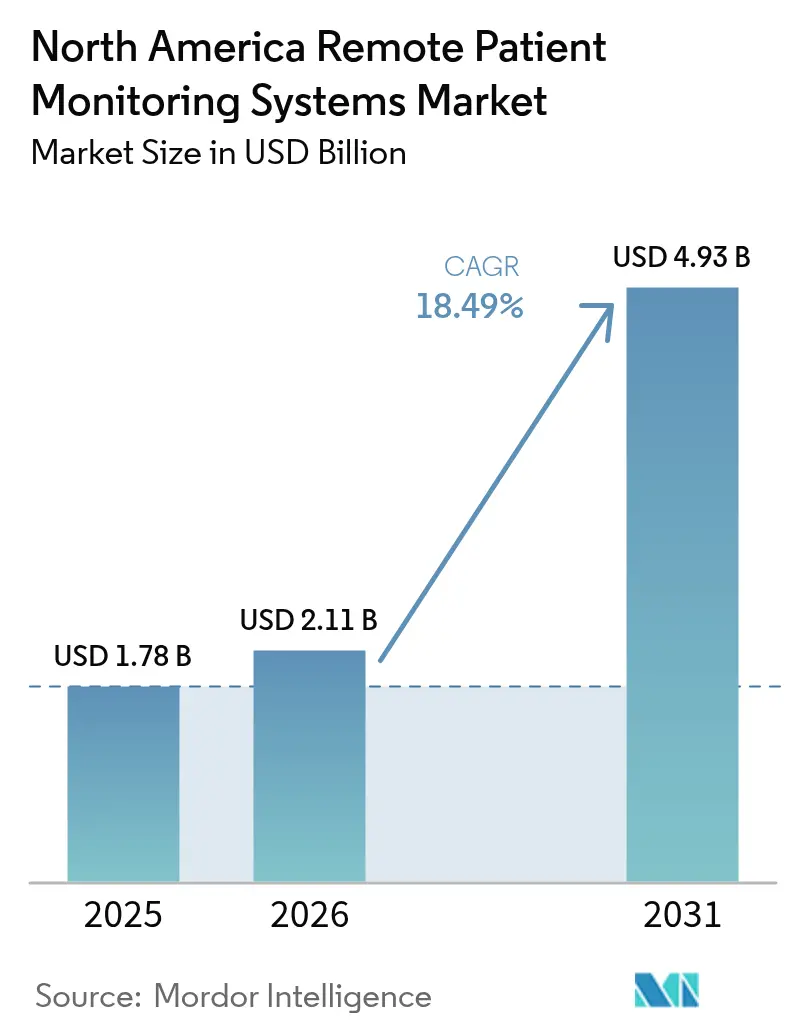
North America Remote Patient Monitoring Systems Market Analysis by Mordor Intelligence
The North America Remote Patient Monitoring Systems Market size was valued at USD 1.78 billion in 2025 and estimated to grow from USD 2.11 billion in 2026 to reach USD 4.93 billion by 2031, at a CAGR of 18.49% during the forecast period (2026-2031).
The remote patient monitoring market in the North America region is growing at a good pace and certain factors that are driving this growth include rising incidence of chronic diseases due to the lifestyle changes in the region, an increase in the aging population and growing demand for home-based monitoring devices.
The United States, being the largest economy in this region, the country's population trend largely affects the growth of the market studied in both, positive and negative manner. For instance, the rising geriatric population in the United States is acting as a growth factor for the use of patient monitoring devices. According to the United States Bureau data, the number of Americans aged 65 years and above is projected to become more than double (from 46 million in 2016 to over 98 million by 2060), and the 65-and-older age group's share of the total population is likely to rise to nearly 24% from 15%. The growing geriatric population is more prone to diseases, which increases the usage of remote monitoring devices. Thus, the increase in the aging population is expected to boost the remote patient monitoring market in the North America region.
Note: Market size and forecast figures in this report are generated using Mordor Intelligence’s proprietary estimation framework, updated with the latest available data and insights as of 2026.
North America Remote Patient Monitoring Systems Market Trends and Insights
Heart Monitors are Expected to Witness a Rapid Growth During the Forecast Period
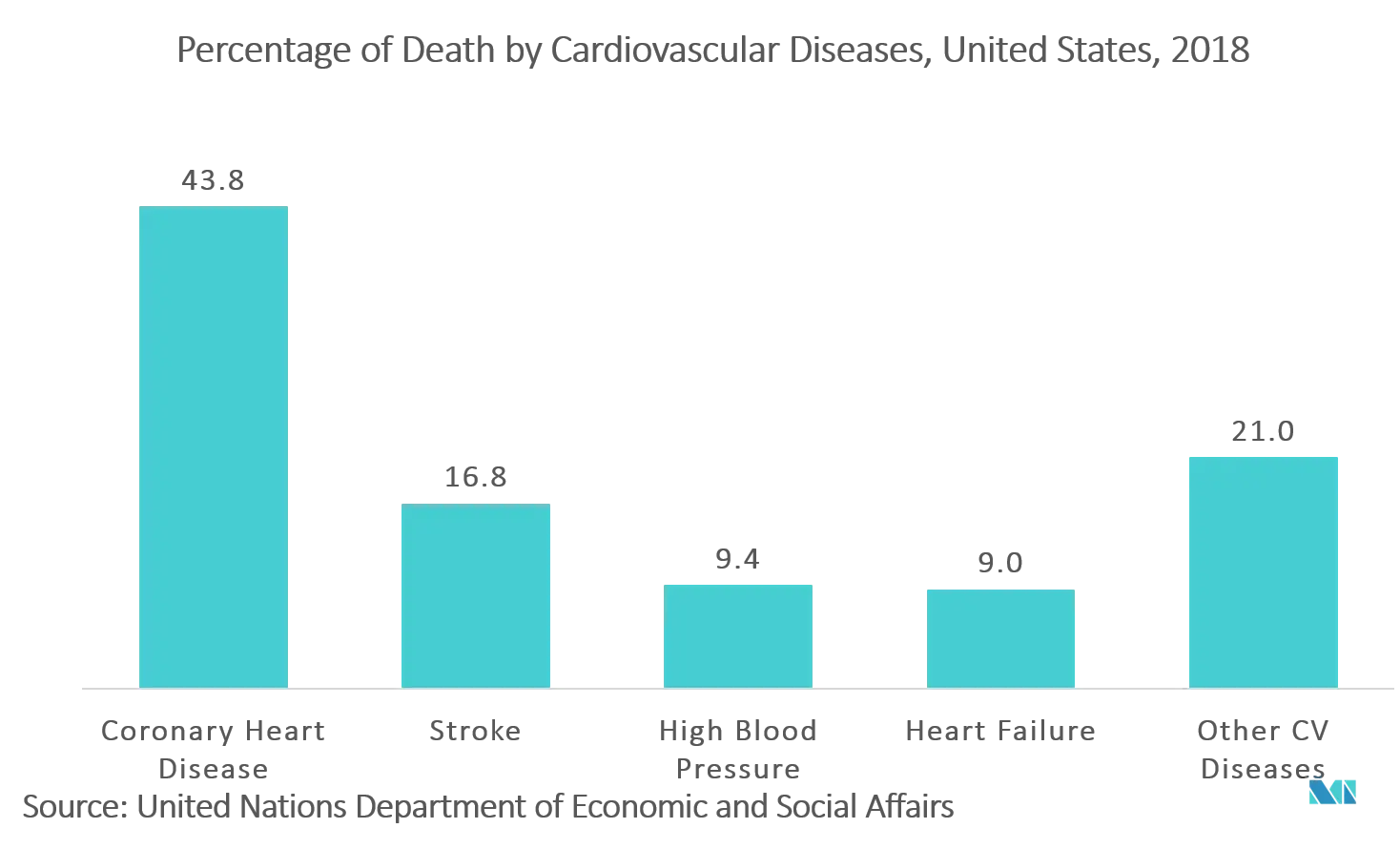
Heart disease is the leading cause of death for both men and women in the United States. According to the CDC, coronary heart disease is the most common type of heart disease, killing over 370,000 people, annually. People have become more concerned about their health, especially regarding heart diseases, and hence, they are adopting preventive care. This has increased the demand for heart rate monitors in this region.
It is estimated that approximately every year, about 735,000 Americans have a heart attack, out of which, 210,000 have already had a heart attack. Moreover, neither the cardiac patients who have been hospitalized for more than six months in a year nor senior citizens can be taken to the hospital every now and then to measure their heart rate.
As is evident from the above-mentioned statistics, coronary conditions in the United States is a major driver for the growth of the heart monitor segment in the North America region.


Regulatory Landscape
In the United States, remote patient monitoring systems are regulated as medical devices under the FDA Center for Devices and Radiological Health (CDRH), with digital health oversight supported by the FDA Digital Health Center of Excellence. In 2026, the FDA advanced a more structured pathway for certain digital health devices through the Technology-Enabled Meaningful Patient Outcomes (TEMPO) pilot, which opened for statements of interest and was subsequently launched to broaden access while maintaining patient-safety controls.
In Canada, Health Canada and federal legislative actions are emphasizing connected-care governance alongside device compliance. In February 2026, the Government of Canada introduced Bill S-5 (Connected Care for Canadians Act), centered on interoperability and prohibitions on data blocking. This raises compliance expectations for health IT vendors that integrate with remote monitoring workflows and data exchange across care settings.
Competitive Landscape
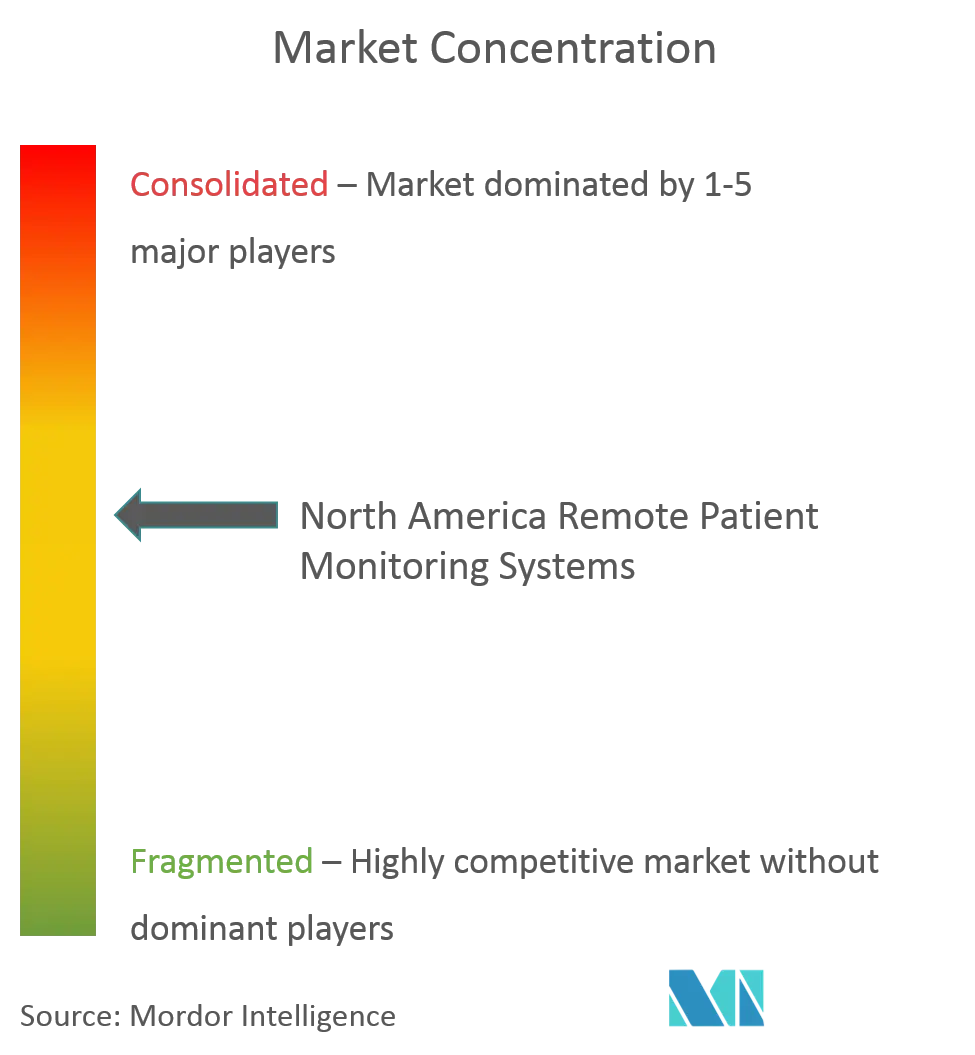
The market for patient monitoring systems in the North America region is moderately competitive and consists of the global as well as local players. Some of the major players that are actively present in this region are Boston Scientific Corporation, Medtronic, Koninklijke Philips N.V, GE Healthcare, among others. The industry is highly competitive and there is a growing trend of partnerships and agreements between the industry participants and other medical device manufacturers in order to incorporate remote patient monitoring functionalities in their devices.
North America Remote Patient Monitoring Systems Industry Leaders
Boston Scientific
Abbott Laboratories
GE Healthcare
Koninklijke Philips N.V.
Medtronic PLC
- *Disclaimer: Major Players sorted in no particular order

Market Opportunities and Future Outlook
Reimbursement rulemaking and state Medicaid coverage expansions continue to create near-term whitespace for remote patient monitoring (RPM) workflows, particularly those that fit shorter monitoring windows and more diverse patient pathways. In the United States, CMS implemented 2026 Physician Fee Schedule updates that introduced new CPT codes designed to support shorter monitoring and management durations, broadening the set of use cases that hospitals, clinics, and home care providers can operationalize without relying on longer minimum-day thresholds.
Programmatic and policy moves are also pushing product and platform differentiation toward interoperability, evidence generation, and workflow integration. The FDA Digital Health Center of Excellence launched the TEMPO pilot in 2026, giving manufacturers a concrete, regulator-backed mechanism to generate outcomes-oriented evidence within a defined model. Canadian federal action (Bill S-5, introduced in February 2026) reinforces interoperability and anti-data-blocking objectives, which favors vendors able to connect devices, apps, and EHR-facing data pipelines. At the state level, Nebraska DHHS issued Health Plan Advisory 26-03 in May 2026, establishing Medicaid coverage for RPM effective July 1, 2026, and highlighting how state-by-state coverage policy can open additional addressable care pathways and create regional adoption requirements for suppliers and service providers.
Recent Industry Developments
- July 2026: Koninklijke Philips N.V. secured a partnership with University Health in San Antonio, Texas, to implement its Enterprise Monitoring as a Service platform. The company’s focus on service-based deployment models bundles technology and operations into longer-term hospital relationships that can extend into home-based and transitional care workflows.
- June 2026: ChartSpan acquired Validic to combine care management capabilities with a remote patient monitoring data platform. The transaction supports more integrated RPM program delivery across devices and data sources, increasing competitive pressure on standalone connectivity layers and smaller point-solution platforms.
- March 2026: Health Recovery Solutions acquired Rimidi to expand and integrate chronic disease management and remote monitoring capabilities. The deal reflects consolidation around end-to-end virtual care programs, where RPM devices, data, and clinical workflows are packaged together for provider and payer customers.


Research Methodology Framework and Report Scope
Market Definition and Coverage
For this market, we define remote patient monitoring (RPM) systems as connected devices and related system software used to capture patient vitals and other health data outside a care facility, then transmit it to clinicians through telehealth links or internet-enabled apps for follow-up and decision-making.
Scope exclusions: We exclude general telemedicine consultation revenue that does not include RPM device-led monitoring and the associated system layer.
Segmentation Overview
- By Type of Device
- Heart Monitors
- Breath Monitors
- Hematology Monitors
- Multi-Parameter Monitors
- Other Types of Devices
- By Application
- Cancer Treatment
- Cardiovascular Diseases
- Diabetes Treatment
- Sleep Disorder
- Weight Management and Fitness Monitoring
- Other Applications
- By End User
- Home Care Settings
- Hospital/Clinics
- Others
- Geography
- North America
- United States
- Canada
- Mexico
- North America
Data Sources, Market Sizing, and Validation
Desk Research
Desk research was used to set the boundaries of what counts as RPM systems and to build a realistic demand base by country (United States, Canada, and Mexico). We relied on public healthcare statistics and adoption signals from government health agencies and national statistical offices, payer and public health publications, and trade association materials related to connected health and medical devices.
To convert those demand signals into a market value, we also reviewed sources such as customs and trade statistics for relevant device categories, peer-reviewed clinical and digital health journals for use patterns, and company filings and investor presentations for product mix and pricing direction. In parallel, a paid subscription focused on company financials and another covering patents were used selectively to cross-check supplier exposure to RPM and to confirm where innovation activity was concentrated. These desk research sources are illustrative only, and many other public references were also consulted during data collection, validation, and clarification.
Primary Interviews and Surveys
Primary interviews and surveys were used to pressure-test the desk assumptions on what is being purchased as an RPM system versus a broader monitoring or telehealth bundle. We spoke with a balanced mix of device and platform stakeholders, care delivery decision-makers, and channel participants across North America, then used their inputs to confirm adoption pace by care setting and the typical pricing and replacement cycle for common RPM devices.
Distribution of primary research fieldwork respondents
| Company type | Respondent position |
|---|---|
| Top tier: 30% | CXOs: 13% |
| Mid tier: 48% | Functional/Unit leaders: 43% |
| Smaller Players: 22% | Managers: 44% |
Market-Sizing & Forecasting
Our sizing model starts with a top-down demand pool build-up where monitored patient cohorts and care program penetration are translated into expected device and system deployments by country, then into value using typical selling price ranges. The results are corroborated with selective bottom-up checks such as sampled supplier revenue exposure to RPM, channel checks on shipment momentum, and an ASP multiplied by volume approximation for common device types, which helps us adjust for over-counting and gaps.
Key inputs that shaped the model included the size of chronic disease and post-acute patient pools likely to be monitored, RPM program enrollment and adherence patterns, device replacement and upgrade timing, reimbursement and payer coverage direction, and the split between home care and provider-led settings. Because these inputs can move at different speeds, forecasting was done using scenario analysis, and the scenario weights were refined using what interviewees expected for reimbursement stability, provider capacity, and connected device uptake over the next few years. Where bottom-up checks were incomplete, gaps were handled by applying conservative coverage ratios consistent with country-level adoption and procurement feedback.
Data Validation & Update Cycle
Outputs were validated by triangulating the final market totals against independent signals such as adoption indicators, reimbursement policy milestones, and the implied per-patient spending level that falls out of the model. Variance checks were run by country and by major use setting, and any sharp jumps were reviewed to ensure they were supported by a clear driver like coverage expansion or pricing changes.
Before sign-off, the work goes through multi-step analyst review so assumptions, arithmetic, and scope boundaries are consistent across the model. Reports are refreshed annually, and interim updates are triggered when material events occur, such as major policy changes or notable shifts in care delivery patterns. Right before delivery, we do a final pass to incorporate the latest available public information and any critical re-checks from follow-up calls.
Mordor Intelligence's North America Remote Patient Monitoring System Market Market Estimate Compared With Other Published Estimates
Published values for North America RPM systems often look far apart because researchers do not always count the same things, and they also choose different base years and currency timing. In practice, the differences usually come from what is included as an RPM system, how bundled software and services are treated, and whether the estimate is anchored to monitored patient volumes or to broader connected-care spending.
By tracking adoption and reimbursement signals and refreshing scope cutoffs each update, Mordor Intelligence keeps the estimate focused on RPM systems where device-led monitoring data is transmitted for clinician use, instead of mixing in wider telehealth services or general patient monitoring device markets.
Benchmark comparison
| Source | Market Size | Gaps in Research Methodology |
|---|---|---|
| Mordor Intelligence | USD 1.78 B (2025) | |
| Global Consultancy A | USD 8.93 B (2024) | This number appears to sit on a wider product bucket that can capture broader monitoring device revenue, which inflates the North America total versus a tighter RPM systems-only boundary. It also uses a different base year, so growth and currency timing are not directly comparable year to year. |
| Industry Publisher B | USD 1.88 B (2024) | The scope looks closer, but the categorization by monitor types and the country grouping can shift what is counted as system value versus device value. Differences can also come from how pricing is updated, especially when older average prices are carried forward without enough checks on mix changes. |
The spread in published numbers is mostly explained by scope and counting rules, not only by growth expectations. When the demand pool, price logic, and inclusions are written down clearly and then checked with real-world adoption and purchasing behavior, the final market value becomes easier to trace and reproduce.


Key Questions Answered in the Report
How big is the North America Remote Patient Monitoring Systems Market?
The North America Remote Patient Monitoring Systems Market size is expected to reach USD 2.11 billion in 2026 and grow at a CAGR of 18.49% to reach USD 4.93 billion by 2031.
What is the current North America Remote Patient Monitoring Systems Market size?
In 2026, the North America Remote Patient Monitoring Systems Market size is expected to reach USD 2.11 billion.
Who are the key players in North America Remote Patient Monitoring Systems Market?
Boston Scientific, Abbott Laboratories, GE Healthcare, Koninklijke Philips N.V. and Medtronic PLC are the major companies operating in the North America Remote Patient Monitoring Systems Market.
What years does this North America Remote Patient Monitoring Systems Market cover, and what was the market size in 2025?
In 2025, the North America Remote Patient Monitoring Systems Market size was estimated at USD 2.11 billion. The report covers the North America Remote Patient Monitoring Systems Market historical market size for years: 2019, 2020, 2021, 2022, 2023 and 2024. The report also forecasts the North America Remote Patient Monitoring Systems Market size for years: 2026, 2027, 2028, 2029, 2030 and 2031.
Page last updated on:


 Your data is secure and never sold or shared.


