
Market Overview
| Study Period | 2020 - 2031 |
|---|---|
| Forecast Data Period | 2026 - 2031 |
| Base Year Market Size (2025) | USD 181.70 Billion |
| Market Size (2026) | USD 192.27 Billion |
| Market Size (2031) | USD 255.09 Billion |
| Growth Rate (2026 - 2031) | 5.82 % |
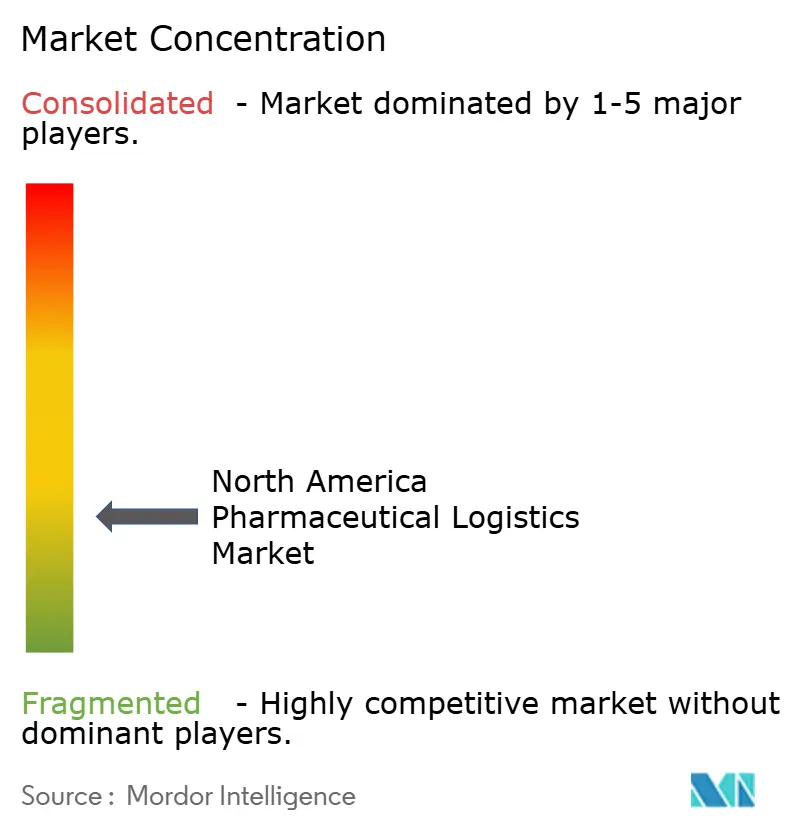
| Market Concentration | Low |
Major Players *Disclaimer: Major Players sorted in no particular order Image © Mordor Intelligence. Reuse requires attribution under CC BY 4.0. | |
North America Pharmaceutical Logistics Market Analysis by Mordor Intelligence
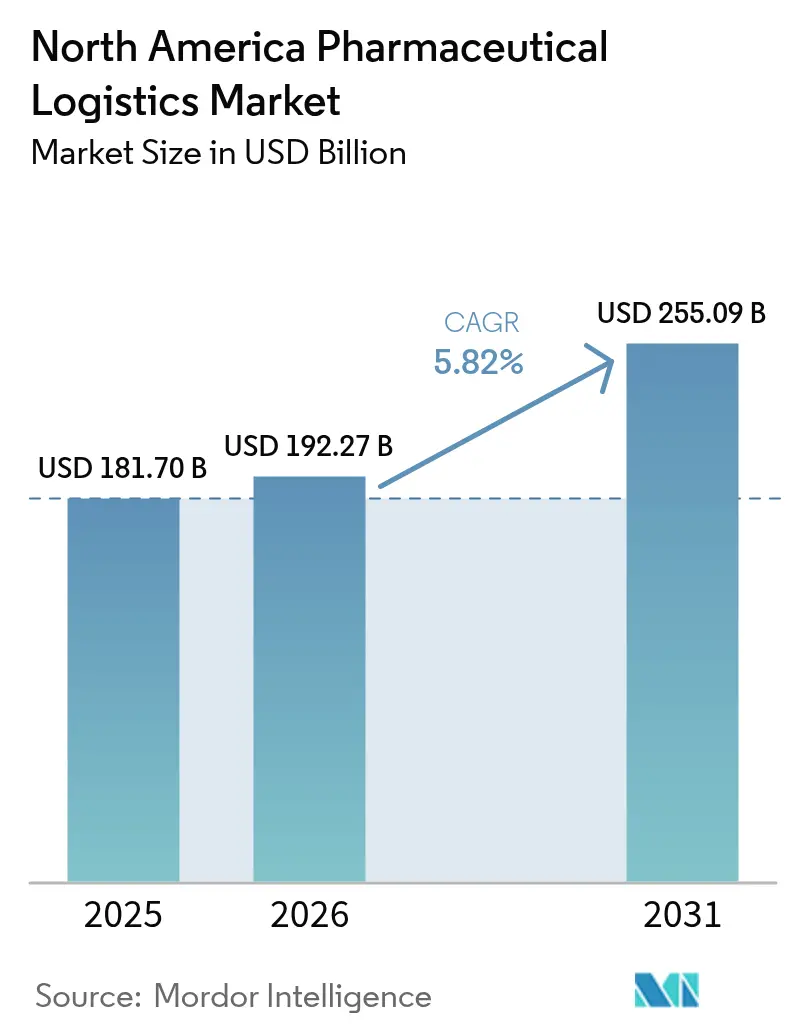
The North America Pharmaceutical Logistics Market size was valued at USD 181.70 billion in 2025 and estimated to grow from USD 192.27 billion in 2026 to reach USD 255.09 billion by 2031, at a CAGR of 5.82% during the forecast period (2026-2031).
Growth is anchored in the region’s large drug manufacturing base, strict compliance environment and rapid adoption of digital supply-chain technologies, all of which demand reliable temperature-controlled transport and granular traceability. Momentum is further reinforced by a surge in cell and gene therapy trials that require ultra-cold networks, rising direct-to-patient distribution in the specialty pharmacy channel and near-shoring of fill-finish capacity to Mexico. Capital expenditure remains strong, with DHL alone committing USD 2.2 billion to healthcare logistics through 2030, half of it in North America, to scale purpose-built hubs, vehicle fleets and control-tower systems[1]. Competitive intensity is escalating as integrators, specialist 3PLs and IoT-enabled start-ups vie for opportunities in biologics, last-mile and cross-border corridors, keeping market concentration moderate.
Key Report Takeaways
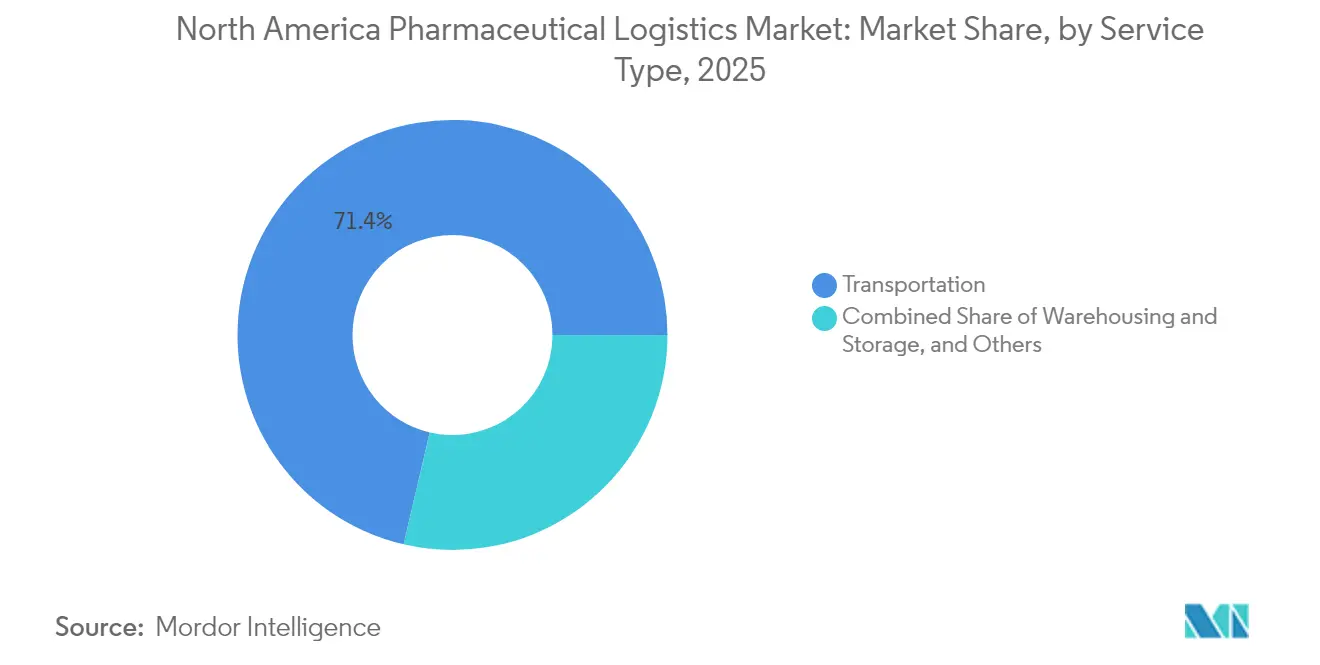
- By service type, transportation captured 71.35% of the North America pharmaceutical logistics market share in 2025, whereas warehousing and storage is projected to log the fastest 6.38% CAGR through 2031.
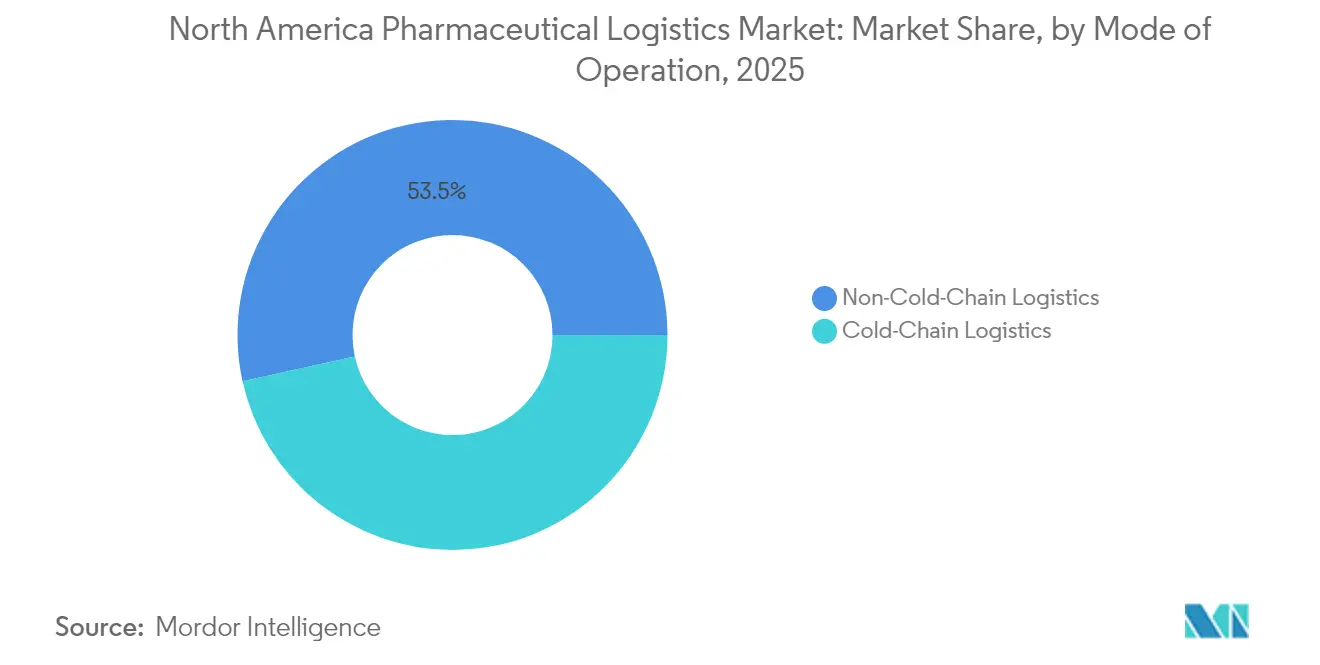
- By mode of operation, non-cold-chain services accounted for a 53.45% share, while cold-chain services are set to expand at 7.05% CAGR to 2031.
- By product type, prescription drugs led with 37.65% revenue share in 2025; cell and gene therapies are forecast to rise at an 11.32% CAGR through 2031.
- By geography, the United States held an 81.30% share of the North America pharmaceutical logistics market size in 2025, while Mexico is poised for the fastest 8.03% CAGR to 2031.
Note: Market size and forecast figures in this report are generated using Mordor Intelligence’s proprietary estimation framework, updated with the latest available data and insights as of 2026.
Market Trends and Insights
Drivers Impact Analysis of North America Pharmaceutical Logistics Market*
| Driver | (~) % Impact on CAGR Forecast | Geographic Relevance | Impact Timeline |
|---|---|---|---|
| Surge in cell & gene therapy clinical trials requiring ultra-cold distribution infrastructure | +1.8% | United States & Canada with spill-over to Mexico | Medium term (2-4 years) |
| Rise of direct-to-patient models in U.S. specialty pharmacy channel | +1.2% | United States, expanding to Canada | Short term (≤ 2 years) |
| Expansion of U.S.–Mexico near-shore fill-finish facilities creating cross-border cold-chain flows | +0.9% | U.S.–Mexico border regions, extending to Canada | Long term (≥ 4 years) |
| Canada’s biologics manufacturing incentives boosting demand for GMP warehousing | +0.7% | Canada, with U.S. cross-border implications | Medium term (2-4 years) |
| Growing adoption of real-time IoT temperature monitoring mandated by U.S. DSCSA 2024 milestone | +0.6% | North America-wide, led by United States | Short term (≤ 2 years) |
| Sustainability push for re-usable passive shippers to slash air-freight carbon footprint | +0.4% | Global, with North America leading | Long term (≥ 4 years) |
| Source: Mordor Intelligence | |||
Surge in Cell & Gene Therapy Clinical Trials Requiring Ultra-Cold Distribution Infrastructure
Advanced therapy trials are scaling rapidly, prompting investment in storage solutions that keep cellular material stable at temperatures as low as -196 °C. OmniaBio’s 120,000 square-foot facility in Hamilton, Ontario, now the largest of its kind in Canada, signals growing regional capacity for these therapies. The U.S. FDA’s new Platform Technology Designation for CRISPR-based products simplifies validation steps and shortens review cycles, thus raising shipment volumes that must meet stringent chain-of-custody rules. Logistics providers able to offer validated cryogenic fleets, redundant power back-ups and real-time excursion alerts are well placed to win contracts. Partnerships between manufacturers and 3PLs are also expanding to embed capacity in multi-tenant campuses near research clusters. These dynamics elevate the North America pharmaceutical logistics market as a critical enabler of precision medicine scale-up.
Rise of Direct-to-Patient Models in U.S. Specialty Pharmacy Channel
Manufacturers are building proprietary portals that send high-value drugs directly to patient homes, trimming intermediaries and improving adherence. The direct-to-patient healthcare logistics segment is growing alongside telehealth, which handled over 18% of U.S. outpatient visits in 2024. Last-mile couriers equipped with temperature-verified packaging extend reach to rural areas while blockchain audit trails document custody events for DSCSA compliance. Retail chains are retrofitting clinics to support decentralized clinical trials that rely on just-in-time drug delivery. Automated micro-fulfilment centers near metropolitan zones shorten lead times further. As these practices mature they contribute to recurring revenue streams within the North America pharmaceutical logistics market.
Expansion of U.S.–Mexico Near-Shore Fill-Finish Facilities Creating Cross-Border Cold-Chain Flows
Life-science companies are diversifying supply risk by moving sterile fill-finish lines to northern Mexico. The country’s 14 free-trade agreements and new tax rules that allow 89% deductibility on research machinery lower capital barriers. Cross-border truck volumes of temperature-sensitive goods are rising, though congested ports of entry and fragmented Mexican cold-chain regulations can delay hand-offs. The Wilson Center urges stronger regulatory alignment to safeguard product efficacy and patient safety. Demand for bilingual control-tower services and GPS-tagged passive shippers is therefore escalating. Providers that master customs brokerage, redundant route planning and harmonised data standards are likely to capture incremental share in the North America pharmaceutical logistics market.
Canada’s Biologics Manufacturing Incentives Boosting Demand for GMP Warehousing
Federal and provincial programs are subsidising new biomanufacturing campuses, accelerating the need for certified storage and distribution nodes. Canada’s diverse electronic health-record ecosystem improves real-world evidence capture, attracting multinational trials that require qualified logistics partners. Ottawa’s national pharmacare proposal envisions a single agency to negotiate drug prices and coordinate distribution, which may centralise requirements for temperature-controlled depots. Cross-border flows of biologics into U.S. clinical networks also benefit from the USMCA framework. These initiatives raise warehouse utilisation rates and spur robotics adoption, reinforcing growth prospects for the North America pharmaceutical logistics market.
Restraints Impact Analysis of North America Pharmaceutical Logistics Market*
| Restraint | (~) % Impact on CAGR Forecast | Geographic Relevance | Impact Timeline |
|---|---|---|---|
| Chronic driver shortages limiting domestic road capacity for time-critical shipments | -1.4% | North America, most acute in United States | Medium term (2-4 years) |
| High cost of dry-ice & liquid-nitrogen compliance for ≤-70 °C modalities | -0.8% | Global, concentrated in North America | Long term (≥ 4 years) |
| Fragmented Mexican Cold-Chain Regulations Elevating In-Transit Risk | -0.6% | U.S.-Mexico border regions, extending to Canada | Medium term (2-4 years) |
| Border Congestion Impacting On-Time Performance of Cross-Border Truckloads | -0.5% | U.S.-Mexico and U.S.-Canada border crossings | Short term (≤ 2 years) |
| Source: Mordor Intelligence | |||
Chronic Driver Shortages Limiting Domestic Road Capacity for Time-Critical Shipments
The American Trucking Associations estimate the shortfall could reach 160,000 drivers by 2030, straining time-definite lanes for healthcare cargo. Manufacturing plants already cite labour gaps at 20.6%, and higher transportation prices in December 2024 marked the steepest rise since April 2022. Driver turnover erodes on-time performance, pushing shippers to use premium air options or build buffer inventories. Potential immigration restrictions could tighten labour pools further. These pressures inflate operating costs and temper the otherwise strong outlook for the North America pharmaceutical logistics market.
High Cost of Dry-Ice & Liquid-Nitrogen Compliance for ≤-70 °C Modalities
Complex handling protocols for ultra-cold cargo raise insurance, packaging and training expenses. Failures across the global cold chain already cost industry USD 35 billion each year, highlighting financial risk. Maersk estimates that cold-chain medicines comprised 35% of total pharmaceutical volumes in 2022, and the share is climbing with next-generation biologics. Dry-ice sublimation plus limits on aircraft cargo mass can force split shipments, doubling freight bills. While IoT telemetry curbs excursion loss, it cannot fully offset high material costs, moderating the growth rate of modalities that rely on extreme temperatures within the North America pharmaceutical logistics market.
*Our forecasts treat driver/restraint impacts as directional, not additive. The impact forecasts reflect baseline growth, mix effects, and variable interactions.
North America Pharmaceutical Logistics Market Segment Analysis
By Service Type:
Transportation Dominates Despite Warehousing AccelerationTransportation captured 71.35% of the North America pharmaceutical logistics market share in 2025, reflecting the centrality of air, road and multimodal services for timely deliveries across a vast region. Domestic truck routes connect more than USD 1.6 trillion in U.S.-Canada-Mexico trade, while Boeing forecasts 4.1% annual expansion in air-cargo traffic driven by e-commerce and high-value goods, including medicines.
Warehousing and storage, though smaller, is set to grow at.5 6.38% CAGR as manufacturers create inventory buffers for critical drugs and as advanced therapies demand controlled environments. Robotic picking systems and automated cold rooms shorten order cycles and raise accuracy, while ISO-certified clean rooms support secondary packaging and kitting. Labour scarcity accelerates capital investment in automation, and value-added services such as late-stage customisation and regulatory support differentiate providers within the North America pharmaceutical logistics industry.

By Mode of Operation:
Cold-Chain Logistics Outpaces Traditional ModelsNon-cold-chain services remain the larger category at 53.45% of the North America pharmaceutical logistics market size in 2025, serving most oral solids and medical devices. Cold-chain services are forecasted to expand 7.05% annually through 2031 as biologics, vaccines and advanced therapies proliferate.
Lineage Logistics and Americold operate 71% of regional cold-storage facilities, yet new entrants armed with sensor-enabled containers are challenging incumbents. Real-time monitoring improves successful deliveries to above 99% while reducing CO₂ output, enhancing competitiveness. Software that predicts lane-specific risk allows shippers to choose optimal modes, strengthening resilience in the North America pharmaceutical logistics market.
By Product Type:
Cell & Gene Therapies Drive Specialized Logistics DemandPrescription medicines led with a 37.65% share of the North America pharmaceutical logistics market size in 2025. Over-the-counter products, biosimilars and vaccines follow as mature revenue sources that require strict yet standardised handling.
Cell and gene therapies, although nascent, are projected to post a 11.32% CAGR through 2031. Cryogenic storage at -196 °C, specialised courier escorts and point-of-care delivery models set this class apart. Regulatory agencies are piloting decentralised manufacturing to cut transit time, which could shift logistics from central hubs to regional nodes. Top animal-health firms such as Zoetis, Merck Animal Health and Boehringer Ingelheim also rely on livestock vaccine chains that mirror human vaccine requirements, adding diversity to the North America pharmaceutical logistics market.
Geography Analysis
United States Pharmaceutical Logistics Market
The United States commanded 81.30% of North America pharmaceutical logistics market revenue in 2025, supported by large-scale drug manufacturing clusters, world-class compliance standards and heavy infrastructure spending. Multi-billion-dollar expansions by Eli Lilly, Johnson & Johnson and Amgen in North Carolina illustrate how new production hubs create parallel demand for validated storage and time-critical transportation. DSCSA milestones continue to catalyse technology adoption, with serialization and data-exchange solutions rolling out across wholesalers, dispensers and 3PLs.
Canada Pharmaceutical Logistics Market
Canada contributes a smaller but strategically important slice of the North America pharmaceutical logistics market. Government incentives for biologics plants, a rich real-world evidence ecosystem and the proposed national pharmacare program are harmonising demand for GMP-compliant depots. Cross-border exchanges under USMCA facilitate two-way flows of APIs and finished dose forms. Continued investment in cold-chain corridors through Ontario and Quebec will lift usage of specialised trucking lanes and air-freight charters.
Mexico Pharmaceutical Logistics Market
Mexico is the fastest-growing geography, expected to rise 8.03% on a CAGR basis through 2031. Tax breaks on research and manufacturing equipment and proximity to U.S. buyers make near-shoring attractive. Yet power reliability, water scarcity and cargo security remain hurdles. Strengthened customs coordination and the 2026 USMCA review could further streamline trade, positioning Mexico as a vital node in the broader North America pharmaceutical logistics market.
Regulatory Landscape
In the United States, compliance requirements for pharmaceutical traceability and import controls continue to shape logistics execution. The FDA-administered Drug Supply Chain Security Act (DSCSA) remains the central framework for interoperable, electronic package-level tracing among trading partners. FDA guidance and waiver pathways support implementation beyond the stabilization period and add a compliance runway for certain downstream participants, including a DSCSA milestone extending to November 27, 2026 for small dispensers. Separately, FDA border processes have tightened data expectations for inbound shipments, reflected in updates to the FDA Supplemental Guide for the Automated Commercial Environment (ACE) in March 2026 that clarified required import submission elements for specific pharmaceutical commodities.
Trade and cross-border planning has also been influenced by U.S. policy actions tied to pharmaceuticals and ingredients. A White House presidential action in April 2026 referenced adjustments to imports of pharmaceutical products and pharmaceutical ingredients into the United States under Section 232 authorities, which increases the importance of customs strategy, documentation quality, and network design choices, including use of Foreign Trade Zones and bonded handling, for logistics providers supporting manufacturers, wholesalers, and specialty supply chains. In Canada, Health Canada oversight under the Food and Drug Regulations anchors storage and transportation expectations through GMP-linked requirements, including temperature control guidance (GUI-0069) and mandatory drug shortage and discontinuation reporting managed via Drug Shortages Canada, which raises recordkeeping, lane qualification, and exception management expectations for third-party logistics partners.
Value Chain Analysis
The value chain covers API and finished-dose manufacturers, packaging and labeling providers, and regulated distribution through wholesale and specialty channels. Logistics operators then deliver compliant transportation, warehousing, and value-added services that connect these upstream and downstream steps. In North America, the execution layer is dominated by global integrators (DHL, UPS, FedEx) and specialist providers focused on clinical and ultra-cold movements, including CryoPDP and Marken, alongside regional healthcare distributors and 3PLs with GMP/cGDP capabilities in the United States and Canada.
Service flows typically move from plant gate to validated storage (ambient and multi-temperature), then into line-haul (road, air, and multimodal) and onward to licensed healthcare wholesalers and hospitals. Increasingly, operators rely on control towers, serialization data exchange, and real-time temperature telemetry to meet DSCSA and GMP expectations. Key enabling inputs include qualified packaging (passive and active), dry ice and cryogenic handling capability for advanced therapies, calibrated monitoring devices, and trained labor for GDP/GMP operations. Bottlenecks noted across the chain include limited time-definite road capacity during labor shortages, weather and infrastructure disruptions that undermine just-in-time replenishment models, and border congestion and regulatory fragmentation that complicate U.S.-Mexico handoffs for temperature-sensitive cargo. Policy-related cost shocks, such as changes in U.S. import measures affecting pharmaceuticals and ingredients, add complexity in landed-cost management and inventory positioning, pushing some shippers toward Foreign Trade Zones and bonded workflows, and encouraging more deliberate network redundancy for high-value and temperature-controlled product categories.
Competitive Landscape
Market structure is moderately fragmented. Global integrators like DHL, UPS and FedEx scale dedicated healthcare units, while specialists such as CryoPDP and Marken focus on clinical and ultra-cold lanes. DHL’s USD 1.1 billion North American outlay covers new pharmaceutical hubs, temperature-controlled vehicles and digital control towers. UPS targets USD 20 billion in healthcare revenue by 2026 via purpose-built campuses and drone-enabled last-mile pilots.
Strategic M&A reshapes capabilities. DHL acquired CryoPDP to lock in end-to-end cell-and-gene coverage, while Novo Holdings’ USD 16.5 billion purchase of Catalent increases integrated supply options though it raised antitrust scrutiny. Technology is becoming a key differentiator. Warehouse robotics, AI-powered demand sensing and blockchain traceability improve visibility and cut errors, helping providers win DSCSA-driven bids.
White-space opportunities are visible in cross-border cold-chain routes, direct-to-patient fulfilment and sustainability-oriented packaging. Emerging players leverage IoT telemetry to promise excursion-free performance and lower carbon footprints, challenging incumbents and expanding service quality across the North America pharmaceutical logistics market.
North America Pharmaceutical Logistics Industry Leaders
-
DHL Supply Chain & Global Forwarding
-
UPS Healthcare
-
Kuehne + Nagel International AG
-
C.H. Robinson
-
FedEx Logistics
- *Disclaimer: Major Players sorted in no particular order
North America Pharmaceutical Logistics Market Companies Covered in this Report
- DHL Group
- United Parcel Service, Inc.
- FedEx
- Kuehne + Nagel International AG
- DSV (DB Schenker)
- CEVA Logistics
- Lineage Logistics
- Expeditors International
- XPO Logistics
- Americold Logistics
- AIT Worldwide Logistics
- Ryder Supply Chain Solutions
- Yusen Logistics (NYK line)
- Nippon Express
- SEKO Logistics
- Schneider
- C.H. Robinson
- Penske Logistics
- GEODIS*
Read Analysis of North America Pharmaceutical Logistics Companies
Market Opportunities and Future Outlook
Cold-chain capacity build-out and automation-led compliance are emerging as clear whitespace areas, supported by measurable investments in 2025-2026. UPS Healthcare announced a USD 48 million investment (June 2026) spanning 27 temperature-controlled cross-dock facilities to support multiple temperature bands (2-8 C, 15-25 C, and frozen), reflecting rising throughput needs for biologics and injectable therapies that depend on fast transfer points and strict excursion control. In distribution infrastructure, McKesson disclosed a USD 179 million automated regional distribution center project in Moore, Oklahoma (June 2026) with expanded cold-chain capability and standby power, pointing to ongoing demand for resilient, high-uptime nodes that can sustain service levels during grid events and peak demand cycles.
Opportunities also center on airport-adjacent pharma-grade storage, domestic repositioning of inventory to manage trade friction, and higher-value services that sit between warehousing and transport. Langham Logistics opened a large pharmaceutical cold-chain facility in Plainfield, Indiana (June 2026) near Indianapolis International Airport with substantial refrigerated pallet positions, which highlights demand for rapid air-road handoffs and validated dwell time in multi-tenant environments. On the service side, DSCSA-driven interoperability and Canada’s GMP temperature-control expectations expand the need for serialization-ready distribution, exception management, and audit-ready data capture, benefiting providers that can integrate WMS/TMS with tracing and monitoring systems. Network strategies that incorporate Foreign Trade Zones and bonded handling are being used to improve duty and cash-flow management in response to shifting U.S. import measures affecting pharmaceuticals and ingredients, adding demand for brokers, FTZ operators, and control-tower orchestration across the United States, Canada, and Mexico corridors.
Recent Industry Developments in North America Pharmaceutical Logistics Market
- June 2026: UPS Healthcare announced a USD 48 million investment in 27 temperature-controlled freight cross-dock facilities across the United States and other markets. The sites are designed to support multiple temperature ranges (including 2-8 C, 15-25 C, and frozen), improving transfer speed and reducing excursion risk for biologics and injectable therapies. The move strengthens UPS Healthcare's ability to handle higher-frequency, time-critical cold-chain flows and complements its broader healthcare network build-out.
- January 2026: DHL Supply Chain opened a one million square foot life sciences and healthcare distribution center in Annville, Pennsylvania, positioned as a Center of Excellence. The facility was established as a Foreign Trade Zone, supporting regulated handling while also enabling customs and duty-management options for customers with cross-border supply chains. This investment expands compliant warehousing capacity and adds levers for tariff and import-process optimization as trade policy uncertainty grows.
- February 2024: DHL Supply Chain announced a USD 200 million investment to expand life sciences and healthcare logistics capabilities, including new and expanded facilities and cold-chain infrastructure. The program emphasized additional square footage and upgraded temperature-controlled handling to support pharmaceutical and medical product distribution requirements. This capital commitment helped accelerate network capacity additions and raised the competitive bar for multi-temperature warehousing and controlled transportation services in North America.
North America Pharmaceutical Logistics Market Report Scope and Research Methodology
Market Definition and Coverage
This market covers paid logistics services used to move, store, handle, and monitor human pharmaceuticals across North America, including ambient and temperature-controlled flows from manufacturing release through regulated distribution points and healthcare facilities.
Scope exclusions: We exclude in-house captive logistics run by drug companies, veterinary pharma distribution, and consumer last-mile courier delivery direct to patients.
Segments Covered in This Report
- By Service Type
- Transportation
- Road Freight
- Air Freight
- Sea Freight
- Rail Freight
- Warehousing & Storage
- Value-added Services and Others
- Transportation
- By Mode of Operation
- Cold-Chain Logistics
- Non-Cold-Chain Logistics
- By Product Type
- Prescription Drugs
- OTC Drugs
- Biologics & Biosimilars
- Vaccines & Blood Products
- Clinical Trail Materials
- Cell & Gene Therapies
- Medical Devices & Diagnostics
- Veterinary Medicine
- Others
- By Country
- United States
- Canada
- Mexico
Data Sources, Market Sizing, and Validation
Desk Research
Desk research was used to set the market boundaries and collect anchor indicators that explain pharma shipment needs and handling intensity. We used public sources such as the US FDA (including GDP and cold chain handling guidance), US Bureau of Transportation Statistics, US International Trade Commission data series, Statistics Canada, and industry references like IQVIA public releases and PhRMA summaries to understand volume growth and therapy mix.
On the supply side, we reviewed company annual reports, investor decks, and press releases to map service coverage, facility footprints, and announced expansions in cold storage and compliance capabilities. In parallel, a paid subscription for company financials and news helped us verify revenue direction and major contract signals, and a shipment-level trade database was used selectively to sanity-check cross-border movements for sensitive product categories. These examples are not exhaustive, and many other public sources were also referred to for data collection, validation, and clarification during the study.
Primary Interviews and Surveys
Primary work centered on interviews and surveys with logistics operators, cold chain warehouse providers, packaging and monitoring solution specialists, and shipper-side stakeholders such as manufacturers and large distributors. We used these inputs to confirm what is commonly outsourced, typical service bundles, and realistic price progression assumptions, and then we re-checked differences across the US, Canada, and Mexico so the totals stay grounded in real operating conditions.
Distribution of primary research fieldwork respondents
| Company type | Respondent position |
|---|---|
| Top tier: 34% | CXOs: 19% |
| Mid tier: 44% | Functional/Unit leaders: 23% |
| Smaller Players: 22% | Managers: 58% |
Market-Sizing & Forecasting
For sizing, we start from a top-down build that reconstructs the addressable logistics spend linked to pharmaceutical output and distribution activity in North America, and then we translate that activity into paid logistics services that are typically contracted. The totals are then corroborated with selective bottom-up approximations, such as sampled provider revenue exposure to pharma lanes, typical warehouse throughput by temperature class, and check values built from average service pricing multiplied by plausible shipment counts.
A few practical inputs that shape the model include the share of biologics and vaccines in the shipped mix (which raises cold chain intensity), the number and utilization of temperature-controlled storage nodes, cross-border pharma trade flows between the US, Canada, and Mexico, modal split for time-sensitive movements (air versus road), and compliance-driven handling steps like validated packaging and monitoring. Where a bottom-up roll-up cannot fully cover smaller operators, we bridge gaps using service penetration rates and channel checks from primary discussions, and the assumptions are documented so they can be repeated.
Forecasting relies mainly on scenario analysis, because this market moves with a mix of demand drivers that do not change evenly each year. Growth paths were set using expected therapy pipeline shifts, cold chain capacity additions, and inflation in energy and compliance costs, and then adjusted based on what primary respondents described as realistic outsourcing trends and contract repricing behavior.
Data Validation & Update Cycle
We validate outputs through several checks so the market value does not depend on one data stream. The model is compared against independent signals such as pharma production and trade trends, known cold chain capacity expansions, and directional revenue growth seen in public filings, and then outliers are reviewed before sign-off.
If a major variance shows up, we re-contact sources to confirm whether it is driven by a definitional issue (for example, captive logistics being mixed in) or by a real market shift such as large-scale vaccine demand or capacity constraints. Reports are refreshed annually, with interim updates when material events occur, and a final pre-delivery review is completed so clients receive the latest updated view.
Mordor Intelligence's North America Pharmaceutical Logistics Market Size Versus Other Published Estimates
Published market sizes for pharmaceutical logistics in North America can look far apart because the scope line is drawn differently from one publisher to another, and the same logistics activity can be counted under transportation, warehousing, or broader healthcare supply chain services. Currency timing, inflation treatment, and the year selected as the current estimate also create visible gaps, even when the story on growth is similar.
Trade-flow directionality, cold chain warehouse expansion signals, and contract repricing patterns are the checks that connect Mordor Intelligence's estimate to a realistic outsourced service pool, rather than to total pharma sales or to captive distribution costs. In practice, differences usually come from whether private last-mile delivery and in-house fleets are included, whether value-added services like packaging and monitoring are treated as separate revenue, and whether forecasts assume aggressive biologics-led mix shifts without re-validating handling intensity with operators.
Benchmark comparison
| Source | Market Size | Gaps in Research Methodology |
|---|---|---|
| Mordor Intelligence | USD 192.27 B (2026) | |
| Industry Data Publisher A | USD 76.59 B (2025) | This figure appears to use a narrower scope that leans toward outsourced cold chain and select pharma handling services, and it can undercount broader ambient distribution, cross-border movements, and value-added compliance services that are paid as part of logistics contracts. |
| Regional Advisory B | USD 65.00 B (2024) | The estimate is likely built from a tighter service definition and earlier-year pricing, which can miss later contract repricing and capacity-driven cost increases, and it may also exclude warehousing and monitoring revenues that are bundled into pharma logistics agreements. |
The table shows that most of the spread can be explained by scope boundaries and the year and price basis used for converting activity into dollars. By keeping inclusion rules explicit and by tying assumptions to observable demand signals and operator feedback, our number stays traceable to repeatable steps that users can challenge and update over time.
Key Questions Answered in the Report
What is the current size of the North America pharmaceutical logistics market?
The market is valued at USD 192.27 billion in 2026 and is projected to reach USD 255.09 billion by 2031.
Which service segment holds the largest share of the market?
Transportation services dominate with 71.35% of revenue in 2025, reflecting the need for rapid, compliant movement of medicines.
Why is cold-chain logistics growing faster than non-cold-chain services?
The rise of biologics, vaccines and cell-and-gene therapies demands strict temperature control, driving an 7.05% CAGR for cold-chain operations through 2031.
Which country is growing the fastest within the region?
Mexico is forecast to post a 8.03% CAGR as companies near-shore fill-finish capacity to take advantage of new tax incentives.
What are the main constraints on market growth?
Chronic driver shortages that limit road capacity and high compliance costs for ultra-cold shipments exert downward pressure on growth despite strong demand.
How are companies addressing sustainability in pharmaceutical logistics?
Carriers are adopting re-usable passive shippers, IoT monitoring and route optimisation to cut carbon emissions while safeguarding product integrity.