
Market Overview
| Study Period | 2020 - 2031 |
|---|---|
| Forecast Data Period | 2026 - 2031 |
| Base Year Market Size (2025) | USD 113.18 Billion |
| Market Size (2026) | USD 117.57 Billion |
| Market Size (2031) | USD 138.20 Billion |
| Growth Rate (2026 - 2031) | 3.29 % |
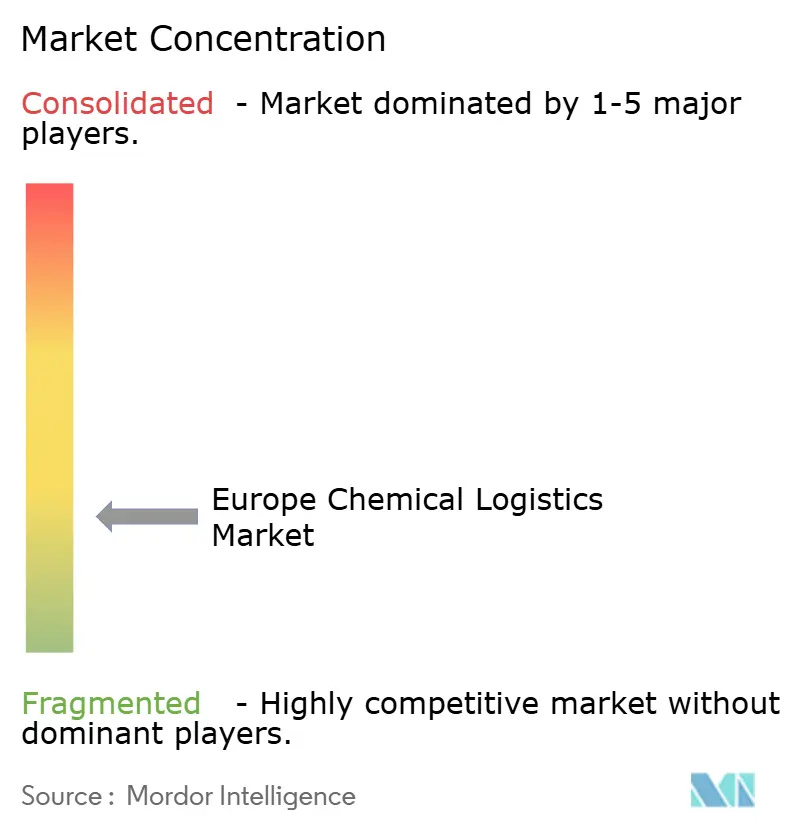
| Market Concentration | Low |
Major Players *Disclaimer: Major Players sorted in no particular order Image © Mordor Intelligence. Reuse requires attribution under CC BY 4.0. | |
Europe Chemical Logistics Market Analysis by Mordor Intelligence
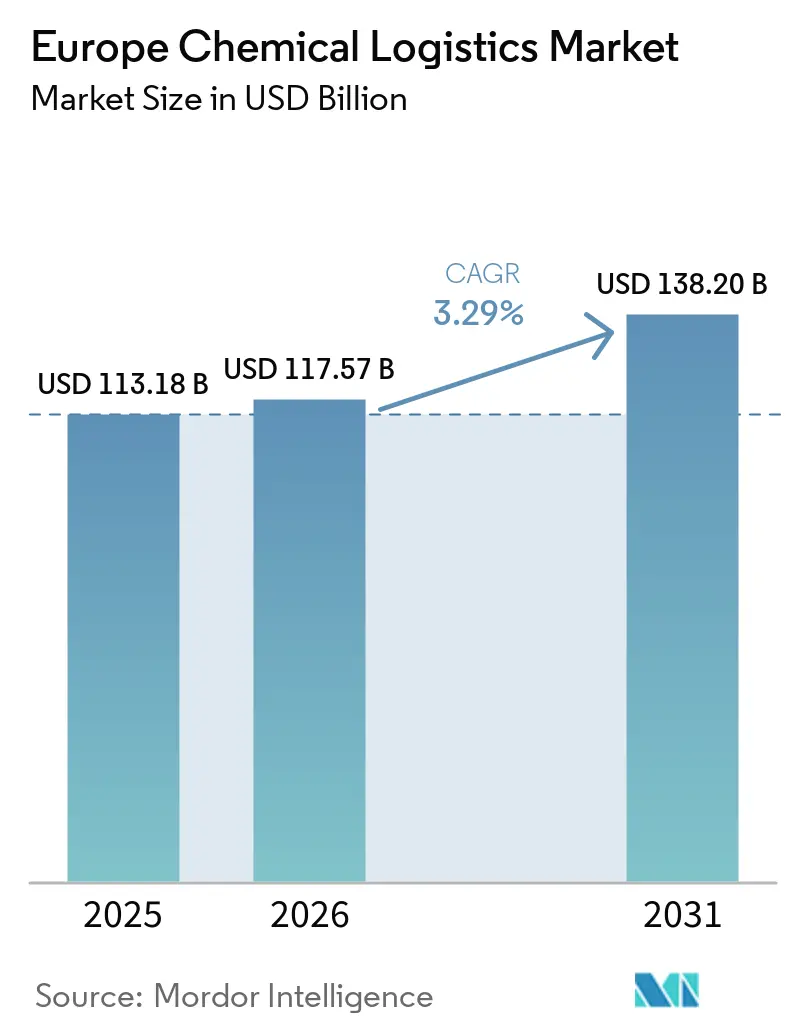
The Europe Chemical Logistics Market size is expected to grow from USD 113.18 billion in 2025 to USD 117.57 billion in 2026 and is forecast to reach USD 138.20 billion by 2031 at 3.29% CAGR over 2026-2031.
Steady expansion stems from resilient chemical production clusters, continued government rail-freight incentives, and growing demand for temperature-controlled services that support green-chemistry and biologics production. Companies optimize cross-border routes to align with REPowerEU energy diversification mandates while strengthening hub-and-spoke networks around specialty manufacturing centers. Digital freight-matching platforms enhance asset utilization for hazardous cargo, and mergers among leading third-party logistics (3PL) providers accelerate network density. However, cost inflation from CO₂-indexed tolls and a shortage of ADR-certified drivers tighten capacity, making regulatory compliance and technology adoption critical for competitive positioning across the Europe chemical logistics market.
Key Report Takeaways
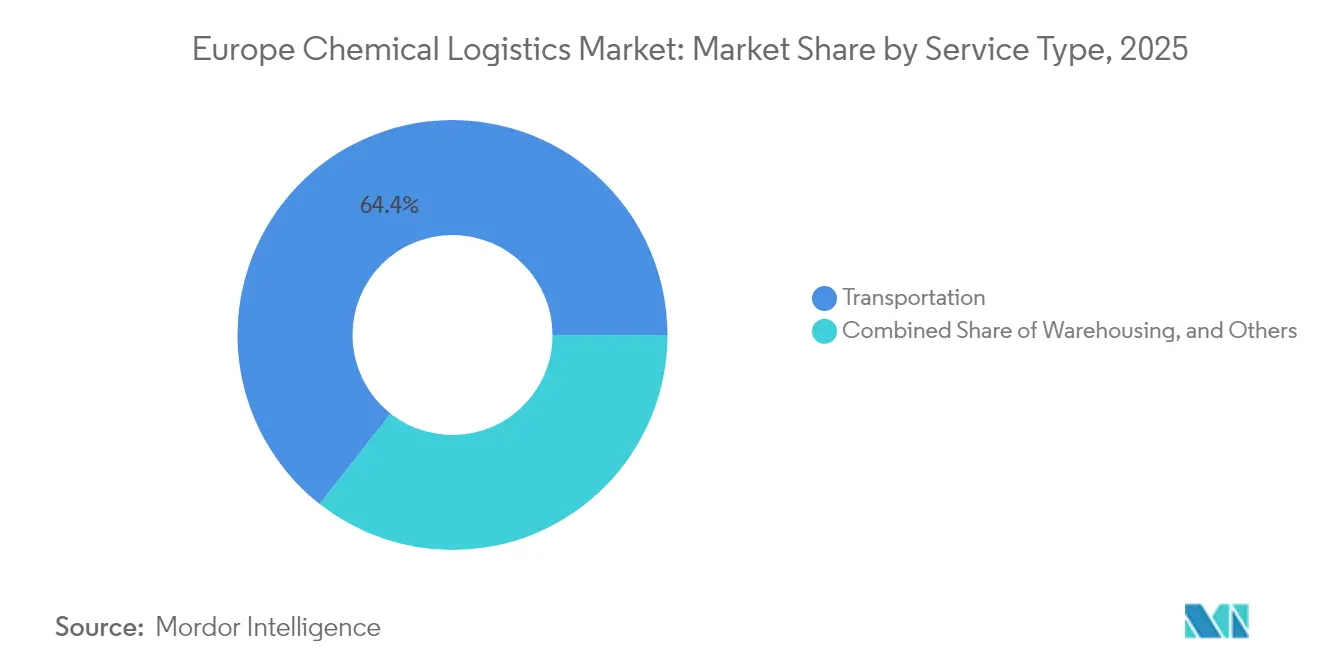
- By service, transportation commanded 64.40% of Europe chemical logistics market share in 2025, while value-added services are expected to record the fastest 3.56% CAGR through 2031.
- By end-user industry, oil & gas held 25.60% of the Europe chemical logistics market size in 2025; specialty chemicals is set to grow quickest at 3.73% CAGR to 2031.
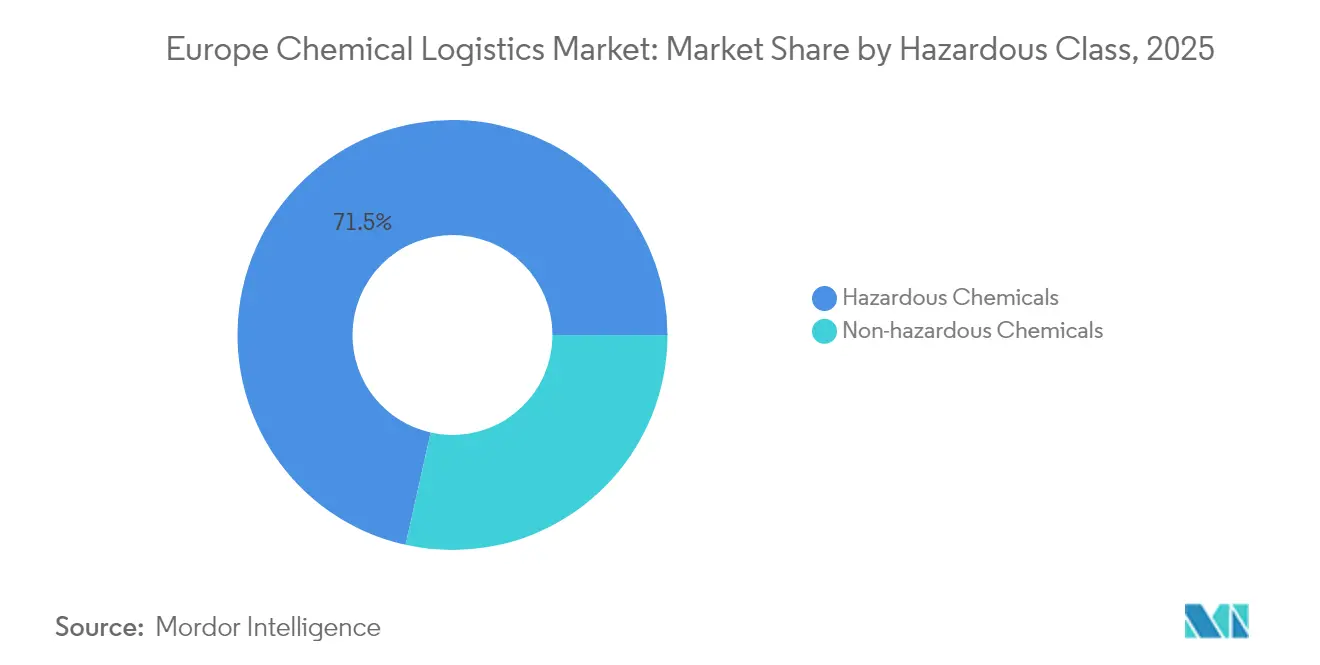
- By hazard class, hazardous chemicals accounted for a dominant 71.50% share of the Europe chemical logistics market in 2025 and should expand at a 4.05% CAGR through 2031.
- By temperature control, temperature-controlled logistics is forecast to post the highest 4.32% CAGR between 2026-2031, although non-temperature-controlled services retained a 59.40% revenue share in 2025.
- By geography, Germany led with 16.80% revenue share in 2025, whereas Poland is projected to register the fastest 4.08% CAGR over the forecast period.
Note: Market size and forecast figures in this report are generated using Mordor Intelligence’s proprietary estimation framework, updated with the latest available data and insights as of 2026.
Market Trends and Insights
Drivers Impact Analysis of Europe Chemical Logistics Market*
| Driver | (~) % Impact on CAGR Forecast | Geographic Relevance | Impact Timeline |
|---|---|---|---|
| Green-chemicals demand clustering | +0.8% | Germany, Netherlands, France | Medium term (2-4 years) |
| REPowerEU bulk chemicals re-routing | +0.9% | Pan-European, strongest in Germany & Netherlands | Short term (≤ 2 years) |
| On-site rail siding subsidies | +0.5% | Germany, Netherlands | Long term (≥ 4 years) |
| Expansion of ADR-compliant ISO-tank pools | +0.6% | Industrial clusters across Europe | Medium term (2-4 years) |
| M&A-driven 3PL network densification | +0.7% | DACH region and wider Europe | Medium term (2-4 years) |
| Digital freight-matching for hazardous cargo | +0.4% | Early adoption in Germany & Netherlands | Long term (≥ 4 years) |
| Source: Mordor Intelligence | |||
Green-chemicals demand concentrating loads closer to specialty hubs
Manufacturers dedicated to sustainable chemistry are relocating production near established clusters, shortening delivery distances yet heightening requirements for temperature-controlled and ADR-compliant infrastructure. ICIG’s integration of Valtris Advanced Organics sites into its Vynova platform illustrates how vertical integration inside chemical parks boosts load density and necessitates specialized warehouses with continuous environmental monitoring. Logistics providers offering validated cold-chain capability and leak-proof ISO-tank fleets capture premium rates because pharmaceutical and cosmetic intermediates demand strict handling protocols.
REPowerEU accelerating intra-Europe bulk chemicals re-routing
The EU policy to reduce dependence on Russian feedstocks has redirected bulk chemical flows toward western ports and inland multimodal hubs. Germany’s extension of EUR 229 million (USD 252.73 million) in track-access subsidies until 2028 strengthens rail viability, cutting end-to-end costs up to 20% compared with long-haul trucking. Agile 3PLs able to harmonize customs, safety, and sustainability compliance across several member states secure new contracts as manufacturers renegotiate supply lines[1].
On-site rail siding subsidies in Germany and Netherlands
Grants for factory rail sidings lower handling costs and curb carbon emissions. Chemie-based industrial parks that invest in private tracks report 2-3-day reductions in order-to-delivery cycles while channeling bulk volumes away from congested highways. The resulting modal shift amplifies the competitive edge of providers operating block-train services and certified tank-wagon cleaning stations, reinforcing the Europe chemical logistics market’s rail segment[2].
Expansion of ADR-compliant ISO-tank leasing pools
Leasing specialists such as Trifleet and Eurotainer expand their European fleets, freeing shippers from heavy upfront purchases. Standardized designs simplify cleaning, certification, and sensor retrofits, boosting fleet utilization while ensuring regulatory conformity. Wider availability of swap-body ISO-tanks offers flexibility for seasonal demand spikes and for new bio-based formulations, accelerating supply-chain responsiveness in the Europe chemical logistics industry.
Restraints Impact Analysis of Europe Chemical Logistics Market*
| Restraint | (~) % Impact on CAGR Forecast | Geographic Relevance | Impact Timeline |
|---|---|---|---|
| Shortage of ADR-certified truck drivers | -0.7% | Germany & United Kingdom | Short term (≤ 2 years) |
| Stricter CO₂ corridor tolls on German Autobahn | -0.5% | Germany, spillover to Netherlands & Austria | Medium term (2-4 years) |
| Limited rail path capacity | -0.4% | Germany, Netherlands, France | Long term (≥ 4 years) |
| Inflation-led surge in specialty packaging | -0.6% | Pan-European, acute in pharmaceutical cold chain | Short term (≤ 2 years) |
| Source: Mordor Intelligence | |||
Shortage of ADR-certified truck drivers
Training fees ranging from GBP 600-1,700 pose an entry barrier, while retirements outpace new license issuances. The Europe chemical logistics market therefore experiences lane imbalances and spot-rate surges on short notice. Providers counteract with in-house academies, pay premiums, and tighter route planning, yet capacity gaps persist, particularly for high consequence dangerous goods[3].
Stricter CO₂ corridor tolls on German Autobahn
Germany introduced carbon-indexed charges that raise per-kilometer costs for Euro VI diesel units by up to 15%, directly impacting hazardous cargo fleets whose powertrain conversion options remain limited. Route diversification toward rail, inland waterways, and intermodal solutions mitigates the burden but requires capital-intensive network re-engineering.
*Our forecasts treat driver/restraint impacts as directional, not additive. The impact forecasts reflect baseline growth, mix effects, and variable interactions.
Europe Chemical Logistics Market Segment Analysis
By Service:
Transportation dominance drives consolidationTransportation retained 64.40% revenue in 2025 as specialized tank-truck, rail-tank-wagon, and ISO-container moves remain the backbone of the Europe chemical logistics market. The segment secures economies of scale via network densification projects such as DSV’s pending takeover of DB Schenker. Meanwhile, the Europe chemical logistics market size for value-added services is forecast to expand at 3.56% CAGR, reflecting an uptick in labeling, repacking, and quality inspection tasks embedded into multi-client chemical distribution centers.
Within transportation, road carries time-critical or hazardous parcels, whereas rail gains share on long corridors backed by government incentives. Digital platforms matching ADR-compliant capacity with backhaul loads curb empty runs, improving margins even as toll surcharges escalate. Airfreight and short-sea solutions address niche, high-value payloads where transit time or bulk discounts outweigh cost premiums.
Value-added offerings increasingly include regulatory documentation, safety data management, and sustainability reporting, enabling shippers to outsource compliance complexity. As environmental, social, and governance (ESG) disclosure becomes mandatory, 3PLs embed CO₂ dashboards into portals, translating logistics performance into actionable emissions data. Growing demand for site logistics, blending, and sample testing further blurs the line between contract manufacturing and third-party logistics, elevating service sophistication across the Europe chemical logistics industry.

By End-User Industry:
Oil and gas leadership faces specialty growthOil & gas accounted for 25.60% of 2025 revenue, underpinned by established petrochemical feedstock flows. However, specialty chemical demand from pharmaceuticals and cosmetics is projected to grow at 3.73% CAGR, outpacing bulk segments. The Europe chemical logistics market size for pharmaceutical distribution benefits from new biologics sites that mandate GDP-certified cold-chain solutions, like UPS Healthcare’s enlarged Dublin campus.
Cosmetics logistics now mirrors drug-grade conditions, emphasizing temperature consistency, allergen segregation, and batch traceability. Green-chemistry initiatives intensify urgency for controlled environments. Petrochemical shippers, in contrast, confront price volatility and energy transition headwinds, prompting efficiency projects such as rail-siding retrofits and barge connectivity at refinery complexes. Agricultural chemicals and industrial gases remain steady contributors, though they require diverse packaging from IBCs to cylinder bundles stretching 3PL capability sets in the Europe chemical logistics market.
By Hazard Class:
Hazardous chemicals drive premium servicesHazardous cargo represented 71.50% revenue in 2025, commanding premium freight rates and specialized equipment deployment. Europe chemical logistics market share for hazardous materials benefits from regulatory barriers that limit competition to certified operators. Providers manage continuous driver training, periodic vehicle inspections, and insurance extensions, reinforcing market entry hurdles.
The Europe chemical logistics industry leverages advanced telematics, pressure sensors, and geofencing to comply with ADR and Seveso directives. Non-hazardous flows, although sizable, see commoditization as general freight carriers encroach; thus margins stay lower. The hazardous segment’s forecast 4.05% CAGR through 2031 is sustained by growth in lithium-ion battery precursors, bio-solvents, and high-purity reagents each necessitating meticulous segregation and documentation.
By Temperature Control:
Cold chain expansion drives growthTemperature-controlled freight is projected to rise at 4.32% CAGR, faster than the broader Europe chemical logistics market, fueled by biologics, vaccines, and heat-sensitive additives. Operators retrofit trailers with electric refrigeration units and remote monitoring to align with EU green-transport legislation. Demo projects like Frigo Logistics’ battery-electric reefer trucks in Poland illustrate early viability.
Non-temperature-controlled moves still represent the bulk of volumes thanks to commodity resins and inorganic minerals. Yet, shippers increasingly request validated temperature mapping even for ambient cargo to ensure product integrity across unpredictable climates, nudging incumbent carriers toward technology upgrades.
Geography Analysis
Germany Chemical Logistics Market
Germany captured 16.80% of 2025 revenue owing to its EUR 200 billion (USD 220.72 billion) chemical output and network of ADR-compliant depots. Federal rail-charge subsidies and public-private investment bolster corridor capacity and support the Europe chemical logistics market. Nevertheless, CO₂-indexed tolls raise trucking expenditure, spurring modal diversification. Mature clusters in Ludwigshafen, Leverkusen, and the Rhine-Ruhr rely on synchronized barge-rail-road synergies, fostering demand for 4PL orchestration services.
Poland Chemical Logistics Market
Poland emerges as the fastest-growing arena at 4.08% CAGR, supported by warehouse stock surpassing 35 million m² and investor appetite for modern Class-A parks that comply with chemical storage norms. Freight corridors linking Silesia to Baltic ports enable east-west transit, while lower labor costs sharpen competitiveness. International 3PLs scale footprints DB Schenker’s Rawicz site grew to 27,000 m² in May 2025 to support optical and specialty chemical clients.
Broader European Markets
The Netherlands, France, and the United Kingdom maintain sophisticated multimodal gateways. Rotterdam’s liquid bulk terminals and pipeline grid anchor trans-Atlantic feedstock. Calais Channel crossings facilitate time-critical UK chemicals, though post-Brexit customs workflows compel investment in digital declarations. Southern Europe (Italy, Spain) leverages Mediterranean routes for agrochemical and resin trades, aided by rising renewable-chemicals initiatives. Nordic nations focus on green hydrogen derivatives and advanced materials, commanding premium freight due to remote geography and stringent safety requirements.
Regulatory Landscape
The market operates under EU chemicals and dangerous-goods transport rules that shape packaging, labeling, documentation, and carrier qualification for hazardous and temperature-controlled moves. ADR 2025 entered into force on 1 January 2025, while Commission Delegated Directive (EU) 2025/149 required Member States to align national rules with technical progress for ADR/RID/ADN by 30 June 2025, reinforcing ongoing updates to operating procedures for road, rail, and inland waterways.
Compliance obligations also extend to upstream chemical classification and downstream waste and article reporting workflows that influence storage and distribution requirements. Regulation (EU) 2024/2865 amended CLP, including provisions that tighten responsibilities for online sales of chemicals into the EU by non-EU operators through an EU-established supplier, with transition arrangements for labelling and packaging running to 31 December 2026. For enforcement and flexibility, Commission Implementing Decision (EU) 2026/1041 (5 May 2026) authorized specific national derogations under Directive 2008/68/EC, and Commission Delegated Directive (EU) 2025/1801 set a 23 June 2026 deadline for Member States to adopt measures related to checks on dangerous-goods transport, raising the premium on auditable SOPs, training, and inspection readiness across cross-border lanes.
Value Chain Analysis
Europe chemical logistics value creation begins at integrated production clusters and chemical parks, then moves through bulk and packaged transport (tank truck, rail tank wagon, ISO tank, barge/short sea), and into specialized terminals and multi-client distribution centers for storage, sampling, labeling, and regulatory documentation. Gateway nodes such as the Port of Rotterdam and the Antwerp chemical cluster concentrate liquid bulk handling and dangerous-goods storage, while inland hubs in Germany, BENELUX, and Poland link plants to multimodal corridors through intermodal terminals and certified cleaning and maintenance points for tanks and swap bodies.
Critical bottlenecks tend to cluster around corridor capacity constraints, modal disruption risk, and compliance-dependent labor and equipment availability. Rail and inland-waterway resiliency remains central because the Rhine corridor supports a large share of bulk chemical flows, and major renovation work on the right bank Rhine rail line between Troisdorf and Wiesbaden, starting in July 2026 and running through mid-December 2026, indicates how planned capacity outages can cascade into road substitution and terminal congestion. Investment is therefore concentrating on trimodal infrastructure and high-spec storage: Noord Natie Odfjell Antwerp Terminal announced a multi-year plan exceeding EUR 200 million (November 2025), while operators such as Bertschi expanded intermodal terminal capabilities at Rotterdam (completed June 2025) and brought online the Antwerp Zomerweg dangerous-goods trimodal facility (operations commenced November 2024).
Competitive Landscape
Europe chemical logistics market competition remains moderate. DSV’s planned acquisition of DB Schenker is poised to reshape rankings by combining extensive European overland networks and deep chemical know-how. Logwin’s July 2025 purchase of Hanse Service Group added GDP-certified cold-chain capacity, signaling targeted consolidation toward high-margin niches.
Technology investments differentiate market leaders: XPO Logistics embeds AI route planning and CO₂ dashboards to meet shipper sustainability targets. Smaller regional specialists survive through unique expertise, such as bulk rail siding management or integrated site logistics at chemical parks.
Integrated platforms offering end-to-end visibility, regulatory documentation, and emissions reporting command premium contracts. Fleet modernization toward alternative fuels remains gradual due to technical constraints on hazardous goods carriage, yet early movers secure green-contract tenders from sustainability-focused producers.
Europe Chemical Logistics Industry Leaders
-
DHL
-
DSV A/S
-
CEVA Logistics
-
XPO Logistics
-
Kuehne + Nagel
- *Disclaimer: Major Players sorted in no particular order
Europe Chemical Logistics Market Companies Covered in this Report
- DHL
- DSV A/S
- CEVA Logistics
- XPO Logistics
- Kuehne + Nagel
- BDP International
- Bertschi AG
- Suttons International
- Den Hartogh Logistics
- Broekman Logistics
- Rhenus Logistics
- H. Essers
- Log4Chem
- Chemical Express
- JCL Logistics
- MOL Logistics
- DACHSER
- De Rijke Group
- Noatum Logistics
- Pfenning Logistics GmbH
Market Opportunities and Future Outlook
Opportunity is concentrated in specialized capacity at major chemical gateways and their inland spokes, especially for polymer, liquid bulk, and dangerous-goods storage that can flex between road, rail, and barge. In June 2026, Van Moer Logistics inaugurated a polymers hub with 63 new silos at the Port of Antwerp as part of a EUR 185 million investment program, and in June 2026 LBC Tank Terminals approved Project Rainbow 5 Phase A in Rotterdam to add 41,000 cubic metres of capacity by 2028. These projects point to where shippers are building throughput and inventory buffers, creating adjacent needs for ISO-tank positioning, cleaning and repair services, and value-added tasks (sampling, labeling, QA, and compliance documentation) around the same nodes.
Digital collaboration and compliance tooling are also near-term focus areas, given how hazardous chemicals dominate the market and how transport checks and CLP responsibilities are tightening. The May 2026 ECTA, Cefic, and ECLIC digitalization survey highlighted standardisation and security as key barriers to API-based collaboration, leaving room for interoperable data layers that connect SDS, UFI and labeling workflows, transport documents, and emissions reporting across multi-carrier networks. On the demand side, early-stage software funding activity suggests SME needs, such as Kyrok securing EUR 3.1 million in June 2026 to apply AI to pharma and chemical supply chains, while large shippers with sensitive products continue to invest in automation, including Symrise breaking ground in May 2026 on a EUR 25 million expansion of its Holzminden logistics center with an automated high-bay warehouse.
Recent Industry Developments in Europe Chemical Logistics Market
- July 2026: CEVA Logistics extended a five-year agreement to continue managing GSK's 9,830 sq m pharmaceutical distribution center in Robakowo, Poland. The renewal reinforces demand for GDP-aligned, temperature-controlled distribution capabilities inside Central European corridors, where hazardous and healthcare-grade handling requirements overlap in staffing, process control, and site security.
- June 2026: DHL Group announced a New Energy logistics growth strategy spanning battery energy storage, hydrogen, solar, and wind. The initiative raises specialized handling and project logistics needs (including hazardous components and sensitive materials), prompting providers to expand certified capacity, visibility tooling, and multimodal execution across Europe.
- July 2025: Logwin AG acquired Hanse Service Internationale Fachspedition GmbH and Pharmalogisticspartner Internationale Fachspedition GmbH, adding 7,600 sq m of temperature-controlled space with GDP, wholesaler, and IFS certifications. The deal expands cold-chain and regulated distribution depth, aligning with faster-growing temperature-controlled and value-added service demand within chemical and life-sciences logistics.
Europe Chemical Logistics Market Report Scope and Research Methodology
Market Definition and Coverage
For this study, the Europe chemical logistics market covers paid logistics services used to move and store chemical products safely, including transportation, warehousing, distribution, and supporting handling services across European routes.
Scope exclusions: This sizing excludes in-house captive logistics done fully by chemical producers, and it also excludes chemical manufacturing value.
Segments Covered in This Report
- By Service (Value, USD Million)
- Transportation
- Road
- Rail
- Air
- Sea
- Warehousing, Distribution and Inventory Management
- Other Services
- Transportation
- By End-User Industry (Value, USD Million)
- Pharmaceutical
- Cosmetic
- Oil and Gas
- Specialty Chemicals
- Other End-Users
- By Hazard Class (Value, USD Million)
- Hazardous Chemicals
- Non-hazardous Chemicals
- By Temperature Control (Value, USD Million)
- Temperature-Controlled (Refrigerated/Heated)
- Non-Temperature-Controlled
- By Geography (Value, USD Million)
- Germany
- United Kingdom
- Netherlands
- France
- Italy
- Spain
- Poland
- BENELUX (Belgium, Netherlands, and Luxembourg)
- NORDICS (Denmark, Finland, Iceland, Norway, and Sweden)
- Rest of Europe
Data Sources, Market Sizing, and Validation
Desk Research
Desk work started with a clear view of what "chemical logistics" means in Europe, and then we mapped it to measurable activity like freight movement, storage needs, and compliance-heavy handling. We used public sources to anchor the macro picture and reduce reliance on assumptions.
We referenced non-paywalled sources such as Eurostat transport and trade series, the European Chemicals Agency (ECHA) for regulatory context, UNECE ADR guidance for dangerous goods movement, European Commission transport and energy statistics, and trade association publications such as Cefic for regional chemical output signals. We also screened company annual reports, investor presentations, and reputable press to understand service mix, customer needs, and capacity additions. Where needed, paid subscriptions were used for company financials and patent databases, and an import-export shipment-level database was used selectively to sanity-check trade lanes and flow direction. The sources listed here are illustrative, and many additional public and paid references were used for data collection, cross-checks, and clarification.
Primary Interviews and Surveys
Primary work focused on validating how chemical volumes translate into outsourced logistics spending, and how much premium is paid for hazardous handling, temperature control, and compliant documentation. We spoke with logistics operators, warehouse providers, and chemical shippers across key European markets, and used their inputs to confirm assumptions on mode mix, utilization, pricing movement, and service bundling.
Distribution of primary research fieldwork respondents
| Company type | Respondent position |
|---|---|
| Top tier: 36% | CXOs: 14% |
| Mid tier: 49% | Functional/Unit leaders: 29% |
| Smaller Players: 15% | Managers: 57% |
Market-Sizing & Forecasting
Sizing was built using a top-down approach where Europe chemical production and trade signals were reconstructed into addressable logistics demand, then adjusted for the share that is outsourced versus handled internally. After forming that demand pool, we converted it into market value by applying service mix and pricing logic that reflects the compliance-heavy nature of chemicals.
Key fingerprints included mode split across road, rail, sea, and pipeline, the hazardous versus non-hazardous handling share, temperature-controlled activity, warehousing throughput intensity, and the spread of value-added services such as labeling, drumming, and documentation support. These variables were not treated as fixed because pricing and mix shift with fuel and energy costs, CO2-related road charges, and changes in chemical output by country. We corroborated the results using selective bottom-up checks such as sampled provider revenue benchmarks, lane-based spot checks for transport rates, and warehouse capacity utilization discussions. Where data gaps existed, we used conservative ranges and then validated them through follow-up calls.
For forecasting, we ran scenario analysis around chemical output and trade recovery, energy and fuel cost paths, and regulatory tightening impacts on compliant capacity. The final year-by-year curve was smoothed to avoid unrealistic jumps, using consensus ranges shared by primary respondents on expected price progression and utilization.
Data Validation & Update Cycle
Model outputs were checked against independent signals such as chemical output direction, export-import movement, and changes in transport activity, then reviewed for any value jumps that could not be linked to a real driver. When variances were found, assumptions were re-tested, and targeted re-contacts were used to confirm whether the change came from mix, pricing, or a scope boundary.
Before sign-off, the work goes through a multi-step analyst review where calculations are re-run, unit consistency is verified, and country rollups are reconciled to the Europe total. Reports are refreshed annually, with interim updates when material events occur, such as regulation changes or sharp cost shifts. Right before delivery, we complete a final pass so clients receive the latest updated view.
Mordor Intelligence's Europe Chemical Logistics Market Size Compared With Other Published Estimates
Published market sizes for Europe chemical logistics do not always match, mainly because the service boundary and the pricing basis are not the same across studies. Some estimates focus only on transport legs, while others add warehousing and value-added handling, which can change the total by a wide margin.
By tracking service-mix weights and refreshing ADR-linked cost uplifts in the model, Mordor Intelligence keeps the Europe chemical logistics total tied to observable transport activity and storage needs, rather than broad chemicals services revenue. Differences also come from how rail and pipeline are treated, whether hazardous premiums are applied uniformly, and whether currency conversion timing aligns to the stated base year.
Benchmark comparison
| Source | Market Size | Gaps in Research Methodology |
|---|---|---|
| Mordor Intelligence | USD 113.18 B (2025) | |
| Trade Journal A | USD 101.91 B (2024) | Reported as chemical distribution and leans toward transport-centric activity, with limited visibility on specialized warehousing and value-added handling in the stated total. |
| Regional Consultancy B | USD 14.52 B (2025) | Appears to capture only a narrow slice of logistics spend (often specialty or hazardous-only services), which leaves out large non-hazardous volumes and routine storage and distribution work. |
The spread in the table is best explained by what is counted as "logistics" and how broadly chemical movement is interpreted. When the boundary includes transportation plus chemical warehousing, distribution, and compliant add-on services, the value naturally sits much higher and can be traced to clear activity drivers. Our approach keeps those drivers explicit, which makes the total easier to reproduce and stress-test as conditions change.
Key Questions Answered in the Report
How large will chemical logistics revenues in Europe reach by 2031?
The European chemical logistics market size was valued at USD 113.18 billion in 2025 and estimated to grow from USD 117.57 billion in 2026 to reach USD 138.20 billion by 2031, at a CAGR of 3.29% during the forecast period (2026-2031).
Which service category leads chemical logistics spending in Europe?
Transportation services dominate with a 64.40% share due to specialized tank-truck, rail-tank, and ISO-container moves.
Why is Poland the fastest-growing logistics hub for chemicals?
Its 35 million m² modern warehouse base, strategic east-west trade location, and lower operating costs propel a 4.08% CAGR.
What is driving demand for temperature-controlled chemical transport?
Expansion of biologics and cosmetics manufacturing requires validated cold-chain networks, lifting the segment at a 4.32% CAGR.
How are CO₂-based tolls affecting chemical freight in Germany?
The carbon-indexed charges raise trucking costs up to 15%, pushing shippers toward rail and intermodal options to control expenses.
What competitive strategies are market leaders pursuing?
Major 3PLs are consolidating networks through acquisitions and adopting digital platforms that optimize hazardous cargo routing and emissions reporting.