
North America Monoclonal Antibody Market Size and Share
| Study Period | 2020 - 2030 |
| Forecast Data Period | 2025 - 2030 |
| Historical Data Period | 2020 - 2023 |
| Market Size (2025) | USD 92.32 Billion |
| Market Size (2030) | USD 152.18 Billion |
| CAGR (2025 - 2030) | 10.51% |
| Market Concentration | Low |
Major Players *Disclaimer: Major Players sorted in no particular order |
North America Monoclonal Antibody Market Analysis by Mordor Intelligence
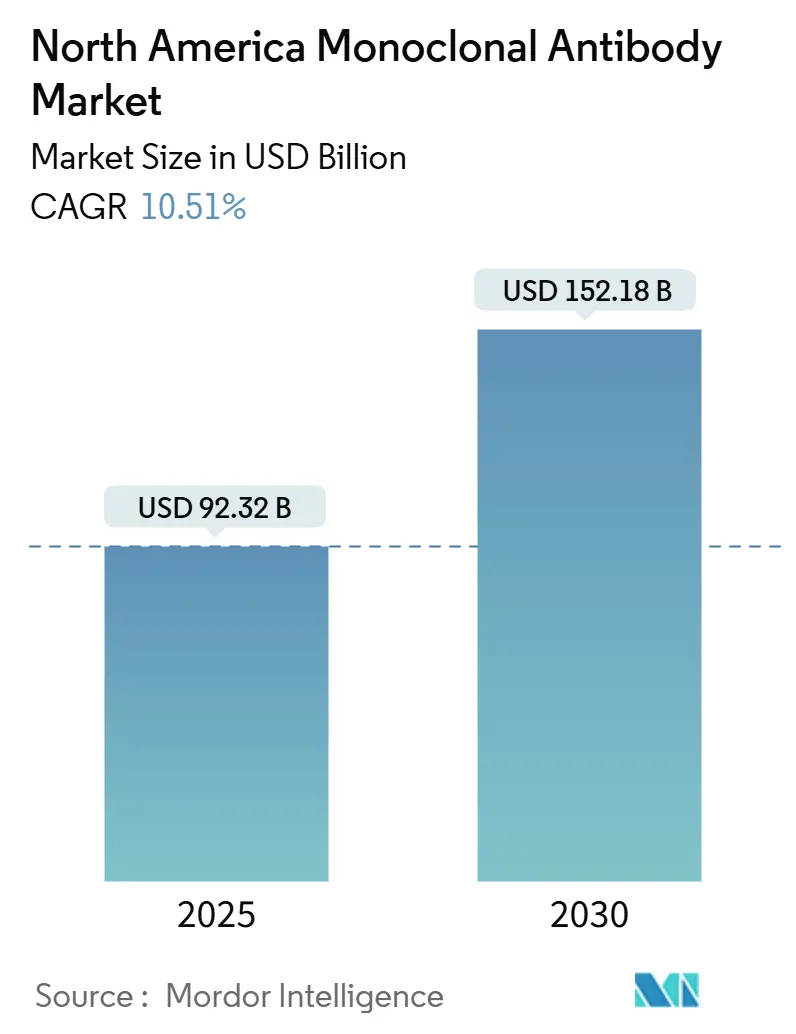
The North America Monoclonal Antibody Market size is estimated at USD 92.32 billion in 2025, and is expected to reach USD 152.18 billion by 2030, at a CAGR of 10.51% during the forecast period (2025-2030).
Technological advancements, the increasing prevalence of cancer and chronic diseases, and substantial government investments in research and development for monoclonal antibodies are anticipated to contribute significantly to market expansion during the forecast period. These factors are expected to enhance innovation, improve treatment options, and create lucrative opportunities for industry stakeholders.
Key market players are increasingly forming strategic partnerships with government authorities, a trend poised to bolster market growth in the coming years. For example, in September 2023, the United States Department of Health and Human Services (HHS) solidified its collaboration with Regeneron. This extension of their public-private partnership aims to develop crucial monoclonal antibodies under Project NextGen, addressing the growing demand for effective therapeutic solutions. This initiative underscores the increasing reliance on monoclonal antibodies as a critical component in combating infectious diseases, thereby driving market expansion.
Besides, in October 2024, Merck reported significant advancements with the release of positive results from its Phase 2b/3 clinical trial (MK-1654-004) for clesrovimab. This investigational monoclonal antibody is strategically developed to provide prophylactic protection for infants against respiratory syncytial virus (RSV) during their first RSV season, addressing a critical unmet medical need. The company also presented interim findings from the ongoing Phase 3 trial (MK-1654-007), further reinforcing the potential of clesrovimab in combating RSV.
Key players in North America are ramping up strategic activities, including product launches, collaborations, and agreements, fueling the region's market growth. For example, in February 2023, Pfizer Inc. secured a Priority Review from the United States Food and Drug Administration (FDA) for its investigational bispecific antibody, elranatamab. This antibody targets the B-cell maturation antigen (BCMA) and is aimed at treating patients with relapsed or refractory multiple myeloma (RRMM). Given this uptick in strategic activities by major players, North America's market growth is poised to accelerate in the coming years.
Thus, due to the rise in strategic activities by the key players, such as agreements, product launches, and collaborations, the studied market is expected to witness significant growth over the forecast period. However, the high cost pertaining to the method involved in the production of monoclonal antibodies and the patent expiry are likely to hinder the market growth over the forecast period.
North America Monoclonal Antibody Market Trends and Insights
Infectious Diseases Segment is Expected to Hold a Notable Share of the Market Over the Forecast Period
Viruses, bacteria, fungi, and parasites cause infectious diseases. Typically, these diseases spread between individuals via contaminated food or water, or through insect bites. Commonly diagnosed infectious diseases include the common cold, influenza, COVID-19, gastroenteritis, hepatitis, and respiratory syncytial virus (RSV). Monoclonal antibodies (mABs) are safe and effective proteins designed to target a specific epitope of a highly conserved protein found in viruses or bacterial pathogens. As a result, mABs are extensively used in treating infectious diseases.
North America is witnessing a surge in infectious diseases, leading to heightened use of monoclonal antibodies (mABs) and the introduction of advanced mABs. These trends are poised to drive segment growth in the coming years, as the demand for effective and targeted therapeutic solutions continues to rise. For example, the CDC's December 2024 Surveillance data, between the last week of November and the last week of December 2024, hospitalizations linked to respiratory viruses surged by over three times, marking a 209.2% increase in the United States. By December's end, these hospitalizations represented 9.3% of the total, a jump from 3.0% just a month prior. This significant rise in respiratory virus-associated hospitalizations underscores the growing demand for effective treatment options, including monoclonal antibodies, which are increasingly being recognized as a critical tool in managing severe respiratory infections.
The rising prevalence of infectious diseases highlights the urgent need for innovative treatments, such as monoclonal antibodies (mABs), which precisely target specific pathogens. Furthermore, the surge in regulatory approvals for mABs aimed at combating infectious diseases propels their growth in North America. For instance, in July 2023, the United States Food and Drug Administration (FDA) approved Beyfortus (nirsevimab-alip) to prevent RSV-related lower respiratory tract disease in newborns and infants. This approval also extends to children up to 24 months who are at risk of severe RSV during their second season. Such endorsements not only affirm the effectiveness of mABs but also address the region's escalating demand for advanced therapeutic solutions.
Funding and grants for infectious diseases and the advancement of monoclonal antibodies are poised to drive segment growth in the coming years. The increasing demand for monoclonal antibodies, driven by their effectiveness in targeting specific pathogens and treating various diseases, further underscores the importance of such developments. For example, in August 2023, the University of Chicago crafted monoclonal antibodies aimed at multiple influenza strains. Celdara Medical commercialized these antibodies and subsequently secured a Phase II Small Business Innovation Research (SBIR) Fast-Track grant from the National Institute of Allergy and Infectious Diseases (NIAID) of the National Institutes of Health (NIH).
Key players are ramping up their strategic activities, and with the uptick in infectious diseases, the segment in question is poised for notable growth in the coming years. This growth is further driven by the increasing demand for monoclonal antibodies, which are widely utilized in the treatment and prevention of infectious diseases, thereby creating significant opportunities in the market.
United States is Expected to Witness Healthy Growth in the Market Over the Forecast Period
Robust healthcare infrastructure, a strong presence of major industry players, and widespread adoption of monoclonal antibodies for chronic disease treatments position the United States as a dominant player in the market. The increasing demand for monoclonal antibodies, driven by their effectiveness in managing chronic and debilitating diseases, further strengthens this position. For instance, in June 2023, Biocon Biologics introduced Hulia (adalimumab-fkjp) injection, a Humira biosimilar, in the United States. This injection targets conditions like rheumatoid arthritis and psoriatic arthritis, among other serious ailments, addressing the growing need for advanced therapeutic solutions.
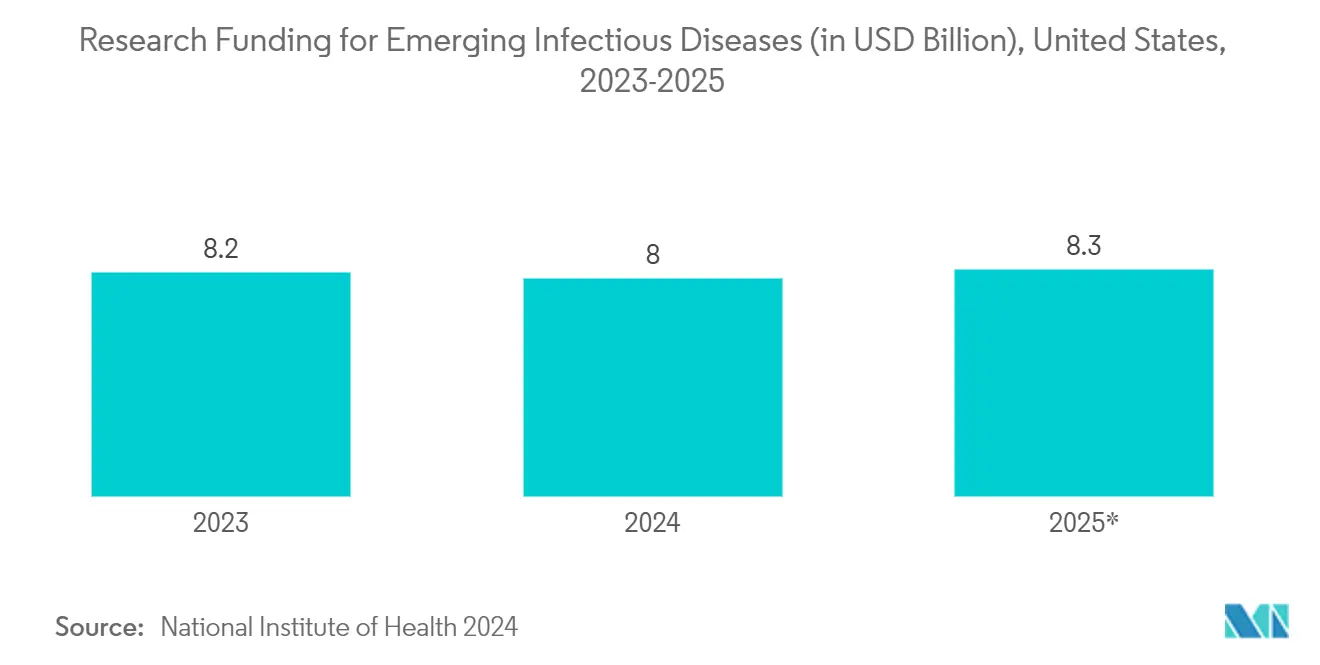
Research funding and collaborations tied to monoclonal antibodies are set to fuel market growth in the United States. For example, in September 2024, the National Institute of Allergy and Infectious Diseases (NIAID), a division of the National Institutes of Health (NIH), granted the University of Texas Medical Branch a substantial three-year award totaling USD 15.6 million annually. This funding was earmarked for pioneering research focused on creating vaccines and monoclonal antibodies (mAbs) targeting high-priority viral pathogens. The growing demand for monoclonal antibodies, driven by their effectiveness in treating infectious diseases and their critical role in addressing emerging health threats, underscores the importance of this initiative. This research aligns with the increasing global need for advanced therapeutic solutions to combat viral outbreaks and safeguard public health.
The increasing demand for monoclonal antibodies, driven by their critical role in treating infectious diseases and their potential in addressing future pandemics, underscores the importance of such investments. Therefore, due to rising government initiatives to support monoclonal antibody development in the United States and the surge in product launches, the United States is expected to witness significant growth over the forecast period.
Competitive Landscape
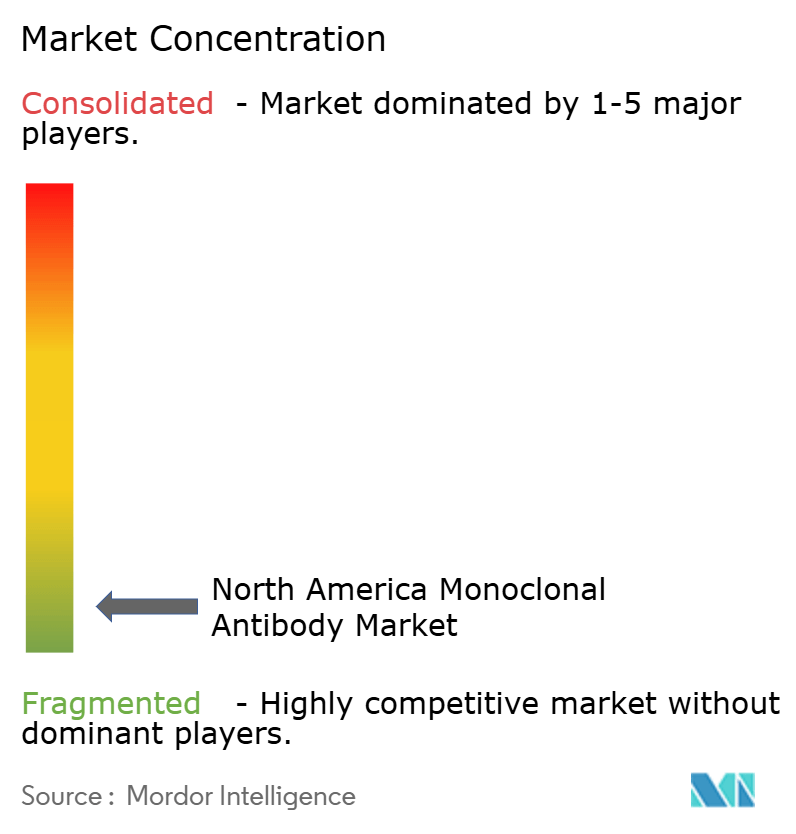
The North America monoclonal antibody market is fragmented in nature due to the presence of several companies operating globally as well as regionally. The key market players are involved in various strategic activities such as product launches, collaborations, and agreements to expand their presence and availability of the products. A few of the major companies in the market are Eli Lilly and Company, Johnson & Johnson, AstraZeneca PLC, Pfizer Inc. and GSK plc among others.
North America Monoclonal Antibody Industry Leaders
-
Johnson & Johnson
-
Pfizer Inc.
-
GSK plc
-
AstraZeneca PLC
-
Eli Lilly and Company
- *Disclaimer: Major Players sorted in no particular order
Recent Industry Developments
- January 2025: The Food and Drug Administration approved datopotamab deruxtecan-dlnk (marketed as Datroway), a conjugate of a Trop-2-directed antibody and a topoisomerase inhibitor, which is now approved for adult patients. Specifically, it is aimed at those with unresectable or metastatic breast cancer. The cancer types targeted are hormone receptor (HR)-positive and human epidermal growth factor receptor 2 (HER2)-negative (classified as IHC 0, IHC1+, or IHC2+/ISH-). Marstacimab, an IgG1l monoclonal antibody, targets explicitly the tissue factor pathway inhibitor.
- July 2024: The United States Food and Drug Administration (FDA) approved donanemab-azbt (Kisunla) for treating Alzheimer's disease (AD) based on evidence of clinically meaningful benefits from the Phase III TRAILBLAZER-ALZ 2 trial. This disease-modifying agent, administered via intravenous infusion, targets patients with mild cognitive impairment (MCI) stemming from AD. The approval highlights the growing demand for monoclonal antibody-based therapies, which are increasingly recognized for their potential to address complex neurological conditions like AD.
North America Monoclonal Antibody Market Report Scope
As per the scope of the report, monoclonal antibodies are cloned from antibodies produced in the body and are used for the treatment of many fatal diseases like cancer, autoimmune diseases, viral disease treatment, and others. The main advantage of using monoclonal antibodies in treating these diseases is that they are taken from a biological source and can produce antibodies in the long term.
The Asia Pacific sleep tech devices market is segmented by product, end-user, and geography. By product, the market is segmented into in-vivo and in-vitro. By source, the market is segmented into chimeric, human, humanized, and murine. By indication, the market is segmented into cancer, autoimmune diseases, infectious diseases, inflammatory diseases, and other indications. By end user market is segmented into hospitals, research institutes, and other end users. By geography, the market is segmented into United States, Canada and Mexico. For each segment, the market size is provided in terms of value (USD).
| In-vivo |
| In-vitro |
| Chimeric |
| Human |
| Humanized |
| Murine |
| Cancer |
| Autoimmune Diseases |
| Infectious Diseases |
| Inflammatory Diseases |
| Other Indications |
| Hospitals |
| Research Institutes |
| Other End Users |
| United States |
| Canada |
| Mexico |
| By Production Methods | In-vivo |
| In-vitro | |
| By Source | Chimeric |
| Human | |
| Humanized | |
| Murine | |
| By Indications | Cancer |
| Autoimmune Diseases | |
| Infectious Diseases | |
| Inflammatory Diseases | |
| Other Indications | |
| By End Users | Hospitals |
| Research Institutes | |
| Other End Users | |
| Geography | United States |
| Canada | |
| Mexico |
Key Questions Answered in the Report
How big is the North America Monoclonal Antibody Market?
The North America Monoclonal Antibody Market size is expected to reach USD 92.32 billion in 2025 and grow at a CAGR of 10.51% to reach USD 152.18 billion by 2030.
What is the current North America Monoclonal Antibody Market size?
In 2025, the North America Monoclonal Antibody Market size is expected to reach USD 92.32 billion.
Who are the key players in North America Monoclonal Antibody Market?
Johnson & Johnson, Pfizer Inc., GSK plc, AstraZeneca PLC and Eli Lilly and Company are the major companies operating in the North America Monoclonal Antibody Market.
What years does this North America Monoclonal Antibody Market cover, and what was the market size in 2024?
In 2024, the North America Monoclonal Antibody Market size was estimated at USD 82.62 billion. The report covers the North America Monoclonal Antibody Market historical market size for years: 2020, 2021, 2022, 2023 and 2024. The report also forecasts the North America Monoclonal Antibody Market size for years: 2025, 2026, 2027, 2028, 2029 and 2030.
North America Monoclonal Antibody Market Report
Statistics for the 2025 North America Monoclonal Antibody market share, size and revenue growth rate, created by Mordor Intelligence™ Industry Reports. North America Monoclonal Antibody analysis includes a market forecast outlook for 2025 to 2030 and historical overview. Get a sample of this industry analysis as a free report PDF download.