
Market Overview
| Study Period | 2021 - 2031 |
|---|---|
| Forecast Data Period | 2026 - 2031 |
| Historical Data Period | 2021 - 2024 |
| Growth Rate | 3.04 % |
| Market Concentration | Medium |
Major Players *Disclaimer: Major Players sorted in no particular order Image © Mordor Intelligence. Reuse requires attribution under CC BY 4.0. | |
North America Gas Turbine MRO Market Analysis by Mordor Intelligence
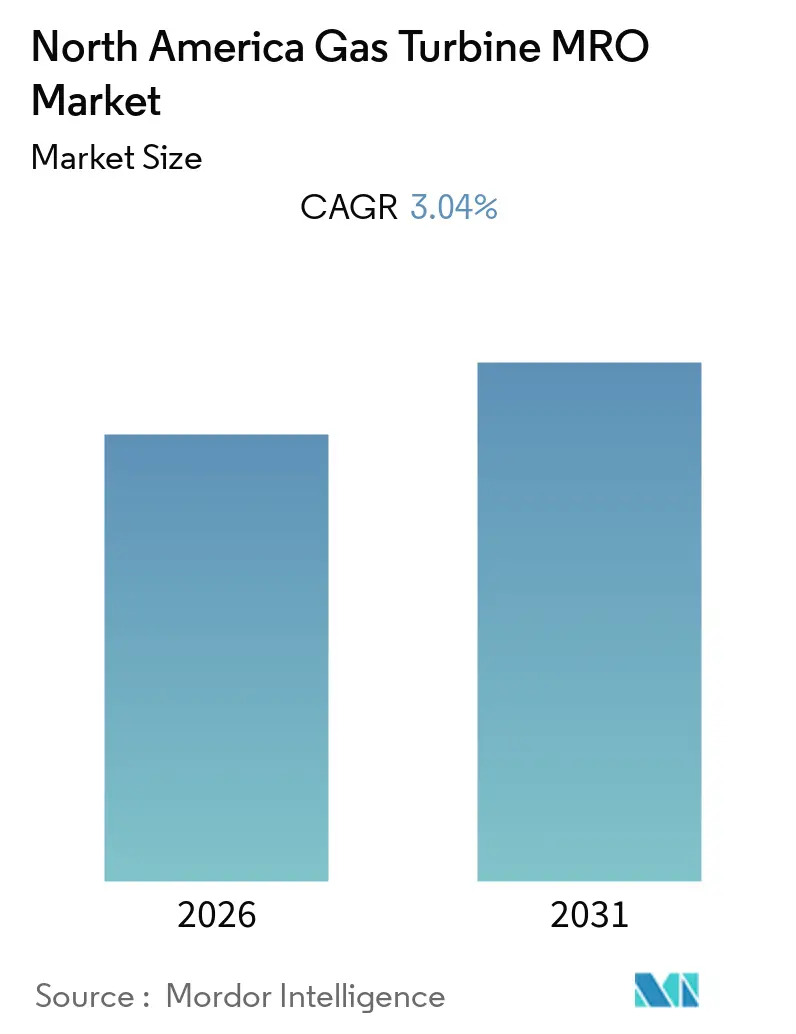
The North America Gas Turbine MRO Market size is expected to register a CAGR of greater than 3.04% during the forecast period.
- The maintenance sector is expected to dominate the market during the forecast period, owing to various factors, such as the growth of the aviation industry in the region, increase in power generation from gas-based plants due to rising concerns over greenhouse gas emissions, maintaining the efficiency of the turbines, and stringent emission norms on power plants.
- The increasing demand for electrical energy to sustain global development requires consistent heavy investments in power supply generation. This has helped the the growth of the market for gas turbines MRO significantly in recent years, and it is expected to do so during the forecast period.
- The United States is expected to dominate the market, owing to the factors, like economic growth, growth of the aviation industry, increase in the number of gas-based power generation plants, and the aging gas-based power plants.
Note: Market size and forecast figures in this report are generated using Mordor Intelligence’s proprietary estimation framework, updated with the latest available data and insights as of 2026.
North America Gas Turbine MRO Market Trends and Insights
Maintenance Sector to Dominate the Market
- The increase in the production of natural gas has shifted the global focus on the development of gas-fired power plants. The greenhouse gases emitted from gas-fired power plants are comparatively lower than that emitted from coal-fired power plants. Moreover, the demand for peak power is increasing globally, which can be most effectively met by gas-based power generation.
- The increase in the number of gas-based power generation plants leads to growth in the gas turbine MRO market in power sector. While a gas turbine may need an engine repair or replacement in 4-5 years, the maintenance starts soon after installation.
- North America holds over 35% of the global revenue passenger kilometers in airplanes, with significant growth in recent years, and the United States is leading the region with a big share. This increase in the aviation industry goes hand in hand with the gas turbine MRO industry.
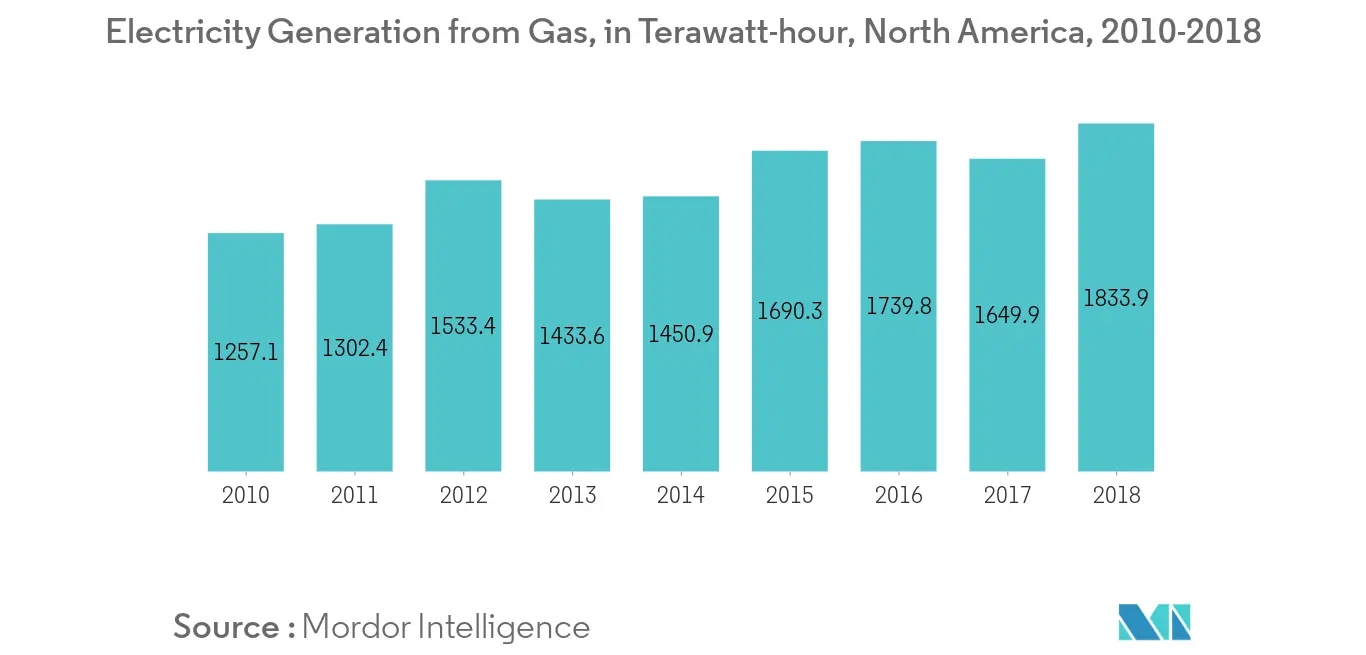
- Furthermore, the electricity demand is expected to increase in future, fueled by the electrification of the automobile. Several countries have adopted targets of phasing out the sale of passenger cars running on fossils. Electricity generation from gas in the region grew from 1122.5 TWh in 2008 to 1833.9 TWh in 2018, registering a growth of over 63%.
- Therefore, factors, such as increased access to electricity, rise in the number of electric vehicles, and increased concerns over greenhouse gas emissions from coal-based power plants, are expected to help drive the gas turbine market in power sector, which is expected to drive the North American gas turbine maintenance market.


United States to Dominate the Market
- The United States is expected to maintain its dominance in the region during the forecast period, due to an increase in energy demand and natural gas usage in the region. There has been a major increase in the use of gas for power generation in the region, aiming at reducing greenhouse gas emissions.
- With the rising pollution concerns due to industrialization in the country, the shift toward clean energy generation from gas turbines has gained considerable momentum. Electricity generation from gas in the United States grew from 949.4 TWh in 2008 to 1578.5 TWh in 2018, registering a growth of over 66% in just a decade.
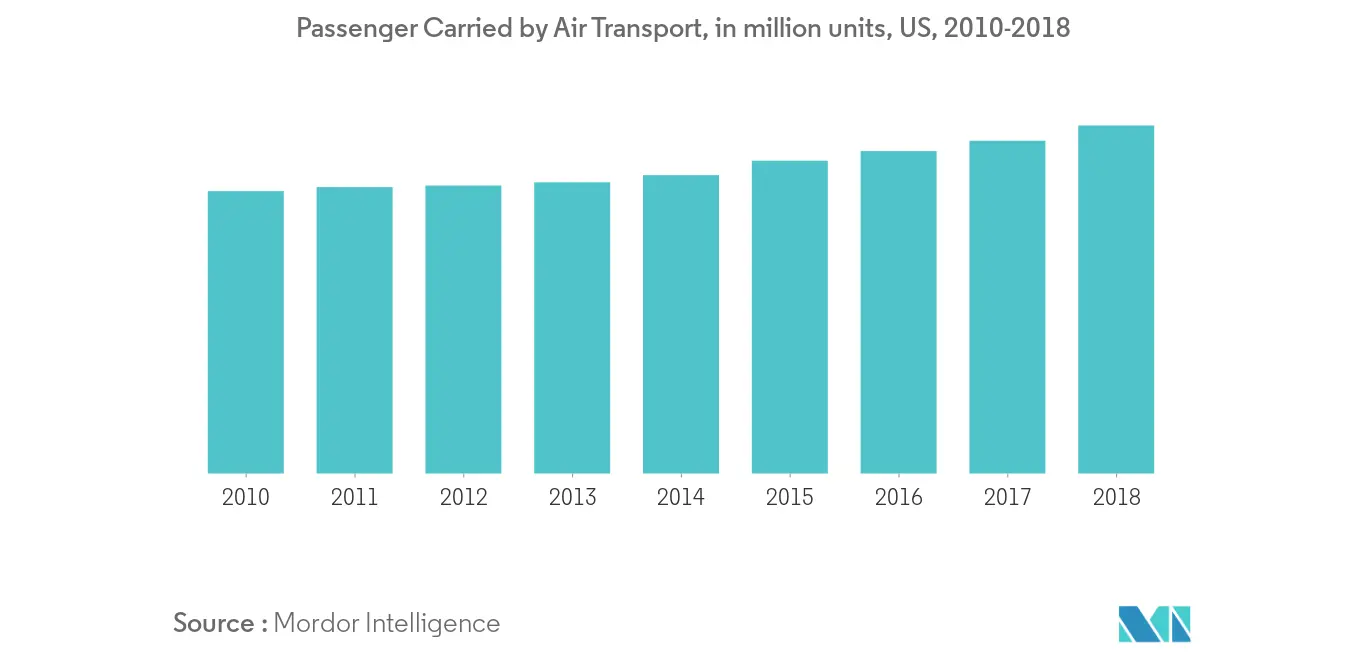
- The country's aviation industry is also on the rise, with 1717.1 billion revenue passenger kilometers flown in the domestic and international sectors in 2008, and with a growth of over 41% reaching 2428 billion revenue passenger kilometers flown in the domestic and international sectors in 2018. This has created a huge market for gas turbine MRO market in the country, as almost all of the modern airplanes use gas turbines for motive power for jet propulsion.
- Therefore, the aforementioned factors are expected to drive the market during the forecast period, similar to the trend witnessed in recent years.
Value Chain Analysis
The value chain in North America gas turbine MRO begins with the installed base of aero-derivative and heavy-duty turbines across power generation, oil and gas, and industrial users. Maintenance planning and diagnostics (including remote monitoring and condition-based maintenance) then shape the scope for outages. OEMs such as GE Vernova and Mitsubishi Power anchor the upstream service ecosystem through OEM parts, engineering, and long-term service agreements. Independent service providers (ISPs) complement or substitute OEM pathways with non-OEM parts and flexible repair and overhaul offerings, depending on fleet mix and operator procurement strategy.
Execution typically spans field services and outage support, component repair shops, and full overhauls. Enabling work includes reverse engineering, coatings, machining, heat treatment, and NDT and inspection. Regional capacity is supported by specialized depots and component facilities, including TransCanada Turbines (Airdrie, Alberta) for authorized aeroderivative work on specific GE and Siemens models, and Hanwha Power Systems Americas (PSM) with a component manufacturing and repair footprint in Jupiter, Florida for heavy-duty frames across major OEM platforms. Downstream activity includes logistics for parts and module exchange, re-commissioning, and performance validation, where lead times for critical parts, notably hot gas path and rotor-related components, can constrain outage schedules when supply chain tightness increases.
Competitive Landscape
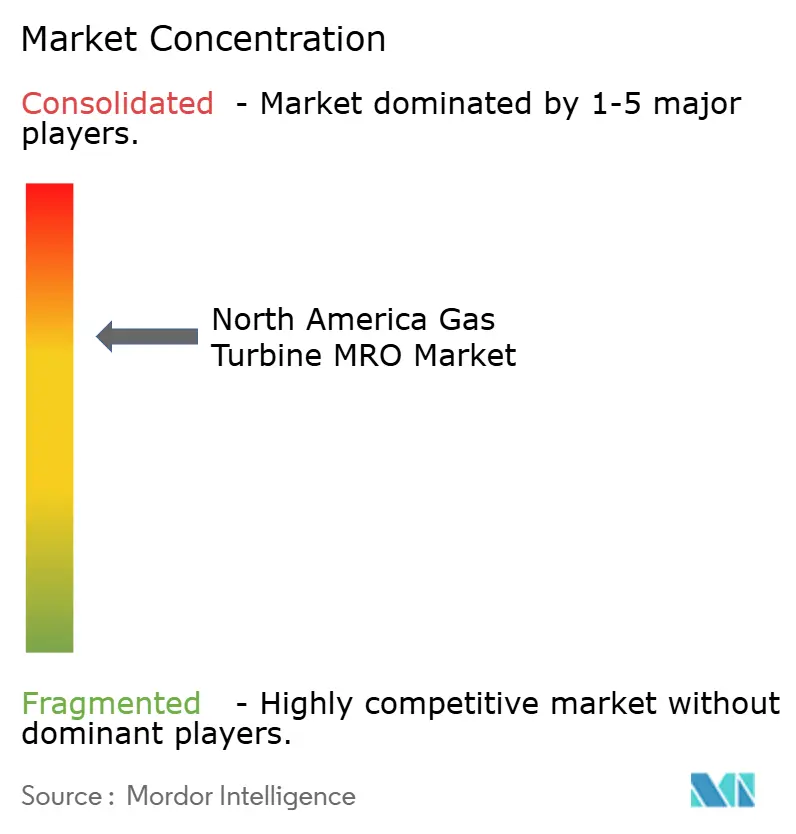
The North American gas turbine MRO market is partially consolidated, with major players holding a big share of the market. Some of the major companies are General Electric, Siemens AG, Mitsubishi Heavy Industries Ltd, Rolls-Royce Holding PLC, and John Wood Group PLC, among others.
North America Gas Turbine MRO Industry Leaders
General Electric Company
Flour Corporation
Mitsubishi Heavy Industries Ltd
Rolls-Royce Holding PLC
Siemens AG
- *Disclaimer: Major Players sorted in no particular order

Market Opportunities and Future Outlook
One near-term opportunity is localized, faster-turn industrial gas turbine service capacity clustered around high-density operating corridors, particularly the US Gulf Coast, where operators prioritize rapid field response and module or package exchange to reduce outage duration. MTU Power's April 2026 opening of a Level-2 service center in Houston for LM2500 and LM6000 industrial gas turbines shows investment flowing into near-asset support models. It also creates room for providers that combine field service with component repair networks and responsive logistics.
A second opportunity comes from shifting emphasis away from new-build dependence toward life extension and upgrade-led service packages. This is influenced by long delivery lead times for new large turbines and by grid constraints that increase the value of incremental capacity and flexibility from existing assets. POWER Magazine and Power Engineering coverage points to rising attention to rotor life limits in widely deployed 7FA and 7EA fleets and to the commercial traction of alternative rotor life extension offerings, including MD&A programs positioned outside traditional OEM channels. On the OEM side, upgrade pathways such as GE Vernova's 7Extend package, along with independent retrofit solutions covering combustion and inlet or capacity improvement technologies, reinforces differentiation for MRO providers through engineering depth, parts access, and the ability to integrate controls, combustion hardware, and outage execution into a single performance and reliability outcome.
Recent Industry Developments
- April 2026: MTU Power opened a Level-2 industrial gas turbine service center in Houston, Texas, expanding capacity for field service, component repairs, and package exchanges for LM-series units such as the LM2500 and LM6000. The Gulf Coast expansion strengthens MTU Power's regional service footprint and supports faster response times amid dense regional energy infrastructure.
- July 2025: Siemens Energy signed an agreement with Delfin Midstream to reserve manufacturing capacity for four SGT-750 gas turbine mechanical drive packages. By securing slots for industrial drive turbines linked to LNG infrastructure timelines, the deal influences downstream service planning and spares strategies for in-region fleets.
- July 2024: GE Aerospace announced a USD 1 billion investment to expand and upgrade MRO facilities worldwide. The capital program supports added repair capacity and modernization across GE's service network, with implications for turnaround times and availability of overhaul slots for turbine-powered aviation assets that contribute to North American gas turbine MRO demand.


Research Methodology Framework and Report Scope
Market Definition and Coverage
This market is defined as the revenue earned from maintaining, repairing, and overhauling gas turbines operating in North America, covering routine inspections, corrective repair work, and planned major overhauls done by service providers and OEM-linked networks.
Scope exclusions: We exclude new gas turbine equipment sales, plant EPC work, and non-turbine balance-of-plant services that are not directly tied to turbine MRO labor, parts, or outsourced service contracts.
Segmentation Overview
- Service Type
- Maintenance
- Repair
- Overhaul
- Geography
- United States
- Canada
- Mexico
Data Sources, Market Sizing, and Validation
Desk Research
We started by building a fact base on the installed gas turbine fleet, typical service intervals, and outage behavior, because these are the practical drivers for MRO demand. Public sources such as the US Energy Information Administration, US EPA emissions compliance documents, Statistics Canada energy datasets, and ISO or ASME technical references helped us anchor operating context and maintenance norms.
To translate activity into dollars, additional public signals were pulled from sources such as US International Trade Commission trade statistics (for relevant parts flows), peer reviewed engineering journals (for degradation and hot section life assumptions), and filings and investor decks of service providers. A paid subscription for company financials and another for patent and technology tracking were used selectively to sanity check revenue splits and the direction of service mix changes. These desk sources are illustrative only, and many other public documents were also reviewed to collect, validate, and clarify inputs.
Primary Interviews and Surveys
To close gaps that desk research cannot answer cleanly, we interviewed and surveyed a mix of turbine service providers, parts suppliers, plant operators, and independent maintenance specialists across the United States, Canada, and Mexico. The discussions focused on service pricing behavior, typical scope per outage, contracting patterns (LTSA versus transactional), and how often overhauls are deferred or advanced based on dispatch needs and emissions compliance.
Distribution of primary research fieldwork respondents
| Company type | Respondent position |
|---|---|
| Top tier: 39% | CXOs: 14% |
| Mid tier: 45% | Functional/Unit leaders: 41% |
| Smaller Players: 16% | Managers: 45% |
Market-Sizing & Forecasting
For sizing, we used a top-down demand reconstruction that starts from the North American operating fleet and its run hours, then converts that activity into expected maintenance events based on service intervals and outage cycles. Once the event pool was built, it was priced using a blended view of labor hours, parts replacement intensity, and contract coverage, and then adjusted for country level operating differences.
To keep the totals realistic, the model was corroborated with selective bottom-up approximations, such as rolling up a sample of provider revenues and checking implied spend per turbine against interview feedback. Inputs that were treated as key drivers included the installed base by turbine class, average annual run hours and starts, hot section and major overhaul intervals, shop visit versus field repair mix, and average price movement for critical parts and labor. Forecasting leaned on scenario analysis, because dispatch patterns and outage deferrals can shift quickly, and assumptions were stress-tested with expert views on gas generation utilization, retirement timing, and emissions related maintenance needs. Where bottom-up signals were incomplete, gaps were handled through conservative interpolation using fleet shares and service mix ratios confirmed in interviews.
Data Validation & Update Cycle
Before finalizing results, model outputs were checked against independent signals like gas-fired generation trends, reported outage cycles, and parts trade movement, and then outliers were reviewed line by line. Any large variance against interview ranges triggered a re-check of run-hour assumptions, service interval inputs, and pricing steps, followed by a second pass to confirm that geography and service categories were not double counted.
After internal review and sign-off, the report is refreshed annually, and interim updates are made when material events occur, such as major fleet additions, retirements, or regulation-driven maintenance changes. Right before delivery, we run a fresh update pass so the market numbers reflect the latest available public and interview-backed inputs.
Mordor Intelligence's North America Gas Turbine MRO Market Size Compared With Other Published Estimates
Published market numbers for gas turbine MRO in North America can look far apart, even when they sound like they cover the same thing. The differences usually come from how each study treats the service scope, the end-use boundary (power only versus power plus industrial), and the way pricing and overhaul timing are carried forward into the forecast.
Some external estimates bundle industrial and power-sector turbine service spend together, and they also use broader component lists that can pull in adjacent plant work. In Mordor Intelligence, we limit the count to gas turbine MRO services in North America that are directly tied to turbine maintenance, repair, and overhaul activity, and we keep pricing tied to outage-driven demand signals rather than applying a single flat escalation.
Benchmark comparison
| Source | Market Size | Gaps in Research Methodology |
|---|---|---|
| Mordor Intelligence | USD 4.80 B (2026) | |
| Regional Consultancy A | USD 6.10 B (2023) | Uses a broader market boundary that appears to include power and industrial end users together, which can raise the total and makes year-to-year comparability harder when fleet mix shifts. |
| Industry Association B | USD 5.35 B (2026) | Often applies standard service spend factors per turbine without fully adjusting for run hours, starts, and overhaul deferrals, which can overstate spend in lower utilization periods. |
The spread across the three values is mainly explained by scope and by how service activity is converted into dollars. By keeping the model tied to fleet operation indicators and outage-linked service events, the final number stays traceable to repeatable steps that can be rechecked as new operating and pricing signals show up.


Key Questions Answered in the Report
What is the current North America Gas Turbine MRO Market in Power Industry size?
The North America Gas Turbine MRO Market in Power Industry is projected to register a CAGR of greater than 3.04% during the forecast period (2026-2031)
Who are the key players in North America Gas Turbine MRO Market in Power Industry?
General Electric Company, Flour Corporation, Mitsubishi Heavy Industries Ltd, Rolls-Royce Holding PLC and Siemens AG are the major companies operating in the North America Gas Turbine MRO Market in Power Industry.
What years does this North America Gas Turbine MRO Market in Power Industry cover?
The report covers the North America Gas Turbine MRO Market in Power Industry historical market size for years: 2021, 2022, 2023, 2024 and 2025. The report also forecasts the North America Gas Turbine MRO Market in Power Industry size for years: 2026, 2027, 2028, 2029, 2030 and 2031.
Page last updated on:


 Your data is secure and never sold or shared.


