
North America Automotive Collision Repair Market Size and Share
Market Overview
| Study Period | 2019 - 2031 |
|---|---|
| Forecast Data Period | 2026 - 2031 |
| Base Year Market Size (2025) | USD 49.20 Billion |
| Market Size (2026) | USD 59.19 Billion |
| Market Size (2031) | USD 65.64 Billion |
| Growth Rate (2026 - 2031) | 2.09 % |
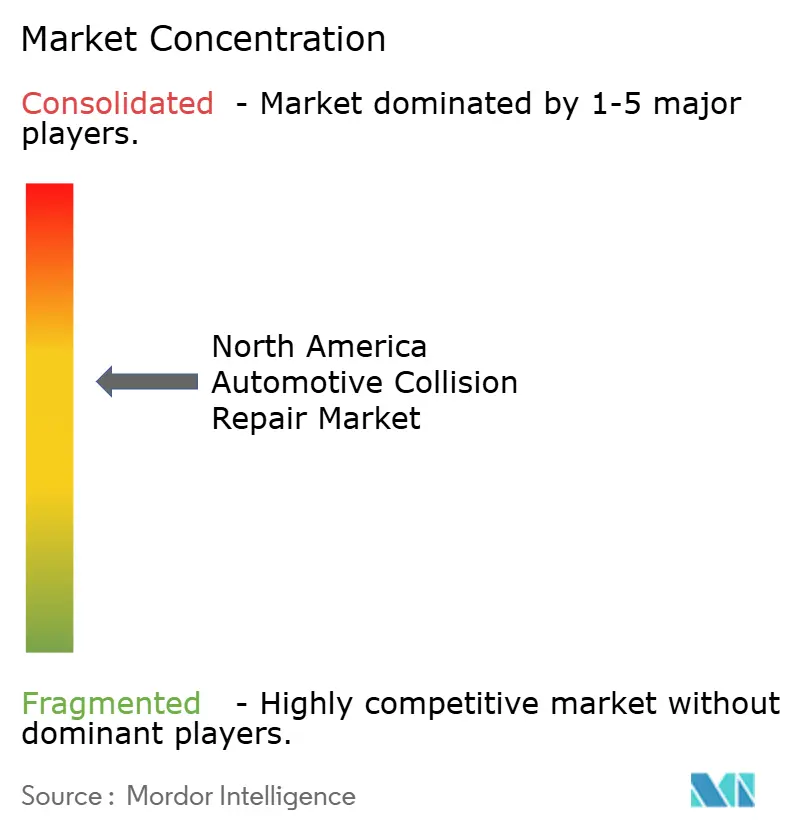
| Market Concentration | Medium |
Major Players *Disclaimer: Major Players sorted in no particular order Image © Mordor Intelligence. Reuse requires attribution under CC BY 4.0. | |
North America Automotive Collision Repair Market Analysis by Mordor Intelligence
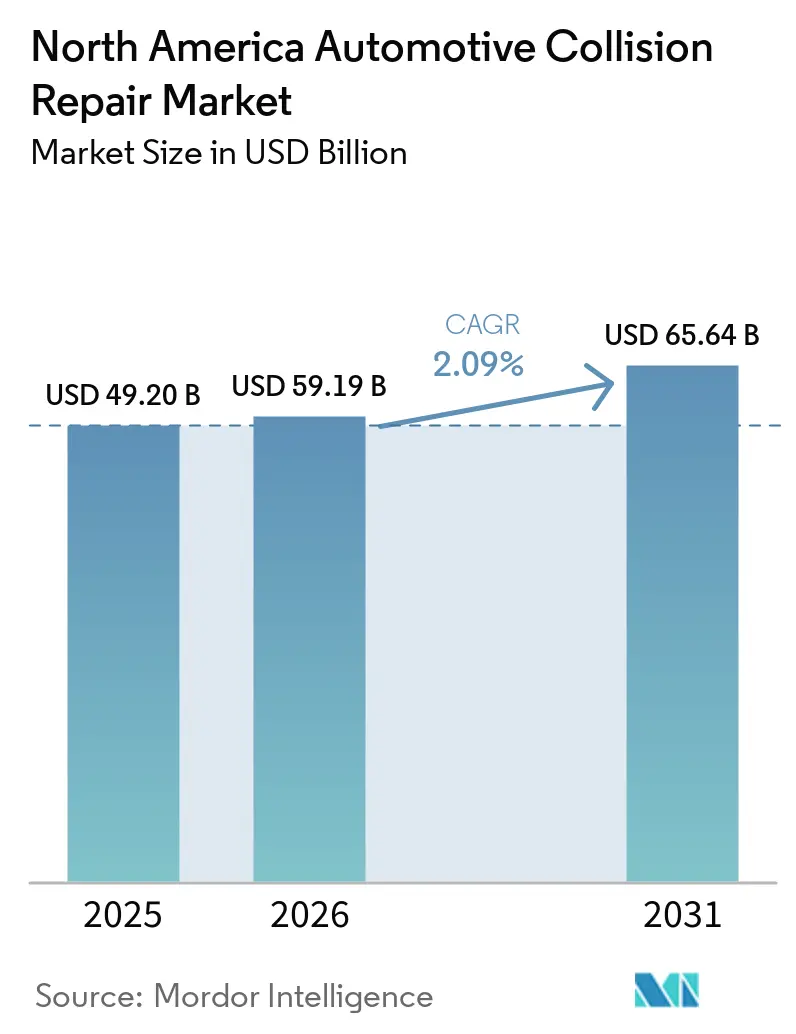
The North America automotive collision repair market size was valued at USD 49.20 billion in 2025 and is estimated to grow from USD 59.19 billion in 2026 to reach USD 65.64 billion by 2031, at a CAGR of 2.09% during the forecast period (2026-2031). As ADAS adoption surges and private-equity firms consolidate, regulatory mandates are expanding, altering the competitive landscape. While the frequency of repairable claims is declining, the average severity of repairs is rising. An increase in calibration-inclusive jobs and persistent parts inflation drives this uptick. Multi-shop operators (MSOs) boasting scale and certified ADAS infrastructure are capitalizing on procurement synergies and premium labor rates, using these advantages to counterbalance dwindling volumes. Independent shops are at a crossroads: retrofitting each bay for dynamic calibration is costly. However, forgoing this investment could mean being sidelined from insurer direct-repair-program (DRP) networks. Even with a moderation in rate growth, labor shortages remain a challenge. Additionally, tariffs are inflating parts invoices, further squeezing margins across the value chain.
Key Report Takeaways
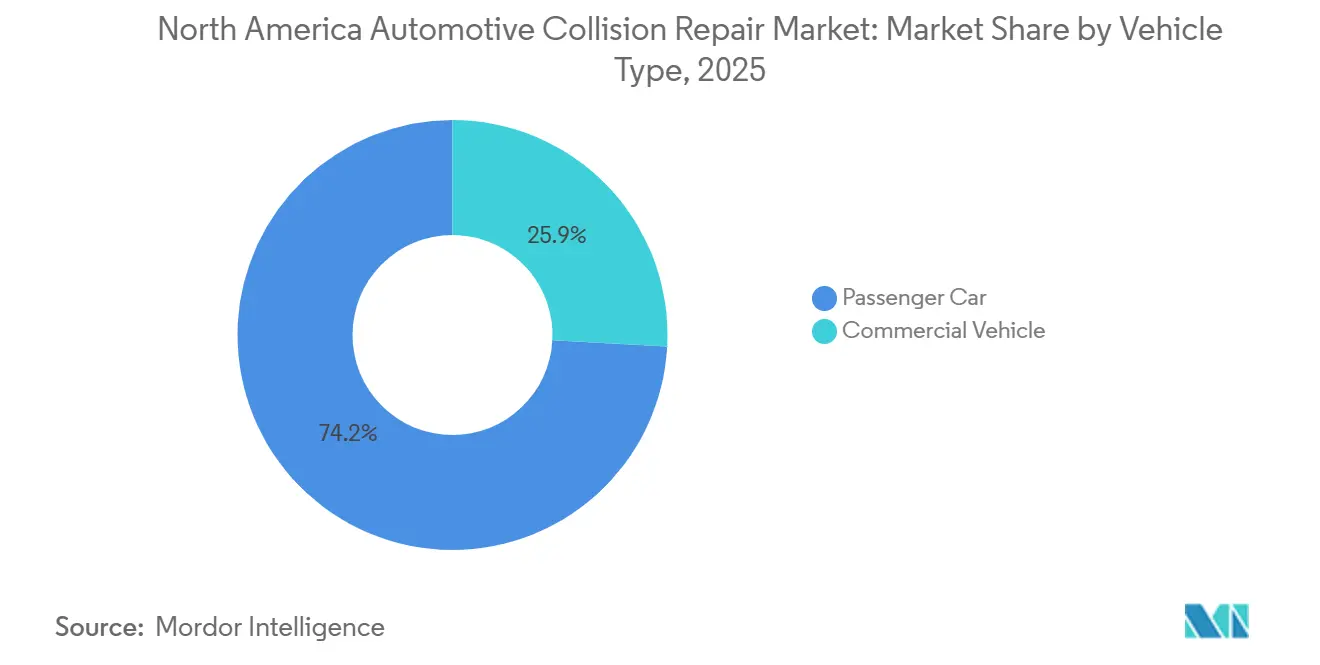
- By vehicle type, passenger cars led with 74.15% of the North America automotive collision repair market share in 2025, while commercial vehicles are projected to expand at a 2.55% CAGR through 2031.
- By product, paints and coatings commanded 44.36% of the North America automotive collision repair market share in 2025; spare parts are forecast to grow at a 2.86% CAGR to 2031.
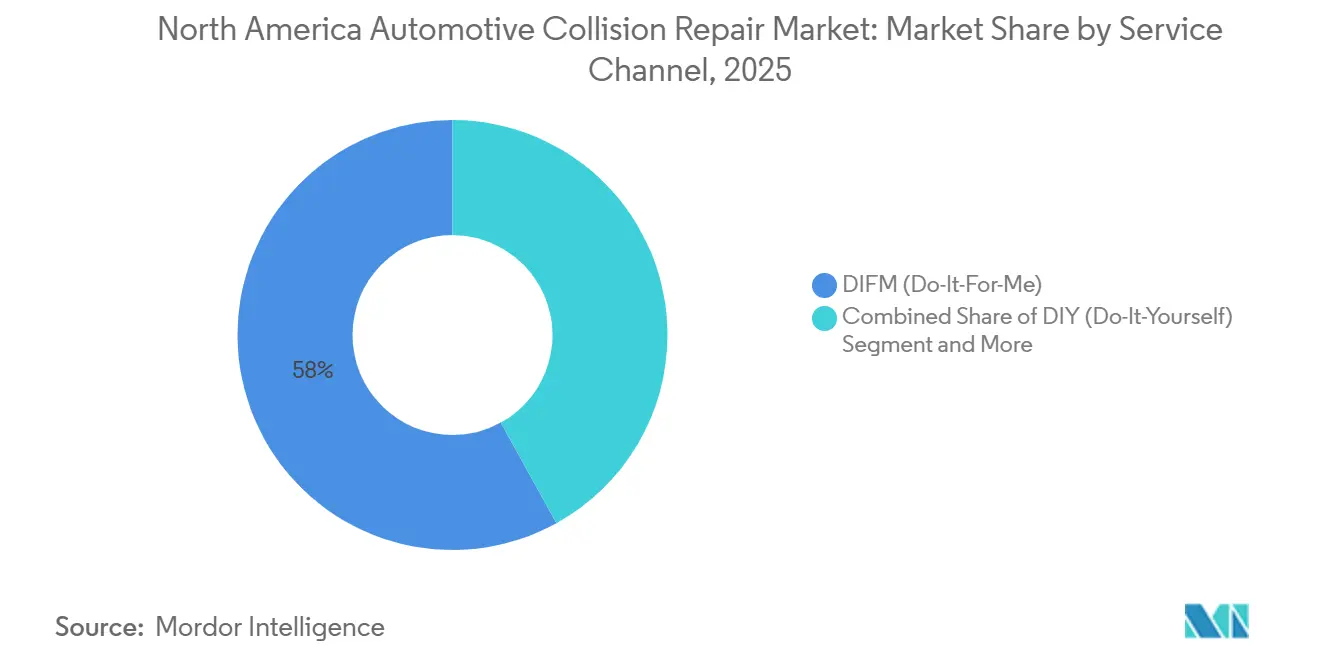
- By service channel, the do-it-for-me segment accounted for 58.03% of the North America automotive collision repair market in 2025, while the OE-certified network is advancing at a 3.72% CAGR through 2031.
- By damage type, the cosmetic and paint segment held 47.18% of the North America automotive collision repair market share in 2025, while glass and ADAS calibration is projected to grow at a 3.14% CAGR by 2031.
- By country, the United States dominated with 84.55% of the North America automotive collision repair market share in 2025, while the rest of North America is set to advance at a 3.48% CAGR through 2031.
Note: Market size and forecast figures in this report are generated using Mordor Intelligence’s proprietary estimation framework, updated with the latest available data and insights as of January 2026.
Worldwide, activity is shaped by contributions from multiple regions, with North america representing one of the more structurally developed among them. The global report on automotive collision repair market by Mordor Intelligence reflects how these regional layers combine into a single system.
North America Automotive Collision Repair Market Trends and Insights
Drivers Impact Analysis*
| Driver | (~) % Impact on CAGR Forecast | Geographic Relevance | Impact Timeline |
|---|---|---|---|
| Calibration Boosting Repair Ticket | +0.5% | United States, Canada | Medium term (2-4 years) |
| Aging Fleet Extending Demand | +0.4% | United States, Canada | Long term (≥ 4 years) |
| PE-Backed MSO Consolidation | +0.3% | United States, Canada | Long term (≥ 4 years) |
| Stringent Safety Regulations | +0.3% | United States, Canada | Medium term (2-4 years) |
| Digital-First Insurance Workflows | +0.2% | United States, Canada | Short term (≤ 2 years) |
| Growing Vehicle Parc and VMT | +0.2% | United States, Canada, Mexico | Long term (≥ 4 years) |
| Source: Mordor Intelligence | |||
ADAS Calibration Boosting Repair Ticket Size
In 2025, vehicles equipped with ADAS accounted for a significant share of the repairable fleet. Each calibration increased the average repair order cost, contributing to higher overall repair expenses. Diagnostic scans featured prominently in repair estimates during the year, yet many independent shops, lacking OEM-specific licenses, contributed to a divided service market. New York and Massachusetts require OEM-spec recalibration after windshield work, and national insurers are adopting identical protocols to reduce liability [1]“ADAS Recalibration Mandates,” Auto Glass Replacement Safety Standards Council, agrss.org. According to industry reports, minor collisions involving ADAS systems incur significantly higher repair costs compared to non-ADAS repairs. While capital entry barriers are high, certified operators benefit from premium labor rates and a larger share of the Direct Repair Program (DRP) volume, thereby amplifying their profitability relative to uncertified competitors.
Aging Fleet Extending Repair Demand
In 2025, the average vehicle age increased, extending the economic life of units likely to visit body shops. Vehicles aged between 6 and 11 years, known for their high repair frequency, are seeing an expanding cohort, especially as new vehicle prices rose that year. While federal EV credits expired in 2025, dampening EV purchases, hybrid vehicle sales surged, resulting in more collision-prone platforms remaining on the road. By 2026, vehicle miles traveled indicated a stable exposure base, even with a dip in frequency.
PE-Backed MSO Consolidation
By the end of 2024, the top five MSOs operated more sites than the previous year and secured a significant share of total revenue. Boyd’s USD 1.30 billion Joe Hudson’s purchase added 258 Southeast U.S. facilities and targets notable synergies, highlighting the operating leverage MSOs gain from centralized purchasing and back-office scale. TPG's move to take Classic Collision private, alongside Crash Champions' refinancing, highlights the North American automotive collision repair market's ability to generate stable cash flows, even amidst a dip in claim counts [2]“2026 Refinancing Statement,” Crash Champions, crashchampions.com. Independents are grappling with dwindling margins as a slowdown in labor-rate growth meets heightened parts inflation and tariff expenses, prompting many to consider exits or sales to larger consolidators.
Stringent U.S. and Canada Safety Regulations
NHTSA will require automatic emergency braking on all new light vehicles by September 2029, ensuring that ADAS penetration continues to rise [3]“AEB Final Rule,” National Highway Traffic Safety Administration, nhtsa.dot.gov. Canada is harmonizing standards, while states such as California tighten VOC limits, forcing shops to transition to waterborne coatings that demand higher capital outlays. Insurance reforms in Ontario and forthcoming Alberta Care-First policies are altering benefit structures, nudging carriers to rationalize DRP networks and to reward certified, high-compliance operators.
Restraints Impact Analysis*
| Restraint | (~) % Impact on CAGR Forecast | Geographic Relevance | Impact Timeline |
|---|---|---|---|
| ADAS and Active-Safety | -0.4% | United States, Canada | Medium term (2-4 years) |
| Certified-Technician Shortage | -0.3% | United States, Canada | Long term (≥ 4 years) |
| Parts-Supply Volatility | -0.3% | United States, Canada, Mexico | Short term (≤ 2 years) |
| VOC Limits on Coatings | -0.2% | United States, Canada | Medium term (2-4 years) |
| Source: Mordor Intelligence | |||
ADAS and Active-Safety Lowering Collision Frequency
Through August 2025, repairable claims declined, driven by AEB and lane-keeping technologies that helped avoid low-speed impacts. Claims for minor repairs have reduced in volume, diminishing the once-reliable cosmetic repair segment. With mandatory AEB set to roll out post-2029, this trend is expected to persist. In October 2025, total-loss claims increased, reducing the number of repairable vehicles, while fleet collision rates rose as drivers adapted to electrified powertrains, resulting in fewer but more expensive repairs.
Certified-Technician Shortage
By the end of the decade, TechForce Foundation foresees a significant technician shortage across various automotive segments, with a notable gap in collision services. Retaining talent is difficult because a considerable portion of the current workforce is nearing retirement age, and wages lag behind those in other trades. Despite the launch of I-CAR’s Registered Apprenticeship in 2025 and the formation of the ASE-CREF-WrenchWay coalition in the same year, the number of collision programs in the United States remains far below demand. Furthermore, high-voltage EV work requires specialized certifications that carry substantial costs, complicating training efforts. These capacity constraints not only extend cycle times but also threaten DRP scorecards.
*Our forecasts treat driver/restraint impacts as directional, not additive. The impact forecasts reflect baseline growth, mix effects, and variable interactions.
Segment Analysis
By Vehicle Type: Commercial Complexity Premium
Commercial vehicles represent a smaller segment but are projected to grow faster, at a CAGR of 2.55%. This growth will increase demand in the North American automotive collision repair market for fleet-focused services requiring specialized ADAS and high-voltage expertise. Passenger cars will continue to dominate repair volumes, accounting for 74.15% of the North American automotive collision repair market share in 2025, although they increasingly require multi-point calibration. As fleets electrify, repair shops must stock parts for electric Class 7-8 trucks and maintain safety protocols for charging. Telematics-triggered claims increase repair frequency, while downtime penalties support higher labor rates at certified repair centers. Passenger vehicle operators also favor MSO networks that can provide same-day calibration, although independent shops can retain niche share by specializing in older, non-ADAS-equipped vehicles.
Commercial fleets yield higher ticket values because electric trucks incorporate composite cabs, thermal systems, and battery enclosures needing manufacturer-approved procedures. Insurance underwriters often mandate OE-certified facilities for commercial EVs, boosting DRP steerage toward MSOs. Passenger-car repairers who cannot meet calibration standards risk being relegated to sub-deductible cosmetic work. Consequently, the North American automotive collision repair market is tilting toward businesses that service both high-volume passenger claims and high-severity fleet jobs, incentivizing investment in integrated diagnostics.


By Product: Spare Parts Outpace Coatings
Paints and coatings led the North American automotive collision repair market in 2025, with a 44.36% share. Yet, spare parts will be the fastest-growing segment, with a 2.86% CAGR, as sensors, cameras, and radar modules become replacement staples, expanding the North American automotive collision repair market size for components such as ultrasonic assemblies priced above USD 1,000. California’s VOC restrictions push shops toward pricier waterborne finishes, but the relative value of a single radar unit eclipses a complete refinish kit, shifting wallet share.
Tariffs and overseas dependency motivate aggregators like LKQ to expand domestic reman offerings and battery re-use programs, ensuring parts availability for aging vehicles and EVs alike. Coatings suppliers respond with low-VOC systems, including BASF Glasurit and Axalta Cromax Gen, yet their revenue growth trails the growth in ADAS module demand. Operators running advanced inventory software can hedge volatility and capture margin through rapid parts fulfillment.
By Service Channel: OE Networks Capture Certification Premium
The do-it-for-me channel remains the volume anchor, securing 58.03% of the North American automotive collision repair market share in 2025. Still, automakers’ proprietary EV repair programs are driving 3.72% CAGR in OE networks. OEMs like Tesla and Rivian mandate their diagnostic platforms and high-voltage isolation gear, allowing certified sites to bill for labor at higher rates than generic shops. The North America automotive collision repair market share commanded by OE facilities rises each year as insurers route complex EV losses to these centers for liability control.
DIFM operators that lack OE credentials still compete on cycle time and customer experience. Digital APIs and real-time parts ordering help MSO-owned DIFM shops retain DRP compliance. DIY repair remains marginal, confined to cosmetic blemishes under high deductibles. Over the forecast horizon, OE and MSO-aligned DIFM facilities will converge; independents without certification must pivot to express cosmetic work or exit.

By Damage Type: Glass and Calibration Lead Growth
Glass and ADAS calibration services are forecast to grow 3.14% CAGR, outpacing the broader North America automotive collision repair market. OEM-spec recalibration is mandatory in several states, and acoustic PVB windshields tack on significant premiums. Cosmetic paint repairs, with 47.18% of the North American automotive collision repair market share in 2025, are losing share as collision-avoidance systems reduce low-speed impacts; nevertheless, refinish work remains nearly half of revenue today, though its contribution will decline as severity skews toward high-tech components.
Structural repairs face headwinds from rising total-loss frequency, yet remain lucrative when battery-electric vehicles are involved, as OEMs often opt for repair over write-off to conserve scarce replacement packs. Shops that integrate static-and-dynamic calibration services can bundle glass replacement and earn higher margins than stand-alone refinish providers.
Geography Analysis
United States dominance persists with 84.55% of the North American automotive collision repair market share in 2025, anchored by large fleets in California, Texas, and Florida. California’s early EV adoption and strict environmental rules force rapid tooling upgrades, making it a bellwether for the entire North American automotive collision repair market. Southern states witness the fastest VMT growth, while Rocky Mountain regions see higher severity due to hail events and long-distance driving. MSO consolidation is most advanced in the Midwest and Southeast because high shop densities allow network synergies.
Canada contributes a modest slice yet mirrors U.S. trends. Ontario’s 2026 insurance reforms encourage carriers to triage claims electronically, raising demand for digitally connected DRP shops. Quebec’s right-to-repair legislation enhances access to aftermarket parts, marginally reducing pressure on OE component pricing. Alberta’s 2027 Care-First regime may shrink bodily injury payouts, freeing carrier capital to invest in repair-cycle speed initiatives that reward certified facilities.
The Rest of North America, mainly Mexico, is projected to grow at a 3.48% CAGR as nearshoring bolsters domestic vehicle ownership and parts manufacturing. Collision repair remains fragmented, but rising EV output and telematics adoption will entice MSO entrants seeking first-mover advantages in calibration and battery repair. Regulatory uncertainties surrounding the 2026 USMCA review and December 2025 tariff hikes inject volatility but may also localize parts sourcing, supporting faster cycle times over the medium term.
Mordor Intelligence provides coverage of the automotive collision repair market across other key regional markets, including Europe and Asia, each with their regulatory frameworks and demand patterns.
Competitive Landscape
As of August 2026, leading MSOs have significantly expanded their reach and captured a notable share of the market's revenue. However, the North American automotive collision repair market remains moderately concentrated, with numerous independent repair shops still operating. Boyd's acquisition of Joe Hudson's and TPG's buyout of Classic Collision underscore private equity firms' confidence in the sector's potential. In addition, Caliber, Crash Champions, and Driven Brands, through their Abra and CARSTAR units, continue to pursue strategic acquisitions to strengthen their regional presence.
Technological advancements continue to differentiate market leaders. CCC Intelligent Solutions enhances insurer interactions through its DRP connectivity, while shops utilizing its diagnostics suite report improved operational efficiency. Parts suppliers are increasingly focusing on advanced technologies such as ADAS calibration lanes and EV battery remanufacturing to align with evolving market demands. Coating suppliers are also innovating by introducing compliant, fast-drying waterborne lines, positioning themselves as key players in sustainability efforts.
Workforce shortages remain a critical challenge for the industry. Programs introduced by organizations like I-CAR and ASE aim to address this issue through apprenticeship and credentialing initiatives. However, these efforts are yet to meet the growing demand for skilled professionals, highlighting the need for continued investment in workforce development to sustain the industry's growth trajectory.
North America Automotive Collision Repair Industry Leaders
Caliber Holdings LLC
Boyd Group Services Ltd.
Crash Champions
Classic Collision
Driven Brands Holdings
- *Disclaimer: Major Players sorted in no particular order

Recent Industry Developments
- March 2026: VIVE Collision acquired Cherry Collision’s three sites in New Jersey, expanding its network to 75 locations and strengthening its presence in the Northeast.
- February 2026: Driven Brands Collision Group has expanded luxury OEM certifications across its Abra, CARSTAR, and Fix Auto USA networks to cover 37 marques, enabling manufacturer-approved repairs for electric vehicles (EVs) and advanced driver-assistance systems (ADAS).
- January 2026: Boyd Group Services completed its USD 1.3 billion acquisition of Joe Hudson’s Collision Center, adding 258 repair shops across the U.S. Southeast and expanding its footprint to 1,301 facilities.
- July 2025: Classic Collision opened a new facility in Cincinnati, Ohio, equipped with advanced diagnostic tools and eco-friendly refinishing processes.


North America Automotive Collision Repair Market Report Scope
The scope includes segmentation by vehicle type (passenger car and commercial vehicle), product (paints and coatings, consumables, spare parts, glass, and other products), service channel (DIY (do-it-yourself), DIFM (do-it-for-me), and OE (original equipment)), and damage type (structural repair, cosmetic and paint, and glass and ADAS calibration). The analysis also covers country-level segmentation, including the United States, Canada, and the rest of North America. Market size and growth forecasts are presented in USD by value.
| Passenger Car |
| Commercial Vehicle |
| Paints and Coatings |
| Consumables |
| Spare Parts |
| Glass |
| Other Product |
| DIY (Do-It-Yourself) |
| DIFM (Do-It-For-Me) |
| OE (Original Equipment) |
| Structural Repair |
| Cosmetic and Paint |
| Glass and ADAS Calibration |
| United States |
| Canada |
| Rest of North America |
| By Vehicle Type | Passenger Car |
| Commercial Vehicle | |
| By Product | Paints and Coatings |
| Consumables | |
| Spare Parts | |
| Glass | |
| Other Product | |
| By Service Channel | DIY (Do-It-Yourself) |
| DIFM (Do-It-For-Me) | |
| OE (Original Equipment) | |
| By Damage Type | Structural Repair |
| Cosmetic and Paint | |
| Glass and ADAS Calibration | |
| By Country | United States |
| Canada | |
| Rest of North America |


Key Questions Answered in the Report
What are the current market value and growth rate of the North American automotive collision repair market?
The North America automotive collision repair market size was valued at USD 49.20 billion in 2025 and is estimated to grow from USD 59.19 billion in 2026 to reach USD 65.64 billion by 2031, at a CAGR of 2.09% during the forecast period (2026-2031).
How fast is the market expected to grow?
The CAGR is projected at 2.09% for the 2026-2031 period.
Which service channel is gaining the most momentum?
OE-certified collision networks are expanding at a 3.72% CAGR as EV and ADAS repairs demand proprietary tooling.
Why are calibration services so important now?
After repairs, ADAS systems necessitate either dynamic or static calibration, incurring an additional cost of USD 300-600 per job and heightening the overall severity of the repair.
Page last updated on:





