
North America ATV and UTV Market Size and Share
North America ATV and UTV Market Analysis by Mordor Intelligence
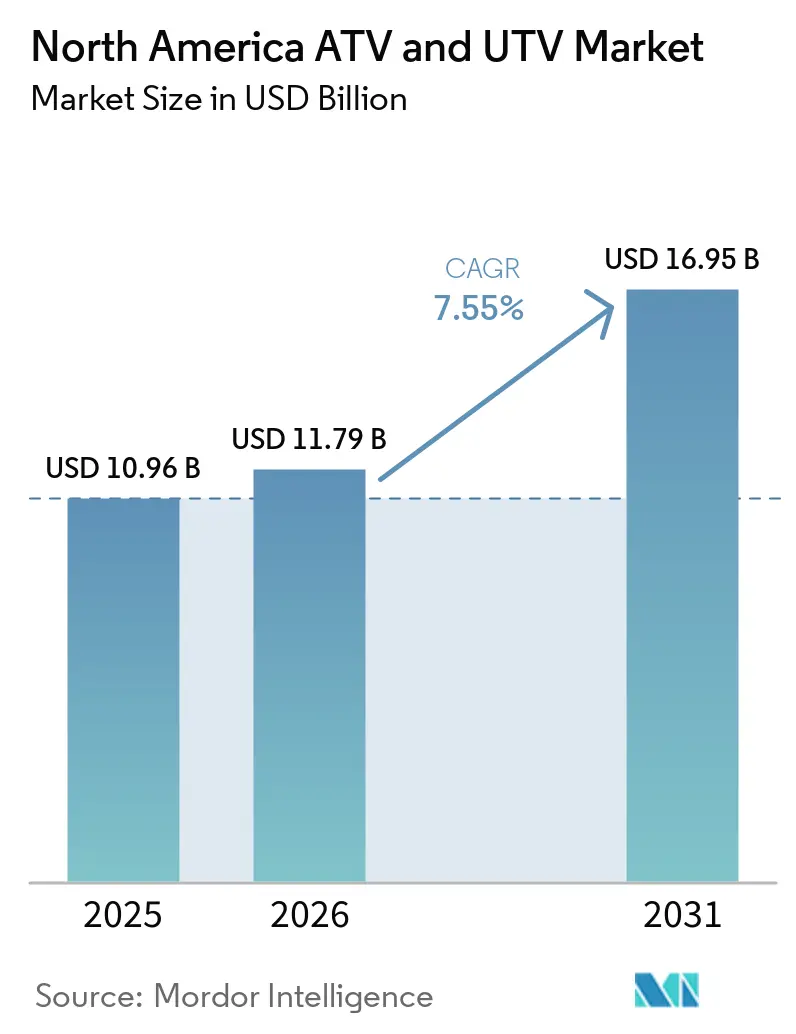
The North America ATV and UTV market size is projected to expand from USD 11.79 billion in 2026 and USD 12.68 billion in 2027 to USD 17.95 billion by 2032, registering a CAGR of 7.2% between 2027 and 2032.
Utility transport in the United States and connected recreational routes give ATVs and side-by-sides practical ownership cases. Those uses support expansion, while financing pressure limits the affordability of discretionary recreational purchases. Suppliers respond with broad vehicle ranges and choices between in-house manufacturing and partner production. Electric ATVs add a bounded-route option for farm work, although range and entry-package outlay constrain how broadly suppliers can address buyers. Utility-focused suppliers can therefore serve working assignments as well as credit-sensitive recreation, reducing dependence on buyers whose discretionary purchases face borrowing pressure.
Key Report Takeaways
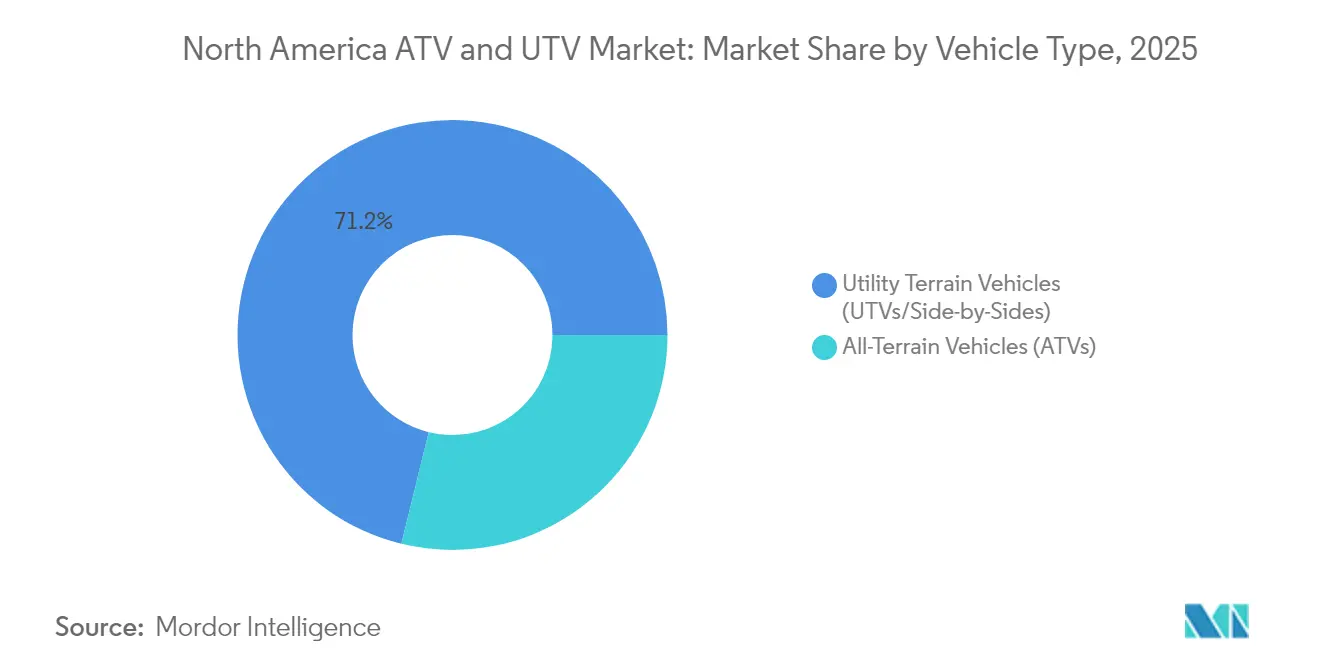
- Utility terrain vehicles led vehicle types with a 71.25% North America ATV and UTV market share in 2026 and are forecast to be the fastest-growing segment, with a CAGR of 7.34% between 2027 and 2032.
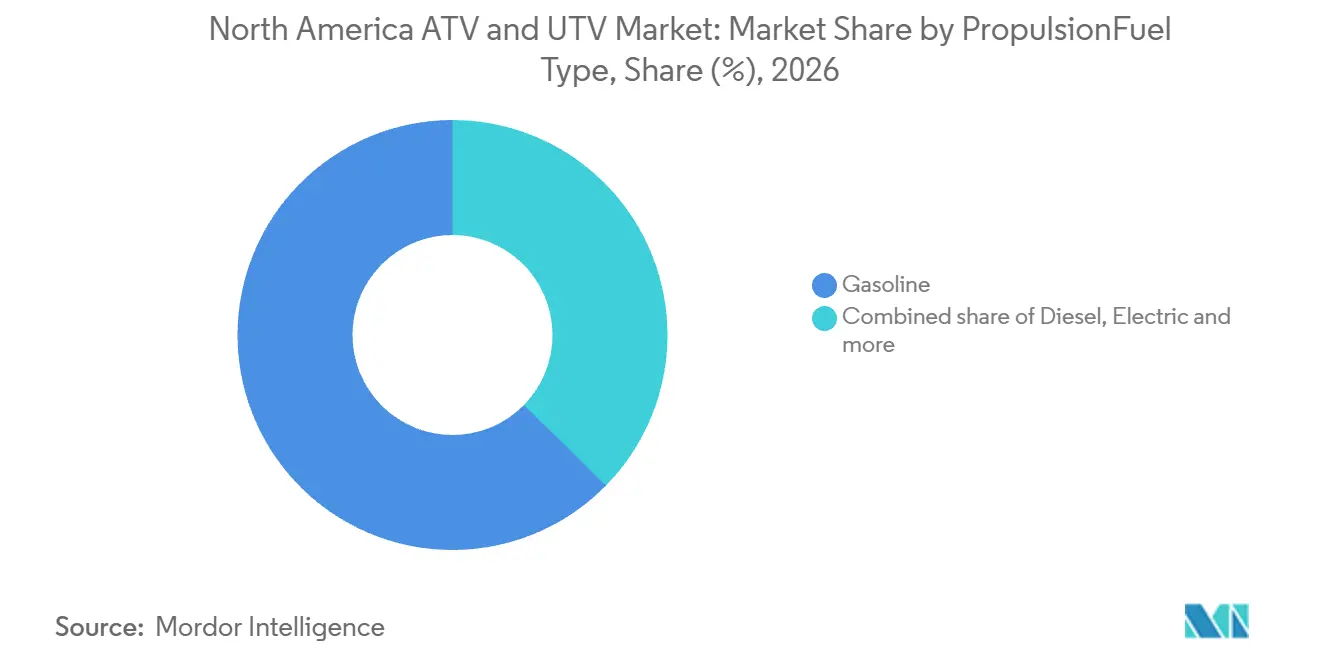
- Within propulsion, gasoline held a 62.66% share of the North America ATV and UTV market size in 2026, while electric vehicles are projected to grow fastest at a CAGR of 7.4% between 2027 and 2032.
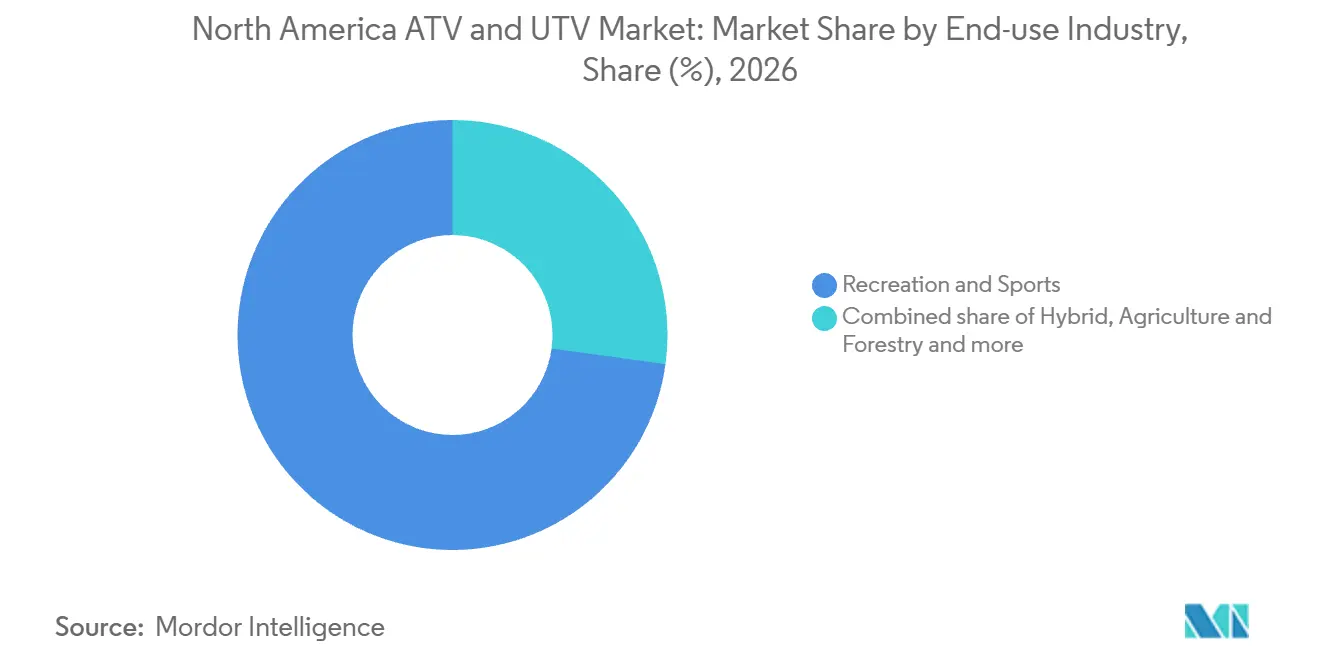
- Recreation and sports led end-use spending with a 72.84% share in 2026, whereas military and government applications are forecast to grow fastest at a CAGR of 7.42% between 2027 and 2032.
- By seating capacity, 2-3-seat vehicles accounted for 47.14% of spending in 2026, while 4-6-seat vehicles are forecast to grow fastest at a CAGR of 7.38% between 2027 and 2032.
- Among drive types, 4-wheel drive held a 60.7% share of spending in 2026, with all-wheel drive projected to grow fastest at a CAGR of 7.45% between 2027 and 2032.
- Geographically, the United States led with a 90.86% share of spending in 2026, while Canada is forecast to be the fastest-growing country at a CAGR of 7.34% between 2027 and 2032.
Note: Market numbers in this report are based on Mordor Intelligence's proprietary estimation framework, which combines nine months of actuals with Q4 projections for base year 2026.
Market Trends and Insights
Drivers Impact Analysis of North America ATV and UTV Market*
| Driver | (~) % Impact on CAGR Forecast | Geographic Relevance | Impact Timeline |
|---|---|---|---|
| Growing agricultural mechanization needs | +1.8% | Farming areas in the United States | Medium term (2-4 years) |
| Rising recreational & motorsports activities | +5.2% | Riding destinations in the United States | Short term (≤ 2 years) |
| Silent electric SxS demand in conservation & hunting | +1.1% | Conservation areas in the United States | Long term (≥ 4 years) |
| Technological advances in suspension & safety | +1.6% | Off-road riding areas in the United States | Medium term (2-4 years) |
| Trail-tourism incentive programs | +0.5% | Trail destinations in Canada | Medium term (2-4 years) |
| Rural broadband-enabled fleet connectivity | +0.4% | United States and Canada | Long term (≥ 4 years) |
| Source: Mordor Intelligence | |||
Growing agricultural mechanization needs
Farm mechanization supports vehicle demand through specific transport jobs and access to livestock and fields. Kansas State University Research and Extension described ATVs and UTVs as essential tools on Kansas farms and ranches in May 2025.[1] In the same account, ATVs were used for livestock checks and weed spraying, while UTVs were described as suited to transporting tools, feed, and calves. That distinction makes carrying capability relevant alongside access across fields. A farm or ranch needing both kinds of work therefore has a reason to own both vehicle types, with the choice following the task.
Rising recreational & motorsports activities
Connected riding routes can strengthen the ownership case by turning individual trail sections into a longer recreational itinerary. Pennsylvania DCNR announced nearly 1,000 miles of connected roads and trails for the Northcentral Regional ATV Trail's 2026 season across Clinton, Lycoming, Potter, and Tioga counties. The announced network included 130 additional miles, with the season scheduled from May 22 through September 27, 2026. Such access can make the same vehicle useful for a longer planned outing, with route continuity adding value to the ownership proposition. An expanded, season-bound network can support a specific recreational offer, making access to connected riding a commercial feature alongside vehicle performance.
Silent electric SxS demand in conservation & hunting
A conservation research team seeking quieter access has a specific reason to consider an electric side-by-side. For that team, the vehicle must carry people or equipment to the work location without defeating the assignment's low-noise objective. A game-stalking buyer may similarly value a quiet approach to the site more than a long recreational outing. Where low-noise travel is a requirement, propulsion choice can determine whether a vehicle fits the assignment even when its carrying capability is sufficient. For these buyers, additional engine performance does not resolve the noise requirement, giving a quiet electric approach a separate reason to support replacement.
Technological advances in suspension & safety
Suspension control gives performance UTV buyers an upgrade criterion beyond the vehicle's engine output. In January 2026, Polaris introduced a DYNAMIX DVS suspension advancement with the RZR Pro R Ultra Edition UTV. On August 3, 2026, Polaris announced that Ultimate trims of the model-year 2027 RZR Pro R Boost will receive desert-tuned DYNAMIX suspension with new G-out protection and rear bump-control functions. Dealer shipments were scheduled to begin in November 2026. Concentrating these functions on named editions and Ultimate trims gives performance buyers a reason to trade up for control technology, allowing a manufacturer to differentiate the upgrade within its own UTV range.
Restraints Impact Analysis of North America ATV and UTV Market*
| Restraint | (~) % Impact on CAGR Forecast | Geographic Relevance | Impact Timeline |
|---|---|---|---|
| High purchase & maintenance costs | -1.7% | United States and Canada | Short term (≤ 2 years) |
| Lithium supply-chain volatility | -0.8% | United States and Canada | Medium term (2-4 years) |
| Emission & noise regulation tightening | -0.5% | Public riding areas in the United States | Short term (≤ 2 years) |
| Land-owner liability litigation | -0.3% | Private recreation lands in the United States | Medium term (2-4 years) |
| Source: Mordor Intelligence | |||
High purchase & maintenance costs
Borrowing costs can restrict recreational vehicle purchases because they raise the payment attached to a financed vehicle. Polaris linked inflation, higher borrowing costs, and negative headlines with cautious North American recreational off-road vehicle consumers and a pressured retail outlook in Q2 2026. For a financed ATV or UTV, a higher borrowing rate increases the payment attached to the same vehicle price. The pressure is especially relevant to discretionary recreation, where the vehicle represents an additional household commitment. An entry-level model can lower the amount financed, but borrowing expenses still raise the cost of completing the sale.
Lithium supply-chain volatility
Benchmark's Q3 2026 lithium review described a July decline, an August rally, and a sharp September reversal in battery-grade lithium carbonate prices, ex-works China. Despite these swings, prices ended the quarter 20.8% lower at USD 19,025 per metric ton. An electric ATV or UTV supplier pricing a complete vehicle faces uncertainty when a battery input reverses direction within the selling cycle. A lower commodity endpoint can ease the underlying cost, but it does not remove the risk of committing at a different point in the cycle. Fixed-price electric ATV and UTV offers therefore expose suppliers to battery-cost commitments made at an uncertain point in the lithium cycle.
*Our forecasts treat driver/restraint impacts as directional, not additive. The impact forecasts reflect baseline growth, mix effects, and variable interactions.
North America ATV and UTV Market Segment Analysis
By Vehicle Type:
Side-by-Sides Combine Scale With Specialized UsesUtility terrain vehicles (UTVs/side-by-sides) accounted for a 71.25% share of the North America ATV and UTV market size in 2026 and are forecast to be the fastest-growing segment, with a CAGR of 7.34% between 2027 and 2032. Polaris management's unaudited estimates put North American side-by-side retail sales at 525,000 units in 2025, more than twice the 255,000 estimated ATV units. A side-by-side program can address different work and riding uses within this established retail category. That volume gap gives side-by-side platforms the larger base over which suppliers spread development and distribution.
Savannah's planned purchase illustrates an institutional application for ATVs. In March 2025, the Savannah Airport Commission obtained city approval to purchase 2 ATVs for assignment to the Airport Police Department. The airport commission was the purchasing agency and the police department the intended recipient, separating the contracting customer from the vehicle user. The approval gives a prospective ATV supplier a defined public-safety assignment to address through an airport buyer.

By Propulsion/Fuel Type:
Gasoline Scale Meets Electric Application OpportunitiesGasoline represented a 62.66% North America ATV and UTV market share in 2026, making it the largest segment. Honda North Carolina Manufacturing is the exclusive source for Honda ATVs sold in North America, including FourTrax and TRX models, with annual ATV capacity of 75,000 units. The 2027 FourTrax Rancher manual specifies unleaded gasoline with a pump octane number of 86 or higher. Because the Rancher runs on pump gasoline of 86 octane or higher, a buyer of a model from that single production source can refuel at ordinary fuel stops.
Electric vehicles are forecast to be the fastest-growing segment, registering a CAGR of 7.4% between 2027 and 2032. Waev launched the GEM eX electric work UTV in the United States in 2025, combining all-terrain capability with street-legal low-speed vehicle (LSV) status. The LSV offering addresses roads with speed limits up to 35 miles per hour (56 kilometers per hour), a distinction from most off-road-only competitors. That combination can address assignments requiring both all-terrain capability and travel on eligible roads. For a commercial buyer, this makes route access a potential reason to choose an electric work vehicle alongside the propulsion system itself.
By End-use Industry:
Recreation Scale Coexists With Military ProcurementRecreation and sports applications constituted the largest segment, accounting for 72.84% of vehicle spending in 2026. Polaris Adventures' multi-platform ride business had more than 250 locations as of December 31, 2025. By the end of 2025, its network had completed more than 2 million rides since 2017 across platforms accounted for in Polaris's Off Road, On Road, and Marine segments. The business partners with local outfitters to offer ride experiences, so recreational demand in this segment includes repeated, outfitter-led use of Polaris platforms.
Military and government applications are forecast to be the fastest-growing segment, with a CAGR of 7.42% between 2027 and 2032. On June 24, 2026, the U.S. Marine Corps placed its first delivery order under an Ultra-Light Tactical Vehicle contract with Polaris Government and Defense for more than 70 MRZR Alphas.[3] The contract provides a procurement route for a named military buyer to obtain a specified off-road platform. The accompanying accessories make the commercial package broader than a bare-vehicle transaction. Because this was the first delivery order under a new Ultra-Light Tactical Vehicle contract, later orders can follow under the same contract.
By Seating/Capacity:
Small Teams Shape Capacity ChoicesVehicles with 2 to 3 seats were the largest segment, accounting for 47.14% of spending in 2026. A farm or property operator planning travel with a small work party can select passenger places around the people who must travel together. Cargo remains a separate specification question, since seating for that team does not establish how much equipment the vehicle must carry. The commercial case is a small-team work package, with a larger passenger cabin becoming relevant only when the assignment requires more people to share the trip.
Vehicles with 4 to 6 seats are forecast to be the fastest-growing segment, registering a CAGR of 7.38% between 2027 and 2032. On March 6, 2026, the U.S. Forest Service awarded Jorgensen's, Inc. a delivery order for 4 model-year 2026 Polaris RANGER CREW XP 1000 Premium UTVs. The order recorded a performance period ending June 19, 2026. Polaris identifies that model as available in a 6-seat configuration. For an institutional buyer needing several people to travel together, a crew-capable platform can make passenger places part of the work package, giving larger cabins a commercial purpose beyond individual rider transport.
By Drive Type:
Work-Site Access Shapes Drivetrain RequirementsFour-wheel drive was the largest segment, accounting for 60.7% of spending in 2026. A farm or forestry operator choosing a vehicle for uneven or loose ground can make traction part of the work requirement. For an assignment that includes hauling equipment, the route's most demanding section can set the drive requirement for the whole trip. Work-site access can therefore justify this configuration even when much of the journey crosses firmer ground, with the commercial case determined by reaching the job rather than by the easiest portion of the route.
All-wheel drive is forecast to be the fastest-growing segment, registering a CAGR of 7.45% between 2027 and 2032. A fleet buyer specifying drive availability at every wheel is defining a traction requirement separate from passenger count or cargo capacity. Where a fleet needs several passenger or cargo configurations, it can assess one common drive requirement across those otherwise different vehicles. For this buyer, AWD can be specified at the fleet level while seating and load packages vary by assignment, separating the traction requirement from the remaining model choices.
Geography Analysis
United States ATV and UTV Market
The United States held a 90.86% North America ATV and UTV market share in 2026. Honda North Carolina Manufacturing, the exclusive North American production source for Honda ATVs, produced 66,941 ATVs in 2025. On September 30, 2026, U.S. Customs and Border Protection awarded World of Powersports Inc. a U.S. Border Patrol-funded order for 285 Yamaha ATVs, with performance through September 30, 2027. Honda's North American ATV supply comes from one domestic plant, whereas the Border Patrol order is a single federal purchase, showing concentrated brand production alongside institutional demand.
Canada ATV and UTV Market
Canada is forecast to be the fastest-growing country, registering a CAGR of 7.34% between 2027 and 2032. Moto Canada reported 48,994 ATV sales in Canada in 2025, providing a measured retail base for future vehicle demand. It also reported 37,918 SxS/ROV sales in 2025, establishing a separate flow of side-by-side purchases. In September 2025, Manitoba announced funding to improve more than 30 recreational trails across the province, including ATV trails. The funded improvements can strengthen the ownership case for ATV buyers using Manitoba's trails, adding a local riding-access mechanism to Canada's established retail demand.
Within the rest of North America, Mexican public agencies illustrate vehicle demand tied to institutional responsibilities. During its reporting period from October 2024 through September 2025, San Martín Texmelucan in Puebla added 4 model-year 2025 CFMOTO CForce 450 patrol quad bikes to its public-security fleet. Separately, Mexico's National Commission of Natural Protected Areas held quad bikes and a UTV as of June 30, 2025. These examples give quad bikes an institutional buyer base, with the municipal purchase focused on a patrol role and the conservation agency holding both vehicle formats.
Regulatory Framework and Outlook
Selected jurisdictions are compared from the perspective of manufacturers placing complete ATVs and UTVs on sale in the United States and Canada. Canada exempts from its prescribed vehicle class restricted-use vehicles whose ungoverned maximum speed is below 32 kilometers per hour over 1.6 kilometers. An importer must substantiate a claimed speed-based exemption. The ratings weigh the cost and predictability of manufacturer compliance against potential administrative flexibility.
Regulatory Table of North America ATV and UTV Market
| Decision factor | United States | Canada |
|---|---|---|
| Primary authority | U.S. Consumer Product Safety Commission and U.S. Environmental Protection Agency | Transport Canada |
| Key instruments or direction | ANSI/SVIA 1-2023 for new four-wheel ATVs manufactured from January 1, 2025, with owner manuals under ANSI/SVIA 1-2017; EPA 40 CFR Part 1051 ATV emissions testing and certification | Canadian Motor Vehicle Safety Standards for covered restricted-use ATVs and UTVs |
| Commercial effect | Manufacturer conformity, testing and certification duties | Manufacturing and import compliance tied to vehicle class |
| Current policy attractiveness | Medium | Medium |
| Future direction of policy attractiveness | No change | Easing |
| Source: Mordor Intelligence | ||
The United States rates Medium for safety and emissions conformity duties, with No change reflecting ANSI/SVIA 1-2023 for new four-wheel ATVs manufactured since January 1, 2025, except owner manuals under ANSI/SVIA 1-2017. Canada's Medium rating reflects federal manufacturing and import compliance for covered restricted-use vehicles. Transport Canada's plan expected publication in fall 2026 of a proposal allowing Product Identification Numbers instead of Vehicle Identification Numbers for restricted-use vehicles and snowmobiles, with a 75-day comment period. That optional identifier substitution supports Easing through documentation flexibility, while underlying safety standards define the manufacturer compliance baseline.
Value Chain Stages
The value chain compares how vehicle manufacturers, sales channels, and after-sales businesses earn revenue around a complete ATV or UTV. Polaris integrates design, engineering, manufacturing, and marketing with online and dealer distribution. This structure gives the producer control over the vehicle platform while leaving customer access and continuing service as separate sources of earnings.
Value Chain Analysis Table of North America ATV and UTV Market
| Primary activity | Key participants | Value capture | Bottleneck | Resilience response |
|---|---|---|---|---|
| Vehicle manufacturing and assembly | Vehicle manufacturers such as Polaris Inc., BRP Inc. and American Honda Motor Co. | Complete vehicle sales | Imported-component tariff exposure, identified by Polaris as a potential cost and sourcing pressure | Identify alternative suppliers in the United States and Mexico, as Polaris reported doing in July 2026 |
| Vehicle distribution and retail | Powersports dealers such as RideNow Group and TG Powersports | Vehicle retail sales and finance products | Model-specific order fulfillment | Daily dealer ordering and segment stocking orders, as used in Polaris's Retail Flow Management system |
| Parts distribution and after-sales service | Parts wholesalers such as Wiedmann Bros and service dealers such as TG Powersports and RideNow Group | Parts and accessory sales and repair services | Matching replacement parts to the vehicle being serviced | Combine genuine parts access with aftermarket distribution |
| Source: Mordor Intelligence | ||||
RideNow's wider US powersports business recorded USD 48.5 million in parts, services, and accessories revenue and USD 22.7 million in gross profit from those categories in 2025.[2] Upstream sourcing flexibility addresses component exposure, while downstream service creates earnings after the vehicle transaction. That gross-profit pool gives repair capability commercial importance beyond the dealership's sale of new vehicles.
Competitive Landscape
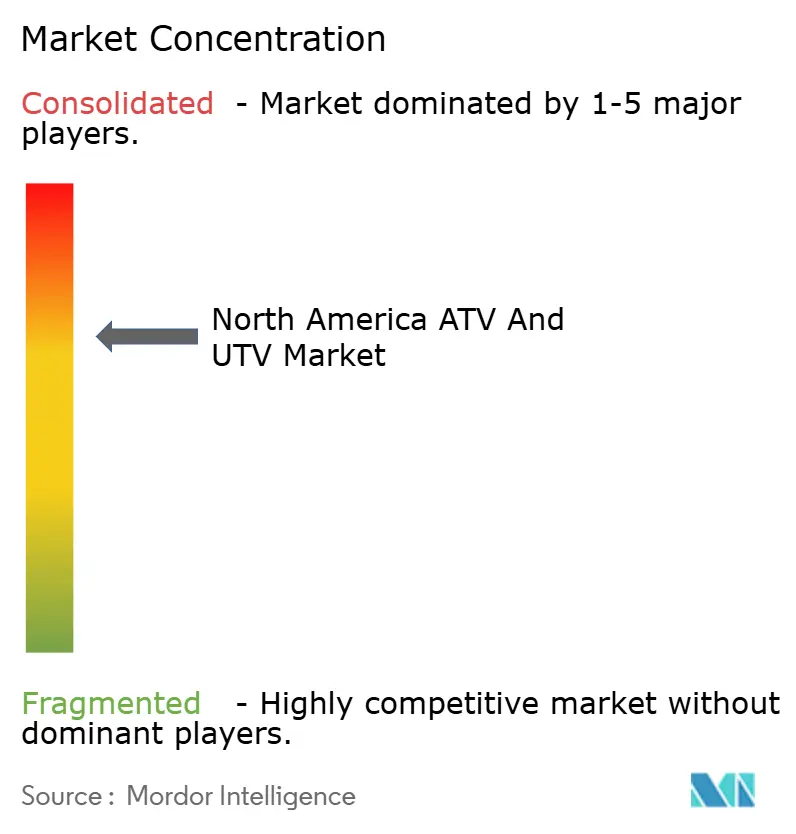
The market is moderately concentrated around established brands with overlapping vehicle ranges. Major players include American Honda Motor Co., Yamaha Motor Co., Arctic Cat, Polaris Inc., and BRP Inc. (Can-Am). Textron Inc. sold its Powersports business, including Arctic Cat, on April 23, 2025, and Brad Darling and an investment group acquired Arctic Cat. The acquired company was a Thief River Falls, Minnesota-based manufacturer of snowmobiles, ATVs, and side-by-sides. Separately, NHTSA's manufacturer record, updated August 21, 2026, lists Tracker Off Road as a Textron E-Z-GO LLC trade name, while White River Marine Group offers Tracker ATVs and side-by-sides.
Honda and Yamaha illustrate manufacturing strategies that place more control inside one operation or rely more heavily on external production partners. In November 2025, Honda announced a planned modernization of its North Carolina plant to bring key ATV parts in-house and add 18 jobs. Yamaha announced plans in August 2026 to end in-house Georgia recreational off-highway vehicle (ROV) production, source ROVs from manufacturing partners, and redirect resources to ATVs and golf cars. Honda's plan would put additional component work under its own management, while Yamaha's would make partner execution central to the continuity of its ROV offering.
For new four-wheel ATVs manufactured from January 1, 2025, CPSC requires ANSI/SVIA 1-2023 conformity, with owner manuals under ANSI/SVIA 1-2017, making safety compliance a common entry condition for challengers and incumbents. Polaris said it remained North America's off-road vehicle market-share leader in 2025. For the 3 months ended July 31, 2026, BRP reported North American off-road vehicle market-share gains. BRP's broader North American powersports retail sales rose 1% versus the same period in 2025, supported by positive side-by-side industry trends and off-road share gains but partly offset by lower Seasonal Products retail sales. An off-road share gain can therefore strengthen a supplier's position even when weakness in other vehicle categories limits the parent company's retail growth.
North America ATV and UTV Industry Leaders
-
American Honda Motor Co.
-
Yamaha Motor Co.
-
Textron Inc. (Tracker Off-Road)
-
Polaris Inc.
-
BRP Inc. (Can-Am)
- *Disclaimer: Major Players sorted in no particular order
North America ATV and UTV Market Companies Covered in this Report
- Polaris Inc.
- BRP Inc. (Can-Am)
- American Honda Motor Co.
- Yamaha Motor Co.
- Kawasaki Heavy Industries
- Textron Inc. (Tracker Off-Road)
- Suzuki Motor Corp.
- CFMOTO Powersports
- Kubota Corp.
- Deere & Company (Gator)
- Mahindra Automotive NA (ROXOR)
- Segway Powersports
- Hisun Motors Corp.
- DRR USA Inc.
- Intimidator Group, LLC
- ODES Powersports
- Club Car LLC
- Toro Co.
- Kioti (Daedong-USA)
Key Opportunities for Market Participants
The opportunities compare task-focused vehicle offers for utility buyers, farm operators, and outdoor users over 2027 to 2032. Polaris introduced the RANGER 500 mid-size utility vehicle as a value offering in 2025. BRP announced the 2026 Can-Am Outlander Electric ATV for farmers, ranchers, and outdoor enthusiasts on August 17, 2025. These introductions provide distinct starting points for utility packages and electric ATV assignments, with the opportunity defined by the job each buyer needs to complete.
Market Opportunities Table of North America ATV and UTV Market
| Opportunity | Why now | Buyer / lead segment | Recommended play | Main barrier | Likely beneficiaries |
|---|---|---|---|---|---|
| Task-focused value UTVs | A mid-size utility value option | Agriculture & Forestry buyers with a recurring transport job | Limit the package to the primary work assignment | Matching the value-tier specification to the required task | Utility-vehicle producers such as Polaris Inc. |
| Electric ATVs for bounded farm routes | An electric ATV offer aimed at farm and ranch users | Farmers and ranchers with repeat utility routes | Package the ATV around assignments compatible with its estimated utility-duty range | Estimated average utility range of 31 miles (50 kilometers) when fully charged | Electric ATV producers such as BRP Inc. (Can-Am) |
| Entry electric ATV packages for outdoor use | An electric ATV offer explicitly targeting outdoor enthusiasts | Recreation & Sports buyers with a defined riding use | Offer an entry package around the selected outdoor assignment | U.S. entry MSRP of USD 12,999, plus transportation and preparation fees that may vary by selection | Electric ATV producers such as BRP Inc. (Can-Am) |
| Source: Mordor Intelligence | |||||
For electric ATVs, estimated utility-duty range and the full entry-package outlay set different limits on how widely a supplier can address potential buyers. The central opening is the farm and ranch buyer with repeat routes compatible with the Outlander Electric's 31-mile (50-kilometer) average utility range. For that buyer, a route-based utility package makes the stated operating range part of the sales proposition, so propulsion alone is insufficient to define the offer.
Recent Industry Developments in North America ATV and UTV Market
- Sep 2026: U.S. Customs and Border Protection awarded World of Powersports Inc. a U.S. Border Patrol-funded purchase order for 285 Yamaha ATVs, with performance through September 30, 2027.
- Aug 2026: BRP Inc.'s Can-Am brand announced its 2027 side-by-side and ATV lineup, including a redesigned Defender HD10 with a triple-cylinder engine.
- Aug 2026: Polaris Off Road unveiled its 2027 lineup, including the RZR Pro R Boost side-by-side and Sportsman 500 ATV.
North America ATV and UTV Market Report Scope and Research Methodology
Market Definition and Coverage
The North America ATV and UTV market measures annual spending on complete all-terrain vehicles and utility terrain vehicles sold in North America. It counts vehicle sales in current US dollars at the point of sale.
Scope exclusions: Motorcycles, snowmobiles, golf carts, full-size off-road trucks, and separately sold replacement parts and maintenance or repair services are excluded.
Segments Covered in This Report
- By Vehicle Type
- All-Terrain Vehicles (ATVs)
- Sport ATVs
- Utility/Work ATVs
- Utility Terrain Vehicles (UTVs/Side-by-Sides)
- Sport UTVs
- Multi-purpose UTVs
- All-Terrain Vehicles (ATVs)
- By Propulsion/Fuel Type
- Gasoline
- Diesel
- Electric
- By End-use Industry
- Hybrid
- Recreation & Sports
- Agriculture & Forestry
- Industrial & Construction
- Military & Government
- Search, Rescue & Emergency Services
- By Seating/Capacity
- Single-seat
- 2 – 3 seat
- 4 – 6 seat
- By Drive Type
- 2-Wheel Drive
- 4-Wheel Drive
- All-Wheel Drive
- By Geography
- United States
- Canada
- Rest of North America
Data Sources, Market Sizing, and Validation
Desk Research
Public sources such as Kansas State University Research and Extension, the U.S. Consumer Product Safety Commission, Transport Canada, and the Occupational Safety and Health Administration can inform vehicle definitions, safety and regulatory conditions, and agricultural use. These sources help distinguish complete ATVs and UTVs from adjacent off-highway vehicle classes and provide context for product requirements and regional market checks.
Company filings, investor materials, dealer and association releases, and reputable automotive or powersports trade reporting can supplement public indicators with production, retail, pricing, inventory, and procurement context. Sources named here are illustrative rather than exhaustive, and further sources inform collection, validation and clarification.
Primary Interviews and Surveys
Structured interviews and surveys may include North American ATV and UTV manufacturers, dealers, distributors, fleet and agricultural buyers, and knowledgeable industry specialists, with executives, functional leaders, and managers addressing their areas of responsibility. Their input can test secondary evidence on vehicle pricing, retail flows, propulsion and end-use mix, and country differences. Unresolved gaps are documented and cross-checked against independent public, company, and channel indicators before estimates are finalized.
Distribution of primary research fieldwork respondents
| Company type | Respondent position | Region |
|---|---|---|
| Top tier: 30% | CXOs: 15% | |
| Mid tier: 45% | Functional/Unit leaders: 35% | |
| Smaller Players: 25% | Managers: 50% |
Market-Sizing & Forecasting
The model starts with a top-down estimate of North American spending on complete ATV and UTV sales, then checks selected totals with sampled vehicle volumes and transaction prices across manufacturers and sales channels. Relevant indicators include new ATV and UTV retail units, reported manufacturer shipments or regional sales, transaction price and product mix, dealer inventory and incentive conditions, and demand conditions in recreation, agriculture, construction, and public fleets. These indicators inform the total and the country, vehicle type, propulsion, end-use, seating, and drive-type shares, which are built from published segment evidence and checked for consistent coverage.
Forecasts can use multivariate regression where historical demand and price indicators are sufficiently consistent, with scenario analysis for changes in financing costs, electric vehicle adoption, trail access, agricultural activity, and government procurement. Value forecasts reflect both unit demand and price and mix changes. Selective supplier roll-ups and sampled average selling price times unit volume provide checks rather than a wholly bottom-up total. Where company coverage or channel evidence is incomplete, the model records the gap, tests a range against independent market signals, and uses North American expert input to challenge variable-level assumptions.
Data Validation & Update Cycle
Analysts triangulate company disclosures, public safety and regulatory information, association retail indicators, and sampled channel checks, then investigate material differences in unit trends, pricing, segment shares, and country totals before sign-off. A second analyst review checks source dates, calculations, scope consistency, and forecast drivers, with re-contact triggered when an interview conflicts with a source, key assumptions change, or a new filing or market event changes a material input. The dataset is refreshed annually, reviewed between cycles after material product, regulatory, trade, or procurement events, and given a fresh pre-delivery source and calculation pass.
Mordor Intelligence's North America Atv and Utv Market Estimate Compared With Other Published Estimates
Published estimates can differ in the transactions and products they count and the inputs used to model demand. The North America ATV and UTV market measures annual spending on complete all-terrain vehicles and utility terrain vehicles sold in North America.
Key Gap Drivers include the study's defined coverage and market-specific modeling choices. Relevant indicators include new ATV and UTV retail units, reported manufacturer shipments or regional sales, transaction price and product mix, dealer inventory and incentive conditions, and demand conditions in recreation, agriculture, construction, and public fleets.
Benchmark comparison
| Source | Market Size | Gaps in Research Methodology |
|---|---|---|
| Mordor Intelligence | USD 12.68 B (2027) | |
| Industry Publisher A | USD 7.96 B (2025) | At its 2025 base, this estimate is 37.2% below this report's 2027 value of USD 12.68 B, 2 years later. |
| Industry Publisher B | USD 9.34 B (2024) | At its 2024 base, this estimate is 26.3% below this report's 2027 value of USD 12.68 B, 3 years later. |
Mordor Intelligence's analysts triangulate company disclosures, public safety and regulatory information, association retail indicators, and sampled channel checks, then investigate material differences in unit trends, pricing, segment shares, and country totals before sign-off.
Key Questions Answered in the Report
What is the projected North America ATV and UTV market size?
Spending is projected at USD 12.68 billion in 2027 and USD 17.95 billion by 2032, with a CAGR of 7.2% between 2027 and 2032.
What supports North American ATV and UTV demand?
Kansas farm uses in 2025 and Pennsylvania's 2026 ATV trail expansion announcement illustrate the work and recreation cases for demand.
Which vehicle type leads North American ATV and UTV spending?
UTVs/side-by-sides held 71.25% of spending in 2026 and are forecast to record a CAGR of 7.34% between 2027 and 2032.
Which companies are major North American ATV and UTV suppliers?
Major players include American Honda Motor Co., Yamaha Motor Co., Arctic Cat, Polaris Inc., and BRP Inc. (Can-Am).
What is a key challenge for North American recreational ATV and UTV buyers?
Polaris linked higher borrowing costs, inflation, and negative headlines with cautious North American recreational off-road vehicle buyers and a pressured retail outlook in Q2 2026.
Which North American country leads ATV and UTV spending, and which is forecast to grow fastest?
The United States held 90.86% of spending in 2026, while Canada is forecast to grow fastest at a CAGR of 7.34% between 2027 and 2032.