
Market Overview
| Study Period | 2020 - 2031 |
|---|---|
| Forecast Data Period | 2026 - 2031 |
| Base Year Market Size (2025) | USD 3.06 Billion |
| Market Size (2026) | USD 3.16 Billion |
| Market Size (2031) | USD 3.71 Billion |
| Growth Rate (2026 - 2031) | 3.27 % |
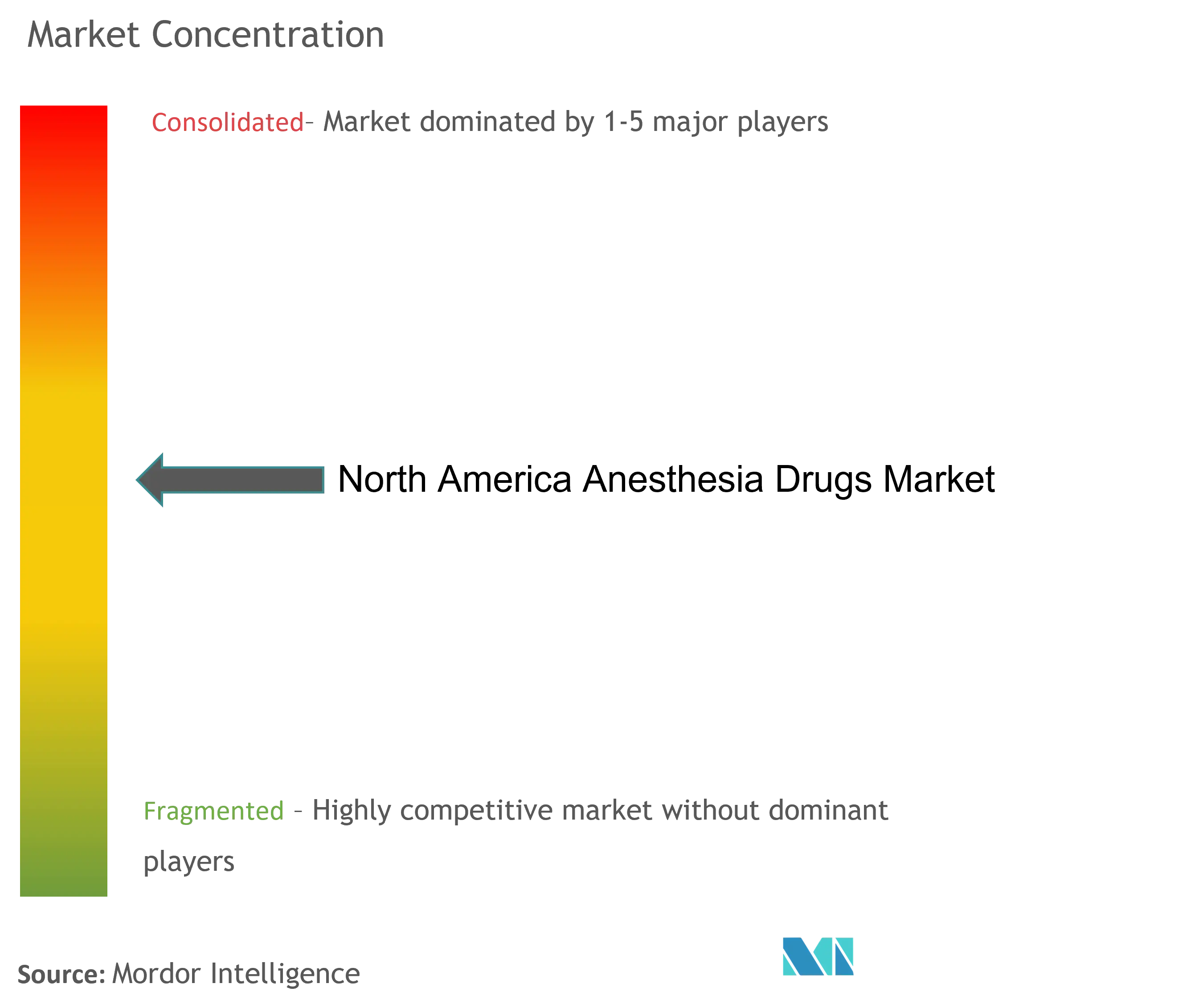
| Market Concentration | Low |
Major Players *Disclaimer: Major Players sorted in no particular order Image © Mordor Intelligence. Reuse requires attribution under CC BY 4.0. | |
North America Anesthesia Drugs Market Analysis by Mordor Intelligence
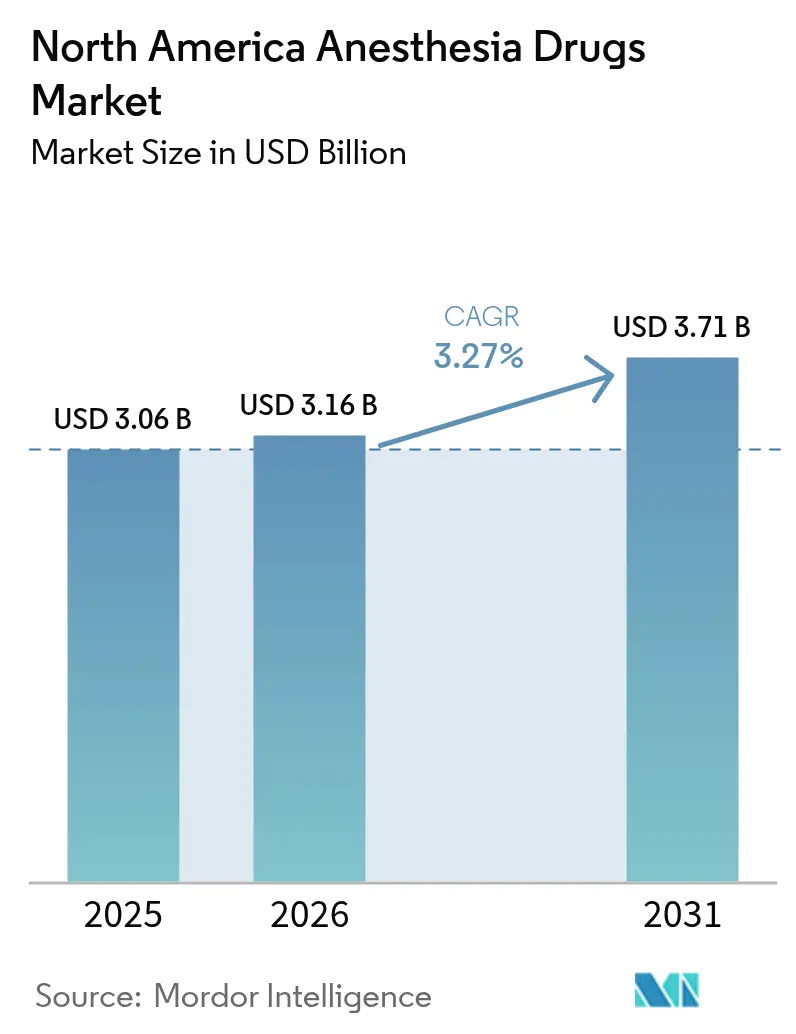
North America anesthesia drugs market size in 2026 is estimated at USD 3.16 billion, growing from 2025 value of USD 3.06 billion with 2031 projections showing USD 3.71 billion, growing at 3.27% CAGR over 2026-2031. This moderate pace signals a maturing environment in which technological advances, rather than procedure volume growth, contribute most of the incremental value. Artificial intelligence (AI) now guides closed-loop delivery systems that fine-tune propofol and sevoflurane dosing, cutting drug waste while improving hemodynamic stability. Machine-learning models also outperform manual methods in predicting intraoperative complications, leading to shorter recovery times and lower readmission rates. Ambulatory surgery centers (ASCs) are pivotal: procedures shifting from inpatient suites to outpatient theaters expand demand for ultra-short-acting agents that enable same-day discharge. Meanwhile, next-generation molecules such as ciprofol and remimazolam are positioned to erode propofol’s lead by offering milder cardiovascular effects.
Key Report takeaways
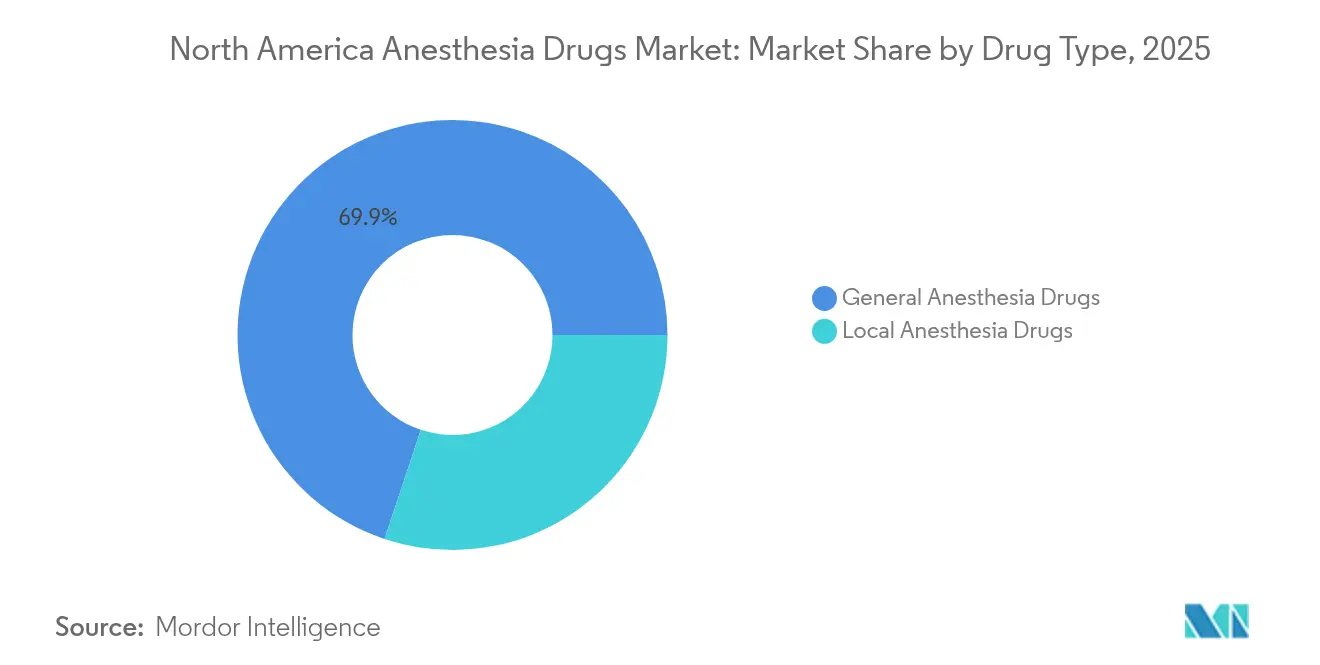
- By drug type, general anesthetics led with 69.88% of the North America anesthesia drugs market share in 2025, while local anesthetics record the fastest 3.80% CAGR through 2031.
- By route of administration, inhalation agents accounted for 62.94% of the North America anesthesia drugs market size in 2025; injectable agents are expected to grow at a 4.10% CAGR to 2031.
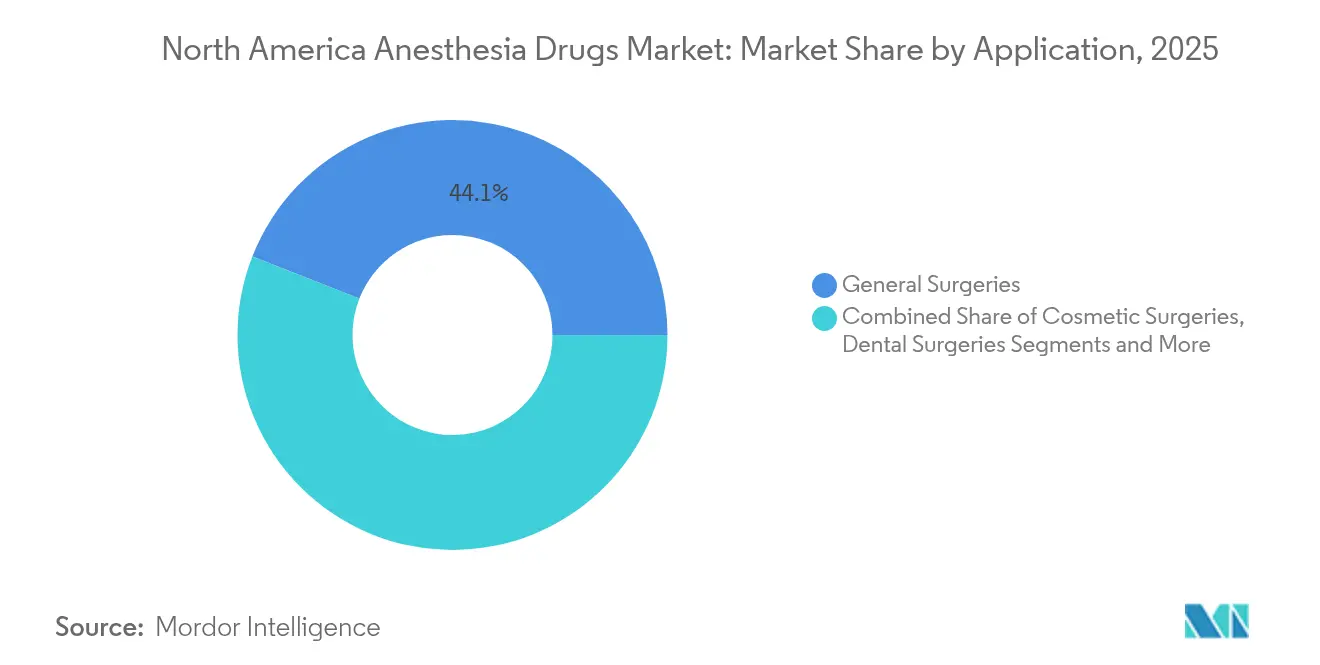
- By application, general surgery captured 44.05% revenue in 2025; cosmetic surgery is set to expand at a 4.22% CAGR to 2031.
- By end user, hospitals held 57.92% of the North America anesthesia drugs market share in 2025, whereas ASCs post the highest 4.55% CAGR to 2031.
- By geography, the United States commanded 87.96% share in 2025; Mexico is forecast to accelerate at a 4.74% CAGR through 2031.
Note: Market size and forecast figures in this report are generated using Mordor Intelligence’s proprietary estimation framework, updated with the latest available data and insights as of 2026.
Market Trends and Insights
Drivers Impact Analysis of North America Anesthesia Drugs Market*
| Driver | (~) % Impact on CAGR Forecast | Geographic Relevance | Impact Timeline |
|---|---|---|---|
| Increasing number of surgeries | +0.9% | North America, with strongest impact in US and Canada | Medium term (2-4 years) |
| Growing R&D investment by pharmaceutical companies | +0.6% | Global, with concentration in US biotech hubs | Long term (≥ 4 years) |
| Shift toward outpatient/ambulatory surgeries driving demand for ultra-short-acting anesthetics | +0.7% | North America, led by US ASC expansion | Short term (≤ 2 years) |
| Rapid adoption of AI-enabled anesthesia monitoring improving drug utilization efficiency | +0.5% | North America, primarily in academic medical centers | Medium term (2-4 years) |
| AI-enabled anesthesia monitoring | +0.4% | North America, with spillover to advanced healthcare systems globally | Medium term (2-4 years) |
| Commercialization of next-gen agents (e.g., ciprofol/HSK3486) offering improved safety profiles | +0.6% | Global, with initial focus on North America and Asia-Pacific | Long term (≥ 4 years) |
| Source: Mordor Intelligence | |||
Increasing Number of Surgeries
Surgical episodes across the region keep rising, with Medicare reporting 5.7% annual gains in procedures per beneficiary during 2024. ASCs anticipate a 22% lift in procedure counts by 2033, reinforcing demand for fast-acting anesthesia formulations. The 65-plus cohort undergoes more complex operations, which lengthen anesthetic exposure and elevate drug consumption. Cosmetic interventions now generate USD 13 billion yearly, expanding use of tailored agents that limit postoperative nausea in aesthetic clinics [1].
Growing R&D Investment by Pharmaceutical Companies
Pharma sponsors channel record sums into anesthesia pipelines, with AbbVie overseeing roughly 90 active compounds and USD 56.3 billion in 2024 revenue that funds clinical programs. Pfizer lists 64 novel entities among 112 pipeline projects, underscoring broad discovery momentum. The FDA cleared Journavx (suzetrigine) in January 2025, a non-opioid that could reshape perioperative pain protocols and curb opioid co-administration [2].
Shift Toward Outpatient/Ambulatory Surgeries Driving Demand for Ultra-Short-Acting Anesthetics
Same-day procedures favor agents such as desflurane and propofol for swift emergence. Enhanced Recovery After Surgery pathways heighten reliance on nerve blocks that reduce opioid exposure. Economic incentives further steer hospitals to adopt outpatient models that intensify competition for drugs with rapid pharmacokinetics.
Rapid Adoption of AI-Enabled Anesthesia Monitoring Improving Drug Utilization Efficiency
Closed-loop systems keep mean arterial pressure 10 mmHg higher than manual protocols, cutting hypotension episodes. The Hypotension Prediction Index posts mean squared error of 0.0062 in depth prediction tasks [3]. Academic hospitals are early adopters and influence community facilities through residency rotations. Drug makers integrating formulations with these platforms gain switching costs that deter generic competition.
Restraints Impact Analysis of North America Anesthesia Drugs Market*
| Restraint | ( ~ ) % Impact on CAGR Forecast | Geographic Relevance | Impact Timeline |
|---|---|---|---|
| Adverse effects and safety concerns | -0.5% | Global, heightened scrutiny in US | Long term (≥ 4 years) |
| Stringent FDA & DEA controls | -0.4% | North America, particularly US | Medium term (2-4 years) |
| Shortages of key APIs | -0.6% | North America import-dependent supply chain | Short term (≤ 2 years) |
| Supply-chain vulnerability | -0.4% | Global, with US concentration | Medium term (2-4 years) |
| Source: Mordor Intelligence | |||
Adverse Effects & Safety Concerns of General Anesthetics
FDA pharmacovigilance tallied 1,126 sevoflurane adverse events between 2004 and 2022, ranging from atrial fibrillation to malignant hyperthermia. Pediatric surveillance uncovered novel signals such as encephalopathy, prompting clinician caution. Environmental moves like the NHS plan to phase out desflurane pressure hospitals to substitute agents despite familiarity advantages. These factors favor newer molecules that claim narrower cardio-respiratory profiles but may require costly education programs.
Stringent FDA & DEA Regulations on Controlled Substances
DEA quota ceilings on fentanyl analogues and Schedule II anesthetics constrain output flexibility during demand spikes. In 2024, the FDA pulled 65 abbreviated drug applications, including several injectable anesthetics, highlighting compliance hurdles for smaller generics. Delays such as PharmaTher’s ketamine dossier, now pushed to June 2025, illustrate how regulatory reviews extend shortages for critical agents.
*Our forecasts treat driver/restraint impacts as directional, not additive. The impact forecasts reflect baseline growth, mix effects, and variable interactions.
North America Anesthesia Drugs Market Segment Analysis
By Drug Type:
General Agents Hold Volume, Locals Lead GrowthGeneral anesthetics accounted for 69.88% of the North America anesthesia drugs market share in 2025. Propofol’s rapid onset underpins this lead, yet ciprofol is gaining clinician interest because it mitigates injection pain and cardiovascular swings. Sevoflurane remains the dominant inhaled choice for pediatric cases even as desflurane usage fades under green-house gas scrutiny. Dexmedetomidine enjoys expanding roles in awake procedures and intensive care where respiratory stability is vital. Remifentanil provides ultra-short opioid support for brief ambulatory cases, whereas midazolam remains a versatile anxiolytic adjunct.
Local anesthetics advance at a 3.80% CAGR, the fastest among all segments, and they benefit from regional blocks that reduce opioid reliance. Bupivacaine leads for its prolonged analgesia in orthopedic and obstetric settings. Ropivacaine’s lower cardiotoxic risk makes it the spinal agent of choice for high-risk populations. Lidocaine, still indispensable for infiltration, now sees extended uses in intravenous regional anesthesia. Ultrasound-guided techniques broaden indications for locals, raising total consumption. The North America anesthesia drugs market size for local agents is projected to swell at a volume pace that outstrips the overall sector during 2026-2031.

By Route of Administration:
Injection Growth Challenges Inhalation LeadershipInhalation drugs held 62.94% of the North America anesthesia drugs market in 2025 due to operating room infrastructure geared toward volatile agents. Sevoflurane’s predictable kinetics underpin its primacy. Supplier concentration is rising after Baxter invested in Puerto Rico fill-finish lines that secure regional stocks. Environmental policies, however, accelerate substitution into total intravenous anesthesia.
Injectables are recording a 4.10% CAGR as ASCs and ERAS pathways reward precise titration. Propofol remains the anchor but fresh FDA clearance for ciprofol and remimazolam will diversify options. The North America anesthesia drugs market size for injectable agents is expected to reach USD 1.93 billion by 2031, reflecting clinician preference for rapid turnover. Ready-to-use vials reduce medication errors and contamination, sustaining demand. Although topical and transdermal routes stay niche, innovation in liposomal lidocaine foams and dermal patches could open incremental revenue.
By Application:
General Surgery Dominates, Cosmetic Leads MomentumGeneral surgery retained 44.05% share of the North America anesthesia drugs market in 2025 with steady inpatient case loads and complex laparoscopic procedures. Medicare’s 5.7% annual growth in surgeries indicates robust baseline volume. ERAS adoption within this segment promotes multimodal analgesia that enlarges total drug cocktails per case. Balanced anesthesia, which blends inhaled and intravenous agents, secures broad demand across drug classes.
Cosmetic surgery cases grow at a 4.22% CAGR, reflecting consumer acceptance and financing options. The 457% rise in aesthetic procedures since 1997 shows enduring upside. Short recovery windows require ultra-short anesthetics to avoid overnight admission, lifting use of desflurane, remifentanil, and regional nerve blocks. Dental and pain-management interventions also scale steadily, adding to segment diversification.
By End User:
Hospitals Anchor Demand While ASCs AccelerateHospitals captured 57.92% of the North America anesthesia drugs market share in 2025 owing to their capacity for complex surgeries and critical care. Academic centers spearhead AI pilots that fine-tune anesthetic infusion rates, yielding cost savings and quality scores. Bulk purchasing allows hospitals to negotiate favorable pricing, though shortages push some systems toward in-house compounding.
ASCs expand at 4.55% CAGR, benefitting from payer reimbursement that favors outpatient care. Medicare spent USD 6.8 billion on ASC bills in 2023, underlining scale. ASCs prefer single-dose vials and ultra-short agents that support 23-hour observation rules. Office-based surgery centers and specialty clinics round out demand but face regulatory variation across states.
Geography Analysis
United States Anesthesia Drugs Market
The United States commanded 87.96% of the North America anesthesia drugs market in 2025 as its surgical intensity, reimbursement levels, and early technology adoption reinforce premium drug use. Workforce shortages rose to 78% by late-2022, encouraging AI systems that reduce provider workload. Chronic shortages, some exceeding three years, led Washington to allocate USD 34 billion for domestic pharma resilience, while Amneal secured FDA approval for in-house propofol that should stabilize key supply.
Canada Anesthesia Drugs Market
Canada holds lower coverage at 29.4% of US anesthesia capacity, which constrains operating room throughput. Its physician-only anesthesia delivery model magnifies staffing gaps. Eleven provincial reimbursement systems fragment procurement, resulting in higher per-unit drug costs. The Canadian device market reached USD 6.8 billion in 2024 and grows 5.4% yearly, opening opportunities for bundled drug-device solutions.
Mexico Anesthesia Drugs Market
Mexico is the fastest-growing sub-region with a 4.74% CAGR through 2031. Infrastructure upgrades and medical tourism raise demand for international-grade anesthesia standards. Mexico also positions itself as an alternate API source for propofol and sevoflurane, aligning with the North American Preparedness Initiative to diversify supply chains. Adoption of regional blocks and AI monitors is nascent but climbing in tertiary centers.
Regulatory Landscape
In North America, anesthesia drugs are governed primarily through the US Food and Drug Administration (approvals, GMP oversight, and shortage monitoring), Health Canada (market authorization and pharmacovigilance), and Mexico's COFEPRIS, with controlled-substance anesthesia adjacencies also shaped by US Drug Enforcement Administration scheduling and quotas. Policy actions aimed at pharmaceutical supply resilience have become more visible in the report period: the US government launched the Strategic Active Pharmaceutical Ingredients Reserve (SAPIR) in 2025 to maintain a six-month supply across a defined set of critical drugs. In April 2026, a Section 232 presidential proclamation elevated import reliance as a national security issue for pharmaceuticals and ingredients.
Product access and compliance requirements continue to tighten around sterile injectables while creating pathways for differentiated entrants. In June 2026, the FDA approved Haisco Pharmaceutical Group's Cypsedo (cipepofol) for induction of general anesthesia in adults undergoing surgery, reinforcing the role of US regulatory clearance as a key step for new IV anesthetic adoption. In Canada, regulatory modernization progressed with amendments to the Food and Drug Regulations related to Agile Licensing published in December 2024, and Health Canada has also been advancing guidance for broader use of Terms and Conditions on authorizations, signaling a more lifecycle-managed approach to benefit-risk oversight.
Value Chain Analysis
The value chain for anesthesia drugs in North America runs from highly concentrated upstream starting materials and APIs (often sourced outside the region) into sterile formulation and fill-finish, then through temperature-controlled distribution to hospital systems and ambulatory surgery centers (ASCs) that purchase via wholesalers and group purchasing organizations (GPOs). Sterile injectables are a structural bottleneck, with supply continuity shaped by limited redundant capacity, high compliance costs, and operational fragility of aseptic manufacturing. FDA shortage surveillance, alongside oversight by Health Canada and COFEPRIS, affects how quickly disruptions are recognized and mitigated, while procurement practices in large health systems increasingly demand evidence of safety stock and multi-site production.
Downstream, readiness-to-administer formats and simplified workflows are becoming a key differentiator as they reduce compounding burden and medication-error risk in operating rooms and ASCs. Strategic coordination and nearshoring initiatives are also shaping the chain: USMCA-linked policy discussions have been cited as an avenue to strengthen essential-medicine supply chains across the United States, Canada, and Mexico. Partnerships such as Fresenius Kabi's alliance with Phlow Corp. (domestic manufacturing and API capability building) and Premier Inc.'s ProvideGx collaborations (safety stock and continuity contracting for critical agents such as propofol) show resilience programs being embedded into procurement and manufacturing rather than treated only as responses to shortages.
Competitive Landscape
The North America anesthesia drugs market features mid-level concentration with competition fueled by supply assurance and digital integration more than simple price rivalry. Fresenius Kabi grew revenue 11% year-on-year in Q3 2024 after vertical integration bolstered API availability. Baxter raised injectable launches to ten in 2024, focusing on ready-made formats that cut pharmacy prep times. Patent cliffs for drugs like Nucynta ER in 2029 invite generic challengers that fragment opioid segments.
Strategic thrust now centers on technology linkages. Companies partner with AI software vendors to embed dose algorithms directly into infusion pumps, locking prescribers into proprietary ecosystems. Environmental stewardship emerges as a differentiator: suppliers developing capture kits for volatile waste gases could gain tender preference in Canada and selected US states. Acquisition activity remains brisk. AbbVie’s late-2024 buys of ImmunoGen and Cerevel add neuro-modulatory assets that complement sedation portfolios.
Disruptors include manufacturers of ciprofol and remimazolam, which aim to displace propofol in high-risk cohorts. Hikma’s West-Ward subsidiary scales injectable anesthetics, filling gaps left by defunct suppliers. Sagent concentrates on syringe fills for regional blocks, while Hospira leverages Pfizer distribution muscle to reclaim hospital share. The North America anesthesia drugs industry thus pivots toward integrated solutions that pair molecules with predictive analytics and eco-friendly handling.
North America Anesthesia Drugs Industry Leaders
-
Baxter International
-
Fresenius SE & Co. KGaA
-
AbbVie Inc.
-
Eisai Co. Ltd
-
B. Braun SE
- *Disclaimer: Major Players sorted in no particular order
North America Anesthesia Drugs Market Companies Covered in this Report
- Abbvie
- Baxter
- Fresenius
- Pfizer
- Aspen Pharmacare Holdings Ltd.
- B. Braun
- Eisai
- Avet Pharmaceuticals
- Roche
- Novartis
- Hikma Pharmaceuticals
- Viatris
- Piramal Group
- Teva Pharmaceutical Industries
- CSL Vifor
- Sun Pharmaceuticals Industries
Market Opportunities and Future Outlook
Whitespace is concentrated in three areas: (1) differentiated IV general anesthetics that can substitute or segment propofol use in higher-risk cohorts, (2) resilient sterile-injectable supply, especially for anesthesia-category injectables with persistent shortage exposure, and (3) non-opioid perioperative pain pathways that increase utilization of regional/local anesthesia and multimodal protocols in outpatient settings. A clear demand-side policy anchor is the NOPAIN Act (effective January 1, 2025 through December 31, 2027), which mandates separate Medicare Part B payment for qualifying non-opioid post-surgical analgesics in hospital outpatient departments and ASCs. That structure supports hospital and ASC purchasing interest in opioid-sparing regimens paired with robust local or regional pain control.
Supply and product opportunity signals are also visible in recent approvals and capacity actions. In June 2026, the FDA approved Haisco Pharmaceutical Group's Cypsedo (cipepofol) for induction of general anesthesia in adults, expanding the competitive set of IV induction agents. In sterile injectables manufacturing, multiple investments point to onshore capacity build-out: Piramal Pharma approved a USD 90 million expansion plan in May 2025 for its Lexington, Kentucky and Riverview, Michigan sites to strengthen sterile injectable and related capabilities, and Jubilant HollisterStier launched an additional sterile fill-finish line at its Spokane, Washington facility in October 2025 as part of a broader capacity program. At the same time, ongoing shortage exposure remains an actionable opening for suppliers with redundancy and quality track records. As of June 2026, the FDA Drug Shortages database listed 342 injectable presentations in the anesthesia therapeutic category, with about 29% recorded as unavailable or limited availability, sustaining willingness to contract for reliability and ready-to-use formats.
Recent Industry Developments in North America Anesthesia Drugs Market
- April 2026: Baxter entered a multi-year strategic partnership with MUSC Health to integrate connected care technologies into bedside care delivery. While not a drug launch, the move strengthens Baxter's position in hospital workflows where anesthesia and critical-care medications are administered, supporting adoption of integrated, safety-focused medication delivery practices.
- December 2025: Fresenius Kabi expanded its Simplist ready-to-administer portfolio by introducing Simplist Ephedrine Sulfate Injection, USP, and Simplist Succinylcholine Chloride Injection, USP, for operating room use. The additions reinforce the shift toward premixed and prefilled anesthesia-adjacent injectables that reduce preparation time and standardize dosing in high-throughput surgical settings.
- August 2024: Amneal Pharmaceuticals received FDA approval for single-dose propofol emulsion vials. The approval adds incremental domestic supply options for a core injectable general anesthetic, addressing continuity needs that are heightened by long-running sterile injectable shortages.
North America Anesthesia Drugs Market Report Scope and Research Methodology
Market Definition and Coverage
This market covers the yearly value of anesthetic drugs used to induce or maintain anesthesia for human surgical and procedural care across the United States, Canada, and Mexico, with sales reflected at prevailing prices in the supply chain.
Scope exclusions: We exclude veterinary-only anesthetics, dentistry-focused conscious sedation drugs, adjunct analgesics, neuromuscular blockers, and anesthesia machines.
Segments Covered in This Report
- By Drug Type
- General Anesthesia Drugs
- Propofol
- Sevoflurane
- Desflurane
- Dexmedetomidine
- Remifentanil
- Midazolam
- Other General Anesthesia Drugs
- Local Anesthesia Drugs
- Bupivacaine
- Ropivacaine
- Lidocaine
- Chloroprocaine
- Prilocaine
- Benzocaine
- Other Local Anesthesia Drugs
- General Anesthesia Drugs
- By Route of Administration
- Inhalation
- Injection (IV/IM)
- Other Routes (Topical, Transdermal, etc.)
- By Application
- General Surgeries
- Cosmetic Surgeries
- Dental Surgeries
- Other Applications
- By End User
- Hospitals
- Ambulatory Surgical Centers
- Other End Users
- By Geography
- United States
- Canada
- Mexico
Data Sources, Market Sizing, and Validation
Desk Research
Desk work starts by setting the demand boundaries and getting the best available public anchors for procedure volumes and healthcare activity across North America. We typically rely on sources such as the US FDA drug databases and labeling updates, CDC health statistics, OECD health data, national statistical agencies, and peer reviewed clinical and pharmacoepidemiology literature that indicates how anesthesia is used in real practice.
To translate that context into a workable market model, we also review company annual reports, investor presentations, product press releases, and reputable healthcare press for pricing actions, shortages, launches, and generic entry timing. Where needed, we complement this with paid subscriptions used for company financials and news screening, an import and export shipment-level view for cross border supply signals, and a patent database check to understand the maturity of newer agents. This list is illustrative and not exhaustive, since many other public and paid sources are also used to collect, validate, and clarify data points.
Primary Interviews and Surveys
Primary interviews and structured surveys were used to test the sizing logic with people who see the market daily, including hospital pharmacy and procurement stakeholders, anesthesia clinicians, distributors, and manufacturers across the United States, Canada, and Mexico. We use these discussions to close gaps around anesthesia mix shifts between IV and inhalation use, hospital versus ambulatory share, and how shortages, genericization, and protocols influence ordering patterns and effective prices.
Distribution of primary research fieldwork respondents
| Company type | Respondent position |
|---|---|
| Top tier: 35% | CXOs: 14% |
| Mid tier: 51% | Functional/Unit leaders: 41% |
| Smaller Players: 14% | Managers: 45% |
Market-Sizing & Forecasting
The sizing starts with a top-down build where procedure volumes and anesthesia utilization patterns are reconstructed by setting, and then applied to average dosing and treatment mix to form a realistic demand pool. That demand pool is then converted into value using price bands that reflect brand versus generic splits, procurement structures, and common vial and pack presentations.
To keep totals grounded, we corroborate the outputs with selective bottom-up approximations, such as rolling up a sampled set of supplier revenues by anesthetic class and doing channel checks on hospital and ambulatory purchasing. Inputs that matter in this market include surgical and procedural volumes by site of care, IV versus inhalation adoption, generic entry timing, shortage frequency, formulary restrictions, and inflation and currency timing for cross border comparisons. When data is missing for smaller categories, we use conservative penetration ranges validated by interviews, and then revisit those ranges if the sensitivity checks show outsized impact.
For forecasting, scenario analysis is used to reflect how procedure growth, outpatient migration, and product mix changes can move demand, with the scenarios calibrated by the most common expectations shared by experts. The final forecast is adjusted only after the assumptions pass reasonability checks against the same demand indicators used in the base year.
Data Validation & Update Cycle
Totals are triangulated by comparing the model outputs against independent signals, including procedure growth direction, reported product availability events, and the implied spending per case, which helps surface outliers early. If a country or drug class shows an unusual jump, the underlying drivers are rechecked, and follow up outreach is triggered to confirm whether it is a real shift or a data artifact.
Before sign-off, the model and the written assumptions go through multi step analyst review so that definitions, math, and scope rules stay consistent throughout the report. The study is refreshed annually, and interim updates are made when material events occur, such as major shortages, approvals, or pricing policy changes. Right before delivery, we do a fresh pass to ensure clients receive the latest view supported by the most recent public releases and interview learnings.
Mordor Intelligence's North America Anesthetic Drugs Market Size Versus Other Published Estimates
Published market sizes for anesthetic drugs in North America can vary even when the topic label looks the same, because the underlying count rules are not always aligned. In our checks, the biggest differences usually come from what drug classes get included, which clinical settings are counted, and how prices are treated when shortages or generic switches are happening.
By tracking procedure-linked demand indicators and refresh timing, Mordor Intelligence keeps the model tied to prescription anesthetic agents used for human surgical and procedural care, while adjacent items like anesthesia equipment, neuromuscular blockers, and dentistry-focused conscious sedation are kept out of the value pool. Some estimates also mix pain management or broader perioperative drugs into the total, or they apply a single price trend across all molecules, which can pull the number up or down depending on the year used.
Benchmark comparison
| Source | Market Size | Gaps in Research Methodology |
|---|---|---|
| Mordor Intelligence | USD 3.06 B (2025) | |
| Regional Consultancy A | USD 2.86 B (2024) | Uses an earlier base year and a broader anesthesia-related definition that appears to blend additional procedure categories and settings, which can shift the effective price and volume mix versus a human surgical and procedural drug-only scope. |
| Industry Data Publisher B | USD 3.62 B (2030) | Reports a later year total and may apply uniform growth and pricing assumptions across drug types, which can overstate value if generic erosion and shortage-driven substitution are not handled at the molecule and setting level. |
The spread across sources is mainly explained by year selection and what is allowed into the scope, followed by how price and mix are updated during shortages and generic transitions. A repeatable model that starts from procedure demand, and then cross-checks with supplier and channel signals, gives a balanced number that is easier to trace and defend in planning discussions.
Key Questions Answered in the Report
How big is the North America Anesthesia Drugs Market?
The North America Anesthesia Drugs Market size is expected to reach USD 3.16 billion in 2026 and grow at a CAGR of 3.27% to reach USD 3.71 billion by 2031.
What is the current North America Anesthesia Drugs Market size?
In 2026, the North America Anesthesia Drugs Market size is expected to reach USD 3.16 billion.
Who are the key players in North America Anesthesia Drugs Market?
Baxter International, Fresenius SE & Co. KGaA, AbbVie Inc., Eisai Co. Ltd and B. Braun SE are the major companies operating in the North America Anesthesia Drugs Market.
Why are ambulatory surgery centers important for future growth?
ASCs post the highest 4.55% CAGR because outpatient procedures demand ultra-short-acting agents that support same-day discharge.