
Next Generation 3D Display Market Size and Share
Market Overview
| Study Period | 2020 - 2031 |
|---|---|
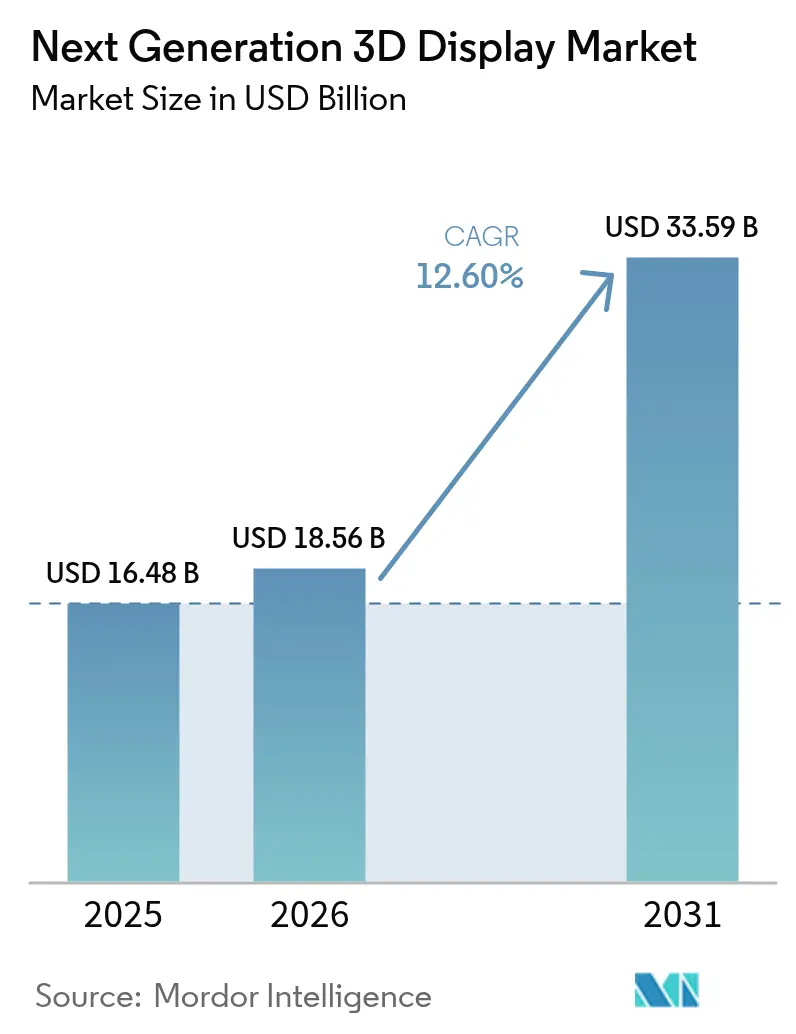
| Market Size (2026) | USD 18.56 Billion |
| Market Size (2031) | USD 33.59 Billion |
| Growth Rate (2026 - 2031) | 12.60 % |
| Fastest Growing Market | Asia Pacific |
| Largest Market | Asia Pacific |
| Market Concentration | Medium |
Major Players *Disclaimer: Major Players sorted in no particular order Image © Mordor Intelligence. Reuse requires attribution under CC BY 4.0. | |
Next Generation 3D Display Market Analysis by Mordor Intelligence
The next generation 3D display market size was valued at USD 16.48 billion in 2025 and estimated to grow from USD 18.56 billion in 2026 to reach USD 33.59 billion by 2031, at a CAGR of 12.60% during the forecast period (2026-2031). This growth reflects sustained demand for immersive visualization across automotive, medical, and consumer devices. Heightened pixel-density goals above 5,000 PPI, the shift toward glasses-free volumetric formats, and rapid OLED-on-silicon capacity additions are widening the application scope of the next generation 3D display market. Suppliers that solve the vergence-accommodation conflict while maintaining brightness over 10,000 nits are capturing design-wins in head-up displays, surgical workstations, and premium tablets. The sector’s expansion also benefits from AI-generated holographic pipelines that slash asset-creation costs and shorten content lead times.
Key Report Takeaways
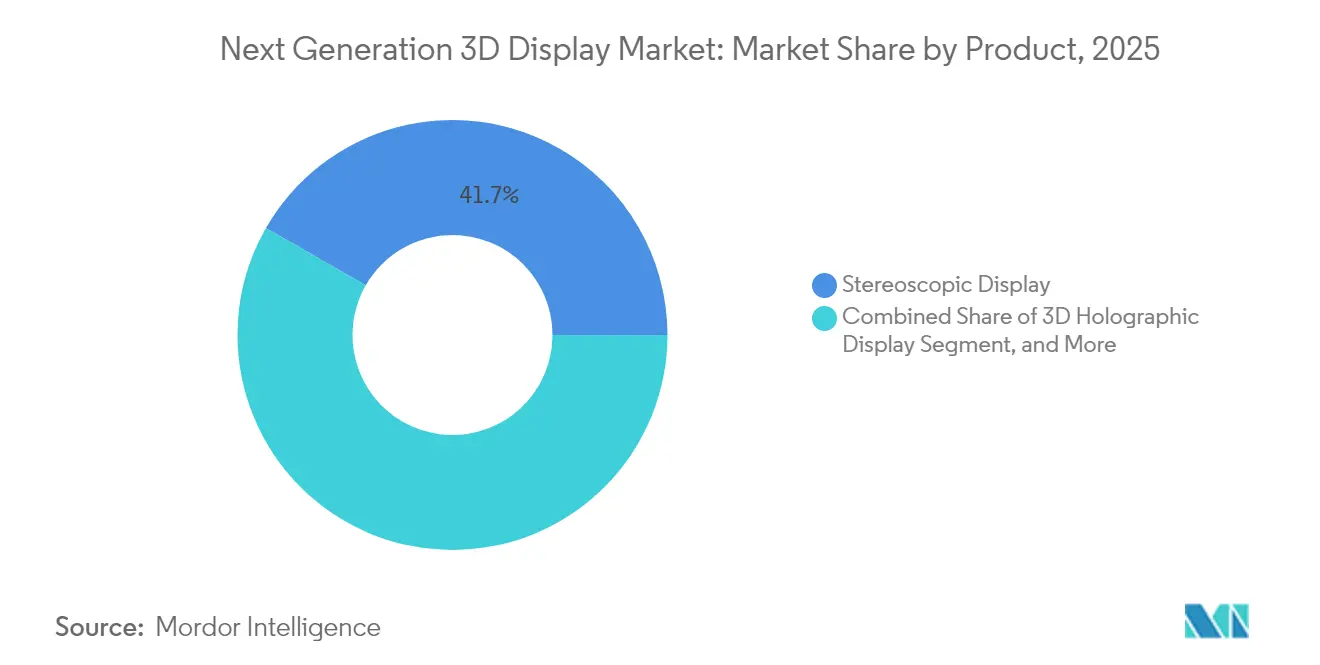
- By product type, stereoscopic displays led with a 41.72% share of the next-generation 3D display market in 2025; volumetric displays are forecast to expand at a 14.25% CAGR through 2031.
- By technology, LED retained 33.74% share of the next-generation 3D display market size in 2025, while OLED-on-silicon is growing at 13.38% to 2031.
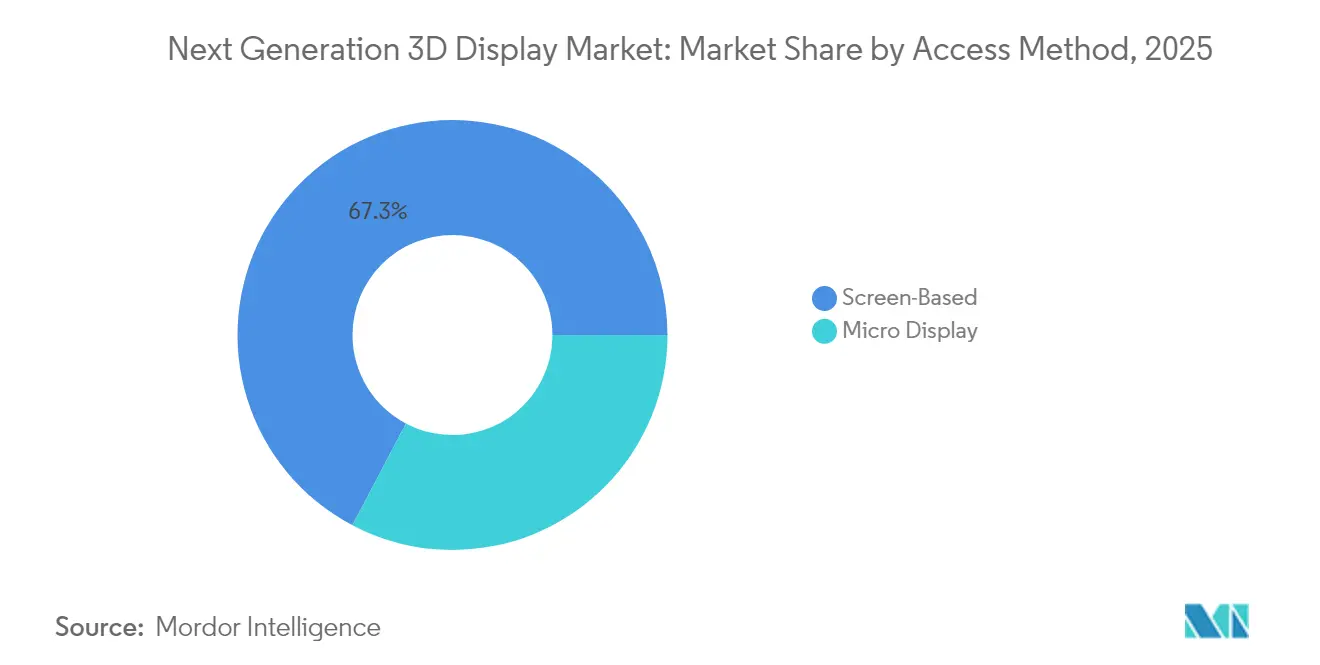
- By access method, screen-based configurations captured 67.29% revenue in 2025; micro-displays are advancing at a 13.98% CAGR.
- By end-user industry, consumer electronics contributed 48.10% of 2025 revenue, whereas medical applications are expanding at a 13.12% CAGR.
- By geography, Asia Pacific generated 46.31% of global revenue in 2025 and is progressing at a 12.74% CAGR.
Note: Market size and forecast figures in this report are generated using Mordor Intelligence’s proprietary estimation framework, updated with the latest available data and insights as of 2026.
Market Trends and Insights
Drivers Impact Analysis of Next Generation 3D Display Market*
| Driver | (~) % Impact on CAGR Forecast | Geographic Relevance | Impact Timeline |
|---|---|---|---|
| Rapid adoption in consumer electronics | 2.8% | Global, with concentration in Asia Pacific and North America | Short term (≤ 2 years) |
| Automotive HUD integration wave | 2.4% | North America, Europe, and Asia Pacific core markets | Medium term (2-4 years) |
| Advancements in OLED and MicroLED technologies | 2.1% | Global, led by Asia Pacific manufacturing hubs | Medium term (2-4 years) |
| Emergence of AI-generated holographic content ecosystems | 1.6% | North America and Europe early adopters, Asia Pacific scale-up | Long term (≥ 4 years) |
| Government incentives for domestic micro-display fabs | 1.4% | United States, European Union, Japan, South Korea, India | Medium term (2-4 years) |
| Growing use in tele-medicine surgical planning | 1.2% | North America and Europe primary, expanding to Middle East | Medium term (2-4 years) |
| Source: Mordor Intelligence | |||
Rapid Adoption in Consumer Electronics
Flagship smartphones and tablets now ship with autostereoscopic screens that deliver gaming, e-commerce, and video-chat depth cues without the need for accessories, thereby boosting perceived value in saturated premium segments. Samsung moved more than 2 million glasses-free 3D tablets during H1 2024, validating the mass-market potential of the next generation 3D display market. Chinese brands are integrating light-field modules into foldables, counting on 15–20% price premiums above USD 1,000 devices to offset panel costs. The cost gap between 2D and 3D displays is narrowing as OLED-on-silicon volume scales, enabling tier-1 vendors to treat 3D capability as a default spec for high-end hardware. Retailers report higher conversion rates for 3D product views, incentivizing content ecosystems that, in turn, expand hardware demand.
Automotive HUD Integration Wave
Head-up displays are graduating from planar overlays to volumetric projections that place navigation arrows 10 meters ahead, eliminating driver refocus lag and cutting false-dismiss rates for ADAS alerts. Continental’s March 2024 holographic HUD demonstration met ISO 26262 safety requirements and secured program adoption by a German luxury marque. Bosch and its partner OEMs plan to launch micro-LED HUDs by model year 2027, aligning display roadmaps with the rollouts of Level-2+ autonomy. Eye-tracking modules dynamically adjust hologram depth within 10 ms, which demands neural-accelerated controllers and propels silicon-level innovation. These advances reinforce the next-generation 3D display market as a core enabler of safety-critical cockpit experiences.
Advancements in OLED and MicroLED Technologies
LG Display’s tandem OLED reached mass production in Q2 2024, doubling brightness while extending lifetime, and permitting outdoor-readable 3D signage for transit hubs. IEEE IEDM prototypes hit 5,100 PPI in December 2024, removing the screen-door effect that once limited headsets.[1] OLED-on-silicon delivers sub-1 µs response, critical for low-latency augmented-reality overlays that must align virtual objects with moving real-world scenes. Stacked RGB pixel configurations now achieve 110% DCI-P3 coverage, satisfying professional creators mastering native 3D content. As MicroLED yields improve, suppliers anticipate transferring laboratory gains into automotive HUDs by 2028, keeping the next generation 3D display market on an aggressive luminance roadmap.
Emergence of AI-Generated Holographic Ecosystems
NVIDIA added volumetric-display support to Omniverse in mid-2024, cutting conversion steps and halving render times for product designers. Google’s Project Starline entered paid enterprise trials in late 2024, showing AI depth estimation can reduce bandwidth 60% against raw volumetric feeds. Pre-trained neural radiance-field models transform 2D photos into 3D assets, extending catalog depth for display owners. Microsoft integrated holographic streaming into Azure, offloading compute to cloud GPUs and enabling lightweight client devices. This software momentum solidifies the content-side foundation of the next generation 3D display market.
Restraints Impact Analysis of Next Generation 3D Display Market*
| Restraint | (~) % Impact on CAGR Forecast | Geographic Relevance | Impact Timeline |
|---|---|---|---|
| Lack of 3D content standards | -1.8% | Global, affecting all markets uniformly | Short term (≤ 2 years) |
| High capital costs of manufacturing lines | -1.5% | Global, concentrated in new market entrants | Medium term (2-4 years) |
| Occupational-health concerns on VAC conflict | -0.9% | Europe and North America regulatory focus | Long term (≥ 4 years) |
| Supply-chain dependency on rare-earth phosphors | -0.7% | Global, with acute impact in regions without domestic rare-earth refining | Medium term (2-4 years) |
| Source: Mordor Intelligence | |||
Lack of 3D Content Standards
With ISO/IEC MPEG-I Part 12 still in draft, manufacturers maintain proprietary pipelines spanning multi-view video, mesh streaming, or light-field encoding. This fragmentation raises production costs 40–60% and slows release cadences, damping device uptake despite robust hardware innovation. SMPTE’s 2024 interoperability report remains voluntary, leaving major studios tied to vendor-specific mastering approaches. Streaming platforms struggle to auto-match content with display capabilities because depth-map metadata remains inconsistent, forcing manual curation. Until a consensus codec emerges, the next generation 3D display market faces an availability bottleneck that tempers near-term household penetration.
High Capital Costs of Manufacturing Lines
A single OLED-on-silicon or MicroLED fab line demands USD 500 million, excluding working capital, keeping barriers high and slowing supply diversification. SEMI reported 24-month lead times for advanced lithography tools in July 2024, which delays capacity additions even at well-funded incumbents.[2] Yield rates below 70% for sub-10 µm MicroLED arrays elevate unit costs, confining early sales to defense and medical niches. While U.S. and European chip-act subsidies offset some risk, reimbursement cycles lag commercialization goals, creating a two-year supply-demand gap. New entrants, lacking scale economics, struggle to warrant multi-hundred-million-dollar investments, limiting competition in the next generation 3D display market.
*Our forecasts treat driver/restraint impacts as directional, not additive. The impact forecasts reflect baseline growth, mix effects, and variable interactions.
Next Generation 3D Display Market Segment Analysis
By Product:
Volumetric Displays Gain TractionVolumetric displays are forecast to expand at 14.25% annually through 2031, making them the fastest-growing slice of the next-generation 3D display market. Laboratory breakthroughs, such as Light Field Lab’s 28-billion-pixel SolidLight pilot, have confirmed commercial viability in retail showcases. Multiple-viewer visibility without glasses reduces fatigue and opens collaborative design, medical imaging, and entertainment scenarios. Stereoscopic formats, despite retaining 41.72% revenue in 2025, face usage-time limits due to accommodative stress studies, which may tilt procurement toward volumetric options. Static volumetric units support radiologists who rotate CT datasets in free space, enhancing anomaly detection compared to 2D monitors. Meanwhile, head-mounted stereoscopic displays stay relevant in gaming and training, where cost ceilings dictate sub-USD 50 panel premiums.
Although holographic tablets remain compute-intensive, edge AI accelerators promise battery-friendly operation by 2027. Automotive OEMs are experimenting with free-space volumetric dashboards to replace conventional clusters, seeking to enhance spatial awareness at highway speeds. Retailers deploy floor-standing volumetric kiosks to display lifelike products without inventory, advancing experiential commerce. Collectively, these deployments propel volumetric formats into mainstream segments of the next generation 3D display market.

By Technology:
OLED-on-Silicon Advances RapidlyOLED-on-silicon shipments are projected to grow at a 13.38% rate through 2031, as near-eye demand in AR headsets, pilot helmets, and surgical scopes accelerates. Pixel-level dimming delivers infinite contrast, crucial for overlaying bright outdoor scenes in aviation and construction. LED panels kept 33.74% of 2025 revenue by dominating stadium-scale walls, yet face pixel-density ceilings that OLED-on-silicon surpasses. MicroLED prototypes now match OLED fidelity while offering burn-in resistance, positioning the technology as a long-term successor once yield climbs. Liquid-crystal variants linger in cost-sensitive digital signage, though narrow viewing angles limit collaborative 3D sessions and cap their influence on the next generation 3D display market.
Foldable tablets utilize flexible OLED substrates to provide 3D depth on large canvases, seamlessly merging portability with spatial immersion. Tandem OLEDs that reach 10,000 nits enable sunlight-readable automotive HUDs without auxiliary reflectors, simplifying optics stacks and reducing cabin heat load. Digital Light Processing rear-projection televisions, once a staple of budget big-screen gaming, are exiting the market as flat-panel advances nullify their size-to-cost edge. Collectively, these shifts consolidate OLED-on-silicon’s lead while keeping MicroLED on the strategic roadmap.
By Access Method:
Micro-Displays AccelerateMicro-displays are expanding at 13.98% CAGR on the back of enterprise AR glasses that must weigh under 150 grams to ensure all-day comfort. By contrast, screen-based systems retained 67.29% of 2025 installations, excelling in living-room TVs and signage, where multi-viewer needs are most prevalent. Gallium-nitride backplanes are improving defect density, enabling micro-display pixel pitches of less than 5 µm while maintaining brightness above 3,000 nits. Automotive architectures blend driver-specific micro-displays for HUDs with shared large screens for passenger infotainment, balancing cost and experience across use cases. Defense programs, including helicopter helmet upgrades, require micro-displays that resist 20 g of vibration and operate within a temperature range of –40 °C to 55 °C, creating profitable niches within the next-generation 3D display market.
Educational institutions are adopting lightweight AR headsets for hands-on training in welding, medical anatomy, and aircraft maintenance, capitalizing on the safe rehearsal environment provided by spatial overlays. Meanwhile, screen-based displays maintain their dominance in collaborative boardrooms, where 85-inch panels enable teams to annotate 3D CAD files without the need for individual headsets. The twin-track adoption pattern keeps both access methods integral to overall market expansion.
By End-User Industry:
Medical Segment ExpandsMedical applications are projected to grow at a rate of 13.12% through 2031, as minimally invasive surgery increasingly relies on depth-accurate endoscopic views. The FDA cleared a holographic surgical planning system in March 2024, highlighting the clinical acceptance of 3D visualization. Tele-surgery pilots now stream stereoscopic feeds across 5G networks, enabling expert surgeons to guide procedures on other continents with a latency of less than 150 ms. Consumer electronics, however, still accounted for 48.10% of 2025 revenue, with the integration of 3D features across smartphones, gaming consoles, and televisions to differentiate mature product lines. Automotive head-up displays integrate holographic depth cues, supporting assisted-driving features that elevate safety and justify higher trim-level pricing.
Industrial quality-control cells utilize 3D monitors to inspect complex geometries, detecting defects that are invisible on 2D screens and thereby reducing rework costs. Retail showrooms utilize holographic podiums to display premium items without physical stock, thereby reducing logistics expenses and shrinkage risk. The education sector introduces volumetric lab kits that allow students to explore molecular structures or engine assemblies virtually, thereby improving comprehension and retention. Together, these trends diversify demand across verticals, broadening the revenue base of the next generation 3D display market.
Geography Analysis
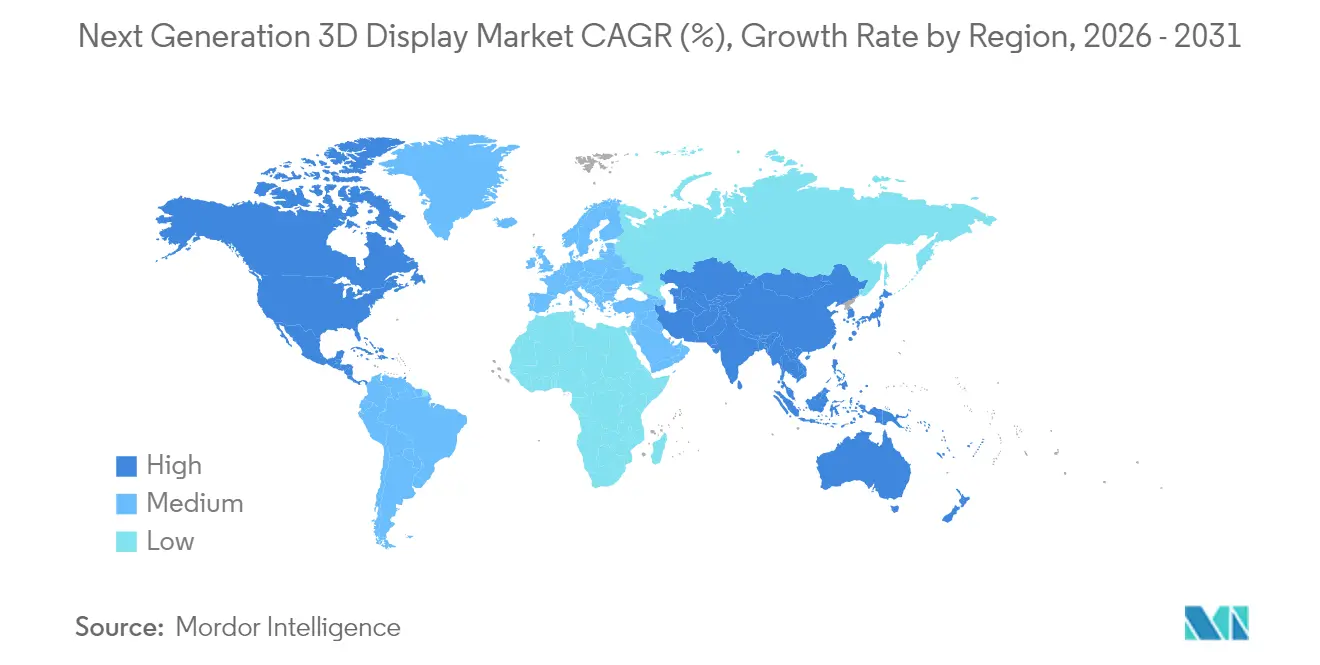
APAC Next Generation 3D Display Market
Asia Pacific retained 46.31% of 2025 revenue and advances at a 12.74% CAGR, underpinned by South Korean and Chinese subsidies that derisk micro-display capex and sustain supply-chain scale. South Korea’s KRW 500 billion grant pool accelerates OLED-on-silicon and MicroLED pilot lines, placing domestic players at the center of global sourcing strategies. Chinese manufacturers BOE and Tianma scale capacity in Chengdu and Wuhan, reducing import dependence and pricing aggressively to gain global design-ins. Japan pivots toward industrial and medical micro-displays, leveraging precision camera and semiconductor expertise to protect margins in the next generation 3D display market.
North America and Europe Next Generation 3D Display Market
North America is driven by the growth of automotive HUD rollouts, military AR procurement, and med-tech innovation, with U.S. defense budgets underpinning the demand for ruggedized headsets. Canada’s visual-effects cluster fuels a burgeoning 3D content ecosystem, driving local hardware sales. Europe remains anchored by German and Italian carmakers integrating holographic HUDs and by rigorous health-and-safety regulations that prioritize low-fatigue displays across workplaces. Policy support under Horizon Europe and the European Chips Act drives pilot fab investments, albeit at slower cadence than Asia Pacific.
MEA and South America Next Generation 3D Display Market
South America sees early retail and hospitality deployments, notably in Brazil’s luxury malls where holographic kiosks elevate brand experiences. The Middle East embraces 3D screens in destination shopping centers and smart-city initiatives, backed by sovereign wealth capital. African adoption stays limited by cost and infrastructure, though South Africa and Nigeria begin corporate rollouts, positioning the continent for gradual inclusion in the next generation 3D display market.
Regulatory Landscape
Regulation for next generation 3D displays is tightening around safety, accessibility, and human-factors performance as glasses-free and near-eye systems move into consumer and workplace use. In India, the Bureau of Indian Standards issued implementation guidance in March 2026 for mandatory migration to IS/IEC 62368-1:2023 for extended reality products, with licensing effective from 01 May 2026. This raises compliance urgency for XR-class micro-displays and related electronics sold into the country.
Standards activity is also getting more 3D-specific. The IEC published IEC TR 62629-1-3:2026 (February 2026) on depth perception and 3D object positioning for non-physical 3D display screens, and IEC TR 63145-400-20:2026 (April 2026) on 3D sensing functions for eyewear displays. That is increasing the need to document ergonomics and sensing behavior alongside optical performance. In the United States, the FCC set an August 2026 compliance deadline for video apparatus to make closed-captioning display settings readily accessible, extending accessibility requirements to advanced user interfaces that increasingly sit alongside 3D capabilities in premium TVs, monitors, and signage.
Value Chain Analysis
The value chain spans (1) materials and components, including OLED and MicroLED epitaxy, silicon backplanes for OLED-on-silicon, rare-earth phosphors, and optical films; (2) critical sub-systems such as meta-optics/lenticular layers, waveguides, and integrated eye-tracking or depth-sensing modules; (3) manufacturing and integration across panel/micro-display fabrication, bonding/advanced packaging, and optical alignment; and (4) software layers for rendering, depth-map handling, and 2D-to-3D conversion that shape perceived quality and device adoption. High capital intensity for OLED-on-silicon and MicroLED lines, along with long lead times for advanced tools, keeps supply constrained, while yield management for sub-10 micrometer arrays remains a key cost lever.
Downstream, OEMs and solution providers assemble displays into end products such as automotive HUD modules, medical workstations, enterprise AR devices, and commercial signage, then sell through consumer retail, systems integrators, and B2B deployment channels. Recent commercial activity points to tighter vertical coordination, including Samsung launching Spatial Signage globally at ISE 2026 by pairing large-format glasses-free 3D displays with tools for deployment. Samsung and POSTECH also published metasurface-based 2D-3D switching research that can be embedded as a thin optical layer and manufactured within existing display ecosystems. New retail introductions, including Acer's glasses-free 3D monitor entering channels in China in 2026, further show how hardware, sensors, and AI software are packaged into configurable platforms rather than standalone panels.
Competitive Landscape
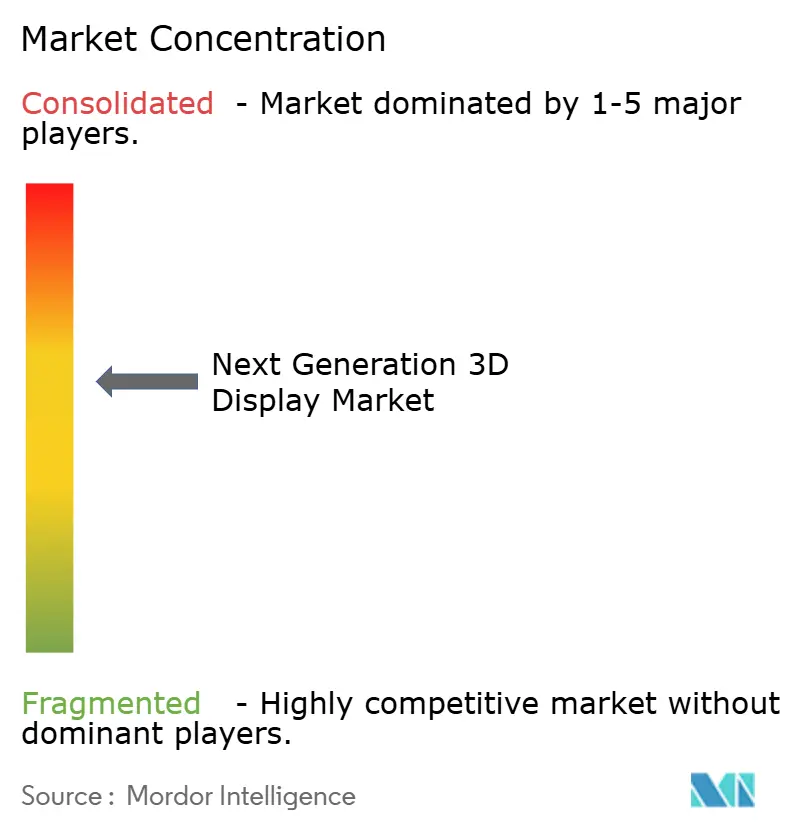
The next generation 3D display market shows moderate concentration, with the top five suppliers controlling 55% of 2024 revenue. Samsung and LG cross-subsidize R&D via their OLED leadership, securing automotive HUD and premium tablet sockets. Chinese competitors pursue cost leadership by localizing materials and accepting thinner margins to accelerate global share gains. Established panel firms acquire optics specialists and software studios, delivering turnkey solutions that minimize customer integration overhead.
Disruptors such as Light Field Lab and Voxon Photonics bypass panels altogether, projecting images into free space and challenging incumbent capital economics. Patent filings exceeded 1,200 in 2024 for light-field optics and AI-driven rendering, indicating an innovation race that could reshape supplier hierarchies. Standards bodies wrestle with codec convergence, but commercial rivalries slow consensus, perpetuating ecosystem fragmentation and sustaining optionality for niche players.
Industrial and military buyers create defensible sub-segments where performance and ruggedization trump cost, allowing smaller vendors to command premium margins. Medical display suppliers maintain moat-like advantages after securing FDA and ISO 13485 certifications, which elongate competitor approval timelines. Consequently, competitive intensity grows both horizontally, with panel vs. volumetric paradigms, and vertically, as suppliers integrate silicon, optics, and content stacks.
Next Generation 3D Display Industry Leaders
-
Avalon Holographics Inc.
-
Avegant Corporation
-
Robert Bosch GmbH
-
Continental Aktiengesellschaft
-
Samsung Electronics Co., Ltd.
- *Disclaimer: Major Players sorted in no particular order
Next Generation 3D Display Market Companies Covered in this Report
- Avalon Holographics Inc.
- Avegant Corporation
- Robert Bosch GmbH
- Continental Aktiengesellschaft
- Fovi3D Inc.
- Samsung Electronics Co., Ltd.
- NVIDIA Corporation
- Google LLC
- Coretronic Corporation
- Creal 3D SA
- Sharp Corporation
- LG Electronics Inc.
- AU Optronics Corp.
- Panasonic Holdings Corporation
- Sony Group Corporation
- Light Field Lab Inc.
- Looking Glass Factory Inc.
- Voxon Photonics Pty Ltd
- RealView Imaging Ltd.
- HYPERVSN Limited
- Holoxica Limited
- Leia Inc.
- Microsoft Corporation
Market Opportunities and Future Outlook
A major whitespace is scalable, standardized content workflows that reduce the burden created by proprietary 3D pipelines, particularly for consumer electronics and streaming use cases. While ISO/IEC MPEG-I Part 12 remains in draft and interoperability guidance has been largely voluntary, suppliers are compensating through software-driven conversion and toolchains that can activate 3D experiences without native assets. Recent rollouts support this shift, including Acer bringing a glasses-free 3D gaming monitor to retail with onboard AI for 2D-to-3D conversion, and Samsung expanding glasses-free 3D into commercial environments via Spatial Signage at ISE 2026. Together, these deployments create more installed base where automated content preparation has clear payback.
Another opportunity is optical-thickness reduction and ergonomics-led differentiation, which directly targets fatigue and vergence-accommodation conflict concerns that influence procurement in professional and workplace settings. Samsung and POSTECH demonstrated a voltage-controlled metasurface lenticular approach for switchable 2D-3D displays with a thin optical profile and wide viewing angle, indicating a pathway to integrate 3D capability into form factors that resemble conventional high-end panels. In parallel, 2026 academic work on diffractive decoders and learning-empowered hologram synthesis for near-eye displays, as well as scanning light-field approaches (for wide viewing angles on high-refresh panels), reinforces an R&D-to-product pipeline aimed at higher pixels-per-degree, larger eyebox, and lower crosstalk. This aligns with automotive HUD, medical visualization, and premium monitor requirements where performance and usability constraints are explicit.
Recent Industry Developments in Next Generation 3D Display Market
- January 2026: Vuzix and Avegant unveiled a lightweight binocular AR smart-glasses reference design at CES 2026, built around Avegant's AG-30L3 LCoS light engine. The reference platform provides OEMs with a more complete optical and display starting point, which can shorten product development cycles for near-eye 3D visualization devices.
- August 2025: The Government of Newfoundland and Labrador announced a CAD 1 million investment to support deployment of Avalon Holographics' NOVAC system at a US Department of Energy facility in Oak Ridge, Tennessee. Public funding tied to a named end-user site signals expanding institutional adoption for true holographic visualization in mission and research environments.
- June 2024: Vuzix and Avegant announced a strategic partnership to develop a full-color optical reference design for AI-enabled consumer smart glasses, leveraging Avegant LCoS light engines. The collaboration strengthened the upstream-to-OEM bridge for micro-display-based 3D/AR devices by aligning optics, display engines, and manufacturable module designs.
Next Generation 3D Display Market Report Scope and Research Methodology
Market Definition and Coverage
This market covers the revenues earned from next generation 3D display solutions that create depth perception using advanced optics and display architectures, and it includes hardware and the enabling display technologies sold into end-use applications.
Scope exclusions: We do not count purely 2D display panels, basic 3D glasses accessories sold standalone, or general purpose GPUs unless they are bundled as part of a 3D display product offering.
Segments Covered in This Report
- By Product
- 3D Holographic Display
- Head Mounted Displays
- Static Volume Displays
- Light Field Displays
- Volumetric Displays
- Stereoscopic Displays
- By Technology
- Digital Light Processing Rear-Projection Television (DLP RPTV)
- Light Emitting Diode (LED)
- Organic Light Emitting Diode (OLED)
- Plasma Display Panel (PDP)
- Liquid Crystal Display (LCD)
- MicroLED
- OLED-on-Silicon (OLEDoS)
- By Access Method
- Micro Display
- Conventional/Screen Based Display
- By End User Industry
- Consumer Electronics
- Automotive and Transportation
- Medical
- Aerospace and Defense
- Industrial
- Education and Training
- Retail and Advertising
- By Geography
- North America
- United States
- Canada
- Mexico
- South America
- Brazil
- Argentina
- Rest of South America
- Europe
- Germany
- United Kingdom
- France
- Italy
- Russia
- Rest of Europe
- Asia Pacific
- China
- Japan
- South Korea
- India
- Australia AND New Zealand
- Rest of Asia Pacific
- Middle East
- Saudi Arabia
- United Arab Emirates
- Turkey
- Rest of Middle East
- Africa
- South Africa
- Nigeria
- Egypt
- Rest of Africa
- North America
Data Sources, Market Sizing, and Validation
Desk Research
Desk work starts by mapping the supply chain and building a clean list of what qualifies as a next generation 3D display sale, which helps keep later calculations consistent across geographies and customer types. For public baselines, we refer to sources such as USITC import and export statistics, World Intellectual Property Organization patent filings, IEEE and other peer reviewed journals on display optics, and standards bodies such as ISO and IEC for terminology and test references.
To make the model realistic, we also cross-check company annual reports and investor presentations for revenue mix cues, plus reputable press releases and conference proceedings for capacity announcements and product launch timing. Where needed, paid subscriptions for company financials and intelligence, patent databases, and shipment level import and export databases are used to fill gaps on unit flows and pricing ranges. These desk sources are illustrative only, since many other public documents were also used for data collection, validation, and clarification.
Primary Interviews and Surveys
Primary work focuses on interviews and structured surveys with display component suppliers, device OEM teams, system integrators, and downstream buyers in segments like automotive, medical imaging, and immersive consumer devices. We use these conversations to confirm what products are being purchased today, how pricing is moving for different architectures (for example, light field versus holographic), and what adoption pace looks realistic by region before finalizing assumptions.
Distribution of primary research fieldwork respondents
| Company type | Respondent position | Region |
|---|---|---|
| Top tier: 36% | CXOs: 18% | APAC: 41% |
| Mid tier: 45% | Functional/Unit leaders: 38% | EMEA: 37% |
| Smaller Players: 19% | Managers: 44% | Americas: 22% |
Market-Sizing & Forecasting
Sizing is built using a top-down approach where device and module demand pools are reconstructed from shipment indicators and adoption rates across key 3D display use cases, and then translated into value using realistic price bands. We then corroborate totals with selective bottom-up checks, such as sampled unit volumes multiplied by average selling prices, plus channel checks on where volumes are actually shipping.
A few inputs that matter in this market include headset and smart glasses shipments that use micro displays, automotive cockpit and HUD fitment rates, medical visualization installations, panel and micro display capacity additions, and the pace of cost down for optics and backplanes. When a country or end use lacks a direct data point, we bridge it using proxy indicators like electronics production trends and import mixes, then run expert checks so the gap fill remains sensible.
For forecasting, we rely on scenario analysis supported by a multivariate regression layer, since adoption is influenced by device cycles, price erosion, and end-market production. Expert feedback helps set realistic ranges for penetration and ASP progression, and scenario outputs are used to select a balanced central case that is repeatable and easier to audit.
Data Validation & Update Cycle
Before numbers are signed off, outputs are triangulated against independent signals, such as unit shipment trends, capacity announcements, and adoption statements from buyers. We also check for year to year jumps that do not match known product cycles. If a variance is large, we revisit assumptions, rerun sensitivities on the most influential drivers, and re-contact sources when clarification is needed.
A multi step internal review is followed, where another analyst checks arithmetic, scope consistency, and whether the growth curve matches market realities. Reports are refreshed annually, and interim updates are made when material events occur, such as major capacity moves, regulation shifts affecting automotive displays, or large product launches. Right before delivery, a final pass is completed so clients receive the most current view available.
Mordor Intelligence's Next Generation 3d Display Market Size Compared Against Other Published Estimates
Published market values can look far apart in this space because the product boundary is not always the same, and the years and forecast windows also vary. Differences usually come from what gets counted as a 3D display sale, how unit demand is estimated, and how fast pricing is assumed to fall as volumes scale.
The main gap comes from whether traditional 3D displays and adjacent 2D display value are folded into the total, where Mordor Intelligence counts only next generation 3D display formats and prices them using architecture specific ASP paths that are rechecked with primary feedback and refreshed for the stated forecast window.
Benchmark comparison
| Source | Market Size | Gaps in Research Methodology |
|---|---|---|
| Mordor Intelligence | USD 16.48 B (2025) | |
| Global Publisher A | USD 0.77 B (2024) | Uses a narrower counted revenue pool that reads closer to a subset of next generation 3D displays, with a different base year and shorter horizon that can exclude higher value device categories captured in broader definitions. |
| Industry Media B | USD 1.05 B (2028) | Reports incremental growth over a period rather than the full market value in a single year, which makes the figure look smaller when compared directly to annual revenue based sizing. |
The spread in the table is mostly explained by scope and metric choices, not just forecasting style. When the demand pool is built from clear device and installation drivers and then checked against pricing realities, the final number stays traceable to inputs that can be reviewed and repeated.
Key Questions Answered in the Report
How large is the next generation 3D display market in 2026?
It is valued at USD 18.56 billion, and it is forecast to reach USD 33.59 billion by 2031 at a 12.60% CAGR.
Which product category is expanding fastest?
Volumetric displays are growing at a 14.25% CAGR as glasses-free viewing gains traction.
Why are OLED-on-silicon microdisplays important for augmented-reality headsets?
They deliver >5,000 PPI density, infinite contrast, and sub-1 µs response times that reduce motion-to-photon latency.
What drives Asia Pacifics leadership in 3D displays?
Subsidized capex, large-scale fabs in South Korea and China, and strong domestic demand from automotive and smartphone supply chains.
How do content-standard gaps restrain market growth?
Proprietary pipelines force creators to maintain parallel workflows, raising costs 4060% and slowing content availability.
Which vertical shows the highest growth potential besides consumer electronics?
Medical visualization leads with a 13.12% CAGR due to minimally invasive surgery and tele-surgery adoption.