
VoLTE Market Size and Share
Market Overview
| Study Period | 2020 - 2031 |
|---|---|
| Market Size (2026) | USD 86.84 Billion |
| Market Size (2031) | USD 513.23 Billion |
| Growth Rate (2026 - 2031) | 42.65 % |
| Fastest Growing Market | Asia Pacific |
| Largest Market | North America |
| Market Concentration | Low |
Major Players *Disclaimer: Major Players sorted in no particular order Image © Mordor Intelligence. Reuse requires attribution under CC BY 4.0. | |
VoLTE Market Analysis by Mordor Intelligence
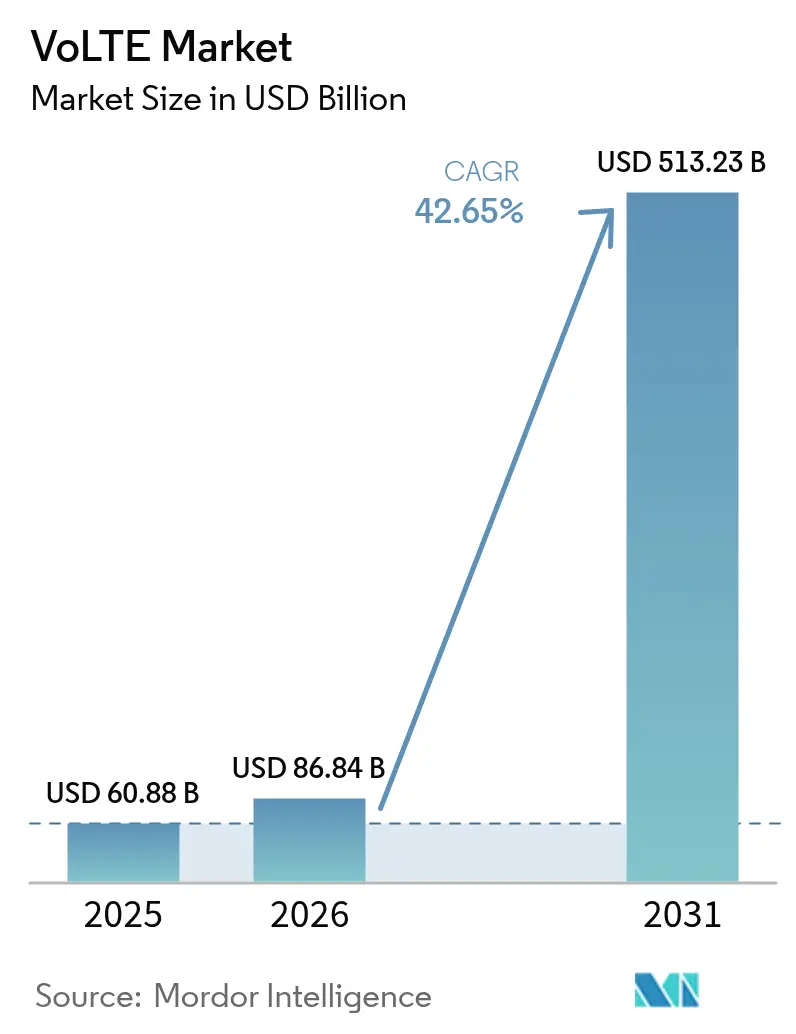
The VoLTE Market size was valued at USD 60.88 billion in 2025 and estimated to grow from USD 86.84 billion in 2026 to reach USD 513.23 billion by 2031, at a CAGR of 42.65% during the forecast period (2026-2031).
Explosive adoption follows the switch-off of 3G networks, spectrum refarming for 5G, and operators’ need to deliver high-quality voice on all-IP infrastructure. Operators that complete VoLTE migration improve spectrum efficiency, cut legacy operating costs, and secure a fallback voice layer for 5G NSA deployments. North America’s early LTE maturity and aggressive 3G sunsets underpin its 40% 2024 revenue share, while Asia-Pacific’s massive subscriber base and state-sponsored digital initiatives drive the fastest 47.2% CAGR. Commercial subscribers dominate with 41.2% share, yet government and public-safety users expand at 45.3% CAGR because mission-critical agencies require resilient broadband voice. Technology migration is at an inflection point: Circuit-Switched Fallback still carries 60% of 2024 calls, but Voice over IMS leads future growth at 46.2% CAGR, highlighting the strategic pivot to native IP voice solutions.
Key Report Takeaways
- By geography, North America held 39.45% of VoLTE market share in 2025; Asia-Pacific is forecast to expand at a 45.8% CAGR through 2031.
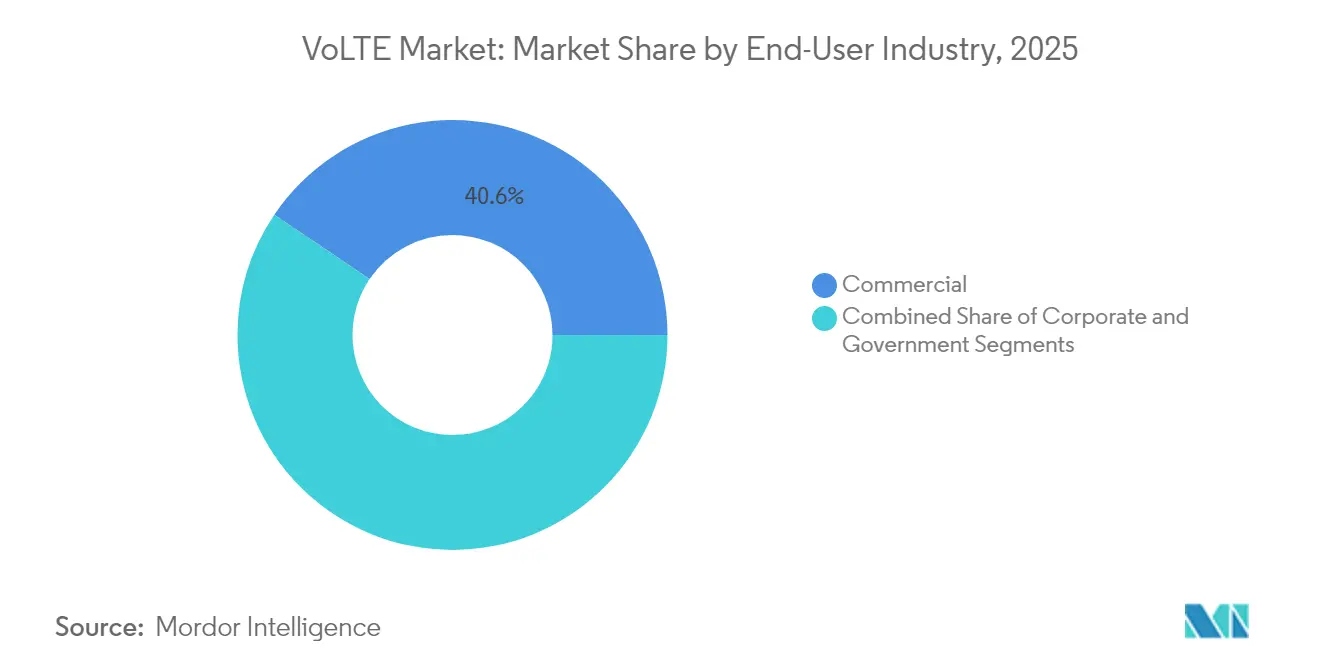
- By end-user, the Commercial segment led with 40.55% revenue share in 2025; Government applications are advancing at a 43.9% CAGR to 2031.
- By technology, Circuit-Switched Fallback accounted for 59.2% share of the VoLTE market size in 2025, while Voice over IMS is projected to grow at a 44.3% CAGR through 2031.
- By device, Smartphones commanded 66.85% share of the VoLTE market size in 2025; IoT Modules & Wearables are expanding at a 45% CAGR between 2026-2031.
- By operator type, Mobile Network Operators captured 71.55% of VoLTE market share in 2025; Private/Enterprise LTE networks record the highest 43.8% CAGR through 2031.
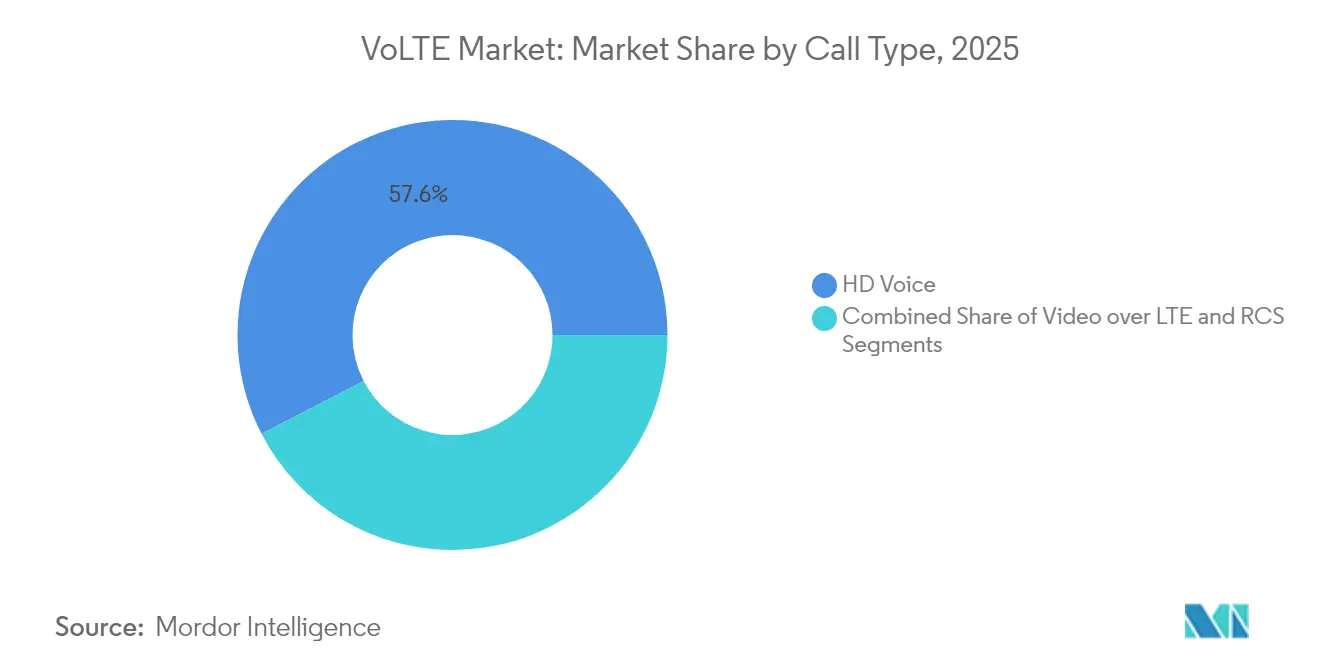
- By call type, HD Voice represented 57.60% of revenue in 2025; Rich Communication Services adoption is rising at a 47% CAGR to 2031.
Note: Market size and forecast figures in this report are generated using Mordor Intelligence’s proprietary estimation framework, updated with the latest available data and insights as of 2026.
Market Trends and Insights
Drivers Impact Analysis of VoLTE Market*
| Driver | (~) % Impact on CAGR Forecast | Geographic Relevance | Impact Timeline |
|---|---|---|---|
| High-speed mobile broadband voice demand | +8.2% | Global (North America & APAC focus) | Medium term (2-4 years) |
| LTE coverage & smartphone penetration | +7.8% | Primarily APAC; MEA & Latin America spill-over | Long term (≥ 4 years) |
| 3G regulatory sunsets | +9.1% | North America & EU first, then APAC | Short term (≤ 2 years) |
| Enterprise private-LTE for mission-critical voice | +6.5% | North America, Western Europe, select APAC | Medium term (2-4 years) |
| eSIM-centric device ecosystem | +4.3% | Global premium devices | Long term (≥ 4 years) |
| 5G NSA fallback requirement | +8.7% | Markets with advanced 5G rollouts | Short term (≤ 2 years) |
| Source: Mordor Intelligence | |||
Growing LTE Network Coverage & Smartphone Penetration
LTE now covers around 95% of populations in developed economies and continues to scale across emerging markets. Smartphone penetration surpassed 74% worldwide in 2024, and most 5G-capable devices ship with VoLTE enabled out-of-box. Operators migrate voice traffic to VoLTE to reclaim 3G spectrum and lower operating costs. Wider rural LTE footprints in India and Brazil, often co-funded by governments, extend VoLTE to previously underserved communities. The alignment of network readiness, device capability, and policy incentives positions VoLTE as the default voice layer during the 4G-to-5G transition.
Regulatory Sunset of 3G Networks Accelerating VoLTE Migration
The FCC’s mandated 3G switch-off schedule and Europe’s 2025 sunset recommendation eliminate fallback circuit-switched voice, compelling operators to provision.[1]European Communications Committee, “Report 335 on 3G Sunset,” cept.org Rapid spectrum refarming for 5G and stringent E911 location-accuracy rules make VoLTE implementation non-negotiable. Equipment vendors gain from brisk IMS core upgrades, and operators report quicker pay-back on VoLTE CAPEX through lower energy costs and reduced legacy maintenance. [2]National Emergency Number Association, “E911 Phase II Requirements,” nena.org
Enterprise Private-LTE Adoption for Mission-Critical Voice
Factories, logistics hubs, and public-safety agencies replace patchy Wi-Fi and narrowband radio with private LTE voice that guarantees deterministic quality of service. The Citizens Broadband Radio Service in the United States accelerates deployments by offering lightly licensed spectrum. Integrated VoLTE supports industrial automation alerts, push-to-talk for first responders, and voice-controlled robotics, broadening the addressable opportunity beyond traditional consumer subscribers.
5G NSA Deployments Requiring VoLTE for Fallback Voice Continuity
Non-Standalone 5G relies on LTE anchoring for voice. Operators rolling out 5G NR must also optimize VoLTE to avoid dropped calls during inter-radio handoffs. Until full Voice over 5G standards mature post-2027, VoLTE remains the mandatory voice layer in dual-connectivity networks, sustaining investment momentum and reinforcing its relevance well into the 2030 horizon. [3]Ericsson AB, “5G Core and VoLTE Interworking,” ericsson.com
Restraints Impact Analysis of VoLTE Market*
| Restraint | (~) % Impact on CAGR Forecast | Geographic Relevance | Impact Timeline |
|---|---|---|---|
| Limited awareness in low-income nations | -3.2% | Sub-Saharan Africa, parts of South Asia, rural Latin America | Long term (≥ 4 years) |
| Roaming/inter-operator interoperability | -2.8% | Global business-travel corridors | Medium term (2-4 years) |
| Voice over 5G cannibalization risk | -4.1% | Early 5G SA markets | Long term (≥ 4 years) |
| Battery drain & QoS in dense networks | -2.3% | Urban small-cell clusters | Short term (≤ 2 years) |
| Source: Mordor Intelligence | |||
Lack of Awareness and Slow Adoption in Low-Income Nations
Subscribers in low-income regions prioritize basic connectivity, so VoLTE’s value proposition remains unclear. Feature-phone prevalence and device affordability gaps stall migration even where LTE coverage exists. Operator campaigns must emphasize tangible benefits such as clearer audio and simultaneous voice-data functionality while aligning with government digital-literacy drives.
Roaming/Inter-Operator Interoperability Challenges
Bilateral roaming deals and inconsistent IMS implementations cause call drops for international travelers. The GSMA’s VoLTE roaming specs progress slowly, and operators incur high testing costs to certify each pairing. Until roaming is seamless, some subscribers fall back to OTT apps, undermining VoLTE’s reliability perception.
*Our forecasts treat driver/restraint impacts as directional, not additive. The impact forecasts reflect baseline growth, mix effects, and variable interactions.
VoLTE Market Segment Analysis
By End-User Industry:
Government Drives Mission-Critical AdoptionGovernment agencies accounted for a 43.9% CAGR through 2031, though the Commercial segment retained the largest 40.55% share of VoLTE market size in 2025. Federal and municipal bodies adopt VoLTE to modernize public-safety communications, integrate broadband push-to-talk, and meet stringent security mandates. First responders in the United States migrate to FirstNet’s VoLTE-enabled broadband, enabling multimedia situational awareness.
Expanding smart-city programs employ VoLTE as a resilient fallback for IoT telemetry and emergency alerts. Defense departments deploy encrypted VoLTE on private networks to simplify voice procurement and maintenance. Commercial enterprises leverage existing smartphone fleets to embed HD voice into unified communications, supporting hybrid work and customer-service workflows without heavy hardware investments.



By Device Category:
IoT Expansion Beyond Traditional VoiceSmartphones retained 66.85% of VoLTE market share in 2025, yet IoT Modules and Wearables log the strongest 45% CAGR. Asset trackers integrate VoLTE modules to relay voice alarms during intrusions, while smartwatches gain autonomous calling functions. Automakers embed VoLTE for automatic crash notification and concierge calling, adding incremental service revenue for operators and OEMs.
Lower-cost feature phones with VoLTE widen addressable bases in emerging markets where OTT voice alternatives consume excessive data. Enterprise IoT deployments require carrier-grade voice for control-room escalation during system faults, converting machines into voice end-points and enlarging the VoLTE market.
By Technology:
Voice over IMS Gains MomentumCircuit-Switched Fallback held 59.2% of 2025 revenues, but Voice over IMS is forecast to expand at a 44.3% CAGR, underscoring operators’ move toward IP-native voice that trims parallel network costs. The VoLTE market size for Voice over IMS platforms is set to triple by 2031 as IMS cores become cloud-native and deploy over off-the-shelf hardware.
Single-Radio Voice Call Continuity ensures seamless hand-offs between LTE and legacy 2G coverage, maintaining quality during transition. As confidence in all-IP voice rises, dual-radio architectures decline, freeing handset battery life and simplifying RF design. Long-term, IMS adoption unlocks RCS and video-over-LTE services that raise ARPU.
By Call Type:
RCS Transforms Communication ExperienceHD Voice supplied 57.60% of 2025 call revenue, delivering full-band audio as the new baseline. RCS traffic, however, is projected to grow at 47% CAGR as operators bundle file sharing, location pins, and group chat into the native dialer. The VoLTE market size for RCS features benefits from enterprise interest in verified sender IDs and rich messaging campaigns.
Video over LTE adoption advances on ubiquitous front-camera smartphones and expanding network capacity. Enhanced call types position carriers as credible alternatives to OTT apps by merging voice, messaging, and content in a single trusted channel.
By Operator Type:
Private Networks Emerge as Growth DriverMobile Network Operators controlled 71.55% revenue in 2025, but Private/Enterprise LTE installations grow at a 43.8% CAGR as factories, airports, and mines deploy stand-alone networks. The VoLTE market share captured by private operators accelerates in the United States, where CBRS spectrum facilitates dedicated networks without nationwide carrier dependence.
Managed-service alliances—such as AT&T and Microsoft’s Azure private 5G offering—simplify turn-key VoLTE for enterprises. MVNOs depend on host carriers’ IMS implementations, so their competitive edge lies in value-added applications rather than network control.
Geography Analysis
North America VoLTE Market
North America commanded 39.45% of 2025 revenue on the back of complete LTE footprints, early smartphone saturation, and FCC-driven 3G sunsets. Operators, including Verizon and AT&T, finalized nationwide VoLTE rollouts and now target latency optimization to support low-latency voice applications. Canadian carriers leverage shared rural infrastructure programs to extend VoLTE coverage into sparsely populated regions, while Mexico’s reform-driven spectrum auctions speed up LTE deployment.
APAC VoLTE Market
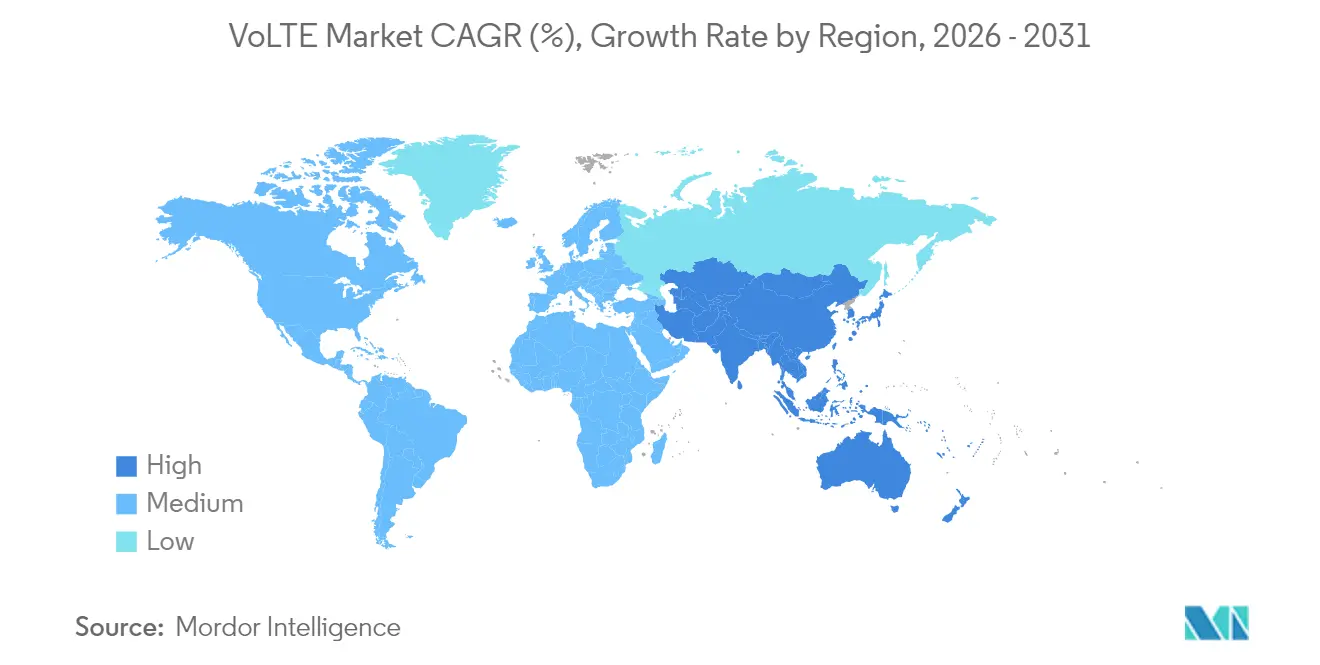
Asia-Pacific is forecast to grow at 45.8% CAGR, buoyed by China’s 500 million-subscriber VoLTE network and India’s Digital India program that subsidizes 4G handsets. Regional giants like Reliance Jio lead with zero-charge VoLTE calling plans, illustrating how inexpensive voice can accelerate adoption. Japan and South Korea exploit dense urban fiber backhaul to layer RCS and ultra-low-latency video over standard VoLTE, attracting premium subscribers.
EMEA and LATAM VoLTE Market
Europe’s coordinated 3G sunset roadmap supports cross-border roaming efforts that bolster traveler confidence in VoLTE continuity. Middle East governments invest in smart-city blueprints, using VoLTE to back up IoT telemetry and emergency services in high-rise clusters. Africa and Latin America trail in revenue terms yet present untapped opportunities as universal service funds finance LTE rollouts and handset affordability programs.

Regulatory Landscape
Regulators and standards bodies continue to push voice services toward all-IP interoperability and emergency-calling compliance, tightening requirements as operators remove legacy circuit-switched fallbacks. In the United States, the FCC adopted a national Next Generation 911 (NG911) transition framework in July 2024, with rules taking effect on November 25, 2024, requiring originating service providers to deliver 911 traffic to designated NG911 Delivery Points in an IP-based SIP format. This raises the operational bar for IMS/VoLTE-ready interconnect and routing.
In Europe, interoperability and messaging requirements increasingly intersect with IMS-based service delivery. Finland's Transport and Communications Agency (Traficom) issued Regulation 28 L/2025, which entered into force on May 4, 2026, setting interoperability requirements for public communications networks and services including SMS, MMS, and RCS handling, alongside number validation provisions with a November 2, 2026 deadline. Globally, ITU-T guidance continues to formalize emergency and interconnect behavior in VoLTE environments, including ITU-T Q Supplement 69 (November 2025) on VoLTE-based network interconnection for emergency calls and ITU-T Q.4073 (June 2024) on VoNR interconnection with IMS/MMTel networks, reinforcing continuity between VoLTE and emerging 5G voice ecosystems.
Value Chain Analysis
The VoLTE value chain covers standards definition, core and radio network supply, device enablement, integration and testing, and commercial operations. At the foundation, 3GPP-defined IMS and related profiles underpin service capability, while organizations such as GSMA support implementation alignment through operator and OEM guidance (for example, its VoLTE Implementation Guide updated in April 2024). Network vendors such as Ericsson and Nokia supply IMS core and related software, while chipset and device OEMs such as Qualcomm and Samsung provide the handset and module ecosystem that must interoperate with operator IMS parameters for HD voice, emergency calling, and supplementary services.
Bottlenecks tend to concentrate in device-network interoperability and roaming, where historically heavy 1:1 testing and inconsistent IMS parameter sets have slowed rollouts, particularly for smaller MNOs and MVNOs. GSMA work on standardized IMS configuration profiles (including P#4 and P#6 highlighted in 2025) and Samsung's collaboration with GSMA to enable VoLTE by default on Android 15+ devices using operator-defined IMS settings/GSMA profiles reduce activation friction and shorten onboarding cycles for new operator relationships. Downstream, operators and managed-service partners monetize through commercial voice bundles (HD voice), richer calling experiences (RCS), and enterprise/private LTE services, with service assurance, lawful intercept compliance, and QoS optimization recurring inputs across deployment and operations.
Competitive Landscape
The VoLTE market features moderate concentration. Three global vendors - Ericsson, Nokia, and Samsung - dominate IMS core supply, while top operators hold strong regional clout. North American carriers capitalize on premium network positioning and patented VoLTE optimizations to counter OTT migration. In Europe, infrastructure-sharing mandates reduce duplication but intensify retail competition, spurring innovative RCS-based customer-experience offerings.
Equipment vendors pivot to cloud-native, software-as-a-service IMS models that slash deployment times for emerging operators and private-network owners. Patent portfolios around SR-VCC and codec optimization enable royalty streams, reinforcing barriers to entry. Disruptive entrants deliver lightweight IMS cores running on Kubernetes, allowing small carriers to launch VoLTE without heavyweight hardware. Strategic moves include Verizon’s USD 2.1 billion VoLTE quality upgrade plan, Nokia’s USD 1.8 billion Airtel IMS contract, and AT&T-Microsoft’s managed private-LTE alliance.
VoLTE Industry Leaders
AT&T Inc.
Verizon Wireless
Vodafone Group PLC
Bharati Airtel Limited
Bell Canada
- *Disclaimer: Major Players sorted in no particular order

VoLTE Market Companies Covered in this Report
- AT&T Inc.
- Verizon Communications Inc.
- China Mobile Ltd.
- Reliance Jio Infocomm Ltd.
- Vodafone Group Plc
- Bharti Airtel Ltd.
- SK Telecom Co. Ltd.
- KT Corporation
- Orange S.A.
- Deutsche Telekom AG
- Telefonica S.A.
- Telstra Corporation Ltd.
- NTT Docomo Inc.
- China Unicom Ltd.
- China Telecom Corp.
- Bell Canada
- Rogers Communications Inc.
- Etisalat Group
- MTN Group
- Zain Group
- Telkomsel

Market Opportunities and Future Outlook
A major opportunity continues to come from network sunset programs and the forced migration of voice to IMS-based platforms, which increases demand for VoLTE enablement, testing, and cloud-native core upgrades. Operator actions in 2026 underline this shift: Telefónica Germany migrated an initial 100,000 mobile customers to 4G/5G voice services on a Mavenir cloud-native IMS platform (May 2026), and Kcell completed a VoLTE rollout across its mobile network in Kazakhstan (June 2026). These steps widen the practical demand for cloud-native IMS capabilities, service assurance, and interconnect modernization, especially where operators need faster deployment cycles and lower operating complexity than legacy core stacks.
Roaming interoperability and cross-operator continuity are another expansion area as markets reduce 2G/3G dependence and travelers seek consistent IP voice. T2's plan to expand VoLTE roaming to 48 countries and territories by end-2026 highlights the commercial priority placed on VoLTE roaming readiness, bilateral agreements, and standardized configuration and testing. Early 5G Standalone voice and VoNR roaming initiatives also show this operationalization, including VTel Wireless partnering with Ericsson to launch 5G SA VoNR roaming for rural America (March 2026). Together, these efforts keep IMS evolution, interconnect, and policy control active investment themes for public networks and private/enterprise LTE deployments.
Recent Industry Developments in VoLTE Market
- April 2026: CIRPACK Software announced the deployment of VoLTE services for Vodafone Polynesie in collaboration with Summa Networks. The implementation expands carrier-grade IMS/VoLTE capability in an island market where legacy voice fallbacks are constrained, and it highlights the role of specialist software suppliers in accelerating operator launches. It reinforces a broader shift toward modular, partner-led VoLTE rollouts beyond the largest Tier-1 equipment stacks.
- January 2025: Verizon announced a USD 2.1 billion network upgrade program targeting VoLTE quality improvements and tighter 5G voice integration. The investment prioritizes voice performance as operators refarm spectrum and increase reliance on IP-based voice continuity across LTE and 5G. It also raises competitive pressure on other carriers to fund similar IMS and radio optimization to reduce dropped calls and improve HD voice consistency.
- December 2024: China Mobile completed nationwide Voice over IMS, serving over 500 million VoLTE users. The milestone reflects large-scale IMS operational maturity and the ability to run voice predominantly on all-IP cores, supporting cost takeout from legacy domains and enabling richer services such as RCS. It also strengthens vendor and operator playbooks for migrating high-volume subscriber bases to VoIMS-centric architectures.


VoLTE Market Report Scope and Research Methodology
Market Definition and Coverage
This market covers revenue generated from delivering voice calling over 4G LTE access networks using an IP Multimedia Subsystem (IMS) core, where voice is carried as IP data rather than legacy circuit switching.
Scope exclusions: Revenues from legacy 2G or 3G voice calling and purely over-the-top calling that does not rely on operator VoLTE capability are excluded from this sizing.
Segments Covered in This Report
- By End-user Industry
- Corporate
- Commercial
- Government
- By Device Category
- Smartphones
- Feature Phones
- IoT Modules and Wearables
- By Technology
- Voice over IMS (VoIMS)
- Circuit-Switched Fallback (CSFB)
- Single-Radio Voice Call Continuity (SRVCC)
- Voice over LTE via GAN (VOLGA)
- Dual-Radio / Simultaneous Voice and LTE (SVLTE)
- By Call Type
- HD Voice
- Video over LTE
- Rich Communication Services (RCS)
- By Operator Type
- Mobile Network Operators (MNO)
- Mobile Virtual Network Operators (MVNO)
- Private / Enterprise LTE Networks
- By Geography
- North America
- United States
- Canada
- Mexico
- South America
- Brazil
- Argentina
- Rest of South America
- Europe
- United Kingdom
- Germany
- France
- Italy
- Russia
- Rest of Europe
- Asia-Pacific
- China
- Japan
- South Korea
- India
- Australia and New Zealand
- ASEAN
- Rest of Asia-Pacific
- Middle East and Africa
- Middle East
- Saudi Arabia
- UAE
- Turkey
- Israel
- Rest of Middle East
- Africa
- South Africa
- Nigeria
- Kenya
- Rest of Africa
- Middle East
- North America
Data Sources, Market Sizing, and Validation
Desk Research
Desk work starts by grounding the model in measurable telecom signals that move with VoLTE usage. We review public releases and statistics such as ITU ICT indicators, GSMA publications, regulator and ministry telecom dashboards, operator spectrum and coverage disclosures, and standards bodies documentation like 3GPP and ETSI to track feature readiness and rollout timelines.
To connect adoption with dollars, we also check operator annual reports, investor decks, and network modernization updates, along with reputable press coverage on LTE sunset plans, VoLTE roaming, and emergency calling requirements. Where helpful, we use company financials and news and financials datasets, and we consult patent databases to spot the pace of IMS and voice feature development. These examples are not exhaustive, and additional public sources were used to collect, validate, and clarify inputs during the research.
Primary Interviews and Surveys
Primary discussions are used to sanity check adoption curves and monetization logic across mobile operators, network and IMS solution providers, device ecosystem participants, and enterprise users that rely on managed voice quality. Since this is a global market, we pressure test inputs across APAC, EMEA, and the Americas to confirm rollout timing, pricing behavior, and the practical impact of LTE coverage and the 4G-to-5G migration choices operators are making.
Distribution of primary research fieldwork respondents
| Company type | Respondent position | Region |
|---|---|---|
| Top tier: 25% | CXOs: 12% | APAC: 51% |
| Mid tier: 60% | Functional/Unit leaders: 39% | EMEA: 31% |
| Smaller Players: 15% | Managers: 49% | Americas: 18% |
Market-Sizing & Forecasting
Sizing is built using a top-down approach where operator network readiness and subscriber usage signals are used to reconstruct the addressable VoLTE revenue pool by region, and then shaped using realistic monetization assumptions. In practice, we map LTE coverage and smartphone LTE penetration to likely VoLTE-capable user bases, and then apply adoption timing that aligns with 2G and 3G sunset activity and IMS rollout schedules.
To keep the model tied to how the market behaves, key inputs include LTE subscription trends, VoLTE feature readiness and rollout timelines, IMS deployment intensity, HD voice and roaming enablement, and regional ARPU direction where voice bundles are being refreshed. When data is missing for smaller countries or niche operator types, we use reasonable proxies from similar markets with comparable network maturity, then adjust them during interviews.
Forecasts are carried forward using scenario analysis, since operator migration plans and regulatory deadlines can shift faster than a smooth time series would suggest. Results are corroborated with selective bottom-up approximations, such as sampled operator revenue mixes, channel checks on IMS and VoLTE enabling spend, and volume times ASP-style checks, which helps correct outliers before finalizing totals.
Data Validation & Update Cycle
Validation is done in several passes so the final numbers do not rely on a single assumption. Model outputs are compared against independent signals such as LTE subscriber totals, public rollout announcements, and major policy or emergency calling requirements, and then variances are investigated before sign-off.
Where a region shows an unusual jump, we re-check the adoption curve, currency conversion timing, and whether a one-time network modernization wave is being over-counted. The work is reviewed internally in steps, and interview callbacks are triggered when desk signals and field feedback do not align. Reports are refreshed annually, with interim updates when material events occur, and a fresh final review is completed before delivery so clients receive the latest updated view.
Mordor Intelligence's Voice Over Lte Market Size Compared With Other Published Estimates
Published market sizes for VoLTE do not always match because each publisher draws the market boundary in a slightly different way and then picks its own time window for the base year and forecast. Differences also come from whether the revenue counted is strictly VoLTE service enablement and usage, or whether adjacent network upgrade spending gets blended into the same total.
By tracking operator IMS readiness, VoLTE rollout status, and regional LTE subscriber progression, Mordor Intelligence keeps the 2026 market size anchored to a defined VoLTE delivery scope, whereas some estimates lean more on broad technology baskets and aggressive adoption timing.
Benchmark comparison
| Source | Market Size | Gaps in Research Methodology |
|---|---|---|
| Mordor Intelligence | USD 86.84 B (2026) | |
| Global Consultancy A | USD 34.90 B (2024) | Uses an earlier base year and a technology-led segmentation that can treat multiple voice technologies as one pool, which can shift what gets counted as VoLTE revenue versus legacy voice continuity methods. |
| Regional Consultancy B | USD 22.23 B (2024) | Includes broader device and endpoint language (including IoT and data terminals) and applies a higher growth curve, which can inflate the revenue pool if LTE readiness and monetization assumptions are not filtered by operator rollout reality. |
The spread is mainly explained by different base years and what is treated as in-scope monetization for VoLTE versus neighboring voice technologies and network programs. Our approach stays traceable to rollout timing, subscriber capability, and practical monetization checks, which makes the final number easier to explain and repeat when new public signals emerge.


Key Questions Answered in the Report
How large is the VoLTE market in 2026?
The VoLTE market size is USD 86.84 billion in 2026.
What CAGR is forecast for VoLTE revenue through 2031?
Global revenue is projected to rise at a 42.65% CAGR from 2026-2031.
Which region is growing fastest for VoLTE adoption?
Asia-Pacific leads with a forecast 45.8% CAGR through 2031.
Which end-user segment shows the highest growth?
Government and public-safety users expand at a 43.9% CAGR as agencies adopt mission-critical broadband voice.
Why do 5G networks still depend on VoLTE?
Non-Standalone 5G leverages LTE anchors for voice, so VoLTE provides essential fallback until full Voice over 5G standards mature.
What technology segment grows quickest within VoLTE?
Voice over IMS platforms lead at a 44.3% CAGR as operators transition to native IP voice.
Page last updated on:


 Your data is secure and never sold or shared.


