
Nanotechnology Market Size and Share
Market Overview
| Study Period | 2020 - 2031 |
|---|---|
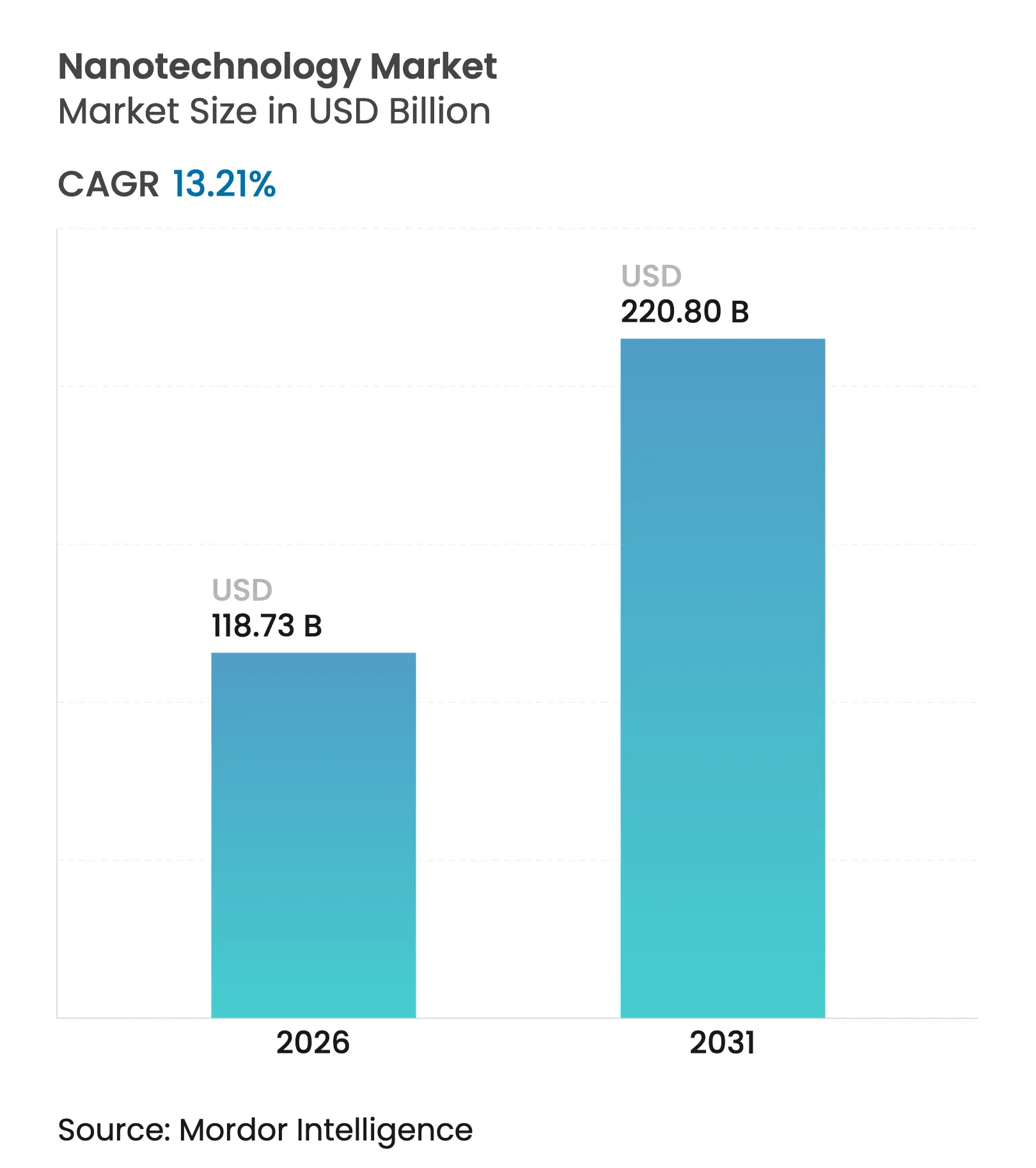
| Market Size (2026) | USD 118.73 Billion |
| Market Size (2031) | USD 220.8 Billion |
| Growth Rate (2026 - 2031) | 13.21 % CAGR |
| Fastest Growing Market | Middle East and Africa |
| Largest Market | Asia Pacific |
| Market Concentration | Medium |
Major Players *Disclaimer: Major Players sorted in no particular order. Image © Mordor Intelligence. Reuse requires attribution under CC BY 4.0. |

Nanotechnology Market Analysis by Mordor Intelligence
The nanotechnology market size is expected to grow from USD 104.88 billion in 2025 to USD 118.73 billion in 2026 and is forecast to reach USD 220.8 billion by 2031 at 13.21% CAGR over 2026-2031. The sharp rise mirrors sovereign technology policies, post-pandemic healthcare priorities, and clean-energy mandates that are resetting industrial demand patterns. Growth is reinforced by the use of lipid nanoparticles in mRNA vaccines, silicon nanowire anodes that can triple electric-vehicle range, and quantum-dot displays that raise color performance without line overhauls. Asia-Pacific remains the production powerhouse, while the Middle East and Africa accelerate on the back of state-funded research hubs. Bottom-up manufacturing keeps the cost edge, yet top-down lithography grows fastest as semiconductor makers chase smaller nodes. Regulatory actions are a double-edged sword: the US CHIPS Act pours capital into domestic fabs, whereas stricter REACH reviews delay certain metal-oxide nanoparticle launches.
Key Report Takeaways
- By manufacturing process, bottom-up approaches held 59.85% of the nanotechnology market share in 2025, while top-down techniques are advancing at 15.1% CAGR through 2031.
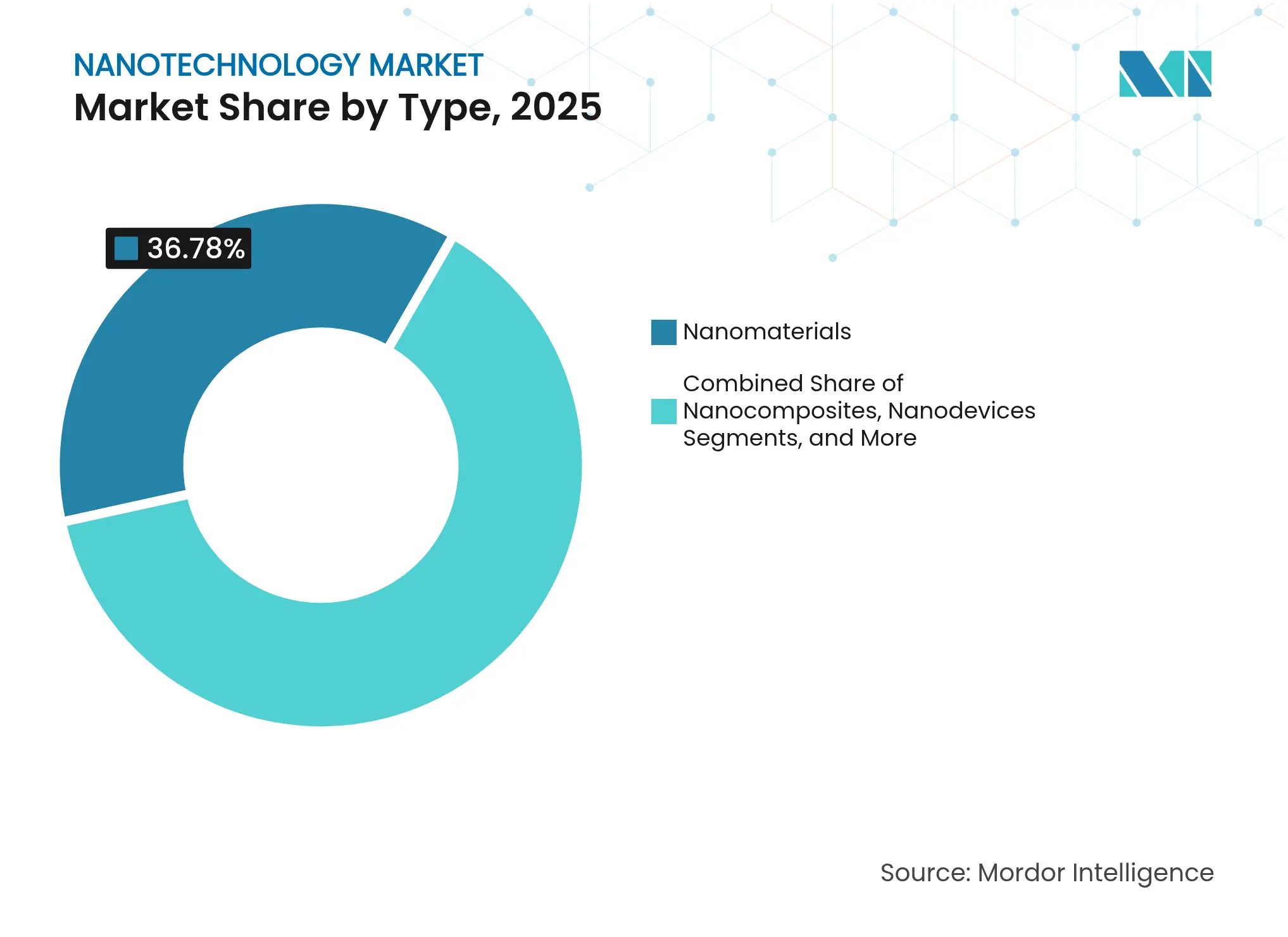
- By type, nanodevices accounted for the highest forecast growth at 16.7% CAGR, whereas nanomaterials retained 36.78% revenue share in 2025.
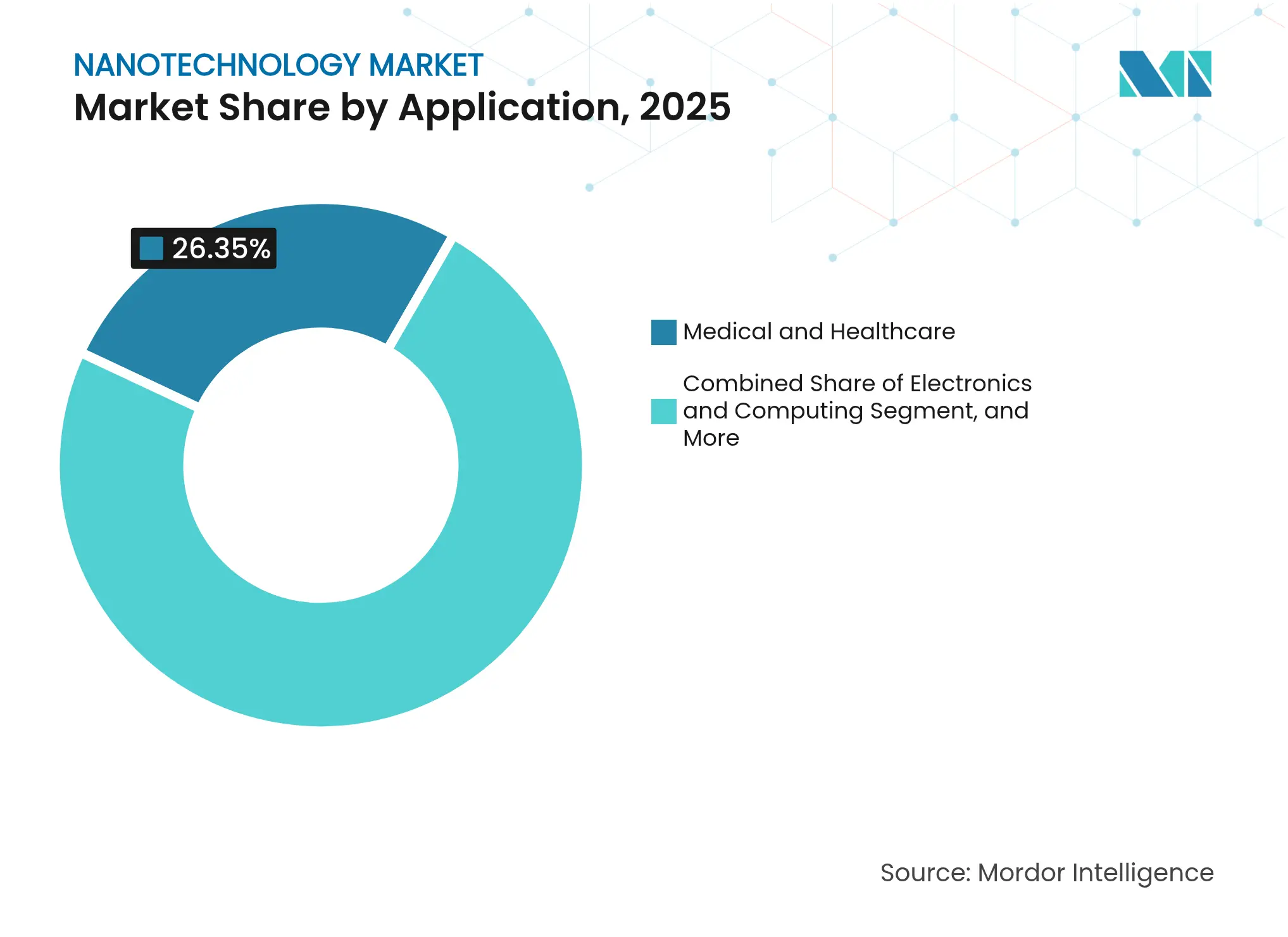
- By application, medical and healthcare led with 26.35% share of the nanotechnology market size in 2025; energy storage is set to grow at 15.6% CAGR to 2031.
- By end user, pharmaceuticals dominated with a 36.05% share in 2025, while semiconductor and display OEMs show the quickest expansion at 18.5% CAGR.
- By geography, Asia-Pacific commanded 38.45% revenue share in 2025; the Middle East and Africa region is forecast to post a 13.8% CAGR through 2031.
Note: Market size and forecast figures in this report are generated using Mordor Intelligence's proprietary estimation framework, updated with the latest available data and insights as of 2026.
Global Nanotechnology Market Trends and Insights
Drivers Impact Analysis
| Driver | (~) % Impact on CAGR Forecast | Geographic Relevance | Impact Timeline |
|---|---|---|---|
Surge in mRNA-lipid nanoparticle demand for next-gen vaccines | +2.1% | Global, concentrated in North America and EU | Medium term (2-4 years) |
EU Green Deal funding for nano-enabled energy-efficient buildings | +1.8% | Europe, spill-over to North America | Long term (≥ 4 years) |
Rapid adoption of quantum-dot displays by Asian TV OEMs | +1.6% | APAC core, global spill-over | Short term (≤ 2 years) |
United States CHIPS Act support for domestic nanosensor fabs | +1.4% | North America, global partnerships | Medium term (2-4 years) |
Rise of nano-enabled antimicrobial coatings in hospitals | +1.2% | Developed markets worldwide | Short term (≤ 2 years) |
Battery anode breakthroughs using silicon nanowires for EV range | +2.3% | China and North America lead | Medium term (2-4 years) |
| Source: Mordor Intelligence | |||
Surge in mRNA-lipid nanoparticle demand for next-gen vaccines
Lipid nanoparticles have shifted from a pandemic solution to a backbone for precision medicine. Ionizable cationic lipids such as ALC0315 and SM102 now secure > 95% delivery efficiency, while FDA guidance issued in 2024 clarifies characterization rules for nanomaterial drugs.[1] Academic groups continue to refine formulations; DOPE-Cx lipids from Hokkaido University lift expression levels and cut cytotoxicity. Momentum is therefore structural, not cyclical, and underpins steady capacity additions by contract drug manufacturers.
EU Green Deal-led funding of nanotech for energy-efficient buildings
The EU anchors building-efficiency targets in law, creating predictable demand for nano-enhanced insulation and smart glazing. Projects such as EXMOLS use synthetic DNA to self-assemble photoactive semiconductors for next-generation panels.[2] Commercial roll-outs include BASF’s trademark product Slentite aerogel panels that meet tougher thermal codes while cutting wall thickness. The long asset life of buildings elongates revenue streams for suppliers of compliant nanomaterials.
Rapid adoption of quantum-dot displays by Asian TV OEMs
Sony and Samsung anchor premium line-ups on quantum-dot films that push LCD panels toward Rec. 2020 color. Perovskite dots ease stability worries and integrate with micro-LED backplanes for higher resolution.[3] Asian supply-chain clustering lowers unit cost, bolsters margins, and widens the technology gap with rivals in other regions. The pull-through effect boosts upstream demand for cadmium-free quantum-dot inks and patterning tools.
United States CHIPS Act boosting domestic nanosensor fabrication
USD 52.7 billion of incentives include USD 11 billion for research programmes run by NIST, with nanosensors flagged as critical nodes. Defense users add USD 2 billion via the Microelectronics Commons program, aiming to shorten prototyping cycles for security-sensitive components.[4] Cluster investments in Arizona, Ohio, and New York tie university labs to new fabs, quickening tech transfer and lowering import dependence.
Restraints Impact Analysis
| Restraint | (~) % Impact on CAGR Forecast | Geographic Relevance | Impact Timeline |
|---|---|---|---|
Toxicology gaps delaying REACH approvals for metal-oxide nanoparticles | -1.9% | Europe, global spill-over | Medium term (2-4 years) |
High CAPEX of atomic-layer deposition production lines | -1.6% | Semiconductor hubs worldwide | Long term (≥ 4 years) |
Supply bottlenecks for high-purity rare-earths in nanocatalysts | -1.4% | Most acute in APAC | Short term (≤ 2 years) |
Public perception risk from “forever-nano” environmental persistence | -1.1% | Developed markets | Long term (≥ 4 years) |
| Source: Mordor Intelligence | |||
Toxicology gaps delaying REACH approvals for metal-oxide nanoparticles
Extended dossier reviews for titanium dioxide and zinc oxide delay cosmetics launches, because ECHA seeks fuller hazard data. The 2024 ban on 12 nano-forms of gold, silver, and copper magnifies uncertainty. Firms with legacy safety files gain an edge, while smaller entrants face multiyear, high-cost studies that sap capital and slow time-to-market.
High CAPEX of atomic-layer deposition (ALD) production lines
State-of-the-art ALD tools can cost USD 80 million each and demand ultra-clean rooms, limiting entrants to well-capitalized chipmakers. Though annual ALD equipment sales top USD 1.8 billion, capacity expansions trail demand for advanced packaging and micro-LED backplanes. Smaller innovators must either license capacity or forge joint ventures, constraining output and slowing adoption in emerging fields such as flexible electronics.
Segment Analysis
By Type: Nanodevices Capture Revenue Momentum
Nanodevices grew at 16.7% CAGR through 2031, outperforming nanomaterials, which held 36.78% revenue in 2025. Commercial roll-outs of nanosensors and quantum-dot devices validate the transition from materials to integrated functions, supporting premium pricing. The nanotechnology market size attributed to nanodevices is projected to climb steadily as smart diagnostic tools and display upgrades proliferate. Nanocomposites rank between the two, gaining from aerospace adoption of responsive systems, whereas nanotools stay niche but high-value.
The revenue mix reflects commoditization of bulk nanomaterials and differentiation of device-level offerings. Pre-clinical nanorobotics that shrink tumors by 70% signal wider health applications. Quantum-dot chips benefit from color-gamut gains and relatively low line-conversion costs. Cross-fertilization with artificial intelligence broadens addressable use cases into real-time analytics and autonomous platforms, entrenching nanodevices as the key value lever in the nanotechnology market.
Note: Segment shares of all individual segments available upon report purchase
By Manufacturing Process: Bottom-Up Approaches Retain Lead
Bottom-up synthesis maintained 59.85% share in 2025, sustained by CVD, sol-gel, and self-assembly methods suited to drug-delivery and catalyst applications. Top-down photolithography and ALD, however, register a brisk 15.1% CAGR alongside semiconductor road-maps toward 3 nm and 2 nm nodes. Consequently, the nanotechnology market share for bottom-up routes stays dominant in volume terms, while revenue growth tilts toward capital-intensive top-down fabs.
Process choice follows functional needs: pharma favors molecular-level precision from bottom-up chemistry, while chipmakers rely on tight tolerances from lithography. TSMC’s Arizona expansion showcases the capital scale: three fabs covering 4 nm to 2 nm nodes require USD 165 billion. Regional supply-chain depth in Asia-Pacific supports both paradigms, anchoring the nanotechnology market in the region.
By Material Category: Quantum Dots Surge Ahead
Carbon-based materials still hold 42.12% share in 2025, spanning graphene to CNTs. Yet quantum dots record an 18.1% CAGR as cadmium-free and perovskite variants solve toxicity and stability barriers. Regulatory headwinds stall metal-oxide adoption in Europe, but dendrimers remain a precision option in targeted drugs. The nanotechnology market size contribution from quantum dots will therefore widen, especially as display volumes unlock supply-chain scale.
Silicon quantum dots enter medical imaging, while graphene nanotubes ramp to 40 MT/y in Europe for battery electrodes. The bifurcation is clear: carbon structures satisfy structural roles; quantum dots address optical and electronic niches.

Recognized by Experts. Trusted by Leaders.
A trusted intelligence partner to global decision-makers across 90+ countries.







By Application: Energy Storage Outpaces Healthcare
Healthcare kept a 26.35% slice of 2025 revenue, yet batteries and renewables now escalate at 15.6% CAGR. Silicon nanowire packs promise 10-fold capacity gains, shifting the demand mix. Electronics stay solid as logic IC scaling and quantum-dot backlighting mature. Environmental systems-water treatment, air filters-draw growth from regulatory pressure on pollution. Therefore, the nanotechnology market will see energy storage eclipse healthcare in incremental value over the forecast horizon.
Within healthcare, nanorobotics and theranostics open deeper value pools, though they face longer development cycles. Food and textiles remain early-stage but benefit from nano-encapsulation that lifts nutrient uptake and smart fabrics that sense biometrics.
Note: Segment shares of all individual segments available upon report purchase
By End-User Industry: Semiconductors Gain Speed
Pharmaceuticals claimed 36.05% share in 2025, yet semiconductor and display OEM demand races at 18.5% CAGR on quantum-dot migration and advanced packaging. The energy sector follows via battery and solar materials. Automotive and aerospace leverage nanocomposites for lightweighting. The nanotechnology market increasingly relies on electronics volumes, and policy impetus like the CHIPS Act cements that trend.
OEMs integrate vertically: BASF builds semiconductor-grade sulfuric acid lines, while display groups secure quantum-dot ink supply. Mature pharma applications pivot to personalized medicine, leveraging nanoparticle delivery and in-line diagnostics.
Geography Analysis
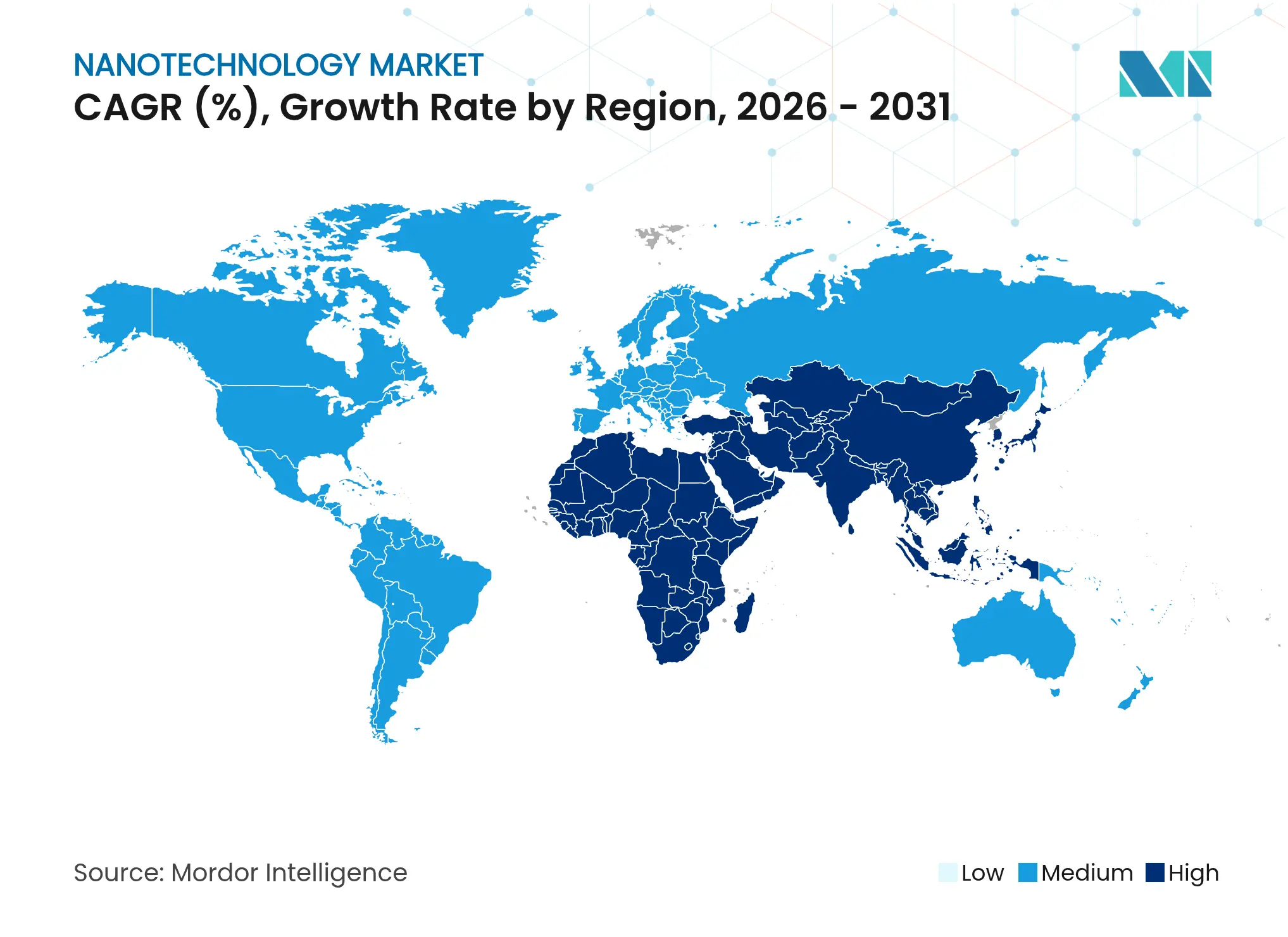
Asia-Pacific held 38.45% of market revenue in 2025, leveraging China’s rare-earth dominance and Japan’s quantum-dot prowess. Integrated supply chains from mine to fab give a cost edge, while South Korea and Taiwan add top-tier lithography. India rises as a pharma-nanotech hub, supplying global vaccine markets. The region’s nanotechnology market will keep its lead due to scale economies and domestic electronics demand.
North America benefits from CHIPS Act funding that restores nanosensor and packaging capacity. Research universities such as Stanford push silicon-nanowire batteries toward commercialization. Canada contributes quantum-dot research, and Mexico offers assembly footholds. Europe faces slower approvals under REACH, yet spearheads sustainable nanotech. Green Deal programs back nano-insulation, while German tool-makers export precision ALD gear. Consistent safety standards allow premium pricing for compliant suppliers.
The Middle East and Africa post the fastest CAGR at 13.8%, fueled by Vision 2030 initiatives and new research centers in Saudi Arabia and Egypt. Water scarcity and solar abundance drive uptake of nano-enabled desalination and PV solutions. South America remains nascent; Brazil leads agri-nanotech R&D and sees early wins in nano-fertilizer encapsulation. Regional growth hinges on infrastructure upgrades and technology transfer partnerships.

Competitive Landscape
Market Concentration
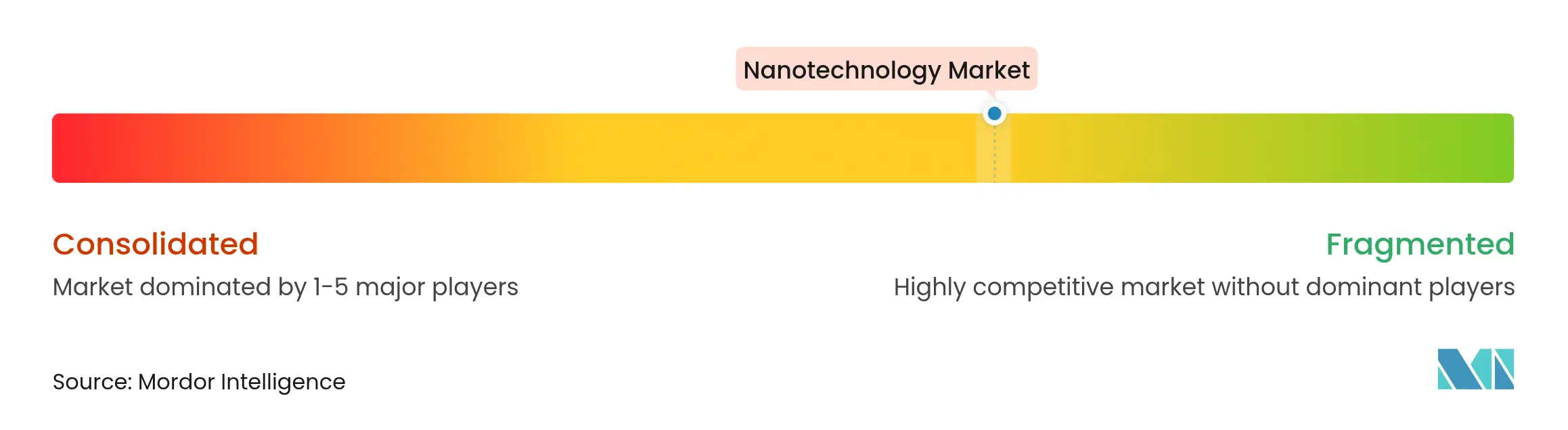
The nanotechnology market remains fragmented. Chemical majors such as BASF and DuPont dominate bulk nanomaterials. Nanosys and Nanoco lead quantum-dot supply, while fab toolmakers like ASML lock in top-down lithography. No firm exceeds a double-digit global share, so rivalry centers on patent depth and application breadth. Recent patent analysis shows firms that align public promises with technical filings secure stronger positions.
Players seek vertical integration: Nano Dimension’s acquisitions of Desktop Metal and Markforged merge additive manufacturing with nano-ink expertise. Start-ups like Black Semiconductor raise USD 275 million to develop graphene chips for optical interconnects. White-space lies in theranostic systems, advanced nano-catalysts, and quantum-dot formulations for low-cost lighting.
Nanotechnology Industry Leaders

*Disclaimer: Major Players sorted in no particular order
Recent Industry Developments
- June 2025: Black Semiconductor secured USD 275 million to build a graphene-chip pilot plant in Germany, targeting mass production by 2031.
- April 2025: BASF committed to a semiconductor-grade sulfuric acid unit in Ludwigshafen, online by 2027, to secure critical chemicals for EU fabs.
- April 2025: University of Texas researchers unveiled a membrane process that sharply improves rare-earth extraction selectivity, easing EV magnet supply risks.
- March 2025: Hokkaido University introduced zwitterionic DOPE-Cx lipids that enhance mRNA delivery and cut toxicity.
- February 2025: The EU enforced Regulation 2024/858 banning 12 nano-forms in cosmetics and restricting hydroxyapatite levels.
- January 2025: NIST issued multiple DNA-nanotech patents supporting biomarker measurement platforms
Table of Contents for Nanotechnology Industry Report
1. INTRODUCTION
- 1.1 Study Assumptions and Market Definition
- 1.2 Scope of the Study
2. RESEARCH METHODOLOGY
3. EXECUTIVE SUMMARY
4. MARKET LANDSCAPE
- 4.1 Market Overview
- 4.2 Market Drivers
- 4.2.1 Surge in mRNA-lipid nanoparticle demand for next-gen vaccines
- 4.2.2 EU Green Deal-led funding of nanotech for energy-efficient buildings
- 4.2.3 Rapid adoption of quantum-dot displays by Asian TV OEMs
- 4.2.4 United States CHIPS and Science Act boosting domestic nanosensor fabrication
- 4.2.5 Rise of nano-enabled antimicrobial coatings in post-COVID hospitals
- 4.2.6 Battery anode breakthroughs using silicon nanowires for EV range
- 4.3 Market Restraints
- 4.3.1 Toxicology gaps delaying REACH approvals for metal-oxide nanoparticles
- 4.3.2 High CAPEX of atomic-layer deposition (ALD) production lines
- 4.3.3 Supply bottlenecks for high-purity rare-earths in nanocatalysts
- 4.3.4 Public perception risk from "forever-nano" environmental persistence
- 4.4 Industry Ecosystem Analysis
- 4.5 Technology Snapshot
- 4.6 Porter's Five Forces Analysis
- 4.6.1 Threat of New Entrants
- 4.6.2 Bargaining Power of Buyers
- 4.6.3 Bargaining Power of Suppliers
- 4.6.4 Threat of Substitutes
- 4.6.5 Competitive Rivalry
5. MARKET SIZE AND GROWTH FORECASTS (VALUES)
- 5.1 By Type
- 5.1.1 Nanomaterials
- 5.1.1.1 Carbon-based
- 5.1.1.2 Metal and Metal Oxide
- 5.1.1.3 Polymeric
- 5.1.1.4 Nanoclays
- 5.1.1.5 Nanocellulose
- 5.1.2 Nanocomposites
- 5.1.2.1 Structural
- 5.1.2.2 Functional
- 5.1.2.3 Smart
- 5.1.3 Competitive Rivalry
- 5.1.3.1 Nanosensors
- 5.1.3.2 Nanoelectronics
- 5.1.3.3 Nanorobotics
- 5.1.3.4 Quantum Dots Devices
- 5.1.4 Nanotools
- 5.1.4.1 AFM/STM Probes
- 5.1.4.2 Lithography Tools
- 5.1.4.3 Others
- 5.1.5 Other Types
- 5.2 By Manufacturing Process
- 5.2.1 Top-Down
- 5.2.1.1 Photolithography
- 5.2.1.2 Etching
- 5.2.1.3 High-energy Ball-milling
- 5.2.2 Bottom-Up
- 5.2.2.1 Sol-gel
- 5.2.2.2 CVD
- 5.2.2.3 Molecular Self-Assembly
- 5.3 By Material Category
- 5.3.1 Carbon-based Nanomaterials
- 5.3.1.1 CNTs
- 5.3.1.2 Graphene
- 5.3.1.3 Fullerenes
- 5.3.2 Metal and Metal Oxide Nanoparticles
- 5.3.2.1 Gold
- 5.3.2.2 Silver
- 5.3.2.3 Titanium-dioxide
- 5.3.2.4 Zinc-oxide
- 5.3.3 Dendrimers
- 5.3.3.1 PAMAM
- 5.3.3.2 PPI
- 5.3.4 Quantum Dots
- 5.3.4.1 II-VI
- 5.3.4.2 III-V
- 5.3.4.3 Perovskite
- 5.4 By Application
- 5.4.1 Medical and Healthcare
- 5.4.1.1 Drug Delivery
- 5.4.1.2 Imaging
- 5.4.1.3 Implants
- 5.4.2 Electronics and Computing
- 5.4.2.1 Logic ICs
- 5.4.2.2 Displays
- 5.4.2.3 Memory
- 5.4.3 Energy Storage and Production
- 5.4.3.1 Li-ion Batteries
- 5.4.3.2 Fuel Cells
- 5.4.3.3 Solar PV
- 5.4.4 Environmental
- 5.4.4.1 Water Treatment
- 5.4.4.2 Air Purification
- 5.4.4.3 Soil Remediation
- 5.4.5 Cosmetics and Personal Care
- 5.4.5.1 UV Filters
- 5.4.5.2 Anti-aging
- 5.4.5.3 Fragrance Carriers
- 5.4.6 Food Science
- 5.4.6.1 Nano-encapsulation
- 5.4.6.2 Food Safety Sensors
- 5.4.7 Textile
- 5.4.7.1 Smart Fabrics
- 5.4.7.2 Stain-resistant Fibers
- 5.4.8 Other Applications
- 5.5 By End-User Industry
- 5.5.1 Pharmaceuticals and Biotechnology
- 5.5.2 Semiconductor and Display OEMs
- 5.5.3 Energy and Power
- 5.5.4 Automotive and Aerospace
- 5.5.5 Consumer Goods
- 5.5.6 Environmental Services
- 5.6 By Geography
- 5.6.1 North America
- 5.6.1.1 United States
- 5.6.1.2 Canada
- 5.6.1.3 Mexico
- 5.6.2 Europe
- 5.6.2.1 Germany
- 5.6.2.2 United Kingdom
- 5.6.2.3 France
- 5.6.2.4 Nordics
- 5.6.2.5 Rest of Europe
- 5.6.3 South America
- 5.6.3.1 Brazil
- 5.6.3.2 Rest of South America
- 5.6.4 Asia-Pacific
- 5.6.4.1 China
- 5.6.4.2 Japan
- 5.6.4.3 India
- 5.6.4.4 South-East Asia
- 5.6.4.5 Rest of Asia-Pacific
- 5.6.5 Middle East and Africa
- 5.6.5.1 Middle East
- 5.6.5.1.1 Gulf Cooperation Council Countries
- 5.6.5.1.2 Turkey
- 5.6.5.1.3 Rest of Middle East
- 5.6.5.2 Africa
- 5.6.5.2.1 South Africa
- 5.6.5.2.2 Rest of Africa
6. COMPETITIVE LANDSCAPE
- 6.1 Market Concentration
- 6.2 Strategic Moves
- 6.3 Market Share Analysis
- 6.4 Company Profiles (includes Global level Overview, Market level overview, Core Segments, Financials as available, Strategic Information, Market Rank/Share for key companies, Products and Services, and Recent Developments)
- 6.4.1 BASF SE
- 6.4.2 DuPont de Nemours Inc.
- 6.4.3 Thermo Fisher Scientific Inc.
- 6.4.4 Asahi Kasei Corporation
- 6.4.5 Bruker Corporation
- 6.4.6 Applied Nanotech Inc.
- 6.4.7 Imina Technologies SA
- 6.4.8 ANP Corporation
- 6.4.9 eSpin Technologies Inc.
- 6.4.10 Kleindiek Nanotechnik GmbH
- 6.4.11 Integran Technologies Inc.
- 6.4.12 Nanonics Imaging Ltd.
- 6.4.13 Nanoco Group PLC
- 6.4.14 Oxford Instruments PLC
- 6.4.15 NanoComposix Inc.
- 6.4.16 Nanophase Technologies Corporation
- 6.4.17 Zyvex Labs LLC
- 6.4.18 Nanosys Inc.
- 6.4.19 QuantumSphere Inc.
- 6.4.20 Showa Denko KK
- 6.4.21 Catalytic Materials LLC
- 6.4.22 Arkema SA
- 6.4.23 LG Chem Ltd.
7. MARKET OPPORTUNITIES AND FUTURE OUTLOOK
- 7.1 White-space and Unmet-Need Assessment
Global Nanotechnology Market Report Scope
Nanotechnology encompasses the science and engineering disciplines focused on designing, producing, and utilizing structures, devices, and systems by manipulating atoms and molecules at the nanoscale—specifically, at 100 nanometers (100 millionths of a millimeter) or smaller dimensions. Nanotechnology has found its way into several domains, with industrial sectors leading the charge, especially information and communications.
The study comprehensively analyzes the trends and dynamics of nanotechnology adoption across different verticals. It also monitors the revenue generated from various types of nanotechnology utilized in several applications.
The nanotechnology market is segmented by type (nanomaterials, nanocomposites, nanodevices, and other types), application (medical and healthcare, material science, energy storage and production, environmental, electronics and computing, cosmetics and personal care products, food science, and textile), and geography (North America, Europe, Asia, Australia and New Zealand, Latin America, and Middle East and Africa). The report offers market forecasts and size in value (USD) for all the above segments.
| By Type | Nanomaterials | Carbon-based | |
| Metal and Metal Oxide | |||
| Polymeric | |||
| Nanoclays | |||
| Nanocellulose | |||
| Nanocomposites | Structural | ||
| Functional | |||
| Smart | |||
| Competitive Rivalry | Nanosensors | ||
| Nanoelectronics | |||
| Nanorobotics | |||
| Quantum Dots Devices | |||
| Nanotools | AFM/STM Probes | ||
| Lithography Tools | |||
| Others | |||
| Other Types | |||
| By Manufacturing Process | Top-Down | Photolithography | |
| Etching | |||
| High-energy Ball-milling | |||
| Bottom-Up | Sol-gel | ||
| CVD | |||
| Molecular Self-Assembly | |||
| By Material Category | Carbon-based Nanomaterials | CNTs | |
| Graphene | |||
| Fullerenes | |||
| Metal and Metal Oxide Nanoparticles | Gold | ||
| Silver | |||
| Titanium-dioxide | |||
| Zinc-oxide | |||
| Dendrimers | PAMAM | ||
| PPI | |||
| Quantum Dots | II-VI | ||
| III-V | |||
| Perovskite | |||
| By Application | Medical and Healthcare | Drug Delivery | |
| Imaging | |||
| Implants | |||
| Electronics and Computing | Logic ICs | ||
| Displays | |||
| Memory | |||
| Energy Storage and Production | Li-ion Batteries | ||
| Fuel Cells | |||
| Solar PV | |||
| Environmental | Water Treatment | ||
| Air Purification | |||
| Soil Remediation | |||
| Cosmetics and Personal Care | UV Filters | ||
| Anti-aging | |||
| Fragrance Carriers | |||
| Food Science | Nano-encapsulation | ||
| Food Safety Sensors | |||
| Textile | Smart Fabrics | ||
| Stain-resistant Fibers | |||
| Other Applications | |||
| By End-User Industry | Pharmaceuticals and Biotechnology | ||
| Semiconductor and Display OEMs | |||
| Energy and Power | |||
| Automotive and Aerospace | |||
| Consumer Goods | |||
| Environmental Services | |||
| By Geography | North America | United States | |
| Canada | |||
| Mexico | |||
| Europe | Germany | ||
| United Kingdom | |||
| France | |||
| Nordics | |||
| Rest of Europe | |||
| South America | Brazil | ||
| Rest of South America | |||
| Asia-Pacific | China | ||
| Japan | |||
| India | |||
| South-East Asia | |||
| Rest of Asia-Pacific | |||
| Middle East and Africa | Middle East | Gulf Cooperation Council Countries | |
| Turkey | |||
| Rest of Middle East | |||
| Africa | South Africa | ||
| Rest of Africa | |||
