
Music Market Size and Share
Market Overview
| Study Period | 2020 - 2031 |
|---|---|
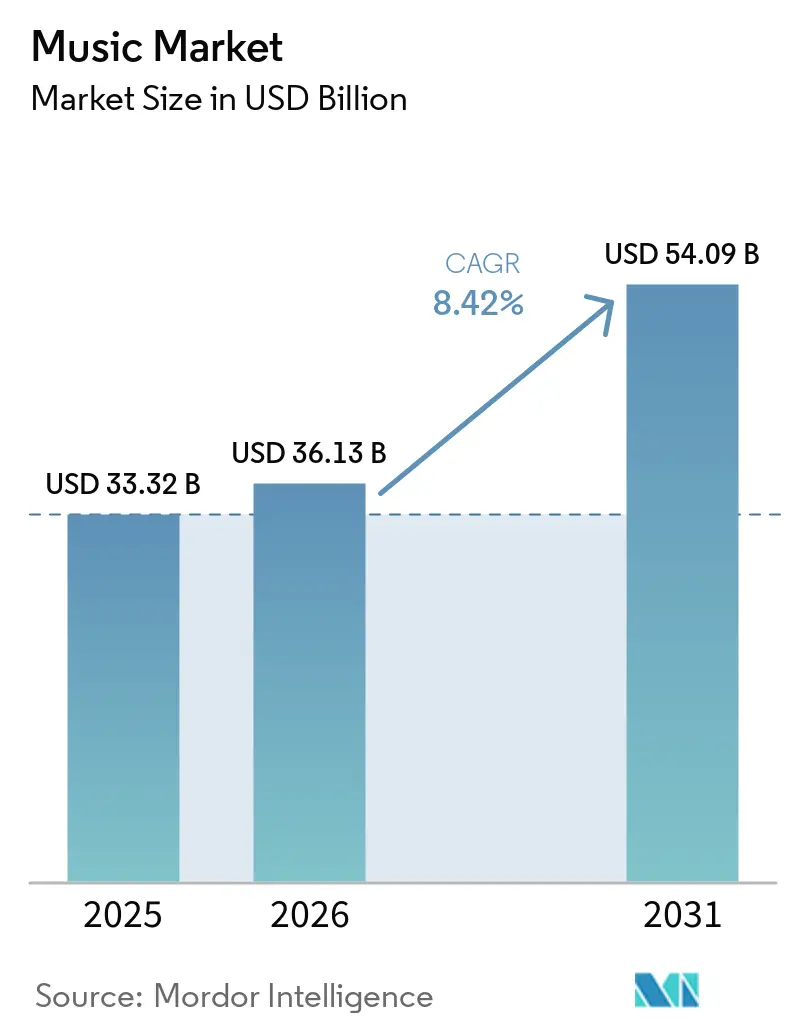
| Market Size (2026) | USD 36.13 Billion |
| Market Size (2031) | USD 54.09 Billion |
| Growth Rate (2026 - 2031) | 8.42 % |
| Fastest Growing Market | Asia-Pacific |
| Largest Market | North America |
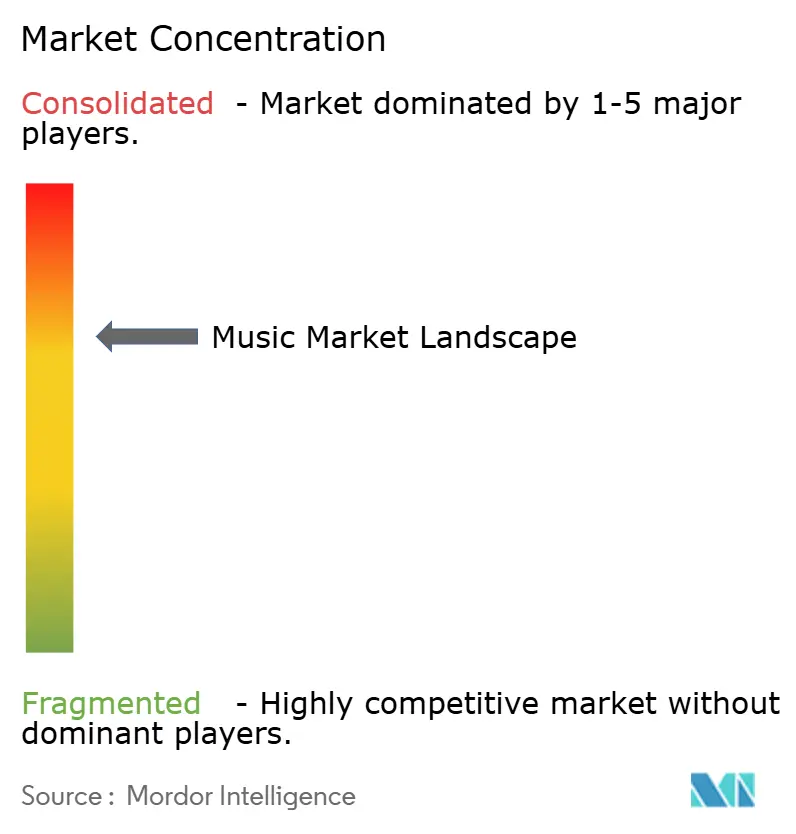
| Market Concentration | Medium |
Major Players *Disclaimer: Major Players sorted in no particular order Image © Mordor Intelligence. Reuse requires attribution under CC BY 4.0. | |
Music Market Analysis by Mordor Intelligence
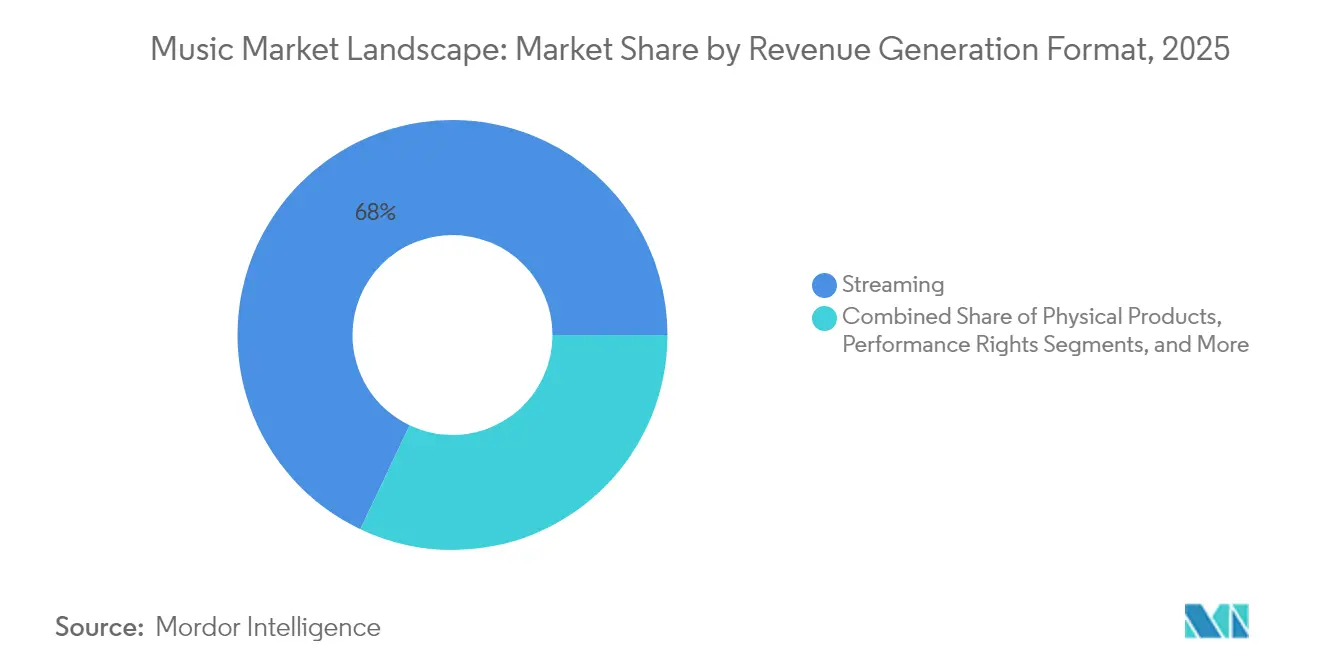
Music market size in 2026 is estimated at USD 36.13 billion, growing from 2025 value of USD 33.32 billion with 2031 projections showing USD 54.09 billion, growing at 8.42% CAGR over 2026-2031. Streaming commands 67.73% music market share in 2025, reaffirming the sector’s ongoing shift from physical formats toward access-based consumption. Parallel expansion in performance rights, live experiences, and commercial licensing adds depth to overall revenue growth. Smartphone penetration, better bandwidth, and rising disposable incomes in emerging economies amplify demand momentum, while catalog acquisitions and immersive audio formats reinforce premium-tier monetization. Competitive strategies prioritize vertical integration and data-driven A&R, and opportunities arise in B2B licensing, localized content, and direct-to-fan ecosystems.
Key Report Takeaways
- By revenue generation format, streaming held 67.95% of the music market share in 2025; performance rights are advancing at a 9.07% CAGR through 2031.
- By genre, pop captured 27.65% share of the music market size in 2025 and Latin music is forecast to expand at an 8.70% CAGR to 2031.
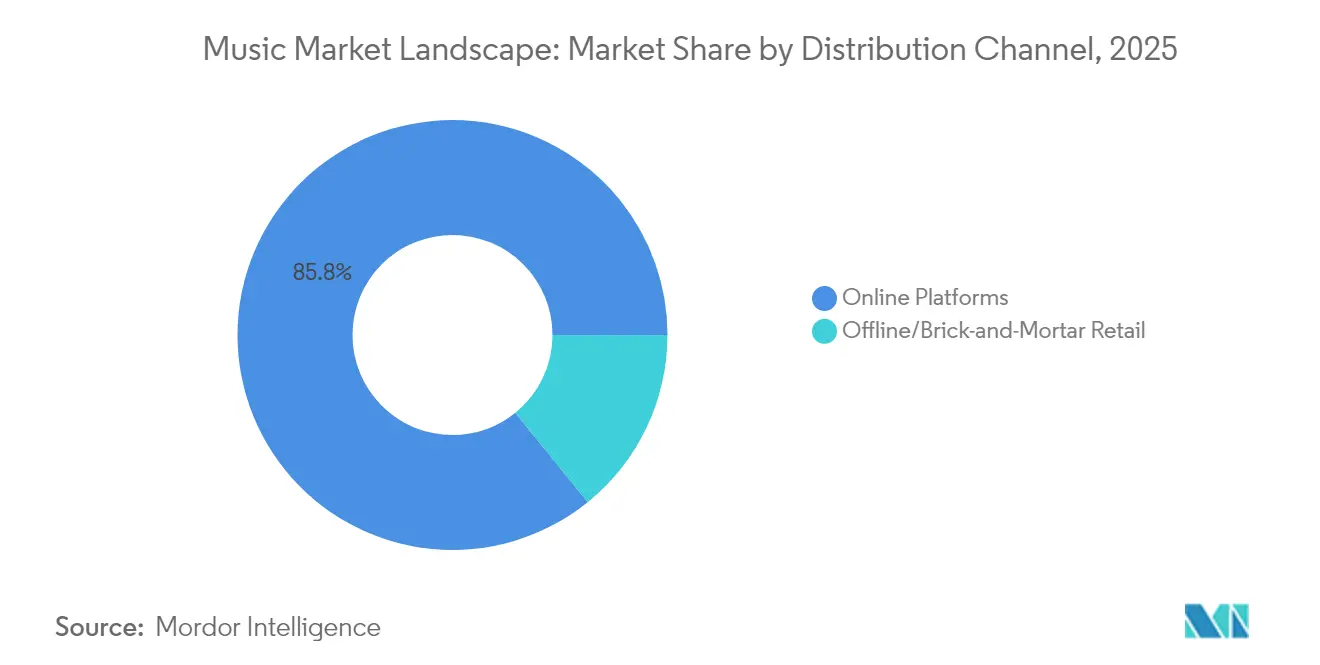
- By distribution channel, online platforms accounted for 85.82% of the music market size in 2025, while brick-and-mortar retail is contracting at a 15.12% annual rate.
- By end user, individual consumers retained 81.78% share of the music market size in 2025; commercial establishments record the fastest growth at 9.61% CAGR to 2031.
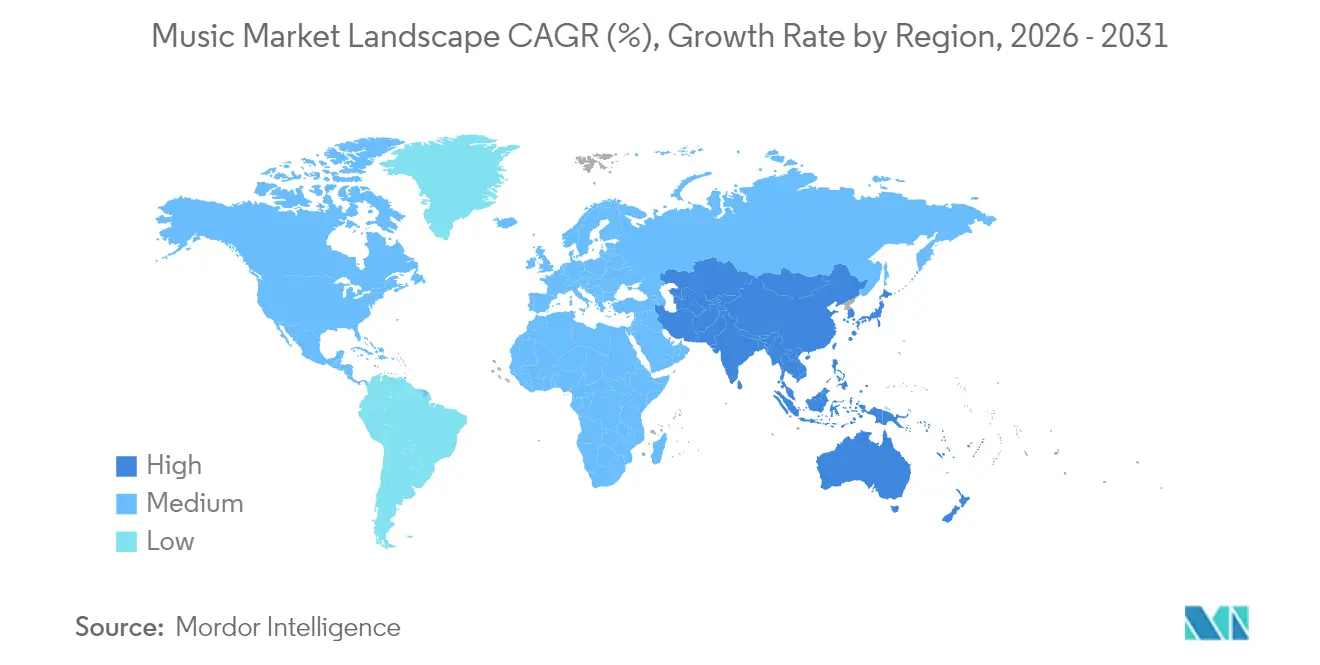
- By geography, Asia Pacific is advancing at a 9.02% CAGR in the music market, even as North America preserved 34.21% 2025 share.
- Universal Music Group, Sony Music Entertainment, and Warner Music Group collectively held roughly 65–70% of global revenue in 2025.
Note: Market size and forecast figures in this report are generated using Mordor Intelligence’s proprietary estimation framework, updated with the latest available data and insights as of 2026.
Market Trends and Insights
Drivers Impact Analysis of Music Market*
| Driver | (~) % Impact on CAGR Forecast | Geographic Relevance | Impact Timeline |
|---|---|---|---|
| Accelerated adoption of music-streaming subscriptions | +2.1% | Global, highest in Asia Pacific and Latin America | Medium term (2–4 years) |
| Rising smartphone and internet penetration | +1.8% | Asia Pacific, Latin America, Middle East and Africa | Long term (≥ 4 years) |
| Growth of social media and short-form video | +1.4% | Global, highest in North America and Asia Pacific | Short term (≤ 2 years) |
| Strong investment and catalog acquisitions | +1.2% | Global, concentrated in North America and Europe | Medium term (2–4 years) |
| Proliferation of immersive audio formats | +0.9% | North America, Europe, developed Asia Pacific | Long term (≥ 4 years) |
| Blockchain-enabled direct-to-fan models | +0.6% | Global, early adoption in North America and Europe | Long term (≥ 4 years) |
| Source: Mordor Intelligence | |||
Accelerated Adoption of Music-Streaming Subscriptions
Premium-tier optimization now outweighs basic subscriber acquisition. Spotify’s USD 4.5 billion payout to independent labels and publishers in 2024 illustrates elevated royalty throughput, yet the platform’s emphasis has shifted toward lossless codecs, exclusive drops, and bundled virtual events that lift ARPU. High-value tiers foster richer data analytics, shaping artist discovery and marketing spend efficiency. Developed markets focus on price segmentation, while emerging regions deliver sheer volume growth backed by mobile payment integration. The driver elevates total streams, boosts performance rights, and underpins cross-channel bundling for live-streamed concerts, supporting music market growth.[1]
Rising Smartphone and Internet Penetration in Emerging Markets
Infrastructure upgrades across India, Indonesia, and Brazil unlock new listener cohorts, establishing mobile-first consumption norms that bypass physical retail constraints. India’s recorded-music revenue climbed to USD 1.9 billion (INR 24 billion) in 2024 and is poised to hit USD 2.9 billion (INR 37 billion) by 2026, a 14.7% CAGR, propelled by regional-language catalogs and low-cost data plans.[2] Monetization remains skewed toward ad-supported tiers, yet localized content commands higher engagement and advertising premiums. Embedded micro-payment options empower direct artist-to-fan transactions, shrinking intermediary margins and reshaping value distribution across the music industry market.
Growth of Social Media and Short-Form Video Platforms Fuelling Music Discovery
User-generated clips transform talent discovery economics: Most of Gen Z listeners encountered new artists first on short-form video in 2024. Viral loops encourage rapid audience building, though the conversion from discovery to sustained streaming remains uneven. Major catalog withdrawals from certain platforms in 2024 exposed a limited revenue impact, highlighting the distinction between visibility and monetization. Labels now invest in influencer marketing and data-mined trend forecasting, shaping music market trends, yet viral unpredictability complicates ROI assessment.
Strong Investment and Catalog Acquisitions by Record Labels and Private Equity
Music rights have become inflation-hedged financial assets. Sony’s pending USD 1.2 billion purchase of the Queen catalog exemplifies cresting valuations. Institutional capital introduces securitization and derivative structures that maximize cash-flow yield but elevate leverage risk. Established catalogs gain negotiating leverage in synchronization, gaming, and film, while emerging artists confront higher hurdles as acquisition budgets tilt toward proven IP. Competitive bidding inflates upfront multiples, encouraging labels to extend monetization lifecycles through cinematic documentaries and immersive experiences.
Restraints Impact Analysis of Music Market*
| Restraint | (~) % Impact on CAGR Forecast | Geographic Relevance | Impact Timeline |
|---|---|---|---|
| Persistent copyright infringement and digital piracy | -1.7% | Global, highest in emerging markets | Long term (≥ 4 years) |
| Growing bargaining power of top creators | -1.3% | Global, concentrated in North America and Europe | Medium term (2–4 years) |
| Fragmentation of licensing regimes in emerging markets | -0.8% | Asia Pacific, Latin America, Middle East and Africa | Medium term (2–4 years) |
| Rising carbon scrutiny of data-center energy use | -0.4% | Europe, North America, developed Asia Pacific | Long term (≥ 4 years) |
| Source: Mordor Intelligence | |||
Persistent Copyright Infringement and Digital Piracy
The Recording Industry Association of America estimated USD 12.5 billion in U.S. revenue losses from illicit consumption in 2024. Stream-ripping tools undermine legitimate platforms, particularly where enforcement is weak and ad-supported options remain scarce. Decentralized distribution channels leveraging peer-to-peer protocols complicate takedown actions. Rights holders divert resources to legal measures and watermarking technology that could otherwise fund artist development. The macro impact depresses ROI expectations in high-piracy territories and slows premium service rollouts.
Growing Bargaining Power of Top Creators Driving Royalty Costs
Artists with scale leverage data transparency to renegotiate contracts, as illustrated by Taylor Swift’s master-recording ownership initiative, which lifted her catalog valuation by USD 200 million between 2023 and 2024.[3] Streaming algorithms skew attention toward headline acts, amplifying winner-take-all dynamics. Labels attempt 360-degree partnerships to retain diversified revenue, yet rising royalty guarantees pressure operating margins. Smaller imprints struggle to match advances, accelerating industry consolidation and tempering investment in emerging talent.
*Our forecasts treat driver/restraint impacts as directional, not additive. The impact forecasts reflect baseline growth, mix effects, and variable interactions.
Music Market Segment Analysis
By Revenue Generation Format:
Streaming Dominance Drives Platform InnovationStreaming represented 67.95% of the music market in 2025 and is projected to rise modestly as premium tiers widen and regional penetration deepens. Performance rights contribute the fastest incremental revenue at a 9.07% CAGR, reflecting renewed emphasis on live experiences and background-music licensing. Digital downloads contract sharply, reducing their share of the music market size, while vinyl’s niche revival adds boutique value for collectors. Synchronization revenues expand alongside film and gaming output, offering non-linear growth uncoupled from subscriber totals.
Merchandising and licensing captured USD 5.09 billion in 2024, up 16.4% year-over-year, supported by global brand-licensing momentum. Concert attendees’ merchandise purchase incidence climbed to 19%, signaling a durable appetite for experiential memorabilia. Platforms diversify into ticketing, livestreaming, and merch fulfillment within a single app environment, cementing higher lifetime value per user and mitigating reliance on any single income source.

By Genre:
Latin Music Leads Global ExpansionPop maintained 27.65% music market share in 2025, yet Latin music delivered the highest trajectory with an 8.70% CAGR through 2031, buoyed by cross-border collaborations and rhythmic suitability for social-video virality. Hip-hop and rap sustain heavy stream counts, while electronic subgenres benefit from festival circuits and immersive audiovisual staging. Rock regains touring momentum, capitalizing on nostalgic fan bases willing to purchase premium vinyl editions.
Genre blending accelerates as DSP curation emphasizes mood over traditional classification. Regional Mexican and K-pop illustrate localized content ascending to global charts through algorithmic discovery. Classical and jazz remain niche but enjoy high per-capita spend and synchronization appeal for luxury advertising. Diversification across genres hedges revenue against cyclical popularity swings, stabilizing aggregate music market performance.
By Distribution Channel:
Online Platforms Consolidate Market ControlOnline channels accounted for 85.82% of the music market in 2025, expanding at 9.74% CAGR as streaming services fold social features, e-commerce, and ticketing into unified user journeys. Physical retail contracts but repositions around experiential shopping and limited-edition releases. Marketplace fragmentation persists, yet dominant platforms wield algorithmic gatekeeping power that shapes discovery and negotiation thresholds.
Integrated commerce functionality enables fans to purchase tour tickets or merchandise directly from an album page, shortening conversion pipelines. Band-loyalty programs offer digital collectibles, reinforcing retention. Dependence on single channels remains a risk; labels negotiate multi-platform strategies to diffuse exposure, leveraging proprietary artist apps and white-label stores that retain first-party data control.
By End User:
Commercial Establishments Drive B2B GrowthIndividual consumers hold 81.78% share of the music market in 2025 but post slower gains as subscription saturation emerges in Western economies. Commercial establishments accelerate at 9.61% CAGR, adopting curated playlists to optimize ambience in hospitality, fitness, and retail settings. Licensors employ data analytics to match tempo and mood with dwell-time objectives, framing music as a revenue driver rather than cost center.
Media producers and gaming studios expand synchronization demand, embedding licensed tracks in original content to heighten engagement. Concert promoters benefit from pent-up live-event demand: Live Nation generated USD 34.5 billion in concert revenue during 2024. Event organizers integrate cashless merch booths, boosting per-capita spend and funneling real-time sales data back to rights holders for dynamic set-list optimization.
Geography Analysis
North America Music Market
North America commanded 34.21% of the music market in 2025, anchored by high ARPU and mature premium-tier penetration. Advanced rights-management structures and a robust live circuit lift blended monetization. Government-supported content funds in Canada strengthen domestic artist export capacity, while U.S. tech hubs pioneer immersive audio and AI-powered recommendation engines. Regulatory debate shifts toward AI-generated content ownership, prompting proactive licensing frameworks across DSPs and major labels.
APAC Music Market
Asia Pacific is the fastest-growing region at a 9.02% CAGR through 2031. China’s ecosystem remains domestically oriented, yet Tencent-backed platforms extend international licensing outreach. India’s rapid rise stems from local language catalogs, short-form video tie-ins, and frictionless micro-payments. Japan and South Korea demonstrate premium-content monetization via bundled entertainment packages that combine music, drama, and gaming subscriptions. Regional growth relies on continued infrastructure deployments and harmonized rights regimes.
EMEA and LATAM Music Market
Europe leverages consumer-protection regulations and carbon targets to influence global platform standards. The Digital Services Act introduces heightened liability for unlicensed uploads, encouraging proactive content-ID systems. Latin America benefits from genre-specific acceleration, notably reggaeton’s mainstream adoption. However, currency volatility complicates royalty repatriation. The Middle East and Africa region exhibits rapid user growth but revenue lags due to ad-supported dominance and payment-gateway limitations. Cross-border licensing consortia seek to streamline deals and unlock latent spend as economic development lifts disposable incomes.
Regulatory Landscape
Regulation in the global music market focuses on copyright, digital-platform accountability, and the conditions under which sound recordings are publicly performed and monetized. In the United States, the Copyright Royalty Board published a final rule on March 10, 2026 setting digital performance royalty rates and terms for the 2026-2030 period, which will affect budgeting and royalty accounting for streaming services and related ephemeral recordings.
Platform governance and fiscal obligations are tightening across regions. In May 2025, the European Commission initiated legal proceedings against multiple EU member states over insufficient implementation of the Digital Services Act, reinforcing compliance pressure on large online platforms that host or recommend user-uploaded content. In Canada, the CRTC announced an increase in the streaming levy on online platforms from 5% to 15% under the Online Streaming Act, raising the cost of serving that market and increasing the weight of local compliance, reporting, and catalog strategies. Global discussions at WIPO and EU policy bodies also emphasize metadata interoperability, royalty transparency, and algorithmic accountability, which shape licensing operations and reporting practices.
Competitive Landscape
The Big Three, Universal Music Group, Sony Music Entertainment, and Warner Music Group—jointly controlled roughly 65–70% of the music market in 2025, illustrating moderate consolidation. Scale affords leverage in catalog buys and global distribution, yet independent artists captured 36–40% of total revenue via direct-to-fan platforms. Vertical integration strategies include investments in immersive audio, ticketing, and merchandise fulfillment to capture full-stack value.
Sony targeted blockbuster catalogs, negotiating a USD 1.2 billion deal for Queen’s repertoire. Warner partnered with Bain Capital in a USD 1.2 billion joint venture to finance additional acquisitions. Universal pursued AI patent filings to fortify IP around machine-generated music and expanded its Amazon Music alliance for enhanced global reach.
AI-driven composition start-ups such as Suno and Udio entered licensing talks with major labels, signaling a future where synthetic content coexists alongside human creation. Blockchain-based rights exchanges test transparent royalty splits, posing competitive pressure on traditional administration models. Market leadership will hinge on combining catalog depth with technology that personalizes discovery, facilitates community interaction, and diversifies revenue beyond pure streaming counts.
Music Industry Leaders
-
BMG Rights Management GmbH
-
Kobalt Music Group, Ltd.
-
SONY MUSIC ENTERTAINMENT
-
Universal Music Group N.V.
-
Warner Music Group Corp.
- *Disclaimer: Major Players sorted in no particular order
Music Market Companies Covered in this Report
- Universal Music Group N.V.
- Sony Music Entertainment (Sony Corporation of America)
- Warner Music Group Corp.
- BMG Rights Management GmbH
- Kobalt Music Group Ltd.
- Spotify Technology S.A.
- Apple Inc. (Apple Music)
- Amazon.com, Inc. (Amazon Music)
- Alphabet Inc. (YouTube Music)
- Tencent Music Entertainment Group
- Deezer S.A.
- Tidal Music AS
- SoundCloud Global Limited and Co. KG
- Pandora Media, LLC (Sirius XM Holdings Inc.)
- NetEase Cloud Music (NetEase, Inc.)
- Anghami Inc.
- Melon Company (Kakao Entertainment)
- Yandex Music LLC
- Boomplay Music Group Limited
- JioSaavn LLC
- KKBOX Inc.
- Curb Records, Inc.
- Believe S.A.
- CD Baby, Inc.
Market Opportunities and Future Outlook
The market has whitespace in B2B licensing, creator-economy tooling, and rights infrastructure as streaming dominates consumption and online platforms account for most distribution. Commercial establishments are also a fast-growing end user for licensed background music, supporting demand for mood, tempo, and brand-safe curation solutions that can be paired with analytics and compliance.
Investment in 2025-2026 highlights where budgets are concentrating: IFPI reported global recorded music revenues rose 6.4% in 2025 to USD 31.7 billion, while major companies pursued partnership-led innovation and catalog scale. Universal Music Group signed new multi-year agreements with Spotify in January 2025 around artist-centric principles and streaming innovation, and in 2026 partnered with Nvidia to deploy AI infrastructure for discovery and engagement. This activity points to differentiated, compute-enabled experiences alongside distribution, while consolidation and capital-backed catalog strategies continue to shape competition and create space for independents and service providers offering financing, administration, and direct-to-fan commerce layers that capture value beyond per-stream payouts.
Recent Industry Developments in Music Market
- July 2026: Universal Music Publishing Group and ONE4 Music formed a new joint publishing venture. This expands UMPG's reach in publishing administration and frontline writer/artist development and improves its ability to capture publishing value alongside recorded-music monetization.
- May 2026: Universal Music Group partnered with Nvidia to deploy AI infrastructure for music discovery and engagement. The collaboration extends UMG's capabilities in AI-powered curation and content discovery across platforms.
- May 2026: Universal Music Group and TikTok announced a new multi-year global licensing agreement that includes AI-generated music protections. The deal clarifies licensing terms for a major short-form video discovery channel and sets expectations around attribution and safeguards for user-generated and AI-assisted content.
Music Market Report Scope and Research Methodology
Market Definition and Coverage
For this study, the music landscape market is defined as the value of music related revenues generated across recorded and monetized music formats, measured in USD, and tracked across major regions.
Scope exclusions: We exclude non monetized consumption and informal activity where there is no clear revenue capture, such as unpaid user uploads and piracy.
Segments Covered in This Report
- By Revenue Generation Format
- Streaming
- Digital Downloads (ex-Streaming)
- Physical Products
- Performance Rights
- Synchronization Revenues
- Merchandising and Licensing
- By Genre
- Pop
- Rock
- Hip-Hop / Rap
- Electronic / Dance
- Classical
- Jazz
- Country
- Latin
- By Distribution Channel
- Online Platforms
- Offline / Brick-and-Mortar Retail
- By End User
- Individual Consumers
- Commercial Establishments (bars, hotels, retail)
- Media and Entertainment Producers (film, TV, gaming)
- Brands and Advertisers
- Event and Concert Organizers
- By Geography
- North America
- United States
- Canada
- South America
- Brazil
- Argentina
- Rest of South America
- Europe
- Germany
- United Kingdom
- France
- Spain
- Italy
- Russia
- Rest of Europe
- Asia Pacific
- China
- Japan
- India
- South Korea
- Australia and New Zealand
- Rest of Asia Pacific
- Middle East and Africa
- Middle East
- United Arab Emirates
- Saudi Arabia
- Turkey
- Rest of Middle East
- Africa
- South Africa
- Egypt
- Rest of Africa
- Middle East
- North America
Data Sources, Market Sizing, and Validation
Desk Research
Desk research is used to set the base market structure and anchor model inputs that can be checked against public records. We rely on public industry reporting such as the IFPI Global Music Report, and policy and economic series from sources such as the World Bank and OECD, which help frame country level demand and spending ability.
We also review sources such as national statistics offices for cultural and consumer spending indicators, official trade and customs statistics where physical media trade is relevant, and peer reviewed journals that discuss format shifts and consumer behavior. Company filings, annual reports, and investor presentations are used to sanity check revenue mix changes and pricing direction in key formats, and then news and financials databases support timelines for major market events. The list of sources stated here is illustrative, and many other public and paid references were used for collection, validation, and clarification.
Primary Interviews and Surveys
Primary interviews and surveys focus on confirming what is counted as market revenue in each format and how quickly format mix is changing by region. We spoke with a mix of rights holders, distributors, platform ecosystem participants, and industry advisors across APAC, EMEA, and the Americas, so pricing assumptions, payout mechanics, and reporting lags could be cross checked and then applied consistently.
Distribution of primary research fieldwork respondents
| Company type | Respondent position | Region |
|---|---|---|
| Top tier: 34% | CXOs: 15% | APAC: 42% |
| Mid tier: 45% | Functional/Unit leaders: 41% | EMEA: 37% |
| Smaller Players: 21% | Managers: 44% | Americas: 21% |
Market-Sizing & Forecasting
The core model starts with a top-down build where country revenue pools are reconstructed from format level series, then summed to regional and global totals. To keep the math practical, we use a limited set of repeatable inputs such as paid subscription counts, ad supported listening monetization signals, ARPU or effective price per user, physical format revenue direction, and performance and synchronization revenue shares that can be checked from public reporting.
After the total is built, we use selective bottom-up approximations to corroborate it, such as sampled price times volume checks for key formats, channel checks on price increases, and supplier and distributor roll ups where disclosures allow it. When parts of the chain do not report cleanly, we handle gaps by using conservative penetration assumptions, and we adjust only after those points are supported in interviews.
For forecasting, scenario analysis is applied around a base case informed by how quickly subscriptions expand, how pricing evolves, and how ad yields move by region. These drivers are then stress tested with short history time series checks, so the forecast remains consistent with observed cycles and with what industry participants expect over the next few years.
Data Validation & Update Cycle
Model outputs are checked against independent signals such as format share totals, regional growth patterns, and any widely cited revenue totals that can be traced to credible public releases. Variance checks are run for sudden jumps in price, users, or mix, and outliers are reviewed again before sign off.
If a result looks inconsistent, we re contact relevant respondents and revisit the assumptions that drive the swing, which usually sit in ARPU, currency timing, or format boundaries. Reports are refreshed annually, and interim updates are made when there are material events that can shift the outlook, such as major pricing changes or regulation impacts. Before delivery, we do one more pass so clients receive the latest updated view aligned to the most recent disclosures.
Mordor Intelligence's Music Market Landscape Market Size Compared Against Other Published Estimates
It is normal to see different market size numbers for the music landscape because the boundaries of what gets counted are not always the same. The biggest differences usually come from whether a source is tracking recorded music only, whether adjacent revenue lines are included, and how currency conversion timing is handled.
By tracking format-level revenue lines and refreshing currency timing checks, Mordor Intelligence places the market boundary around monetized music formats, which avoids mixing recorded music totals with broader rights expansions that are not consistently reported across regions.
Benchmark comparison
| Source | Market Size | Gaps in Research Methodology |
|---|---|---|
| Mordor Intelligence | USD 36.13 B (2026) | |
| Industry Association A | USD 29.60 B (2024) | Tracks recorded music revenues for a single year, which can understate the broader monetized music scope when performance, sync, or adjacent licensing lines are treated separately. |
| Industry Analytics B | USD 36.20 B (2024) | Uses a recorded music lens that can be presented with or without expanded rights, and the inclusion choice plus different revenue line mapping can shift totals versus a format-defined market boundary. |
The spread across the table is mostly explained by scope and revenue line treatment rather than simple math differences. When the definition is kept consistent by format, and cross checks are applied for pricing and currency timing, the final total becomes easier to replicate and to use for planning.
Key Questions Answered in the Report
How big is the music industry?
The music market size is USD 36.13 billion in 2026 and is set to reach USD 54.09 billion by 2031.
Which region is growing the fastest?
Asia Pacific leads with a 9.02% CAGR through 2031, driven by mobile-first consumption and localized catalogs.
What share of revenues does streaming hold?
Streaming accounts for 67.95% music market share and continues to climb on premium-tier uptake.
Which genre is expanding most rapidly?
Latin music posts the highest growth at an 8.70% CAGR to 2031, aided by cross-cultural collaborations.
How consolidated is the competitive landscape?
The three major labels hold roughly 65–70% of revenue, but independent artists command up to 40% via direct platforms.
What is the biggest B2B opportunity?
Commercial establishments are adopting licensed background music at 9.61% CAGR, underscoring growth in experiential branding.