
Multi-Experience Development Platform (MXDP) Market Size and Share
Market Overview
| Study Period | 2020 - 2031 |
|---|---|
| Market Size (2026) | USD 5.94 Billion |
| Market Size (2031) | USD 15.03 Billion |
| Growth Rate (2026 - 2031) | 20.41 % |
| Fastest Growing Market | Asia-Pacific |
| Largest Market | North America |
| Market Concentration | Medium |
Major Players *Disclaimer: Major Players sorted in no particular order Image © Mordor Intelligence. Reuse requires attribution under CC BY 4.0. | |
Multi-Experience Development Platform (MXDP) Market Analysis by Mordor Intelligence
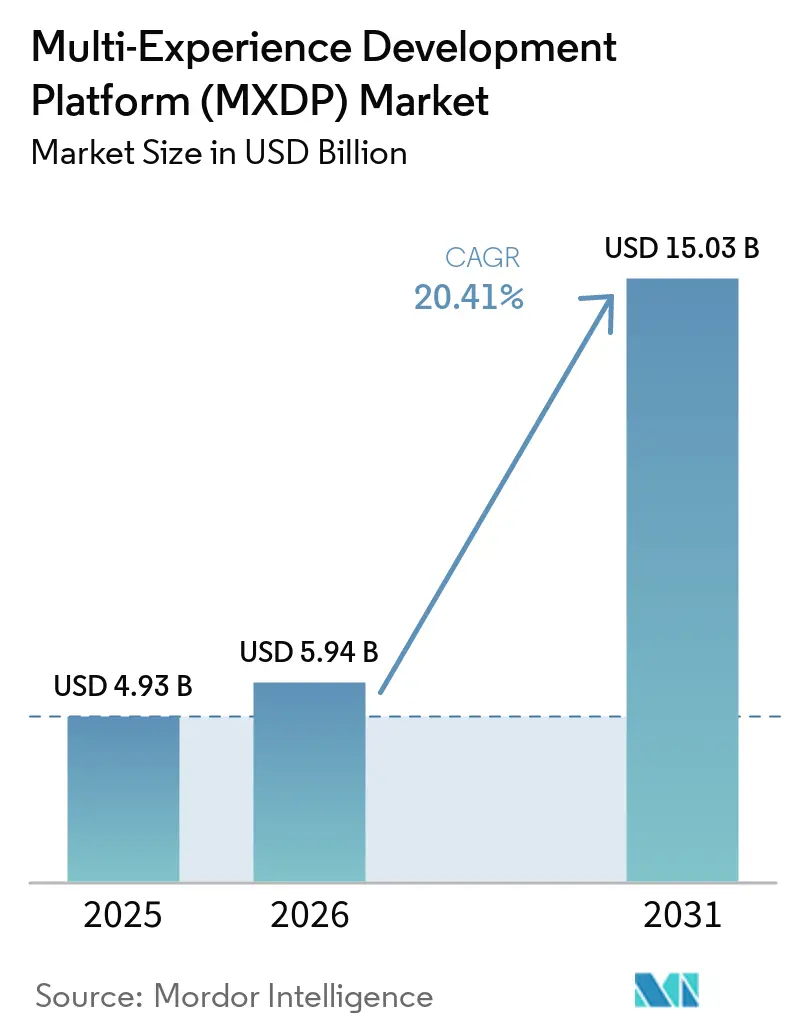
The multi-experience development platform (MXDP) market size is projected to expand from USD 4.93 billion in 2025 and USD 5.94 billion in 2026 to USD 15.03 billion by 2031, registering a CAGR of 20.41% between 2026 to 2031. The multi-experience development platform (MXDP) market is moving ahead as enterprises commit more spending to unified application stacks that work across web, mobile, voice, wearable, and conversational interfaces. Demand is also rising because developer shortages are pushing organizations toward low-code and no-code approaches that reduce delivery dependence on large specialist teams. The multi-experience development platform (MXDP) market is also being shaped by AI-embedded orchestration, which is pushing vendors to combine application design, workflow execution, and governance in one environment instead of separate tools. Sovereign AI policies and stricter compliance expectations are creating more value for vendors that support cloud, private cloud, and on-premises deployment without major tradeoffs in functionality. As a result, the MXDP market is opening more room for vendors that can tie integration depth, AI controls, and multichannel delivery into a single operating model.
Key Report Takeaways
- By component, Platforms led with 58.81% of revenue of the multi-experience development platform (MXDP) market in 2025, while Services is projected to expand at a 23.42% CAGR through 2031.
- By deployment model, Cloud held 62.36% of revenue of the MXDP market in 2025 and also recorded the highest projected CAGR at 24.14% through 2031.
- By organization size, Large Enterprises accounted for 59.67% of revenue of the multi experience development platform (MXDP) market in 2025, while SMEs are forecast to grow at a 24.78% CAGR through 2031.
- By industry vertical, BFSI captured 21.11% of revenue of the MXDP market in 2025, while the Government and Public Sector is set to advance at a 24.99% CAGR through 2031.
- By geography, North America led with 40.98% share of the multi experience development platform (MXDP) market in 2025, while Asia-Pacific is projected to record the fastest CAGR at 25.34% through 2031.
Note: Market size and forecast figures in this report are generated using Mordor Intelligence’s proprietary estimation framework, updated with the latest available data and insights as of January 2026.
Market Trends and Insights
Drivers Impact Analysis of Multi-Experience Development Platform (MXDP) Market*
| Driver | (~) % Impact on CAGR Forecast | Geographic Relevance | Impact Timeline |
|---|---|---|---|
| Digital Transformation and Omnichannel Experience Modernization | +5.2% | Global, with concentrated gains in North America and APAC | Short term (≤ 2 years) |
| Low-Code and No-Code Adoption to Offset Developer Shortages | +4.8% | Global, with accelerated uptake in APAC, Europe, and South America | Short term (≤ 2 years) |
| AI-Assisted Development and Embedded Conversational Experiences | +4.1% | North America and Europe first movers, APAC scaling rapidly | Medium term (2-4 years) |
| Cloud-Native Deployment and API-First Composability | +3.2% | Global, highest concentration in North America and Europe | Short term (≤ 2 years) |
| Agentic Interface Orchestration and Micro-Frontend Governance | +2.1% | North America and Europe, emerging in APAC core | Medium term (2-4 years) |
| Offline-First Field Workflow Redesign | +1.8% | APAC, Middle East and Africa, South America, global manufacturing and logistics sectors | Long term (≥ 4 years) |
| Source: Mordor Intelligence | |||
Digital Transformation And Omnichannel Experience Modernization
The multi-experience development platform (MXDP) market is benefiting from enterprise efforts to replace fragmented channel investments with unified application delivery models. Organizations in BFSI, retail, and healthcare increasingly need the same service logic to work across mobile apps, websites, kiosks, voice interfaces, and chatbot-led workflows. That requirement is pushing the MXDP market beyond customer experience use cases and into employee experience, field operations, and service delivery redesign. Enterprises are treating these platforms less as incremental developer tools and more as foundational infrastructure for fixing disconnected journeys that were built over several technology cycles. This shift matters because every additional channel raises the cost of maintaining separate front ends, separate rules, and separate governance models. It also expands the opportunity set for the multi experience development platform (MXDP) market because platform decisions now affect both revenue-facing and operational workflows.
Low-Code And No-Code Adoption To Offset Developer Shortages
The multi experience development platform market is also advancing because low-code and no-code adoption now addresses a labor constraint rather than a temporary productivity preference. Large organizations are under pressure to deliver more applications with fewer skilled developers, which is making visual development environments and reusable components more important in project planning. In Japan, the low-code platform market reached JPY 317.8 billion, or USD 2.1 billion, in FY2024, showing that enterprise demand is already broad enough to support sustained double-digit expansion in a talent-constrained environment.[1]Deloitte Tohmatsu MIC Research Institute, “Low-Code/No-Code Platform Solution Market Trends 2025 Edition,” Deloitte Tohmatsu MIC Research Institute, mic-r.co.jp The same pattern supports the multi-experience development platform (MXDP) market because AI-assisted development lets business users and departmental teams contribute more directly to app creation while experienced developers move toward architecture, governance, and integration oversight. Mendix Maia and Microsoft Copilot style workflows reinforce this model by shortening the time between requirement definition and working application output. As this operating model spreads, the MXDP market gains from both faster adoption among large enterprises and better accessibility for smaller organizations.
AI-Assisted Development And Embedded Conversational Experiences
AI-native tooling is changing how the multi-experience development platform market creates value across the delivery cycle. OutSystems stated that more than 5,500 agents were in production deployment and that around 1,500 developers had achieved AI-related certification by November 2025, which shows that enterprise buyers are moving beyond pilots into governed operational use. Salesforce reported that monthly usage of Agentforce Vibes increased 22x between Dreamforce 2025 and April 2026, with 100 million lines of code accepted across the developer community, which indicates how quickly AI-assisted generation is entering enterprise workflows.[2]Salesforce, “What’s New in Salesforce Development 2026,” Salesforce, salesforce.com This matters for the multi-experience development platform (MXDP) market because speed gains at the development layer are now tied to conversational interfaces, embedded agents, and ongoing experience orchestration inside the finished application. The tradeoff is that the error profile moves away from classic coding mistakes and toward governance gaps, model behavior risk, and incomplete auditability. Vendors that build hallucination controls, approval steps, and traceability into the pipeline are therefore in a stronger position than vendors that add AI features without changing the governance model.
Cloud-Native Deployment And API-First Composability
Cloud-native architecture continues to support the multi-experience development platform market because it separates experience layers from core systems and makes reuse easier across channels. API-first design allows one business logic layer to serve web, mobile, voice, and agentic interfaces without rebuilding the same workflow for each surface. IBM App Connect Enterprise 13.0.7.0 introduced the ability to expose existing REST APIs directly as MCP Tools in March 2026, which shows how established integration investments can now support AI agents and conversational assistants without a full rebuild.[3]Ben Thompson, “Explore the New Features in App Connect Enterprise 13.0.7.0,” IBM Community, community.ibm.comThat development improves the economics of the MXDP market because enterprises with mature API estates can connect AI-enabled interfaces to existing flows faster and with less disruption. It also rewards vendors that can bridge front-end design, integration middleware, and agent governance in one stack. Salesforce reinforced this direction when it made hosted MCP Servers generally available in April 2026, showing that cloud trust layers are becoming part of the application architecture itself.
Restraints Impact Analysis of Multi-Experience Development Platform (MXDP) Market*
| Restraint | (~) % Impact on CAGR Forecast | Geographic Relevance | Impact Timeline |
|---|---|---|---|
| Legacy Integration Complexity and Data Silos | -3.8% | Global, acute in manufacturing, BFSI, and government sectors | Long term (≥ 4 years) |
| Security, Privacy, and Compliance Burdens | -2.9% | Europe, North America, global | Medium term (2-4 years) |
| LLM Governance and Hallucination Risk in AI-Assisted Experience Flows | -1.6% | Global, with acute regulatory exposure in Europe and North America | Medium term (2-4 years) |
| Device-Fragmentation Testing Burden and Design-System Drift | -1.2% | Global, most acute in APAC and Middle East and Africa where device diversity is highest | Short term (≤ 2 years) |
| Source: Mordor Intelligence | |||
Legacy Integration Complexity And Data Silos
Legacy integration remains a major restraint on the multi experience development platform market because unified front ends still depend on fragmented data and process estates underneath. Many enterprises are trying to deliver consistent omnichannel journeys while core business logic remains tied to older systems that were never designed for reusable APIs or real-time orchestration. That raises implementation cost, extends delivery timelines, and increases reliance on custom middleware and specialist services. The multi experience development platform (MXDP) market therefore faces a practical limit in organizations where presentation-layer modernization runs ahead of data unification. In those cases, the user experience may look consistent across channels while the data used by workflows and AI models remains incomplete or inconsistent. This issue is especially hard to resolve in manufacturing, BFSI, and government environments where process history, data sensitivity, and system age all slow down structural modernization.
Security, Privacy, And Compliance Burdens
Security and compliance pressures also slow the multi-experience development platform market because every added interface creates more data flows, more API surfaces, and more governance obligations. Enterprises building applications across web, mobile, chat, voice, and agent-led channels must align architecture choices with privacy, access control, audit logging, and model oversight requirements from the start. This issue is becoming more material as AI-enabled delivery expands into regulated use cases where explainability and human oversight carry operational weight. Vendors are responding by strengthening secure deployment options for public sector and regulated buyers, including Appian's expanded AI availability in self-managed and FedRAMP environments and ServiceNow's federal-grade agreement structures.[4]U.S. General Services Administration, “GSA and ServiceNow Strike Landmark OneGov Deal to Accelerate AI-Driven Government Modernization,” U.S. General Services Administration, gsa.gov The MXDP market is therefore likely to favor providers that can embed governance and compliance controls directly into application development and runtime management. Buyers that move too quickly without those controls face higher legal, operational, and reputational risk once AI-assisted experiences move into production at scale.
*Our forecasts treat driver/restraint impacts as directional, not additive. The impact forecasts reflect baseline growth, mix effects, and variable interactions.
Multi-Experience Development Platform (MXDP) Market Segment Analysis
By Component:
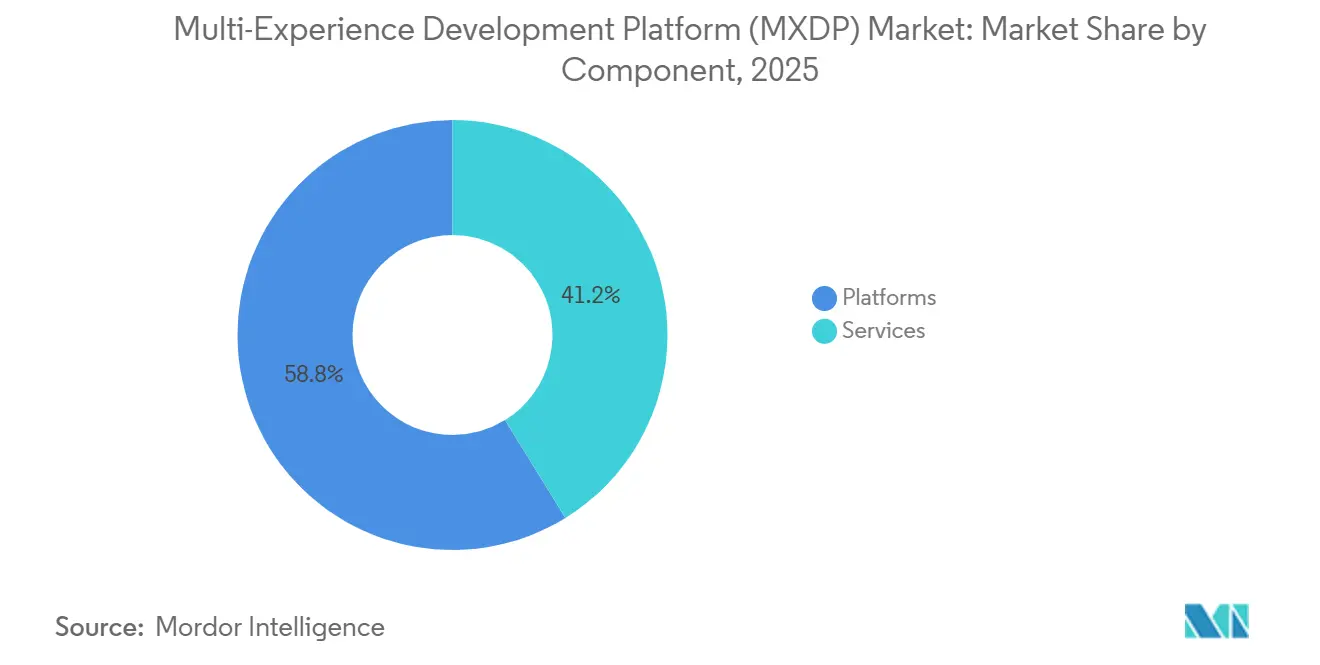
Services Poised To Close The Gap On PlatformsPlatforms held 58.81% of the Multi-Experience Development Platform (MXDP) market share in 2025, showing that buyers still place the most value on integrated environments that combine design, deployment, monitoring, and governance in one licensed stack. The appeal of the platform layer comes from consolidation, since one environment can replace separate tools for UI design, workflow configuration, integration handling, testing, and access management. That makes the multi-experience development platform market more resilient than narrower developer tool categories because the buying decision is tied to operating model simplification rather than a single feature set. The multi-experience development platform (MXDP) industry also benefits when vendors embed AI co-development and agent orchestration into the core integrated development environment, because that raises switching costs after customers standardize on one platform. OutSystems Developer Cloud and ServiceNow Studio reflect this direction by linking development work more directly to AI-assisted delivery and governed orchestration.
Services are forecast to grow at 23.42% through 2031, which means the gap with platforms should narrow as deployments become more complex and governance-heavy. The multi-experience development platform market size for Services is projected to expand at a 23.42% CAGR through 2031 as enterprises require help with implementation, agent lifecycle management, training, and ongoing optimization. Vendors are also broadening their own service models to capture modernization work that sits between legacy application cleanup and new AI-enabled experience design. Appian's April 2026 announcement of AI-assisted spec-driven development points to a service model where modernization becomes faster, more template-driven, and less dependent on fully manual migration programs.


By Deployment Model:
Cloud Dominance Deepened By Agentic ArchitecturesCloud accounted for 62.36% of the Multi-Experience Development Platform (MXDP) market size in 2025 and is also expected to grow at a 24.14% CAGR through 2031, which gives it both scale and growth leadership. That position reflects more than pricing flexibility, because real-time agentic systems depend on shared context, continuous model updating, and coordinated workflows that are easier to manage in cloud-native environments. The multi-experience development platform market is therefore seeing cloud become the default architecture for enterprises that want rapid deployment across multiple channels with built-in AI layers. Salesforce's hosted MCP Servers became generally available in April 2026, enabling AI agents to securely access Salesforce data across enterprise environments and showing how infrastructure trust is becoming part of application orchestration. This architecture also supports broader ecosystem participation because external tools and agents can interact with governed enterprise assets through standardized interfaces instead of one-off integrations.
On-premises deployment still retains a strategic role inside the MXDP market, especially in regulated sectors and sovereign environments where public cloud hosting is not always acceptable. Buyers in these settings treat hosting jurisdiction, network isolation, and access control as part of the application design decision rather than a later infrastructure choice. That means vendors need genuine portability across cloud, private cloud, and self-managed deployments if they want to compete for sensitive workloads. Mendix on Azure general availability in December 2025 and Appian's expanded AI support in self-managed environments both show how deployment flexibility remains central to enterprise buying criteria.
By Organization Size:
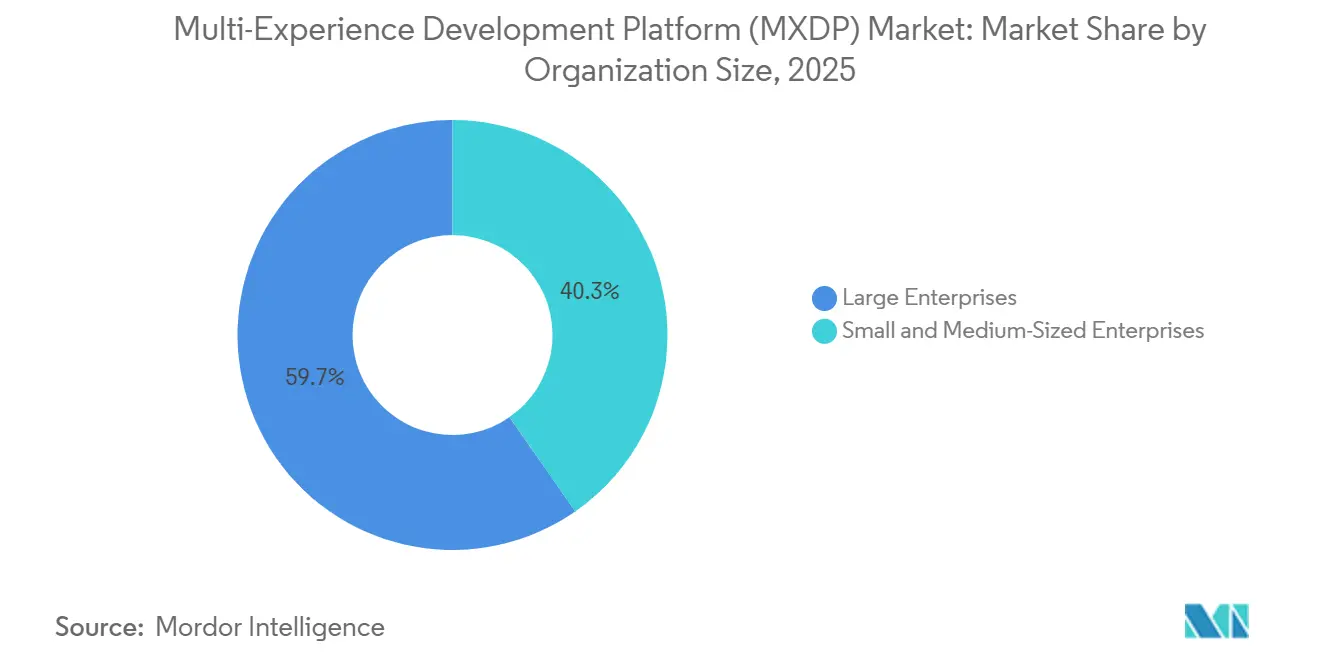
SME Momentum Builds On Easier AccessLarge enterprises accounted for 59.67% of revenue in 2025, reflecting their complex integration estates, larger channel footprints, and stronger need for centralized governance across regions and teams. They continue to anchor the multi-experience development platform market because they can justify higher platform spending when one environment supports security controls, workflow consistency, and cross-channel delivery at scale. Their deployments also generate follow-on demand for consulting and managed services because large organizations often run many legacy systems, multiple clouds, and broad device portfolios at the same time. This keeps large accounts important to the multi-experience development platform (MXDP) industry even as access becomes easier for smaller buyers. The combination of licensing revenue, services revenue, and long implementation cycles makes this segment strategically valuable for leading vendors.
SMEs are projected to grow at a 24.78% CAGR through 2031, which shows how platform accessibility is improving across the MXDP market. Lower entry pricing, subscription delivery, and AI-assisted development reduce the need for deep in-house engineering teams, which allows smaller organizations to adopt more sophisticated app strategies than before. The multi-experience development platform (MXDP) market is therefore widening from a large-enterprise stronghold into a broader adoption base where smaller firms can build customer-facing and internal applications with fewer technical bottlenecks. Mendix has continued to improve AI-assisted project scoping, automated microflow generation, and native agent editing, all of which support faster delivery by leaner teams with human approval still built into the process. That balance between speed and oversight is important because SMEs often need rapid execution but cannot afford governance failures that create rework later.
By Industry Vertical:
Regulated Use Cases Set The PaceBFSI represented 21.11% of revenue in 2025, which made it the largest vertical in the multi-experience development platform market. Banks and financial service providers need digital parity across mobile apps, websites, branch support tools, voice channels, and chatbot-led journeys, while still meeting strict audit and access requirements. That combination makes the multi experience development platform (MXDP) market especially relevant in finance, where application inconsistency can affect both customer experience and compliance posture. The multi experience development platform industry is also gaining traction in this vertical because AI features are being layered onto existing process controls instead of replacing them outright. This pattern suits financial institutions that want faster service design without giving up governance discipline.
The government and public sector are projected to expand at a 24.99% CAGR through 2031, showing that modernization of citizen and workforce services is becoming a strong growth path for the multi experience development platform market. The September 2025 OneGov agreement between the U.S. General Services Administration and ServiceNow, which provided federal agencies with major upgrade discounts through September 2028, highlighted how procurement frameworks can accelerate platform adoption across public institutions. Beyond BFSI and government, adoption curves remain differentiated across the multi experience development platform (MXDP) market, with manufacturing and energy favoring offline-first field workflows, healthcare focusing on multimodal patient and staff interfaces, and retail scaling AI-personalized omnichannel commerce delivery. Transportation, logistics, media, and telecom are also progressing, though their buying priorities differ more by workflow complexity and channel strategy than by one common template.
Geography Analysis
North America Multi-Experience Development Platform (MXDP) Market
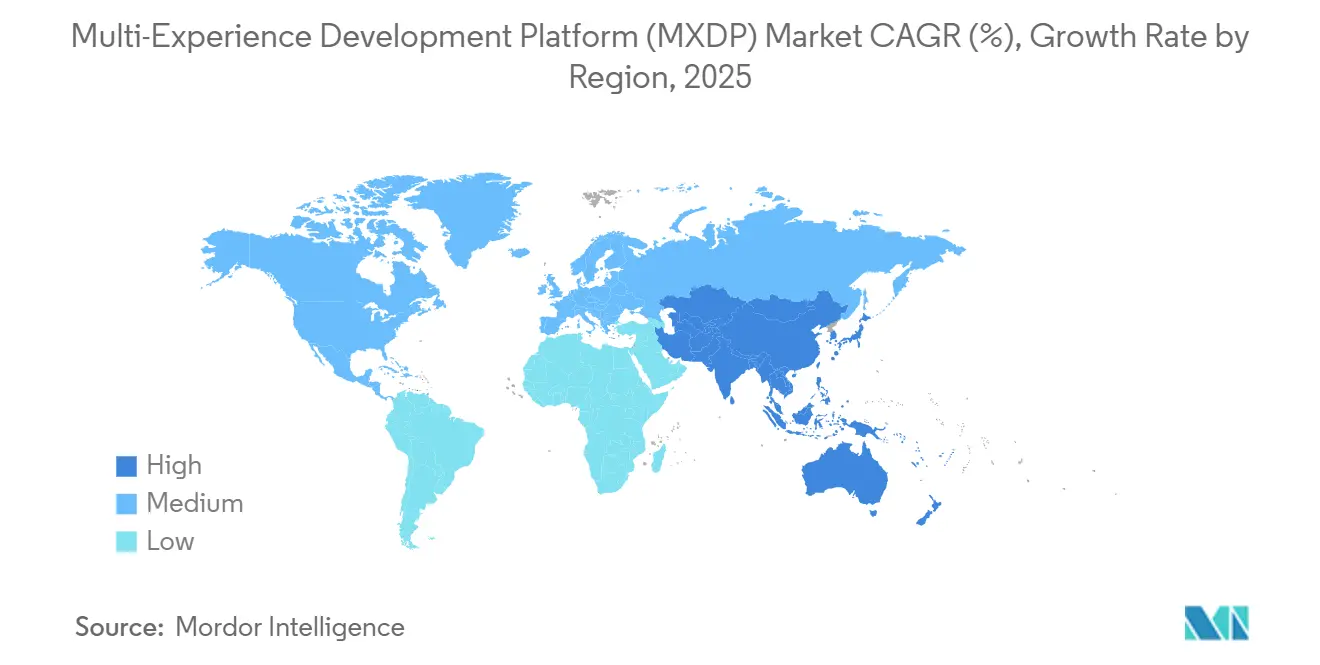
North America accounted for 40.98% of the Multi-Experience Development Platform (MXDP) market share in 2025, which kept it in the lead on the back of mature cloud infrastructure, high enterprise technology spending, and the strong presence of major vendors. The region continues to set the tone for the multi-experience development platform market because large enterprises and public sector bodies are willing to fund broader modernization programs that connect application delivery with AI governance. Appian's 10-year enterprise agreement with the U.S. Army, worth up to USD 500 million and awarded in January 2026, showed how public sector demand can support platform revenue over long timeframes. North America also benefits from dense integration ecosystems, which makes it easier for enterprises to combine low-code delivery, process automation, data access, and AI-assisted design in one roadmap. This combination helps the multi-experience development platforms market retain strong commercial and government momentum in the region.
APAC Multi-Experience Development Platform (MXDP) Market
Asia-Pacific is the fastest-growing geography, and the multi-experience development platform market size in the region is set to advance at a 25.34% CAGR through 2031. Growth in the region is being supported by aggressive digitalization, large mobile-first user bases, and greater urgency around application delivery efficiency. Japan remains a key example because its low-code platform segment reached JPY 317.8 billion, or USD 2.1 billion, in FY2024, reflecting strong enterprise demand in a market facing long-term IT talent constraints. China, India, Japan, and Southeast Asia are not following one identical path, but all are reinforcing the multi-experience development platform market through combinations of public digitalization programs, domestic cloud ecosystems, and rising enterprise demand for faster software delivery. The region also gives smaller and mid-sized firms more room to adopt platform-led development as pricing and AI assistance improve access.
EMEA and South America Multi-Experience Development Platform (MXDP) Market
Europe occupies a distinct position in the multi-experience development platforms (MXDP) market because demand for modernization remains strong while data governance expectations are among the strictest in the world. Buyers in the region place greater weight on deployment choice, auditability, and policy alignment, which narrows the field toward vendors with stronger compliance and sovereignty options. This pattern keeps on-premises and private-cloud deployment relevant, especially for sensitive public sector and regulated commercial workloads. South America and the Middle East and Africa remain smaller in absolute size, yet the multi-experience development platforms market is still gaining support there through digital financial services expansion, national transformation programs, and growing partner ecosystems tied to local cloud investment.

Competitive Landscape
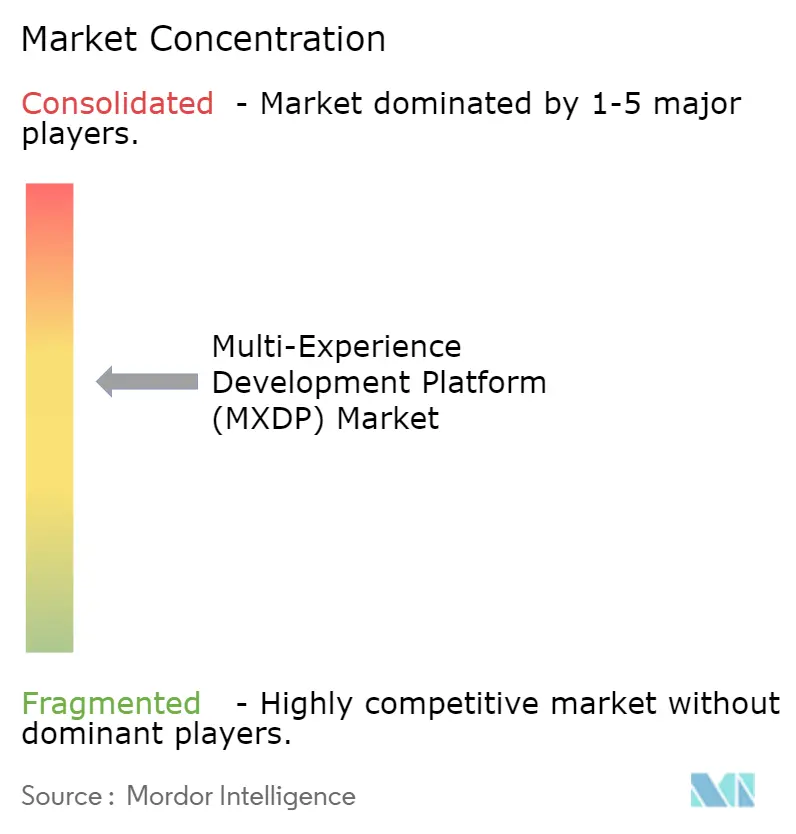
The Multi-Experience Development Platform (MXDP) market is moderately concentrated at the top, with Microsoft, Salesforce, ServiceNow, SAP, Oracle, OutSystems, and Mendix holding strong positions through deep enterprise relationships and broad integration ecosystems. Competition is becoming tighter because the line between low-code development, process automation, and multi-experience delivery is fading as more vendors build AI agent capabilities into the same stack. In 2026, the multi-experience development platform market is being shaped less by isolated feature launches and more by how well vendors connect app building, orchestration, integration, and governance in one coherent architecture. That is why the competitive conversation now centers on governed AI execution, data access, and deployment flexibility rather than simple drag-and-drop development claims. The multi-experience development platform market therefore rewards vendors that can tie channel delivery to enterprise control models without slowing adoption.
Large vendors are using acquisitions, integrations, and platform releases to widen that moat. Salesforce completed its acquisition of Informatica in November 2025, adding data catalog, governance, quality, and master data management capabilities that support trusted data foundations for autonomous AI agents. ServiceNow and Figma announced a strategic integration in November 2025 that allows enterprise applications to be generated from Figma design files through Figma's MCP Server, with early results indicating an over 80% reduction in initial UI and data model implementation time. OutSystems added Agentic Systems Engineering and the Enterprise Context Graph in 2026, showing how vendors are trying to give AI agents a structured understanding of enterprise architecture before they generate or modify applications. Appian also pushed further into AI-assisted modernization through spec-driven development and a Snowflake partnership, which signals that process-centric vendors are expanding toward broader AI-enabled experience orchestration.
Smaller vendors such as Betty Blocks, Creatio, Neptune Software, and Convertigo are responding by focusing on specialization instead of direct scale competition. Some are leaning into open ecosystems, some are emphasizing SAP-adjacent positioning, and others are targeting narrower use cases where delivery speed or sector fit matters more than platform breadth. White space remains most visible in offline-first field workflows and edge-resident agent execution, where connectivity constraints still challenge cloud-first assumptions across the MXDP market. Procurement expectations are also becoming stricter, which means the multi experience development platform market increasingly favors vendors that can show auditable AI lifecycle management instead of only rapid generation features.
Multi-Experience Development Platform (MXDP) Industry Leaders
OutSystems, Inc.
Salesforce, Inc.
Microsoft Corporation
SAP SE
Pegasystems Inc.
- *Disclaimer: Major Players sorted in no particular order
Multi-Experience Development Platform (MXDP) Market Companies Covered in this Report
- OutSystems, Inc.
- Mendix Technology B.V.
- Microsoft Corporation
- Salesforce, Inc.
- SAP SE
- Oracle Corporation
- Pegasystems Inc.
- Progress Software Corporation
- ServiceNow, Inc.
- Appian Corporation
- International Business Machines Corporation
- Temenos AG
- GeneXus S.A.
- Neptune Software AS
- HCL Technologies Limited
- i-exceed technology solutions private limited
- Convertigo SA
- Neutrinos Solutions Pvt. Ltd.
- Betty Blocks B.V.
- Creatio Ltd.

Recent Industry Developments in Multi-Experience Development Platform (MXDP) Market
- May 2026: Salesforce announced its Summer '26 Release, introducing multi-agent orchestration in Agentforce enabling specialized AI agents to collaborate on end-to-end workflows, alongside Tableau MCP for direct AI-to-analytics queries and the Agentforce Self-Service portal with a new Help Agent setup capability.
- April 2026: Salesforce launched Agentforce Operations as generally available, automating back-office workflows across supply chain, procurement, and finance with AI agents reporting 50-70% reduction in cycle times and 80% elimination of manual data entry across early adopter deployments.
- April 2026: Appian announced AI-assisted spec-driven development and a technology partnership with Snowflake at Appian World 2026, enabling direct MCP-powered interaction between Appian's data fabric and Snowflake Cortex AI for intelligent, data-backed process decisions.
- April 2026: Salesforce and Google Cloud announced expanded integrations enabling Agentforce agents to execute workflows within Gemini Enterprise and Google Workspace, with Gemini-powered reasoning for Agentforce natively supporting text, image, and video formats via the Atlas Reasoning Engine.


Global Multi-Experience Development Platform (MXDP) Market Report Scope
The Multi-Experience Development Platform (MXDP) market includes software platforms that help businesses build and manage applications across multiple digital touchpoints such as web, mobile, voice, wearables, AR/VR, and IoT. These platforms aim to deliver a consistent user experience across devices without needing separate apps for each channel.
The Multi-Experience Development Platform (MXDP) Market is Segmented by Component (Platforms and Services), Deployment Model (Cloud and On-Premises), Organization Size (Large Enterprises and SMEs), Industry Vertical (BFSI, IT and Telecom, Government, Manufacturing, Retail, Healthcare, Energy, Media, and Transportation), and Geography (North America, South America, and More). The market forecasts are provided in terms of Value (USD).
| Platforms |
| Services |
| Cloud |
| On-premises |
| Large enterprises |
| Small and medium-sized enterprises |
| BFSI |
| IT and telecommunications |
| Government and public sector |
| Manufacturing |
| Retail and consumer goods |
| Healthcare and life sciences |
| Energy and utilities |
| Media and entertainment |
| Transportation and logistics |
| North America | United States |
| Canada | |
| Mexico | |
| South America | Brazil |
| Argentina | |
| Rest of South America | |
| Europe | Germany |
| United Kingdom | |
| France | |
| Italy | |
| Spain | |
| Russia | |
| Rest of Europe | |
| Asia-Pacific | China |
| Japan | |
| India | |
| South Korea | |
| Australia | |
| Rest of Asia-Pacific | |
| Middle East and Africa | Saudi Arabia |
| United Arab Emirates | |
| South Africa | |
| Nigeria | |
| Rest of Middle East and Africa |
| By component | Platforms | |
| Services | ||
| By deployment model | Cloud | |
| On-premises | ||
| By organization size | Large enterprises | |
| Small and medium-sized enterprises | ||
| By industry vertical | BFSI | |
| IT and telecommunications | ||
| Government and public sector | ||
| Manufacturing | ||
| Retail and consumer goods | ||
| Healthcare and life sciences | ||
| Energy and utilities | ||
| Media and entertainment | ||
| Transportation and logistics | ||
| By geography | North America | United States |
| Canada | ||
| Mexico | ||
| South America | Brazil | |
| Argentina | ||
| Rest of South America | ||
| Europe | Germany | |
| United Kingdom | ||
| France | ||
| Italy | ||
| Spain | ||
| Russia | ||
| Rest of Europe | ||
| Asia-Pacific | China | |
| Japan | ||
| India | ||
| South Korea | ||
| Australia | ||
| Rest of Asia-Pacific | ||
| Middle East and Africa | Saudi Arabia | |
| United Arab Emirates | ||
| South Africa | ||
| Nigeria | ||
| Rest of Middle East and Africa | ||


Key Questions Answered in the Report
What is the current and forecast value of the multi-experience development platform (MXDP) market?
The multi-experience development platform (MXDP) market was valued at USD 4.93 billion in 2025, reached USD 5.94 billion in 2026, and is forecast to reach USD 15.03 billion by 2031 at a 20.41% CAGR.
Which region is leading multi-experience development platform (MXDP) adoption?
North America led in 2025 with a 40.98% share, supported by strong cloud infrastructure, high enterprise IT spending, and major vendor presence.
Which region is growing the fastest in multi-experience development platform (MXDP)?
Asia-Pacific is projected to post the fastest growth at a 25.34% CAGR through 2031, driven by digitalization across China, India, Japan, and Southeast Asia.
Which deployment model is strongest in this space?
Cloud led with 62.36% of revenue in 2025 and is also the fastest-growing deployment model with a 24.14% CAGR through 2031, reflecting the needs of AI-enabled and agentic architectures.
Which customer group is expanding fastest for multi-experience platforms?
SMEs are projected to grow at a 24.78% CAGR through 2031 as lower pricing tiers and AI-assisted development reduce the need for large in-house developer teams.
Which vertical shows the strongest demand outlook?
BFSI was the largest vertical in 2025 with a 21.11% revenue share, while government and public sector is set to grow the fastest at a 24.99% CAGR through 2031 as agencies modernize citizen and workforce services.
Page last updated on:





