
Motor Driver IC Market Size and Share
Market Overview
| Study Period | 2020 - 2031 |
|---|---|
| Market Size (2026) | USD 5.34 Billion |
| Market Size (2031) | USD 7.46 Billion |
| Growth Rate (2026 - 2031) | 6.90 % |
| Fastest Growing Market | South America |
| Largest Market | Asia Pacific |
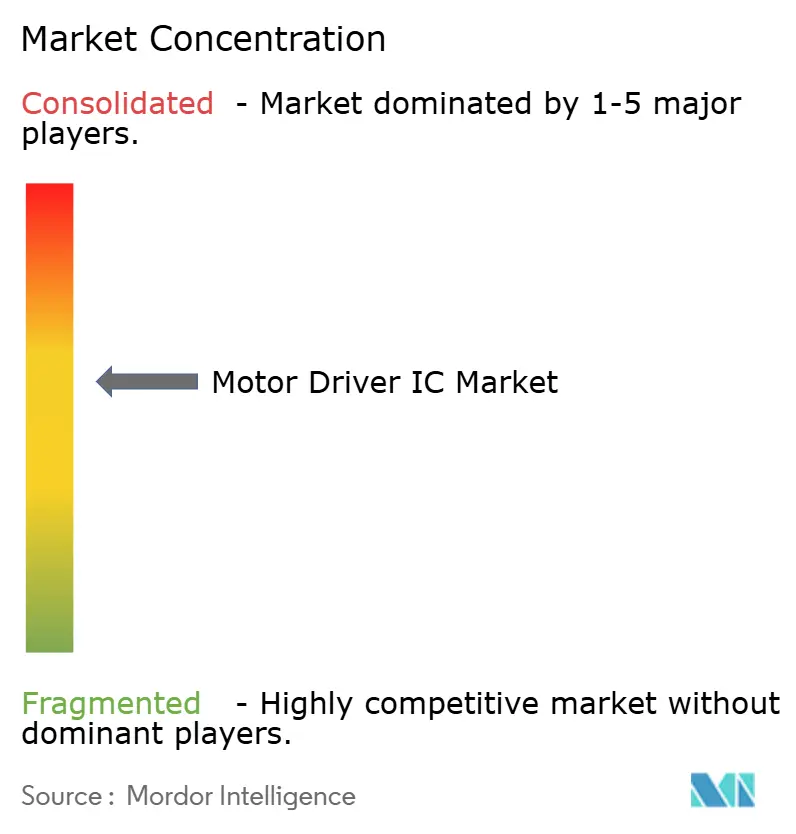
| Market Concentration | Medium |
Major Players *Disclaimer: Major Players sorted in no particular order Image © Mordor Intelligence. Reuse requires attribution under CC BY 4.0. | |
Motor Driver IC Market Analysis by Mordor Intelligence
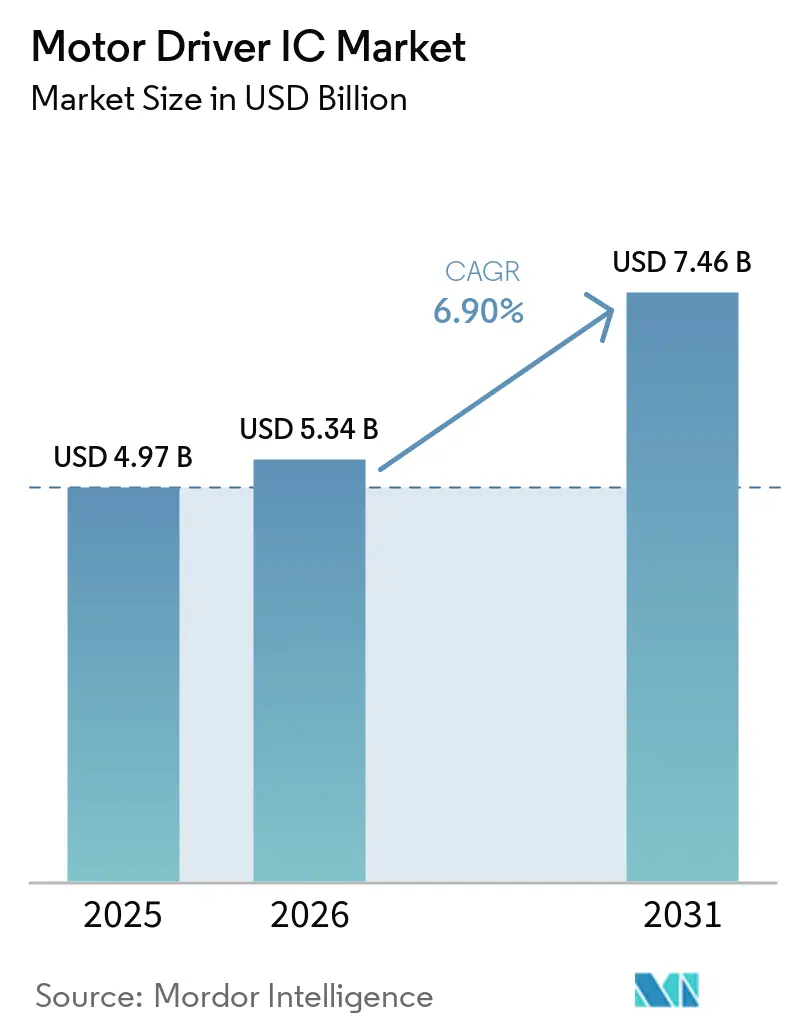
The motor driver IC market size is projected to expand from USD 4.97 billion in 2025 and USD 5.34 billion in 2026 to USD 7.46 billion by 2031, registering a CAGR of 6.9% between 2026 and 2031. A synchronized push from electric-vehicle mandates, factory-automation budgets, and energy-efficiency regulations is reshaping design priorities, moving wide-bandgap and brushless DC driver architectures from specialist tools to default choices. SiC and GaN gate drivers shorten switching times and raise thermal ceilings, enabling traction inverters, servo drives, and HVAC compressors to reduce heatsink footprints without sacrificing reliability. In parallel, demand for integrated diagnostics that satisfy ISO 26262 and predictive-maintenance firmware lifts average selling prices even as zonal vehicle architectures trim discrete socket counts. Suppliers with automotive-grade mixed-signal portfolios, mature AEC-Q100 processes, and in-house functional-safety IP convert these shifts into sustainable pricing power while fabless newcomers ride the SiC and GaN wave in performance-driven niches.
Key Report Takeaways
- By motor type, brushless DC led with 46.94% of motor driver IC market share in 2025, while silicon-carbide driver ICs are projected to expand at a 7.89% CAGR between 2026 and 2031.
- By voltage range, the 25-48 V category commanded 44.25% of the motor driver IC market in 2025, whereas the above-240 V segment is forecast to grow at a 7.95% CAGR through 2031.
- By end-use industry, automotive accounted for 37.53% of the motor driver IC market in 2025, and EV automotive applications are set to grow at a 7.83% CAGR through 2031.
- By semiconductor material, silicon retained 63.68% of the motor driver IC market size in 2025, while gallium-nitride drivers are on track for an 8.11% CAGR over 2026-2031.
- By geography, Asia-Pacific held 52.53% of the motor driver IC market in 2025, but South America is poised for the fastest expansion at 8.18% CAGR through 2031.
Note: Market size and forecast figures in this report are generated using Mordor Intelligence’s proprietary estimation framework, updated with the latest available data and insights as of January 2026.
Market Trends and Insights
Drivers Impact Analysis of Motor Driver IC Market*
| Driver | (~) % Impact on CAGR Forecast | Geographic Relevance | Impact Timeline |
|---|---|---|---|
| EV-led Demand for High-Voltage Driver ICs | +1.8% | Global, with focus on China, Europe, and North America | Medium term (2-4 years) |
| Industrial Robotics and Automation Surge | +1.5% | Asia-Pacific core, with spill-over to North America and Europe | Medium term (2-4 years) |
| Rapid Adoption of BLDC Motors in Consumer and HVAC | +1.2% | Global, led by Asia-Pacific and Europe | Short term (≤ 2 years) |
| Shift to Wide-Bandgap (SiC, GaN) Driver ICs | +1% | North America and Europe (automotive), Asia-Pacific (industrial) | Long term (≥ 4 years) |
| Embedded AI-based Predictive-Maintenance Features | +0.8% | North America and Europe early adopters, scaling in Asia-Pacific industrial ecosystems | Medium term (2-4 years) |
| Vehicle Zonal-Architecture Reducing Power Stage BOM (Under-Reported) | +0.6% | Europe and North America automotive OEMs, emerging in China | Long term (≥ 4 years) |
| Source: Mordor Intelligence | |||
EV-Led Demand for High-Voltage Driver ICs
Battery-electric vehicle output is scaling quickly, and each high-voltage traction inverter now requires multi-phase gate drivers that tolerate junction temperatures above 175°C. Silicon-carbide MOSFETs satisfy this envelope at switching frequencies beyond what legacy IGBT drivers handle, letting OEMs downsize cooling loops and cable gauges.[1]International Energy Agency, “Global Electric Vehicle Outlook 2025,” iea.org Commercial-vehicle electrification in California and the European Union further widens the opportunity because 800 V battery packs need reinforced-isolation drivers with creepage clearances exceeding IEC 60664-1 limits. Although demand is strong, qualified 200 mm SiC wafer capacity remains tight, extending lead times past half a year and inflating device ASPs, a bottleneck that entrenches suppliers with captive epitaxy lines.
Industrial Robotics and Automation Surge
Collaborative robots, automated guided vehicles, and high-speed CNC centers collectively drive the motor driver IC market, as each articulated joint embeds a three-phase servo loop. Factories in China, Japan, and South Korea dominate installation counts, yet North America and Europe are closing the gap with reshoring policies that reward productivity upgrades.[2]International Federation of Robotics, “World Robotics Industrial Robots 2025,” ifr.org Integrated safe-torque-off channels and EtherCAT-ready logic-shrinkboard real estate, while ISO 13849 compliance favors driver ICs with deterministic shutdown pathways. Vendors that can pre-certify functional-safety macrocells lock in design wins before value-engineering rivals can benchmark prototypes.
Rapid Adoption of BLDC Motors in Consumer and HVAC
Residential air-conditioner and white-goods efficiency mandates, including the U.S. SEER 15.0 threshold effective from 2027, pressure appliance makers to switch to electronically commutated motors.[3]U.S. Department of Energy, “Residential Central Air Conditioners and Heat Pumps Final Rule,” energy.gov Once driver IC costs fall below USD 1.50 per million units, BLDC platforms yield 20-30% energy savings versus induction units, making them indispensable in competitive product lines. Household brands already demand AEC-Q100-like reliability to guarantee ten-year lifecycles, so analog vendors that migrated automotive quality systems into consumer fabs now enjoy a head start. The motor driver IC market benefits because every smart compressor, fan, and pump needs precise current sensing and sensorless FOC algorithms that reside inside the gate driver.
Shift to Wide-Bandgap (SiC, GaN) Driver ICs
SiC and GaN substrates raise permissible switching frequencies and deliver higher power density, a trade that carries a 2-3x die-cost premium yet slashes heatsink volume and inverter weight. Automotive OEMs already report double-digit efficiency gains in 800 V drivetrains that rely on SiC gate drivers with >10 kV/µs common-mode immunity.[4]IEEE, “High-Frequency GaN Motor Drive Efficiency Study,” ieee.org GaN drivers, though capped at 650 V, dominate 48 V mild-hybrid systems, server-fan arrays, and fast-charging adapters where lower gate charge beats silicon. Supply, however, is concentrated among a handful of epi vendors, and qualification cycles often span two model years, slowing uptake in cost-sensitive SKUs yet reinforcing margins in high-performance tiers.
Restraints Impact Analysis of Motor Driver IC Market*
| Restraint | (~) % Impact on CAGR Forecast | Geographic Relevance | Impact Timeline |
|---|---|---|---|
| Automotive-grade safety qualification costs | -0.7% | Global, acute in North America and Europe | Short term (≤ 2 years) |
| Semiconductor supply-chain volatility | -0.9% | Global, with acute impact in Asia-Pacific and North America | Short term (≤ 2 years) |
| Thermal limits in ultra-compact BLDC modules | -0.3% | Global consumer electronics, concentrated in Asia-Pacific | Medium term (2-4 years) |
| Smart-motor integration cannibalizing low-power ICs | -0.5% | Global, led by Europe and North America appliance segments | Long term (≥ 4 years) |
| Source: Mordor Intelligence | |||
Automotive-Grade Safety Qualification Costs
Securing AEC-Q100 Grade 1 approval forces suppliers to perform 1 000-hour HTOL, THB, and ESD tests that collectively span up to two years and can cost more than USD 500 000 per product line. Layering ISO 26262 ASIL-D and SAE J3061 cybersecurity checks on top strains smaller fabless firms that lack the cash to absorb repeated test-lot failures. As a result, tier-1 module integrators gravitate toward incumbents with long automotive track records, consolidating purchasing power and throttling innovation at the low-volume edge of the motor driver IC market.
Semiconductor Supply-Chain Volatility
Geopolitical friction, export controls on gallium and germanium, and foundry prioritization of AI accelerators lengthen lead times for automotive-qualified wafers. Recent spikes pushed 200 mm fab queues past 22 weeks, compelling OEMs to dual source or pre-buy annual volumes, both of which inflate inventory carrying costs. Although the U.S. CHIPS and Science Act funnels billions into domestic capacity, meaningful relief is unlikely before 2027, leaving the motor driver IC market exposed to abrupt allocation shortages that can derail new-vehicle launch schedules.
*Our forecasts treat driver/restraint impacts as directional, not additive. The impact forecasts reflect baseline growth, mix effects, and variable interactions.
Motor Driver IC Market Segment Analysis
By Motor Type:
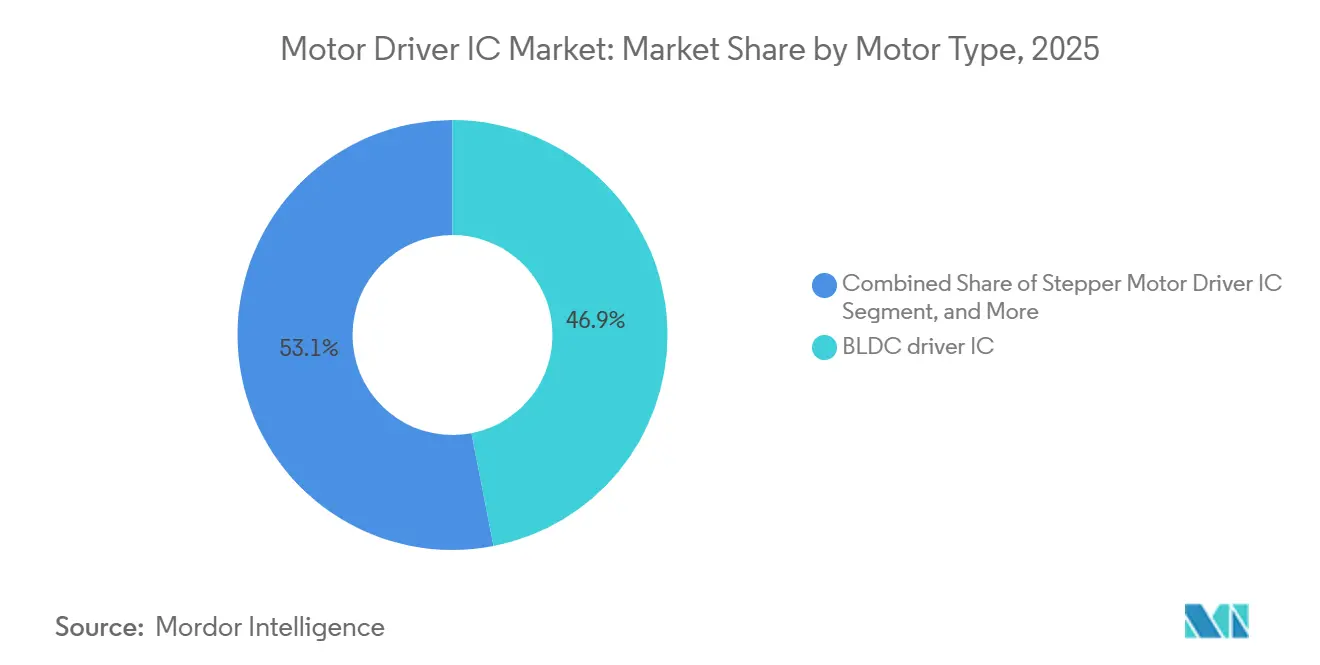
Silicon Carbide Drivers Accelerate FastestSiC driver ICs headline the performance story, outpacing the overall motor driver IC market with a projected 7.89% CAGR through 2031. The motor driver IC market size for SiC-based solutions rises as OEMs chase higher junction temperatures and switching speeds in 800 V traction and heavy-industrial drives. Brushless DC controllers remain the workhorse in volume terms, holding 46.94% revenue in 2025 across appliances, HVAC blowers, and low-to-mid-power factory equipment.
Continued cost erosion in coreless FET arrays keeps brushed-DC and stepper options alive in price-sensitive or legacy sockets, yet regulatory efficiency floors nudge even budget platforms toward three-phase topologies. Integration trends deepen as next-generation automotive microcontrollers embed gate-driver channels, a shift that trades discrete sockets for higher ASP monolithic devices. SiC, therefore, becomes the benchmark in premium tiers, while GaN pilots service 48 V accessories, and brushed-DC controllers settle into a long tail of maintenance and refurbishment demand.



By End-Use Industry:
EV Automotive Leads GrowthAutomotive platforms absorbed 37.53% of 2025 demand, and escalating battery-electric penetration keeps the segment on a 7.83% CAGR path. Each BEV typically installs 15-25 driver ICs for traction, battery-thermal loops, steering, and comfort functions, sustaining one of the deepest bill-of-materials stacks in the motor driver IC market. Industrial automation follows, with collaborative robots and automated warehouses installing dense clusters of servo loops that command premium diagnostics and deterministic latency.
Consumer electronics from cordless vacuums to high-end coffee machines embrace BLDC motors for acoustic and energy gains, generating stable mid-volume orders albeit at fierce cost targets. Medical equipment, although smaller in units, maintains high-margin pricing because life-support and surgical robots need ISO 13485 documentation and failure rates below single-digit FIT, bolstering the motor driver IC market share of vendors touting medical-grade process discipline.
By Voltage Range:
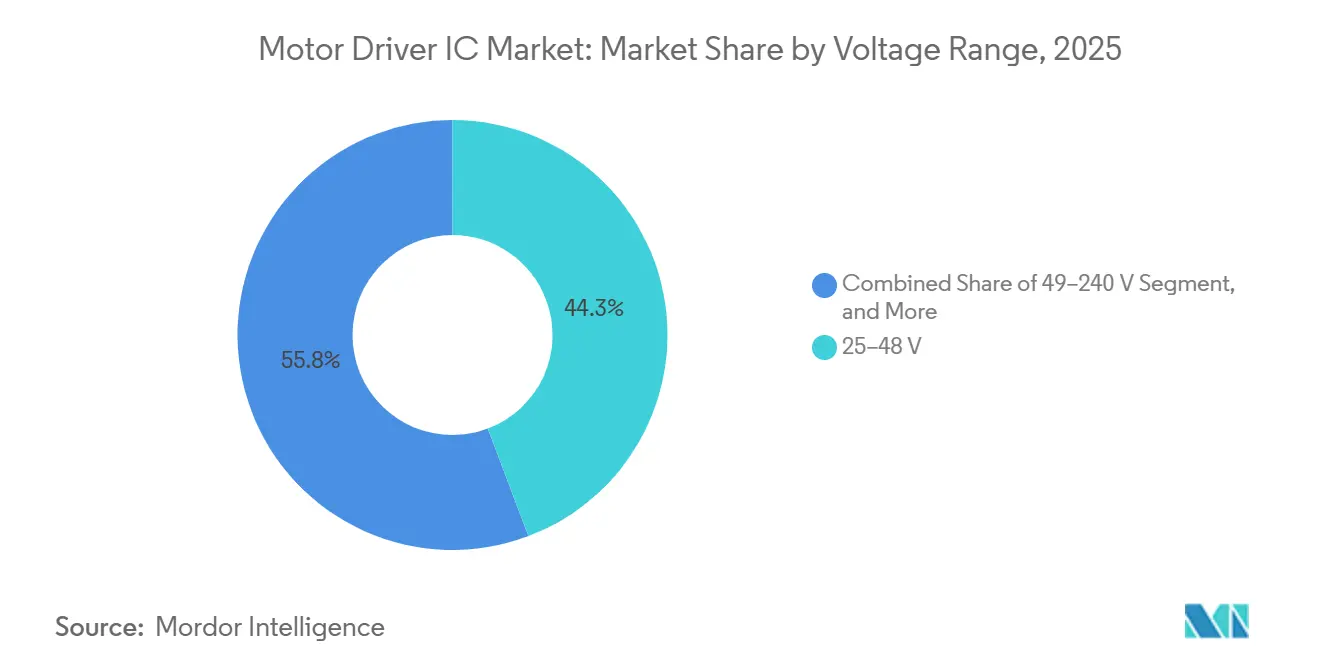
Above 240 V Segment Gains TractionThe above-240 V slice is forecast to grow at 7.95% CAGR as 400-800 V battery strings spread from luxury sedans into electric buses and mining trucks. Reinforced isolation of 3.75 kV RMS or higher becomes standard, and driver ICs integrate active Miller clamps plus fast desaturation detection to shield SiC modules from avalanche events. The 25-48 V category still accounted for 44.25% of 2025 shipments, reflecting its dominance in auxiliary automotive motors, light e-mobility, and industrial I/O rails.
Up to 24 V designs thrive in toys, drones, and IoT appliances where cost per watt overrides thermal overhead. Mid-band 49-240 V parts balance insulation margins with serviceability in HVAC compressors and power tools, exploiting the sweet spot where consumer safety regulations converge with manufacturing cost realities. Equipment running on 800 V architectures improves wiring efficiency by cutting copper mass, a system-level saving that offsets the higher sticker price of advanced gate drivers and thereby enlarges the motor driver IC market.
By Semiconductor Material:
GaN Posts Highest CAGRGallium-nitride parts are set for an 8.11% CAGR through 2031, the fastest material run-rate in the wider motor driver IC market. GaN-on-silicon compatibility enables foundries to plumb existing 200 mm CMOS lines, allowing driver vendors to iterate quickly on 48 V mild-hybrid starters and server-cooling fans operating at 100 kHz pulse widths. Silicon retained 63.68% revenue in 2025 because it owns sub-100 V, sub-10 A niches where every cent matters, while silicon-carbide wins >10 kW traction and industrial drives that care about 200 °C junction caps.
GaN excels at low gate charge and near-lossless switching, delivering 98.5% inverter efficiency in lab trials, yet its 650 V ceiling confines it to lower-power targets such as e-motorcycles and data-center fans. Diamond and aluminum nitride remain research topics, occasionally surfacing at academic conferences but generating no meaningful revenue. As a result, wide-bandgap materials complement rather than cannibalize silicon, expanding the total motor driver IC market rather than compressing it.
Geography Analysis
APAC Motor Driver IC Market
Asia-Pacific commanded 52.53% of 2025 revenue because China dominates battery-electric car production while India unlocks fresh fab incentives for analog components. Joint-venture fabs in Japan and South Korea add capacity for automotive-grade SiC, supporting surging export volumes of industrial robots and infotainment modules. Local tier-1s choose domestic driver ICs whenever ISO 26262 and IATF 16949 paperwork aligns, reinforcing regional supply loops and shortening design-cycle feedback.
North America and Europe Motor Driver IC Market
North America and Europe share a policy-led demand pattern where fleet-average CO₂ caps compel OEMs to front-load EV investments. The CHIPS and Science Act dedicates USD 39 billion to fabrication subsidies, with analog multichip modules listed as priority categories, and Germany’s EUR 3 billion semiconductor R and D pool steers grants toward automotive power electronics. These cash injections offset higher labor costs and de-risk long builds for motor driver IC suppliers that co-locate packaging and final test near customer plants.
South America and Saudi Arabia Motor Driver IC Market
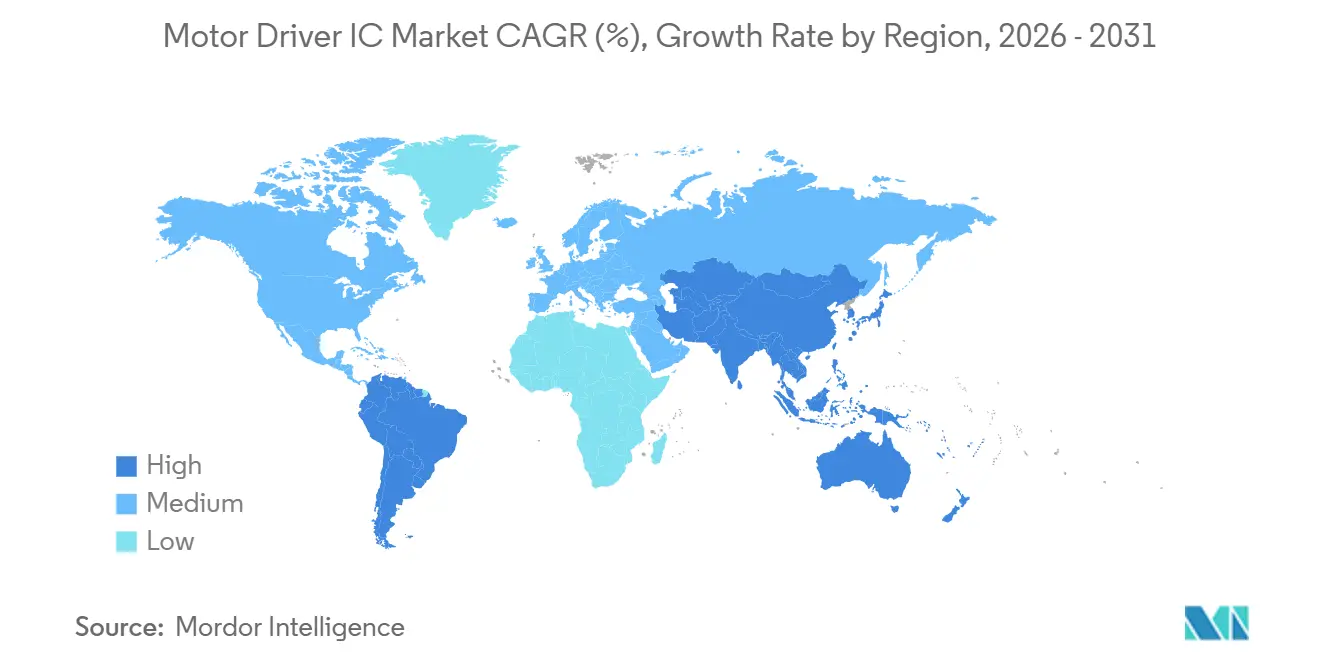
South America achieves the fastest regional climb at 8.18% CAGR, anchored by Brazil’s industrial modernization loans and Argentina’s move to electrify mineral extraction. Mining haul trucks, conveyor lines, and process-plant pumps adopt BLDC and SiC drive packs to curb diesel usage, each installation embedding dozens of high-voltage driver ICs. Elsewhere, renewable megaprojects from Chile’s Atacama solar corridor to Saudi Arabia’s NEOM smart city specify electronically commutated pumps and HVAC systems, importing incremental demand into the motor driver IC market.

Competitive Landscape
The competitive field remains moderately fragmented, with three integrated device manufacturers, Texas Instruments, Infineon Technologies, and STMicroelectronics, leveraging end-to-end portfolios that bundle gate drivers, current-sense amplifiers, microcontrollers, and power modules. Their advantages include mature AEC-Q100 flows, in-house test farms, and close ties to tier-1s that insist on ISO 26262 collateral at the quotation stage. Package thermal resistance below 25 °C/W, sub-20 ns propagation delays, and SPI-enabled diagnostics define table-stakes metrics, pushing laggards out of premium design slots.
Fabless challengers such as Navitas Semiconductor and GaN Systems fill performance crevices in 48 V and 650 V spaces, outsourcing wafer starts to specialty GaN foundries and reinvesting saved capex into rapid qualification loops. Patent activity underscores rising barriers: the United States Patent and Trademark Office logged a 42% year-on-year increase in motor-driver claims in 2024, with filings focusing on integrated current sensing, sensorless FOC libraries, and multi-phase interleaving. As zonal architectures merge multiple low-power loads onto central controllers, socket counts shrink, yet per-board ASPs climb because consolidated drivers must withstand higher fault energy and deliver richer telemetry.
Suppliers lacking mixed-signal intellectual property or access to 200 mm SiC and GaN processes risk marginalization. Market entrants attempt to differentiate through predictive-maintenance analytics or co-packaged drivers and FETs, but qualification hurdles and the capital burden of safety testing slow penetration. Overall, the top five vendors account for roughly 55% of global revenue, giving the motor driver IC market a moderate concentration profile that balances innovation with price competition.
Motor Driver IC Industry Leaders
Allegro MicroSystems, Inc.
Alpha & Omega Semiconductor Ltd.
Analog Devices, Inc.
Diodes Incorporated
Infineon Technologies AG
- *Disclaimer: Major Players sorted in no particular order
Motor Driver IC Market Companies Covered in this Report
- Allegro MicroSystems, Inc.
- Alpha & Omega Semiconductor Ltd.
- Analog Devices, Inc.
- Diodes Incorporated
- Infineon Technologies AG
- Maxim Integrated Products, Inc.
- Melexis NV
- Microchip Technology Incorporated
- Monolithic Power Systems, Inc.
- NXP Semiconductors N.V.
- ON Semiconductor Corporation
- Panasonic Industry Co., Ltd.
- Power Integrations, Inc.
- Renesas Electronics Corporation
- ROHM Co., Ltd.
- Sanken Electric Co., Ltd.
- Silergy Corp.
- STMicroelectronics N.V.
- Texas Instruments Incorporated
- Toshiba Electronic Devices & Storage Corporation

Recent Industry Developments in Motor Driver IC Market
- April 2026: ROHM completed development of its 5th-generation SiC MOSFET platform, achieving ~30% lower ON-resistance at high temperatures. This directly strengthens next-gen motor driver IC efficiency in EV and industrial applications, accelerating transition toward wide-bandgap-based driver architectures.
- November 2025: Melexis launched the MLX81339 motor driver IC featuring integrated control, diagnostics, and protection functions targeting automotive and industrial applications.
- November 2025: STMicroelectronics introduced the VNH9030AQ motor driver IC with enhanced current handling and protection features for automotive motor control systems.
- March 2025: Infineon Technologies released the EiceDRIVER 2ED2410-EM SiC gate driver with 6 A source and sink capability and 10 kV/µs immunity, targeting 800 V traction inverters.


Global Motor Driver IC Market Report Scope
The Motor Driver IC Market refers to integrated circuits that control the speed, direction, and torque of electric motors by acting as the interface between low-power control logic and the motor load. It includes ICs used in automotive systems, industrial automation, robotics, consumer appliances, and smart devices where precise and efficient motor control is required. The market is driven by electrification, rising motor density in EVs, factory automation, and demand for energy-efficient motion control.
The Motor Driver IC Market Report is Segmented by Motor Type (Brushed DC driver IC, Brushless DC driver IC, Stepper motor driver IC, and SiC driver IC), End-use Industry (Automotive, Industrial Automation and Robotics, Consumer Electronics and Appliances, and Healthcare Equipment), Voltage Range (Up to 24 V, 25-48 V, 49-240 V, and Above 240 V), Semiconductor Material (Silicon, Silicon Carbide (SiC), and Gallium Nitride (GaN)), and Geography (North America, Europe, Asia-Pacific, Middle East, Africa, and South America). Market Forecasts are Provided in Terms of Value (USD).
| Brushed DC driver IC |
| Brushless DC driver IC |
| Stepper motor driver IC |
| SiC driver IC |
| Rest of Motor Type |
| Automotive |
| Industrial automation and robotics |
| Consumer electronics and appliances |
| Healthcare equipment |
| Rest of End-use Industry |
| Up to 24 V |
| 25-48 V |
| 49-240 V |
| Above 240 V |
| Silicon |
| Silicon Carbide (SiC) |
| Gallium Nitride (GaN) |
| Rest of Semiconductor Material |
| North America | United States |
| Canada | |
| Mexico | |
| Europe | Germany |
| United Kingdom | |
| France | |
| Italy | |
| Rest of Europe | |
| Asia-Pacific | China |
| Japan | |
| India | |
| South Korea | |
| Australia | |
| Rest of Asia-Pacific | |
| South America | |
| Middle East and Africa |
| By Motor Type | Brushed DC driver IC | |
| Brushless DC driver IC | ||
| Stepper motor driver IC | ||
| SiC driver IC | ||
| Rest of Motor Type | ||
| By End-use Industry | Automotive | |
| Industrial automation and robotics | ||
| Consumer electronics and appliances | ||
| Healthcare equipment | ||
| Rest of End-use Industry | ||
| By Voltage Range | Up to 24 V | |
| 25-48 V | ||
| 49-240 V | ||
| Above 240 V | ||
| By Semiconductor Material | Silicon | |
| Silicon Carbide (SiC) | ||
| Gallium Nitride (GaN) | ||
| Rest of Semiconductor Material | ||
| By Geography | North America | United States |
| Canada | ||
| Mexico | ||
| Europe | Germany | |
| United Kingdom | ||
| France | ||
| Italy | ||
| Rest of Europe | ||
| Asia-Pacific | China | |
| Japan | ||
| India | ||
| South Korea | ||
| Australia | ||
| Rest of Asia-Pacific | ||
| South America | ||
| Middle East and Africa | ||


Key Questions Answered in the Report
What is the projected value of the global motor driver IC space by 2031?
It is forecast to reach USD 7.46 billion by 2031, expanding at a 6.9% CAGR over 2026-2031.
Which semiconductor material is expected to post the fastest growth and why?
Gallium-nitride driver ICs are set for an 8.11% CAGR because their low gate charge and high switching speed suit 48 V mild-hybrid vehicles, data-center fans, and compact consumer devices.
How fast will the silicon-carbide driver IC segment expand during the forecast period?
Silicon-carbide driver IC revenue is projected to grow at a 7.89% CAGR between 2026 and 2031.
Which region is likely to record the highest growth through 2031?
South America is expected to post the quickest expansion at an 8.18% CAGR, propelled by automation upgrades in Brazil and mining electrification in Argentina.
How significant is automotive demand in current revenues?
Automotive applications captured 37.53% of global revenue in 2025 and remain the largest end-use segment.
What near-term challenges could restrain supplier growth?
Rising AEC-Q100 qualification costs and ongoing semiconductor supply-chain volatility may shave roughly 1.6 percentage points off forecast CAGR over the next two years.
Page last updated on:





