
Automotive Special Purpose Logic IC Market Size and Share
Market Overview
| Study Period | 2020 - 2031 |
|---|---|
| Market Size (2026) | USD 3.72 Billion |
| Market Size (2031) | USD 4.40 Billion |
| Growth Rate (2026 - 2031) | 3.39 % |
| Fastest Growing Market | Asia Pacific |
| Largest Market | Asia Pacific |
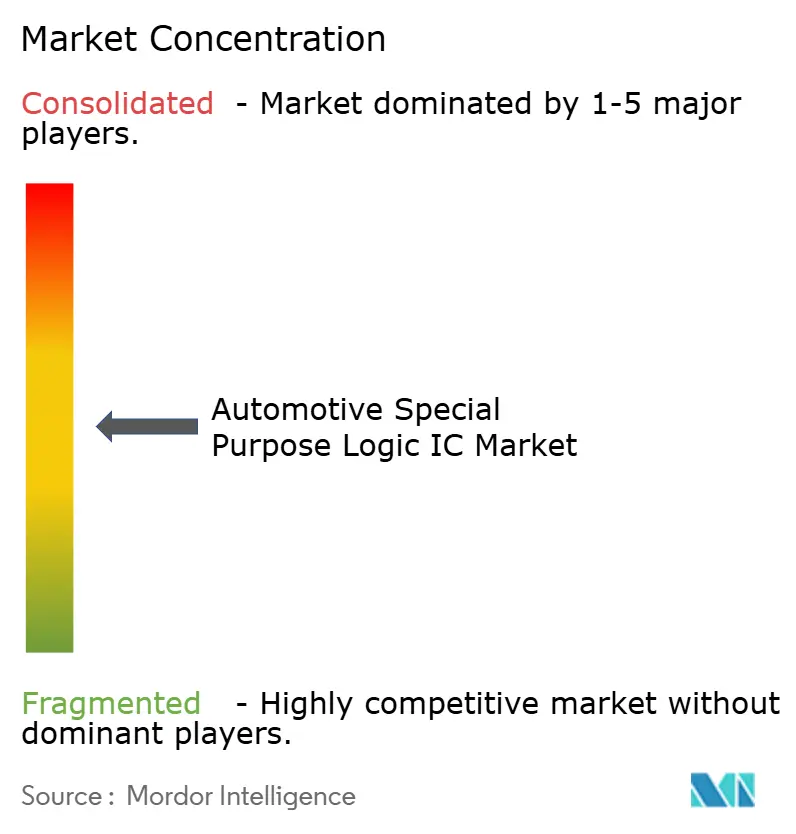
| Market Concentration | Medium |
Major Players
*Disclaimer: Major Players sorted in no particular order Image © Mordor Intelligence. Reuse requires attribution under CC BY 4.0. |
|
Automotive Special Purpose Logic IC Market Analysis by Mordor Intelligence
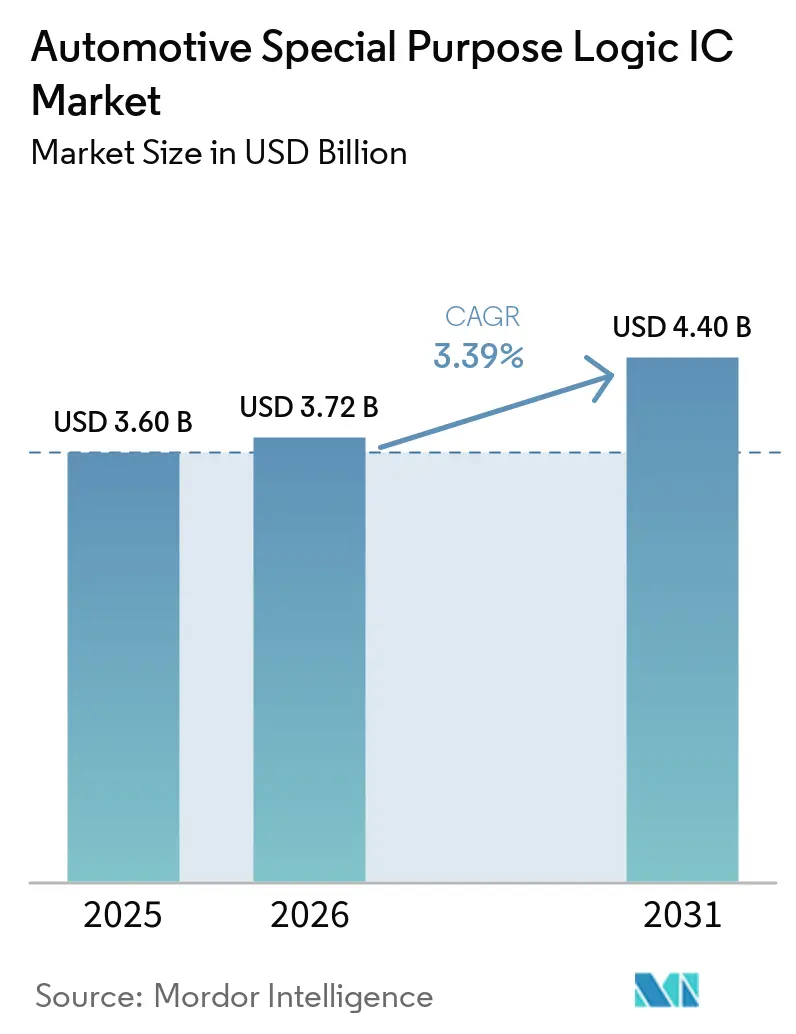
Automotive special-purpose logic IC market size in 2026 is estimated at USD 3.72 billion, growing from 2025 value of USD 3.6 billion with 2031 projections showing USD 4.4 billion, growing at 3.39% CAGR over 2026-2031. Robust demand stems from the rising penetration of ADAS, the widening electrification of powertrains, and a steady shift toward zonal electrical/electronic (E/E) architectures, which require higher integration densities and real-time processing capabilities. Automakers favor logic ICs that combine low-latency performance with strict functional safety compliance, prompting suppliers to move beyond commodity devices toward application-specific solutions. Supply resilience remains a strategic focus as mature-node wafer capacity tightens amid geopolitical tensions, prompting OEMs to dual-source parts and secure long-term foundry agreements. Concurrently, chiplet-oriented System-in-Package (SiP) designs lower total cost of ownership by allowing incremental feature updates without full-mask re-spins.
Key Report Takeaways
- By logic IC type, ASICs led with 35.82% revenue share in 2025; FPGAs are projected to expand at a 3.58% CAGR through 2031.
- By application, ADAS held a 29.55% market share of the automotive special-purpose logic IC market in 2025 and is expected to grow at a 3.88% CAGR through 2031.
- By vehicle type, passenger cars accounted for a 47.85% share of the automotive special-purpose logic IC market size in 2025, while electric vehicles are expected to advance at a 3.95% CAGR through 2031.
- By packaging technology, SiP captured 30.76% of 2025 revenue and is anticipated to rise at a 3.74% CAGR over the forecast period.
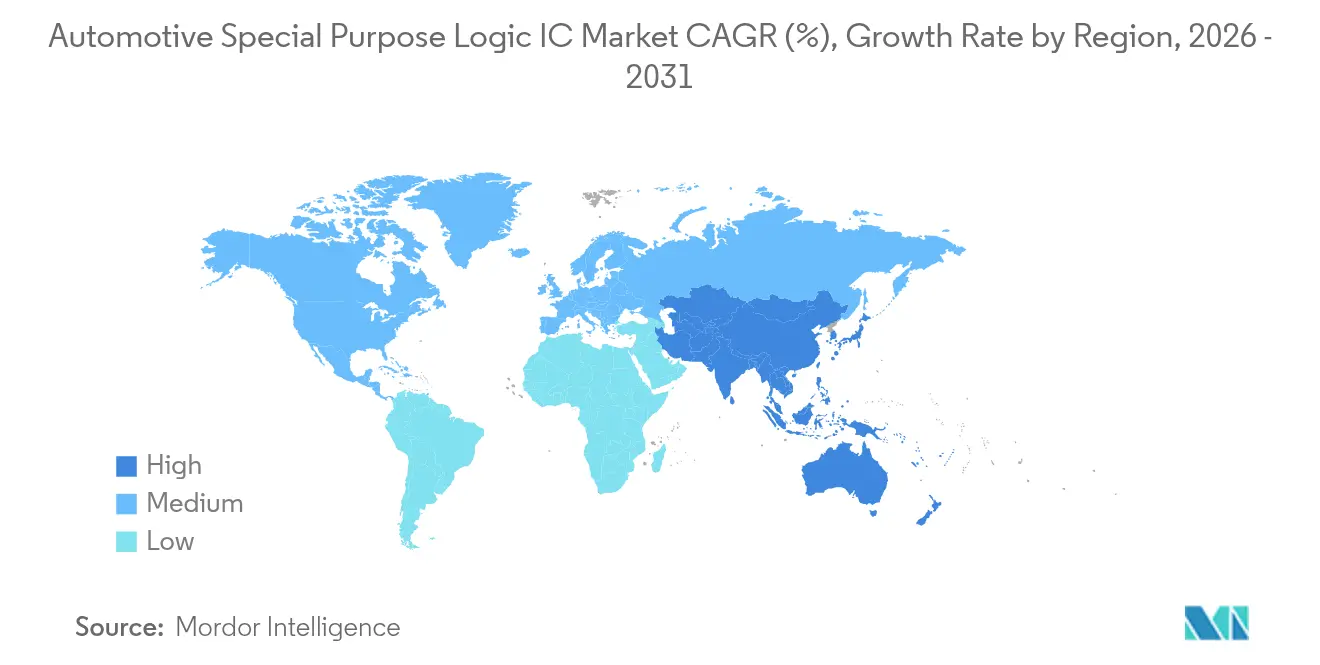
- By geography, the Asia-Pacific region contributed 32.05% of global sales in 2025; it is forecast to record the fastest growth of 3.46% CAGR from 2025 to 2031.
Note: Market size and forecast figures in this report are generated using Mordor Intelligence’s proprietary estimation framework, updated with the latest available data and insights as of 2026.
Market Trends and Insights
Drivers Impact Analysis of Automotive Special Purpose Logic IC Market*
| DRIVER | (~) % IMPACT ON CAGR FORECAST | GEOGRAPHIC RELEVANCE | IMPACT TIMELINE |
|---|---|---|---|
| Surging ADAS and autonomous-driving penetration | +0.8% | Global; early adoption in North America and Europe | Medium term (2-4 years) |
| Rapid electrification of powertrains elevates logic-IC content | +0.6% | Asia-Pacific core; spill-over to North America and Europe | Long term (≥ 4 years) |
| Government safety mandates are accelerating semiconductor demand | +0.4% | Global, led by the European framework | Short term (≤ 2 years) |
| Transition to zonal/centralized E/E architectures | +0.3% | Premium segments in North America and Europe | Medium term (2-4 years) |
| Chiplet-based SiP enabling cost-efficient customization | +0.2% | Global manufacturing concentration in the Asia-Pacific | Medium term (2-4 years) |
| Automotive-Ethernet PHY adoption for high-speed data backbones | +0.1% | Premium and luxury segments worldwide | Long term (≥ 4 years) |
| Source: Mordor Intelligence | |||
Surging ADAS and autonomous-driving penetration
Euro NCAP protocol updates now require automatic emergency braking on commercial vehicles, instantly boosting demand for logic devices that fuse radar, camera, and LiDAR inputs while meeting ASIL-D safety targets.[1]European Commission Staff, “Road Safety—Vehicle Safety,” European Commission, ec.europa.eu Level 3 autonomy shifts have normalized dual-core lockstep architectures, prompting OEMs to specify custom ASICs that reduce power budgets and BOM costs compared to general-purpose MCUs, as ADAS availability nears that of new-car sales in developed markets.
Rapid electrification of powertrains elevating logic-IC content
Each battery electric model introduces higher-value logic controllers for pack monitoring, motor inverters, and on-board chargers; Tesla’s 4680 cell design alone adds USD 150–200 of semiconductor logic per vehicle for battery management.[2]Tesla Investor Relations. "Quarterly Earnings Reports." 2024. https://ir.tesla.com/quarterly-earnings Wider 800 V architectures in premium EVs create fresh demand for isolated gate drivers and fault-tolerant logic, with SiC and GaN components pushing switching frequencies and thermal limits that legacy devices cannot match.[3]Infineon Technologies. "Press Releases 2024." https://www.infineon.com/cms/en/about-infineon/press/press-releases/2024/
Government safety mandates accelerating semiconductor demand
The EU's General Safety Regulation mandates intelligent speed assistance and emergency braking in all new vehicles, turning legislative requirements into tangible silicon demand. These regulations aim to enhance road safety by reducing accidents and fatalities through the use of advanced vehicle technologies. Concurrently, the NHTSA's proposals for heavy-duty fleets and Japan's functional-safety guidelines further bolster the demand for logic ICs. These measures are designed to ensure compliance with safety standards while addressing the growing complexity of modern vehicles. This trend provides suppliers with clearer visibility into their order books, easing the financial strain of qualification costs and enabling long-term planning for production and innovation.
Transition to zonal/centralized E/E architectures
BMW's move to consolidate over 100 electronic control units (ECUs) into just five zone controllers necessitates the use of advanced logic ICs. These ICs must manage diverse tasks and transmit gigabit data via automotive Ethernet. This transition reflects the industry's efforts to simplify vehicle architectures, reduce wiring complexity, and improve overall system efficiency. While bridge logic, which ensures compatibility with older systems, sees a surge in demand, this is expected to decline as the industry fully transitions to zonal architectures, which offer enhanced scalability and support for future technological advancements.
Restraints Impact Analysis of Automotive Special Purpose Logic IC Market*
| RESTRAINT | (~) % IMPACT ON CAGR FORECAST | GEOGRAPHIC RELEVANCE | IMPACT TIMELINE |
|---|---|---|---|
| Stringent manufacturing-process complexity and defect-density limits | –0.4% | Global; acute at mature node fabs | Long term (≥ 4 years) |
| Lengthy AEC-Q qualification cycle prolongs time-to-market | –0.3% | Global; regional test-variance | Medium term (2-4 years) |
| Geopolitical risks around mature-node wafer supply | –0.2% | Asia-Pacific hubs; global spill-over | Short term (≤ 2 years) |
| Escalating ASIC NRE costs for low-volume vehicle programs | –0.1% | Global, premium vehicles | Medium term (2-4 years) |
| Source: Mordor Intelligence | |||
Stringent manufacturing-process complexity and defect-density limits
AEC-Q100 Grade 0 mandates single-digit DPPM rates from –40 °C to +150 °C. This requirement pushes TSMC to implement specialized tweaks in its automotive lines, resulting in lower utilization rates, increased unit costs, and constrained spare capacity during demand surges. Additionally, extended burn-in periods and tighter SPC loops can extend the fab cycle time by as much as 60% when compared to flows used for consumer logic. These factors collectively contribute to the increased complexity and higher costs associated with manufacturing processes for automotive-grade semiconductors.
Lengthy AEC-Q qualification cycle prolonging time-to-market
Qualification windows typically span 12 to 18 months, costing an additional USD 2 to 5 million for each device family. This financial burden sidelines smaller innovators from niche markets and keeps older silicon in production longer than its technological relevance warrants. Such delays hinder the swift adoption of rapidly evolving standards, such as V2X, transforming what could have been early revenue into postponed gains. The extended qualification process also impacts the ability of manufacturers to respond quickly to market demands, further complicating the competitive landscape.
*Our forecasts treat driver/restraint impacts as directional, not additive. The impact forecasts reflect baseline growth, mix effects, and variable interactions.
Automotive Special Purpose Logic IC Market Segment Analysis
By Logic IC Type:
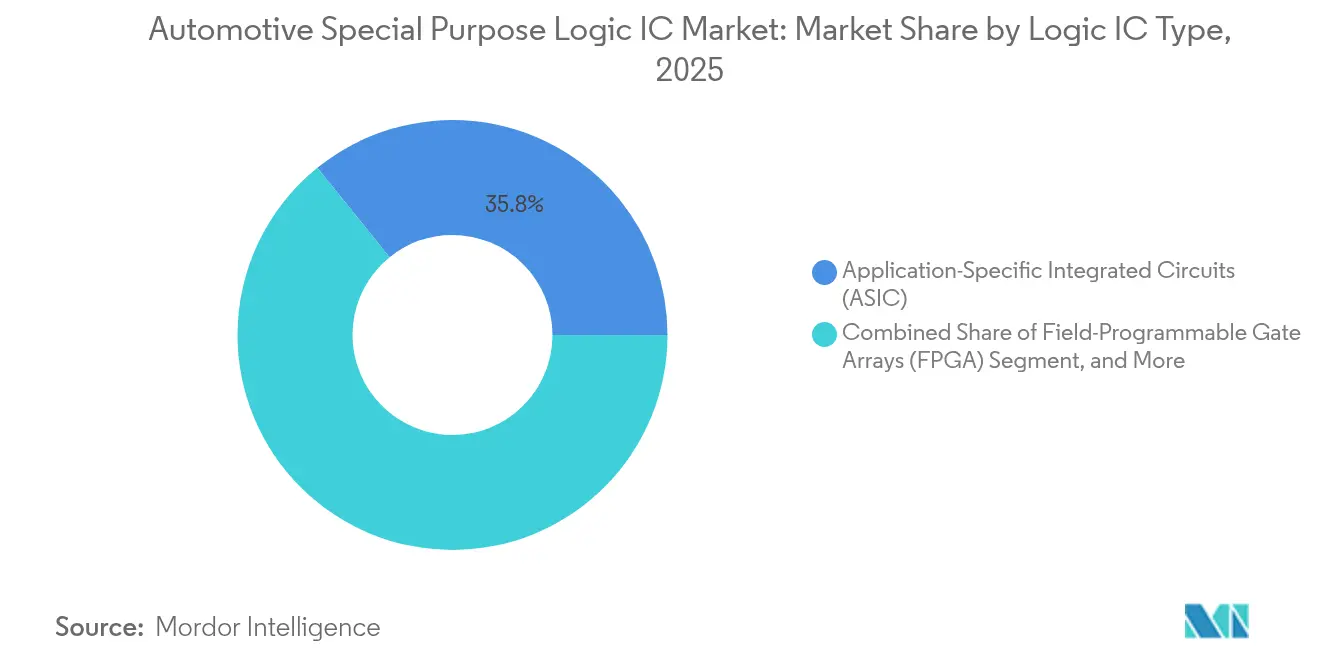
ASIC solutions anchor cost controlASICs accounted for 35.82% of 2025 revenue, underscoring OEM preference for high-volume economies over the programmable convenience of FPGAs. FPGA uptake, however, is rising fastest at 3.58% CAGR as over-the-air update requirements force reconfigurability without mechanical recalls. Intel’s latest automotive FPGA family cuts power consumption by 30% and narrows the cost gap, inviting wider design-ins where algorithm agility is paramount. The automotive special-purpose logic IC market size for FPGA-based implementations is projected to increase steadily as Level 3 autonomy layers demand code adaptability for sensor fusion tweaks.
Second-tier CPLDs serve deterministic tasks such as airbag trigger logic, where nanosecond response times and near-zero standby power outweigh raw computational power. Similar design principles also support the consumer special-purpose logic IC market in applications requiring compact, reliable control functions. ASSPs remain mid-volume default picks when custom ASIC economics falter, giving Tier 1 suppliers a balance between per-unit cost and schedule risk. Across all categories, the automotive special-purpose logic IC market opportunities tilt toward devices that integrate embedded safety monitors and secure boot features mandated under the UNECE cybersecurity regulation.



By Application:
ADAS sustains top billingADAS generated 29.55% of industry revenue in 2025 and is poised for a 3.88% CAGR through 2031 as mandatory automatic emergency braking and lane-keeping rules are implemented worldwide. ADAS compute loads no longer isolate vision or radar; centralized domain controllers now perform heterogeneous sensor fusion and decision loops within 50 ms latency. Qualcomm’s Snapdragon Ride blends logic fabric, AI accelerators, and connectivity PHYs in one SoC, reflecting the convergence trend and enabling OEMs to shrink PCB real estate by up to 30%.
Infotainment and connectivity follow closely, driven by dual-screen cockpits and 5G telematics that expand memory bandwidth and necessitate multicore logic. Powertrain and battery management logic ICs are expanding rapidly in EV lineups, particularly as 800 V platforms proliferate beyond the luxury tier. Body electronics maintain a steady clip, yet feature creep-powered doors, ambient lighting, and HVAC zonal control still lift logic density per car. Safety and security logic segments command the highest ASIL grades and therefore sustain premium ASPs, cushioning revenue when unit volumes soften in cyclical markets.
By Vehicle Type:
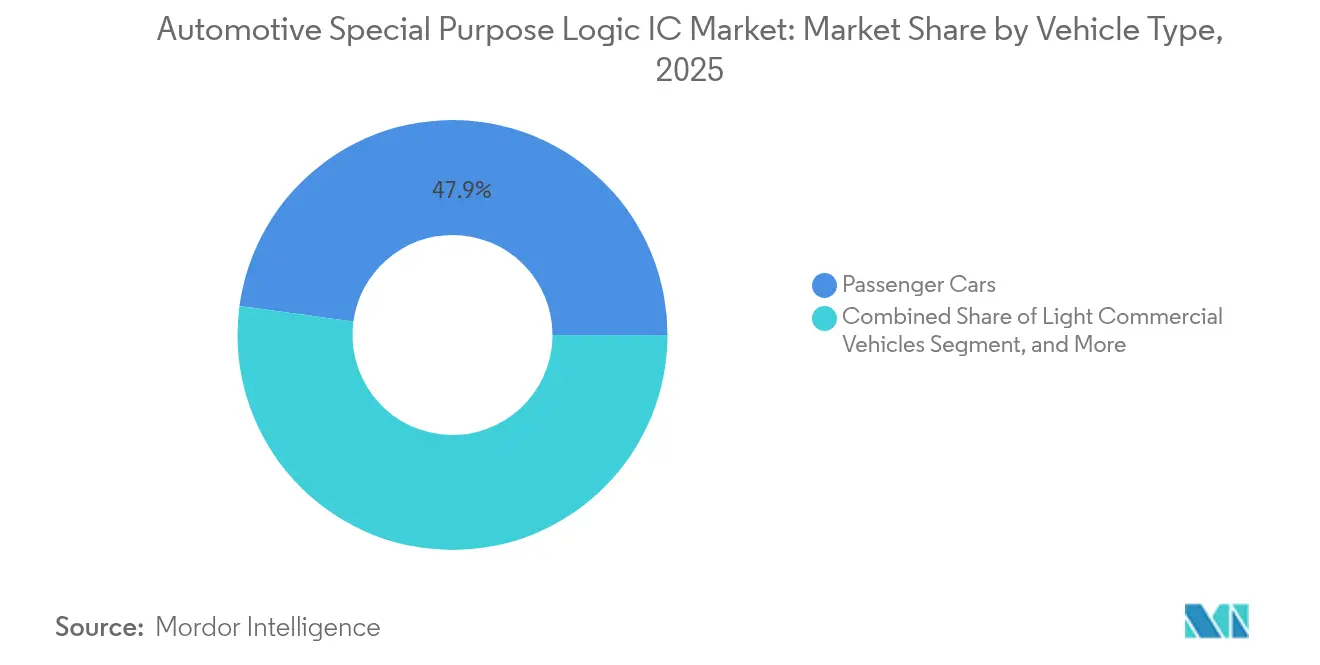
EVs elevate silicon valuePassenger cars retained a 47.85% share in 2025, driven by mainstream volume and incremental ADAS content. Electric vehicles rank as the volume underdog but the growth pacesetter, with a 3.95% CAGR, requiring every pack controller, thermal loop, and inverter to have isolation logic, an innovation unheard of in combustion platforms. Tesla’s in-house silicon epitomizes OEM verticalization, shrinking BOM variance while optimizing firmware cohesion. The automotive special-purpose logic IC market share, currently dominated by specialized EV subsystems, is projected to widen as Chinese brands leverage localized semiconductor ecosystems to reduce costs.
Light commercial vehicles are adopting ADAS and telematics more quickly than heavy trucks, benefiting from urban delivery electrification mandates. Heavy commercial vehicles demand ruggedized logic with 15-year lifespans, pushing suppliers to guarantee extended availability schedules, often at mature process nodes where reliability field data remain abundant.
By Packaging Technology:
SiP compresses form factorSiP led with 30.76% share in 2025, and its 3.74% CAGR underscores OEM appetite for footprint-constrained modules that meet AEC-Q100 without multiple component qualifications. Amkor’s latest automotive SiP cuts PCB area by half versus discrete assemblies and eases thermal routing in dense battery packs. The automotive special-purpose logic IC market size derived from SiP-centric designs will continue to rise as chiplet methodologies enable designers to mix critical IP blocks on known-good dies.
MCM approaches still dominate high-power traction inverters where heat dissipation rules out compact packages. Discrete packages linger in cost-pressured entry models and aftermarket retrofits, although even these segments are adopting higher pin-count QFN formats over older SOIC footprints.
Geography Analysis
APAC Automotive Special Purpose Logic IC Market
Asia-Pacific generated 32.05% of global revenue in 2025 and is on track for a 3.46% CAGR through 2031, lifted by China’s production scale exceeding 30 million vehicles, aggressive EV subsidies, and an expanding domestic fabless ecosystem. Japan adds engineering heft through Renesas and Rohm, exporting logic ICs that anchor global supply chains. South Korea supplies backend capacity yet skews toward memory; nevertheless, Samsung’s automotive foundry services attract Western OEM design wins.
North America Automotive Special Purpose Logic IC Market
North America ranks second, buoyed by stringent Federal Motor Vehicle Safety Standards and consumer appetite for premium ADAS packages. The USMCA framework incentivizes localized semiconductor sourcing, and CHIPS Act subsidies funnel billions into 28 nm and 16 nm automotive capacity, though tangible wafer starts lag until the late-decade horizon. Tesla’s Austin Gigafactory drives demand for traction inverter logic and high-voltage gate drivers, which are sourced partly from domestic suppliers.
Europe Automotive Special Purpose Logic IC Market
Europe remains a technology crucible led by Germany’s luxury brands. Tight CO₂ norms and the Green Deal are accelerating EV sales, thereby bolstering demand for battery-management logic ICs and high-efficiency power electronics. Supply resilience challenges surface as Brexit complicates cross-channel component flows; however, continental OEMs diversify wafer sources through joint ventures with STMicroelectronics, NXP, and GlobalFoundries to lock mature-node output.

Regulatory Landscape
Automotive special-purpose logic IC demand is shaped by safety, cybersecurity, and software-update requirements that increase silicon content and raise qualification thresholds. ISO 26262 functional safety (including ISO 26262-11 for semiconductors) sets the basis for ASIL-driven design and verification, while ISO/SAE 21434 cybersecurity engineering connects product-development and incident-response processes across the vehicle lifecycle.
At the vehicle approval layer, UNECE WP.29 regulations R155 (Cybersecurity Management System) and R156 (Software Update Management System) push OEMs and suppliers to deploy auditable controls for type approval. That requirement encourages logic IC vendors to embed secure boot, hardware security monitors, and update-safe architectures in domain and zonal controllers. Industrial policy also affects supply localization and resiliency planning, and the EU Chips Act (EUR 43 billion program envelope) is cited by stakeholders as a lever to expand semiconductor capability relevant to automotive-grade devices.
Value Chain Analysis
The value chain runs from EDA and IP enablement to semiconductor design and wafer fabrication, often on mature 28/16 nm automotive-qualified nodes, then moves through assembly and test. In the next step, Tier 1 integrators incorporate these devices into ECUs and emerging zonal controllers. Suppliers such as Infineon, NXP, Renesas, STMicroelectronics, and Texas Instruments typically anchor long platform commitments with Tier 1s, where AEC-Q qualification and ISO 26262 compliance support long change-control cycles and extended revenue tails for proven device families.
Manufacturing and supply resilience are also decisive. Foundry reliance is material for many automotive logic and MCU-class devices, and TSMC is frequently referenced in automotive-grade flows, while some players retain more internal fabrication capacity, such as Renesas. As electrification expands, constraints in the ecosystem also shift toward specialized packaging and assembly capabilities, including advanced interconnect and high-reliability processes. That increases the strategic importance of OSAT capacity and automotive-qualified back-end lines alongside front-end wafer supply.
Competitive Landscape
The market is moderately consolidated, with the top players leveraging decades-long OEM relationships and extensive AEC-Q portfolios. Infineon’s USD 3.2 billion acquisition of GaN Systems in October 2024 strengthens its high-voltage logic and power stack for 800V EV drives. NXP’s USD 2.8 billion capacity expansion in Texas and Arizona, announced in September 2024, secures domestic automotive wafer supply amid foundry tightness.
Renesas released its R-Car Gen4 SoC in August 2024, combining logic, AI acceleration, and network security on a single chip to support Level 3 autonomy compute loads. STMicroelectronics and CATL formed a joint venture in July 2024, targeting battery-management logic, which ensures captive demand from China’s dominant pack supplier. Nvidia, Qualcomm, and Intel intensify competitive pressure by converging traditional logic IC, GPU, and connectivity IP into unified automotive compute platforms, as evidenced by Qualcomm’s Snapdragon Ride Flex debut in June 2024. Patent filings for automotive logic ICs increased 40% year-over-year, signaling a crowded IP landscape where niche innovators can differentiate themselves through ASIL-B/C optimizations or ultra-low-leakage processes for battery management.
Automotive Special Purpose Logic IC Industry Leaders
-
Infineon Technologies AG
-
NXP Semiconductors N.V.
-
Renesas Electronics Corporation
-
STMicroelectronics N.V.
-
Texas Instruments Incorporated
- *Disclaimer: Major Players sorted in no particular order
Automotive Special Purpose Logic IC Market Companies Covered in this Report
- Infineon Technologies AG
- NXP Semiconductors N.V.
- Renesas Electronics Corporation
- STMicroelectronics N.V.
- Texas Instruments Incorporated
- Analog Devices, Inc.
- Qualcomm Incorporated
- Broadcom Inc.
- NVidia Corporation
- Marvell Technology, Inc.
- Intel Corporation
- ON Semiconductor Corporation
- Microchip Technology Inc.
- Rohm Co., Ltd.
- Lattice Semiconductor Corporation
- MediaTek Inc.
- Toshiba Electronic Devices & Storage Corporation
- Skyworks Solutions, Inc.
- Socionext Inc.
- Himax Technologies, Inc.
- Synaptics Incorporated
- HiSilicon Technologies Co., Ltd.
- Achronix Semiconductor Corporation
Read Analysis of Automotive Special Purpose Logic IC Companies

Market Opportunities and Future Outlook
White-space is opening for highly integrated, safety-compliant power-and-networking companion logic in zonal and centralized E/E architectures, particularly where OEMs are consolidating ECUs and tightening latency and functional safety targets. System basis chips (SBCs) and integration points around power management, networking interfaces, and safety monitors for domain controllers stand out as a near-term commercialization lane. Observable supply friction supports this, with SBC-related device lead times cited at 38+ weeks in June 2026, pointing to unmet demand and prioritization by OEMs and Tier 1s.
Supply-chain and cost dynamics also create room for suppliers that can secure automotive-grade capacity at mature nodes while providing integration that reduces qualification burden. Mid-2026 repricing actions referenced across major automotive semiconductor vendors, including NXP, ST, TI, Infineon, and Renesas, indicate a premium for qualified capacity, long-life support, and validated reliability. In parallel, software-defined vehicle and centralized compute architectures increase demand for logic ICs with embedded cybersecurity features aligned to UNECE R155/R156 workflows and ISO/SAE 21434, favoring vendors that can provide auditable security and update-safe hardware foundations alongside functional safety evidence.
Recent Industry Developments in Automotive Special Purpose Logic IC Market
- July 2026: Micron strengthens automotive ecosystem through strategic customer agreements with major Tier 1s including Qualcomm, Visteon, HARMAN, JOYNEXT, DENSO, Astemo, and Hyundai Mobis to secure long-term memory supply. Secure long-term memory supply for automotive ADAS and in-cabin computing, reinforcing memory resilience amid AI data demands and evolving vehicle architectures.
- July 2026: Micron and Ford sign strategic agreement to secure memory/storage supply for next-generation vehicle production, supported by capacity expansion at Manassas fab. Assures memory/storage provisioning for Ford’s next-gen platforms, solidifying Micron as a memory backbone for Ford’s software-defined vehicle push.
- July 2026: Micron and General Motors sign strategic agreement to provide LPDRAM, NOR, and UFS NAND memory for AI-enabled in-cabin and ADAS systems. Memory platforms for GM’s AI-enabled cockpit/ADAS roadmap, enhancing GM’s data-centric compute capabilities with secure memory supply.


Automotive Special Purpose Logic IC Market Report Scope and Research Methodology
Market Definition and Coverage
This market covers revenue from special purpose logic integrated circuits used in vehicles, where the device is designed for a defined automotive function and sold into OEM and tiered supply chains for in-vehicle electronics.
Scope exclusions: We exclude commodity general purpose logic sold for non-automotive end uses. We also exclude discrete analog, sensors, memory, and power devices even when shipped into vehicles.
Segments Covered in This Report
-
By Logic IC Type
- Application-Specific Standard Products (ASSP)
- Application-Specific Integrated Circuits (ASIC)
- Field-Programmable Gate Arrays (FPGA)
- Complex Programmable Logic Devices (CPLD)
-
By Application
- Advanced Driver-Assistance Systems (ADAS)
- Infotainment and Connectivity
- Powertrain and Battery Management
- Body Electronics and Comfort
- Safety and Security Systems
-
By Vehicle Type
- Passenger Cars
- Light Commercial Vehicles
- Heavy Commercial Vehicles
- Electric Vehicles (BEV, PHEV, FCEV)
-
By Packaging Technology
- System-in-Package (SiP)
- Multi-Chip Module (MCM)
- Discrete IC Package
-
By Geography
-
North America
- United States
- Canada
- Mexico
-
South America
- Brazil
- Argentina
- Rest of South America
-
Europe
- Germany
- United Kingdom
- France
- Italy
- Spain
- Russia
- Rest of Europe
-
Asia-Pacific
- China
- Japan
- India
- South Korea
- South-East Asia
- Rest of Asia-Pacific
-
Middle East and Africa
-
Middle East
- Saudi Arabia
- United Arab Emirates
- Rest of Middle East
-
Africa
- South Africa
- Egypt
- Rest of Africa
-
Middle East
-
North America
Data Sources, Market Sizing, and Validation
Desk Research
Desk work starts with mapping the demand pool and the rules that make a logic IC automotive-grade, then tying that back to vehicle electronics content. We rely on public sources such as OICA vehicle production data and IEA electrification statistics, plus NHTSA and UNECE safety regulation references, and trade data portals such as UN Comtrade to understand shipment direction and mix shifts.
We also review company filings, earnings decks, and reputable press coverage to understand product positioning, capacity commentary, and pricing direction on mature nodes. On top of that, we use paid subscriptions for company financials and intelligence, patent databases, and shipment-level import and export records to cross-check whether unit trends align with the story from public indicators. These desk sources are illustrative and not exhaustive, and many other references were consulted for data collection, validation, and clarification.
Primary Interviews and Surveys
Primary work is used to confirm what counts as special purpose logic in real purchasing, and to sanity-check unit volumes, ASP movement, and design cycle timing. We speak with semiconductor teams, automotive electronics stakeholders, and channel-facing experts across APAC, EMEA, and the Americas so assumptions can be checked against how programs are awarded and how parts are qualified.
Distribution of primary research fieldwork respondents
| Company type | Respondent position | Region |
|---|---|---|
| Top tier: 31% | CXOs: 16% | APAC: 41% |
| Mid tier: 53% | Functional/Unit leaders: 24% | EMEA: 34% |
| Smaller Players: 16% | Managers: 60% | Americas: 25% |
Market-Sizing & Forecasting
Sizing is built using a top-down and bottom-up approach, where vehicle production by region is reconstructed into an addressable electronics demand pool. We then filter that pool by the penetration of key applications that use special purpose logic. Category-level ASP ranges are applied to estimated unit needs to arrive at revenue, and we cross-check totals with selective bottom-up approximations such as sampled device pricing times implied volumes. Where coverage is available, we also use supplier and channel checks.
Inputs that materially move the model include light vehicle and commercial vehicle output, the take-rate of ADAS and connectivity features, electrified powertrain share that changes control content, packaging mix shifts toward SiP and similar integration styles, and automotive qualification lead times that delay revenue recognition into SOP years. Where the bottom-up view is thin for smaller suppliers, gaps are handled through share bands informed by interviews and by triangulating shipment direction and public financial disclosures.
Forecasting uses scenario analysis anchored on vehicle production outlooks and feature penetration. We then smooth ASP progression to reflect node maturity and cost-down patterns. Assumptions are reviewed with primary respondents so the forward view stays aligned with platform cadence and program award visibility.
Data Validation & Update Cycle
Validation is done through multiple checks, including comparing the model output to independent signals such as automotive semiconductor content trends, trade flow direction, and regional production swings. When large variances appear, we review driver assumptions, re-check the math, and then re-contact relevant experts if the issue points to a scope or pricing misunderstanding.
The work is reviewed in steps by analysts before sign-off so inconsistencies are removed early and late-stage edits are limited. Reports refresh annually, and interim updates are made when material events affect demand, supply, or pricing. Before delivery, an analyst performs a fresh pass so clients receive the latest updated view.
Mordor Intelligence's Automotive Special Purpose Logic Ic Market Size Compared Against Other Published Estimates
Published market sizes for automotive special purpose logic ICs often vary because each publisher draws the line differently on what is counted. Pricing and vehicle content assumptions are not always stated clearly, which adds another layer of uncertainty. Differences in base year selection and currency timing also add noise, even when publishers follow a similar growth narrative.
Key gaps usually come from whether adjacent logic categories are blended in, how the model treats internal transfers versus external merchant sales, and how quickly ASPs are assumed to decline on mature process nodes. Another common issue is forecast stance, where some figures reflect an aggressive ramp in ADAS penetration without checking qualification lead times and platform cycles.
Benchmark comparison
| Source | Market Size | Gaps in Research Methodology |
|---|---|---|
| Mordor Intelligence | USD 3.72 B (2026) | |
| Industry Research Desk A | USD 6.20 B (2024) | Uses a wider logic IC bucket and an earlier base year, and it appears to mix in broader automotive logic revenue that is not limited to special purpose devices, which inflates the total. |
| Global Consultancy B | USD 9.59 B (2025) | Looks closer to an automotive logic IC total, and the uplift is consistent with counting general purpose logic and related IC content per vehicle with higher assumed ASPs and faster feature ramp. |
The table shows a wide spread that mainly traces back to category boundaries. In Mordor Intelligence's model, revenue is counted only for special purpose logic ICs sold into defined automotive applications, and totals are cross-checked using vehicle production, ADAS and electrification take-rates, and packaging mix signals so broader automotive logic categories are not double-counted.


Key Questions Answered in the Report
What is the 2026 valuation for automotive special-purpose logic ICs?
The market is valued at USD 3.72 billion in 2026.
What compound annual growth rate is projected through 2031?
A 3.39% CAGR is forecast between 2026 and 2031.
Which end-use application is expanding fastest?
Advanced driver-assistance systems generate the strongest momentum, advancing at a 3.88% CAGR.
Why do automakers still favor ASIC-based solutions?
ASICs balance high-volume cost efficiency with functional-safety tailoring, making them a practical choice despite lower flexibility than FPGAs.
How does System-in-Package technology help vehicle electronics programs?
SiP consolidates multiple dies in one footprint, trimming board area by as much as 50% while meeting AEC-Q100 reliability targets.
Which geographic region shows the quickest demand expansion?
Asia-Pacific leads growth at a 3.46% CAGR thanks to China's electric-vehicle output and a robust local semiconductor supply chain.
Page last updated on:





