
Automotive MCU Market Size and Share
Market Overview
| Study Period | 2020 - 2031 |
|---|---|
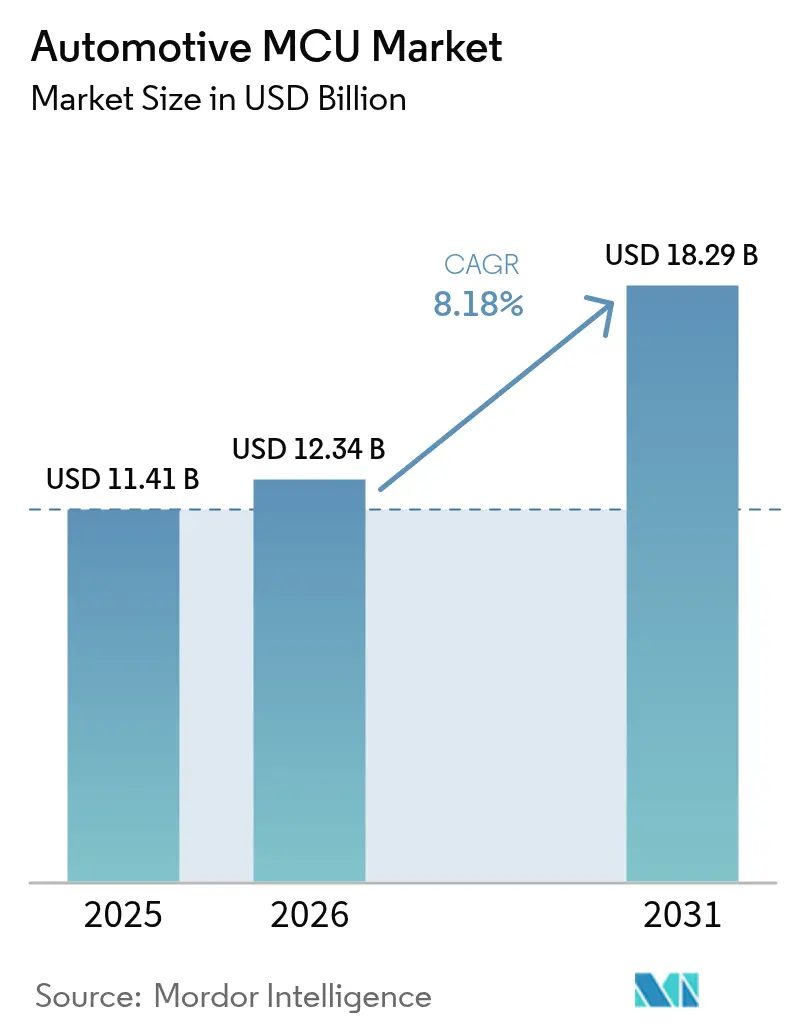
| Market Size (2026) | USD 12.34 Billion |
| Market Size (2031) | USD 18.29 Billion |
| Growth Rate (2026 - 2031) | 8.18 % |
| Fastest Growing Market | Asia Pacific |
| Largest Market | North America |
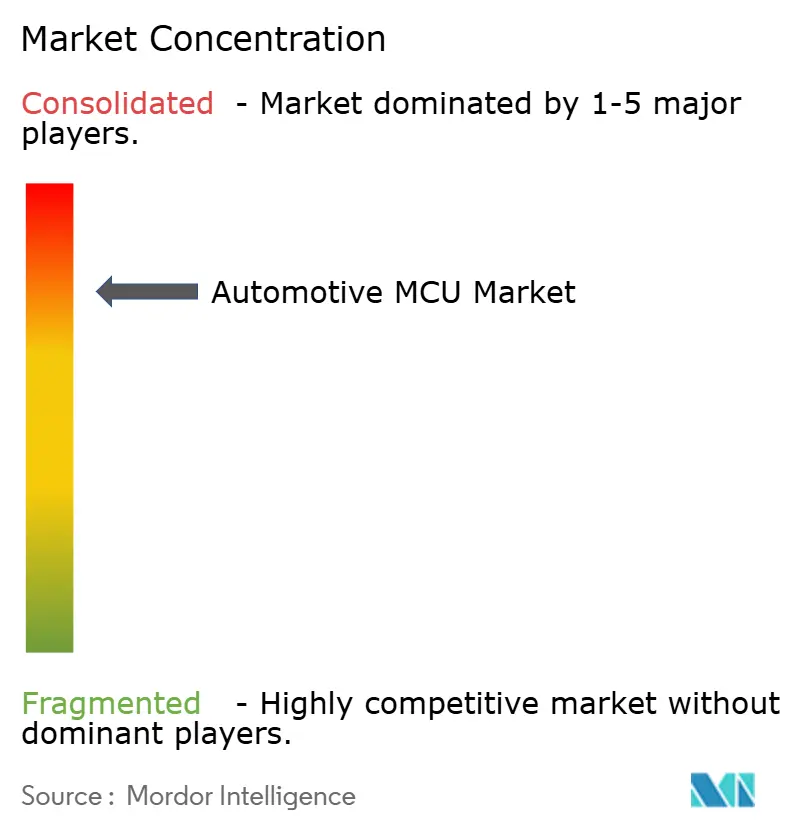
| Market Concentration | High |
Major Players *Disclaimer: Major Players sorted in no particular order Image © Mordor Intelligence. Reuse requires attribution under CC BY 4.0. | |
Automotive MCU Market Analysis by Mordor Intelligence
The automotive MCU market size was valued at USD 11.41 billion in 2025 and estimated to grow from USD 12.34 billion in 2026 to reach USD 18.29 billion by 2031, at a CAGR of 8.18% during the forecast period (2026-2031). Rising electric-vehicle (EV) penetration, the migration to zonal electronic/electrical (E/E) architectures, and tighter cybersecurity rules are the primary forces expanding automotive microcontroller content per vehicle. Modern platforms integrate more than 100 controllers versus fewer than 10 in legacy models. Higher-performance 32-bit devices, advanced ≤16 nm FinFET process technologies, and Cortex-R/A-class real-time cores lead the shift to software-defined vehicles and over-the-air (OTA) upgrades that demand low-latency, deterministic processing. Competitive activity centers on RISC-V adoption, security-hardened designs, and geographic supply-chain diversification to satisfy localization requirements and mitigate geopolitical risk. These trends collectively keep the automotive MCU market on a strong growth trajectory through the decade.
Key Report Takeaways
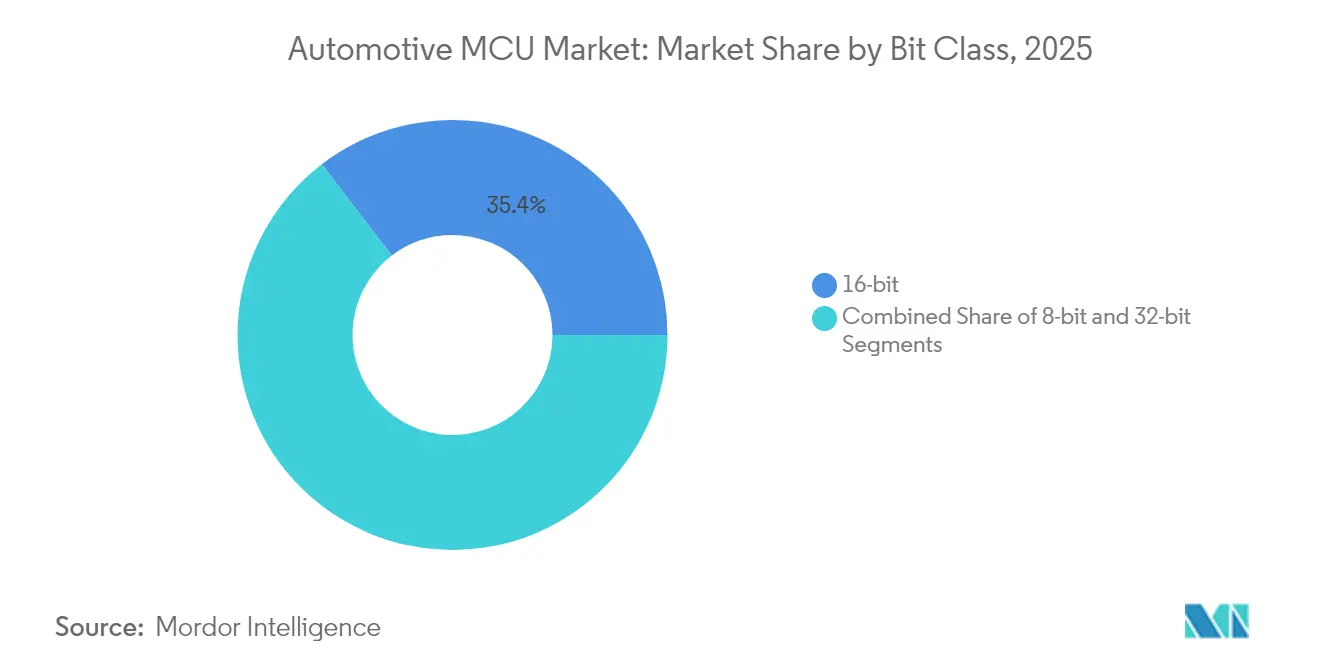
- By bit class, 32-bit devices lead expansion with an 11.2% CAGR through 2031, while 16-bit controllers retained a 35.40% revenue share of the automotive MCU market in 2025.
- By application, safety and ADAS captured 13.6% CAGR, the fastest among segments; powertrain and chassis held 25.60% of the automotive MCU market share in 2025.
- By vehicle propulsion, battery electric vehicles contributed the quickest rise at 13.10% CAGR; commercial ICE maintained a 27.80% slice of the automotive MCU market size in 2025.
- By process node, ≤16 nm FinFET devices posted a 11.9% CAGR, whereas 40-22 nm nodes commanded a 22.10% revenue share in 2025.
- By core architecture, ARM Cortex-R/A solutions accelerated at 15.0% CAGR; RISC-V held 8.35% of 2025 revenue but is growing swiftly.
- Regionally, Asia-Pacific shows the highest 13.2% CAGR, yet North America held a 18.80% share in 2025.
- The five largest suppliers controlled 81.5% of global revenue; Infineon led with 28.5%.
Note: Market size and forecast figures in this report are generated using Mordor Intelligence’s proprietary estimation framework, updated with the latest available data and insights as of 2026.
Market Trends and Insights
Drivers Impact Analysis of Automotive MCU Market*
| Driver | (~) % Impact on CAGR Forecast | Geographic Relevance | Impact Timeline |
|---|---|---|---|
| Electrification and xEV penetration surge | 2.10% | Global, with APAC and EU leading adoption | Medium term (2-4 years) |
| Growing ADAS and autonomous feature content | 1.80% | North America and EU regulatory push, APAC volume growth | Long term (≥ 4 years) |
| Software-defined vehicle and OTA architecture | 1.40% | Global, with early adoption in premium segments | Long term (≥ 4 years) |
| Cyber-security regulation-driven refresh cycles | 0.90% | EU and North America compliance-driven | Short term (≤ 2 years) |
| Zonal E/E architecture transition | 1.20% | Global, led by European OEMs | Medium term (2-4 years) |
| Localization incentives (CHIPS Acts, etc.) | 0.80% | National, with focus on US, EU, and China | Medium term (2-4 years) |
| Source: Mordor Intelligence | |||
Electrification and xEV Penetration Surge
Battery-electric cars need more than 300 controllers compared with 70 in ICE vehicles, quadrupling MCU unit demand. Thermal loads in 800 V traction systems drive designs rated for junctions beyond 150°C. NXP’s S32K39/37 controls six-phase motors at >200 kHz, illustrating the high-speed loops required. Moving to 48 V zonal backbones trims wiring mass by 85% and frees power budget for heating, ventilation, and battery-conditioning loops.
Growing ADAS and Autonomous Feature Content
Level 2 platforms already embed about USD 500 in semiconductors, an order of magnitude above basic vehicles. Progression to Level 4 autonomy mandates sensor-fusion, redundancy, and ASIL-D conformance. Texas Instruments’ AWRL6844 radar integrates edge AI in its MCU, processing in-cabin child-presence data in real time. Consolidating perception and control code on single MCUs accelerates the pivot from distributed to centralized compute.[2]European Commission, “Industrial Action Plan for the Automotive Sector,” ec.europa.eu
Software-Defined Vehicle and OTA Architecture
Frequent software updates favour embedded MRAM and fast erase/write cycles. NXP’s 16 nm S32K5 family writes firmware 15 × faster than flash while meeting ASIL-D targets. Zonal controllers manage multiple subsystems, reducing ECU count. Infineon and Flex demonstrated a modular zone platform that bundles Ethernet acceleration and AI inference for real-time adaptation.
Cyber-Security Regulation-Driven Refresh Cycles
UN R155 and ISO/SAE 21434 require certified cyber-security management from July 2024 onward. Hardware security modules and secure-boot roots now ship standard. Automotive cyber incidents generated USD 22.5 billion impact in 2024, reinforcing demand for trusted-execution MCUs. EU mandates add blockchain-based authentication, increasing hardware refresh frequency.
Restraints Impact Analysis of Automotive MCU Market*
| Restraint | (~) % Impact on CAGR Forecast | Geographic Relevance | Impact Timeline |
|---|---|---|---|
| Lengthy functional-safety qualification cycles | -1.30% | Global, with stricter EU requirements | Long term (≥ 4 years) |
| Persistent 150mm foundry capacity bottlenecks | -0.80% | Global, with Asia-Pacific manufacturing concentration | Medium term (2-4 years) |
| Junction-temperature derating issues >150°C | -0.60% | Global, particularly in EV applications | Medium term (2-4 years) |
| Rising ISO 26262/21434 compliance costs | -0.90% | EU and North America primarily | Short term (≤ 2 years) |
| Source: Mordor Intelligence | |||
Lengthy Functional-Safety Qualification Cycles
Achieving ASIL-D certification stretches 18-24 months, delaying innovation. Mixed-critical workloads need hardware partitioning and formal proofs, inflating cost and schedule risk.
Persistent 150 mm Foundry Capacity Bottlenecks
More than 75% of automotive controllers still run on ≥28 nm nodes. Mature-node expansion is limited to roughly 7% in 2025, exposing OEMs to supply shocks and geopolitical exposure concentrated in Taiwan and South Korea fabs.
*Our forecasts treat driver/restraint impacts as directional, not additive. The impact forecasts reflect baseline growth, mix effects, and variable interactions.
Automotive MCU Market Segment Analysis
By Bit Class:
Higher-End 32-Bit Solutions Take ShareThe 16-bit segment maintained 35.40% revenue in 2025, mainly in body electronics. In contrast, 32-bit devices recorded an 11.2% CAGR, riding ADAS demand and software-defined-vehicle workloads. ARM Cortex-R5 dominates safety-critical roles, while Infineon’s TriCore excels in powertrain. The automotive MCU market size for 32-bit controllers is forecast to expand to USD 10.62 billion by 2031. Heterogeneous computing that blends control and AI neural processing widens the gap with 16-bit devices. 8-bit MCUs linger in low-speed sensor interfaces yet see declining share as integration rises.
Extended peripherals, deterministic latency, and hardware firewalls keep 32-bit parts preferable for ASIL-D systems. Infineon’s latest AURIX-3 devices deliver triple-core lockstep and 1,500 DMIPS per watt, underscoring the efficiency imperative. The automotive MCU market increasingly treats 16-bit as cost bins, while premium tiers pursue 32-bit for advanced cryptography and Ethernet TSN support.



By Application:
Safety and ADAS Lead GrowthSafety and ADAS logged a 13.6% CAGR between 2026-2031, climbing on mandatory automated-brake and lane-keep assist regulations. Powertrain and chassis still hold the largest revenue due to universal fitment. The automotive MCU market share for powertrain remained 25.60% in 2025, yet its growth moderates as electrification shifts spend to battery-management units.
Software stacks now blur application lines; predictive maintenance RUNs on powertrain MCUs, while infotainment MCUs host speech AI. Texas Instruments’ AM275x-Q1 merges graphics rendering and driver-monitoring neural nets, evidencing cross-domain convergence. Edge-learning reduces cloud traffic and ensures privacy compliance in regions tightening data-sovereignty laws.
By Vehicle Propulsion Type:
EVs Command MomentumCommercial ICE fleets still led 27.80% of 2025 revenue. Electrified platforms, however, accelerate; battery-electric cars chart a 13.10% CAGR through 2031. The automotive MCU market size for BEV controllers is projected to more than triple, boosted by 800 V inverters and bi-directional charging controls. Hybrid systems require dual-domain MCUs orchestrating combustion and electric loops, translating to complex safety partitions.
MCUs for EVs must tolerate higher dv/dt spikes and integrate galvanic isolation to satisfy IEC 60747-17. Renesas’ RH850/C1M-Ax supports dual traction inverters and synchronous boost converters, highlighting the specialized demands of propulsion electrics.
By Process-Node Technology:
FinFET Adoption Rises40-22 nm nodes kept 22.10% of revenue in 2025, balancing cost and reliability. Yet ≤16 nm FinFET designs show a 11.9% CAGR, fuelled by AI-enabled zonal controllers. The automotive MCU market size linked to ≤16 nm is set to reach USD 5.29 billion by 2031. Radiation robustness and qualification costs slow adoption, but FinFET’s lower leakage aligns with EV power-budget constraints.
Meanwhile, ≥180 nm lines serve cost-sensitive body-control functions but lose share as consolidation intensifies. Automotive qualification lags consumer by 3-5 years; thus, leading-edge 5 nm nodes remain rare in automotive microcontrollers until strict zero-defect reliability proof emerges.

By Core Architecture:
RISC-V Emerges as ChallengerARM Cortex-R/A shipments grow 15.0% CAGR on real-time AI workloads in fail-operational systems. RISC-V commands 8.35% of 2025 revenue yet is scaling near 28% annually as OEMs chase royalty freedom. Infineon’s March 2025 RISC-V MCU family signals mainstream validation, supported by virtual prototypes that shorten time-to-merge for AUTOSAR stacks. Proprietary cores persist in niche torque-control loops where cycle-accurate legacy code is entrenched.
Customization potential lets suppliers tailor RISC-V instruction extensions for battery analytics or radar-fast-chirp loops, improving per-watt performance. The automotive MCU market could see RISC-V double share by 2028 if tool-chain maturity holds pace.
Geography Analysis
North America Automotive MCU Market
North America held 18.80% of revenue in 2025, propelled by autonomous-vehicle pilot zones and the CHIPS Act that subsidizes domestic fabs. Microchip’s USD 880 million Colorado silicon-carbide expansion secures local supply for EV traction inverters. Mexico’s cost-based assembly plants complement U.S. design hubs, while Canada benefits from zero-emission purchase incentives.
APAC Automotive MCU Market
Asia-Pacific is the fastest-rising region with a 13.2% CAGR. China’s 25% domestic-chip-content mandate for 2025 energizes local MCU startups and joint ventures; VisionPower Semiconductor’s USD 7.8 billion 300 mm fab in Singapore underpins mixed-signal automotive output. Japan’s Renesas reported 50% year-on-year automotive growth in 2024, while South Korea leverages battery-cell expertise to embed high-density controllers into pack-management systems. India represents a nascent but strategic opportunity as production volumes climb and import duties favour localized sourcing.
Europe Automotive MCU Market
Europe’s path to 65% EV penetration by 2030 necessitates heavier MCU content per car. The Industrial Action Plan announced March 2025 directs funds toward digitalization and cybersecurity, compelling OEMs to adopt ISO 21434-compliant controllers. Germany’s cost gap versus Chinese rivals pushes automation and software-centric designs that prioritize zonal compute. The EU Chips Act aims for 20% global semiconductor output by 2030, but cross-border coordination remains a headwind. Strict UN R155 enforcement across member states accelerates hardware security adoption.


Regulatory Landscape
Cybersecurity and software governance are tightening the compliance baseline for automotive MCUs, anchored by UNECE WP.29 requirements such as UN R155 and ISO/SAE 21434, which OEMs and suppliers use to structure security processes and technical controls across ECU lifecycles. These requirements are translating into hardware-level mandates in MCU designs, including secure boot, hardware security modules, and audit-ready cybersecurity work products, and they are being operationalized through supplier programs such as Infineon commencing ISO/SAE 21434 compliance for its TRAVEO T2G and AURIX TC3x MCU families in March 2026.
Trade and national-security policies are also affecting sourcing and design-in decisions for automotive electronics sold into major markets. In the United States, a BIS connected-vehicle rule finalized in March 2025 restricts certain connected vehicle transactions involving hardware and software with a sufficient nexus to China or Russia, increasing due-diligence and substitution needs for electronic control components. Separately, a US action effective January 15, 2026 applied a 25% ad valorem duty on imports of covered semiconductor products, adding cost and supplier-mix pressure for automotive-grade components and reinforcing the business case for regionalized manufacturing footprints.
Value Chain Analysis
The automotive MCU value chain runs from IP and EDA through wafer fabrication (foundry or IDM), assembly and test, automotive-grade qualification, and distribution into Tier 1 suppliers and OEMs for ECU and zonal/domain controller integration. Market supply is highly concentrated at the device level, with leading vendors (Renesas, NXP, Infineon, Texas Instruments, and Microchip) controlling most 32-bit automotive MCU volume, while production still relies heavily on mature nodes (around 40 nm and above) that compete for constrained capacity. Qualification and long-life support obligations extend cycle times and increase the importance of stable wafer starts, packaging allocation, and robust quality management across the chain.
Supply-chain diversification and localization are increasingly visible in manufacturing and packaging partnerships. In July 2025, Tata Electronics and Robert Bosch GmbH signed an MoU to collaborate on chip packaging and manufacturing at Tata Electronics units in Assam and Gujarat, reflecting efforts to build local capability for automotive electronics supply. India also saw a December 2025 partnership between Tata Electronics and ROHM focused initially on assembly and testing of automotive-grade silicon MOSFETs for electric mobility, highlighting how OSAT and test capacity are becoming strategic levers alongside wafer supply for automotive semiconductors.
Competitive Landscape
Market concentration is moderate: the top five vendors captured 81.5% of 2024 revenue, fostering high entry barriers but vigorous rivalry on feature integration. Infineon, with 28.5% share, leverages its AURIX tri-core safety heritage and the USD 2.5 billion Marvell Automotive Ethernet acquisition to fuse networking and compute for software-defined vehicles. NXP follows with a scalable S32 platform strategy that pairs MRAM flash with dedicated AI accelerators, easing OTA updates. STMicroelectronics differentiates through embedded Phase-Change Memory (PCM) and analog-front-end co-integration.
Microchip and Renesas round out the top five, emphasizing long-term supply commitments and functional-safety tool chains. RISC-V opens disruptive paths for China-based entrants aligned with localization policies. Yet the stringent 15-year product-support expectations and ISO certification overhead temper fast upheaval. White-space prospects include vehicle-to-grid bidirectional charging controllers, in-vehicle payment security MCUs, and AI-enhanced power-domain zonal hubs.
Supplier diversification gains urgency as OEMs hedges geopolitical exposure. Infineon, NXP, and ST are expanding European and U.S. front-end capacity, while foundry collaborations (e.g., VIS-NXP’s Singapore JV) pursue balanced global footprints. These moves aim to guarantee controller availability after the 2021-2023 shortage disrupted production plans worldwide.[4]Microchip Technology, “Microchip Expands Colorado SiC Manufacturing,” microchip.com
Automotive MCU Industry Leaders
Renesas Electronics Corporation
NXP Semiconductors N.V.
Infineon Technologies AG
STMicroelectronics N.V.
Texas Instruments Incorporated
- *Disclaimer: Major Players sorted in no particular order
Automotive MCU Market Companies Covered in this Report
- Infineon Technologies AG
- Microchip Technology Inc.
- NXP Semiconductors N.V.
- Renesas Electronics Corporation
- STMicroelectronics N.V.
- Texas Instruments Incorporated
- Toshiba Electronic Devices and Storage Corporation
- Analog Devices, Inc.
- ROHM Semiconductor Co., Ltd.
- Broadcom Inc.
- ON Semiconductor Corp.
- Qualcomm Technologies, Inc.

Market Opportunities and Future Outlook
A whitespace is emerging around cybersecurity-hardened and crypto-agile automotive MCUs as OEMs refresh architectures to meet UNECE cybersecurity requirements and ISO/SAE 21434-aligned development evidence. In March 2026, Infineon highlighted Post-Quantum Cryptography enablement in AURIX TC49 and introduced ISO/SAE 21434 compliance activity across key MCU families, while Renesas expanded its RH850 lineup in March 2026 with the 28 nm RH850/U2C, emphasizing ISO/SAE 21434 alignment and PQC support. Together, standards-driven requirements and new silicon with integrated security capabilities support design-ins for secure OTA, gateway/zonal controllers, and safety-related control systems where secure boot and hardened update paths are procurement checkboxes.
Another opportunity area sits at the intersection of software-defined vehicles and open architectures, where alignment on standards can reduce toolchain friction and enable multi-sourcing strategies. Quintauris, backed by Infineon, Bosch, NXP Semiconductors, Nordic Semiconductor, Qualcomm, and STMicroelectronics, is coordinating industry standardization for automotive RISC-V, and Infineon has communicated plans to integrate RISC-V cores into its automotive MCU lineup alongside existing AURIX offerings. In manufacturing, diversification programs are translating into new capacity and regional footprints, including Bosch commencing sample production at its Roseville, California semiconductor facility tied to a USD 2 billion investment, and Infineon opening a 5 billion euro Smart Power Fab in Dresden in July 2026. While these are not MCU-only assets, they support broader automotive semiconductor supply that underpins adjacent mixed-signal and power/control ecosystems used in zonal and electrified platforms.
Recent Industry Developments in Automotive MCU Market
- July 2026: Infineon opened its 5 billion euro Smart Power Fab in Dresden, Germany, expanding 300 mm manufacturing capacity for power and analog/mixed-signal semiconductors used in automotive platforms. The added capacity supports higher levels of integration across vehicle electrification and zonal E/E architectures where mixed-signal and power-control content rises. It also reinforces regional supply-chain diversification for automotive semiconductor sourcing.
- March 2026: Renesas launched the 28 nm RH850/U2C automotive MCU for vehicle control and safety applications, emphasizing cybersecurity engineering alignment including ISO/SAE 21434 and readiness features such as PQC support. The release targets domain and zonal consolidation trends that demand more compute and security in control-class MCUs. It strengthens Renesas positioning in safety-focused designs where qualification and security artifacts influence platform selection.
- April 2025: Infineon announced the purchase of Marvell's Automotive Ethernet business for USD 2.5 billion, adding Ethernet portfolio depth alongside its AURIX MCU franchise. The combination improves the ability to pair networking and real-time control for software-defined vehicle architectures that depend on high-bandwidth in-vehicle connectivity. It also increases competitive pressure on suppliers offering integrated MCU plus networking roadmaps for zonal controllers.


Automotive MCU Market Report Scope and Research Methodology
Market Definition and Coverage
This market covers the revenue generated from automotive-grade microcontroller units used inside vehicles to sense, control, and communicate across key electronic functions, counted at the point they are supplied into automotive applications globally.
Scope exclusions: We exclude non-automotive MCUs and adjacent automotive semiconductors such as sensors, power discretes, and standalone processors that are not sold as MCUs.
Segments Covered in This Report
- By Bit Class
- 8-bit
- 16-bit
- 32-bit
- By Application
- Powertrain and Chassis
- Safety and ADAS
- Body and Comfort Electronics
- Telematics and Infotainment
- By Vehicle Propulsion Type
- Passenger ICE
- Commercial ICE
- Battery Electric Vehicle (BEV)
- Hybrid Electric Vehicle (HEV)
- Plug-in Hybrid (PHEV)
- Fuel-Cell Electric Vehicle (FCEV)
- By Process-Node Technology
- ≥180 nm
- 90–65 nm
- 40–22 nm
- ≤16 nm (FinFET)
- By Core Architecture
- ARM Cortex-M
- ARM Cortex-R/A
- Proprietary 16/32-bit
- RISC-V
- By Geography
- North America
- United States
- Canada
- Mexico
- Europe
- United Kingdom
- Germany
- France
- Italy
- Rest of Europe
- Asia-Pacific
- China
- Japan
- India
- South Korea
- Rest of Asia-Pacific
- Middle East
- Israel
- Saudi Arabia
- United Arab Emirates
- Turkey
- Rest of Middle East
- Africa
- South Africa
- Egypt
- Rest of Africa
- South America
- Brazil
- Argentina
- Rest of South America
- North America
Data Sources, Market Sizing, and Validation
Desk Research
Desk research starts with building the demand and supply context that explains why automotive MCU shipments and pricing move. We reference public vehicle production and registration data (such as OICA and national transport agencies), trade and customs statistics for semiconductors (such as UN Comtrade), and macro indicators from sources like the World Bank and IMF to keep regional cycles consistent.
To anchor the technology and the content-per-vehicle shift, we also review safety and vehicle electronics standards and recall signals (such as NHTSA and UNECE), plus technical papers published through IEEE. Company annual reports, earnings decks, and credible press releases are then used to map capacity additions, qualification timelines, and product-mix shifts. In a few spots, paid subscriptions for company financials, patents, and shipment-level trade signals are used to cross-check inputs that are sensitive to directionality, such as ASP movement and node migration. These are illustrative sources, and many other public and proprietary references were also used for collection, validation, and clarification.
Primary Interviews and Surveys
Primary work focuses on validating the model inputs that desk sources do not consistently publish, especially MCU ASP ranges by bit class and application, typical sourcing patterns by vehicle platform, and how quickly shortages and lead times normalize. We spoke with a mix of component suppliers, vehicle electronics stakeholders, and channel participants across major producing and consuming regions, then used follow-up checks to confirm the final assumptions used in the forecast.
Distribution of primary research fieldwork respondents
| Company type | Respondent position | Region |
|---|---|---|
| Top tier: 29% | CXOs: 15% | APAC: 41% |
| Mid tier: 55% | Functional/Unit leaders: 32% | EMEA: 37% |
| Smaller Players: 16% | Managers: 53% | Americas: 22% |
Market-Sizing & Forecasting
Sizing begins with a top-down rebuild of automotive MCU demand by linking vehicle production to electronic content assumptions, where application penetration and MCU count per vehicle are mapped across powertrain and chassis, safety and security, body electronics, and telematics and infotainment. Into that structure, we layer practical pricing logic using bit class mix (8-bit, 16-bit, 32-bit), technology-node migration, and the share of advanced functions in new platforms, which helps explain why revenue can rise even when unit growth is steadier.
The totals are then corroborated with selective bottom-up checks using supplier revenue exposure, sampled ASP-by-application ranges, and channel feedback on allocation patterns. Where public disclosure is thin, we apply conservative ranges, then run a second-pass normalization to remove double counting across applications. For forecasting, we use scenario analysis around production cycles and electrification uptake, and we constrain those scenarios using primary views on lead-time normalization, typical annual ASP movement, and qualification timing for new designs.
Data Validation & Update Cycle
Validation happens in layers, where model outputs are compared with independent signals like vehicle build trends, trade flows, and reported semiconductor content commentary, before exceptions are investigated. When variances are large, we re-check assumptions such as regional mix, application penetration, and implied ASP, and then re-contact sources if the mismatch cannot be explained with public evidence.
Each report is refreshed annually, and interim updates are done when material events shift supply, demand, or pricing in a noticeable way. Before delivery, a final analyst pass is completed so the numbers and commentary reflect the latest available inputs and revisions.
Mordor Intelligence's Global Automotive Mcu Market Size Measured Against Other Published Estimates
Published market sizes for automotive MCUs can look far apart even when everyone is talking about the same industry direction, because the boundaries and timing choices are not always aligned. The main differences typically come from what is counted as an MCU versus nearby chips, which year is treated as the current base, and how ASP changes are carried through the forecast.
A refresh-led gap shows up often in this market, since vehicle production, lead times, and pricing moved quickly after supply shocks, and the currency conversion month can also swing the USD total. When ASP logic is updated using bit-mix shifts and node transitions, and then cross-checked back to application demand signals before publishing, the result is less sensitive to one-off price spikes, a discipline applied by Mordor Intelligence.
Benchmark comparison
| Source | Market Size | Gaps in Research Methodology |
|---|---|---|
| Mordor Intelligence | USD 12.34 B (2026) | |
| Trade Wire Service A | USD 14.32 B (2024) | Uses an earlier base year and a longer forecast window, and the public note does not clarify currency timing or whether shortage-era pricing and allocation effects were normalized in the starting value. |
| Newswire Summary B | USD 15.49 B (2025) | Appears to apply a broader interpretation that can pull in technology and application labels beyond a clean MCU revenue boundary, and the base-year ASP level may reflect different timing assumptions around pricing resets. |
The table suggests the spread is driven more by base-year timing and how ASP is carried forward than by a disagreement on long-term growth drivers. By keeping the scope tight to automotive-grade MCUs and forcing each year to reconcile with vehicle build, content, and pricing checks, the estimate stays traceable to inputs that can be reviewed and repeated.


Key Questions Answered in the Report
What is the current size of the automotive MCU market?
The automotive MCU market size is USD 12.34 billion in 2026 and is forecast to reach USD 18.29 billion by 2031.
Which application segment is growing fastest?
Safety and ADAS applications lead, expanding at a 13.6% CAGR as global regulations mandate advanced driver-assistance features.
Why are 32-bit MCUs gaining share over 16-bit devices?
Higher code complexity in EV powertrains and autonomous systems requires floating-point math, enhanced security, and AI acceleration only available in modern 32-bit architectures.
How will RISC-V influence the automotive MCU market?
RISC-V offers open-source flexibility and lower licensing costs, enabling custom instruction sets and fostering new entrants, which could double its market share by 2028.
Which region will contribute most to future growth?
Asia-Pacific shows the highest 13.2% CAGR, driven by China’s localization policies and rapid EV adoption across major Asian economies.
What are the main restraints limiting market expansion?
Lengthy ASIL-D safety qualification, mature-node foundry constraints, and rising compliance costs under ISO 26262/21434 temper growth momentum.
Page last updated on:





