
Morocco Molded Case Circuit Breaker (MCCB) Market Size and Share
Market Overview
| Study Period | 2021 - 2031 |
|---|---|
| Forecast Data Period | 2026 - 2031 |
| Base Year Market Size (2025) | USD 30.82 Million |
| Market Size (2026) | USD 32.38 Million |
| Market Size (2031) | USD 45.66 Million |
| Growth Rate (2026 - 2031) | 7.12 % |
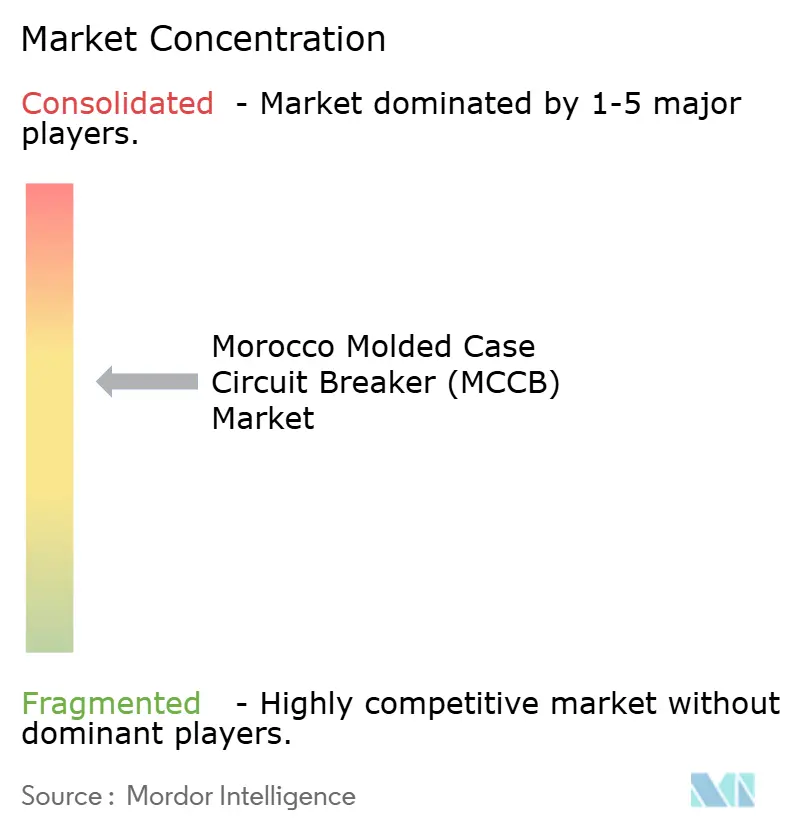
| Market Concentration | Medium |
Major Players *Disclaimer: Major Players sorted in no particular order Image © Mordor Intelligence. Reuse requires attribution under CC BY 4.0. | |
Morocco Molded Case Circuit Breaker (MCCB) Market Analysis by Mordor Intelligence
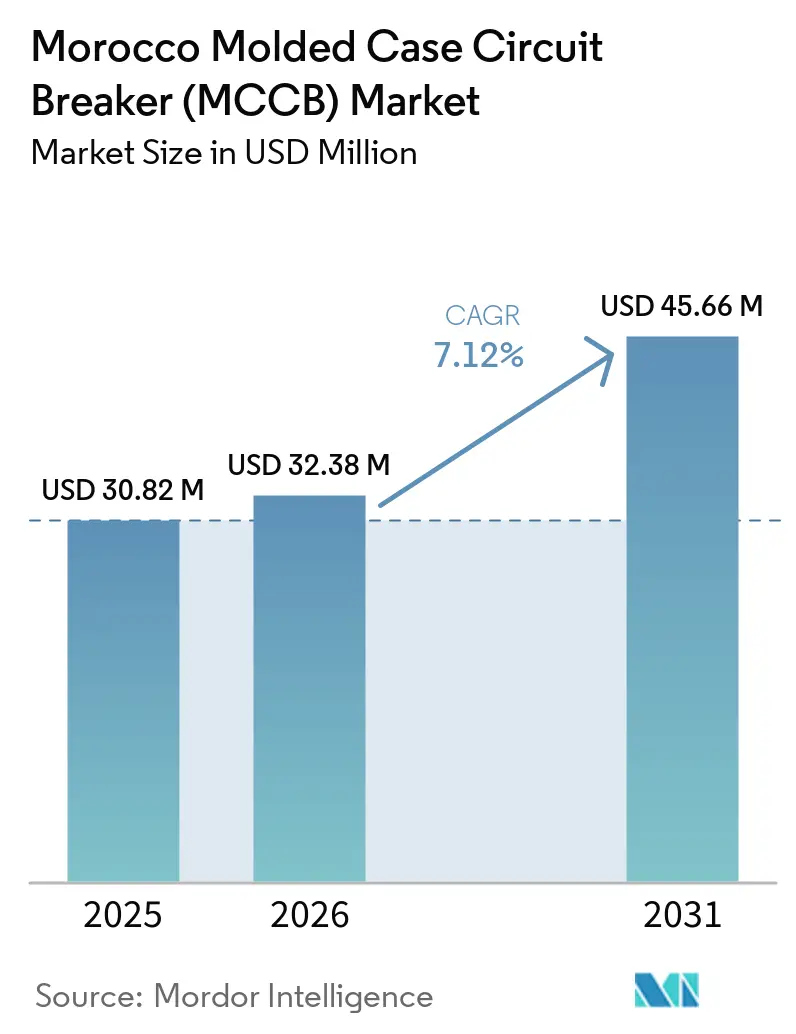
The Morocco Molded Case Circuit Breaker Market size is projected to be USD 30.82 million in 2025, USD 32.38 million in 2026, and reach USD 45.66 million by 2031, growing at a CAGR of 7.12% from 2026 to 2031. The Morocco molded case circuit breaker market is being supported by simultaneous spending on power generation, factory electrification, water infrastructure, and digital capacity, which is lifting demand from basic protection products toward more intelligent protection systems.[1]Ministry of Energy Transition and Sustainable Development, “Morocco Accelerates Energy Reforms With USD 2.27 Billion in Renewable Projects,” En Yabiladi, en.yabiladi.com Renewable energy represented 46% of installed capacity in 2025, and the approval of 3,000 MW of new projects in Q1 2026 is increasing the need for coordinated low-voltage protection at the interface between generation assets and distribution panels. The competitive environment is also shifting because Schneider Electric formalized a local manufacturing partnership with Groupelec in June 2025, which points to stronger confidence in premium demand and a clear effort to reduce lead-time risk for higher-specification equipment. Morocco’s 2030 FIFA World Cup preparations, access to European financing, and the country’s role as the site of Africa’s first EV battery gigafactory are creating a multi-year infrastructure cycle that supports durable project demand for the Morocco molded case circuit breaker market. At the same time, delayed implementation of the low-voltage residential self-consumption framework and longer conformity checks under the PortNet-led compliance process are limiting the pace of demand in the lower-current range and favoring suppliers that already hold certified stock inside Morocco.
Key Report Takeaways
- By trip-unit technology, Thermal-Magnetic units held 64.1% of the Morocco molded case circuit breaker market share in 2025, while Microprocessor-Based units are projected to grow at a 10.3% CAGR through 2031.
- By rated current, the 75A–250A range accounted for 42.3% of the Morocco molded case circuit breaker market size in 2025, while the Above 800A range is forecast to expand at an 8.2% CAGR through 2031.
- By end user, Industry held 31.3% of revenue in 2025, while Infrastructure is expected to advance at a 9.6% CAGR through 2031.
Note: Market size and forecast figures in this report are generated using Mordor Intelligence’s proprietary estimation framework, updated with the latest available data and insights as of January 2026.
Morocco Molded Case Circuit Breaker (MCCB) Market Trends and Insights
Drivers Impact Analysis*
| Driver | (~) % Impact on CAGR Forecast | Geographic Relevance | Impact Timeline |
|---|---|---|---|
| Utility-Scale Renewables And Grid-Flex Investments | +2.3% | National, concentrated in Souss-Massa, Oriental, and Atlantic corridors | Medium term (2-4 years) |
| Industrial Self-Consumption And Surplus-Sale Regime | +0.8% | National, early gains in Casablanca-Settat and Tangier-Tétouan industrial zones | Short term (≤ 2 years) |
| Gigafactory And EV Supply-Chain Electrification | +1.4% | Kenitra and northwestern Morocco | Short term (≤ 2 years) to Medium term (2-4 years) |
| Desalination And Water-Energy Megaproject Buildout | +1.2% | Atlantic and southern coastal corridors, including Casablanca, Agadir, and Dakhla | Medium term (2-4 years) |
| AI And Data-Center Power-Distribution Demand | +0.7% | Casablanca-Settat region, with spillover to northern Morocco | Medium term (2-4 years) to Long term (≥ 4 years) |
| Heat And Dust Derating Favoring Premium Breaker Upgrades | +0.6% | National, most acute in Saharan and semi-arid zones | Long term (≥ 4 years) |
| Source: Mordor Intelligence | |||
Utility-Scale Renewables and Grid-Flex Investments
Morocco’s electricity investment program through 2030 is expanding the project base that feeds the Morocco molded case circuit breaker market, with roughly 15 GW of new capacity planned and more than 12 GW tied to solar and wind. Every new generation node requires protection panels, especially in the 250A–800A range, because grid interconnection and plant distribution points rely on coordinated low-voltage protection. Morocco is also targeting more than 3,500 MW of storage by 2030, and those storage assets introduce bidirectional current flows that standard thermal-magnetic breakers do not manage as well as electronic or microprocessor-based units. Financing in 2025 for ONEE’s grid expansion is extending 731 km of high-voltage lines and adding 1,850 MVA of evacuation capacity, which expands the downstream need for substation and switchroom protection equipment. This matters because the core installation point for MCCBs remains inside the distribution architecture that sits below transmission upgrades and renewable generation connections. As a result, renewable expansion is not only increasing unit volumes, it is also shifting procurement in the Morocco molded case circuit breaker market toward breakers with better selectivity, monitoring, and fault-handling capability.
Gigafactory and EV Supply-Chain Electrification
Gotion High-Tech’s battery gigafactory in Kenitra is one of the clearest single-site demand catalysts for the Morocco molded case circuit breaker market, with Phase 1 targeting 20 GWh and commercial start scheduled for Q3 2026.[2]Gotion High-Tech, “Morocco’s Gotion Battery Gigafactory Is Africa’s First,” BETAR Africa, betar.africa The wider program is designed to scale to 100 GWh across five phases, which means the protection requirement extends well beyond first-phase commissioning. A dedicated 500 MW wind plant with 2,000 MWh of battery storage is being developed to serve the site, which reinforces the need for high-reliability distribution and coordinated protection across intake, process, and auxiliary systems. This kind of industrial campus requires thousands of breakers across battery manufacturing lines, electrode processing, utility intake, and plant-wide distribution, with most of that demand falling between 75A and 800A. The signal is broader than one factory because the Renault and Stellantis corridor in Kenitra and Tangier is already upgrading power systems for EV-related production lines. That multiplier effect makes vehicle electrification a lasting source of premium industrial demand within the Morocco molded case circuit breaker market rather than a one-time project cycle.
Desalination and Water-Energy Megaproject Buildout
Large desalination and water-energy projects are creating another durable layer of growth for the Morocco molded case circuit breaker market, especially along the Atlantic and southern coastal corridors. The TAQA Morocco, Nareva, ONEE, and Mohammed VI Investment Fund consortium committed MAD 130 billion (USD 14.1 billion) for power generation, transmission, and desalination assets that will produce 900 million m³ annually by 2030. ACCIONA’s Casablanca desalination plant is designed for 300 million m³ per year and is powered by a dedicated 360 MW wind farm, which requires a strong internal distribution system with high-current protection at pump and motor feed level. Reverse-osmosis trains also create heavy starting-current spikes, and that raises the risk of nuisance tripping when standard thermal-magnetic devices are used in demanding motor applications. This operating profile is pushing project designers toward electronic and microprocessor-based trip units that can apply programmable motor-start delay curves more accurately. The Agadir plant expansion, which adds 125,000 m³ per day and carries investment above USD 250 million, reinforces the same specification pattern and broadens the coastal demand base for higher-value breakers.
AI and Data-Center Power-Distribution Demand
AI and data-center investment is raising the technical ceiling of the Morocco molded case circuit breaker market because these facilities rely on dense, redundant, and continuously monitored power distribution layouts. Morocco’s data center footprint in 2026 is being shaped by the USD 1.2 billion Nexus AI Factory in Nouaceur, Oracle’s North Africa cloud presence in Casablanca and Settat, and a planned 500 MW green data center in Dakhla. Standard N+1 and 2N redundancy architectures increase the number of distribution panels required for a given load, which means breaker counts rise faster than installed megawatts alone might suggest. This environment favors microprocessor-based MCCBs because remote monitoring, arc-flash management, and predictive maintenance support are more valuable in uptime-sensitive digital facilities. These products carry a price premium over thermal-magnetic units, so the revenue contribution from digital infrastructure can exceed its share of installed electrical capacity. That makes data centers one of the clearest channels through which the Morocco molded case circuit breaker market is moving toward premium specifications and higher average selling values.
Restraints Impact Analysis*
| Restraint | (~) % Impact on CAGR Forecast | Geographic Relevance | Impact Timeline |
|---|---|---|---|
| Import Dependence And Compliance Lead Times | -2.8% | National, most acute for projects in southern and eastern regions that are farther from Casablanca customs clearance | Short term (≤ 2 years) to Medium term (2-4 years) |
| Price-Led Substitution To Low-Specification Products | -1.5% | National, concentrated in smaller commercial and industrial and residential applications | Short term (≤ 2 years) |
| Delayed Low-Voltage Residential Self-Consumption Framework | -0.9% | National, with the highest effect in urban and peri-urban areas | Medium term (2-4 years) |
| FX And Logistics Volatility On Imported Components | -0.8% | National | Short term (≤ 2 years) |
| Source: Mordor Intelligence | |||
Import Dependence and Compliance Lead Times
Import dependence remains a clear brake on the Morocco molded case circuit breaker market because most domestic activity still centers on switchboard assembly rather than full breaker manufacturing. The updated PCA Morocco conformity process, centralized through PortNet in Q1 2026, requires importers to manage the full compliance chain instead of relying on exporters. In practical terms, project procurement windows can stretch by 8 to 12 weeks when products come from manufacturers that have not yet been fully registered in the system. The January 2025 update to IEC 60947-2 also raised the minimum short-circuit breaking capacity for 100A industrial MCCBs from 36 kA to 40 kA, which forces re-certification for older product lines that were not tested under the revised standard. That combination benefits suppliers with pre-certified bonded stock near Casablanca because they can respond faster than entrants that import against each project order. The disadvantage is more visible in southern and eastern project locations, where longer inland logistics compounds the time lost in certification and customs handling.
Price-Led Substitution to Low-Specification Products
Price-led substitution continues to weigh on the Morocco molded case circuit breaker market in smaller commercial and industrial applications where procurement teams focus on unit cost more than lifecycle performance. Lower-cost thermal-magnetic breakers from Chinese suppliers are entering the market at 40% to 60% of the price of comparable IEC-certified products, which makes them attractive in channels with limited engineering review. The hidden problem is that current-carrying capability falls as ambient temperature moves above the 40°C calibration baseline used in IEC 60947-2. Under that logic, a 100A breaker operating inside a 55°C enclosure is only reliable near 78A, which creates nuisance tripping and earlier failure when the device is already lightly specified. Buyers often absorb those failures later because the specification decision is rarely revisited after procurement. That weakens the ability of premium brands to defend pricing on total-cost grounds even when the technical case is stronger.
*Our forecasts treat driver/restraint impacts as directional, not additive. The impact forecasts reflect baseline growth, mix effects, and variable interactions.
Segment Analysis
By Rated Current: High-Current Demand Surges on Gigafactory and Grid Loads
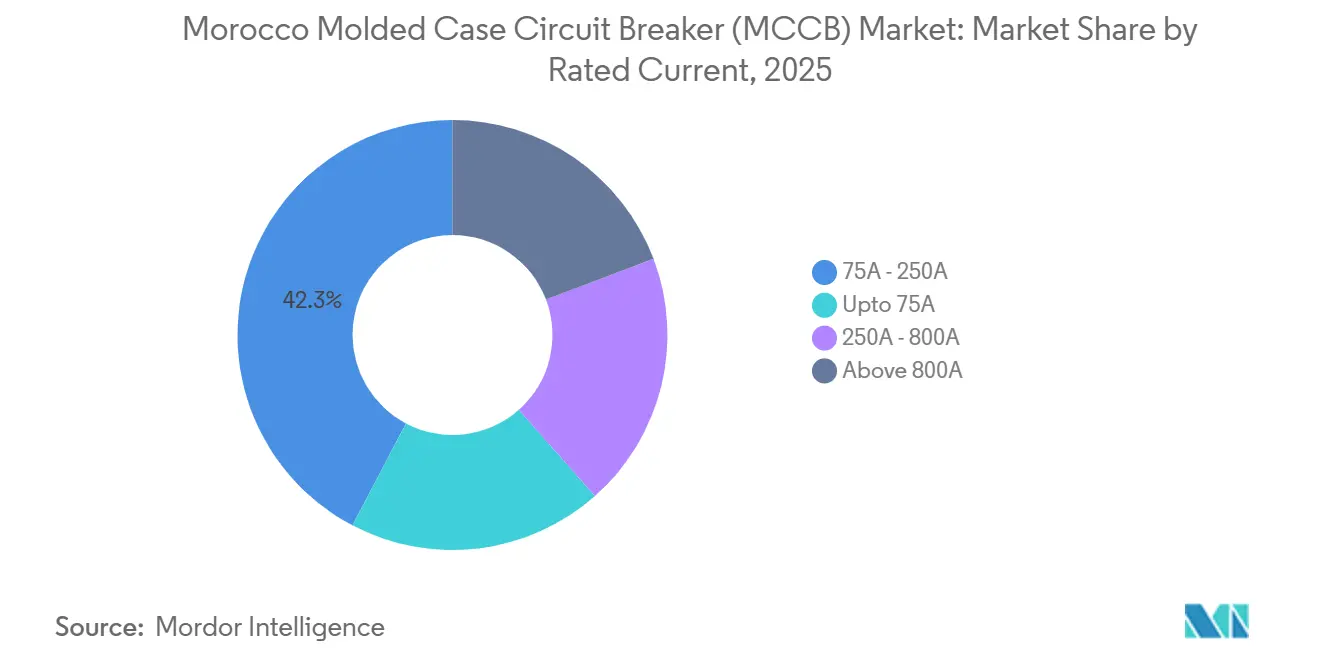
The 75A–250A band held 42.3% of the Morocco molded case circuit breaker market size in 2025, which reflects its role as the standard protection range for industrial boards, commercial buildings, and mid-scale infrastructure sites. This range remains dominant because it sits at the center of manufacturing facilities, hospitality projects, and most commercial construction activity across Casablanca, Rabat, Marrakech, and Tangier. The Above 800A segment is expanding at an 8.2% CAGR through 2031, supported by Gotion’s intake systems, ONEE substation upgrades, and desalination main boards that require higher short-circuit capability. The 250A–800A class sits in a strong middle position because it serves renewable collection panels and EV charging aggregation boards that are both expanding. The below-75A range remains the most exposed to lower-cost imports because miniature circuit breakers still dominate many smaller low-current installations.
Ambient derating is also changing buying behavior across the Morocco molded case circuit breaker industry because equipment must be sized for real enclosure conditions rather than nominal ratings alone. A 250A breaker installed in a 50°C industrial enclosure can require a rating closer to 285A to 295A to maintain reliable protection margins. That pushes procurement toward the next current class up, which quietly adds volume to the 250A–800A and Above 800A ranges. This pattern is particularly relevant in Fez, Ouarzazate, Agadir, and other warmer operating environments where panel temperatures can rise well above standard calibration assumptions. As a result, rated-current demand is no longer shaped only by nameplate load, because climate, compliance, and fault-duty requirements now move the specification mix upward across the Morocco molded case circuit breaker market.



By Trip-Unit Technology: Premium Upgrade Cycle Accelerates Beyond the Dominant Thermal-Magnetic Tier
Thermal-Magnetic trip units retained 64.1% of the Morocco molded case circuit breaker market share in 2025, which reflects the installed base and the continued importance of cost-sensitive procurement in commercial and light-industrial projects. They remain adequate for stable-load applications and still benefit from broad availability through global brands, local distributors, and lower-cost entrants. The Microprocessor-Based segment is growing at a 10.3% CAGR through 2031 because data centers, renewable inverter panels, storage systems, and variable-speed-drive circuits need programmable trip curves and communication features. The Electronic segment sits between the two because it improves discrimination and adjustability without moving fully into the intelligence layer of microprocessor devices. That middle position is becoming more relevant after Morocco’s self-consumption framework moved forward in 2026, since grid-tied onsite generation needs more careful coordination than legacy one-way industrial loads.
The deeper shift is that storage and inverter-based assets are changing what intelligence means for protection design in the Morocco molded case circuit breaker industry. Morocco’s storage target above 3,500 MW by 2030 introduces bidirectional current behavior that conventional bimetallic elements do not handle as reliably in every application. Microprocessor-based devices with directional overcurrent protection are therefore becoming the preferred specification in grid-connected renewable and storage projects. Schneider Electric’s September 2025 Innovation Day in Casablanca, together with its local sourcing target above USD 100 million by 2030, shows that major OEMs are already aligning local supply with that premium demand. This is why the technology mix in the Morocco molded case circuit breaker market is shifting on application need rather than on simple replacement of an aging installed base.
By End User: Infrastructure Projects Outpace Industry Despite the Latter's Dominant Share
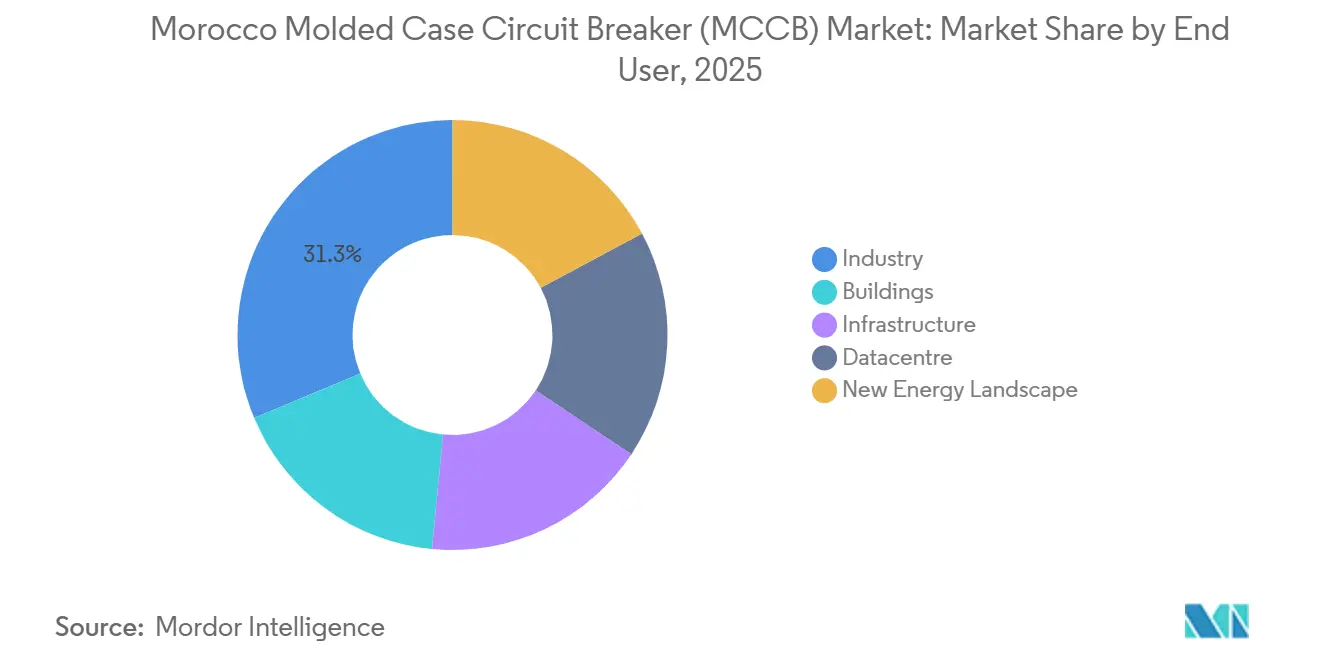
The Industry segment held 31.3% of revenue in 2025, supported by phosphates processing, automotive supply chains in Kenitra and Tangier, and a broader agro-industrial base that still anchors installed demand. Morocco’s installed electricity capacity reached 12.2 GW in 2025, and industrial activity remained the largest consumption block, which helps explain why factories continue to hold the leading share in the Morocco molded case circuit breaker market. Infrastructure is projected to grow at a 9.6% CAGR through 2031 because the 2030 World Cup pipeline, major port and grid projects, and new digital facilities are all moving into execution. The Grand Stade Hassan II electrical package and the wider capital program around 2030 tournament infrastructure are raising the share of complex distribution work outside traditional factory settings. Nador West Med and the Casablanca-Settat digital cluster add more large-load project sites that strengthen the infrastructure case across the forecast period.
Buildings and Datacentre are the end-user groups showing the clearest upgrade path because event, hospitality, airport, and digital assets need more advanced panel design and monitoring. The airport expansion plan from 38 million to 80 million passengers before 2030 supports stronger demand for compliant low-voltage distribution equipment in terminals, hospitality projects, and related transport infrastructure. The Datacentre segment remains smaller today, but its breaker content per installation is higher because redundant panels, premium enclosures, and microprocessor-based devices are standard. The New Energy Landscape category still contributes the least volume today, yet the Gotion start-up in Q3 2026 and future storage tenders will keep lifting its relevance. This leaves the Morocco molded case circuit breaker market with a broader end-user mix, where infrastructure and digital loads increasingly challenge the long-standing dominance of industrial demand.
Geography Analysis
Casablanca-Settat remained the largest demand hub within the Morocco molded case circuit breaker market in 2025 because it combines port access, distributor headquarters, industrial loads, desalination investment, and new digital infrastructure. The region hosts the Nouaceur Nexus AI Factory site, the Sidi Rahal desalination project, and the warehousing base that gives importers with bonded inventory a clear response-time advantage. That logistics edge matters because the Moroccan compliance system now places more responsibility on the importer, which rewards companies that can keep certified products close to the main point of customs clearance. The broader Atlantic corridor, running from Tangier to Agadir, therefore captures the highest concentration of installations in the Morocco molded case circuit breaker market.
The Kenitra and Tanger Med axis is the fastest-growing zone because it combines automotive production, EV supply-chain expansion, large-scale logistics, and the Gotion gigafactory. Gotion alone requires a power system that resembles the needs of a mid-sized industrial city, and that has direct implications for current-class mix, selectivity, and the use of premium devices. Nador West Med is adding another anchor point in the east after ONEE commissioned a second 225 kV line in May 2026, which reinforces the grid backbone supporting industrial development around the port complex. Compliance matters more in this corridor because European automotive and industrial buyers bring tighter procurement standards into local project execution. The six 2030 World Cup host cities add a second layer of demand across Casablanca, Rabat, Marrakech, Fez, Agadir, and Tangier, which broadens the regional spread of the Morocco molded case circuit breaker market rather than concentrating it in a single industrial belt.
Southern Morocco is becoming the next frontier, led by Agadir and Dakhla, where desalination, data centers, and long-distance power infrastructure are creating a distinct operating environment. Ambient temperatures above 45°C raise the practical importance of derating, which means standard catalog products are less suitable unless they are oversized or upgraded. The planned 3,000 MW HVDC corridor from Dakhla to Casablanca will extend substation and distribution requirements over a much wider footprint once commissioning proceeds. This makes the southern part of the Morocco molded case circuit breaker market less of a late-developing extension and more of a separate high-current, high-temperature specification zone.
Competitive Landscape
The Morocco molded case circuit breaker market is moderately consolidated at the premium OEM level and highly fragmented across distribution and system integration. Schneider Electric, ABB, Siemens, Eaton, Mitsubishi Electric, Legrand, and Hager form the leading multinational layer, while local companies such as Groupelec, Ingelec, PEC Group, GMT, and F2V Groupe support project execution and channel reach. Competition in the premium tier depends on certification depth, engineering support, delivery readiness, and how close inventory sits to Casablanca port and the main project corridor. Chint is the clearest price-led disruptor in the thermal-magnetic category, where imported lower-cost devices are putting pressure on both global brands and local distributors.
Schneider Electric has made the strongest localization move inside the Morocco molded case circuit breaker market through its June 2025 partnership with Groupelec in Mohammedia to produce PIX medium-voltage cells and customize low-voltage switchboards locally. That step reduces lead-time exposure and gives Schneider a stronger position in higher-specification projects where timing and engineering support matter as much as price. The company extended that position in September 2025 by signing agreements with Morocco’s Ministry of Industry, FENELEC, Kazinov, and Iozera, with a local sourcing target above USD 100 million by 2030. Those moves matter because premium demand is rising in data centers, renewable integration, and self-consumption projects where turnkey local support creates clear commercial advantages. Smaller Moroccan integrators are also gaining relevance by pairing imported OEM breakers with locally engineered switchboard assemblies, which helps them stay close to the customer and reduce procurement friction.
ABB remains visible through local distributors such as F2V Groupe, which allows it to serve industrial automation projects without carrying the fixed-cost burden of local manufacturing. There is still open space in the New Energy Landscape and Datacentre categories because no single supplier is yet presented in the supplied material as offering a full Morocco-localized package of arc-flash-rated, microprocessor-based, communication-ready MCCBs. That leaves the Morocco molded case circuit breaker market shaped by a mix of premium localization, technical service, compliant inventory, and price-led substitution. The result is a market where leadership is meaningful in selected premium channels, but the broader project landscape still remains dispersed across brands, distributors, and integration partners.
Morocco Molded Case Circuit Breaker (MCCB) Industry Leaders
Schneider Electric SE
ABB Ltd
Siemens AG
Eaton Corp plc
Hager Group
- *Disclaimer: Major Players sorted in no particular order

Recent Industry Developments
- May 2026: ONEE commissioned the second 225 kV Very High Voltage line to Nador West Med, energised on May 24, 2026. This second line strengthens power supply to Morocco's largest industrial-port complex in the Oriental region, directly driving electrical distribution panel demand in the industrial zone.
- May 2026: Nexus AI Factory MoU signed at GITEX Africa 2026, Marrakesh. The USD 1.2 billion project, backed by NVIDIA and Naver Cloud, will deliver a 500 MW AI data center campus in Nouaceur, Casablanca-Settat, in two phases by 2027, requiring complex power distribution infrastructure including high-reliability, microprocessor-based MCCB systems.


Morocco Molded Case Circuit Breaker (MCCB) Market Report Scope
The Molded Case Circuit Breaker (MCCB) is engineered to shield circuits from overcurrents, overloads, and short circuits. Encased in robust molded plastic for enhanced durability, the MCCB is adept at managing higher current capacities compared to its standard circuit breaker counterparts.
The Morocco Molded Case Circuit Breaker (MCCB) Market is segmented into rated current, trip-unit technology, and end-user. By rated current, the market is segmented into up to 75A, 75A–250A, 250A–800A, and above 800A. By trip-unit technology, the market is segmented into thermal-magnetic, electronic, and microprocessor-based systems. By end-user, the market is segmented into buildings, industry, infrastructure, datacenter, and new energy landscape applications. For each segment, the market sizing and forecasts have been done on the basis of value (USD).
| Upto 75A |
| 75A - 250A |
| 250A - 800A |
| Above 800A |
| Thermal-Magnetic |
| Electronic |
| Microprocessor-Based |
| Buildings |
| Industry |
| Infrastructure |
| Datacenter |
| New Energy Landscape |
| By Rated Current | Upto 75A |
| 75A - 250A | |
| 250A - 800A | |
| Above 800A | |
| By Trip-Unit Technology | Thermal-Magnetic |
| Electronic | |
| Microprocessor-Based | |
| By End User | Buildings |
| Industry | |
| Infrastructure | |
| Datacenter | |
| New Energy Landscape |


Key Questions Answered in the Report
What is the 2031 outlook for Morocco molded case circuit breakers?
The Morocco Molded Case Circuit Breaker Market size is projected to be USD 30.82 million in 2025, USD 32.38 million in 2026, and reach USD 45.66 million by 2031, growing at a CAGR of 7.12% from 2026 to 2031.
Which product technology is gaining momentum fastest in Morocco?
Microprocessor-based units are growing fastest at a 10.3% CAGR through 2031 because renewable systems, storage assets, and data centers need programmable and monitored protection.
Which rated current range leads current demand?
The 75A-250A range held 42.3% of revenue in 2025 because it is the standard range for industrial boards, commercial facilities, and mid-scale infrastructure sites.
Why is the Above 800A range growing faster?
It is linked to gigafactory intake systems, ONEE substation upgrades, and desalination main distribution boards, which require higher fault-handling capability and larger load coverage.
Which end-user group is expanding the quickest?
Infrastructure is forecast to grow at a 9.6% CAGR through 2031 as stadiums, ports, water projects, and digital facilities move into execution.
What is the biggest near-term risk for suppliers and importers?
Import dependence and the PortNet-led conformity process can extend procurement by 8 to 12 weeks, especially when products are sourced from newly introduced manufacturers or older lines need re-certification.
Page last updated on:


 Your data is secure and never sold or shared.


