
Market Overview
| Study Period | 2022 - 2031 |
|---|---|
| Forecast Data Period | 2026 - 2031 |
| Historical Data Period | 2022 - 2024 |
| Growth Rate | 1.94 % |
| Market Concentration | Low |
Major Players *Disclaimer: Major Players sorted in no particular order Image © Mordor Intelligence. Reuse requires attribution under CC BY 4.0. | |
Middle East Wireline Logging Services Market Analysis by Mordor Intelligence
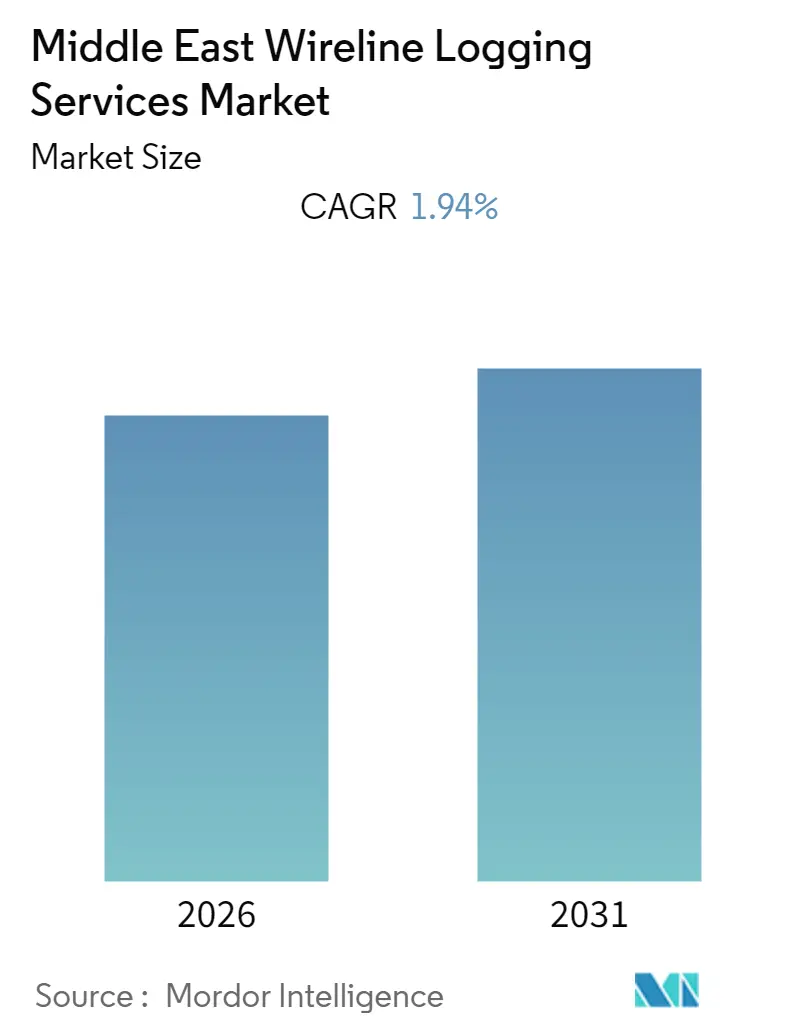
The Middle East Wireline Logging Services Market size is expected to register a CAGR of 1.94% during the forecast period 2026-2031.
COVID-19 negatively impacted the market in 2020. Presently the market has now reached pre-pandemic levels.
- Over the medium term, factors such as increased discoveries and increased investment in the offshore sector are expected to drive the market for wireline logging services.
- On the other hand, the volatile nature of oil prices in recent years led to decreased exploration activity, causing a slowdown in the middle-east wireline logging services market.
- Nevertheless, the increasing exploration activity in the region to compensate for aging mature oil and gas fields is expected to offer significant opportunities for the wireline logging services market in the region.
- Due to the increased exploration activity in the country, Saudi Arabia is expected to dominate the market to compensate for declining fields elsewhere. Oil and gas drilling activity in Saudi Arabia is anticipated to grow because of the government policy to drive oil and gas production in the country.
Note: Market size and forecast figures in this report are generated using Mordor Intelligence’s proprietary estimation framework, updated with the latest available data and insights as of 2026.
Middle East Wireline Logging Services Market Trends and Insights
Onshore Segment to Dominate the Market
- The market for wireline logging services in the Middle East saw a growth slowdown owing to the volatile oil prices in recent years. However, with oil prices expected to become stable in the coming years, the market is expected to show growth during the forecasted period.
- Onshore oil production accounts for around 70% of global oil production. Increased onshore exploration activity globally in the forecasted period is expected to help grow the market for wireline logging services.
- Moreover, the region is home to the world's largest onshore oilfields, consisting of the Ghawar Oilfield in Saudi Arabia, with proven reserves upwards of 75 billion barrels of oil.
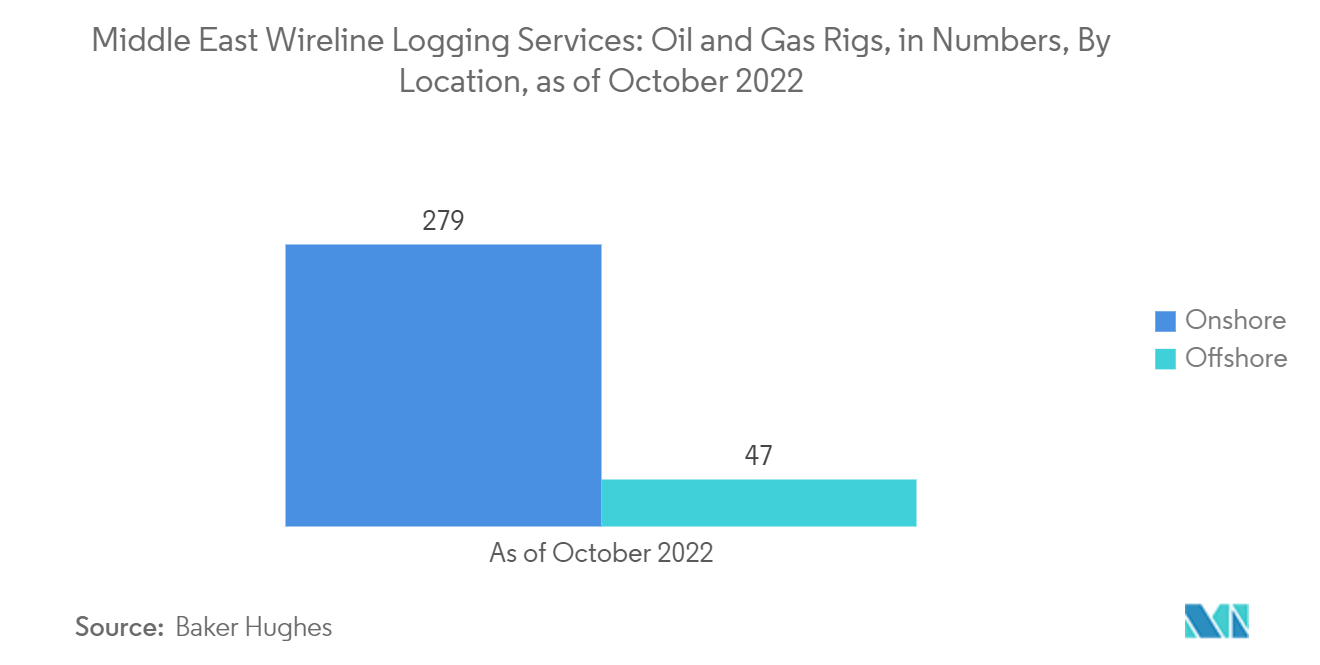
- As of October 2022, there were 279 onshore rigs in the middle east, with a further 47 rigs located offshore.
- The United Arab Emirates (UAE) is the fourth largest crude oil producer in the MENA region. According to OPEC statistics, the country produced an average of 2,718 thousand barrels/day of oil in 2021. During 2021, according to OPEC Annual Statistical Bulletin 2022, the country produced 54.49 billion cubic meters (Bcm) of natural gas.
- Like its GCC neighbors, the country's economy is heavily dependent on energy exports as the primary source of foreign revenue. As of 2021, according to OPEC Annual Statistical Bulletin 2022, natural gas reserves stood at 8.2 trillion cubic meters, while proven oil reserves stood at 111 billion barrels.
- About 90% of the total reserves are in Abu Dhabi, followed by Dubai, Sharjah, and Ras al-Khaimah. The Umm Shaif, Bu Hasa, Upper Zakum, Lower Zakum, and Habshun are the largest oilfields in Abu Dhabi, while Dubai has the Fateh, Rashid, and Faleh fields. Sharjah, Ras al-Khaimah, and Um Al Quwain primarily have gas fields. Most of the acreage, both onshore and offshore, is relatively well explored, while the recent drilling has yielded a few significant discoveries.
- Since November 2021, ADNOC was awarded over USD 16 billion in agreements for drilling-related equipment and services, including these awards and other agreements for wellheads, downhole completion equipment, liner hangers, cementing service, wireline logging, directional drilling, and logging while drilling.
- In August 2022, ADNOC offered five framework agreements to major oilfield services companies, which include Al Ghaith Oilfield Supplies and Services Company, Al Mansoori Directional Drilling Services (Al Mansoori), Schlumberger Middle East SA (Schlumberger), Haliburton Worldwide Limited Abu Dhabi (Haliburton) and Weatherford Bin Hamoodah Company LLC (Weatherford). These framework agreements are for directional drilling and logging while drilling (LWD) services for both onshore and offshore assets and will run for five years, with an option of extending the contracts for two more years.
- Kuwait is one of the major oil & gas producers in the Middle East region, which produced nearly 2.71 million barrels per day of crude oil and 12.88 billion standard cubic meters (bscm) of natural gas in 2021. The country holds a proven crude oil reserve of around 101.5 billion barrels and 1,784 bscm of natural gas in 2021.
- In October 2022, Precision Drilling was awarded four contracts in Kuwait, each for a five-year term with the option of renewing for one year. As a result of the contract awards, the company will have five active drilling rigs by the middle of 2023, increasing its total rig count from three to five.
- As the crude oil prices are expected to recover, the upstream investment is expected to grow significantly and bring several projects online, thereby driving the market.


Saudi Arabia to Dominate the Market
- Due to increased drilling and completion activities, Saudi Arabia is expected to maintain its dominance in the forecast period.
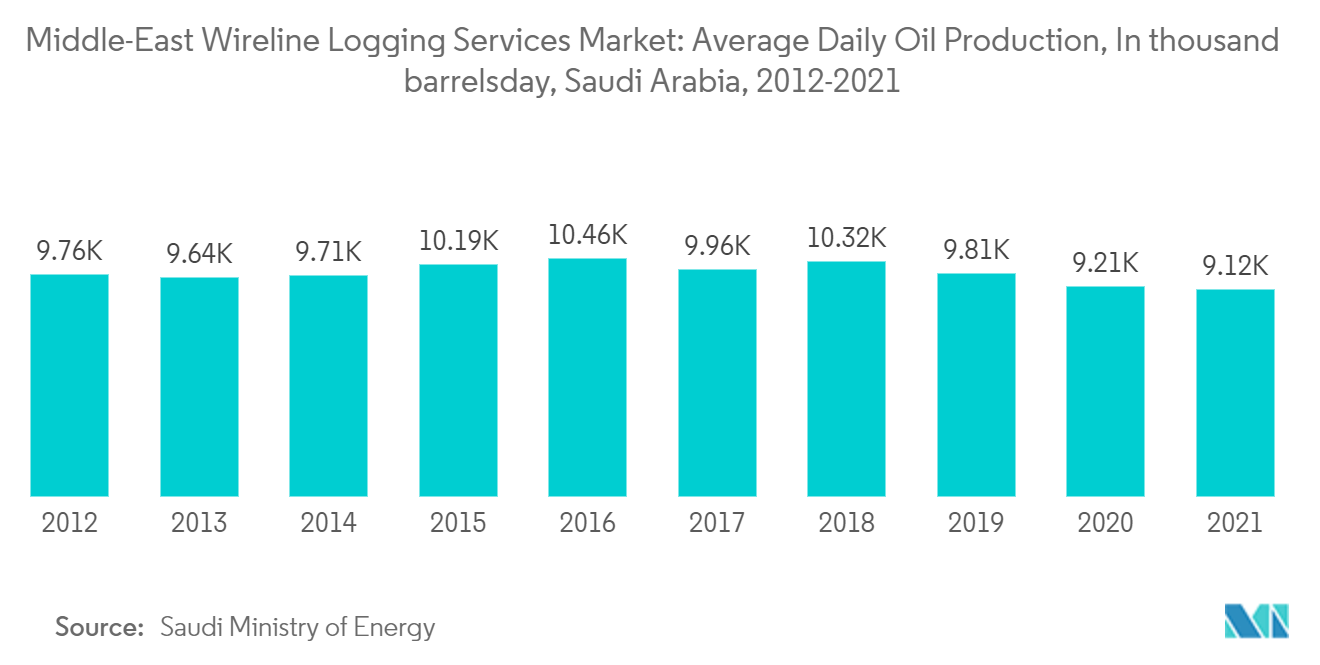
- Saudi Arabia is the largest crude oil producer in the Middle East and has been a global leader in upstream technology. According to the Saudi Ministry of Energy, the country produced 9124.72 thousand barrels/day of crude during 2021, making it the 3rd largest producer of crude oil. In 2021, the country had 120.46 billion CU meters of gas, making it the eighth largest producer globally.
- The country is the largest producer of crude oil in the Middle East and has the second-largest proven crude oil reserves globally. The country's E&P sector is dominated by the state-owned hydrocarbon utility Saudi Aramco, the world's largest exporter of crude oil.
- The country's upstream sector is focused on developing massive limestone reservoirs in the country's onshore and offshore areas, such as the world's largest conventional onshore oil field (Ghawar) and the largest conventional offshore field (Safaniyah). These colossal fields have been producing for a long time and still have significant recoverable reserves. Saudi Arabia has also started the development of the Jafurah Shale play, the country's largest unconventional shale play, estimated to hold nearly 200 Trillion cubic feet of shale gas, which has further increased the demand for wireline logging services in the region.
- Drilling and completing new wells is a significant investment; Saudi Arabia has one of the lowest drilling costs globally. According to Saudi Aramco, the average upstream lifting cost was USD 3 per barrel produced in 2021 and 2020.
- Saudi Arabia has one of the largest hydrocarbon reserves globally. Despite the government's move to increase investment in sustainable solutions and renewable energy, the hydrocarbon industry forms the backbone of the economy. The government aims to maximize its profits over the next decade in a high-price environment. Saudi Aramco has disclosed plans to boost its capital expenditure (CAPEX) to USD 40-50 billion in 2022, up by nearly 50% from 2021, with further growth expected until 2025.
- The company plans to increase its crude production capacity to 13 million barrels/day by 2027 and aims to increase gas production by nearly 50% by 2030. Such ambitious expansion plans, coupled with new-age goals of complying with sustainability and environmental standards, are expected to attract significant investments and require major innovation in the sector, factors which are expected to drive the upstream market in the country and the demand for OCTG in the country during the forecast period.
Value Chain Analysis
The value chain for wireline logging services in the Middle East begins with tool and consumables inputs (logging cables, sensors, perforating systems, downhole electronics, pressure-control equipment), then moves into service delivery via oilfield service contractors and integrated drilling service providers. National oil companies and their operating subsidiaries procure services through framework agreements and multi-year tenders, which are then executed across drilling and workover programs with close coordination with rig contractors and completion or workover service lines (directional drilling, cementing, well intervention), reflecting the region's preference for bundled scopes.
Downstream, acquisition and interpretation outputs support reservoir characterization, completion design, production allocation, and EOR surveillance workflows, particularly in mature carbonate reservoirs. Recent regional technical work points to tighter integration between cased-hole logging suites (production/injection logs, noise/temperature surveys, pulsed neutron) and formation testing and imaging. This includes deployments such as ADNOC Offshore using an intelligent wireline formation testing platform for sampling in low-resistivity pay zones (November 2025). Operational bottlenecks are most visible around HTHP and sour environments, logistics and mobilization across remote onshore fields and offshore islands, and the need for local content and in-country support capabilities to maintain tool reliability and telemetry performance under demanding well conditions.
Competitive Landscape
The Middle East wireline logging services market is partially consolidated. Some of the major players in the market (in no particular order) include Schlumberger Limited, Halliburton Company, Baker Hughes Company, and Weatherford International plc, among others.
Middle East Wireline Logging Services Industry Leaders
Schlumberger Limited
Halliburton Company
Baker Hughes Company
Weatherford International plc
Expro Group
- *Disclaimer: Major Players sorted in no particular order


Market Opportunities and Future Outlook
Contracting patterns by Middle East NOCs show whitespace for providers that can compete on integrated scopes rather than standalone logging, combining wireline logging with directional drilling, cementing, and related downhole services. ADNOC Offshore awarding ADNOC Drilling a USD 1.63 billion, five-year integrated drilling services contract in April 2025 (including wireline logging) illustrates the scale and structure of demand in the UAE, and lifts the bar for service packaging, execution capacity, and in-country operating footprint.
Technology-led opportunities are centered on mature carbonate optimization and gas-focused developments that require higher-spec formation evaluation and cased-hole surveillance. Regional technical deployments during 2025, including integrated cased-hole acquisition studies for EOR pilots and advanced formation testing in low-resistivity pay zones, indicate demand for high-end logging, real-time data integration, and toolstrings compatible with complex well architectures. In Saudi Arabia, Aramco awarding a five-year contract to SLB in December 2025 to support gas growth initiatives, along with Aramco's 2025 MoUs and agreements with U.S. oilfield services companies (including SLB, Baker Hughes, and Halliburton) for procurement and professional service support, reinforces the commercial pathway for wireline providers that can support long-duration gas programs with localized supply chains, reliability, and digital workflows.
Recent Industry Developments
- April 2026: Weatherford reported in its first-quarter 2026 update that it secured a two-year wireline services contract from a national oil company in Turkey and highlighted advanced wireline execution progress in the broader region. The award supports backlog visibility for wireline operations and signals continued customer appetite for multi-year service coverage tied to well intervention and evaluation needs.
- January 2026: Kuwait Oil Company awarded logging and perforation services contracts totaling about USD 676.8 million to Western Atlas International, Halliburton, China National Logging Corporation, and Weatherford. The awards expand competitive intensity in Kuwait and reinforce the importance of scale, tool availability, and localized execution capability for winning large tenders.
- April 2025: National Energy Services Reunited (NESR) announced multiple five-year slickline contract awards across Kuwait and Oman totaling about USD 200 million. The wins strengthen regional workover and well intervention capacity, supporting higher activity levels where cased-hole operations and associated logging and perforation services are frequently bundled around well lifecycle programs.


Research Methodology Framework and Report Scope
Market Definition and Coverage
This market covers revenue earned from wireline logging services used in oil and gas wells across the Middle East, where downhole tools are run on electric line or slickline to measure formation and well conditions in open hole and cased hole jobs.
Scope exclusions: It excludes drilling rigs, completion hardware, and permanent downhole monitoring equipment sales unless they are priced and delivered as part of a wireline logging service job.
Segmentation Overview
- Type
- Electric Line
- Slick Line
- Hole Type
- Open Hole
- Cased Hole
- Location of Deployment
- Onshore
- Offshore
- Geography
- Saudi Arabia
- United Arab Emirates
- Rest of Middle East
Data Sources, Market Sizing, and Validation
Desk Research
Desk work starts with building the activity backbone for the region, and then mapping it to wireline logging demand. Public upstream indicators were reviewed from sources such as OPEC and OPEC+ releases, national energy ministry updates, national oil company tender portals, and operator field development announcements that signal how many wells and workovers are moving forward.
To keep the model grounded, we also checked government statistics and regulators where available, customs and trade summaries for relevant tools and cables as directional signals, and technical publications such as SPE papers that help verify how logging programs shift by well type. Company annual reports, investor presentations, and reputable press were used to confirm service mix changes, fleet utilization commentary, and pricing pressure periods. A paid subscription for company financials and news intelligence, plus a paid patents database, was selectively used to speed up data extraction and to verify technology adoption timelines. These are illustrative examples of desk sources used, and many other public references were also consulted for data collection, validation, and clarification.
Primary Interviews and Surveys
Primary work focused on interviews and structured surveys with wireline service providers, field operations leaders, tool specialists, and upstream buyers across key Middle East producing countries. These discussions were used to confirm job mix splits (open hole versus cased hole, electric line versus slickline), typical logging string selection, and how pricing moves with tender cycles and service intensity.
Distribution of primary research fieldwork respondents
| Company type | Respondent position |
|---|---|
| Top tier: 39% | CXOs: 19% |
| Mid tier: 42% | Functional/Unit leaders: 27% |
| Smaller Players: 19% | Managers: 54% |
Market-Sizing & Forecasting
Sizing is built using a top-down demand pool that reconstructs service revenue from upstream activity, and then it is checked with selective bottom-up approximations. We start from country level drilling and intervention signals, and then apply wireline logging penetration by well type and development stage, followed by an average service price per job that is adjusted for complexity and offshore exposure.
Key inputs include active rig and well intervention levels, the share of wells requiring open hole logs versus cased hole evaluation, electric line versus slickline mix, average logging runs per well, and pricing behavior linked to tender cadence and service intensity. When country data is patchy, gaps are handled using nearby market proxies and operator program ratios, and then those assumptions are re-tested in expert calls.
For forecasting, scenario analysis is used with a base case anchored to expected upstream spending and well counts, and then it is stress-tested for oil price sensitivity and project slippage risk. The final trajectory is adjusted only when multiple sources point in the same direction, which keeps year to year changes explainable in plain terms.
Data Validation & Update Cycle
Validation is done through triangulation across activity metrics, pricing signals, and interview feedback, before the final numbers are signed off. Analysts compare modeled revenue against independent checks like announced drilling programs, tender volumes, and service intensity comments, and then outliers are reviewed until the reason is clear.
If a major variance shows up, we re-contact industry respondents to verify whether it came from a short-term pricing move, a country scope shift, or a change in job mix (for example, more cased hole work following production optimization). Reports are refreshed annually, and interim updates are triggered when material events occur, such as large project awards or sharp changes in rig activity. Before delivery, a final analyst pass is completed so clients receive the latest updated view.
Mordor Intelligence's Middle East Wireline Logging Services Market Market Size Versus Other Published Estimates
Published market values for Middle East wireline logging services can vary a lot, even when the titles sound similar. Differences usually come from what is counted as logging, how the Middle East boundary is set, and whether revenue is tied to logging runs or to broader oilfield service spending buckets.
By tracking country level drilling and intervention activity, and refreshing average service price per logging job by hole type, Mordor Intelligence keeps the total limited to paid wireline logging services, which reduces inflation from bundled intervention work or tool sales.
Benchmark comparison
| Source | Market Size | Gaps in Research Methodology |
|---|---|---|
| Mordor Intelligence | USD 0.43 B (2024) | |
| Regional Consultancy A | USD 4.21 B (2024) | This estimate appears to use a wider oilfield services style scope where wireline logging is grouped with intervention and related job types, which can lift totals versus logging-only service revenue. |
| Global Consultancy B | USD 1.90 B (2024) | This estimate likely includes additional cased hole integrity monitoring services beyond core logging runs, and it may apply higher average service pricing without the same mix checks by country and deployment. |
The table shows that the biggest swings come from whether adjacent services are counted together with logging, and from how pricing is applied across job types. Keeping the build tied to observable well activity, and then checking it against interview-led pricing and mix realities, makes the final market number easier to explain and repeat.


Key Questions Answered in the Report
What is the current Middle East Wireline Logging Services Market size?
The Middle East Wireline Logging Services Market is projected to register a CAGR of 1.94% during the forecast period (2026-2031)
Who are the key players in Middle East Wireline Logging Services Market?
Schlumberger Limited, Halliburton Company, Baker Hughes Company, Weatherford International plc and Expro Group are the major companies operating in the Middle East Wireline Logging Services Market.
What years does this Middle East Wireline Logging Services Market cover?
The report covers the Middle East Wireline Logging Services Market historical market size for years: 2021, 2022, 2023 and 2024. The report also forecasts the Middle East Wireline Logging Services Market size for years: 2026, 2027, 2028, 2029, 2030 and 2031.
Page last updated on:


 Your data is secure and never sold or shared.


