
Market Overview
| Study Period | 2021 - 2031 |
|---|---|
| Forecast Data Period | 2026 - 2031 |
| Historical Data Period | 2021 - 2024 |
| Growth Rate | 2.58 % |
Major Players *Disclaimer: Major Players sorted in no particular order Image © Mordor Intelligence. Reuse requires attribution under CC BY 4.0. | |
Middle East Wireline Services Market Analysis by Mordor Intelligence
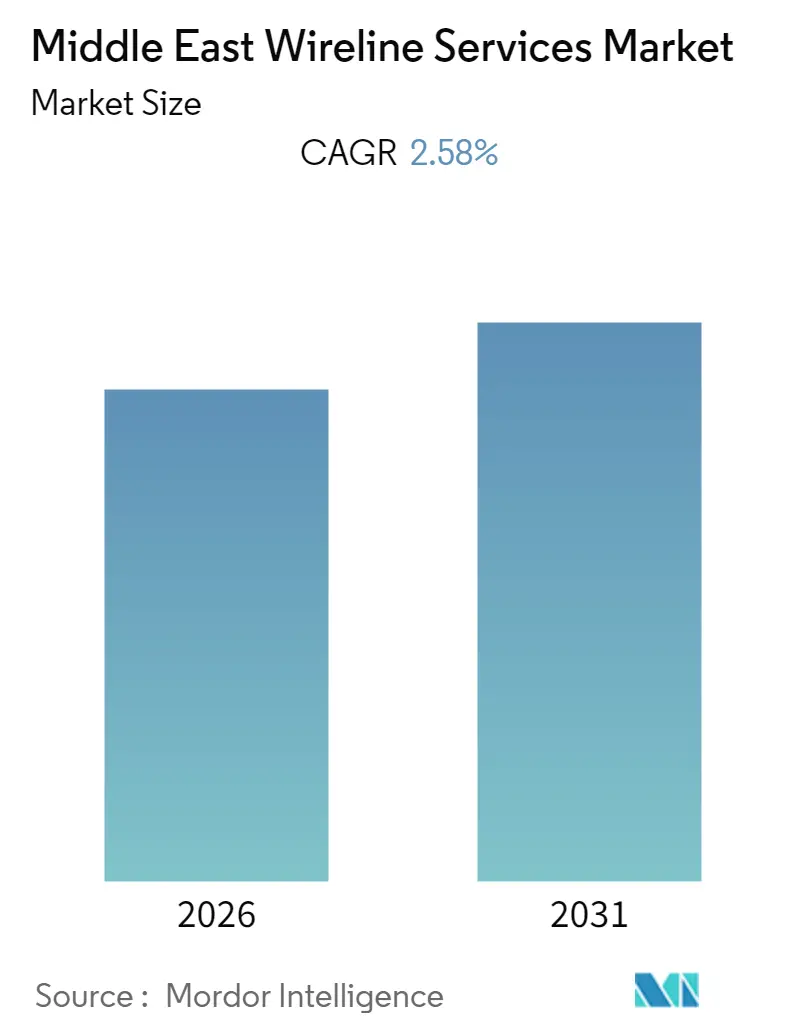
The Middle East Wireline Services Market size is expected to register a CAGR of greater than 2.58% during the forecast period.
- The increasing exploration activities in the offshore region are expected to boost the demand for the wireline services market during the forecast period, thus making it a dominating segment.
- The shift of the projects from offshore to onshore, shallow waters to deep waters and ultra-deep waters is an opportunity for the wireline service providers to innovate and come up with products suitable and customized to the harsh climatic conditions of offshore basins.
- Saudi Arabia is expected to drive the wireline services market in the region, followed by United Arab Emirates (UAE), Iran, and others.
Note: Market size and forecast figures in this report are generated using Mordor Intelligence’s proprietary estimation framework, updated with the latest available data and insights as of 2026.
Middle East Wireline Services Market Trends and Insights
Offshore to Dominate the Market
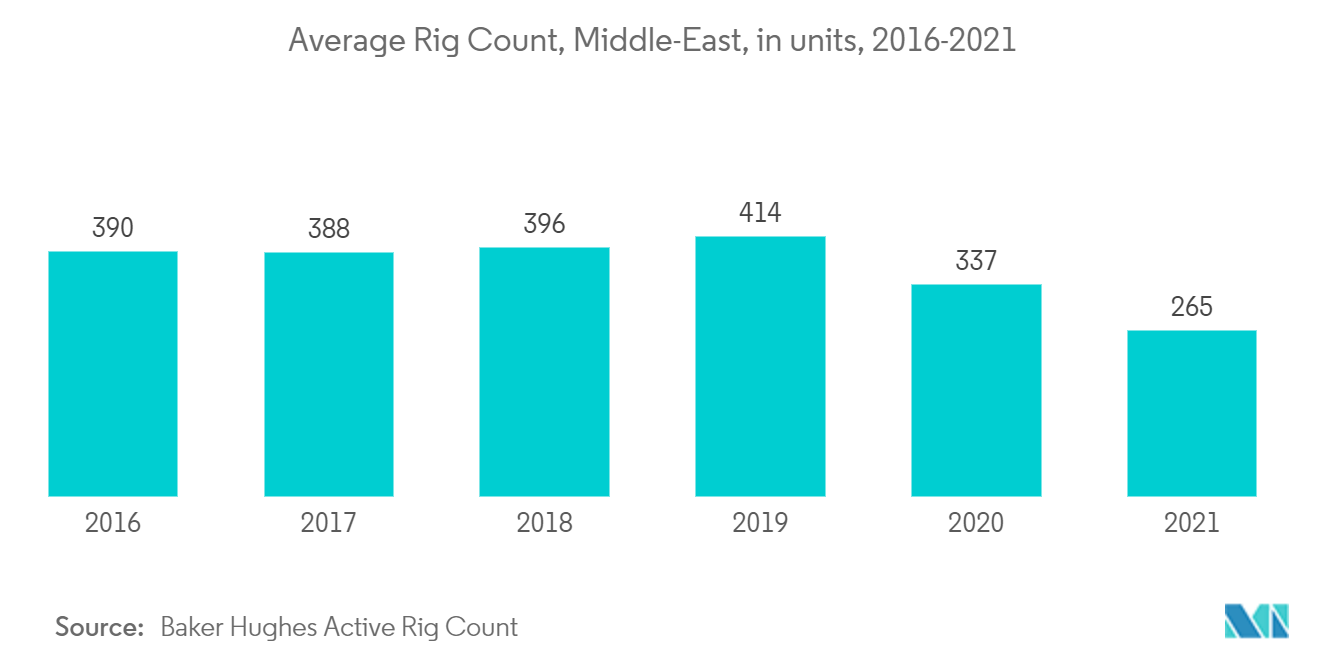
- The offshore oil and gas drilling sector has been subdued in the past few years, mainly due to the crude oil price being lower than the breakeven price of several offshore oil and gas fields. As a result, the demand in the oil and gas wireline services market was negatively impacted.
- The Brent crude oil price started showing signs of improvement after the COVID-19 pandemic and remained well above USD 60 per barrel throughout 2021. This, coupled with the cost reduction program of upstream oil and gas companies, gained investors' confidence for final investment decisions for projects which got canceled during the low commodity price environment.
- For instance, in 2022, ENI, an Italian gas company, made a gas discovery in offshore Block 2 in Abu Dhabi, and it is estimated that the well has around 1.5-2 trillion cubic feet of raw gas, and the completion of the well is expected to be completed by the second quarter of 2022. These new offshore exploration projects would directly aid the Middle-East wireline market.
- Hence, the offshore segment is expected to dominate the market during the forecast period.


Saudi Arabia to Dominate the Market
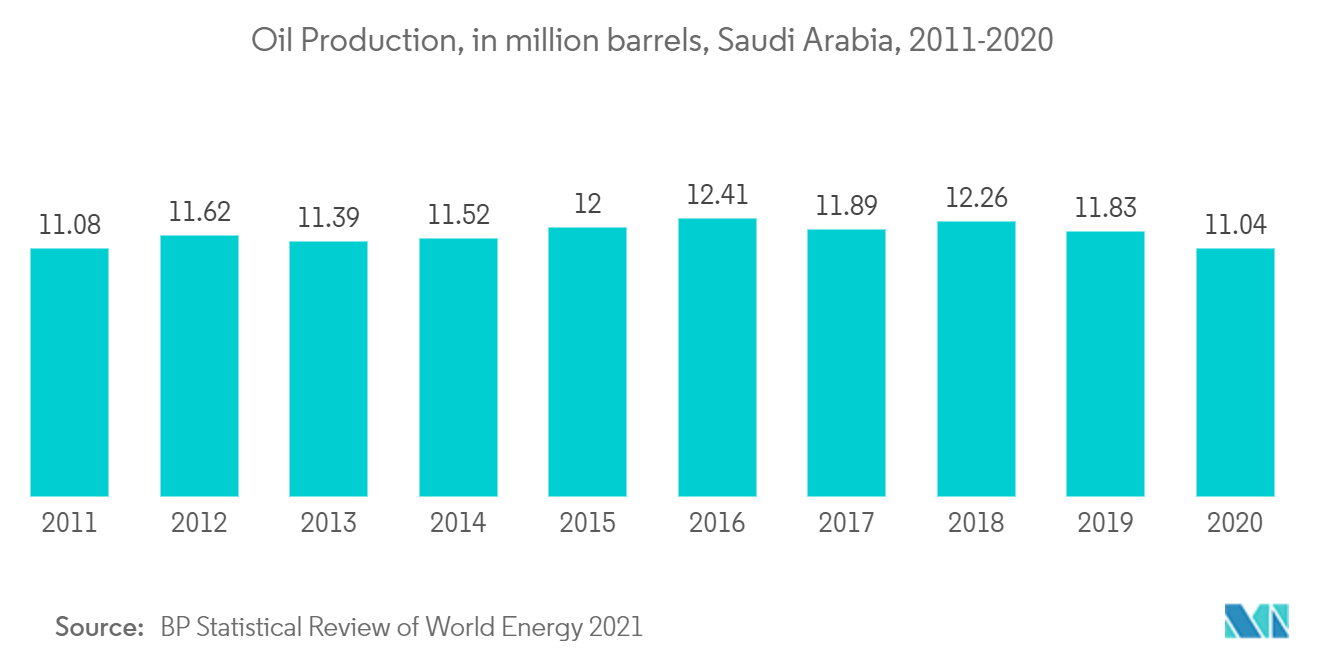
- The Kingdom of Saudi Arabia is one of the biggest global oil producers, with the production of 11.3 million barrels per day in 2020, according to the BP Statistical Review of World Energy 2021.
- The Kingdom of Saudi Arabia holds the second-largest proven oil reserves in the world after Venezuela. Saudi Aramco, the country's largest oil and gas company, is continuously engaged in exploration and development in order to compensate for declining fields elsewhere.
- The crude oil production rate has been consistent in Saudi Arabia, even during the distressful period in the industry, when crude oil prices plunged to a very low level in recent years.
- Oil and gas drilling activity in Saudi Arabia is anticipated to increase on account of government policy to drive the oil and gas production in the country. The policy to drive upstream activity will likely promulgate the oil and gas wireline services market in the near future.
- For instance, in November 2021, Saudi Arabian Oil company announced the development of the Jafurah unconventional gas field, where the company awarded an engineering, procurement, and construction contract worth USD 10 billion.
- Therefore, due to the above-mentioned points, the wireline services are expected to witness significant growth in Saudi Arabia during the forecast period.
Regulatory Landscape
Wireline service delivery in the Middle East is shaped by national licensing and operating-permit regimes, along with NOC-led technical and HSE contracting standards. In Saudi Arabia, the 2025 Law of Energy Supplies and the 2025 Law of Petroleum and Petrochemical Products place energy-sector activities under licensing and oversight by the Ministry of Energy, and the ministry uses an e-services channel for license applications and related permits. This structure raises the importance of document-ready compliance for service providers.
Across key producing states, operator and regulator requirements are built into procurement and work execution. QatarEnergy sets the legal and regulatory framework for the sector and requires contractors to comply with its corporate HSE contract standard (CORP-HSE-STD-080), while ADNOC has applied unified technical scopes of work for electric line logging services to standardize performance requirements across onshore and offshore operations. Together, these frameworks push wireline vendors toward auditable HSE management systems, standardized service quality, and qualification processes to maintain access to NOC work programs.
Value Chain Analysis
The Middle East wireline services value chain begins with tool and consumable OEMs (wireline units, pressure control, downhole sensors, cables, perforating systems, and software) and moves to service integrators and specialized providers that execute electric line and slickline operations. Field activities typically cover open-hole logging, cased-hole evaluation, perforation, production logging, and well integrity. Operator programs (including Saudi Aramco, ADNOC, Kuwait Oil Company, and other NOCs) anchor field execution, while logistics and mobilization are generally routed through established oilfield supply corridors and in-country bases to meet response-time and safety requirements.
Service delivery is concentrated among international oilfield service companies (SLB, Halliburton, Baker Hughes, Weatherford, and Expro) and complemented by regional and specialist players such as APC Oilfield Services and Setcore Petroleum Services. Procurement is increasingly structured around integrated well and drilling service packages. Collaboration models further shape the chain, for example, Turnwell Industries finalizing a joint venture with ADNOC Drilling and SLB to drill and complete unconventional wells in the UAE (September 2024), which tightens linkages between drilling, completion, and wireline data and intervention workflows.
Competitive Landscape
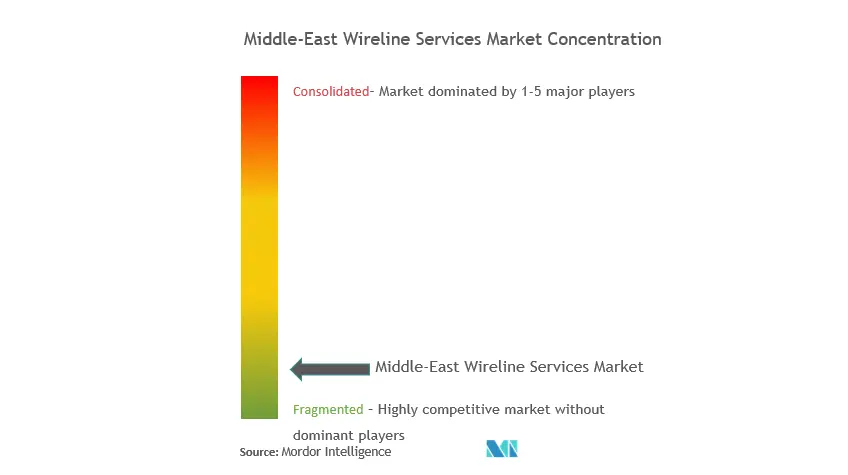
The Middle-East wireline services market is moderately fragmented. Some of the key players include Schlumberger Limited, Halliburton Company, Baker Hughes Company, Expro Group, and Weatherford International PLC.
Middle East Wireline Services Industry Leaders
Schlumberger Limited
Halliburton Company
Baker Hughes Company
Expro Group
Weatherford International Plc
- *Disclaimer: Major Players sorted in no particular order

Market Opportunities and Future Outlook
Opportunities for wireline providers are expanding where NOCs bundle subsurface data acquisition and intervention into larger integrated service models, and where complex reservoirs require higher-fidelity evaluation and targeted interventions. In April 2025, ADNOC Drilling received a USD 1.63 billion, five-year integrated drilling services contract from ADNOC Offshore that includes wireline logging alongside directional drilling, fluids, cementing, and tubular running. This reinforces demand for wireline capabilities that can compete within integrated contracting frameworks rather than only as standalone logging.
Another opportunity track centers on technology-enabled wireline and intervention workflows that support mature fields and complex wellbore configurations. In 2024, ADNOC Onshore executed the UAE's first e-line electromechanical and fiber-optic-equipped coiled tubing ICD shifting operations, showing how wireline conveyance, measurement, and real-time feedback can be used for production optimization. In parallel, ADNOC scaling its AiPSO AI-powered production system optimization stack with SLB and Cognite across onshore and offshore fields (April 2026) increases the value of wireline data as an input to digital subsurface and production decision cycles. This creates room for providers that can integrate acquisition, interpretation, and data delivery into operator platforms.
Recent Industry Developments
- July 2026: Kuwait Oil Company (KOC) awarded seven-year strategic partnership contracts under the Ahmadi Innovation Valley (AIV) initiative to SLB, Baker Hughes, Halliburton, and National Energy Services Reunited (NESR). The long-duration structure favors providers that can sustain multi-year capability deployment and integration, including logging and well intervention workflows that connect to wider drilling and production programs.
- April 2025: ADNOC Drilling was awarded a USD 1.63 billion, five-year contract by ADNOC Offshore for integrated drilling services that includes wireline logging as part of the bundled scope. The award strengthens the role of wireline services inside integrated packages by raising the bar on end-to-end execution, tool availability, and cross-service coordination.
- September 2024: Patterson-UTI Energy's Turnwell Industries finalized a joint venture with ADNOC Drilling and SLB to drill and complete unconventional wells in the UAE. The collaboration indicates deeper coupling of drilling, completion, and formation evaluation requirements, supporting demand for fit-for-purpose wireline operations aligned with unconventional well development.


Research Methodology Framework and Report Scope
Market Definition and Coverage
This market is defined as revenues earned from wireline operations used to evaluate, intervene, and complete oil and gas wells in the Middle East, including electric line and slickline work onshore and offshore, across open-hole and cased-hole settings.
Scope exclusions: It excludes drilling rigs and tubular supply, surface production equipment, and broader oilfield services that are not delivered through wireline or slickline conveyance.
Segmentation Overview
- Deployment
- Onshore
- Offshore
- Type
- Electric Line
- Slick Line
- Hole Type
- Open Hole
- Cased Hole
- Geography
- Saudi Arabia
- Iran
- United Arab Emirates
- Rest of Middle-East
Data Sources, Market Sizing, and Validation
Desk Research
Desk research was used to anchor the model on activity signals that wireline demand typically follows, and then to sanity-check trends across countries in the Middle East. We referred to public sources such as OPEC and JODI oil datasets, national energy ministries and regulators, official statistics portals, and customs or trade bulletins where relevant to equipment and materials movement.
Along with these, company annual reports, investor presentations, and reputable industry press were reviewed to map service intensity changes linked to well intervention programs, mature-field workovers, and offshore campaigns. In parallel, we used paid subscriptions for company financials and intelligence, a patent database to track tool and logging innovation, and, where needed, an import-export shipment-level database for directional checks on cross-border flows. These examples are illustrative only, and many other sources were also consulted for data collection, validation, and research clarification.
Primary Interviews and Surveys
Primary work focused on validating what the desk signals cannot fully explain, mainly pricing behavior, job mix shifts, and how contracts are being awarded across the region. We spoke with a mix of service-side and buyer-side experts, then used structured surveys to confirm assumptions on electric line versus slickline splits, typical job counts per active well program, and how offshore mobilization affects service intensity across key Middle East markets.
Distribution of primary research fieldwork respondents
| Company type | Respondent position |
|---|---|
| Top tier: 29% | CXOs: 13% |
| Mid tier: 55% | Functional/Unit leaders: 34% |
| Smaller Players: 16% | Managers: 53% |
Market-Sizing & Forecasting
Market sizing starts with a top-down build that reconstructs the regional demand pool from upstream activity, and then translates it into wireline service consumption using service-intensity factors. In practice, key inputs include the number of wells drilled and worked over, intervention and completion cadence in mature fields, onshore versus offshore activity mix, open-hole versus cased-hole exposure, and the share of jobs that require electric line versus slickline.
Once the demand pool is established, selective bottom-up approximations are used to cross-check totals, such as sampled job counts by country multiplied by typical price bands, and spot checks on major contract awards and fleet deployment. Where data is thin for smaller countries, gaps are handled by applying proxy intensity ratios from comparable basins (after adjusting for offshore exposure and operator development pace), and then re-tested through interview feedback.
For forecasting, scenario analysis is used because wireline demand in the Middle East is sensitive to project timing, deferred well interventions, and budget cycles. The scenarios are anchored on expected drilling and workover plans, oil price driven capex sentiment, and likely pricing direction for key job types, then moderated using primary feedback on utilization and discounting behavior.
Data Validation & Update Cycle
Outputs are validated by comparing the modeled result against independent signals such as country-level upstream spending direction, active project pipelines, and observed shifts in onshore and offshore well activity. Variance checks are run at the country and service-type level, and any outliers trigger a second review of the underlying drivers, followed by targeted re-contact with experts when the mismatch remains.
Before sign-off, the model and assumptions are reviewed in multiple steps so unit logic, pricing conversions, and year alignment issues are caught early. The report is refreshed annually, and interim updates are completed when material events occur, such as major contract awards, sanctions-related changes to activity, or sharp pricing moves. Right before delivery, a final pass is done so clients receive the latest updated view.
Mordor Intelligence's Middle East Wireline Services Market Market Sizing Compared With Other Published Estimates
Published market values for Middle East wireline services often differ because firms do not lock the same boundaries and timing, even when the labels look similar. The gaps usually come from how each study treats regional coverage, pricing conversion into USD, and whether service mix changes are modeled year by year or kept flat.
A refresh-led gap is common in this market because contract pricing and utilization can move within a year, and the base exchange-rate month used in USD conversion can shift the headline value. Some studies also blend in adjacent geographies, like Africa, or they apply a single average price across electric line and slickline jobs without adjusting for offshore mobilization, cased-hole intensity, or higher-spec logging work, which tends to push totals up or down versus a job-mix driven approach.
Benchmark comparison
| Source | Market Size | Gaps in Research Methodology |
|---|---|---|
| Mordor Intelligence | USD 4.35 B (2024) | |
| Global Consultancy A | USD 4.35 B (2024) | The scope is Middle East and Africa together, which can inflate a Middle East-only read, and the pricing conversion basis is not clearly tied to a specific exchange-rate timing. |
| Regional Consultancy B | USD 3.80 B (2026) | A different base year and forecast window makes the number hard to compare, and the approach appears to lean on a single projected total without showing how job mix and ASP movement are refreshed across electric line versus slickline. |
The spread across sources is mostly explained by scope and timing choices rather than a true disagreement on demand direction. By refreshing job-mix assumptions and currency timing during updates, then rechecking them through interviews, Mordor Intelligence keeps the estimate traceable to activity drivers like wells, interventions, and service intensity rather than a single blended average.


Key Questions Answered in the Report
What is the current Middle East Wireline Services Market size?
The Middle East Wireline Services Market is projected to register a CAGR of 2.58% during the forecast period (2026-2031)
Who are the key players in Middle East Wireline Services Market?
Schlumberger Limited, Halliburton Company, Baker Hughes Company, Expro Group and Weatherford International Plc are the major companies operating in the Middle East Wireline Services Market.
What years does this Middle East Wireline Services Market cover?
The report covers the Middle East Wireline Services Market historical market size for years: 2020, 2021, 2022, 2023 and 2024. The report also forecasts the Middle East Wireline Services Market size for years: 2026, 2027, 2028, 2029, 2030 and 2031.
Page last updated on:





