
United Kingdom Rechargeable Battery Market Size and Share
| Study Period | 2019 - 2030 |
| Forecast Data Period | 2025 - 2030 |
| Historical Data Period | 2019 - 2023 |
| Market Size (2025) | USD 4.56 Billion |
| Market Size (2030) | USD 9.60 Billion |
| CAGR (2025 - 2030) | 16.05% |
| Market Concentration | Low |
Major Players *Disclaimer: Major Players sorted in no particular order |
United Kingdom Rechargeable Battery Market Analysis by Mordor Intelligence
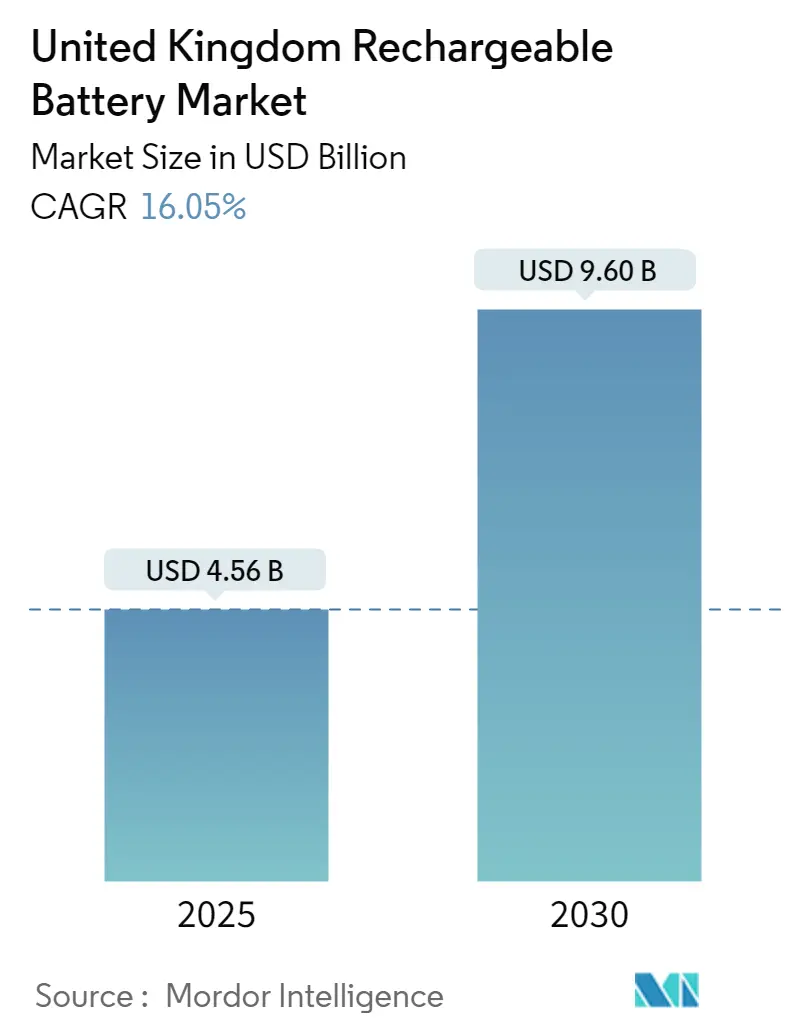
The United Kingdom Rechargeable Battery Market size is estimated at USD 4.56 billion in 2025, and is expected to reach USD 9.60 billion by 2030, at a CAGR of 16.05% during the forecast period (2025-2030).
- Over the medium term, rising electric vehicle (EV) adoption and declining lithium-ion battery prices are expected to drive the demand for rechargeable batteries during the forecast period.
- On the other hand, the lack of raw material reserves can significantly restrain the growth of the United Kingdom's rechargeable battery market.
- Nevertheless, the growing adoption of wearable devices like smartwatches, wireless earphones, smart bands, and more are expected to create significant opportunities for rechargeable battery market players in the near future.
The contribution of United kingdom may read different when placed against the full pool of global outputs. The worldwide rechargeable battery market shares by Mordor Intelligence reflect that proportional balance.
United Kingdom Rechargeable Battery Market Trends and Insights
Lithium-Ion Battery Type Dominate the Market
- Lithium-ion batteries are outpacing other technologies in popularity due to their superior capacity-to-weight ratio. Further, advantages like longevity, low maintenance, an extended shelf life, and a notable drop in prices are further fueling the demand for lithium-ion batteries in the United Kingdom.
- While lithium-ion batteries traditionally commanded a premium over their counterparts, key industry players have been ramping up investments. Their focus on achieving economies of scale and bolstering R&D efforts has intensified competition, leading to a notable dip in lithium-ion battery prices.
- In 2023, lithium-ion battery prices fell to USD 139/kWh, marking a decline of over 13%. With ongoing technological innovations and manufacturing advancements, projections suggest prices will further drop to USD 113/kWh by 2025 and reach USD 80/kWh by 2030.
- The surging demand for lithium-ion batteries is largely attributed to their pivotal role in the shift towards renewable energy and electric mobility. Given the intermittent nature of renewable sources like solar and wind, there's a pressing need for dependable energy storage. Lithium-ion batteries play a crucial role in energy storage systems, helping to balance supply and demand and ensuring grid stability.
- The government is making significant strides in bolstering the country's battery energy storage capacity. Major corporations are rolling out projects aimed at amplifying storage system capacities. A case in point: In March 2024, NatPower UK, a subsidiary of the clean energy giant NatPower Group, unveiled plans to invest over GBP 10 billion (USD 12 billion) in battery energy storage systems nationwide. The ambitious project aims to boost battery capacity by 60 GWh, complemented by an investment of GBP 600 million (USD 766 million) for new substations in the United Kingdom's electricity grid. Such undertakings are poised to elevate the demand for lithium-ion batteries in storage facilities during the forecast period.
- In a bid to bolster the lithium-ion battery market, governments are rolling out substantial investments and actively promoting the production of rechargeable lithium-ion batteries. For instance, in November 2023, the UK government pledged an investment of GBP 50 million (USD 63 million) to fortify a resilient battery supply chain, emphasizing lithium-ion batteries, in alignment with the nation's ambitious EV production goals. The Battery Strategy, set to run until 2030, promises targeted support for zero-emission vehicles, batteries, and their supply chains, including fresh capital and R&D funding over the next five years. Such strategic investments and incentives are poised to supercharge battery production in the United Kingdom, subsequently amplifying the demand for lithium-ion batteries.
- Given these developments, the outlook for lithium-ion rechargeable batteries remains bullish during the forecast period.


Increasing Adoption of Electric Vehicle to Drive the Market
- For a long time, vehicles with internal combustion engines (ICE) dominated the market. However, as environmental concerns grow, there's a notable shift towards electric vehicles (EVs). Predominantly, EVs utilize lithium-ion rechargeable batteries, favored for their high energy density, lightweight nature, minimal self-discharge, and low maintenance needs.
- Lithium-ion battery systems are the driving force behind plug-in hybrids and electric vehicles. Their unmatched energy density, rapid recharge capability, and robust discharge power make lithium-ion batteries the sole technology meeting OEM standards for driving range and charging time. In contrast, lead-based traction batteries fall short for full hybrids or EVs due to their heftier weight and lower energy efficiency.
- In recent years, the United Kingdom has seen a surge in electric vehicle adoption. The International Energy Agency (IEA) reported that in 2023, battery electric vehicle sales reached 0.31 million, marking a 14.8% increase from 2022. Projections indicate a significant uptick in EV sales across the region in the years ahead.
- The United Kingdom government has rolled out multiple policies to champion electric vehicles (EVs) and facilitate a shift towards a low-carbon transportation landscape. These initiatives have bolstered the demand for lithium-ion batteries. In 2023, the government unveiled ambitious plans to boost EV production and expedite the journey towards zero carbon emissions.
- The United Kingdom has set a Zero Emission Vehicle (ZEV) mandate, targeting 80% of new cars and 70% of new vans to be zero-emission by 2030, with a complete transition by 2035. Additionally, a ban on new petrol and diesel cars and vans is slated for 2030, and by 2035, all new vehicles must be zero-emission at the tailpipe. Such measures are poised to not only boost EV production and sales but also escalate the demand for rechargeable batteries in the coming years.
- Leading companies in the region are heavily investing and launching projects to amplify electric vehicle production. For instance, in November 2023, Nissan, alongside its partners, unveiled a GBP 2 billion (USD 2.5 billion) initiative to manufacture three electric car models, including the electric Qashqai and Juke, at their plant. Additionally, Nissan allocated GBP 1.12 billion (USD 1.4 billion) to ready its United Kingdom facilities and supply chain for these new models. Such endeavors underscore the anticipated surge in lithium-ion battery demand.
- Given these concerted efforts, it's evident that EV sales, charging infrastructure, and the demand for rechargeable batteries are set to rise significantly in the forecast period.


The rechargeable battery market is analyzed by Mordor Intelligence across multiple other geographies, with in-depth regional assessments available for Europe, South America, and North America. This is complemented by country-specific insights for France, Italy, United States, Norway, Japan, and Denmark, reflecting various localized market behavior and policy environments' coverage.
Competitive Landscape
The United Kingdom rechargeable battery market is semi-fragmented. Some of the key players (not in particular order) are BYD Company Ltd, Duracell Inc., Exide Technologies, EnerSys, and Panasonic Holdings Corporation, among others.
United Kingdom Rechargeable Battery Industry Leaders
Duracell Inc.
BYD Company Ltd
Panasonic Holdings Corporation
EnerSys
Exide Technologies
- *Disclaimer: Major Players sorted in no particular order


Recent Industry Developments
- May 2024: The Faraday Battery Challenge (FBC) has unveiled a GBP 1.5 million (USD 1.9 million) investment aimed at supporting small and medium-sized (SME) battery developers throughout the United Kingdom. In the upcoming years, the projects spearheaded by the company are expected to focus on cylindrical and pouch cell technologies nationwide.
- May 2023: Tata Motors, the owner of Jaguar Land Rover, revealed its intentions to establish a multi-billion dollar electric car battery plant next year. The company has secured a deal to construct the battery factory in Somerset, located in southwest England.


United Kingdom Rechargeable Battery Market Report Scope
Rechargeable batteries, also known as secondary batteries, are energy storage devices that can be recharged and reused multiple times. They are crucial in various applications, from consumer electronics to renewable energy storage. Rechargeable Batteries are widely used in smartphones, laptops, electric vehicles (EVs), and energy storage systems due to their high energy density and long cycle life.
The United Kingdom's rechargeable battery market is Segmented by Technology and Application. By Technology, the market is segmented into Lithium-ion, Lead-Acid, and Others (NiMh, Nicd, etc.); by Application, the market is segmented into Automotive Batteries, Industrial Batteries (Motive, Stationary (Telecom, UPS, Energy Storage Systems (ESS), etc.), Portable Batteries (Consumer Electronics, etc.), and Other Applications. The Report Offers the Market Size and Forecasts in Revenue (USD) for all the Above.
| Lithium-ion |
| Lead-Acid |
| Other Technologies (NiMh, Nicd, etc.) |
| Automotive Batteries |
| Industrial Batteries (Motive, Stationary (Telecom, UPS, Energy Storage Systems (ESS), etc.) |
| Portable Batteries (Consumer Electronics, etc.) |
| Other Applications |
| Technology | Lithium-ion |
| Lead-Acid | |
| Other Technologies (NiMh, Nicd, etc.) | |
| Application | Automotive Batteries |
| Industrial Batteries (Motive, Stationary (Telecom, UPS, Energy Storage Systems (ESS), etc.) | |
| Portable Batteries (Consumer Electronics, etc.) | |
| Other Applications |


Key Questions Answered in the Report
How big is the United Kingdom Rechargeable Battery Market?
The United Kingdom Rechargeable Battery Market size is expected to reach USD 4.56 billion in 2025 and grow at a CAGR of 16.05% to reach USD 9.60 billion by 2030.
What is the current United Kingdom Rechargeable Battery Market size?
In 2025, the United Kingdom Rechargeable Battery Market size is expected to reach USD 4.56 billion.
Who are the key players in United Kingdom Rechargeable Battery Market?
Duracell Inc., BYD Company Ltd, Panasonic Holdings Corporation, EnerSys and Exide Technologies are the major companies operating in the United Kingdom Rechargeable Battery Market.
What years does this United Kingdom Rechargeable Battery Market cover, and what was the market size in 2024?
In 2024, the United Kingdom Rechargeable Battery Market size was estimated at USD 3.83 billion. The report covers the United Kingdom Rechargeable Battery Market historical market size for years: 2019, 2020, 2021, 2022, 2023 and 2024. The report also forecasts the United Kingdom Rechargeable Battery Market size for years: 2025, 2026, 2027, 2028, 2029 and 2030.
Page last updated on:
United Kingdom Rechargeable Battery Market Report
Statistics for the 2025 United Kingdom Rechargeable Battery market share, size and revenue growth rate, created by Mordor Intelligence™ Industry Reports. United Kingdom Rechargeable Battery analysis includes a market forecast outlook for 2025 to 2030 and historical overview. Get a sample of this industry analysis as a free report PDF download.


 Your data is secure and never sold or shared.


