
Norway Rechargeable Battery Market Size and Share
| Study Period | 2019 - 2030 |
| Forecast Data Period | 2025 - 2030 |
| Historical Data Period | 2019 - 2023 |
| Market Size (2025) | USD 1.05 Billion |
| Market Size (2030) | USD 1.92 Billion |
| CAGR (2025 - 2030) | 12.84% |
| Market Concentration | High |
Major Players *Disclaimer: Major Players sorted in no particular order |
Norway Rechargeable Battery Market Analysis by Mordor Intelligence
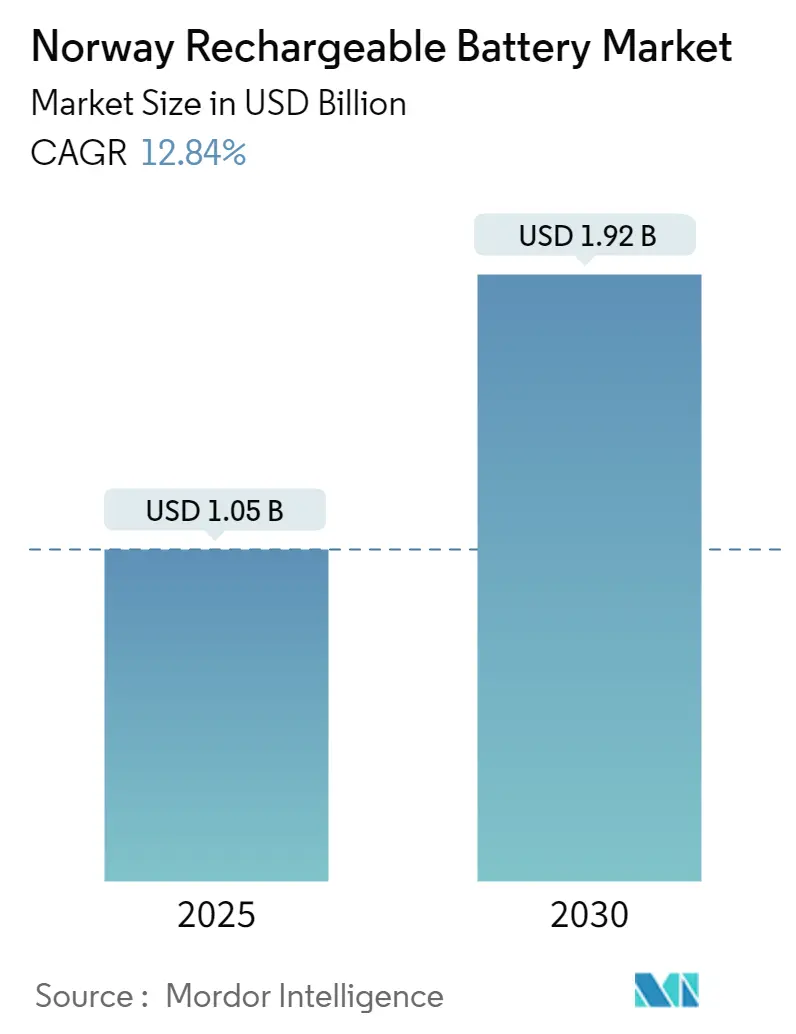
The Norway Rechargeable Battery Market size is estimated at USD 1.05 billion in 2025, and is expected to reach USD 1.92 billion by 2030, at a CAGR of 12.84% during the forecast period (2025-2030).
- Over the medium term, the increasing adoption of electric vehicles, and the surging renewable energy sector accompanied by the favourable government policies are expected to drive the Norway rechargeable battery market during the forecast period.
- On the other hand, the demand-supply mismatch of raw materials, and the safety issues related to battery technologies are expected to hinder the market's growth during the forecast period.
- Nevertheless, the growing progress in developing new battery technologies and advanced battery chemistries will likely create opportunities for the Norway rechargeable battery market.
Dynamics observed within Norway present a country level view when set against the broader international context. The rechargeable battery market analysis by Mordor Intelligence provides that expanded global perspective.
Norway Rechargeable Battery Market Trends and Insights
Automotive Segment is Expected to Dominate the Market
- In Norway, the automotive sector is poised to emerge as a primary application for rechargeable batteries, notably lithium-ion batteries, in the foreseeable future. The rising adoption of electric vehicles (EVs) is set to significantly propel the growth of the rechargeable battery industry.
- Automobiles utilize batteries as secondary power units, either to energize components or assist the engine during cranking. While conventional vehicles predominantly rely on lead-acid and nickel-metal-hydride batteries, EVs have transitioned to lithium-ion batteries.
- The electric vehicle (EV) sector embraced lithium-ion batteries, mirroring their adoption in consumer electronics. Due to the rapid expansion of the EV industry, the automobile sector has now overtaken consumer electronics as the primary consumer of rechargeable batteries, especially lithium-ion variants.
- Globally, electric vehicles are garnering attention for their promise to reduce greenhouse gas emissions and lessen reliance on fossil fuels. In Norway, the uptake of electric vehicles has been on a consistent rise. For example, the International Energy Agency (IEA) projected that in 2023, Norway's stock of battery electric cars would surpass 690,000 units, marking a 16% increase from approximately 590,000 units in 2022. This uptick in EV sales has subsequently spurred demand for rechargeable batteries. Moreover, the Norwegian Parliament has set a national objective: by 2025, all newly sold passenger cars and light goods vehicles must be zero-emissions, either electric or hydrogen. Notably, nearly 80% of new car purchases in Norway were electric by the close of 2022.
- The pace of this transition is intricately linked to the country's policy instruments and diverse incentives. In Norway, tax incentives are structured progressively, based on vehicle weight and emissions, rendering EVs more cost-effective for consumers. Furthermore, EVs enjoy exemptions from emissions taxes and VAT on both purchases and leases. The government bolsters EV demand with road tax and toll exemptions, or at least a 50% reduction. Additional perks for EVs encompass reduced parking fees and access to bus lanes, all aimed at enhancing the appeal of EVs over traditional fossil fuel vehicles. Given the current incentives, Norway is optimistic about meeting its EV targets, steering consumer preferences towards EVs without outright banning fossil fuel vehicle sales. With these trends, Norway anticipates a significant uptick in EV adoption, subsequently fueling a robust demand for rechargeable batteries.
- Efforts are also underway to bolster investments in battery manufacturing facilities. For instance, in early 2023, Elinor Batteries, a battery producer, and SINTEF, a research organization based in Norway, signed a Memorandum of Understanding (MoU) to set up a giga-scale battery factory in central Norway. This collaboration has enabled Elinor to access crucial research and development (R&D) resources to advance the project.
- In tandem with Elinor's factory plans, SINTEF is set to inaugurate a battery lab. Their agreement encompasses all technological facets of the battery production value chain, spanning production technology, infrastructure, management, economics, and societal considerations. Construction of the factory is slated to begin in 2024, with the inaugural production anticipated by mid-2026. Such advancements in battery technology are poised to cater to the evolving automotive landscape in Norway.
- Given these dynamics, Norway's automotive battery segment is on track for substantial growth in the coming years.

Growing Adoption of Renewable Energy Sector To Drive the Market
- Norway's increasing embrace of renewable energy is set to propel the rechargeable batteries market in the years ahead. The International Renewable Energy Agency (IRENA) reported that Norway's cumulative renewable energy capacity hit approximately 40.16 GW in 2023, marking a modest uptick of over 1% from 2022. In 2023, hydropower dominated the renewable landscape, contributing 34.4 GW (85% of the total), followed by wind at 5.06 GW, solar at 616 MW, and other sources making up the remainder.
- Looking ahead, Norway is keen on amplifying its solar and offshore wind capabilities. For instance, authorities have set an ambitious target of 30 gigawatts (GW) of offshore wind energy by 2040, a move poised to draw in innovators, start-ups, and established players alike. Additionally, Norway aspires to ramp up its solar power from 0.45 TWh in 2023 to 8 TWh by 2030, necessitating solar plants with over 10,000 MW capacity.
- With the expansion of solar and wind energy, Norway is witnessing a surge in demand for efficient battery energy storage systems (BESS) to counteract the intermittent nature of these sources. Lithium-ion batteries, in particular, play a crucial role in storing excess energy during peak production and releasing it during high demand or low production times.
- Beyond large-scale solar installations, the rising trend of solar panels on residential and commercial rooftops is expected to bolster Norway's 8 TWh solar target. The Norwegian Water and Energy Directorate (NVE) has streamlined the process, stating that solar power plants up to 5 MW won't require a license under the Energy Act. NVE's approach ties license obligations to the plant's capacity, ensuring larger plants are managed by NVE and smaller ones by local municipalities. This facilitates the deployment of small-scale solar projects, subsequently driving the adoption of BESS.
- In April 2024, Morrow Batteries, a battery technology firm, inked a deal with Nordic Batteries for a supply of 5.5 GWh Lithium Iron Phosphate (LFP) BEV2 batteries over seven years, with the first batch arriving by the end of 2024. Nordic Batteries will craft modules and packs using Morrow's LFP cells and both companies are exploring joint production and collaborative sales and marketing efforts.
- Morrow is set to commence battery cell production at its inaugural gigafactory in Arendal, Norway, in Q3 2024. Nordic Batteries specializes in assembling and crafting battery packs and energy storage systems tailored for maritime and industrial needs. They are also pioneering battery modules and racks with elevated energy and power ratings, marking the initiation of a 1 GWh automated battery assembly line with a pilot line in Q2 2024.
- Battery technologies are pivotal for Norway's ambition of achieving zero emissions by 2050, playing a crucial role in curbing carbon emissions across energy sectors. Norway boasts a robust battery research community, nurtured over a decade, now drawing heightened industry interest. Numerous battery manufacturing initiatives are underway, with several companies making strides in setting up commercial production facilities.
- For instance, in 2022, FREYR Battery greenlit the Giga Artic project, its inaugural battery production facility in MO industrial park, Norway. They've expanded the project's capacity to an impressive 29 GWh, backed by a substantial USD 1.6 billion in debt financing, courtesy of the Norwegian National Battery Strategy and Eksfin's EUR 400 million in guarantees and loans.
- Moreover, in mid-2023, Freyr Battery secured a EUR 100 million grant from the EU Innovation Fund to bolster the Giga Arctic project. This dual giga factory, boasting a 29 GWh capacity, is set to run entirely on renewable hydroelectric power. Freyr views this financial backing as a testament to the pivotal role of batteries in the energy transition and regional energy security.
- In summary, the Norwegian government is keen on positioning the country as a hub for battery value chain activities, aiming to attract substantial investments and giga factories. These initiatives are poised to bolster Norway's renewable energy adoption and the demand for dependable energy storage, fueling the growth of the rechargeable batteries market in the coming years.

Coverage of the rechargeable battery market by Mordor Intelligence spans a wide geographic footprint, with regional analysis available for Europe, Asia, and Middle East and Africa, alongside detailed country-level intelligence for Germany, Romania, India, South Korea, China, and United Kingdom, each shaped by local operating conditions.
Competitive Landscape
The Norway rechargeable battery market is semi-consolidated. Some of the key players in the market (not in any particular order) include Panasonic Corporation, BYD Company Ltd., Freyr AS, Morrow Batteries, and Exide Technologies.
Norway Rechargeable Battery Industry Leaders
-
Panasonic Corporation
-
Freyr AS
-
Morrow Batteries
-
BYD Company Ltd.
-
Exide Technologies
- *Disclaimer: Major Players sorted in no particular order

Recent Industry Developments
- July 2023: FREYR Battery, a startup focused on the battery storage sector, secured a grant commitment of EUR 100 million (USD 112.29 million) from the European Union (EU). This funding, channeled through the EU's Innovation Fund, supports clean energy projects that significantly contribute to the bloc's decarbonization goals.
- January 2023: Elinor Batteries, a battery producer, has partnered with SINTEF, a research organization based in Norway, by signing a Memorandum of Understanding (MoU). Their joint venture aims to set up a giga-scale battery factory in central Norway. Elinor has, through this collaboration, obtained essential resources for research and development to propel the project. In tandem with Elinor's factory plans, SINTEF is set to inaugurate a dedicated battery lab. The MoU encompasses all technological facets of the battery production value chain, addressing production technology, infrastructure, management, economic considerations, and societal impacts.
Norway Rechargeable Battery Market Report Scope
- Rechargeable batteries are energy storage devices designed to be refill with electrical power after use, enabling multiple cycles of discharge and recharge. Unlike disposable batteries, which are single-use and must be replaced once depleted, rechargeable batteries can be reused numerous times, making them more cost-effective and environmentally friendly. These batteries come in various chemistries such as lithium-ion, nickel-metal hydride, and lead-acid, each offering different performance characteristics suited for various applications ranging from small electronic devices to electric vehicles.
- The Norway rechargeable battery market is segmented into Technology and Application. By technology, the market is segmented into lead-acid, lithium-ion, and other technologies (NiMh, Nicd, etc). By application, the market is segmented into automotive batteries, industrial batteries (motive, stationary (telecom, UPS, energy storage systems (ESS), etc.), portable batteries (consumer electronics, etc.) and other applications. The report offers the market size and forecasts for the market in revenue for all the above segments.
| Lead-Acid |
| Lithium-Ion |
| Other Technologies (NiMh, Nicd, etc.) |
| Automotive Batteries |
| Industrial Batteries (Motive, Stationary (Telecom, UPS, Energy Storage Systems (ESS), etc.) |
| Portable Batteries (Consumer Electronics, etc.) |
| Other Applications |
| Technology | Lead-Acid |
| Lithium-Ion | |
| Other Technologies (NiMh, Nicd, etc.) | |
| Application | Automotive Batteries |
| Industrial Batteries (Motive, Stationary (Telecom, UPS, Energy Storage Systems (ESS), etc.) | |
| Portable Batteries (Consumer Electronics, etc.) | |
| Other Applications |
Key Questions Answered in the Report
How big is the Norway Rechargeable Battery Market?
The Norway Rechargeable Battery Market size is expected to reach USD 1.05 billion in 2025 and grow at a CAGR of 12.84% to reach USD 1.92 billion by 2030.
What is the current Norway Rechargeable Battery Market size?
In 2025, the Norway Rechargeable Battery Market size is expected to reach USD 1.05 billion.
Who are the key players in Norway Rechargeable Battery Market?
Panasonic Corporation, Freyr AS, Morrow Batteries, BYD Company Ltd. and Exide Technologies are the major companies operating in the Norway Rechargeable Battery Market.
What years does this Norway Rechargeable Battery Market cover, and what was the market size in 2024?
In 2024, the Norway Rechargeable Battery Market size was estimated at USD 0.92 billion. The report covers the Norway Rechargeable Battery Market historical market size for years: 2019, 2020, 2021, 2022, 2023 and 2024. The report also forecasts the Norway Rechargeable Battery Market size for years: 2025, 2026, 2027, 2028, 2029 and 2030.
Norway Rechargeable Battery Market Report
Statistics for the 2025 Norway Rechargeable Battery market share, size and revenue growth rate, created by Mordor Intelligence™ Industry Reports. Norway Rechargeable Battery analysis includes a market forecast outlook for 2025 to 2030 and historical overview. Get a sample of this industry analysis as a free report PDF download.