
Middle East Agricultural Sprayers Market Size and Share
Market Overview
| Study Period | 2021 - 2031 |
|---|---|
| Forecast Data Period | 2026 - 2031 |
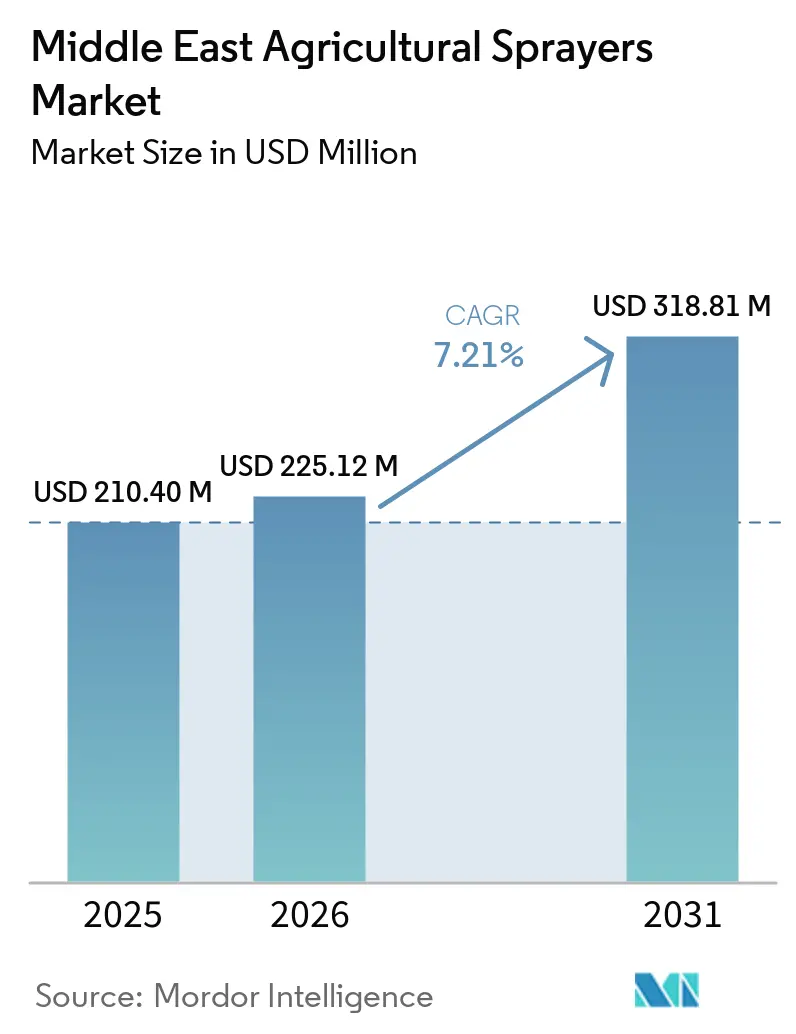
| Base Year Market Size (2025) | USD 210.40 Million |
| Market Size (2026) | USD 225.12 Million |
| Market Size (2031) | USD 318.81 Million |
| Growth Rate (2026 - 2031) | 7.21 % |
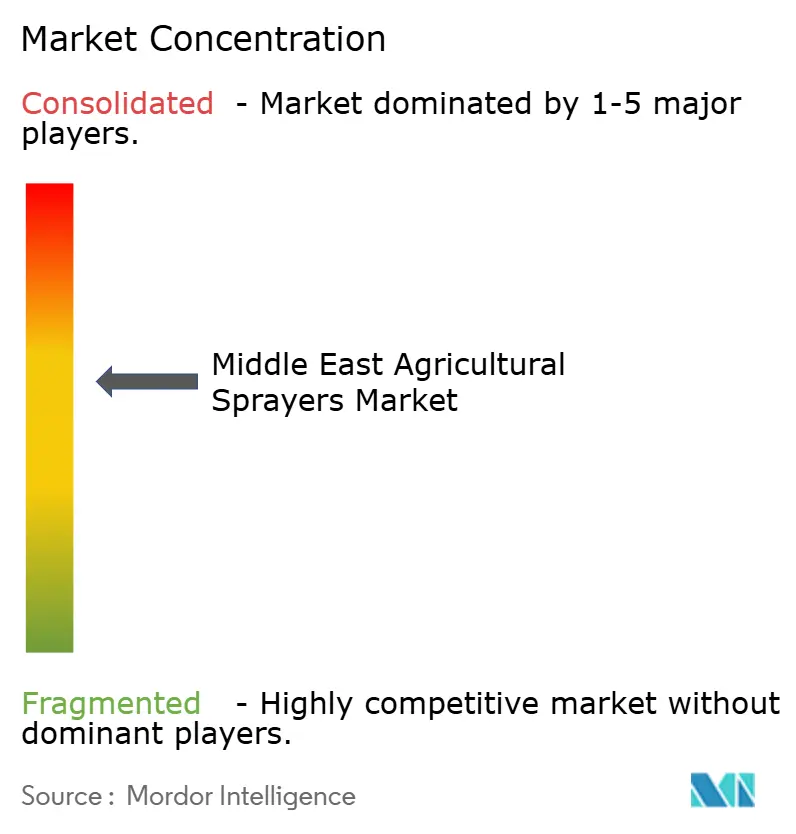
| Market Concentration | Medium |
Major Players *Disclaimer: Major Players sorted in no particular order Image © Mordor Intelligence. Reuse requires attribution under CC BY 4.0. | |
Middle East Agricultural Sprayers Market Analysis by Mordor Intelligence
The Middle East agricultural sprayers market size is projected to expand from USD 210.40 million in 2025 and USD 225.12 million in 2026 to USD 318.81 million by 2031, growing at an estimated CAGR of 7.21% during 2026-2031. The Middle East agricultural sprayers market is developing in a region where countries face extreme water stress, and freshwater availability per person remains below half the global average, underscoring the commercial relevance of water-efficient farm equipment. This condition is supporting wider interest in precision spraying because it helps reduce water use and agrochemical losses while improving application control on high-value crops. Government-backed food security programs in Saudi Arabia and the United Arab Emirates are also pushing farms toward mechanization, greenhouse expansion, and digital crop management, thereby strengthening replacement demand and new equipment uptake in the Middle East agricultural sprayers market. Tractor-mounted systems continue to anchor installed volume across large farming zones, while unmanned aerial vehicle sprayers are gaining traction in organized service models and controlled-environment agriculture.
Key Report Takeaways
- By source of power, fuel-operated sprayers accounted for 46.2% of the Middle East agricultural sprayers market size in 2025, while solar-powered sprayers are anticipated to grow at the fastest CAGR of 8.2% during 2026-2031.
- By product type, tractor-mounted sprayers accounted for 41.4% of the Middle East agricultural sprayers market share in 2025, whereas unmanned aerial vehicle sprayers are projected to grow at the fastest CAGR of 9.8% during 2026-2031.
- By application, field crops constituted 45.2% of the Middle East agricultural sprayers market in 2025, while orchards and vineyards are anticipated to grow at the highest CAGR of 7.4% during 2026-2031.
- By technology level, conventional systems accounted for 61.1% of the Middle East agricultural sprayers market in 2025, while AI-enabled and autonomous systems are forecast to grow at the fastest CAGR of 8.5% during 2026-2031.
- By geography, Saudi Arabia held 38.2% of the Middle East agricultural sprayers market share in 2025 and is estimated to grow at the highest CAGR of 7.5% during 2026-2031.
Note: Market size and forecast figures in this report are generated using Mordor Intelligence’s proprietary estimation framework, updated with the latest available data and insights as of January 2026.
Middle East Agricultural Sprayers Market Trends and Insights
Drivers Impact Analysis*
| Driver | (~) % Impact on CAGR Forecast | Geographic Relevance | Impact Timeline |
|---|---|---|---|
| Precision Spraying Adoption in Water-Scarce Farms | 1.40% | Saudi Arabia, United Arab Emirates, and Rest of Middle East | Short term (≤ 2 years) |
| Orchard and Greenhouse Crop Expansion | 1.20% | Saudi Arabia and United Arab Emirates | Medium term (2-4 years) |
| Drone Service Fleet Penetration in Specialty Crops | 1.00% | Saudi Arabia, United Arab Emirates, and Rest of Middle East | Medium term (2-4 years) |
| Government Food Security and Mechanization Incentives | 0.90% | Saudi Arabia and United Arab Emirates | Short term (≤ 2 years) |
| Retrofit Demand for Variable-Rate and GPS Kits | 0.80% | Saudi Arabia, United Arab Emirates, and Rest of Middle East | Medium term (2-4 years) |
| Demand for Low-Drift Application in High-Value Export Crops | 0.60% | Saudi Arabia and United Arab Emirates | Long term (≥ 4 years) |
| Source: Mordor Intelligence | |||
Precision Spraying Adoption in Water-Scarce Farms
Freshwater scarcity remains one of the strongest commercial forces driving the Middle East agricultural sprayers market, as growers in the region cannot treat spray water as a low-cost input. The supplied draft states that countries in the region face extreme water stress, and that backdrop makes precision application a practical operating choice rather than a premium feature. The same draft notes that precision agriculture can reduce water use by 20% to 30% and fertilizer use by 25% per crop cycle, thereby improving payback periods for farms managing tight water budgets[1]Source: World Economic Forum, “Water Scarcity Solutions in the Middle East,” World Economic Forum, weforum.org. This is especially relevant in Saudi Arabia, where food self-sufficiency targets are tied to higher production efficiency, and farms are under pressure to increase output through better input control. Uniformity of spray coverage matters because waste from overlap, runoff, and drift is more costly in arid production systems than in water-abundant agricultural zones. The Middle East agricultural sprayers market is therefore shifting toward equipment that delivers measurable agronomic returns at the farm level, not just mechanical reliability or subsidy eligibility. This benefits suppliers capable of linking sprayer performance to input savings, ensuring consistent crop protection and minimizing labor intervention during application windows.
Orchard and Greenhouse Crop Expansion
Greenhouse expansion and orchard development are creating a distinct demand pattern in the Middle East agricultural sprayers market, as these crops require more controlled, targeted spray applications than broadacre field crops. The supplied draft states that Saudi Arabia installed more than 100 high-tech greenhouses between 2023 and 2025, and that this buildout was supported by Agricultural Development Fund financing for high-tech infrastructure[2]Source: Agricultural Development Fund, “Agricultural Development Financing Programs,” Agricultural Development Fund, adf.gov.sa. The commercial meaning is that growers in confined environments increasingly need compact systems, low-drift delivery, canopy penetration, and compatibility with fertigation-linked crop programs rather than large boom equipment. The United Arab Emirates is moving along a similar path under its food security strategy, where precision agriculture and controlled-environment farming are being promoted to strengthen local production under extreme climatic limits. This changes the product mix in the market because greenhouse and orchard operators often prioritize accuracy, residue control, and crop safety over tank size alone. It also underscores the relevance of air-blast systems, robotic platforms, and specialized nozzles that can operate in high-value horticulture without compromising crop quality. As a result, this driver supports both unit demand and value growth, as specialized horticulture spraying equipment typically commands a higher selling price and more stringent service requirements than standard field units.
Drone Service Fleet Penetration in Specialty Crops
Drone service fleets are changing who buys equipment in the Middle East agricultural sprayers market, as the end customer is increasingly a licensed service operator or organized spraying contractor, not just an individual farm owner. This is important in the Gulf states, where farm structures, labor models, and government-backed campaigns make service-based procurement more practical for advanced aerial application technologies. The supplied draft notes that Saudi Arabia has become the largest national agricultural drone market in the Gulf Cooperation Council through a government-led adoption path, which differs from grower-led patterns seen in many other regions. DJI Technology Co., Ltd. strengthened this category in 2025 by launching the Agras T100, T70P, and T25P platforms and expanding dealer availability in adjacent regions that supply Middle East demand channels[3]Source: DJI, “DJI Agras T100, T70P and T25P Launches Globally,” DJI Media Center, July 2025, dji.com. These fleet models matter because they compress sales cycles, raise average order size, and create recurring needs for maintenance, batteries, software support, and pilot training. The market benefits from this structure because fragmented plots, greenhouse clusters, and difficult terrain can be served without full reliance on conventional tractor access. This gives drone spraying a wider role than niche demonstration use and supports its position as the fastest-growing product group in the forecast period.
Government Food Security and Mechanization Incentives
Government financing and policy support are reorienting capital spending in the Middle East agricultural sprayers market toward modern application systems, particularly where food security programs are tied to local production and controlled-environment farming. The supplied draft states that the Agricultural Development Fund in Saudi Arabia disbursed USD 220.0 million between 2021 and 2025 for high-tech agricultural infrastructure, including automated spraying systems, which have helped move advanced equipment beyond pilot scale[4]Source: Agricultural Development Fund, “Agricultural Development Financing Programs,” Agricultural Development Fund, adf.gov.sa. The draft also notes that Saudi Arabia and the Netherlands signed an agricultural technology cooperation framework valued at USD 114.0 million in June 2025, covering smart farming, digital agriculture, soil health, and precision crop-protection solutions. In June 2026, a Gulf Cooperation Council and International Center for Agricultural Research in the Dry Areas workshop pushed regional alignment on artificial intelligence, Internet of Things tools, and digital farm management in food security strategies, keeping sprayer modernization connected to broader agricultural policy. The market is therefore seeing stronger traction for imported precision technologies, dealer partnerships, and integrated spraying systems that align with government-backed modernization goals.
Restraints Impact Analysis*
| Restraint | (~) % Impact on CAGR Forecast | Geographic Relevance | Impact Timeline |
|---|---|---|---|
| Limited Battery Runtime During Peak Spray Windows | -0.80% | Saudi Arabia, United Arab Emirates, Rest of Middle East | Short term (≤ 2 years) |
| Skilled Operator Shortage for Precision and Drone Systems | -0.70% | Saudi Arabia and United Arab Emirates | Medium term (2-4 years) |
| High Import Dependence for Core Components | -0.60% | Saudi Arabia, United Arab Emirates, Rest of Middle East | Medium term (2-4 years) |
| Uneven Farm-Level Access to After-Sales Service Networks | -0.50% | Rest of the Middle East and Inland Saudi Arabia | Long term (≥ 4 years) |
| Source: Mordor Intelligence | |||
Limited Battery Runtime During Peak Spray Windows
Battery limitations remain a practical brake on the Middle East agricultural sprayers market because high ambient temperatures reduce the operating comfort margin for electric and drone-based platforms. The supplied draft states that summer field conditions in the region regularly exceed 40°C during peak spray windows, and that this directly affects effective payload and flight duration in lithium-ion systems. The same draft notes that operators in Saudi Arabia can experience 30 to 45 minutes of interruption per battery-swap cycle during summer applications, reducing throughput when crop-protection timing is tight. Even advanced platforms such as DJI Technology Co., Ltd.'s Agras T100 still have to operate within thermal management limits despite much higher payload capability than earlier models. In practice, the limitation keeps fuel-operated and tractor-mounted systems relevant for large-area work even as farms test newer electric formats. The Middle East agricultural sprayers market, therefore, develops as a mixed-technology market rather than a rapid one-way shift to battery platforms. Until energy density, charging logistics, and heat resilience improve further, runtime limits will continue to constrain the pace of adoption of electrified spraying across the region.
Skilled Operator Shortage for Precision and Drone Systems
The operator skills gap is a significant restraint on the Middle East agricultural sprayers market, as advanced spraying systems require more than basic machinery handling. The supplied draft states that much of the region's agricultural labor base is more familiar with conventional mechanized operations than with GPS-guided, AI-assisted, or autonomous equipment. Precision spraying depends on calibration, route planning, crop interpretation, software navigation, and often digital reporting, which creates a training burden that simple replacement sales do not solve. Saudi Vision 2030 recognizes the need to localize agricultural technology capability, but workforce upgrading is a multi-year process and cannot close the gap instantly across all farming zones. This issue is also present in the United Arab Emirates, where sophisticated farms may adopt faster than the broader labor pool can support. As a result, suppliers with remote diagnostics, local-language training, and simplified user interfaces are better placed to reduce deployment friction than suppliers selling hardware alone. The market is therefore not limited only by equipment availability. It is also limited by the speed at which operators can use new systems well enough to justify repeat investment.
*Our forecasts treat driver/restraint impacts as directional, not additive. The impact forecasts reflect baseline growth, mix effects, and variable interactions.
Segment Analysis
By Source of Power: Fuel Dominates Field Operations, Solar Emerges in Off-Grid Horticulture
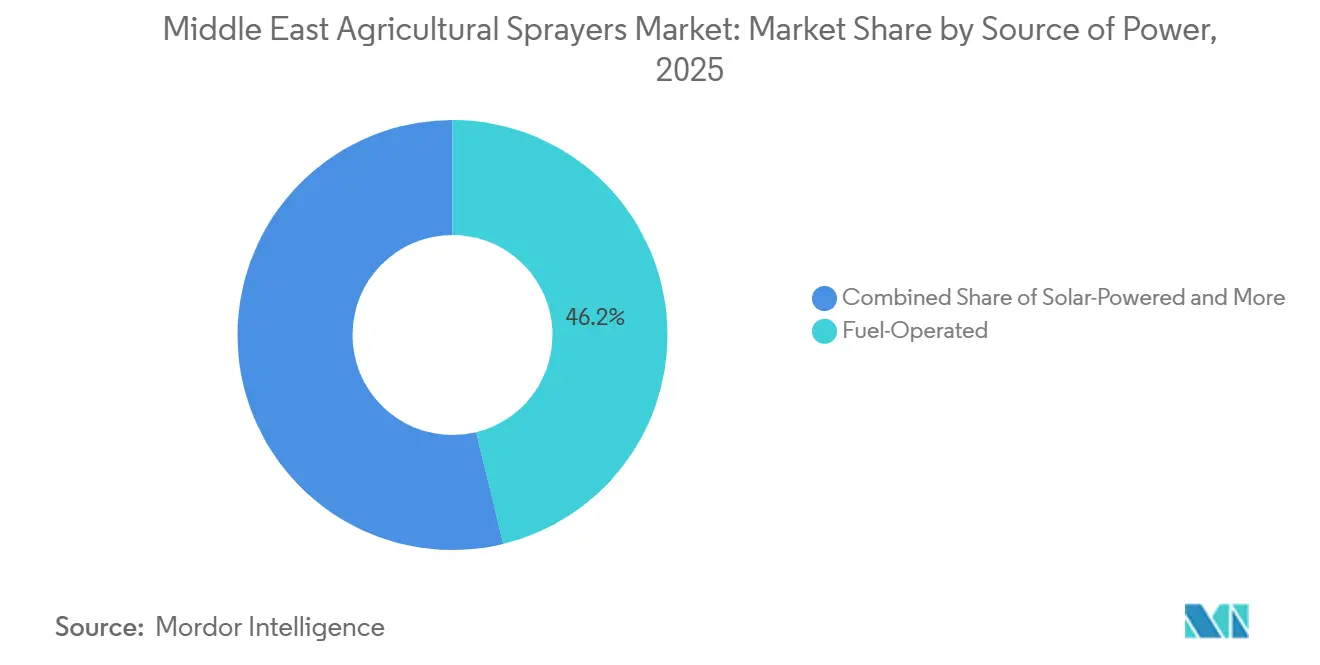
Fuel-operated sprayers held 46.2% of the Middle East agricultural sprayers market share in 2025, supported by their range, runtime, and suitability for large-field operations in Saudi Arabia and the United Arab Emirates. This leadership shows that conventional power systems still fit the scale and workload of the region's main farming belts. Battery-operated, solar-powered, and manual systems remained smaller, but they served distinct use cases in greenhouses, remote plots, and low-mechanization farms.
Solar-powered sprayers are anticipated to post the fastest 8.2% CAGR during 2026-2031, reflecting their suitability for off-grid horticulture and areas where handling diesel is less attractive. The Middle East agricultural sprayers market is supporting this shift because the region has high solar irradiance and a growing need for low-energy spraying options in arid zones. Battery systems are also gaining traction in enclosed environments where emissions and noise matter more. Manual units should persist among smallholders, while fuel-operated machines are likely to remain central for high-throughput field coverage.



By Product Type: Tractor-Mounted Anchors Volume, Unmanned Aerial Vehicle Sprayers Redefine Speed and Reach
Tractor-mounted sprayers accounted for 41.4% of revenue in 2025, giving them the largest share in the Middle East agricultural sprayers market across product types. Their lead reflects the continued role of mechanized cereal and row-crop farming in major agricultural zones. Trailed and self-propelled units also served commercial farms that value tank capacity and boom control, while handheld systems maintained a smaller role in localized horticulture and orchard maintenance.
Unmanned aerial vehicle sprayers are anticipated to expand at a 9.8% during 2026-2031, making them the fastest-growing product group in the Middle East agricultural sprayers market. DJI Technology Co., Ltd. strengthened this category through the Agras T100 platform and wider dealer availability in late 2025. Growth is also supported by service fleet models that enable organized operators to buy in bulk and spray hard-to-access plots more efficiently. Tractor-mounted units are estimated to continue anchoring volume. However, unmanned aerial vehicle systems are transforming the approach to building commercial spraying capacity.
By Application: Field Crops Drive Volume, Orchards and Vineyards Lift Value
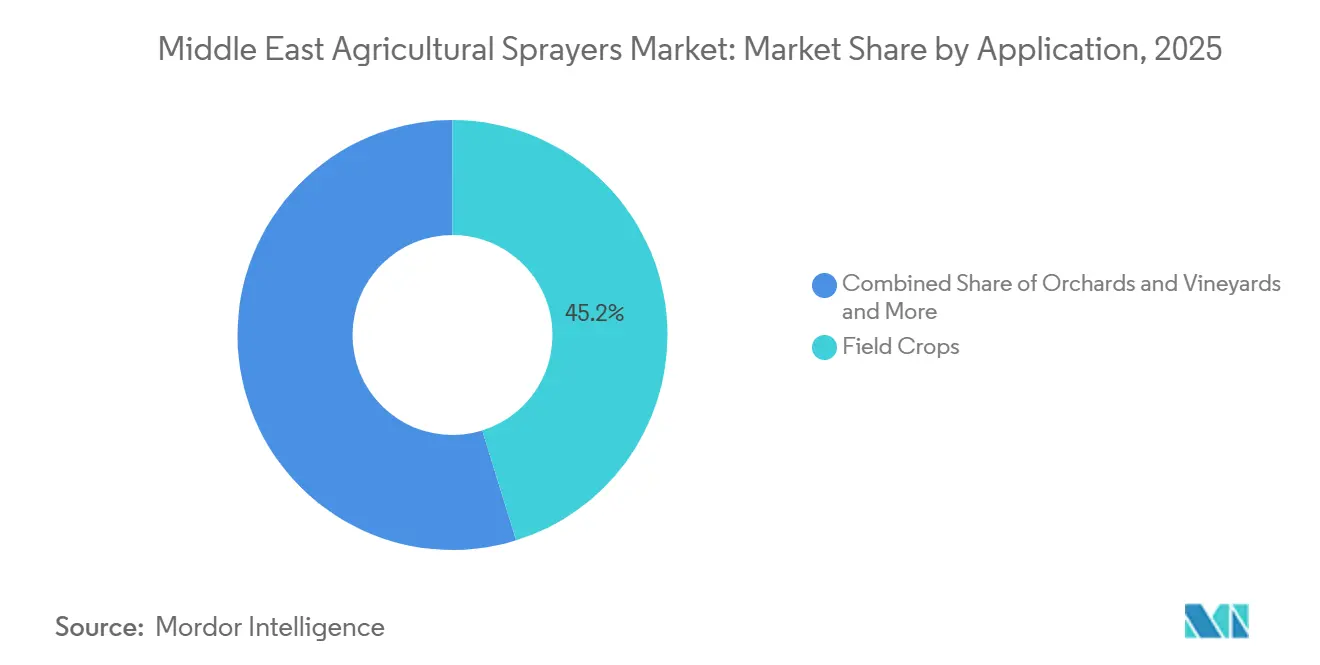
Field crops accounted for 45.2% of revenue in 2025, making them the largest end use in the Middle East agricultural sprayers market. This reflected the volume needs of cereal and alfalfa cultivation across Saudi Arabia. Greenhouse crops, turf, and gardening remained important secondary uses, while orchard-related spraying attracted greater commercial attention as the crop mix gradually shifted toward higher-value horticulture. Large cultivated areas and recurring crop protection requirements further strengthened demand for field spraying equipment.
Orchards and vineyards are anticipated to grow at a 7.4% CAGR during 2026-2031, making them the fastest-expanding application group. This pace is tied to date-palm orchard expansion, citrus production, and the need for low-drift systems in crop environments where precision matters. Greenhouse crops should also continue to advance as controlled-environment farming spreads in Saudi Arabia and the United Arab Emirates. Field crops remain the volume base, but orchard and greenhouse demand is lifting average equipment value and supporting more specialized sprayer configurations. Rising investment in high-value crops is further accelerating the adoption of advanced application technologies.
By Technology Level: Conventional Holds the Base, Artificial Intelligence Systems Set the Pace
The conventional segment accounted for 61.1% of revenue in 2025, maintaining the largest installed base in the Middle East agricultural sprayers market. This position reflects the long operating life of standard equipment in lower-income agricultural zones across the wider region. Global positioning system guided systems already form a growing middle layer, especially on large commercial farms and in controlled-environment operations that value tighter application control. Their continued adoption is supported by lower costs, operational familiarity, and widespread service availability.
AI-enabled and autonomous systems are anticipated to grow at an 8.5% CAGR during 2026-2031, the fastest among technology levels. Ecorobotix SA has shown the direction of travel with plant-level targeting systems, while Deere and Company expanded crop coverage for See and Spray Gen 2 in 2026. Khalifa University's AerialYield platform also demonstrates how aerial analytics and smart-spraying logic are converging in the United Arab Emirates in 2025. Conventional systems should retain scale, but the growth path is clearly moving toward data-driven applications. Increasing labor constraints and the need for precision farming are further supporting adoption across commercial operations.
Geography Analysis
Saudi Arabia accounted for 38.2% of the Middle East agricultural sprayers market share in 2025 and is projected to grow at a 7.5% CAGR during 2026-2031. This positions the country as both the largest and fastest-growing geography in this report. Saudi Arabia benefits from extensive commercial farming operations, robust capital formation, and a policy framework that integrates agricultural modernization with food security objectives under Vision 2030. Water scarcity is a significant commercial driver, as agriculture faces the challenge of increasing output while optimizing input use. The country's annual agricultural water consumption exceeds 17 billion cubic meters, and its plan to meet 90% of water demand through desalination by 2030 underscores the importance of precise application. Consequently, the national market is witnessing simultaneous advancements in conventional fleet scale and the adoption of advanced spraying technologies.
The United Arab Emirates remains the region's most technology-intensive market, particularly in advanced agricultural equipment. Precision agriculture has been promoted through national food security initiatives and broader support for domestic production under water-scarce conditions. In November 2025, Dubai-based advanced air mobility technology company EANAN partnered with Dubai Municipality to demonstrate the practical use of AI-guided drones for spraying in green spaces and agricultural areas.
The remaining countries in the Middle East cluster are smaller and less mechanized. However, they are starting to generate significant demand as investments in greenhouses and controlled-environment agriculture increase. For instance, Oman and Jordan are implementing agricultural investment programs to expand modern farming capacity, which is projected to drive the need for improved spraying systems during the forecast period. The June 2026 Gulf Cooperation Council and International Center for Agricultural Research in the Dry Areas workshop also suggested greater regional alignment around artificial intelligence, Internet of Things tools, and digital farm management, which could support future procurement frameworks. Because development levels vary widely across this cluster, the Middle East agricultural sprayers market rewards suppliers that can offer both entry-level products and higher-specification precision systems rather than relying on one end of the range alone.
Competitive Landscape
The Middle East agricultural sprayers market was moderately concentrated in 2025, with Deere and Company, CNH Industrial N.V., AGCO Corporation, Kubota Corporation, and DJI Technology Co., Ltd. together accounting for a significant share of revenue. Deere and Company accounted for a major share, supported by its precision agriculture ecosystem and established regional channels. CNH Industrial N.V. maintained strong relevance through the Case IH and New Holland lines in tractor-mounted and self-propelled categories. AGCO Corporation and Kubota Corporation also remained important because their portfolios fit the mechanical and replacement needs of commercial farms across the region.
A clear competitive pattern in the Middle East agricultural sprayers market is the shift from equipment-only sales to integrated precision capabilities, software features, and fleet support. Deere and Company reinforced this in January 2026, when it announced the See and Spray Gen 2 for the Model Year 2027 lineup and expanded crop coverage to wheat, barley, and canola. These moves show that technology relevance and route-to-market execution are both central to share retention in the Middle East agricultural sprayers market.
The remaining share of revenue was spread across European specialists and newer precision challengers, which kept competition active below the top tier. Ecorobotix SA had already deployed more than 1,000 ARA ultra-high precision sprayers globally over the past five years, showing that artificial intelligence-based challengers are moving from concept to commercial scale. Even so, dealer coverage, service density, and local partnerships continue to be as important as product innovation. Fragmented geographies penalize suppliers unable to provide post-sale support for machines. Consequently, the Middle East agricultural sprayers market offers opportunities for specialist advancements.
Middle East Agricultural Sprayers Industry Leaders
CNH Industrial N.V.
AGCO Corporation
Kubota Corporation
DJI Technology Co., Ltd.
Deere and Company
- *Disclaimer: Major Players sorted in no particular order

Recent Industry Developments
- January 2026: Deere and Company announced See and Spray Gen 2 for its Model Year 2027 sprayer lineup. The update consolidates previous Select, Premium, and Ultimate tiers into a single unified platform with optional dual-tank and nighttime operation configurations, increasing relevance for high-intensity Middle East spray windows.
- November 2025: Dubai Municipality partnered with a United Arab Emirates-based drone manufacturer, EANAN, to deploy the Gaith AI-guided agricultural drone for precision spray and fertilizer application across municipal agricultural land and green spaces.
- November 2025: DJI Technology Co., Ltd. strengthened this category in 2025 by launching the Agras T100, T70P, and T25P platforms and expanding dealer availability in adjacent regions that supply Middle East demand channels.


Middle East Agricultural Sprayers Market Report Scope
Agricultural sprayers are specialized equipment designed to apply liquid substances, such as fertilizers, pesticides, herbicides, and fungicides, as well as water, evenly and in controlled amounts to crops, plants, and soil.
The Middle East Agricultural Sprayers Market is segmented by Source of Power (Manual, Solar-Powered, Fuel-Operated, and Battery-Operated), by Product Type (Handheld, Tractor-Mounted, Trailed, Self-Propelled, and Unmanned Aerial Vehicle Sprayers), by Application (Field Crops, Orchards and Vineyards, Greenhouse Crops, and Turf and Gardening), by Technology Level (Conventional, Precision and GPS Guided, and AI-Enabled and Autonomous), and by Geography (Saudi Arabia, United Arab Emirates, and Rest of Middle East). The Market Forecasts are Provided in Terms of Value.
| Manual |
| Battery-Operated |
| Solar-Powered |
| Fuel-Operated |
| Handheld |
| Tractor-Mounted |
| Trailed |
| Self-Propelled |
| Unmanned Aerial Vehicle Sprayers |
| Field Crops |
| Orchards and Vineyards |
| Greenhouse Crops |
| Turf and Gardening |
| Conventional |
| Precision and GPS Guided |
| AI-Enabled and Autonomous |
| Saudi Arabia |
| United Arab Emirates |
| Rest of Middle East |
| By Source of Power | Manual |
| Battery-Operated | |
| Solar-Powered | |
| Fuel-Operated | |
| By Product Type | Handheld |
| Tractor-Mounted | |
| Trailed | |
| Self-Propelled | |
| Unmanned Aerial Vehicle Sprayers | |
| By Application | Field Crops |
| Orchards and Vineyards | |
| Greenhouse Crops | |
| Turf and Gardening | |
| By Technology Level | Conventional |
| Precision and GPS Guided | |
| AI-Enabled and Autonomous | |
| By Geography | Saudi Arabia |
| United Arab Emirates | |
| Rest of Middle East |


Key Questions Answered in the Report
What is the 2026 value of the Middle East agricultural sprayers space?
The market is estimated at USD 225.12 million in 2026 and is projected to reach USD 318.81 million by 2031 at a 7.21% CAGR.
Which country leads demand in the region?
Saudi Arabia leads with 38.2% of revenue in 2025 and is also the fastest-growing geography at 7.5% CAGR during 2026-2031.
Which product category is growing the fastest?
Unmanned aerial vehicle sprayers are the fastest-growing product type, with an anticipated 9.8% CAGR during 2026-2031.
Why is precision spraying gaining traction in this region?
Water scarcity, food security programs, and greenhouse expansion are making accurate application more valuable because farms need better control of water and agrochemical use.
Page last updated on:


 Your data is secure and never sold or shared.


