
Market Overview
| Study Period | 2021 - 2031 |
|---|---|
| Forecast Data Period | 2026 - 2031 |
| Base Year Market Size (2025) | USD 0.86 Billion |
| Market Size (2026) | USD 0.91 Billion |
| Market Size (2031) | USD 1.23 Billion |
| Growth Rate (2026 - 2031) | 6.21 % |
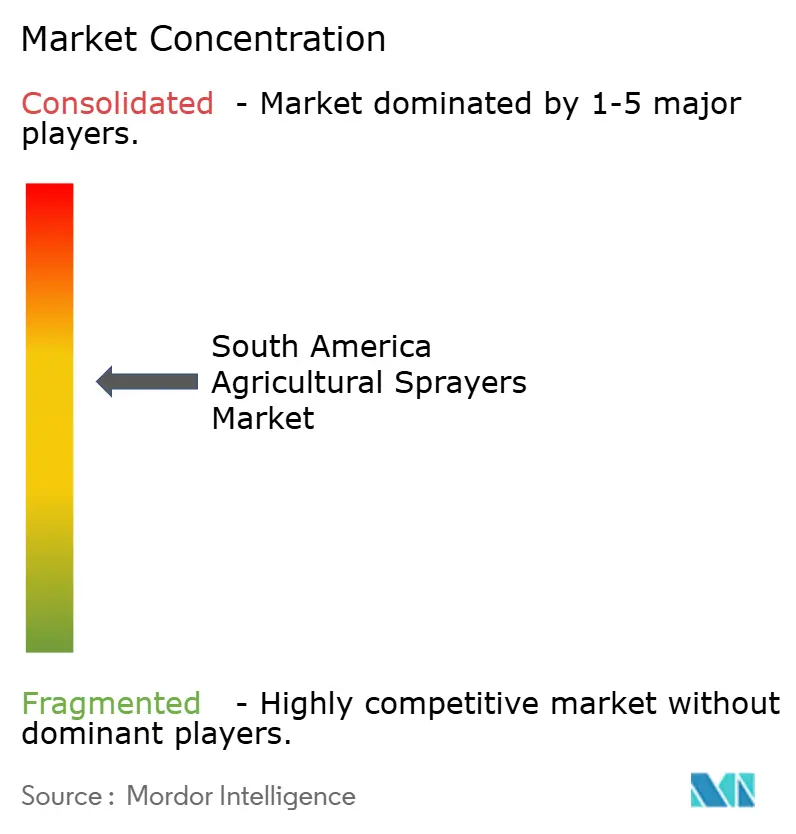
| Market Concentration | Medium |
Major Players *Disclaimer: Major Players sorted in no particular order Image © Mordor Intelligence. Reuse requires attribution under CC BY 4.0. | |
South America Agricultural Sprayers Market Analysis by Mordor Intelligence
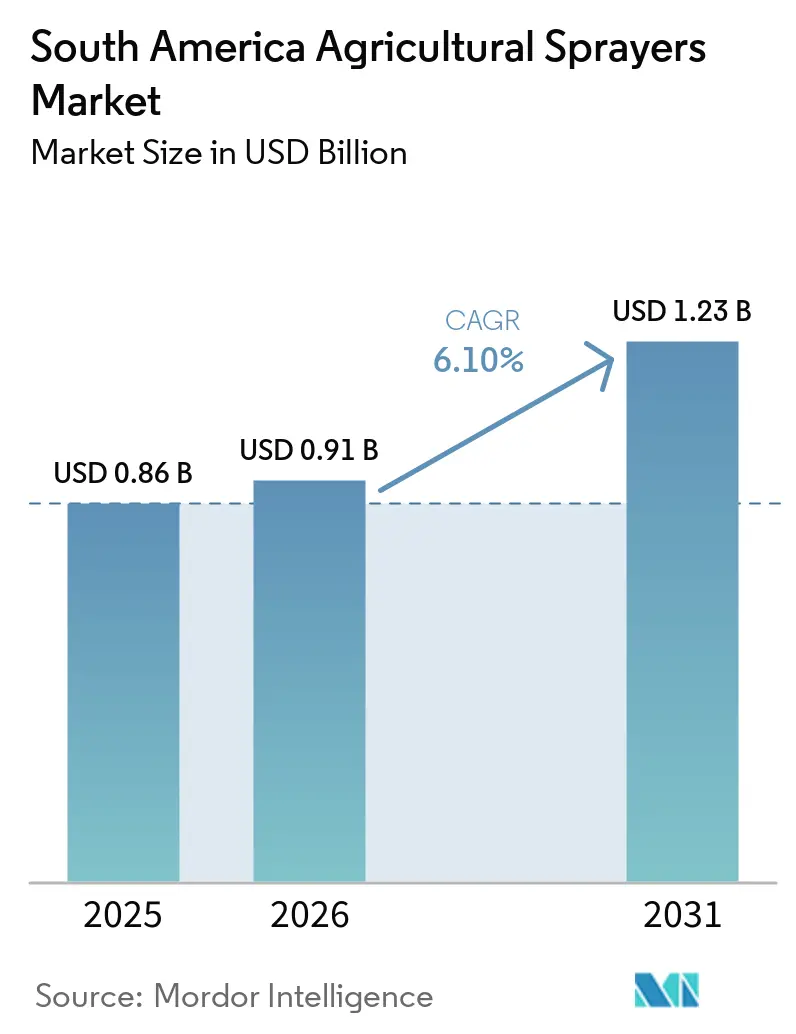
The South America agricultural sprayers market size is expected to grow from USD 0.86 billion in 2025 to USD 0.91 billion in 2026 and is forecast to reach USD 1.23 billion by 2031 at 6.21% CAGR over 2026-2031. The market growth is driven by increased mechanization as farmers address labor shortages and expand soybean cultivation across the region. Brazil’s Moderfrota financing line injected USD 2.46 billion in 2024/25 to modernize machinery fleets, while parallel 4G roll-outs in Argentina now cover 15 million hectares, easing real-time machine guidance across vast row-crop zones.[1] Farmers are adopting precision spraying systems with GPS guidance to reduce chemical usage and improve operational efficiency. Government-supported machinery financing programs and improved digital infrastructure enable real-time equipment monitoring and control. Increased pest pressure and climate variability contribute to market demand, while battery-powered and ultra-low-volume sprayers are gaining popularity due to reduced fuel consumption and lower operational costs. The adoption of efficient and environmentally sustainable farming practices influences equipment selection across South America.
Key Report Takeaways
- By source of power, fuel-operated units led with 45.62% of the South American agricultural sprayers market share in 2025, and battery-operated systems are advancing at a 7.34% CAGR through 2031.
- By usage, field sprayers commanded a 60.35% share of the South American agricultural sprayer market size in 2025, and orchard sprayers are projected to grow at a 6.18% CAGR to 2031.
- By mode of capacity, high-volume equipment accounted for a 51.20% share of the market in 2025, whereas ultra-low-volume technology is expanding at a 6.88% CAGR through 2031.
- By geography, Brazil held a 67.10% share of the market in 2025, and Argentina is growing the fastest with a 7.06% CAGR to 2031.
- Deere and Company, AGCO Corporation, CNH Industrial N.V., Jacto S.A., and Stara S/A together controlled nearly half of the market share in 2025.
Note: Market size and forecast figures in this report are generated using Mordor Intelligence’s proprietary estimation framework, updated with the latest available data and insights as of 2026.
Market Trends and Insights
Drivers Impact Analysis of South America Agricultural Sprayers Market*
| Driver | (~) % Impact on CAGR Forecast | Geographic Relevance | Impact Timeline |
|---|---|---|---|
| Shrinking Rural Labor Pool | +1.8% | Global, with acute impact in Brazil and Argentina | Medium term (2-4 years) |
| Expansion of Soybean Acreage and Agrochemical Intensity | +1.5% | Brazil core, spill-over to Argentina and Paraguay | Long term (≥ 4 years) |
| Government Subsidies for Crop-protection Mechanization | +1.2% | Brazil and Argentina primary, emerging in Colombia | Short term (≤ 2 years) |
| Adoption of GPS-guided Precision Spraying | +0.9% | Brazil and Argentina leading, expanding to Chile and Uruguay | Medium term (2-4 years) |
| Climate-linked Pests and Diseases Pressure Spikes | +0.7% | Global, with varying intensity across sub-regions | Long term (≥ 4 years) |
| Carbon-credit Premiums for Input-efficient Farms | +0.4% | Brazil leading, Argentina following, and early adoption in Chile | Long term (≥ 4 years) |
| Source: Mordor Intelligence | |||
Shrinking Rural Labor Pool
South America's agricultural labor force continues to decline as younger generations move to urban areas and older farmers retire, creating a shortage of skilled operators for complex spraying operations. This workforce reduction has led to increased wages and shorter spraying windows, compelling growers to invest in self-propelled or autonomous machines for extended, efficient operations. Robotic systems that combine scouting and spraying functions are increasing in adoption, offering reduced input costs. Brazil leads the region in agricultural automation, with Argentina following closely. This shift in the regional workforce continues to drive growth in the agricultural sprayers market across South America.
Expansion of Soybean Acreage and Agrochemical Intensity
The rapid expansion of soybean cultivation in South America has intensified the need for crop protection equipment. The presence of diseases such as Asian Soybean Rust requires multiple applications during growing seasons, making efficient and timely spraying crucial. Farmers managing larger fields with limited operational windows are investing in high-capacity sprayers to increase coverage rates. Precision spraying technologies have gained adoption as farmers seek to control costs amid variable commodity prices. These systems enhance application accuracy while reducing waste. The combination of increased acreage and agrochemical requirements continues to support market growth for agricultural sprayers in the region.
Government Subsidies for Crop-protection Mechanization
Government initiatives are accelerating mechanization in South America's agricultural sector. Credit programs and subsidies reduce financing costs and improve capital access for farmers investing in modern spraying equipment.[2] These programs align with agricultural seasonal cash flows, enabling better budget management for producers. Favorable interest rates and loan terms reduce equipment payback periods, encouraging rapid adoption of advanced machinery. This has accelerated fleet modernization and increased the adoption of advanced sprayers. Government support continues to strengthen the agricultural sprayers market across South America.
Adoption of GPS-guided Precision Spraying
GPS-guided spraying systems are becoming standard in South American agriculture. Farmers are implementing digital solutions that enhance chemical application accuracy, decrease input usage, and improve operational efficiency. Modern equipment, including drones and smart sprayers, enables sectional and targeted treatments, reducing environmental impact while improving crop protection effectiveness. Equipment manufacturers are developing hardware with integrated vision systems for real-time control and data-based operations. Satellite partnerships are addressing connectivity issues, expanding digital farming access in remote regions. The increasing adoption of technology continues to drive demand for precision-equipped sprayers.
Restraints Impact Analysis of South America Agricultural Sprayers Market*
| Restraint | (~) % Impact on CAGR Forecast | Geographic Relevance | Impact Timeline |
|---|---|---|---|
| Volatile Farm Income Tied to Soft-commodity Prices | -1.4% | Global, with acute impact in export-dependent regions | Short term (≤ 2 years) |
| High Upfront Cost of Self-propelled Units | -1.1% | Regional, affecting small to medium producers primarily | Medium term (2-4 years) |
| Patchy Rural Broadband Hampers Telematics | -0.8% | Brazil and Argentina core, improving gradually | Medium term (2-4 years) |
| Fuel Price Inflation Raising Operating Costs | -0.6% | Global, with varying impact by operational intensity | Short term (≤ 2 years) |
| Source: Mordor Intelligence | |||
Volatile Farm Income Tied to Soft-commodity Prices
Fluctuating commodity prices affect farm income across South America, creating uncertainty in agricultural equipment investments. Rising global grain stockpiles often lead to price decreases, reducing farmers' margins for machinery upgrades. This financial pressure results in delayed purchases, loan restructuring, and limited credit access for new sprayers. Market momentum can stall even during periods of strong demand due to revenue volatility. These cyclical downturns affect the agricultural sprayers market's growth, making it dependent on commodity trends and rural producers' financial stability.
High Upfront Cost of Self-propelled Units
Self-propelled sprayers require significant financial investment from South American farmers, with costs exceeding annual earnings for many diversified operations. Strict lending requirements limit credit access for smaller producers despite available financing options. Equipment depreciation accelerates due to technological advancements, particularly in crops like sugarcane and cotton. While cooperative ownership and flexible payment options exist, their use remains minimal. These financial constraints limit mechanization progress and agricultural sprayers market growth, especially among small and medium-sized farms unable to manage the initial investment costs.
*Our forecasts treat driver/restraint impacts as directional, not additive. The impact forecasts reflect baseline growth, mix effects, and variable interactions.
South America Agricultural Sprayers Market Segment Analysis
By Source of Power:
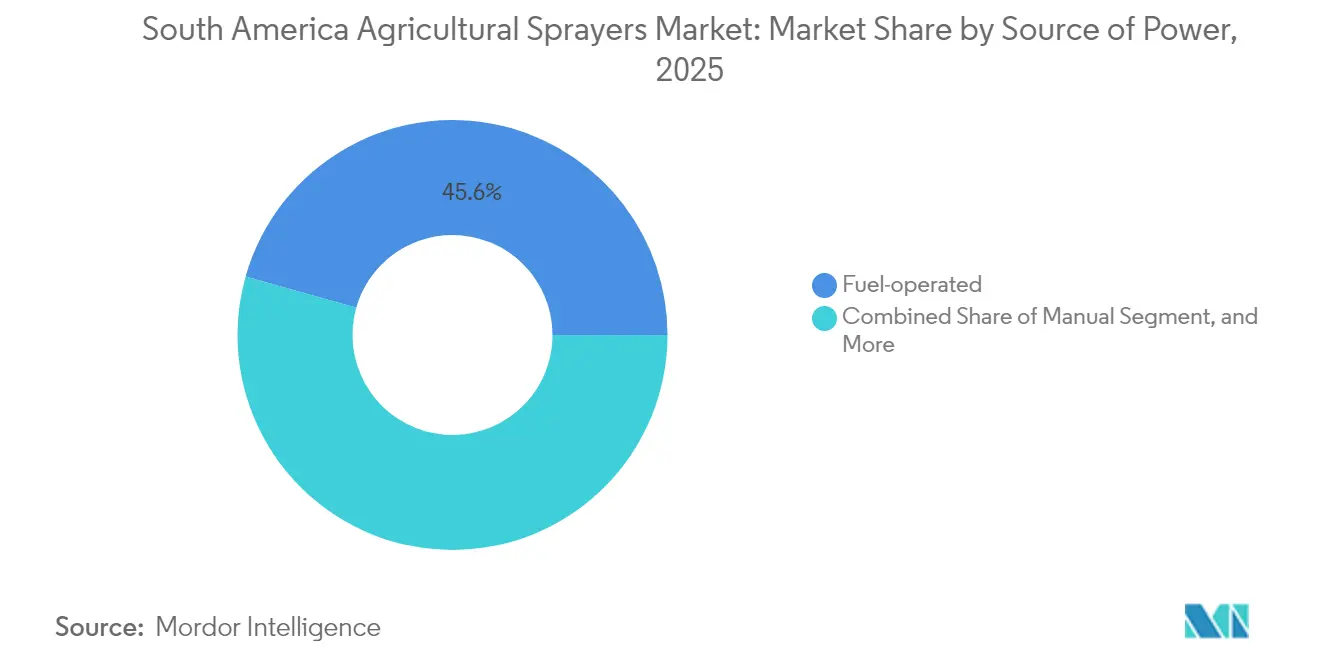
Fuel Dominance Meets Electric InnovationFuel-operated equipment retained 45.62% of the South American agricultural sprayers market share in 2025 because diesel technology offers ample power density and rapid refueling over thousands of hectares of soy and corn. The South American agricultural sprayers market size for battery models, however, is climbing at 7.34% CAGR as large growers test solar-charged fleets to cut fuel costs and qualify for low-carbon premiums.
Autonomous battery sprayers slash herbicide bills and mitigate operator shortages, sharpening their payback profile despite higher acquisition costs. Solar support trailers from Jacto and field-scale charging hubs are addressing range concerns. Manual and solar units still fill niche needs among smallholders or protected-crop growers, but are gradually conceding share to powered alternatives. The power-source mix illustrates the South American agricultural sprayers market evolution toward greener, data-ready solutions.

By Usage:
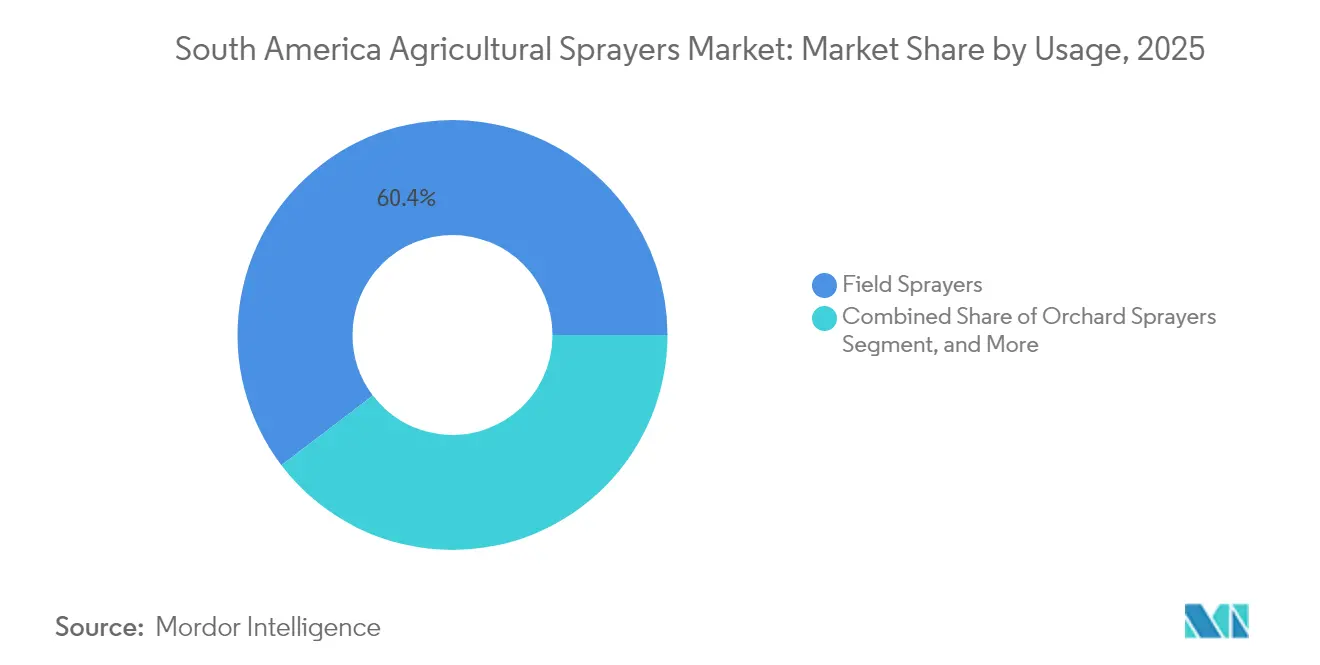
Field Applications Lead Orchard ExpansionField sprayers covered 60.35% of usage in 2025, mirroring the dominance of row crops across Brazil’s Cerrado and Argentina’s Pampas regions. Long-reach booms and 4,000-liter tanks ensure timely coverage across contiguous soybean blocks where a single application can protect yields worth millions of dollars.
Orchard units are advancing at a 6.18% CAGR as specialty fruit acreage grows in Brazil’s south and in Chile’s export corridors. Autonomous GUSS sprayers are undergoing trials for citrus and nut groves, indicating a broader move toward precision canopy treatments. Gardening or greenhouse sprayers remain a stable but small slice, catering to high-value vegetables and floriculture. These divergent growth paths underscore how crop diversification is reshaping demand patterns within the South American agricultural sprayers market.
By Mode of Capacity:
High-Volume Efficiency Versus Ultra-Low PrecisionHigh-volume platforms commanded 51.20% of the South American agricultural sprayers market size in 2025 because large tanks and broad booms reduce downtime and maximize weather windows. Such rigs dominate soybean belts where one missed fungicide pass can trigger steep yield penalties.
Ultra-low-volume systems, growing at 6.88% CAGR, deploy AI cameras and PWM valves to place droplets only where needed, cutting herbicide use by 54.2% in Stara’s Eco Spray field trials. Medium-capacity low-volume rigs still serve mid-scale farms, bridging throughput and precision needs. This capacity spectrum demonstrates how the South America agricultural sprayers market balances productivity and sustainability imperatives.
Geography Analysis
Brazil Agricultural Sprayers Market
Brazil holds 67.10% of South America's agricultural sprayers market share in 2025. This dominance stems from extensive soybean cultivation areas, agricultural credit programs, and increased adoption of domestically manufactured precision spraying systems. While recent economic conditions have temporarily reduced machinery purchases, market growth is anticipated to resume due to equipment replacement needs and sustainability initiatives. The expansion of satellite internet coverage in rural farming regions is improving digital connectivity, enabling broader implementation of precision agriculture practices and strengthening Brazil's position in the regional sprayers market.
Argentina Agricultural Sprayers Market
Argentina shows the highest growth rate at 7.06% CAGR through 2031. This growth is supported by improved digital infrastructure and increased use of drone-assisted spraying technology, which enhances operational efficiency and reduces input costs. Export-linked financing options enable farmers to invest in advanced sprayer systems. The introduction of new equipment with selective spraying features is raising performance standards. The combination of technological innovation, flexible financing, and enhanced network coverage establishes Argentina as an emerging leader in South America's precision agriculture sector.
Andean and Southern Cone Agricultural Sprayers Market
Colombia, Chile, Paraguay, Uruguay, and Bolivia are gradually implementing precision spraying technologies. Chilean orchards are testing autonomous spraying systems, while Paraguayan farmers are addressing weed resistance issues through targeted application methods. Colombia demonstrates potential for increased mechanization through improved crop yields, despite challenges from land fragmentation and limited financing options. These markets, though smaller in scale, present growth opportunities for manufacturers looking to expand their presence and meet the increasing demand for agricultural technology solutions in South America.
Regulatory Landscape
Regulation affecting agricultural sprayers in South America is shaped by machinery safety, environmental, and product-handling rules, with Brazil and Argentina setting much of the compliance baseline. In Brazil, agricultural equipment placed on the market commonly aligns with NR-12 safety requirements and IBAMA-related expectations tied to emissions and noise, while the national machinery registry framework (RENAGRO, created under Decree 11.014/2022) adds traceability for tractors and agricultural machinery used in field operations.
Operational compliance also extends to application methods and mobility. For aerial application, Brazil requires agricultural aircraft and equipment configurations to follow Ministry of Agriculture and Livestock (MAPA) rules, and installation approvals involve the National Civil Aviation Agency (ANAC), which shapes demand for approved models and documented fitments. In Argentina, SENASA oversight of phytosanitary products and related establishments includes updated requirements under Resolution 458/2025, and Decree 273/2025 changed the import pathway for used machinery by removing the CIBU and certain non-automatic licenses, shifting the process toward sworn declarations in the import system alongside phytosanitary clearance for equipment that contacts agro-products.
Competitive Landscape
The South American agricultural sprayers market is moderately consolidated, with the top five suppliers accounting for approximately 62% market share in 2024. Deere & Company holds a significant share, supported by its extensive service network and vision technology integration. AGCO Corporation maintains market presence through its Valtra and Massey Ferguson brands among mid-size agricultural operations, while CNH Industrial N.V. focuses on enhancing connectivity through telecom partnerships and implementing AI-enabled spraying systems.
The market competition has evolved from equipment specifications to software capabilities. Stara S/A and Bosch BASF Smart Farming have introduced precision weed-management systems in South America, integrating camera technology, analytics, and automated dosing systems. The market has also expanded to include companies like Psyche Aerospace, which offers electric drone platforms. This transformation indicates an industry-wide shift toward data-driven application systems that optimize input usage and provide alternatives to conventional ground equipment.
Market expansion opportunities focus on telematics and autonomous systems, with manufacturers developing partnerships with telecommunication providers and implementing cloud platforms to utilize agricultural data. Partnerships with SpaceX, Telecom Argentina, and regional internet service providers enable connectivity in remote agricultural areas. These technological integrations improve equipment performance and strengthen customer relationships through integrated data services, allowing companies to increase long-term customer value in the South American agricultural sprayers market.
South America Agricultural Sprayers Industry Leaders
-
Deere & Company
-
AGCO Corporation
-
CNH Industrial N.V.
-
Jacto S.A.
-
Stara S/A
- *Disclaimer: Major Players sorted in no particular order
South America Agricultural Sprayers Market Companies Covered in this Report
- Deere & Company
- AGCO Corporation
- CNH Industrial N.V.
- Mahindra & Mahindra Limited
- Jacto S.A.
- Stara S/A
- LS Mtron Ltd.
- Sonalika International Tractors Ltd. (ITL)
- Kubota Corporation
- Bucher Industries AG (KUHN Group)
- EXEL Industries SA
- Guarany Indústria Ltda.
- Implementos Agrícolas Jan S.A.
- Baldan Implementos Agrícolas S/A
- Andreas STIHL AG & Co. KG
Read Analysis of South America Agricultural Sprayers Companies
Market Opportunities and Future Outlook
Adoption headroom is concentrated in precision and autonomy packages that reduce chemical use and labor dependency across large row-crop operations. Field evidence already embedded in manufacturer roadmaps supports this: camera-based selective spraying has moved from trials into commercial offerings (for example, spot-spray systems launched by Stara and smart-spray manufacturing investments by Deere in Goias), creating whitespace for retrofits, software subscriptions, and dealer-led service models that keep older high-volume fleets productive while meeting sustainability and input-efficiency goals.
A second opportunity cluster is the convergence of connectivity and aerial application with conventional ground sprayers. Brazil has formal rules for agricultural drones (including Ordinance No. 298, 2021 and RBAC-E No. 100), and the national drone fleet expanded sharply from around 3,000 units in 2021 to about 35,000 by 2025, which signals a fast-growing installed base that needs compatible tank-mix practices, digital prescription workflows, and integrated agronomy services. At the same time, manufacturers are investing in localized manufacturing and capability upgrades in Brazil (for example, CNH/New Holland announced over BRL 100 million to nationalize Draper platform production in Curitiba, with production starting in the second half of 2026), improving parts availability and dealer readiness for higher-spec sprayers and precision add-ons as farms modernize through programs such as Brazil’s Moderfrota machinery financing line.
Recent Industry Developments in South America Agricultural Sprayers Market
- May 2026: Jacto launched the Arbus 4000 JAV autonomous sprayer at Agrishow 2026 in Brazil. The launch put autonomy into a mainstream self-propelled platform and highlighted remote operation concepts that raise hectares covered per operator during tight spray windows. It also intensified competitive focus on safety, connectivity, and software integration in high-capacity field sprayers.
- February 2025: Stara S/A launched the Eco Spray spot spraying system integrated into the Imperador 3000 and 4000 sprayers. The AI-camera and sensor-based system targets weeds selectively to reduce agrochemical consumption and operating costs. This accelerated the shift from boom width and tank size differentiation toward computer vision and variable-rate control as purchase criteria.
- April 2024: Deere & Company began production of its See & Spray Select smart spraying technology at an expanded factory in Goias following an investment of over USD 120.7 million. The system uses computer vision and machine learning for targeted herbicide application to cut overall chemical use. Local production improved availability and service support for precision spraying upgrades across key Brazilian row-crop regions.
South America Agricultural Sprayers Market Report Scope and Research Methodology
Market Definition and Coverage
This market covers equipment used to apply crop protection chemicals and liquid nutrients on farms across South America, counted on a revenue basis from sprayer sales across the region.
Scope exclusions: It excludes agrochemicals, spare parts and consumables, standalone spraying services, and non-agricultural use cases such as municipal pest control.
Segments Covered in This Report
- By Source of Power
- Manual
- Battery-operated
- Solar
- Fuel-operated
- By Usage
- Field Sprayers
- Orchard Sprayers
- Gardening Sprayers
- By Mode of Capacity
- Ultra-Low Volume
- Low Volume
- High Volume
- By Geography
- Brazil
- Argentina
- Rest of South America
Data Sources, Market Sizing, and Validation
Desk Research
Desk work starts with building the demand map and the operating context for spraying in South America, then narrowing it to the equipment categories that match our market definition. Public and official sources such as FAOSTAT, national agriculture ministries and statistics offices (for example IBGE in Brazil), UN Comtrade trade data, and customs or tariff schedules help us track planted area, crop mix, and trade-linked signals for machinery flows.
We also review manufacturer annual reports, investor presentations, product catalogs, and distributor announcements to understand product positioning and typical price bands by configuration. Patent databases and peer-reviewed agronomy journals help sanity check technology shifts like precision spraying, drift reduction, and electrification trends that can change replacement cycles. Where needed, we add paid database subscriptions for company financials and intelligence, import and export shipment-level checks, and a patent search layer to fill gaps that are difficult to close using public data alone. These desk research inputs are not exhaustive, and many other public documents were also used for data collection, validation, and clarification.
Primary Interviews and Surveys
We use interviews and surveys with manufacturers, dealers, distributors, farm operators, and crop advisers active across South America. Respondents help clarify country-level demand differences, equipment prices, replacement timing, dealer inventory, and gaps between trade data and farm purchases. Their input is compared with crop and customs indicators, and respondents are re-contacted when answers conflict with those records.
Distribution of primary research fieldwork respondents
| Company type | Respondent position |
|---|---|
| Top tier: 28% | CXOs: 15% |
| Mid tier: 47% | Functional/Unit leaders: 35% |
| Smaller Players: 25% | Managers: 50% |
Market-Sizing & Forecasting
The core model is built using a top-down demand pool assessment, where crop area and farming intensity indicators are translated into an equipment need for spraying, then converted into value using typical price bands by sprayer format and power source. To keep results grounded, we test the totals with selective bottom-up approximations, including supplier and channel checks on unit movement, sampled average selling price ranges, and country-level splits.
Inputs that matter for this market include cultivated area in major row crops and orchards, mechanization penetration, replacement cycles by sprayer type, financing and credit availability for farm machinery, and the adoption rate of precision or low-drift spraying features. Country dynamics are handled explicitly because Brazil and Argentina can shift the regional total when planting decisions, currency, or access to credit change.
For forecasting, we use scenario analysis supported by a regression-style view of key drivers, so the outlook tracks crop area trends, expected farm income direction, and equipment affordability under different currency and interest rate paths. When bottom-up checks are incomplete in smaller countries, gaps are handled through calibrated ratios tied to crop footprint and import patterns, then reviewed again with primary feedback before finalizing the series.
Data Validation & Update Cycle
Validation is done in layers so the numbers stay explainable and consistent. Model outputs are compared against independent signals such as agricultural machinery import movement, planted area changes, and reported farm equipment demand sentiment, and any variance beyond a reasonable band is flagged for review.
Before sign-off, another analyst reviews key assumptions, unit-to-value conversions, and country splits, and outliers are traced back to the original input used. Reports are refreshed annually, and interim updates are triggered when major events occur, such as abrupt currency swings, policy shifts in farm credit, or step-changes in planting decisions. Right before delivery, we run a final pass to make sure clients receive the most current view available.
Mordor Intelligence's South America Agricultural Sprayers Market Estimate Compared With Other Published Estimates
Published market values for agricultural sprayers in South America can look different because each publisher selects its own year and currency timing, and defines what counts as a sprayer sale versus adjacent items. Differences also show up when one estimate leans more on trade values while another leans more on farm-level demand signals, which changes how replacement demand is treated.
The main gap drivers are scope and conversion logic, where some estimates fold in parts, service, or broader farm machinery bundles, and others apply a single price trend across countries without reflecting local financing cycles. The comparison also considers refresh timing, since exchange-rate swings and seasonal buying patterns can shift the USD value materially from one update window to another. That is why the market sizing approach used in this study stays tied to crop mix and replacement behavior, with currency timing aligned to the base year near the end of the build, a step applied by Mordor Intelligence.
Benchmark comparison
| Source | Market Size | Gaps in Research Methodology |
|---|---|---|
| Mordor Intelligence | USD 0.86 B (2025) | |
| Regional Consultancy A | USD 0.53 B (2024) | Uses an earlier base year and a tighter product set that appears to undercount large farm purchases, and the USD conversion timing is not clearly aligned to seasonal buying and currency volatility. |
| Trade Journal B | USD 0.75 B (2031) | Publishes a forward-year value without showing a full bridge from crop area, replacement cycles, and pricing, which can compress the role of financing-driven replacement demand across Brazil and Argentina. |
The spread across sources mostly comes from year choice and what gets counted inside the equipment scope, followed by how currency and price changes are carried through the forecast. By tying the model to repeatable demand indicators and then checking results with channel and supplier feedback, we keep the final series balanced and easier to audit over time.
Key Questions Answered in the Report
What is the current South America agricultural sprayers market size, and how is it projected to grow by 2031?
It stands at USD 0.91 billion and is on track for USD 1.23 billion by 2031 at 6.21% CAGR (2026-2031).
Which country dominates demand for crop sprayers across South America?
Brazil leads with 67.10% share, driven by vast soybean acreage and subsidized machinery credit.
What is the fastest-growing product category in regional spraying equipment?
Battery-operated sprayers are expanding at 7.34% CAGR due to lower fuel use and carbon-credit incentives.
What is the main restraint on sprayer investment in the region?
Volatile commodity prices and high interest rates compress margins and delay capital purchases, especially for self-propelled units.
Which segment shows the highest market share by capacity?
High-volume sprayers hold 51.20% share because they maximize field coverage during narrow spray windows.