
Market Overview
| Study Period | 2021 - 2031 |
|---|---|
| Forecast Data Period | 2026 - 2031 |
| Base Year Market Size (2025) | USD 421 Million |
| Market Size (2026) | USD 484.66 Million |
| Market Size (2031) | USD 981.65 Million |
| Growth Rate (2026 - 2031) | 15.16 % |
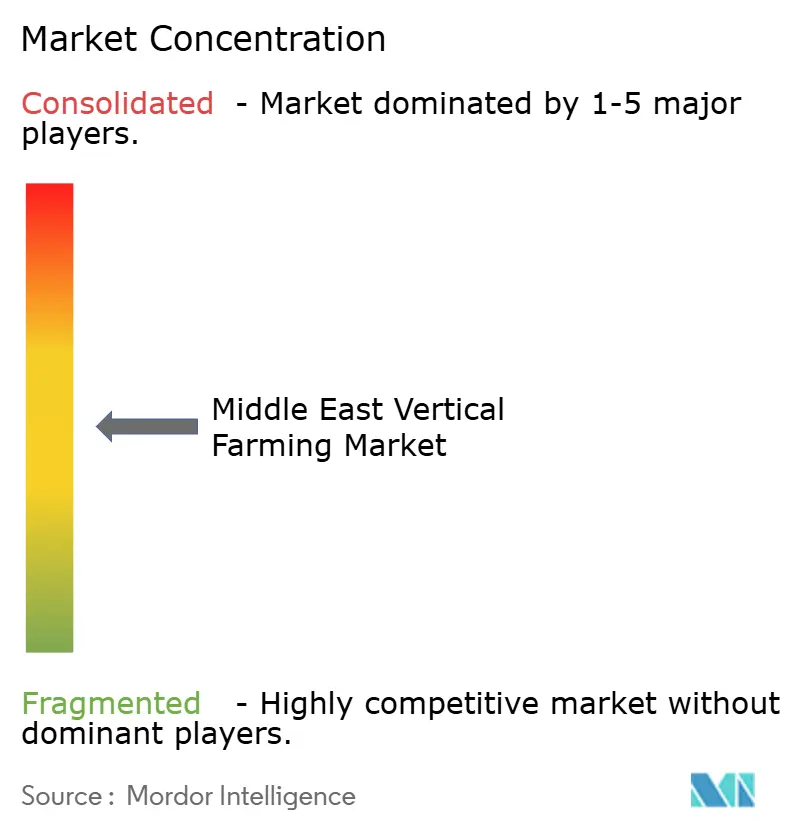
| Market Concentration | Medium |
Major Players *Disclaimer: Major Players sorted in no particular order Image © Mordor Intelligence. Reuse requires attribution under CC BY 4.0. | |
Middle East Vertical Farming Market Analysis by Mordor Intelligence
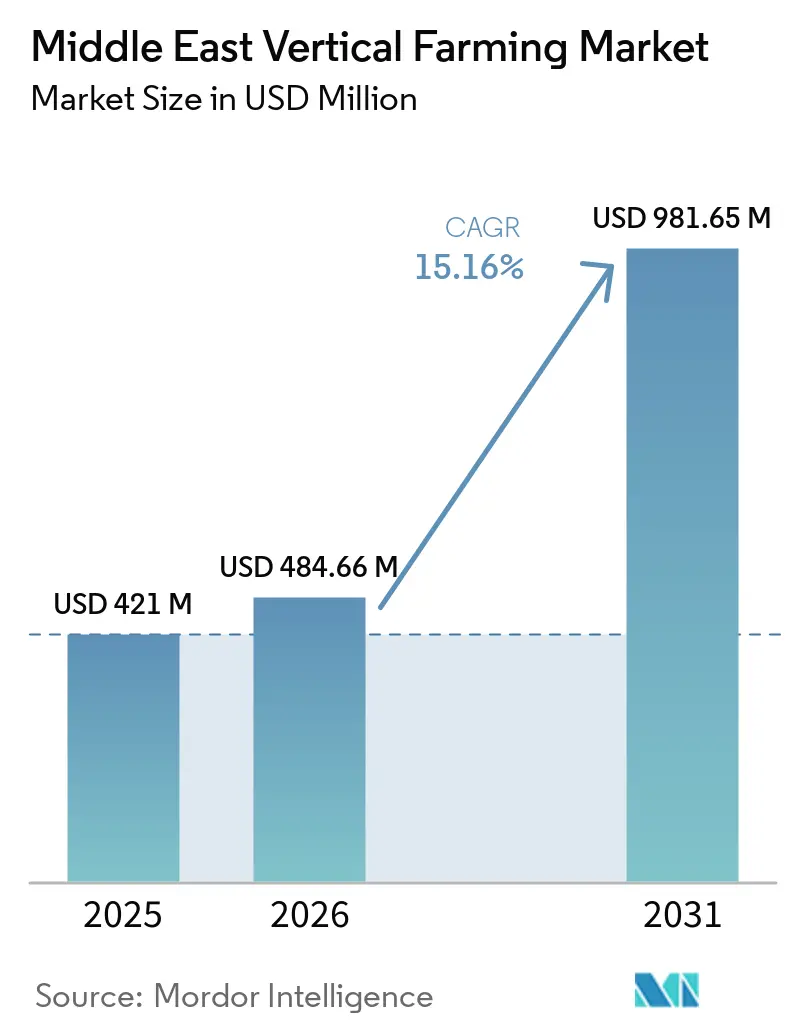
The Middle East vertical farming market size in 2026 is estimated at USD 484.66 million, up from the 2025 value of USD 421.0 million, with projections to USD 981.65 million in 2031, growing at a 15.16% CAGR over 2026-2031. Government support, sovereign wealth investments, and increasing consumer demand for traceable produce drive the market growth in the region. The Gulf Cooperation Council (GCC) states recognize water scarcity as a critical challenge, making indoor hydroponic systems an essential solution, as they consume 95% less water than traditional farming methods. The region's economic diversification initiatives direct both public and private investments toward agricultural technology, establishing vertical farming as a key component of national food security plans. Sovereign wealth funds are investing through minority stakes and acquisitions to gain operational expertise, while retailers allocate space for premium locally grown produce. The market's increasing competition drives operators to focus on automation and energy-efficient solutions to reduce operational costs and offset high capital and electricity expenditures.
Key Report Takeaways
- By growth mechanism, hydroponics held 59.84% of the Middle East vertical farming market share in 2025, whereas aeroponics is advancing at a 15.55% CAGR through 2031.
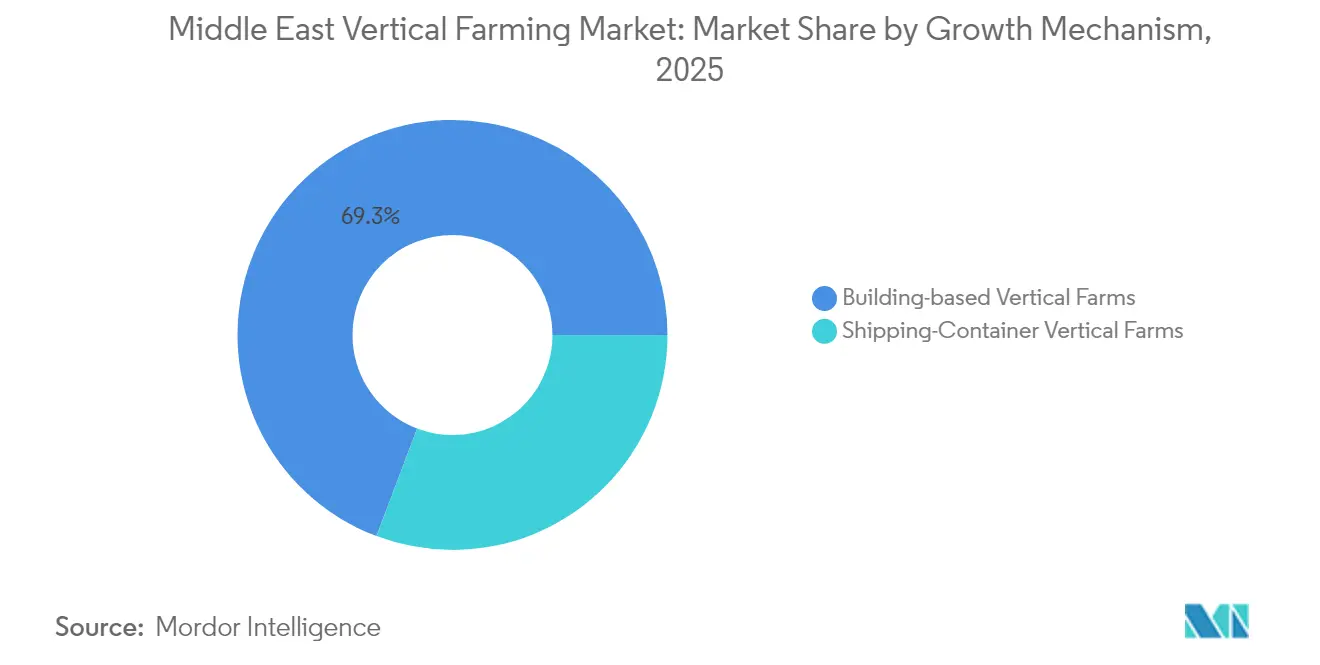
- By Structure, building-based vertical farms accounted for 69.25% of the Middle East vertical farming market size in 2025, yet shipping-container systems are moving ahead at a 12.76% CAGR on the back of hospitality and campus demand.
- By crop type, fruits and vegetables led with 47.35% revenue share in 2025, and herbs and micro-greens are rising at an 11.62% CAGR to 2031.
- Geographically, Saudi Arabia captured a 40.42% share of the market in 2025, while the United Arab Emirates recorded the fastest trajectory at 13.23% CAGR.
- The top five companies, such as Pure Harvest Smart Farms Ltd., Bustanica (Emirates Crop One LLC), AeroFarms, Madar Farms, and VeggiTech Hydroponic Technologies Private Limited (SNASCO Holding Company), together commanded 45.9% revenue in 2024, signaling moderate consolidation and leaving room for scale-driven mergers.
Note: Market size and forecast figures in this report are generated using Mordor Intelligence’s proprietary estimation framework, updated with the latest available data and insights as of 2026.
Market Trends and Insights
Drivers Impact Analysis of Middle East Vertical Farming Market*
| Driver | (~) % Impact on CAGR Forecast | Geographic Relevance | Impact Timeline |
|---|---|---|---|
| Favorable Food-security Mandates by Governments | +3.2% | UAE, Saudi Arabia, Qatar core with spillover to Kuwait, and Oman | Medium term (2-4 years) |
| Water-saving Potential | +2.8% | Global across all Middle East markets | Long term (≥ 4 years) |
| Rapid Retail Adoption of Locally Branded “Zero-mile” Produce | +2.1% | UAE, Saudi Arabia with early gains in Dubai, Riyadh, and Jeddah | Short term (≤ 2 years) |
| Integration of IoT-driven Climate Control Platforms | +1.9% | UAE, Saudi Arabia, and Qatar with technology transfer to other markets | Medium term (2-4 years) |
| Expansion of Public–private Mega Farm Projects | +2.4% | Saudi Arabia, UAE core with expansion to Jordan | Long term (≥ 4 years) |
| Modular Farm-as-a-service Models for Hotels and Campuses | +1.7% | UAE, Qatar, and Bahrain with hospitality sector concentration | Short term (≤ 2 years) |
| Source: Mordor Intelligence | |||
Favorable Food-security Mandates by Governments
Middle Eastern governments are integrating vertical farming into national food strategies to reduce dependence on imports and protect food systems from geopolitical disruptions. The United Arab Emirates' food security plan includes specific targets for controlled-environment agriculture, while Saudi Arabia's development vision allocates public investment to indoor farming projects. These policies simplify licensing and customs procedures for farm inputs while providing concessional financing through agricultural banks. Regional climate initiatives have increased funding for sustainable farming systems. Regulatory authorities now provide expedited certification for nutrient solutions meeting sustainability standards.
Water-saving Potential
Water scarcity in the Gulf region has positioned vertical farming as a practical solution for sustainable agriculture. These systems utilize recirculating hydroponics and closed-loop nutrient systems to reduce water consumption and eliminate runoff, meeting environmental regulations. With traditional methods like cloud seeding showing limited effectiveness, policymakers are prioritizing hydroponic technologies for consistent water conservation. New developments, such as renewable energy-powered root-zone cooling systems, are being tested to decrease water usage in high-value crops. These methods demonstrate both resource efficiency and commercial feasibility in arid environments.
Rapid Retail Adoption of Locally Branded “Zero-mile” Produce
Middle Eastern retailers are incorporating vertical farming to provide fresh, traceable produce that appeals to consumers. Supermarkets include harvest time information on products, increasing transparency and enabling premium pricing while maintaining sales. Airline catering operations use pesticide-free greens, introducing travelers to local produce options. Hotel groups are implementing modular farming systems to ensure a consistent supply and quick delivery. Market research shows consumers prefer locally grown vertical farm produce, influenced by environmental considerations and product freshness. This retail adoption is establishing vertical farming as an essential component of urban food supply chains.
Expansion of Public–private Mega Farm Projects
Major vertical farming facilities are developing as key projects supporting national food production objectives. The Saudi Ministry of Environment, Water, and Agriculture has implemented a vertical farming program in Riyadh to support sustainable agriculture goals.[1] These operations combine waste recycling, modern cultivation methods, and educational programs to develop regional expertise. Saudi Arabia's Public Investment Fund works with international agricultural technology companies to establish indoor farms across various regions, with government support through land allocation and energy subsidies. NEOM's technology center provides testing facilities for new companies to evaluate technologies in desert environments.
Restraints Impact Analysis of Middle East Vertical Farming Market*
| Restraint | (~) % Impact on CAGR Forecast | Geographic Relevance | Impact Timeline |
|---|---|---|---|
| High Capex per Meter Square Relative to Greenhouse Alternatives | -2.1% | Across all Middle East markets | Medium term (2-4 years) |
| Scarce Regional Skill for Controlled-environment Agronomy | -1.8% | Saudi Arabia, Jordan with limited impact in UAE, and Qatar | Long term (≥ 4 years) |
| Import Dependence on Nutrient Solutions and Substrates | -1.4% | Across all Middle East markets with particular impact on smaller markets | Short term (≤ 2 years) |
| Fragmented Cold-chain Logistics for Micro-greens | -1.2% | UAE, and Saudi Arabia core markets with distribution challenges | Medium term (2-4 years) |
| Source: Mordor Intelligence | |||
Scarce Regional Skill for Controlled-environment Agronomy
The Middle East faces a significant talent shortage in controlled-environment agriculture, despite recent capacity-building efforts.[2] Academic institutions lack specialized curricula, forcing operators to rely on foreign consultants for managing advanced systems. This dependence increases operational costs and impedes long-term sustainability. Training effectiveness suffers due to language barriers, while immigration policies restrict skilled growers from long-term residency and contribution. Vertical farming ventures struggle to scale efficiently without a robust local talent pipeline. The region requires coordinated investments in education, vocational training, and policy reform to develop local expertise in agricultural innovation.
Fragmented Cold-chain Logistics for Micro-greens
The regional logistics systems lack optimization for delicate produce like micro-greens, which require specific delivery conditions to maintain freshness. Third-party networks primarily serve bulk commodities, leading to temperature variations that reduce shelf life. Farms must operate their own refrigerated vehicles, increasing last-mile delivery costs and limiting growth potential. Cross-border trade faces restrictions due to inconsistent food-safety documentation requirements among neighboring countries, reducing market access.[3] The development of the vertical farming market requires standardization of regulations and improvements in cold-chain infrastructure.
*Our forecasts treat driver/restraint impacts as directional, not additive. The impact forecasts reflect baseline growth, mix effects, and variable interactions.
Middle East Vertical Farming Market Segment Analysis
By Growth Mechanism:
Hydroponics Leads Despite Aeroponic InnovationHydroponics accounted for 59.84% of the Middle East vertical farming market share in 2025, driven by its operational predictability and established nutrient solutions. The method benefits from developed supply chains and widespread technical expertise, particularly in Saudi Arabia and the United Arab Emirates. The segment attracts investment due to shorter payback periods and reliable yields. The scalability of hydroponic systems appeals to commercial and institutional stakeholders focused on food security.
The aeroponic segment is projected to grow at a 15.55% CAGR through 2031. Its misting technique improves oxygen absorption, resulting in faster plant growth and higher yields. The method uses approximately 10% less water than hydroponics, addressing regional water scarcity concerns. Research institutions and restaurants are testing aeroponic systems with desert-adapted crops. Aquaponics remains a small segment but is growing among premium market consumers due to its circular system benefits.

By Structure:
Building-based Dominance Faces Container DisruptionBuilding-based vertical farms facilities represented 69.25% of the Middle East vertical farming market size in 2025, reflecting the advantages of large-scale operations. These facilities incorporate nutrient mixing systems, automation, and renewable energy infrastructure, enabling consistent production costs and efficient operations. The facilities support centralized distribution and food safety compliance, making them suitable for supermarket chains and institutional customers. The prevalence of building-based farms indicates market confidence in permanent infrastructure investments.
Shipping-container vertical farms are growing at a 12.76% CAGR, providing flexibility in deployment. Their modular design reduces regulatory requirements and enables quick installation in urban areas. Hotels and specialty retailers are installing container units for direct cultivation, reducing transport costs. These systems include remote monitoring capabilities and data analytics features, attracting technology-focused operators. The mobility of container farms provides operational flexibility in regions with uncertain property markets and infrastructure limitations.
By Crop Type:
Fruits and Vegetables Lead While Herbs Show Premium GrowthFruits and Vegetables generated 47.35% of revenue in 2025, establishing their position as the primary vertical farming crop category. Lettuce, kale, and arugula are preferred for their quick-growing cycles, allowing multiple harvests per year. This production pattern ensures a consistent supply to retail and food service customers, building market stability. The segment provides operators with predictable income streams and efficient production processes.
Herbs and micro-greens are experiencing growth due to higher price points and culinary demand. These products are popular among restaurants and luxury hospitality venues for their intense flavors and freshness guarantees. The segment's 11.62% CAGR through 2031 reflects increasing demand for local, traceable produce that meets sustainability requirements. Flower and ornamental cultivation provides seasonal revenue opportunities, particularly during cultural events, while adherence to traceability standards enables regional export opportunities.
Geography Analysis
Saudi Arabia Vertical Farming Market
Saudi Arabia accounts for 40.42% of the Middle East vertical farming market size in 2025, supported by comprehensive government policies. The development of vertical farms in Riyadh and Jeddah benefits from government subsidies on land and utilities, facilitating rapid expansion. The partnerships between government-affiliated food companies and private operators ensure financial stability and guaranteed demand. The regulatory framework, including resource-efficiency certifications and agricultural incentives, strengthens investor confidence and promotes foreign technology adoption in the country's agritech sector.
United Arab Emirates Vertical Farming Market
The United Arab Emirates demonstrates the highest growth rate at 13.23% CAGR through 2031, driven by innovation policies and startup development. Government programs facilitate integration between farms, technology providers, and logistics centers. Efficient licensing and import procedures minimize operational barriers, while dedicated funding initiatives address early-stage financing needs. The United Arab Emirates' focus on sustainability and circular economy principles, including food waste composting, establishes it as a regional pioneer in agricultural technology and urban farming.
MEA Vertical Farming Market
Other Middle Eastern countries display varying degrees of market development. Qatar implements smart-farm systems combining data analytics with efficient climate control. Bahrain and Oman are developing controlled-environment agriculture capabilities while addressing logistics and supply-chain challenges. The expansion of expertise and infrastructure across Gulf Cooperation Council centers is anticipated to accelerate regional adoption through knowledge transfer and collaborative initiatives.
Regulatory Landscape
Regulation for vertical farming in the Middle East is led by national food-safety and import control regimes, with the UAE Federal Law Concerning Food Safety serving as a key compliance anchor for pesticide-free leafy greens, packaged salads, and other fresh produce entering modern retail and food service. Across GCC markets, licensing and permitting for controlled-environment agriculture is increasingly linked to national food-security agendas. Authorities have also used expedited procedures for imported inputs, such as nutrient solutions, when documentation aligns with sustainability and safety requirements.
In the UAE, the Ministry of Climate Change and Environment (MOCCAE) and the FAO hosted the July 2026 "Legislations of the Future" workshop to accelerate modernization of agriculture regulation, including mechanisms such as regulatory sandboxes for agritech trials. The shift toward test zones and faster administrative processing supports operators running trials of cultivation methods such as hydroponics and aeroponics, alongside automation deployments. It also pushes the region toward more standardized compliance requirements that can reduce friction in cross-emirate and cross-border distribution.
Competitive Landscape
Pure Harvest Smart Farms Ltd., Bustanica (Emirates Crop One LLC), AeroFarms, Madar Farms, and VeggiTech Hydroponic Technologies Private Limited (SNASCO Holding Company) collectively held 45.9% market revenue in 2024. The Middle East vertical farming market maintains moderate concentration, with Pure Harvest Smart Farms and Bustanica as primary market leaders. Pure Harvest's adoption of a farm-as-a-service model has expanded its market presence and established recurring revenue streams, reducing its reliance on infrastructure projects. Bustanica utilizes its parent company's logistics network for broad retail distribution, demonstrating the benefits of integrated supply chains.
AeroFarms AgX in Abu Dhabi functions as a regional research and development center, performing cultivar trials to enhance commercial farm operations. iFarm's strategic move to the United Arab Emirates highlights the region's strong intellectual property protection and favorable funding environment. Crysp Farms has developed a specialized market position in hospitality through container farms combined with chef training programs, improving customer retention and product freshness.
Small-scale operators encounter difficulties with expansion and increasing operational expenses. This has resulted in increased merger and acquisition activity, while investors prefer revenue-linked financing structures. Companies distinguish themselves through energy-efficient systems, automated harvesting technologies, and climate-adapted seed varieties. Blockchain-based traceability systems are increasing in adoption, providing product recall capabilities and supporting premium positioning for health-conscious consumers.
Middle East Vertical Farming Industry Leaders
-
Pure Harvest Smart Farms Ltd.
-
Bustanica (Emirates Crop One LLC)
-
AeroFarms
-
Madar Farms
-
VeggiTech Hydroponic Technologies Private Limited (SNASCO Holding Company)
- *Disclaimer: Major Players sorted in no particular order
Middle East Vertical Farming Market Companies Covered in this Report
- AeroFarms
- Madar Farms
- Bustanica (Emirates Crop One LLC)
- Pure Harvest Smart Farms Ltd.
- VeggiTech Hydroponic Technologies Private Limited (SNASCO Holding Company)
- Badia Farms (Gulf Islamic Investments)
- Geap Group (Oasis Greens)
- Armela Farms
- GreenFactory Emirates
- Mowreq Specialized Agriculture Co.
- iFarm Corp.
- Vertical Field Ltd.
- Emirates Hydroponics Farms
Market Opportunities and Future Outlook
National food-security programs and administrative reform are creating room for scaled, compliant indoor production that can replace a larger share of imported fresh produce in high-consumption urban corridors. In the UAE, MOCCAE-linked efforts include a stated goal of cutting licensing timelines for new agritech ventures (as referenced in July 2026 coverage). A regulatory sandbox model for agritech trials also supports pilots that require temporary approvals for novel inputs, crop protocols, and digital monitoring platforms.
Commercial opportunity is also showing up in route-to-market integration and new demand channels. Emirates Flight Catering fully acquired the facility previously known as Emirates Crop One and rebranded it as Bustanica in February 2024, reinforcing vertical farming as a dedicated infrastructure asset tied to aviation catering and local retail distribution. Demand is supported by the continued move toward direct-to-consumer and rapid grocery delivery partnerships, alongside retailers promoting traceable "zero-mile" produce. Operators' focus on energy efficiency and automation also aligns with the region's elevated electricity costs and capex intensity.
Recent Industry Developments in Middle East Vertical Farming Market
- June 2026: Pure Harvest Smart Farms initiated internal testing of the Sweetloom heirloom tomato variety at its UAE facilities ahead of potential retail listing. The testing expands the product pipeline beyond core leafy greens and moves into premium, controlled-environment vine crops. It also reinforces operators' emphasis on cultivar and SKU innovation as they compete for differentiated shelf space.
- March 2025: Bustanica expanded distribution channels through a partnership with Careem Groceries, enabling direct-to-consumer delivery of leafy greens in Dubai and Abu Dhabi. The expansion strengthens last-mile access for vertically farmed produce and reduces reliance on in-store retail placement. It also increases demand visibility and order frequency, which can help optimize harvest planning in high-capex indoor farms.
- February 2024: Emirates Flight Catering completed the 100% acquisition of the vertical farming entity previously known as Emirates Crop One and rebranded the facility as Bustanica. Full ownership tightens integration between vertical farming output, airline catering demand, and broader local distribution. The consolidation also strengthens scale advantages in procurement, logistics, and brand-building for locally grown produce.
Middle East Vertical Farming Market Report Scope and Research Methodology
Market Definition and Coverage
This market is defined as revenue generated from vertical farming operations in the Middle East, where crops are grown in stacked layers under controlled conditions using soilless growing methods and artificial lighting, with value captured at the farm gate.
Scope exclusions: Outdoor farming, conventional greenhouses that are not vertically stacked, and downstream retail and foodservice margins are excluded from the market value.
Segments Covered in This Report
- By Growth Mechanism
- Aeroponics
- Hydroponics
- Aquaponics
- By Structure
- Building-based Vertical Farms
- Shipping-Container Vertical Farms
- By Crop Type
- Fruits and Vegetables
- Herbs and Micro-greens
- Flowers and Ornamentals
- By Geography
- Saudi Arabia
- United Arab Emirates
- Qatar
- Kuwait
- Oman
- Bahrain
- Jordan
- Rest of Middle East
Data Sources, Market Sizing, and Validation
Desk Research
Desk research is used to build the starting structure of the model and to keep assumptions tied to real signals that can be checked again later. We typically pull macro and food system indicators from public sources such as FAOSTAT, World Bank data, UN Comtrade trade statistics, and national statistics offices and agriculture ministries across key Middle East countries.
We also review policy and program documents that affect local production economics, along with energy and water context that can change operating decisions. These include IEA publications, IRENA materials, and government food security strategies. In addition, we review company filings, investor presentations, reputable press, and patent databases, and where relevant, an import and export shipment-level database, to validate equipment sourcing patterns and the timing of new farm builds. These sources are not exhaustive, and many other public documents and datasets were also referenced to collect data, validate assumptions, and clarify open questions.
Primary Interviews and Surveys
Primary work is used to validate what is actually being built and operated in the region, and to translate project activity into realistic utilization and revenue outcomes. We speak with growers and farm operators, input and equipment stakeholders, controlled-environment agriculture specialists, and buyers such as retail and foodservice procurement teams, covering key demand centers across the Middle East so the model reflects local conditions.
These discussions help close gaps around crop mix priorities, yield expectations, electricity and cooling impacts, and practical ramp-up timelines. Assumptions are then adjusted before final sign-off.
Distribution of primary research fieldwork respondents
| Company type | Respondent position |
|---|---|
| Top tier: 38% | CXOs: 21% |
| Mid tier: 40% | Functional/Unit leaders: 23% |
| Smaller Players: 22% | Managers: 56% |
Market-Sizing & Forecasting
Our sizing starts with a top-down build where the regional demand pool for locally produced leafy greens and herbs is reconstructed, and then filtered through vertical farming penetration, farm commissioning pipelines, and realistic capacity utilization. Once this view is formed, it is corroborated using selective bottom-up checks, such as rolling up a sample of operational sites, applying typical yield ranges to known grow area, and cross-checking implied revenue using sampled price points and crop cycles.
Key inputs that shape the numbers include announced and commissioned facility counts, effective grow area and stacking intensity, crop cycle length, yield per square meter under controlled conditions, and average realized selling prices by crop type. We also track electricity and cooling cost pressure signals, because they often change how fast farms scale output, especially during peak summer months. When a project does not disclose details, gaps are handled through scenario brackets based on comparable sites in similar climates, and then refined through expert feedback.
For forecasting, scenario analysis is used so expansion plans, policy support, and operating constraints can be expressed as clear cases rather than a single aggressive line. The forward view is anchored in facility build timing, ramp curves, and expected crop mix stability, and then stress-tested using alternative assumptions on utilization and pricing progression.
Data Validation & Update Cycle
Validation is done through triangulation across independent signals so the final totals do not rely on one data stream. We compare model outputs with practical checks such as implied kilograms produced, consistency with import dependence trends, and whether farm-level revenues align with typical crop economics reported by operators.
Variance checks are run at the country level and then rolled up to the regional total. After that, anomalies are reviewed in a second analyst pass before sign-off. If a material mismatch shows up, the team re-contacts sources to re-check the assumption that is driving the spread. Reports are refreshed annually, with interim updates when large facility announcements, policy changes, or energy price shocks materially change the near-term outlook, and a final pre-delivery review is completed so clients receive the latest updated view.
Mordor Intelligence's Middle East Vertical Farming Market Estimate Compared With Other Published Estimates
Published estimates for Middle East vertical farming can look far apart because the underlying boundary is not always the same, even when the market name sounds identical. Differences usually come from whether values are counted at the farm gate or as a wider controlled-environment agriculture total, and from how quickly new facilities are assumed to reach stable production.
By tracking facility commissioning timelines, utilization ramp curves, and crop-level realized pricing, Mordor Intelligence keeps the model tied to operating farms and announced projects, instead of mixing in adjacent greenhouse revenues or equipment-only spending. The spread also grows when some sources use aggressive build-out scenarios, apply global average prices to the region, or do not refresh currency timing and inflation assumptions in the same way.
Benchmark comparison
| Source | Market Size | Gaps in Research Methodology |
|---|---|---|
| Mordor Intelligence | USD 421.00 M (2025) | |
| Regional Consultancy A | USD 320.00 M (2024) | Uses an earlier base year and appears to rely more on announced project value without fully normalizing for ramp-up, utilization, and farm-gate revenue recognition across countries. |
| Trade Journal B | USD 862.00 M (2030) | Presents a forward year number that likely assumes faster scaling and higher realized pricing, and the scope may blend in broader indoor farming activity rather than isolating stacked vertical production. |
The table shows that most variance is explained by timing and what gets counted as market value. When the scope is kept to farm-gate revenue from vertical farms, and when ramp-up and utilization are applied consistently, the market total stays traceable to clear operating inputs that can be rechecked as new facilities come online.
Key Questions Answered in the Report
What is the current value of the Middle East vertical farming market?
The market stands at USD 484.66 million in 2026 and is projected to reach USD 981.65 million in 2031.
Which cultivation method holds the largest share?
Hydroponics leads with 59.84% share in 2025, given its operational reliability and mature supply chains.
Which country is the fastest grower?
The United Arab Emirates records the highest CAGR at 13.23% through 2031, propelled by innovation policies and startup development.
How much water can vertical farms save compared with open-field farming?
Modern vertical farms in the region report 95% water savings by using closed-loop hydroponic and aeroponic systems.