
Middle East and Africa Fruits and Vegetables Market Analysis by Mordor Intelligence
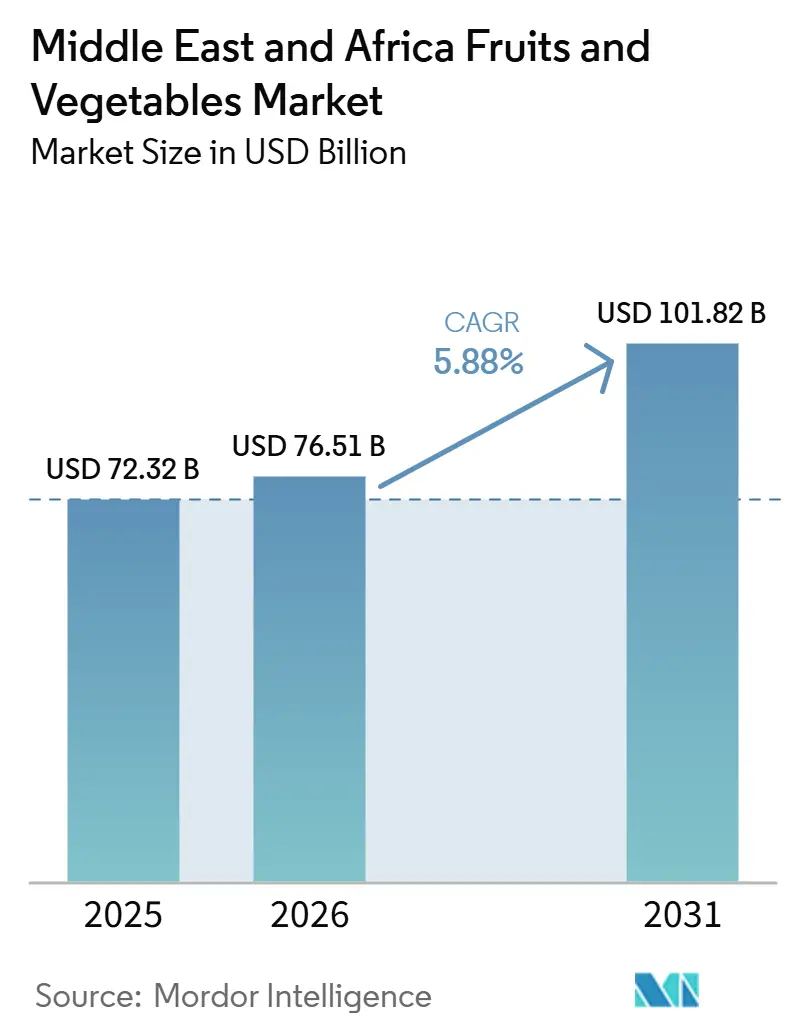
The Middle East and Africa fruits and vegetables market is forecast to grow from USD 72.32 billion in 2025 to USD 76.51 billion in 2026, reaching USD 101.82 billion by 2031, at a CAGR of 5.8% during the forecast period 2026-2031. Steady daily consumption, high import dependence across the Gulf, and rising public investment in food security systems continue to support the market by shaping sourcing, storage, and local production decisions. The disruption to maritime movement in 2026 through the Strait of Hormuz could expose operational risks linked to import dependence and push major retailers toward emergency air cargo, accelerating investment in domestic cultivation, supply diversification, and procurement planning. Controlled-environment agriculture projects, increased retail shelf space for local produce, and cold-chain expansion are also improving availability and reducing quality loss in key urban centers. Export momentum from South Africa provides additional support, as stronger regional and intercontinental trade flows broaden supply options for buyers across the Middle East and Africa fresh fruits and vegetables market. Competitive conditions remain fragmented, creating opportunities for regional distributors, greenhouse operators, and digital produce platforms to scale by combining traceability, logistics control, and dependable supply in a market that still lacks a dominant cross-regional operator.
Key Report Takeaways
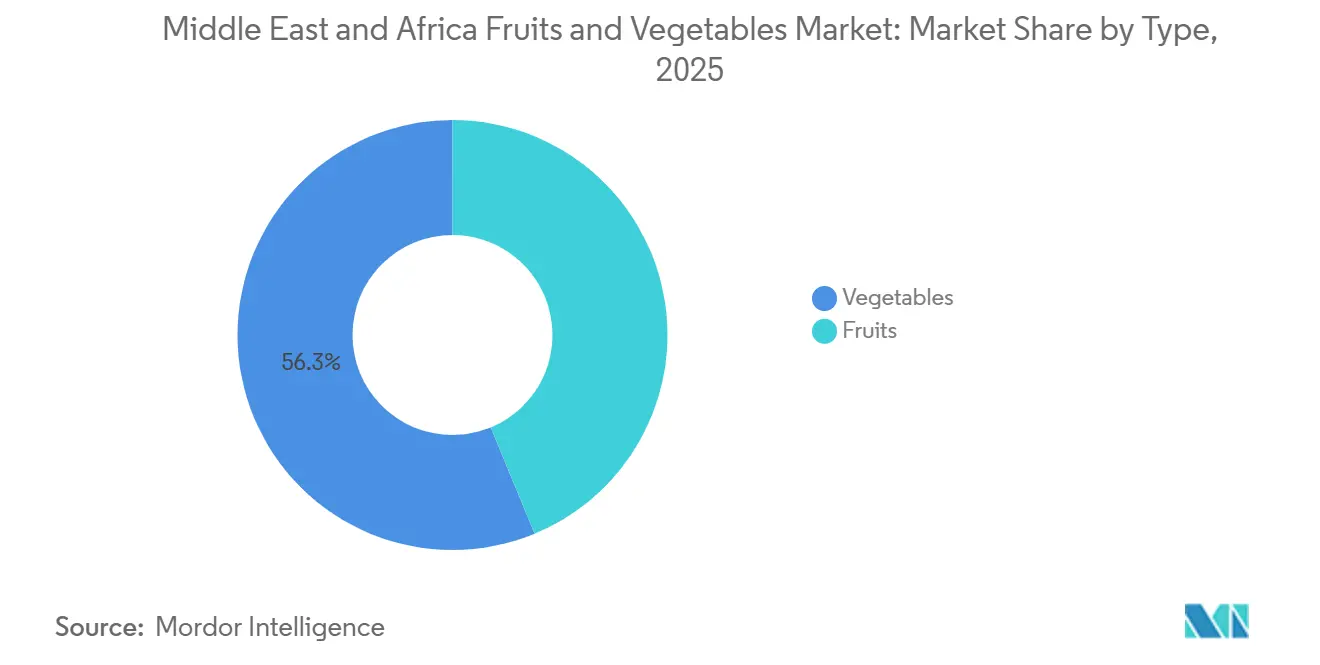
- By type, vegetables accounted for 56.3% of the Middle East and Africa fruits and vegetables market size in 2025, and fruits are forecast to grow at a 5.9% CAGR between 2026 and 2031.
- By geography, the Middle East accounted for 68.5% of the fresh fruits and vegetables market share in 2025, and it is also the fastest-growing geography, projected to expand at a 6.3% CAGR between 2026 and 2031.
Note: Market size and forecast figures in this report are generated using Mordor Intelligence’s proprietary estimation framework, updated with the latest available data and insights as of January 2026.
Market Trends and Insights
Drivers Impact Analysis of Middle East and Africa Fruits and Vegetables Market*
| Driver | (~) % Impact on CAGR Forecast | Geographic Relevance | Impact Timeline |
|---|---|---|---|
| Rising import dependence in the Middle East | +1.1% | Middle East core, particularly Saudi Arabia and United Arab Emirates | Short term (≤ 2 years) |
| Expansion of controlled environment agriculture | +0.9% | Middle East core, Africa emerging | Medium term (2-4 years) |
| Food security programs supporting local production | +0.9% | Middle East and East Africa, spill-over to Southern Africa | Medium term (2-4 years) |
| Modern retail expansion and cold-chain development | +0.8% | Africa core, Middle East expanding | Medium term (2-4 years) |
| Premium demand for fresh, organic, and ready-to-eat produce | +0.7% | Global, concentrated in GCC and urban Africa | Short term (≤ 2 years) |
| Digital procurement and traceability adoption | +0.5% | Global, early gains in United Arab Emirates and Kenya | Medium term (2-4 years) |
| Source: Mordor Intelligence | |||
Rising Import Dependence in the Middle East
The fresh fruits and vegetables market in the Middle East and Africa remains highly exposed to the Gulf region’s dependence on imports. This dependence supports trade volumes but also increases supply risks. In early 2026, disruptions to movement through the Strait of Hormuz forced retailers, including LuLu Group, to arrange more than 37 charter flights and import over 6,000 tons of fresh produce within a short period[1]. This event showed that buyers could no longer rely on narrow just-in-time replenishment systems, as fresh produce availability could be affected within days. It also prompted importers to broaden their supplier base, hold more safety stock, and place greater value on distributors that could secure cargo capacity under pressure. South Africa and Kenya stand to benefit from this shift, as both already supply regional produce flows and can support diversification goals when Gulf buyers seek alternative origins. As a result, the fresh fruits and vegetables market in the Middle East and Africa is seeing demand growth from higher import planning needs and stronger local production spending.
Expansion of Controlled Environment Agriculture
Controlled-environment agriculture (CEA) is reshaping the supply side of the fresh fruits and vegetables market in the Middle East and Africa by stabilizing production in areas where open-field farming is constrained by climate conditions and water scarcity. Investment across the Middle East is shifting this model from pilot projects to commercial scale, particularly in Saudi Arabia, where Dava Agricultural's Taif project spans 350 hectares of glass greenhouses and targets output of 250 metric tons of fresh produce per day by 2028 and 1,000 metric tons per day by 2030. In the United Arab Emirates, adoption of greenhouse, hydroponic, and precision irrigation systems is also expanding. In May 2025, Silal and China's Shouguang Vegetable Industry Group announced an AED 120 million (USD 32.7 million) smart AgriTech hub in Al Ain, anticipated to reduce water and fertilizer use by up to 30%. These projects are reducing exposure to import disruptions, improving supply reliability for retailers and foodservice buyers, and supporting year-round sourcing of premium categories such as pesticide-free, traceable, and retail-ready produce. Over time, these developments are anticipated to retain more value within the regional fresh produce market and gradually reduce dependence on emergency imports across selected vegetable and premium fruit categories.
Food Security Programs Supporting Local Production
Government programs play a direct role in the fresh fruits and vegetables market in the Middle East and Africa by shaping buyer sourcing strategies and grower investment decisions. In the United Arab Emirates, the National Agriculture Centre and NRTC Group are anticipated to agree in 2026 to support local produce through logistics, grading, marketing, and shelf placement under the Sustainable Product initiative. The United Arab Emirates in 2024, has also expanded farm support through certification, training, and market access programs, making more domestic growers commercially viable in modern retail channels. Saudi Arabia is using national campaigns to promote seasonal local fruit and strengthen self-sufficiency in produce categories that are already important to household demand. These initiatives influence procurement behavior, as retailers increasingly treat local supply as a core product line rather than a backup to imports. This shift strengthens the fresh fruits and vegetables market in the Middle East and Africa by creating a more durable domestic demand base for growers that can meet quality and continuity requirements.
Modern Retail Expansion and Cold-Chain Development
Retail formalization is improving product movement and visibility across the fresh fruits and vegetables market in the Middle East and Africa, as supermarkets and organized distribution systems can better enforce quality standards, reduce shrinkage, and support traceability. Carrefour entered Ethiopia in January 2026 through a franchise arrangement with Midroc, converting 13 stores and planning further expansion, which will strengthen the modern retail channel for fruits and vegetables especially for locally sourced produce. In Kenya, store expansion by international retailers is increasing the share of produce sold through structured retail environments that support better handling and more predictable shelf standards. Almarai invested in freezers, chillers, and refrigerated trucks during 2025 to expand fresh and chilled distribution reach, highlighting how leading food companies continue to build core logistics infrastructure. Across Africa, cold-chain gaps still limit full value capture, but public and private investment cases are strengthening as loss reduction and shelf-life extension become more measurable. As a result, the fresh fruits and vegetables market in the Middle East and Africa is moving toward a structure in which modern retail and temperature-controlled logistics shape category growth more than informal trade alone.
Restraints Impact Analysis of Middle East and Africa Fruits and Vegetables Market*
| Restraint | (~) % Impact on CAGR Forecast | Geographic Relevance | Impact Timeline |
|---|---|---|---|
| Water scarcity and high irrigation costs | -1.0% | Middle East core, East Africa secondary | Long term (≥ 4 years) |
| Post-harvest losses and weak cold-chain coverage in Africa | -0.8% | Africa core, spill-over to Middle East import quality | Medium term (2-4 years) |
| Import cost volatility and logistics disruptions | -0.7% | Global, concentrated in GCC and East Africa | Short term (≤ 2 years) |
| Fragmented smallholder supply and quality inconsistency | -0.5% | Africa core, selective relevance in Middle East | Long term (≥ 4 years) |
| Source: Mordor Intelligence | |||
Water Scarcity and High Irrigation Costs
Water scarcity remains the most structural constraint on the fresh fruits and vegetables market in the Middle East and Africa, as local supply expansion cannot extend far beyond resource limits without costly technology. This situation makes conventional open-field cultivation less competitive in areas where desalination, groundwater pressure, and irrigation costs affect farm economics. It also concentrates local production growth among operators that can invest in hydroponics, drip systems, climate control, and tighter crop management. Smaller farms struggle to keep pace as yields, water use, and market standards become more demanding. As a result, the fresh fruits and vegetables market in the Middle East and Africa continues to face a persistent tension between food security goals and the cost of producing more crops in arid environments.
Post-Harvest Losses and Weak Cold-Chain Coverage in Africa
Post-harvest losses continue to constrain the African side of the fresh fruits and vegetables market in the Middle East and Africa, as a large share of output still fails to reach final buyers in saleable condition. Organisation for Technology Advancement of Cold Chain in West Africa (OTAC), reported in 2025, that cold-chain gaps contribute to loss rates of 30% to 50%, while only a small share of fresh produce currently moves through formal cold storage systems in many African markets. Kenya’s avocado export chain further demonstrates how the issue affects higher-value trade, with losses exceeding 40% in some seasons. These losses reduce grower returns, weaken exporter reliability, and limit the volume of produce that can consistently meet buyer specifications in the Gulf and Europe. Until stakeholders expand storage, refrigerated transport, and monitoring systems at scale, the fresh fruits and vegetables market in the Middle East and Africa will continue to lose value between harvest and sale.
*Our forecasts treat driver/restraint impacts as directional, not additive. The impact forecasts reflect baseline growth, mix effects, and variable interactions.
Middle East and Africa Fruits and Vegetables Market Segment Analysis
By Type:
Vegetables Anchor Market Scale as Fruits Gain Faster MomentumVegetables held a 56.25% market share in 2025, maintaining their position as the dominant fresh produce category across the Middle East and Africa. This is driven by the consistent demand for staple items such as tomatoes, onions, potatoes, cucumbers, and leafy greens in daily diets across both regions. Vegetable demand remains stable across income groups, as these products are distributed through wet markets, supermarkets, and foodservice channels with limited substitution. In the Middle East, greenhouse and controlled-environment farming is gradually reducing dependence on imported vegetables, particularly in categories such as tomatoes. In Africa, vegetable supply remains largely domestic and informal, though weak cold-chain infrastructure continues to limit the volume of farm output that reaches the market in saleable condition.
Fruits are projected to grow at a CAGR of 5.9% between 2026 and 2031, making them the faster-growing product type. This growth is supported by rising consumption of premium and health-focused fruit in GCC cities and through organized retail in markets such as South Africa. African fruit exports have also demonstrated strong long-term momentum, supporting the segment's outlook. Categories such as avocados, blueberries, grapes, and citrus are contributing greater value to the fruit segment, while local production projects in the Gulf are beginning to replace some imported premium varieties. Kenya remains an important supplier in this space, with fruits accounting for 30% of the country's horticultural export earnings in 2025. Africa's avocado export growth further highlights the region's increasing role as a premium fruit supplier to both Middle Eastern and European buyers.

Geography Analysis
Middle East Fruits and Vegetables Market
The Middle East accounted for 68.5% of the fresh fruits and vegetables market in the Middle East and Africa in 2025, making it the largest regional market and the fastest-growing, projected to expand at a 6.3% CAGR between 2026 and 2031. Growth is supported by government food security programs, increased investment in controlled-environment agriculture. Saudi Arabia remains the key country, with Vision 2030 investment expanding tourism and hospitality demand for fresh produce while the Ministry of Environment, Water and Agriculture supports greenhouse expansion to reduce import dependence. The United Arab Emirates functions as the region's premium retail center, logistics and re-export hub, and an early mover in digital traceability programs that translate food security policy into practical supply chain action.
Africa Fruits and Vegetables Market
Africa accounts for the remainder of the market, shaped by rising urban demand, expanding organized retail, and stronger horticultural export capacity. According to National Agricultural Marketing Council, South Africa recorded USD 15.1 billion in total agricultural exports in 2025, up 10% from the previous year, with fruits and nuts making up 26% of total agricultural export value in Q4 2025[2]. Export growth depends heavily on phytosanitary certification and compliance with European Union and Gulf import requirements. Kenya is the second major African market, with the United Arab Emirates, the Netherlands, the United Kingdom, and Saudi Arabia as its major export destinations. The National Horticulture Traceability System launched by the Agriculture and Food Authority in June 2026 is anticipated to reduce pest interceptions and support more stable export growth into premium European and Gulf markets.
MEA Fruits and Vegetables Market
The rest of the Middle East, including Kuwait, Bahrain, Qatar, and Oman, shares similar import dependence characteristics and is benefiting from alternative logistics routes through Oman's Port of Duqm, Saudi Arabia's Red Sea ports, and the United Arab Emirates' Fujairah corridor. Policy developments in Saudi Arabia and the United Arab Emirates are shaping technology adoption, local sourcing standards, and retail expectations across smaller nearby markets, gradually pushing the subregion toward a mixed model where local production and routing diversification are becoming more important alongside imports. In the rest of Africa, including Nigeria, Ethiopia, Morocco, and Egypt, the long-term volume opportunity remains substantial as urbanization and organized retail expansion continue to support demand formalization in fruits and vegetables.
Competitive Landscape
The Middle East and Africa fruits and vegetables market is highly competitive, encompassing multinational importers, regional processors, local cultivators using controlled environment agriculture, and digital B2B distributors. The market is divided between the import-dependent, high-value Gulf Cooperation Council (GCC) markets and Sub-Saharan Africa's high-yield but fragmented production zones. As a result, companies utilizing Controlled Environment Agriculture (CEA) to manage extreme climates are gaining significant market advantages. Operators that invest in solar-powered cold chains and digital traceability to reduce post-harvest losses and access expanding retail channels are well-positioned in this market.
Strategic initiatives by leading participants indicate that competitive advantage is shifting toward logistics control and tighter supply integration. DP World and Al Dahra are anticipated to partner in 2026 to develop end-to-end food and agricultural supply chain solutions across the GCC, combining sourcing, cold chain, warehousing, and transport capabilities[3]. Fresh Del Monte is anticipated to expand its Kenya operations with a new quick-freezing facility and a solar plant in early 2026, improving raw material utilization and operational efficiency at the site. Carrefour's anticipated entry into Ethiopia in 2026 is anticipated to strengthen modern retail access for locally sourced fruits and vegetable produce and reflects the growing role of organized retail platforms in shaping producer access.
These developments indicate that scale alone is not sufficient in this market, as supply reliability and route-to-market execution are becoming more important than a simple trading presence. Competitive opportunities remain in premium local production, digital distribution, and cold chain services across Africa. Operators such as NRTC, Pure Harvest Smart Farms, and other technology-driven platforms are pushing the market toward greater transparency and stricter handling standards, particularly where premium retail and foodservice buyers require better quality visibility. This trend makes procurement capability a competitive differentiator, as smaller fragmented suppliers often struggle to meet retailer requirements related to documentation, supply continuity, and shrink control. At the same time, the fragmented market structure allows regional specialists to build strong positions without needing to dominate the entire value chain.
Recent Industry Developments in Middle East and Africa Fruits and Vegetables Market
- June 2026: Kenya's Agriculture and Food Authority launched the National Horticulture Traceability System, a digital farm-to-export platform integrating farm mapping, electronic licensing, and phytosanitary certification. The initiative is anticipated to strengthen Kenya's fruits and vegetables market by improving export traceability, reducing pest interceptions, and enhancing access to premium markets such as the European Union and Gulf countries.
- January 2026: Carrefour entered Ethiopia through a franchise agreement with Midroc, converting 13 Queens Supermarket stores and planning 17 additional outlets by 2028. The expansion strengthens organized retail distribution for locally sourced fresh produce, including fruits and vegetables, improving market access, supply chain efficiency, and product availability for urban consumers.
- May 2025: Abu Dhabi's Silal and China's Shouguang Vegetable Industry Group announced an AED 120 million (USD 32.7 million), smart AgriTech hub in Al Ain, featuring photovoltaic glass greenhouses and AI-driven precision irrigation projected to reduce water and fertilizer consumption by up to 30% which aims at increasing production of fruits and vegetables.
Middle East and Africa Fruits and Vegetables Market Report Scope
Fruits and vegetables are edible plant products harvested for human consumption, including fruits, vegetables, roots, tubers, legumes, leafy greens, and other horticultural crops. They are consumed fresh or may serve as raw materials for further processing into food products.
The Middle East and Africa Fruits and Vegetables Market is segmented by Type (Vegetables and Fruits), and by Geography (Middle East, and Africa). The Report Includes Production Analysis (Volume), Consumption Analysis (Value and Volume), Export Analysis (Value and Volume), Import Analysis (Value and Volume), Wholesale Price Trend Analysis and Forecast and More. The Market Forecasts are Provided in Terms of Value (USD) and Volume (Metric Tons).
By Type
| Vegetables | Potatoes | Production Analysis | Production Volume | |
| Area Harvested and Yield | ||||
| Consumption Analysis (Value and Volume) | ||||
| Trade Analysis (Value and Volume) | Import Market Analysis | Import Value and Volume | ||
| Key Supplying Markets | ||||
| Export Market Analysis | Export Value and Volume | |||
| Key Destination Markets | ||||
| Wholesale Price Trend Analysis and Forecast | ||||
| Seasonality Analysis | ||||
| Tomatoes | Production Analysis | Production Volume | ||
| Area Harvested and Yield | ||||
| Consumption Analysis (Value and Volume) | ||||
| Import Value and Volume | ||||
| Key Supplying Markets | ||||
| Export Value and Volume | ||||
| Key Destination Markets | ||||
| Wholesale Price Trend Analysis and Forecast | ||||
| Seasonality Analysis | ||||
| Onions | Production Analysis | Production Volume | ||
| Area Harvested and Yield | ||||
| Consumption Analysis (Value and Volume) | ||||
| Import Value and Volume | ||||
| Key Supplying Markets | ||||
| Export Value and Volume | ||||
| Key Destination Markets | ||||
| Wholesale Price Trend Analysis and Forecast | ||||
| Seasonality Analysis | ||||
| Fruits | Grapes | Production Analysis | Production Volume | |
| Area Harvested and Yield | ||||
| Consumption Analysis (Value and Volume) | ||||
| Import Value and Volume | ||||
| Key Supplying Markets | ||||
| Export Value and Volume | ||||
| Key Destination Markets | ||||
| Wholesale Price Trend Analysis and Forecast | ||||
| Seasonality Analysis | ||||
| Apples | Production Analysis | Production Volume | ||
| Area Harvested and Yield | ||||
| Consumption Analysis (Value and Volume) | ||||
| Import Value and Volume | ||||
| Key Supplying Markets | ||||
| Export Value and Volume | ||||
| Key Destination Markets | ||||
| Wholesale Price Trend Analysis and Forecast | ||||
| Seasonality Analysis | ||||
| Blueberries | Production Analysis | Production Volume | ||
| Area Harvested and Yield | ||||
| Consumption Analysis (Value and Volume) | ||||
| Import Value and Volume | ||||
| Key Supplying Markets | ||||
| Export Value and Volume | ||||
| Key Destination Markets | ||||
| Wholesale Price Trend Analysis and Forecast | ||||
| Seasonality Analysis | ||||
| Cherries | Production Analysis | Production Volume | ||
| Area Harvested and Yield | ||||
| Consumption Analysis (Value and Volume) | ||||
| Import Value and Volume | ||||
| Key Supplying Markets | ||||
| Export Value and Volume | ||||
| Key Destination Markets | ||||
| Wholesale Price Trend Analysis and Forecast | ||||
| Seasonality Analysis | ||||
| Avocados | Production Analysis | Production Volume | ||
| Area Harvested and Yield | ||||
| Consumption Analysis (Value and Volume) | ||||
| Import Value and Volume | ||||
| Key Supplying Markets | ||||
| Export Value and Volume | ||||
| Key Destination Markets | ||||
| Wholesale Price Trend Analysis and Forecast | ||||
| Seasonality Analysis | ||||
| Kiwi | Production Analysis | Production Volume | ||
| Area Harvested and Yield | ||||
| Consumption Analysis (Value and Volume) | ||||
| Import Value and Volume | ||||
| Key Supplying Markets | ||||
| Export Value and Volume | ||||
| Key Destination Markets | ||||
| Wholesale Price Trend Analysis and Forecast | ||||
| Seasonality Analysis | ||||
Geography
| Middle East | Saudi Arabia | Production Analysis (Area Harvested, Yield, and Production Volume) |
| Consumption Analysis (Consumption Value and Volume) | ||
| Import Market Analysis (Import Value, Volume, and Key Supplying Markets) | ||
| Export Market Analysis (Export Value, Volume, and Key Destination Markets) | ||
| Wholesale Price Trend Analysis and Forecast | ||
| Regulatory Framework | ||
| List of Key Players | ||
| Logistics and Infrastructure | ||
| Seasonality Analysis | ||
| United Arab Emirates | Production Analysis (Area Harvested, Yield, and Production Volume) | |
| Consumption Analysis (Consumption Value and Volume) | ||
| Import Market Analysis (Import Value, Volume, and Key Supplying Markets) | ||
| Export Market Analysis (Export Value, Volume, and Key Destination Markets) | ||
| Wholesale Price Trend Analysis and Forecast | ||
| Regulatory Framework | ||
| List of Key Players | ||
| Logistics and Infrastructure | ||
| Seasonality Analysis | ||
| Africa | South Africa | Production Analysis (Area Harvested, Yield, and Production Volume) |
| Consumption Analysis (Consumption Value and Volume) | ||
| Import Market Analysis (Import Value, Volume, and Key Supplying Markets) | ||
| Export Market Analysis (Export Value, Volume, and Key Destination Markets) | ||
| Wholesale Price Trend Analysis and Forecast | ||
| Regulatory Framework | ||
| List of Key Players | ||
| Logistics and Infrastructure | ||
| Seasonality Analysis | ||
| Kenya | Production Analysis (Area Harvested, Yield, and Production Volume) | |
| Consumption Analysis (Consumption Value and Volume) | ||
| Import Market Analysis (Import Value, Volume, and Key Supplying Markets) | ||
| Export Market Analysis (Export Value, Volume, and Key Destination Markets) | ||
| Wholesale Price Trend Analysis and Forecast | ||
| Regulatory Framework | ||
| List of Key Players | ||
| Logistics and Infrastructure | ||
| Seasonality Analysis | ||
| By Type | Vegetables | Potatoes | Production Analysis | Production Volume | |
| Area Harvested and Yield | |||||
| Consumption Analysis (Value and Volume) | |||||
| Trade Analysis (Value and Volume) | Import Market Analysis | Import Value and Volume | |||
| Key Supplying Markets | |||||
| Export Market Analysis | Export Value and Volume | ||||
| Key Destination Markets | |||||
| Wholesale Price Trend Analysis and Forecast | |||||
| Seasonality Analysis | |||||
| Tomatoes | Production Analysis | Production Volume | |||
| Area Harvested and Yield | |||||
| Consumption Analysis (Value and Volume) | |||||
| Import Value and Volume | |||||
| Key Supplying Markets | |||||
| Export Value and Volume | |||||
| Key Destination Markets | |||||
| Wholesale Price Trend Analysis and Forecast | |||||
| Seasonality Analysis | |||||
| Onions | Production Analysis | Production Volume | |||
| Area Harvested and Yield | |||||
| Consumption Analysis (Value and Volume) | |||||
| Import Value and Volume | |||||
| Key Supplying Markets | |||||
| Export Value and Volume | |||||
| Key Destination Markets | |||||
| Wholesale Price Trend Analysis and Forecast | |||||
| Seasonality Analysis | |||||
| Fruits | Grapes | Production Analysis | Production Volume | ||
| Area Harvested and Yield | |||||
| Consumption Analysis (Value and Volume) | |||||
| Import Value and Volume | |||||
| Key Supplying Markets | |||||
| Export Value and Volume | |||||
| Key Destination Markets | |||||
| Wholesale Price Trend Analysis and Forecast | |||||
| Seasonality Analysis | |||||
| Apples | Production Analysis | Production Volume | |||
| Area Harvested and Yield | |||||
| Consumption Analysis (Value and Volume) | |||||
| Import Value and Volume | |||||
| Key Supplying Markets | |||||
| Export Value and Volume | |||||
| Key Destination Markets | |||||
| Wholesale Price Trend Analysis and Forecast | |||||
| Seasonality Analysis | |||||
| Blueberries | Production Analysis | Production Volume | |||
| Area Harvested and Yield | |||||
| Consumption Analysis (Value and Volume) | |||||
| Import Value and Volume | |||||
| Key Supplying Markets | |||||
| Export Value and Volume | |||||
| Key Destination Markets | |||||
| Wholesale Price Trend Analysis and Forecast | |||||
| Seasonality Analysis | |||||
| Cherries | Production Analysis | Production Volume | |||
| Area Harvested and Yield | |||||
| Consumption Analysis (Value and Volume) | |||||
| Import Value and Volume | |||||
| Key Supplying Markets | |||||
| Export Value and Volume | |||||
| Key Destination Markets | |||||
| Wholesale Price Trend Analysis and Forecast | |||||
| Seasonality Analysis | |||||
| Avocados | Production Analysis | Production Volume | |||
| Area Harvested and Yield | |||||
| Consumption Analysis (Value and Volume) | |||||
| Import Value and Volume | |||||
| Key Supplying Markets | |||||
| Export Value and Volume | |||||
| Key Destination Markets | |||||
| Wholesale Price Trend Analysis and Forecast | |||||
| Seasonality Analysis | |||||
| Kiwi | Production Analysis | Production Volume | |||
| Area Harvested and Yield | |||||
| Consumption Analysis (Value and Volume) | |||||
| Import Value and Volume | |||||
| Key Supplying Markets | |||||
| Export Value and Volume | |||||
| Key Destination Markets | |||||
| Wholesale Price Trend Analysis and Forecast | |||||
| Seasonality Analysis | |||||
| Geography | Middle East | Saudi Arabia | Production Analysis (Area Harvested, Yield, and Production Volume) | ||
| Consumption Analysis (Consumption Value and Volume) | |||||
| Import Market Analysis (Import Value, Volume, and Key Supplying Markets) | |||||
| Export Market Analysis (Export Value, Volume, and Key Destination Markets) | |||||
| Wholesale Price Trend Analysis and Forecast | |||||
| Regulatory Framework | |||||
| List of Key Players | |||||
| Logistics and Infrastructure | |||||
| Seasonality Analysis | |||||
| United Arab Emirates | Production Analysis (Area Harvested, Yield, and Production Volume) | ||||
| Consumption Analysis (Consumption Value and Volume) | |||||
| Import Market Analysis (Import Value, Volume, and Key Supplying Markets) | |||||
| Export Market Analysis (Export Value, Volume, and Key Destination Markets) | |||||
| Wholesale Price Trend Analysis and Forecast | |||||
| Regulatory Framework | |||||
| List of Key Players | |||||
| Logistics and Infrastructure | |||||
| Seasonality Analysis | |||||
| Africa | South Africa | Production Analysis (Area Harvested, Yield, and Production Volume) | |||
| Consumption Analysis (Consumption Value and Volume) | |||||
| Import Market Analysis (Import Value, Volume, and Key Supplying Markets) | |||||
| Export Market Analysis (Export Value, Volume, and Key Destination Markets) | |||||
| Wholesale Price Trend Analysis and Forecast | |||||
| Regulatory Framework | |||||
| List of Key Players | |||||
| Logistics and Infrastructure | |||||
| Seasonality Analysis | |||||
| Kenya | Production Analysis (Area Harvested, Yield, and Production Volume) | ||||
| Consumption Analysis (Consumption Value and Volume) | |||||
| Import Market Analysis (Import Value, Volume, and Key Supplying Markets) | |||||
| Export Market Analysis (Export Value, Volume, and Key Destination Markets) | |||||
| Wholesale Price Trend Analysis and Forecast | |||||
| Regulatory Framework | |||||
| List of Key Players | |||||
| Logistics and Infrastructure | |||||
| Seasonality Analysis | |||||
Key Questions Answered in the Report
What is the 2031 value forecast for fresh fruits and vegetables in the Middle East and Africa?
The market is forecast to reach USD 101.82 billion by 2031, rising from USD 76.51 billion in 2026 at a 5.88% CAGR over 2026-2031.
Which region leads in growth between 2026 and 2031?
The Middle East leads on both scale and growth, with 68.5% revenue share in 2025 and a projected 6.28% CAGR between 2026 and 2031.
Why are greenhouse and protected farming systems expanding so quickly?
They are growing because they support local supply, reduce exposure to import shocks, and improve output control in water-stressed environments.
What is holding back stronger growth across African produce supply chains?
Post-harvest loss and weak cold-chain coverage remain major limits, with loss rates often ranging from 20% to 50% depending on the source and crop.