
Market Overview
| Study Period | 2020 - 2031 |
|---|---|
| Forecast Data Period | 2026 - 2031 |
| Base Year Market Size (2025) | USD 333.45 Million |
| Market Size (2026) | USD 359.62 Million |
| Market Size (2031) | USD 524.81 Million |
| Growth Rate (2026 - 2031) | 7.85 % |
| Market Concentration | Medium |
Major Players *Disclaimer: Major Players sorted in no particular order Image © Mordor Intelligence. Reuse requires attribution under CC BY 4.0. | |
Mexico Pressure Sensor Market Analysis by Mordor Intelligence
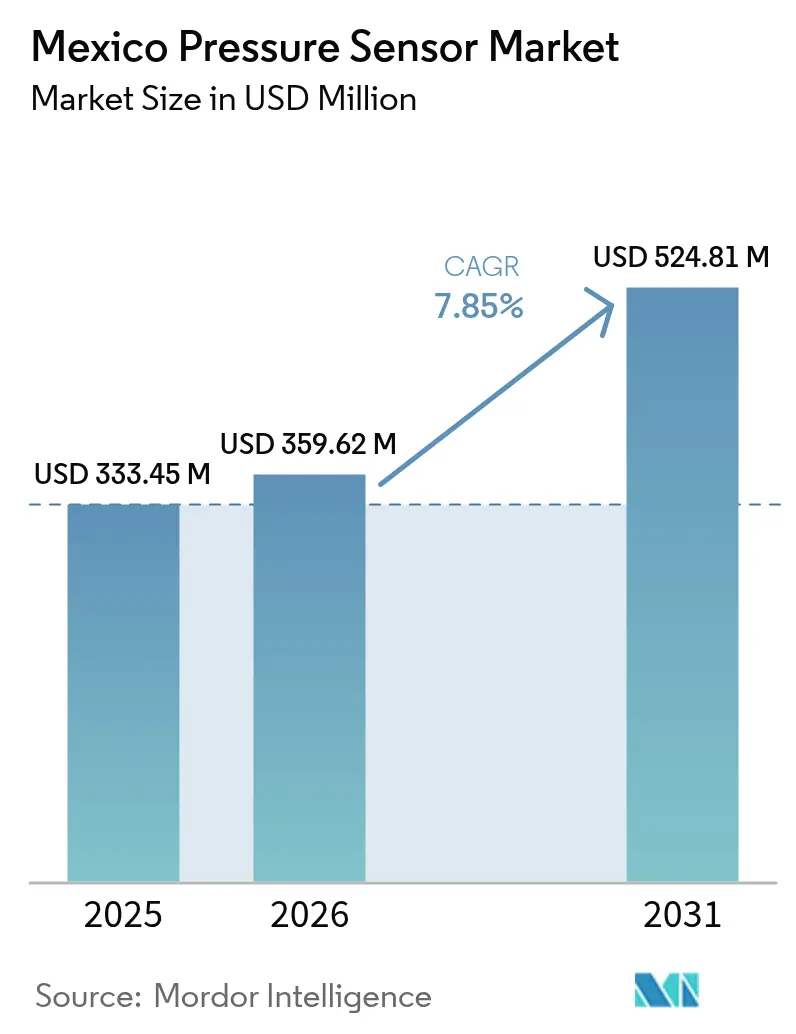
The Mexico pressure sensors market size was valued at USD 333.45 million in 2025 and estimated to grow from USD 359.62 million in 2026 to reach USD 524.81 million by 2031, at a CAGR of 7.85% during the forecast period (2026-2031). The upward trajectory mirrors the country’s position as Latin America’s most competitive manufacturing economy, with manufacturing contributing 18% of national GDP in 2024. Mandatory tire-pressure monitoring, healthcare digitization, and Industry 4.0 adoption underpin sustained demand, while the nation’s integration in North American semiconductor supply chains reduces structural risk. Automotive applications dominate spend, yet medical, optical, and differential sensing technologies record the fastest growth as Mexico pressure sensors market participants diversify into precision healthcare, building automation, and offshore energy. Central Mexico leads volumes, Southern Mexico and the Yucatán Peninsula provide the highest growth curve, and established multinationals compete alongside regional MEMS specialists in a moderately fragmented field.
Key Report Takeaways
- By application, automotive captured 37.65% of Mexico pressure sensors market share in 2025; medical applications are projected to expand at a 9.05% CAGR through 2031.
- By technology, MEMS commanded 41.75% share of the Mexico pressure sensors market size in 2025, while optical technology is forecast to grow at an 8.15% CAGR through 2031.
- By pressure type, gauge sensors held 46.02% of the Mexico pressure sensors market size in 2025; differential pressure sensors register the highest projected CAGR at 8.65% through 2031.
- By output type, digital sensors accounted for 53.55% revenue share of the Mexico pressure sensors market size in 2025 and are advancing at a 8.95% CAGR through 2031.
- By region, Central Mexico led with 50.65% Mexico pressure sensors market share in 2025, while Southern Mexico and the Yucatán Peninsula expand at a 9.55% CAGR between 2026-2031.
Note: Market size and forecast figures in this report are generated using Mordor Intelligence’s proprietary estimation framework, updated with the latest available data and insights as of 2026.
Mexico Pressure Sensor Market Trends and Insights
Drivers Impact Analysis*
| Driver | (~)% Impact on CAGR Forecast | Geographic Relevance | Impact Timeline |
|---|---|---|---|
| Automotive and Healthcare production expansion | +2.1% | Central Mexico, Northern Mexico | Medium term (2-4 years) |
| Accelerating MEMS/NEMS adoption | +1.8% | Central Mexico, Jalisco | Long term (≥ 4 years) |
| Industry 4.0-driven factory automation | +1.5% | Northern Mexico, Bajío region | Medium term (2-4 years) |
| Mandatory TPMS under NOM-194-SCFI-2015 | +1.2% | National | Short term (≤ 2 years) |
| Smart-agro greenhouse sensing demand | +0.9% | Southern Mexico, Central Mexico | Long term (≥ 4 years) |
| Offshore Oil and Gas pressure-monitoring projects | +0.8% | Southern Mexico, Gulf Coast | Medium term (2-4 years) |
| Source: Mordor Intelligence | |||
Automotive and Healthcare Production Expansion
Mexico pressure sensors market demand rises as engine-management, exhaust control, and TPMS roll into every locally built vehicle; at the same time, oxygen concentrators and respiratory monitors require higher-accuracy pressure chips for compliance with COFEPRIS labeling standard NOM-137-SSA1-2024.[1] EV battery packs introduce new cooling and safety loops, adding incremental sensor nodes while nearshoring relocates North American Tier-1 suppliers to Central and Northern clusters. The parallel boom in medical device exports multiplies use cases—from blood pressure monitors to infusion pumps—further reinforcing sensor volumes. Capacity expansion in Sonora and Nuevo León reduces lead times for local OEMs, and cross-licensing agreements with US fabs speed knowledge transfer.
Accelerating MEMS/NEMS Adoption
A regional ecosystem anchored in Jalisco funnels venture funding, university talent, and Bosch’s expanded R&D footprint into MEMS prototypes and small-batch runs.[2] Mexico pressure sensors market participants align with micro-foundry partners to convert legacy piezoresistive designs into wafer-level packages that cut cost per die. Projects financed by the Secretariat of Energy prove MEMS down-hole gauges viable for shale well profiling, broadening the technology’s TAM into oil and gas. Cooperative agreements with Guadalajara universities streamline material characterisation, shortening time-to-market for next-generation devices.
Industry 4.0-Driven Factory Automation
Retrofitting legacy machine tools with information-processing kits places digital pressure transducers at each pneumatic cylinder, enabling cloud dashboards and predictive maintenance loops. Automotive stamp-press lines in Coahuila adopt sensor clusters that feed SPC algorithms and reduce unplanned downtime. Textile mills in the Bajío region integrate compressed-air leak detection to cut utility cost by 8%, evidencing tangible ROI for mid-sized factories. Government mapping through the ‘Prospective Territorial-Industrial Atlas’ channels fiscal incentives to sensor-rich brownfield upgrades, accelerating replacement cycles for analog gauges.
Mandatory TPMS Under NOM-194-SCFI-2015
Federal rules mirror U.S. FMVSS performance thresholds, obliging every new light vehicle sold to trigger an under-inflation warning within 20 minutes.[3] Local assemblers synchronize ECU firmware with ISO 21750 diagnostics, pushing OEMs to lock long-term agreements with sensor makers. Mexico pressure sensors market growth accelerates because TPMS units migrate from optional trim to base trim, elevating average sensor content per vehicle. Independent aftermarket demand adds a replacement tier as the light-duty fleet ages.
Restraints Impact Analysis*
| Restraint | (~) % Impact on CAGR Forecast | Geographic Relevance | Impact Timeline |
|---|---|---|---|
| High unit cost of precision sensors | -1.1% | National, with higher impact in Southern Mexico | Medium term (2-4 years) |
| Low-price Asian imports intensifying competition | -0.9% | National, concentrated in Central Mexico | Short term (≤ 2 years) |
| MEMS chip supply-chain disruptions | -0.7% | Northern Mexico, Central Mexico | Short term (≤ 2 years) |
| Shortage of calibration and metrology talent | -0.6% | National, acute in emerging regions | Long term (≥ 4 years) |
| Source: Mordor Intelligence | |||
High Unit Cost of Precision Sensors
Certification under Mexico’s Quality Infrastructure Law elevates CapEx as manufacturers pay for NOM testing, metrology services, and periodic audits. Procurement teams in Chiapas citrus plants often postpone upgrades when ROI falls below internal hurdle rates, limiting Mexico pressure sensors market penetration outside premium tiers. Suppliers counter with localized assembly in Querétaro that reduces import duties and with value-engineered SKUs targeting ±1% FS accuracy instead of ±0.1% in cost-sensitive lines.
Low-Price Asian Imports Intensifying Competition
Commodity gauge transmitters priced 15–20% below regional averages reach the aftermarket via gray-market channels, squeezing margins for domestic distributors. Mexico pressure sensors market incumbents respond by bundling on-site calibration, bilingual technical support, and warranty extensions to justify price premiums. Nearshoring rationales—shorter lead times, USMCA duty preferences—temper but do not erase price gaps, especially in analog vacuum sensors for packaging equipment.
*Our forecasts treat driver/restraint impacts as directional, not additive. The impact forecasts reflect baseline growth, mix effects, and variable interactions.
Segment Analysis
By Application: Automotive Dominance Drives Market Growth
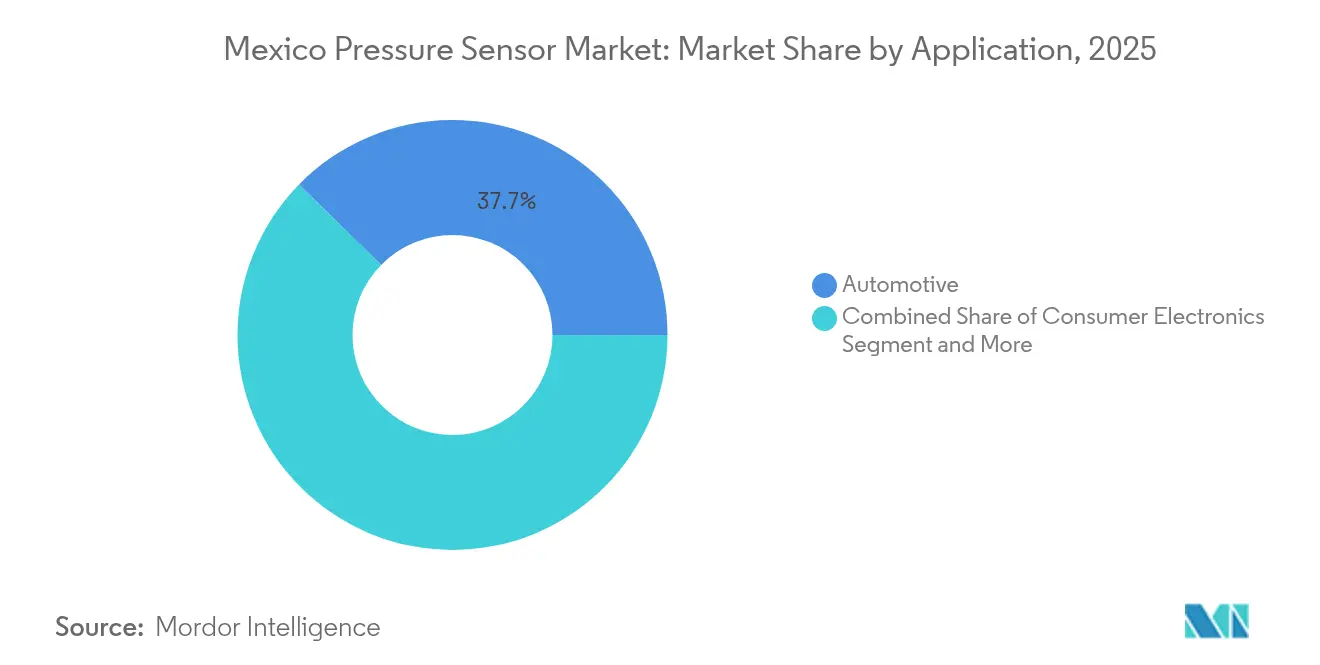
Automotive applications account for 37.65% of Mexico pressure sensors market share in 2025, underscoring the country’s status as a regional vehicle-production powerhouse. Engine control, TPMS, and emissions subsystems together shape baseline demand. Mexico pressure sensors market size for medical devices is projected to expand at a 9.05% CAGR as tele-med and in-hospital diagnostic equipment proliferate under COFEPRIS oversight. Industrial automation sequences drive consistent replacement of obsolete pneumatic monitors, and smart-home gadgets enlarge the consumer slice by embedding miniaturized gauges in HVAC controllers and air purifiers.
High-growth verticals benefit from value pools beyond unit shipments. Medical-device OEMs require traceability and MDR-style documentation, prompting bundled offerings with digital calibration certificates. In automotive, the EV transition adds battery safety circuits that need absolute micro-barometric sensors, increasing BOM value per unit. Offshore operators widen the industrial envelope, procuring sapphire-diaphragm assemblies rated for 15,000 psi. Collectively, these vectors reinforce the diversified resilience of the Mexico pressure sensors market.

By Technology: MEMS Leadership Accelerates Innovation
MEMS holds 41.75% share of the Mexico pressure sensors market size in 2025 as die-level integration reduces package footprint and cost while sustaining automotive-grade repeatability. Optical technology registers the fastest 8.15% CAGR because non-contact interrogation thrives in corrosive offshore and sterile bioprocess settings. Piezoresistive chips retain incumbency in most gauge and absolute variants, whereas capacitive structures capture niches demanding sub-Pa resolution.
Mexico pressure sensors market suppliers leverage Jalisco’s micro-electronics corridor to co-develop ASICs that process MEMS outputs in-package, cutting board real estate for vehicle ECUs. Optical OEMs partner with Veracruz shipyards to trial fiber Bragg pressure arrays in subsea risers. Resonant sensing, albeit niche, enters barometric drones where frequency drift offers self-calibration advantages. Technology diversification enables portfolio risk management ahead of the next semiconductor cycle.
By Pressure Type: Gauge Sensors Lead Diverse Applications
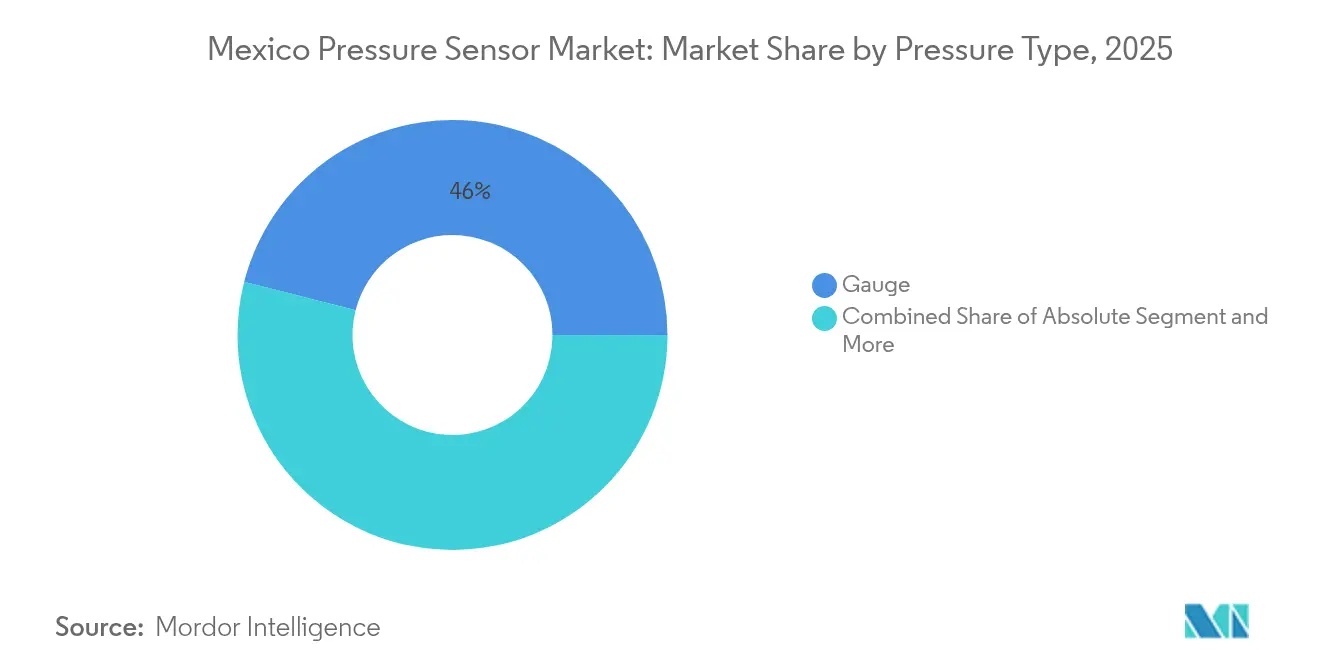
Gauge devices contribute 46.02% share to the Mexico pressure sensors market size, valued for versatility from TPMS to industrial compressors. Differential sensors outpace the field with 8.65% CAGR, fueled by HVAC energy-saving mandates that rely on duct airflow balancing. Absolute transducers serve altitude corrections in avionics, whereas vacuum units underpin sputtering chambers at Chihuahua semiconductor back-end lines.
Future demand clusters around energy-efficiency retrofits. Smart-building integrators specify dual-port differential transmitters with BACnet over IP to fine-tune VAV boxes, directly lowering electricity spend. Agriculture startups adopt differential configurations to manage irrigation filters and avoid clogging. The Mexico pressure sensors market thus demonstrates depth across price tiers, ranging from low-cost anodized brass gauges to hermetically welded stainless units for LNG loading arms.
By Output Type: Digital Transformation Drives Adoption
Digital sensors represent 53.55% of 2025 shipments, advancing at a 8.95% CAGR powered by Industry 4.0 connectivity. I²C, SPI, and CANopen interfaces slot directly into control buses, enabling timestamped data for machine-learning diagnostics. Mexico pressure sensors market buyers migrate away from analog 4-20 mA loops except where legacy DCS infrastructure persists.
In greenhouses, LoRaWAN-enabled digital nodes broadcast pressure data every minute to cloud dashboards, supporting rule-based vent actuation. Automotive plants in Saltillo deploy EtherCAT ring networks linking up to 1,000 digital pressure points across stamping presses. Analog sensors continue in furnace atmospheres where high EMI challenges digital interfaces; however, multiplexed A/D converter modules increasingly supplement them, reducing the installed gap.
Geography Analysis
Central Mexico holds 50.65% of Mexico pressure sensors market share owing to dense automotive, electronics, and medical-device corridors serving US trade lanes. Southern Mexico and the Yucatán Peninsula expand at a 9.55% CAGR as deepwater projects mandate ruggedized subsea assemblies. Northern Mexico benefits from nearshoring, absorbing feeder-plant investment that lifts baseline sensor demand across border-adjacent value networks.
Regional government schemes direct funding toward technology parks in Tabasco and Campeche to service offshore mega-projects, enhancing downstream opportunities for calibration houses. Nuevo León’s auto-parts SMEs accelerate ISO 9001 and IATF 16949 certifications to penetrate OEM sourcing lists, widening Mexico pressure sensors market volume potential. Balanced growth across regions diversifies country-level risk.
Regulatory Landscape
Mexico regulates pressure-sensing instruments used for measurement and industrial safety primarily through the Secretaria de Economia (SE) and its framework of Normas Oficiales Mexicanas (NOM). A key anchor standard is NOM-013-SCFI-2004, which covers manometers, vacuum gauges, and manovacuometers with elastic sensors across approximately -0.1 MPa to 1,000 MPa, with enforcement handled through conformity assessment procedures by accredited testing labs and verification units.
For pressure sensors embedded in connected or wireless devices used in automation and IIoT, requirements can extend beyond SE metrology to telecommunications compliance. The Instituto Federal de Telecomunicaciones (IFT) governs homologation for equipment that connects to public networks or uses radio spectrum, creating a dual-compliance pathway for sensor-enabled transmitters and gateways that pair measurement with connectivity.
Value Chain Analysis
The Mexico pressure sensors value chain is characterized by imported sensing elements feeding local module build-out. Core upstream inputs (MEMS dies, ASICs, specialty diaphragms, and wafer-level packaging capacity) are sourced mainly from the United States and Asian foundry ecosystems, while domestic value add focuses on assembly, calibration, testing, harnessing, and application-specific packaging for automotive and industrial customers.
Downstream, suppliers sell through OEM and Tier-1 procurement channels, industrial automation distributors, and service partners that provide commissioning and recalibration. Operations are concentrated in northern border states and the Bajio to support USMCA-aligned logistics and automotive supply chains, with Sensata Technologies de Mexico (Aguascalientes) serving as an example of a high-volume OEM assembly hub that integrates imported sensing elements into finished sensor modules for automotive and HVAC use cases. Qualification and NOM-related conformity work can extend component onboarding timelines, which reinforces the role of local test and metrology capability as a competitive differentiator.
Competitive Landscape
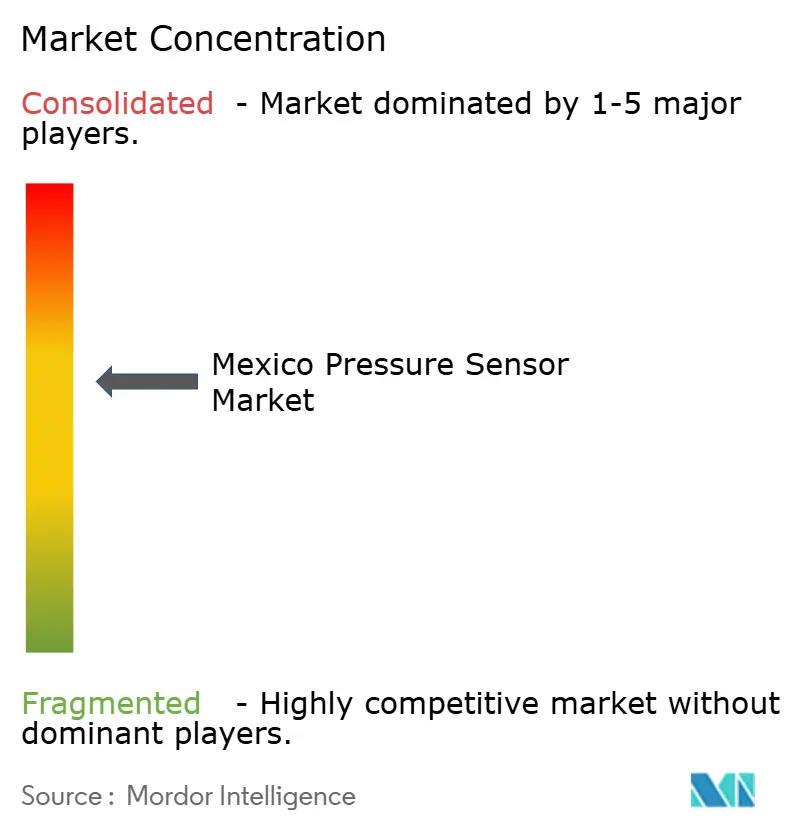
The Mexico pressure sensors market features moderate fragmentation. Honeywell, Sensata, and TE Connectivity headline the field, flanked by regional specialists and fledgling MEMS startups. Honeywell’s USD 37 billion 2023 revenue underscores scale advantages in industrial automation and building controls. Sensata leverages powertrain pedigree to preserve OEM contracts, whereas TE Connectivity concentrates on harsh-environment interfaces tailored to offshore and EV thermal systems.
Strategic moves focus on securing upstream silicon and expanding downstream service wraps. Bosch’s Jalisco expansion aligns R&D co-location with wafer-level packaging, squeezing time-to-market for MEMS pressure dice. TE Connectivity pilots additive-manufactured stainless sensor housings to cut weight by 30% for deepwater modules. Regional newcomers concentrate on application-specific products, such as IP68 digital sensors approved for greenhouse fertigation lines, differentiating through agile customization and local service loops. Market participants increasingly pursue ecosystem alliances—OEM-tier data-platform integration, university joint labs—to embed lock-in beyond price competition.
Mexico Pressure Sensor Industry Leaders
-
ABB Ltd
-
All Sensors Corp.
-
Bosch Sensortec GmbH
-
Endress+Hauser AG
-
GMS Instruments BV
- *Disclaimer: Major Players sorted in no particular order
Market Opportunities and Future Outlook
A clear opportunity sits at the intersection of industrial automation, connected instrumentation, and Mexico's industrial policy push for higher domestic content in strategic industries. Plan Mexico (launched January 2025) identifies semiconductors, electronics, and automotive manufacturing as priority pillars and targets lower dependency on imported industrial components, creating whitespace for sensor suppliers that can localize assembly, calibration, documentation, and service around OEM and public-sector procurement requirements.
A second opportunity comes from demand pull in high-tech manufacturing and data-center supply chains expanding in northern and central states, which increases the installed base of power, thermal-management, and process-control equipment that uses pressure measurement. Recent announced investments provide tangible proof points: Flex disclosed a USD 1 billion Mexico investment program across Jalisco, Chihuahua, and Aguascalientes (2026-2028) tied to power systems, cooling units, and server infrastructure, and Inventec announced a USD 450 million expansion in Ciudad Juarez, Chihuahua to add AI-server production lines. These additions create adjacent needs for pressure sensors in cooling loops, compressed air and pneumatics, leak detection, and facility HVAC balancing, supporting uptake of compact digital sensors and serviceable transmitters that integrate into plant connectivity stacks.
Recent Industry Developments
- April 2026: Flex announced a USD 1 billion investment program in Mexico (2026-2028) spanning Jalisco, Chihuahua, and Aguascalientes to manufacture power systems, cooling units, and server infrastructure for AI and data centers. The buildout expands local production of thermal and power subsystems that rely on pressure measurement across cooling loops, HVAC, and factory utilities, lifting opportunities for industrial-grade digital pressure sensors and calibration services in these clusters.
- June 2025: ABB completed the expansion of its Mexico Technology and Engineering Center (MXTEC) in Merida, Yucatan, doubling office space to support engineering and sales for process industries. Expanded engineering proximity strengthens specification, integration, and lifecycle support for instrumentation-heavy projects, benefiting pressure-sensor adoption in process automation and plant modernization.
- February 2024: Woodside Energy selected Dril-Quip to supply 24 BigBore IIe subsea wellheads for the Trion field offshore Mexico. The award reinforces demand for harsh-environment, high-pressure monitoring architectures in Southern Mexico, supporting procurement of rugged pressure sensors and transmitters qualified for subsea and HPHT applications.
Research Methodology Framework and Report Scope
Market Definition and Coverage
This market covers revenue generated from pressure sensors sold for use in Mexico across industrial, automotive, medical, and other end uses, counted at the point of sale into the country. Values reflect sensor demand captured through technology and application adoption rather than only local manufacturing output.
Scope exclusions: We exclude general pressure measurement instruments that are not sensor components, and we also exclude installation and maintenance services when they are billed separately.
Segmentation Overview
- By Application
- Automotive
- Medical
- Consumer Electronics
- Industrial
- Aerospace and Defence
- Food and Beverage
- HVAC
- By Technology
- Piezoresistive
- Capacitive
- Resonant
- Optical
- MEMS
- By Pressure Type
- Absolute
- Gauge
- Differential
- Vacuum
- By Output Type
- Analog
- Digital
- By Region (Mexico)
- Northern Mexico
- Central Mexico
- Southern and Yucatn Peninsula
Data Sources, Market Sizing, and Validation
Desk Research
Desk work starts with Mexico-specific production and trade signals so the demand pool is anchored to realistic industrial activity. We referred to public sources such as INEGI for industrial production series, Banco de Mexico for macro indicators and FX context, and Mexico Customs plus UN Comtrade trade statistics for sensor-related import and export trends. Customs tariff schedules were also used to map the most relevant product codes.
To pressure-test end use demand, we reviewed sources such as standards and regulatory notices that affect automotive adoption, academic and patent literature for sensing technology shifts, and company filings, investor presentations, and reputable press for capacity moves and pricing direction. A paid subscription focused on company financials, patent analytics, and shipment-level trade intelligence was used selectively to fill gaps on private players and to validate trade-linked assumptions. These are illustrative sources, and we also used other public references for data collection, cross-checks, and clarification.
Primary Interviews and Surveys
Primary interviews were used to translate macro activity into realistic Mexico sensor demand and pricing, since published datasets rarely provide Mexico-only splits at the level needed. We spoke with a mix of sensor manufacturers, distributors, system integrators, and large end users in automotive plants, process industries, and medical device supply chains across Mexico. The inputs were used to validate adoption rates, typical bill-of-materials usage, and the pace of ASP changes.
Distribution of primary research fieldwork respondents
| Company type | Respondent position |
|---|---|
| Top tier: 35% | CXOs: 13% |
| Mid tier: 46% | Functional/Unit leaders: 39% |
| Smaller Players: 19% | Managers: 48% |
Market-Sizing & Forecasting
Sizing was built using a top-down approach where Mexico end market demand is reconstructed from sector output indicators, trade flows for relevant sensor categories, and penetration rates by application. We then aligned results to price bands reported by channels. Bottom-up checks were applied selectively by rolling up sampled supplier revenues in Mexico and validating against distributor throughput and typical ASP x volume ranges, which helped adjust totals when a single indicator appeared overstated.
Key model inputs included automotive production and content per vehicle for pressure sensing, especially for safety and powertrain systems, industrial automation capex cycles, oil and gas and process industry maintenance patterns, and medical device output trends. We also tracked import mix shifts that signal technology preference, for example, changes across absolute, gauge, and differential sensing. Where direct volumes were missing, proxy ratios from trade code splits were used and then corrected using interview-based share estimates and channel checks.
For forecasting, scenario analysis was used with a base case anchored to expected manufacturing output, automation adoption, and regulated feature penetration. The variable paths were vetted through primary discussions. Growth assumptions were converted into annual revenue using expected ASP progression and product mix shifts, so the forecast remains explainable and repeatable with observable signals.
Data Validation & Update Cycle
Outputs are validated through triangulation across three layers, macro indicators, trade and channel signals, and expert feedback from the field. When large variances appear across these checks, assumptions are revisited, and targeted re-contacts are triggered to confirm whether the issue is definitional, timing-related, or driven by a one-off event.
Before sign-off, the model and supporting notes undergo multi-step analyst review, including sanity checks against unit economics and year-over-year movement by major end uses. Reports are refreshed annually, and interim updates are made when material events occur, such as sharp FX moves, policy shifts, or major supply changes. Right before delivery, a final pass is completed so clients receive the most current view traceable to clear inputs.
Mordor Intelligence's Mexico Pressure Sensors Market Size Versus Other Published Estimates
Published market sizes for Mexico pressure sensors often differ even when they appear to describe the same space, because each publisher applies its own cut of products, end uses, and timing for currency conversion. Differences can also come from whether estimates are built from production-side proxies, trade-only views, or demand-side adoption logic.
In this study, the biggest gap drivers were whether automotive content per vehicle is treated as a broad sensor bundle or as pressure sensing only, how imported sensors are allocated into Mexico consumption versus re-exports, and how ASP trends are updated when product mix shifts toward higher performance devices. The spread you see is mainly explained by counting only sensors shipped for use inside Mexico and updating application penetration using recent plant and channel validation, a choice applied by Mordor Intelligence.
Benchmark comparison
| Source | Market Size | Gaps in Research Methodology |
|---|---|---|
| Mordor Intelligence | USD 333.45 M (2025) | |
| Global Consultancy A | USD 154.52 M (2024) | Uses an earlier base year with a smaller captured scope, and the approach appears to lean on a narrower counted revenue pool that can understate Mexico demand when imports are not fully allocated to domestic consumption. |
| Industry Publisher B | USD 230.10 M (2025) | Often closer on timing, but differences can come from broader product inclusion and more aggressive ASP progression, particularly if higher value sensor types are blended into the same Mexico total without consistent application level penetration checks. |
Taken together, the comparison suggests that scope control and consistent allocation of trade linked supply into local use are the main reasons figures vary. Our method keeps the total tied to observable production, trade, and adoption signals, and the final number can be reproduced by following the same steps and assumptions year to year.
Key Questions Answered in the Report
What is the current value of the Mexico pressure sensors market?
The market stands at USD 359.62 million in 2026 and is forecast to rise to USD 524.81 million by 2031.
Which application segment leads demand in Mexico?
Automotive applications lead with 37.65% market share in 2025, driven by vehicle safety mandates and powertrain controls.
Why are digital output sensors growing faster than analog versions?
Digital sensors integrate seamlessly with Industry 4.0 networks, supporting predictive maintenance and cloud analytics, which accelerates adoption at a 8.95% CAGR.
Which Mexican region shows the highest growth rate for pressure sensors?
Southern Mexico and the Yucatán Peninsula expand at a 9.55% CAGR thanks to offshore oil and gas projects and greenhouse agriculture