
Metal Powder Market Size and Share
Market Overview
| Study Period | 2021 - 2031 |
|---|---|
| Market Size (2026) | USD 7.52 Billion |
| Market Size (2031) | USD 9.53 Billion |
| Growth Rate (2026 - 2031) | 4.86 % |
| Fastest Growing Market | Asia Pacific |
| Largest Market | Asia Pacific |
| Market Concentration | Low |
Major Players *Disclaimer: Major Players sorted in no particular order Image © Mordor Intelligence. Reuse requires attribution under CC BY 4.0. | |
Metal Powder Market Analysis by Mordor Intelligence
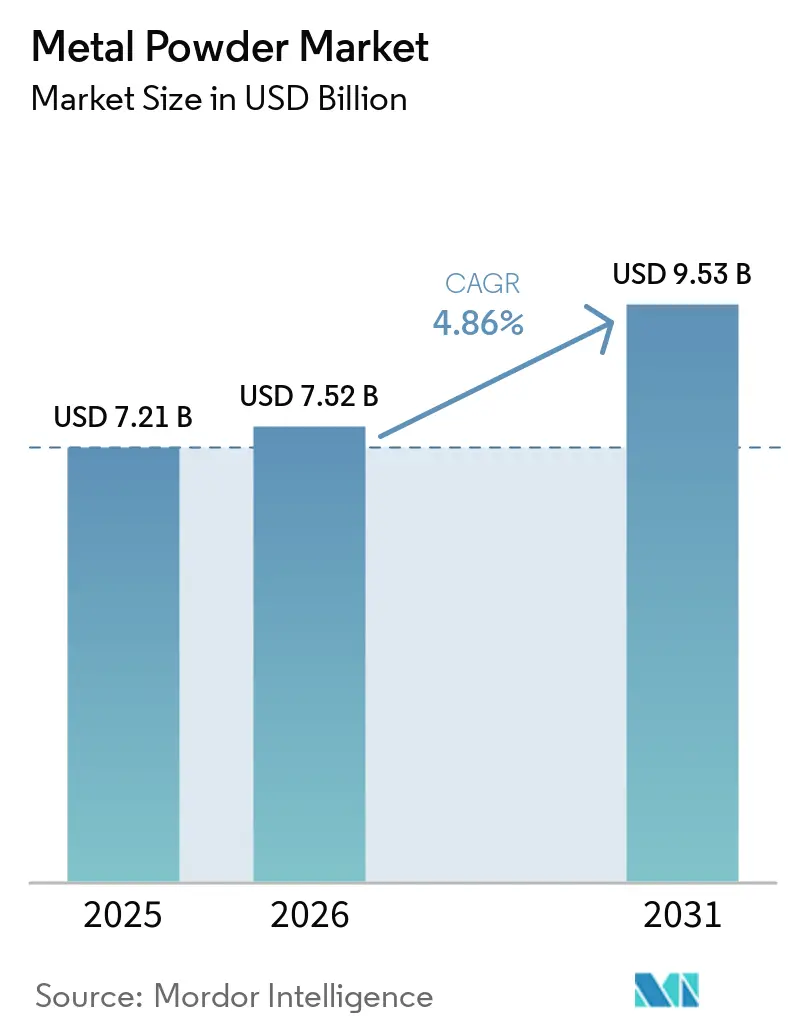
The Metal Powder Market size is projected to expand from USD 7.21 billion in 2025 and USD 7.52 billion in 2026 to USD 9.53 billion by 2031, registering a CAGR of 4.86% between 2026 to 2031. Electrification of vehicles, rapid industrialization of binder-jet additive manufacturing, and hydrogen-based direct-reduced-iron (DRI) projects are reshaping demand patterns across process technologies and alloy types. Atomization continues to dominate high-volume automotive and appliance applications, yet hydrometallurgical routes enjoy faster growth because they deliver energy savings. Titanium and refractory-alloy powders gain traction as medical-implant makers and hypersonic-weapon programs require near-net-shape components with ultra-low oxygen content. Asia-Pacific anchors both volume and growth as China and India scale hydrogen-DRI capacity alongside government incentive schemes, while North America protects domestic aerospace and defense supply chains through production credits and Title III funding.
Key Report Takeaways
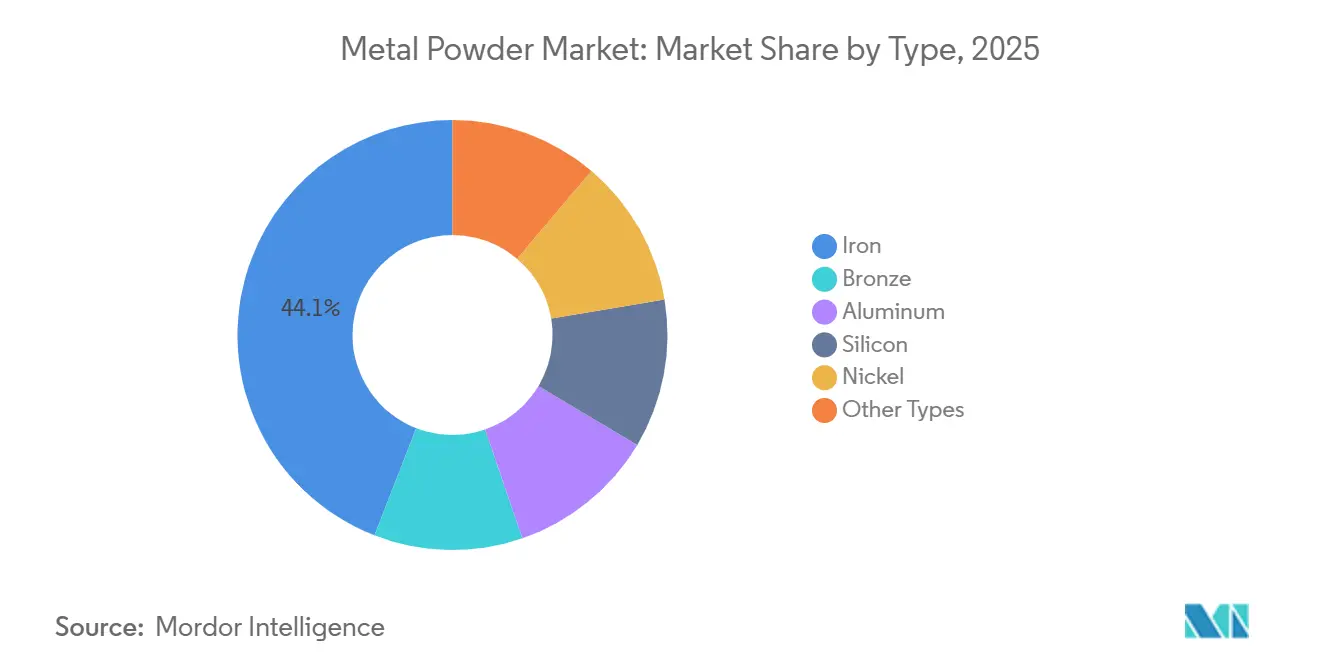
- By type, iron powders captured a 44.08% share in 2025, while "other types" are forecast to expand at a 5.85% CAGR to 2031.
- By process, atomization held 69.79% of the metal powder market share in 2025; other processes are projected to advance at a 5.38% CAGR through 2031.
- By manufacturing method, press-and-sinter commanded 91.18% share in 2025; additive manufacturing is predicted to achieve a 6.10% CAGR through 2031.
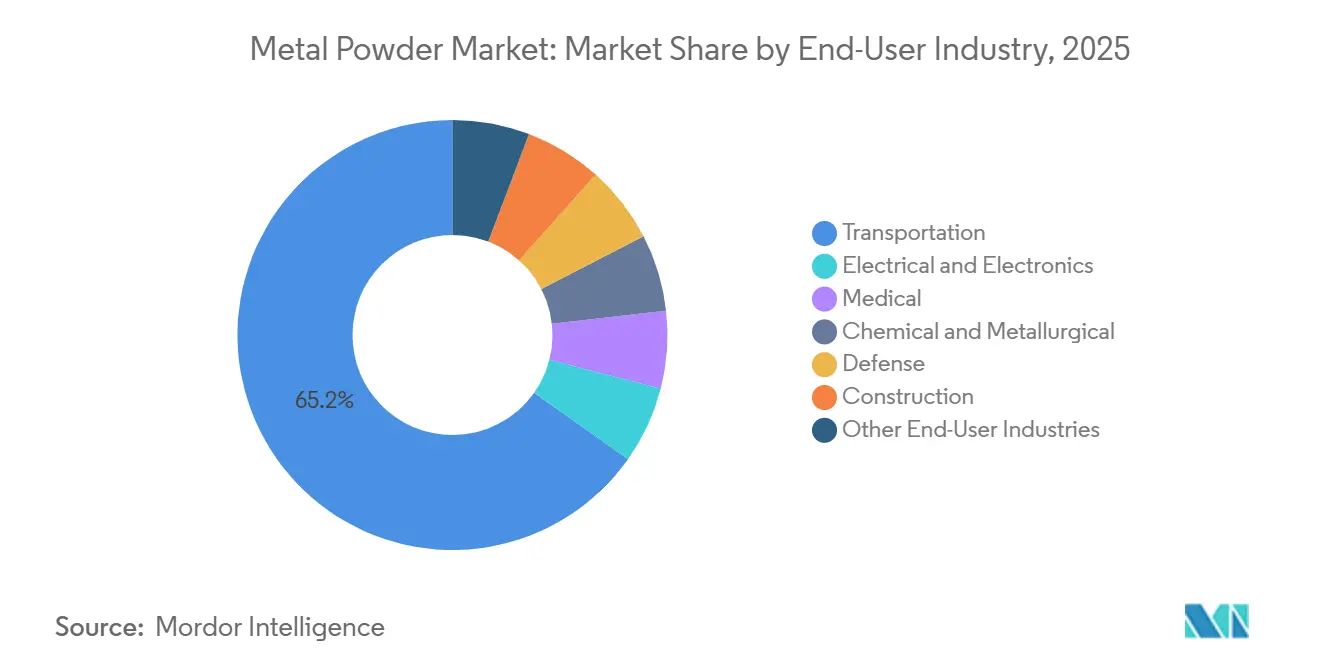
- By end-user industry, transportation led with a 65.21% share in 2025, and medical applications are set to post a 6.26% CAGR to 2031.
- By geography, Asia-Pacific accounted for a 44.26% share in 2025 and is expected to grow at a 5.48% CAGR between 2026 and 2031.
Note: Market size and forecast figures in this report are generated using Mordor Intelligence’s proprietary estimation framework, updated with the latest available data and insights as of 2026.
Market Trends and Insights
Drivers Impact Analysis of Metal Powder Market*
| Drivers | (~) % Impact on CAGR Forecast | Geographic Relevance | Impact Timeline |
|---|---|---|---|
| Surge in automotive and aerospace lightweighting programs | +1.2% | Global, with concentration in North America, Europe, and China | Medium term (2-4 years) |
| Rapid industrialization of binder-jet additive manufacturing | +0.9% | North America and Europe core, APAC adoption accelerating | Medium term (2-4 years) |
| Electronics densification driving ultra-fine powder demand | +0.6% | APAC (China, South Korea, Taiwan), spill-over to North America | Short term (≤ 2 years) |
| Rise of hydrogen-based DRI routes creating high-purity Fe powders | +0.8% | China, India, Middle East (Saudi Arabia, UAE) | Long term (≥ 4 years) |
| Defense-grade refractory alloys for hypersonic systems | +0.5% | United States, Europe (France, UK), China | Long term (≥ 4 years) |
| Source: Mordor Intelligence | |||
Surge in Automotive and Aerospace Lightweighting Programs
Automotive and aerospace manufacturers are increasingly turning to powder metallurgy for components like gears, connecting rods, brackets, and hydraulic manifolds. This shift not only reduces the mass of vehicles and aircraft but also leads to significant cuts in lifecycle emissions and fuel consumption. For instance, General Motors has integrated press-and-sinter gears into its Ultium electric-vehicle platform, achieving a reduction in component mass while retaining fatigue life over 200,000 cycles. Similarly, Airbus has adopted aluminum-silicon powder brackets for its A320neo, resulting in a weight reduction and a significant reduction in lead times. These achievements have paved the way for multi-year powder supply contracts, tightening atomization capacity. Consequently, prices for aerospace-grade aluminum powder are projected to rise in 2025. With regulatory pressures from CAFE and Euro 7 pushing for lightweighting, powder suppliers holding aerospace certifications stand to gain margin premiums, a privilege not extended to commodity iron-powder vendors.
Rapid Industrialization of Binder-Jet Additive Manufacturing
Desktop Metal's P-50 system has propelled binder-jet technology from mere prototyping to full-scale serial production. This advancement allows automotive suppliers to competitively price their offerings, matching the cost-efficiency of metal-injection molding for unit batches. In a significant endorsement, GE Aerospace has approved binder-jet titanium for its RISE engine program, noting a sintered density surpassing wrought materials. While the demand for powder is increasingly leaning towards a highly spherical titanium feedstock, a bottleneck emerges: a scarcity of high-temperature vacuum furnaces is extending lead times to a year. This situation is advantageous for vertically integrated firms that possess both powder and sintering capabilities.
Electronics Densification Driving Ultra-Fine Powder Demand
In 2025, South Korean and Taiwanese capacitor manufacturers secured long-term supply agreements, driving a year-over-year surge in demand for dendritic electrolysis nickel powder. Advanced smartphones and data-center hardware now rely on multilayer ceramic capacitors, enhanced by sub-micron nickel and copper powders for superior dielectric performance. As a result, powder producers with electrorefining capabilities have outshone atomizers, who struggle to economically produce powders under 5 µm, redirecting profit margins towards specialty suppliers in East Asia.
Rise of Hydrogen-Based DRI Routes Creating High-Purity Fe Powders
China Baowu and JSW Steel have launched hydrogen-DRI lines, producing sponge iron with an oxygen content below a specification unachievable through traditional blast furnaces. A portion of this sponge iron is set aside for powder atomization, fetching a premium due to its enhanced sintered density and surface finish from the lower oxygen content. Meanwhile, producers in the Middle East, capitalizing on affordable renewable energy, export their high-purity powder to Europe. There, the CBAM tariffs provide a cost edge to green-iron feedstock[1].
Restraints Impact Analysis of Metal Powder Market*
| Restraints | (~) % Impact on CAGR Forecast | Geographic Relevance | Impact Timeline |
|---|---|---|---|
| Respiratory and explosion hazards in nano-scale production | -0.7% | Global, acute in North America and EU due to enforcement | Short term (≤ 2 years) |
| Quality drift in recycled feedstock streams | -0.6% | North America and Europe (aerospace certification requirements), spill-over to APAC | Medium term (2-4 years) |
| Energy-intensive atomisation impacting sustainability metrics | -0.5% | Europe (carbon pricing), China (dual-control policy), North America | Medium term (2-4 years) |
| Source: Mordor Intelligence | |||
Respiratory and Explosion Hazards in Nano-Scale Production
In January 2025, OSHA mandated enclosed handling and live particulate monitoring for powders smaller than 10 µm[2]. This requirement has raised compliance costs significantly for each production line. Meanwhile, European ATEX regulations are pushing smaller producers away from nano-powder lines due to the high costs of retrofitting for explosion-proof electrics and inert-gas blanketing. Following a series of dust explosions in 2024, insurance premiums have increased. This spike has led to a concentration of supply among integrated players, who can spread the burden of safety investments across their broader portfolios.
Energy-Intensive Atomization Undermining Sustainability Metrics
Gas atomization, consuming significant energy per kilogram, clashes with net-zero commitments. Starting in 2026, this energy consumption will lead to CBAM tariffs, increasing import costs in Asia. Both Höganäs and Rio Tinto have pledged substantial investments towards hydrogen-plasma and renewable-electricity retrofits. Their goal is to achieve a carbon footprint of less than 1 kg CO₂ per kg of powder by 2027. Meanwhile, smaller atomizers are feeling the pinch. As automotive and aerospace clients enforce Scope 3 caps, those using high-carbon feedstock face penalties, tightening margins for these smaller players.
*Our forecasts treat driver/restraint impacts as directional, not additive. The impact forecasts reflect baseline growth, mix effects, and variable interactions.
Metal Powder Market Segment Analysis
By Type:
Iron Dominates Volume, Titanium and Specialty Alloys Lead GrowthIron accounted for a 44.08% share in 2025, reflecting its role in high-volume gears, bearings, and structural components, but commoditization continues to suppress margins. "Other Types" are forecast to grow 5.85% annually as orthopedic and dental implants, hypersonic systems, and semiconductor thermal-management parts demand ultra-clean powders. Iron suppliers hedge margin risk by capturing vehicular electrification volumes in EV battery trays, while premium-alloy producers secure long-term take-or-pay contracts with medical and defense customers that insulate pricing.

By Process:
Atomization Anchors Volume, Hydrometallurgy Targets PurityAtomization delivered 69.79% of the metal powder market share in 2025 because decades of investment locked in low-cost production for press-and-sinter iron and aluminum powders, This makes atomizing metal powder a key process for high-volume applications. "Other Processes" will expand at a 5.38% CAGR through 2031 as fluidized-bed electrolysis and hydrogen reduction slash energy use and accept lower-grade ores, tightening the metal powder market size cost gap versus traditional atomization. Atomization incumbents leverage scale, captive scrap, and tolling deals with automotive tier-ones, yet they invest in plasma and hydrogen-plasma upgrades to defend share. Electrochemical challengers focus on titanium, copper, and nickel powders for electronics and aerospace, where purity and morphology command premiums, avoiding head-on volume battles until cost parity approaches at smaller batch sizes. Competitive intensity, therefore, pivots on energy economics and feedstock flexibility rather than throughput alone.
By Manufacturing Method:
Press-and-Sinter Defends Economics, Additive Gains Certification TractionPress-and-sinter retained 91.18% share in 2025, offering lower part costs at scale compared to binder-jet. This cost advantage solidifies its lead in transmissions and drivetrain components. As approvals accumulate, additive manufacturing will post a 6.10% CAGR through 2031, subsequently boosting the metal powder market for additive-grade feedstock. The economic crossover threshold is set below specific part batch sizes or for geometries that can shave off significant costs post-machining. Consequently, additive vendors are focusing on aerospace brackets, orthopedic implants, and tooling inserts, steering clear of bulk powertrain components. In response, press-and-sinter operators are diversifying with multi-material stacks and warm compaction techniques to fortify their market position.
By End-User Industry:
Transportation Anchors Volume, Medical Commands MarginTransportation absorbed a 65.21% share in 2025, driven by sustained iron-powder demand for gears and structural cast-replacement parts amidst rising EV adoption. Meanwhile, medical devices emerge as the fastest-growing consumer, with a robust annual growth rate fueled by trends in joint replacements and protocols for single-use surgical instruments. Medical devices, however, are the fastest-growing consumer, advancing 6.26% annually on the back of joint-replacement demographics and single-use surgical-instrument protocols. Powder producers boasting ISO 13485 certifications and a history with the FDA enjoy a price premium over standard commodity grades, a gap likely to widen as regulatory scrutiny sharpens.
Geography Analysis
APAC Metal Powder Market
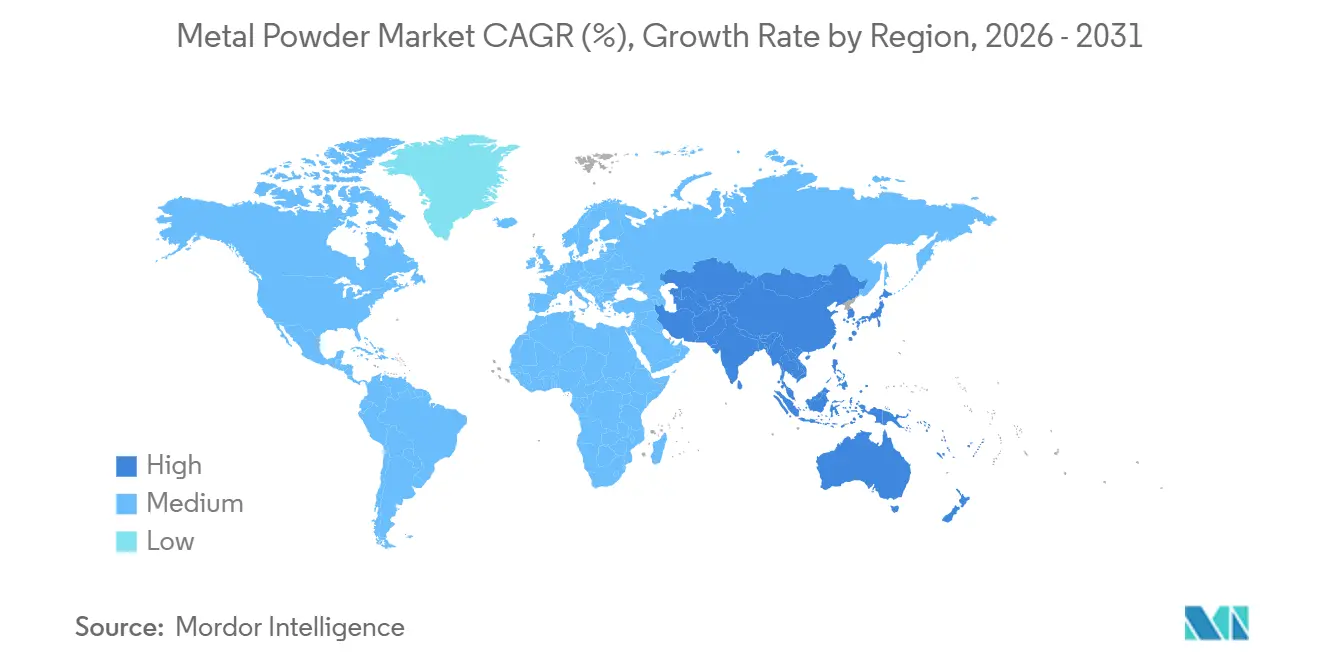
Asia-Pacific held 44.26% of the metal powder market share in 2025 and is projected to post the fastest 5.48% CAGR to 2031. This growth is largely fueled by initiatives in China and India, notably in hydrogen-DRI production and the expansion of electric vehicle platforms. Chinese industry leader Baowu is reaping significant cost advantages over Western counterparts by seamlessly integrating upstream sponge iron with water-atomization. Meanwhile, India's Production-Linked Incentive (PLI) scheme unveiled a significant boost in press-and-sinter capacity in 2025. Both Japan and South Korea have carved a niche, specializing in ultra-fine copper and silver powders tailored for multilayer ceramic capacitors, solidifying their export dominance in the Americas and Europe.
North America Metal Powder Market
North America accounted for a substantial portion of the 2025 market volume, propelled by robust demand from the aerospace, defense, and electric vehicle sectors. Domestic titanium-powder production lines received a boost from Title III grants, while the Inflation Reduction Act's advanced-manufacturing credit is driving green-powder production, essential for EV motors and wind turbine gearboxes. Leveraging its hydropower advantage, Quebec's cluster is positioning giants like Rio Tinto Metal Powders and Tekna as prime low-carbon suppliers to both the U.S. and Europe.
EMEA and South America Metal Powder Market
Europe, holding a significant share of the market in 2025, faced growth constraints due to stagnant light-vehicle output. However, the region found momentum in scope-3 decarbonization incentives, which favor low-CO₂ powders. Companies like Höganäs and Metalysis are racing ahead, fast-tracking hydrogen-plasma and electrolysis technologies, eyeing market leadership as CBAM tariffs push import prices higher. Meanwhile, smaller atomizers in Germany and Italy are honing in on aerospace and luxury tooling powders, strategically safeguarding their profit margins. Though South America and the Middle-East and Africa collectively account for a smaller portion of the market, there's potential for growth, especially with Brazil's automotive ambitions and Saudi Arabia's push towards renewables and hydrogen-DRI strategies.
Value Chain Analysis
The metal powder value chain starts with upstream feedstocks such as primary metals (iron, nickel, titanium, copper, aluminum), alloying elements, and recycled scrap, then moves into powder-making routes that include atomization, solid-state reduction, electrolysis, and other chemical or hydrometallurgical pathways. Midstream activities cover powder classification and sieving, blending, heat treatment, packaging, and logistics under tight handling protocols for fine and reactive powders, followed by qualification and certification against end-user specifications for automotive press-and-sinter, metal injection molding, additive manufacturing, electronics, aerospace, and medical. Industry bodies such as MPIF (and its Metal Powder Producers Association) and ISO/TC 119 also influence common test methods and specification approaches that support cross-border supply.
Downstream, service bureaus and OEMs convert powders using press-and-sinter lines, binder-jet and laser-based additive manufacturing, and component finishing. Capacity constraints such as furnace availability, oxygen control, and traceability requirements can become limiting factors for aerospace and medical grades. Over time, the chain has been shaped more by compliance and quality management systems, including ISO 9001/14001/45001 adoption among producers, and by initiatives that reduce reliance on long-haul powder logistics, including on-demand bar-to-powder concepts discussed in 2026 life-cycle work on DirectPowder-type systems aimed at lowering transport and contamination risks for localized production.
Competitive Landscape
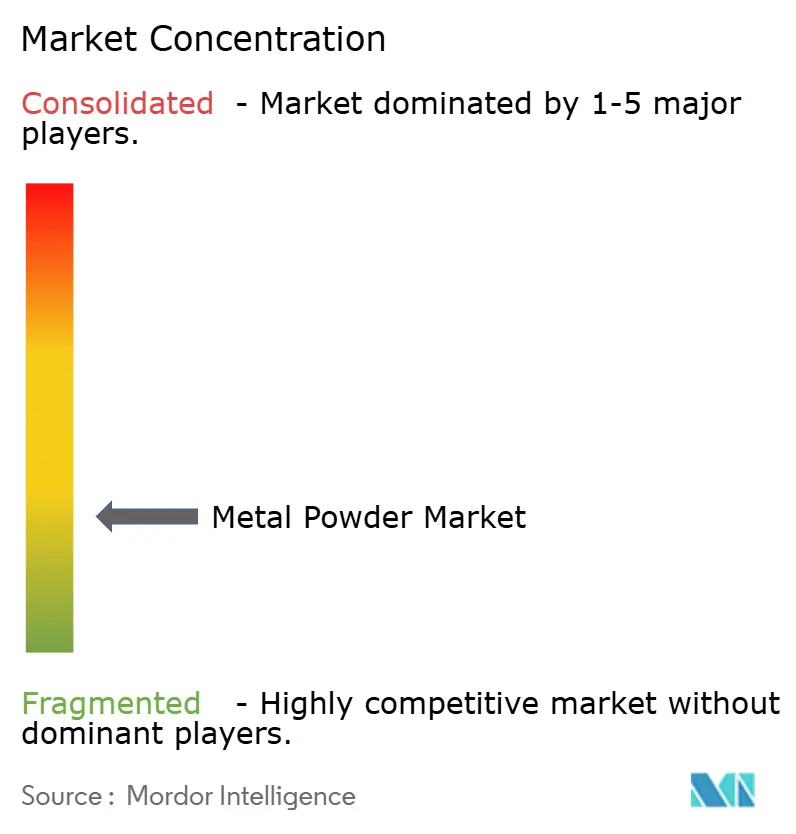
The metal powder market is moderately fragmented. Competitive intensity, therefore, bifurcates: scale economics continue to dominate commoditized press-and-sinter iron, while certification moats and novel process IP shield margin pools in aerospace, medical, and defense alloys. Over the forecast window, incumbents that fail to secure low-carbon energy or proprietary atomization upgrades risk erosion of both share and EBITDA.
Metal Powder Industry Leaders
-
Höganäs AB
-
GKN Powder Metallurgy
-
Sandvik AB
-
ATI
-
Kymera International
- *Disclaimer: Major Players sorted in no particular order
Metal Powder Market Companies Covered in this Report
- Advanced Technology & Materials Co., Ltd.
- Alcoa Corporation
- ATI
- Aubert & Duval
- BASF
- CNPC Powder
- CRS Holdings, LLC.
- Erasteel
- GKN Powder Metallurgy
- H.C. Starck Tungsten GmbH
- Hitachi High-Tech India Private Limited
- Höganäs AB
- JFE Steel Corporation
- Kymera International
- Linde Plc
- Metalysis Ltd.
- Outokumpu
- Polema
- Rio Tinto Metal Powders
- Sandvik AB
- Seiko Epson Corporation
- Tekna
- Valimet
Market Opportunities and Future Outlook
Specialty and application-qualified powders create whitespace where certification, traceability, and compliance requirements support more durable differentiation than commodity iron powders. This is especially visible for additive manufacturing into aerospace, space, medical, and defense applications. June 2026 actions such as Sandvik's launch of Osprey GRCop-42 for space applications with cradle-to-gate traceability highlight how demand is moving toward documented provenance and high-performance alloy powders for thermal management and high-heat-flux use cases.
Regional capacity build-outs and supply-chain localization also translate into more concrete opportunities for producers that can add qualified capacity and meet tightening safety and chemical constraints. 2026 investment announcements and commissioning milestones, including SSAB's steel powder expansion in Oxelosund (350 tpa planned by Q1 2028) and Amaero's additional EIGA atomizer commissioned in Tennessee, point to continued expansion routes for additive-grade materials. In parallel, the EU REACH amendment (EU) 2026/1289 adopted on July 14, 2026 lowers the hexavalent chromium migration limit to 0.001 ppm effective January 1, 2027, which increases the value of compliant powder production, testing, and documentation for suppliers serving Europe.
Recent Industry Developments in Metal Powder Market
- June 2026: Sandvik launched Osprey GRCop-42, a copper-chromium-niobium alloy powder designed for additive manufacturing of demanding space applications. The product targets high-heat-flux and propulsion-adjacent requirements and reinforces differentiation through traceability and application-specific powder engineering.
- June 2026: Sandvik announced an agreement to sell its Osprey metal powder business to Swedish investment firm Mimir, creating a standalone platform focused on advanced metal powders. The carve-out supports consolidation and specialization in additive manufacturing and MIM powders, and the transition also reshapes how customers source certified powders from dedicated operators.
- April 2026: GKN Powder Metallurgy expanded its US binder-jetting footprint by adding HP Metal Jet technology at its Auburn Hills, Michigan facility. The expansion increases domestic conversion capacity for powders into serial-production parts and strengthens supply options for automotive, thermal management, and defense programs that prioritize local manufacturing and qualification.
Metal Powder Market Report Scope and Research Methodology
Market Definition and Coverage
For this study, the market covers commercially sold metal powders used as inputs for powder metallurgy and additive manufacturing. This includes powders made by atomization, reduction, electrolysis, and related routes, and consumed across major end-use industries worldwide.
Scope exclusions: We exclude downstream finished parts revenue and focus only on the metal powder material value, not the value added by part making, machining, or assembly.
Segments Covered in This Report
- Type
- Iron
- Bronze
- Aluminum
- Silicon
- Nickel
- Other Types (Titanium, etc.)
- Process
- Atomization
- Reduction of Compounds
- Electrolysis
- Other Processes (Hydrometallurgical Routes, etc.)
- Manufacturing Method
- Press and Sinter (Conventional PM)
- Metal Injection Molding
- Additive Manufacturing/3D Printing
- Other Methods (Hot Isostatic Pressing, etc.)
- End-User Industry
- Transportation
- Electrical and Electronics
- Medical
- Chemical and Metallurgical
- Defense
- Construction
- Other End-User Industries (Additive Manufacturing Service Bureaus, etc.)
- Geography
- Asia-Pacific
- China
- India
- Japan
- South Korea
- Thailand
- Indonesia
- Vietnam
- Malaysia
- Philippines
- Rest of Asia-Pacific
- North America
- United States
- Canada
- Mexico
- Europe
- Germany
- United Kingdom
- France
- Italy
- Spain
- Russia
- NORDIC Countries
- Turkey
- Rest of Europe
- South America
- Brazil
- Argentina
- Colombia
- Rest of South America
- Middle-East and Africa
- Saudi Arabia
- United Arab Emirates
- Qatar
- South Africa
- Nigeria
- Egypt
- Rest of Middle-East and Africa
- Asia-Pacific
Data Sources, Market Sizing, and Validation
Desk Research
We started with desk research to pin down market boundaries, typical conversion steps, and the demand centers where powders are actually consumed. Public sources helped anchor the storyline and inputs, including USGS mineral and metals statistics, UN Comtrade trade flows, Eurostat industrial production series, USITC trade data, and standards-body publications (such as ASTM International) for powder and AM related definitions.
Company annual reports, investor presentations, and technical notes were then used to understand portfolio mix across iron, aluminum, nickel, and specialty powders, as well as where capacity additions were being announced. In parallel, paid database subscriptions for company financials and news screening were used alongside patent databases to track technology direction in atomization and powder handling. This list of desk research sources is not exhaustive, and additional public and paid references were used to compile data points, validate assumptions, and clarify open questions.
Primary Interviews and Surveys
Primary work was used to test what we saw in secondary sources, especially around how demand splits by transportation, industrial PM, and additive manufacturing, and how pricing differs by powder type and purity. We spoke with a mix of powder producers, distributors, equipment ecosystem participants, and large end users across key regions so the model assumptions could be corrected where local supply patterns and import dependence looked different.
Distribution of primary research fieldwork respondents
| Company type | Respondent position | Region |
|---|---|---|
| Top tier: 32% | CXOs: 16% | APAC: 45% |
| Mid tier: 51% | Functional/Unit leaders: 35% | EMEA: 37% |
| Smaller Players: 17% | Managers: 49% | Americas: 18% |
Market-Sizing & Forecasting
Market sizing was built using a top-down and bottom-up approach. Industrial production, trade, and end-use output indicators were first used to reconstruct the demand pool for metal powders by region, and then cross-checked using selective supplier and channel approximations. Since metal powder is used heavily in press-and-sinter parts and is rising in additive manufacturing, we kept the model tied to a few practical fingerprints that can be checked year to year.
On the demand side, we used inputs such as powder metallurgy parts output by major producing regions, transportation production trends (given transportation is a large consuming industry), additive manufacturing adoption signals, and import-export balances for relevant powder categories where trade is meaningful. On the pricing side, we tested assumptions around average selling prices by powder type, purity, and process route (atomized vs. reduced and others), because these differences can move total market value even when volumes appear stable. Where a clean bottom-up roll-up was not possible in smaller countries, gaps were handled by using proxy indicators such as manufacturing output and trade intensity, and then adjusted after primary feedback.
For forecasting, scenario analysis was used to reflect different adoption speeds in additive manufacturing and different cycles in transportation and industrial production. Growth rates by region and end-use were reviewed with interview inputs and then applied to the key variables, and the revenue path was recomputed from updated volumes and price progression rather than using a flat CAGR shortcut.
Data Validation & Update Cycle
Outputs were checked through triangulation against independent signals, including regional manufacturing activity, trade movements, and publicly visible capacity or expansion announcements that should show up in supply availability. When an estimate looked out of line, the assumptions were reopened, and the outlier was traced back to either pricing, mix, or a geography mapping issue, then corrected before it moved forward.
A multi-step analyst review was followed so calculations, unit conversions, and regional splits were checked by a second reviewer before sign-off. If a material event occurs, such as a large capacity ramp, a major trade restriction, or a sudden demand swing in transportation or additive manufacturing, the team triggers re-contacts with industry participants to refresh key parameters. Reports are refreshed annually, and a final pre-delivery pass is done to make sure the latest public updates are reflected in the numbers.
Mordor Intelligence's Metal Powder Market Size Measured Against Other Published Estimates
It is normal to see different market sizes for metal powder because each publisher draws the boundary in a slightly different place, and the value can shift quickly when price, mix, and end-use weighting are treated differently. Differences usually show up from what is counted as metal powder revenue, which end uses are included, and how the year currency and pricing are handled.
By tracking end-use demand signals and refreshing price and mix assumptions each cycle, Mordor Intelligence keeps the 2025 total tied to powder material revenue only (not finished parts), which reduces over-counting that can happen when additive manufacturing and powder metallurgy value chains are blended together.
Benchmark comparison
| Source | Market Size | Gaps in Research Methodology |
|---|---|---|
| Mordor Intelligence | USD 7.21 B (2025) | |
| Trade Journal A | USD 9.00 B (2023) | Uses an earlier base year and appears to bundle broader powder-related value, which can include downstream powder metallurgy part value or wider advanced materials revenues, and then extends growth without rechecking mix shifts. |
| Regional Consultancy B | USD 7.50 B (2024) | Leans more on supply-side announcements and headline capacity, which can overstate realized sales when utilization, exports, and application-level consumption are not fully reconciled by region. |
The spread across published numbers mostly comes from scope and the way price and application mix are updated from year to year. When the model is anchored to observable end-use demand and then reconciled with trade and capacity context, the final market value becomes easier to explain and replicate, even when parts of the data are not perfectly visible.
Key Questions Answered in the Report
What is the projected value of the metal powder market in 2031?
Global consumption is USD 7.52 billion in 2026 and is projected to reach USD 9.53 billion by 2031, reflecting a 4.86% CAGR.
Which process currently dominates global metal powder output?
Atomization leads with 69.79% share, driven by established gas- and water-atomized lines.
Which end-user segment is expected to grow the fastest through 2031?
Medical devices are projected to record a 6.26% CAGR, outpacing all other industries.
How will CBAM influence European metal powder sourcing?
The tariff raises Asian import costs, encouraging European buyers to shift toward regionally produced low-carbon powder.