
Market Overview
| Study Period | 2020 - 2031 |
|---|---|
| Forecast Data Period | 2026 - 2031 |
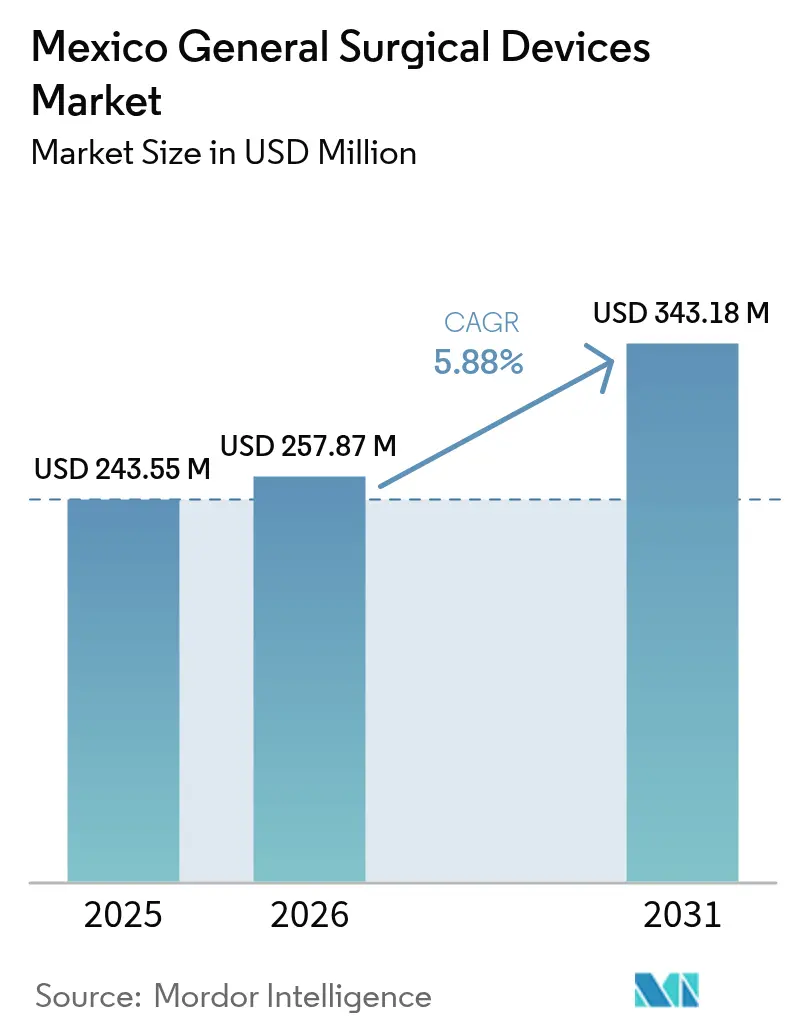
| Base Year Market Size (2025) | USD 243.55 Million |
| Market Size (2026) | USD 257.87 Million |
| Market Size (2031) | USD 343.18 Million |
| Growth Rate (2026 - 2031) | 5.88 % |
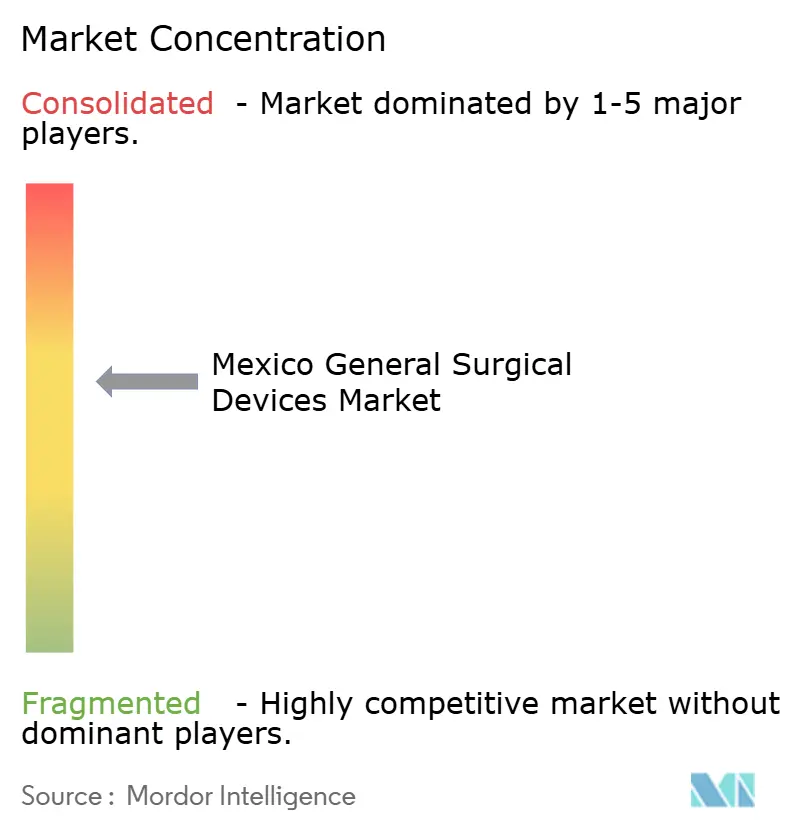
| Market Concentration | Medium |
Major Players *Disclaimer: Major Players sorted in no particular order Image © Mordor Intelligence. Reuse requires attribution under CC BY 4.0. | |
Mexico General Surgical Devices Market Analysis by Mordor Intelligence
The Mexico General Surgical Devices Market size is expected to grow from USD 243.55 million in 2025 to USD 257.87 million in 2026 and is forecast to reach USD 343.18 million by 2031 at 5.88% CAGR over 2026-2031. Hospitals, private clinics, and border health centers continue to adopt technology that enables shorter recovery times, which has accelerated demand for minimally invasive and robotic systems. The market benefits from near-shoring strategies that position Mexico as a manufacturing hub for North American supply chains, reducing lead times and import costs for critical components. Continued growth in medical tourism underpins premium demand for advanced visualization, imaging, and robotic platforms in border cities. Government hospital-modernization spending and private sector investment in ambulatory surgery centers add further momentum, even as fiscal constraints encourage cost-effective device configurations.
Key Report Takeaways
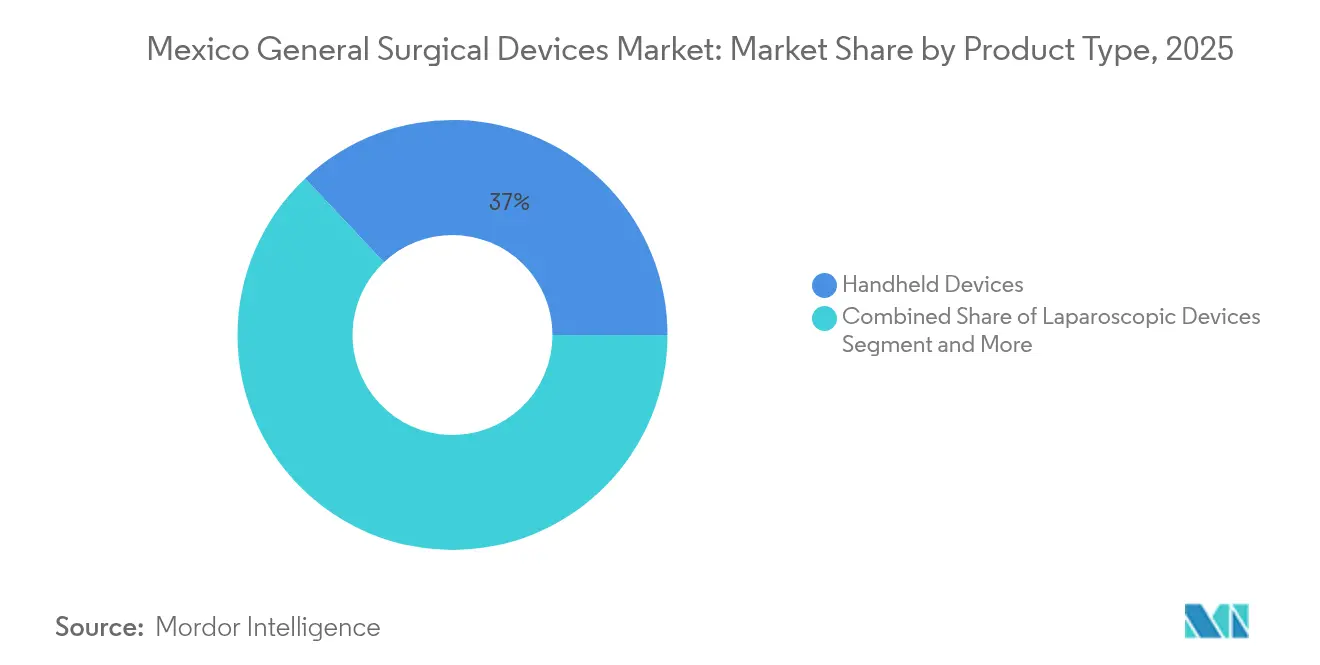
- By product type, handheld devices led with 37.02% of the Mexico general surgical devices market share in 2025, while robotic and computer-assisted systems posted the fastest 6.61% CAGR through 2031.
- By procedure approach, minimally invasive surgery captured 71.24% revenue share in 2025; the segment is expanding at a 6.05% CAGR to 2031.
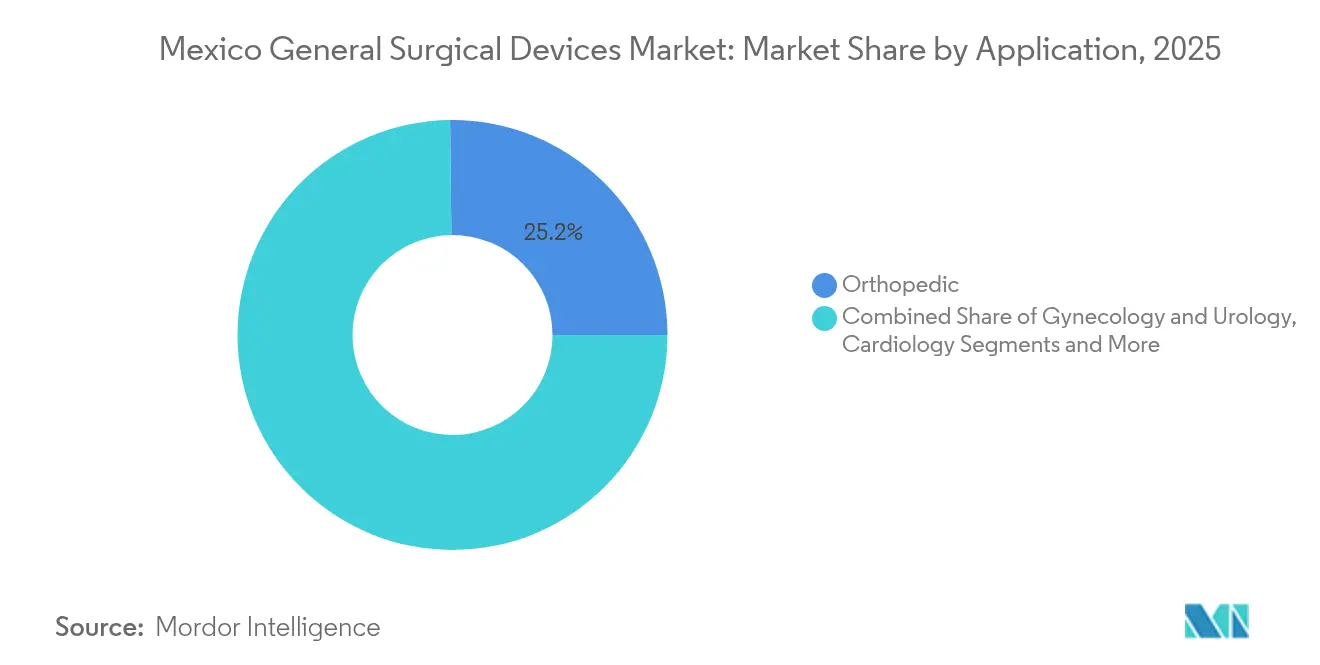
- By application, orthopedic procedures accounted for 25.18% of the Mexico general surgical devices market size in 2025, while cardiology is projected to rise at a 6.02% CAGR through 2031.
- By end user, hospitals held 70.86% share of the Mexico general surgical devices market size in 2025, whereas ambulatory surgery centers are forecast to post a 6.78% CAGR between 2026-2031.
Note: Market size and forecast figures in this report are generated using Mordor Intelligence’s proprietary estimation framework, updated with the latest available data and insights as of 2026.
Mexico General Surgical Devices Market Trends and Insights
Drivers Impact Analysis*
| Driver | (~) % Impact on CAGR Forecast | Geographic Relevance | Impact Timeline |
|---|---|---|---|
| Rising Demand for Minimally-Invasive Surgery | +1.2% | National, with concentration in border cities and major metropolitan areas | Medium term (2-4 years) |
| Technological Advances in Laparoscopic & Robotic Systems | +0.9% | National, with early adoption in private hospitals and medical tourism centers | Long term (≥ 4 years) |
| Growing Surgical Burden from Obesity & Metabolic Diseases | +0.8% | National, with higher prevalence in northern and urban regions | Long term (≥ 4 years) |
| Government Hospital-Modernization (INSABI) Programs | +0.6% | National, focusing on underserved rural and urban areas | Medium term (2-4 years) |
| Near-Shoring of Device Manufacturing Boosts Local Supply | +0.4% | Regional, concentrated in Baja California, Sonora, Jalisco manufacturing clusters | Medium term (2-4 years) |
| Expansion of Private Border Hospitals for Medical Tourism | +0.3% | Regional, primarily US-Mexico border cities including Tijuana, Ciudad Juárez | Short term (≤ 2 years) |
| Source: Mordor Intelligence | |||
Rising Demand for Minimally Invasive Surgery
Mexican surgeons increasingly favor laparoscopic and endoscopic techniques that shorten recovery and reduce postoperative pain, especially in gynecology and bariatric care. Comparative studies show robotic-assisted laparoscopy lowers conversion rates and complications in complex cases such as endometriosis, prompting investment in visualization systems and advanced handheld devices. Ambulatory surgery centers are scaling capacity which further supports demand for portable minimally invasive platforms.[1] Artificial-intelligence guidance, already demonstrating sub-millimeter tracking accuracy, is poised to enhance surgeon confidence and accelerate adoption. Collectively, these factors reinforce the dominance of minimally invasive devices across the Mexico general surgical devices market.
Technological Advances in Laparoscopic & Robotic Systems
Launches such as Intuitive Surgical’s da Vinci 5 and Johnson & Johnson’s Velys Spine platform provide Mexico-based hospitals access to smaller footprints, improved imaging, and ergonomic enhancements that overcome earlier cost and training hurdles. Partnerships like Medtronic-Siemens integrate 3D imaging with robotic navigation, enabling precise vertebrae measurement during spine procedures. Domestic training capacity is rising as SAGES rolls out iLAP master programs in nine Mexican centers, standardizing skills and broadening the talent pool available for advanced therapies. Enhanced hardware and educational infrastructure position the Mexico general surgical devices market to sustain long-term technological upgrading.
Growing Surgical Burden from Obesity & Metabolic Diseases
With obesity prevalence among the highest worldwide, bariatric procedures surge, requiring advanced stapling, closure, and imaging systems that withstand complex abdominal anatomy. Diabetes complications are also driving wound-care device consumption, particularly in northern states. An aging population—8.2% over 65—adds knee and cataract surgery volumes under new government programs, widening orthopedic device demand. Robotic bariatric techniques, though capital intensive, deliver lower length-of-stay metrics, improving hospital economics and boosting adoption in tertiary centers.
Government Hospital-Modernization (INSABI) Programs
INSABI’s mandate to reduce care gaps has allocated multiyear budgets for surgical suites, though procurement delays have created pent-up demand for essential devices. Recent bids centralize purchasing to secure scale discounts, saving MX$30 billion while requiring suppliers to prove value over total cost of ownership. Public-private hospital projects in rural districts open channels for vendors that can align training and maintenance packages with modernization targets. Although health budgets fell 11% in 2025, the program still stimulates device demand where clinical need is acute
Restraints Impact Analysis*
| Restraint | (~) % Impact on CAGR Forecast | Geographic Relevance | Impact Timeline |
|---|---|---|---|
| High Capital Cost of Advanced Surgical Equipment | -0.8% | National, with greater impact on public hospitals and smaller private facilities | Medium term (2-4 years) |
| COFEPRIS Registration Timelines & Documentation Burden | -0.6% | National, affecting all device manufacturers and importers | Short term (≤ 2 years) |
| Rural Surgeon Shortage Limits Device Penetration | -0.4% | Regional, concentrated in rural and underserved areas | Long term (≥ 4 years) |
| Peso Volatility Inflates Imported Component Prices | -0.3% | National, with greater impact on import-dependent manufacturers | Short term (≤ 2 years) |
| Source: Mordor Intelligence | |||
High Capital Cost of Advanced Surgical Equipment
Public hospitals face tighter budgets after a 14.3% spending decline in 2025, limiting acquisition of premium robotic systems despite proven clinical benefits. Smaller private providers also struggle to justify multimillion-dollar outlays without scale efficiencies, pushing them toward refurbished or shared-service models. Consolidation deals in healthcare M&A highlight the search for capital synergies capable of funding next-generation platforms. Consequently, cost remains a ceiling on penetration for high-value systems within the Mexico general surgical devices market.
COFEPRIS Registration Timelines & Documentation Burden
Standard device approvals take 10-18 months, and deficiency letters can extend the process by another half-year, delaying launches of innovative tools.[2] Detailed technical dossiers, ISO 13485 evidence, and local holder requirements add to expense, with single registrations often costing USD 5,000-10,000 before testing fees. Smaller innovators find these hurdles particularly challenging, which slows technology refresh cycles inside the Mexico general surgical devices industry.
*Our forecasts treat driver/restraint impacts as directional, not additive. The impact forecasts reflect baseline growth, mix effects, and variable interactions.
Segment Analysis
By Product Type: Handheld Dominance amid Rapid Robotic Uptake
Handheld devices generated 37.02% of the Mexico general surgical devices market in 2025, underscoring their ubiquity across every specialty and procedure complexity level. Public institutions appreciate reusable scalpels, forceps, and needle holders that withstand sterilization while private centers pair premium handheld electrosurgical pencils with high-definition screens for delicate work. Demand also rises for energy instruments compatible with minimally invasive ports. The Mexico general surgical devices market size for robotic and computer-assisted systems is projected to climb at 6.61% CAGR, supported by da Vinci 5 and Velys Spine launches that improve haptic feedback and imaging clarity.
Robotic uptake remains highest in spine, bariatric, and urology programs catering to international patients who research technology specifications before travel. Electrosurgical consoles that integrate with AI-guided video feeds show steady volume gains because they shorten procedure times. Trocars and access systems grow in tandem with laparoscopic volumes, particularly in gynecology where spinal anesthesia protocols cut recovery by full days. Wound-closure demand stays resilient with IMSS-Bienestar planning around 1 million surgeries despite budget pressure, locking in baseline consumption of sutures and staplers. Emerging AI-enhanced handhelds capable of real-time tissue identification signal the next frontier for product differentiation within the Mexico general surgical devices market.

By Procedure Approach: Minimally Invasive Supremacy
Minimally invasive surgery held 71.24% share in 2025 and is expanding at 6.05% CAGR through 2031, reflecting nationwide surgeon retraining and patient preference for faster discharge. Many private centers position minimally invasive care as a differentiator for US and Canadian medical tourists, prompting acquisitions of 4K laparoscopes, articulating staplers, and 3 mm ports that minimize scarring.
Open surgery persists for trauma and emergent pathology but its proportion continues sliding as ambulatory centers win case mix from inpatient wards. The Mexico general surgical devices market size tied to minimally invasive platforms benefits from government cataract and knee programs that specify arthroscopy and phacoemulsification techniques. SAGES training hubs further integrate simulation into curriculum, ensuring a pipeline of residents proficient in laparoscopy, which supports downstream device consumption. Robust data that show lower complication rates in robotic endometriosis surgery reinforce physician confidence and fuel procurement budgets in tertiary centers.
By Application: Orthopedic Scale and Cardiovascular Momentum
Orthopedic procedures captured 25.18% of the Mexico general surgical devices market in 2025, led by knee and spine interventions that address aging demographics and rising obesity. President Sheinbaum’s 2025 knee replacement initiative allocates funding for implants and navigation systems, drawing competitive bids from global suppliers.
Cardiology’s 6.02% CAGR stems from device-imaging convergence that streamlines valve, bypass, and hybrid interventions. Medtronic’s cardiovascular portfolio milestone of USD 3.1 billion in Q2 FY25 global revenue provides confidence for Mexican distributors to widen inventory. Gynecological and urological volumes increase through cross-border fertility and prostate programs, requiring fine-bore instruments and laser lithotripters. Neurosurgical adoption of robotic positioning arms drives sales of frameless navigation probes, benefiting from AI-assisted tremor suppression technologies. The Mexico general surgical devices market share associated with bariatric suites rises in parallel with obesity surgery growth, a trend evident in tertiary centers that report shorter stays and lower complication rates after robotic gastric bypass.
By End User: Hospitals Rule yet ASCs Accelerate
Hospitals retained 70.86% revenue dominance in 2025 as they manage trauma, obstetric, and complex oncology cases that demand full operating theater capabilities. Teaching centers in Mexico City and Guadalajara deploy robotic suites to attract residency candidates and to meet accreditation metrics for advanced procedure volumes.
Ambulatory surgery centers grow at 6.78% CAGR, propelled by insurer reimbursement policies that favor outpatient settings and by patient preference for shorter admissions. Border ASCs earn premium returns servicing international clientele who bundle vacation packages with elective surgeries, justifying investments in compact intraoperative CT scanners and high-definition endoscopy. Specialty clinics sharpen focus on single-service lines, leveraging modular surgical towers that reduce floor space. Collective shifts in care sites support diversified channel strategies for suppliers within the Mexico general surgical devices market.
Geography Analysis
Northern border cities concentrate premium surgical demand because proximity to the United States attracts 1.4 million medical tourists per year, fostering high adoption of robotic systems, 4K imaging, and single-use instruments that meet international expectations. Baja California alone accounts for 36% of Mexico’s medical device exports, enabling rapid replenishment of components and streamlined service support, which benefits hospitals in Tijuana and Mexicali.
Central Mexico—especially Mexico City and Guadalajara—hosts national reference hospitals and manufacturing R&D clusters. Guadalajara’s high-tech corridor now mirrors Silicon Valley’s device prototyping culture, encouraging joint ventures where design iterations proceed alongside clinical pilots, reducing time to market for laparoscopic accessories and neurosurgical probes.
Southern and rural regions lag in device penetration due to surgeon shortages and infrastructure gaps, yet INSABI reforms channel grants for modular theaters and tele-surgery pilots that could decentralize access. These programs create future opportunities for rugged handhelds and portable imaging systems tailored to intermittent power conditions. Overall, geographic diversity necessitates multi-tier distribution and after-sales models across the Mexico general surgical devices market.
Regulatory Landscape
Mexico regulates general surgical devices through the Federal Commission for the Protection against Sanitary Risks (COFEPRIS) under the Secretariat of Health, with market access centered on sanitary registration and ongoing post-market controls. NOM-241-SSA1-2021 remains the key mandatory standard for Good Manufacturing Practices (GMP) for medical devices, shaping supplier qualification requirements for both imports and local manufacturing.
In July 2025, Mexico introduced a new medical-device classification framework by decree, clarifying categories such as low-risk products subject to registration and products exempt from registration. This affects dossier depth and launch sequencing across broader surgical portfolios. Separately, Lineamientos published in March 2025 set criteria for recognizing GMP (CBPF) certificates issued by recognized regulatory authorities, enabling equivalence-based submissions for multinational manufacturers while keeping GMP evidence and documentation completeness as gating factors for time-to-market.
Competitive Landscape
Multinationals such as Johnson & Johnson, Medtronic, and Stryker dominate high-value specialties through integrated platforms that combine hardware, software, and training packages. Johnson & Johnson’s MedTech division invested USD 1.3 billion in surgical instruments development, underscoring a commitment to next-generation systems that differentiate on ergonomics and AI analytics. Medtronic’s partnership with Siemens showcases ecosystem strategies that lock in imaging and navigation workflows under unified service contracts, raising switching costs for hospitals.
Local production gains momentum as tariff changes add 4-8% duties to imported finished goods, motivating companies like ThermoFab to build enclosures and single-use components in Mexicali where labor costs undercut Asian benchmarks. Olympus Latin America expanded its bipolar energy line and launched the Visera Elite III endoscopic tower, broadening mid-price options for public hospitals.
Emerging innovators develop AI-guided handhelds capable of delivering real-time tissue characterization, threatening to leapfrog legacy vendors reliant on incremental hardware updates. Regulatory expertise remains a strategic asset; firms that navigate COFEPRIS efficiently achieve earlier revenue booking and can reinvest in localized after-sales teams. The Mexico general surgical devices industry therefore balances scale advantages of global incumbents with agile entrants positioned to serve niche clinical needs.
Mexico General Surgical Devices Industry Leaders
-
Boston Scientific Corporation
-
Stryker Corporation
-
Johnson & Johnson (Ethicon)
-
Medtronic plc
-
B. Braun SE
- *Disclaimer: Major Players sorted in no particular order
Market Opportunities and Future Outlook
Public-sector capacity expansion and modernization create a multi-year opportunity for equipment replacement and installed-base growth across core general surgery categories (handheld instruments, electrosurgery, visualization, and wound-closure). The National Hospital Infrastructure Plan (2024-2030) announced by the Secretariat of Health focuses on large-scale delivery (new hospitals, expansions, and major upgrades) and is linked to national institutions such as IMSS, ISSSTE, and IMSS-Bienestar. This increases the value of vendors that can package devices with commissioning, preventive maintenance, and clinical training that aligns with centralized tenders.
A second opportunity is speed-to-market and portfolio refresh for minimally invasive platforms, where COFEPRIS process changes require suppliers to align global approvals, technical dossiers, and local holder models for quicker commercialization cycles. With minimally invasive surgery already dominant in Mexico (71.24% revenue share in 2025 within this report scope), suppliers can compete through smaller-footprint towers, energy devices, and stapling systems designed for ambulatory workflows, alongside service models that reduce capital barriers (shared-use, managed equipment services, and refurbishment) for public hospitals and smaller private providers. Regional gaps in southern and underserved areas targeted by modernization programs support demand for rugged, portable surgical and imaging configurations that can operate under infrastructure constraints while staying compliant with NOM-241-SSA1-2021 quality expectations.
Recent Industry Developments
- June 2026: Medtronic announced the launch in Mexico of a leadless pacemaker system for patients with bradycardia. The launch supports procedure migration toward catheter-based, minimally invasive cardiac workflows and increases distributor and service requirements for advanced implant programs in major Mexican centers.
- April 2025: Olympus Latin America expanded its POWERSEAL advanced bipolar sealer-divider portfolio in Mexico. The expansion broadened access to vessel sealing options used across laparoscopic and open procedures, supporting standardization of energy device consumables in hospital operating rooms and ambulatory settings.
- March 2024: Olympus Latin America introduced the VISERA ELITE III endoscopic visualization platform in Mexico. Upgraded visualization towers raise baseline expectations for image quality and system integration, reinforcing investment in minimally invasive surgery infrastructure among private hospitals and high-throughput surgical sites.
Research Methodology Framework and Report Scope
Market Definition and Coverage
This market covers the value of general surgical devices sold and used in Mexico for routine and minimally invasive procedures across hospital and outpatient surgical settings, counted at the point of sale into the healthcare system.
Scope exclusions: We exclude non-surgical medical devices and general hospital consumables that are not directly used as surgical devices during a procedure.
Segmentation Overview
- By Product Type
- Handheld Devices
- Laparoscopic Devices
- Electrosurgical Devices
- Wound-Closure Devices
- Trocars and Access Systems
- Robotic and Computer-Assisted Systems
- Other Devices
- By Procedure Approach
- Open Surgery
- Minimally Invasive Surgery
- By Application
- Gynecology and Urology
- Cardiology
- Orthopedic
- Neurology
- Other Applications
- By End User
- Hospitals
- Ambulatory Surgical Centres
- Specialty Clinics
Data Sources, Market Sizing, and Validation
Desk Research
Desk research was used to set the Mexico specific demand context and to anchor assumptions that can be checked against public signals. We reviewed official health system publications such as Mexico Ministry of Health updates, OECD health statistics, and World Bank indicators to understand procedure volumes, capacity expansion, and spending direction.
Trade and regulatory signals were also screened, including customs trade statistics (import and export trends for relevant device categories), PAHO and WHO publications, and scientific articles indexed on PubMed that discuss adoption of minimally invasive techniques and wound closure practices. Alongside these, we used company annual reports, investor presentations, and credible news coverage to map product focus, channel presence, and pricing posture. For select financial context, we applied a paid subscription for company financials and intelligence, and we used a shipment level import and export database for cross-checks. The sources listed here are illustrative only, and we also relied on other public materials to collect, validate, and clarify specific data points.
Primary Interviews and Surveys
Primary work was done through expert interviews and structured surveys with manufacturers, distributors, procurement stakeholders, and clinical users who influence device choice and utilization in Mexico. To reduce blind spots, we balanced responses across the public and private care mix and cross checked inputs across major urban demand centers and broader regional coverage. This helped confirm volumes, price bands, and the adoption pace of minimally invasive procedures for the device groups in scope.
Distribution of primary research fieldwork respondents
| Company type | Respondent position |
|---|---|
| Top tier: 31% | CXOs: 18% |
| Mid tier: 48% | Functional/Unit leaders: 26% |
| Smaller Players: 21% | Managers: 56% |
Market-Sizing & Forecasting
Sizing starts from a top down build where procedure activity and care delivery capacity are used to reconstruct the addressable demand pool for general surgical devices in Mexico, then converted into value using realistic price bands. We corroborate totals with selective bottom-up approximations, such as sampling distributor channel checks and using observed selling price ranges by device group multiplied by implied volumes. If the two views diverge, we adjust the assumptions to align with the most defensible demand and pricing drivers.
Key inputs in the model include trends in minimally invasive procedure penetration, hospital and ambulatory surgical center expansion, the mix shift between open and minimally invasive approaches, replacement and utilization cycles for key device groups, and import reliance that affects availability and pricing. Where direct volume indicators are missing, we use proxy rates agreed in expert calls. For example, we map device use per procedure by specialty and then stress test it against procurement patterns.
Forecasting is built using scenario analysis supported by short historical movement and confirmed directionality from primary respondents, with emphasis on pricing progression, adoption speed for minimally invasive techniques, and expected changes in procurement behavior. Each scenario remains transparent so readers can see which assumption drives the market the most, and then one central case is selected for the final forecast series.
Data Validation & Update Cycle
Outputs are validated through triangulation across independent demand signals, trade indicators, and field feedback, followed by variance checks at category and total levels. When an unexpected jump appears, we recheck underlying drivers and recontact selected respondents to confirm whether the change reflects a shift in procedure mix or a modeling artifact.
Before sign off, the model and assumptions go through a multi step analyst review so definitions, units, and currency treatment stay consistent across years. Reports are refreshed annually, and interim updates are triggered when material events occur, followed by a final pre delivery review pass to ensure the latest information is reflected in the numbers.
Mordor Intelligence's Mexico General Surgical Devices Market Size Measured Against Other Published Estimates
Published market sizes for Mexico general surgical devices can differ even when the titles sound similar, because each publisher may count a different set of device categories, channels, or procedure settings. Differences also come from how prices are normalized, how imports are treated, and how often assumptions get revisited.
The main gap is whether robot assisted and computer assisted systems are counted inside general surgical devices. In Mordor Intelligence, we include only the device groups explicitly scoped to general surgery use, and we avoid rolling in broader operating room equipment bundles that can inflate totals. Other spreads are often driven by aggressive adoption curves for minimally invasive procedures, mixing manufacturer list prices with realized selling prices, and applying currency conversion timing that does not match the base year purchasing environment.
Benchmark comparison
| Source | Market Size | Gaps in Research Methodology |
|---|---|---|
| Mordor Intelligence | USD 243.55 M (2025) | |
| Industry Research Firm A | USD 343.10 M (2025) | Uses a broader inclusion set that can pull adjacent operating room equipment and system level spending into the total, which lifts the 2025 value above a device only view. |
| Trade Journal B | USD 220.00 M (2025) | Often reflects a narrower tracked set of imported categories and reported trade values, which can understate locally distributed products and does not always align prices to actual selling levels. |
Looking across the three values, the difference is mainly explained by what gets counted as a general surgical device and how pricing is converted into market value. By keeping the scope tied to observable device groups, checking assumptions with field respondents, and using repeatable demand drivers like procedure activity and care setting mix, the final number stays easier to audit year to year and to update when conditions change.
Key Questions Answered in the Report
What is the current value of the Mexico general surgical devices market?
The market is valued at USD 257.87 million in 2026 and is projected to reach USD 343.18 million by 2031, growing at 5.88% CAGR.
Which product segment leads the market?
Handheld devices hold the top spot with a 37.02% share of 2025 revenue.
Why is minimally invasive surgery so prominent in Mexico?
It delivers faster recovery, supports medical tourism competitiveness, and now accounts for 71.24% of procedures with a 6.05% CAGR.
How does COFEPRIS regulation affect device launch timelines?
Standard approvals take 10-18 months, and additional requests can prolong entry, which impacts smaller innovators the most.
Which region generates the highest demand for advanced surgical technology?
Northern border cities such as Tijuana and Mexicali lead because of strong medical tourism inflows and proximity to US patients.