
Market Overview
| Study Period | 2019 - 2031 |
|---|---|
| Forecast Data Period | 2026 - 2031 |
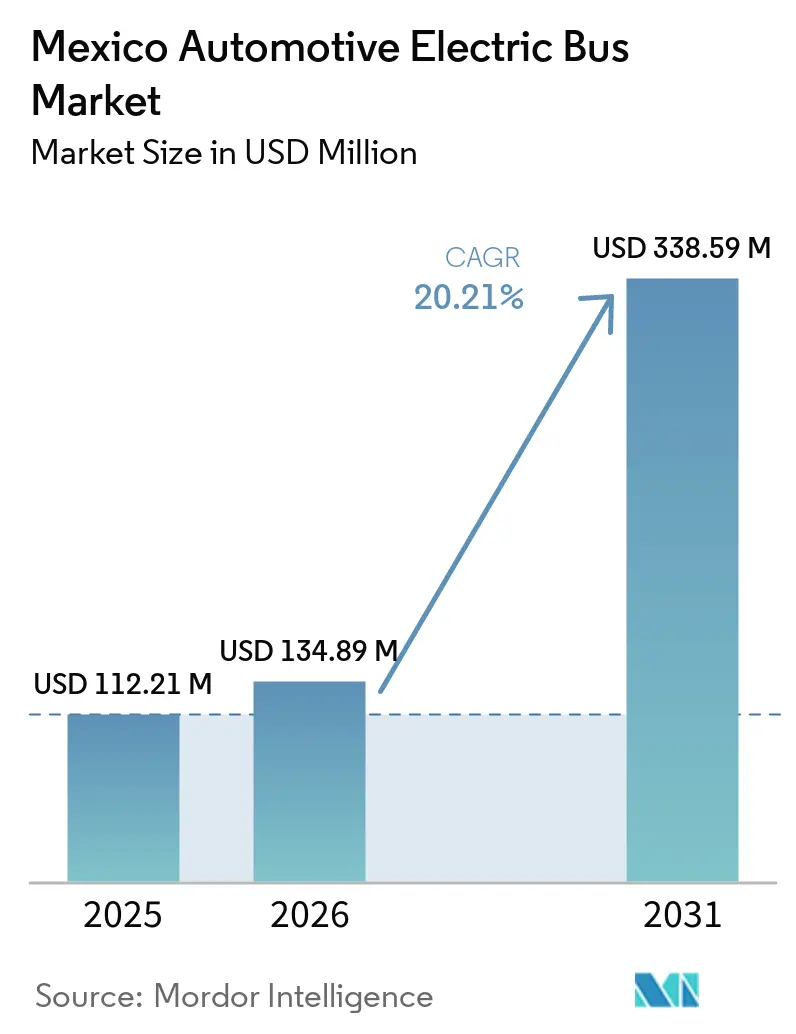
| Base Year Market Size (2025) | USD 112.21 Million |
| Market Size (2026) | USD 134.89 Million |
| Market Size (2031) | USD 338.59 Million |
| Growth Rate (2026 - 2031) | 20.21 % |
| Market Concentration | Medium |
Major Players *Disclaimer: Major Players sorted in no particular order Image © Mordor Intelligence. Reuse requires attribution under CC BY 4.0. | |
Mexico Automotive Electric Bus Market Analysis by Mordor Intelligence
The Mexico automotive electric bus market size was valued at USD 112.21 million in 2025, is estimated at USD 134.89 million in 2026, and is projected to reach USD 338.59 million by 2031, growing at a CAGR of 20.21% during the forecast period (2026-2031). Federal purchase subsidies, strict particulate-matter limits, and the localization of battery-electric bus (BEB) assembly together accelerate near-term volumes. Depot charging networks in Mexico City and Guadalajara already support multi-shift operations, and rising production of lithium-iron-phosphate (LFP) cells is reducing the total cost of ownership compared with Euro 6 diesel units. Tariffs on fully built Chinese buses are compressing import margins and nudging original equipment manufacturers (OEMs) such as Volvo and Daimler to certify “Hecho en México” models. Meanwhile, corporate logistics fleets are piloting electric vans and shuttles, building a parallel demand stream that spills into public-transport concessions. Large sporting events—most notably the 2026 FIFA World Cup—accelerate municipal procurements to showcase zero-emission mobility on television and social media.
Key Report Takeaways
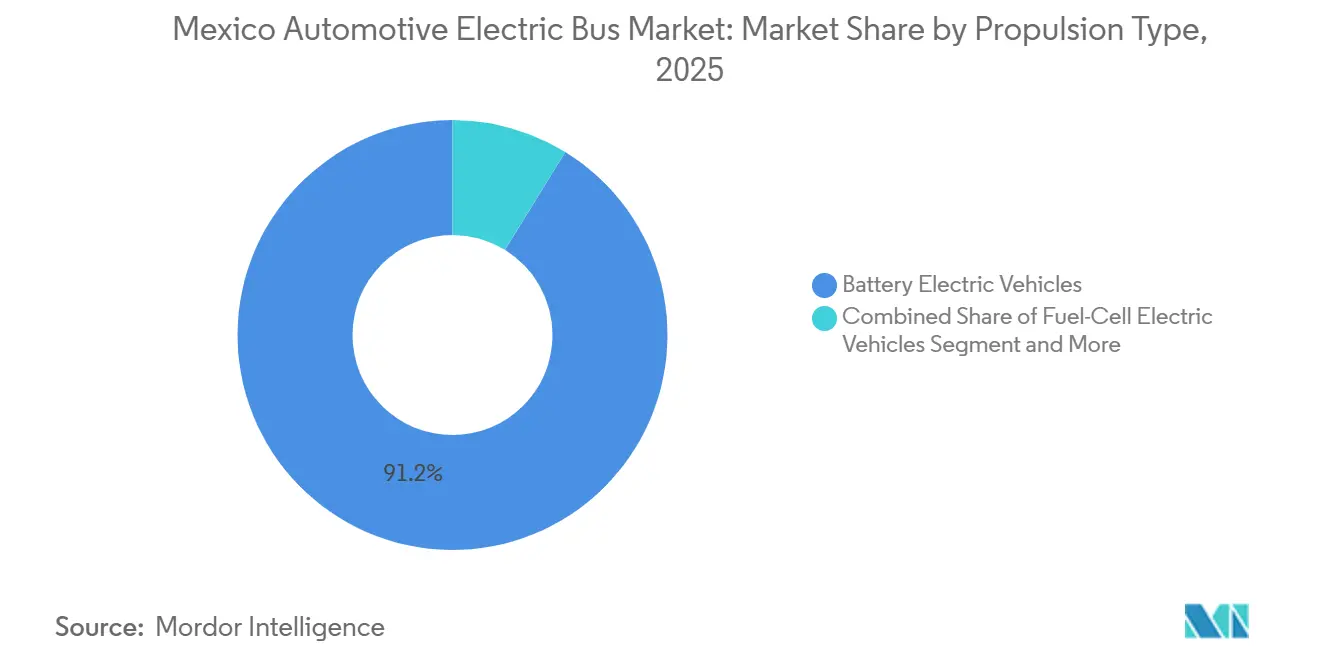
- By propulsion type, battery-electric vehicles led with 91.22% of Mexico's automotive electric bus market share in 2025; fuel-cell buses are forecast to post the fastest CAGR, at 22.28%, through 2031.
- By consumer type, government procurement accounted for 68.41% of the Mexican automotive electric bus market in 2025, while private operators recorded the highest CAGR at 21.16% to 2031.
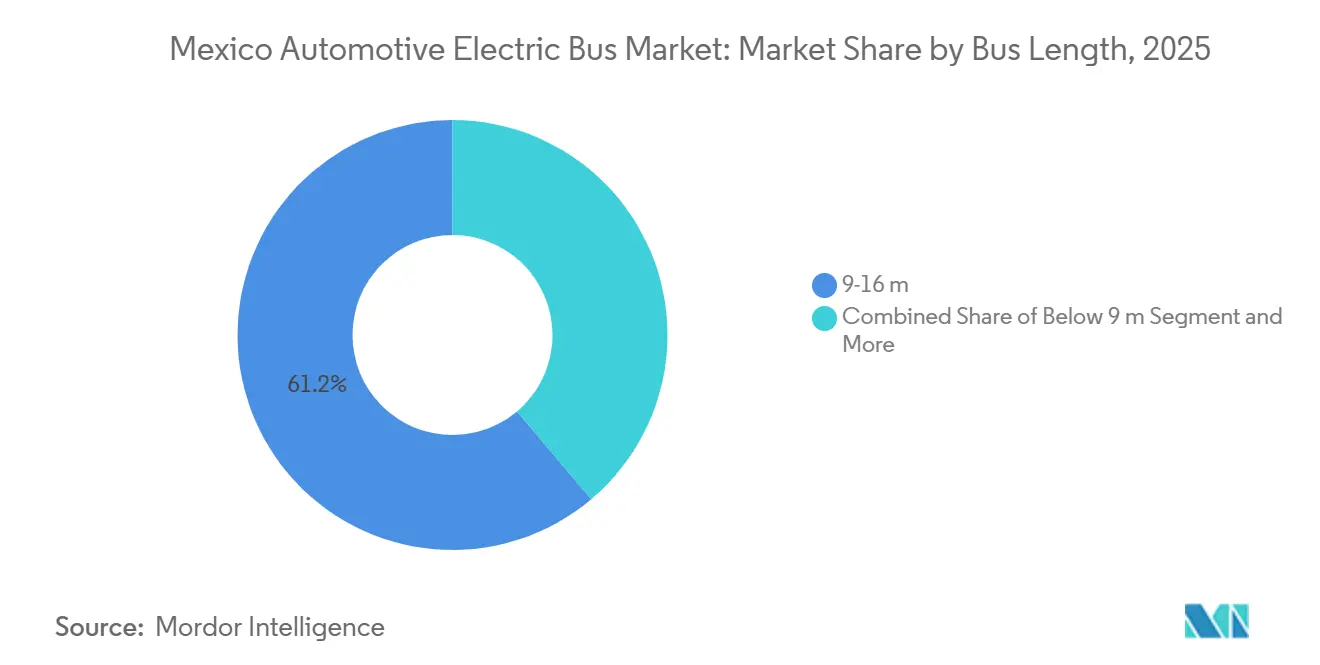
- By bus length, 9-14-meter models captured 61.16% of the Mexican automotive electric bus market share in 2025, while articulated buses above 14 meters are advancing at a 20.43% CAGR through 2031.
- By operating range, buses in the 201-400-kilometer range accounted for 77.28% of the Mexican automotive electric bus market share in 2025; variants above 400 kilometers are growing at a 21.72% CAGR to 2031.
Note: Market size and forecast figures in this report are generated using Mordor Intelligence’s proprietary estimation framework, updated with the latest available data and insights as of January 2026.
Mexico Automotive Electric Bus Market Trends and Insights
Drivers Impact Analysis*
| Driver | (~) % Impact on CAGR Forecast | Geographic Relevance | Impact Timeline |
|---|---|---|---|
| Federal E-Bus Subsidies | +4.2% | National, concentrated in CDMX, Guadalajara, Monterrey | Medium term (2-4 years) |
| Urban Air-Quality Mandates Rising | +3.8% | CDMX core, spillover to Guadalajara, Monterrey, Puebla | Short term (≤ 2 years) |
| OEM Localization of BEB Assembly | +3.5% | National, early gains in Jalisco, Nuevo León, Estado de México | Long term (≥ 4 years) |
| LFP Battery Cost Declines | +2.9% | Global supply chain benefits, national procurement impact | Medium term (2-4 years) |
| Growth in Carbon-Neutral Corporate Fleets | +2.6% | National, concentrated in industrial corridors and metropolitan areas | Medium term (2-4 years) |
| National Targets for 100% Zero-Emission Public Transport | +2.4% | National policy framework, phased implementation by city size | Long term (≥ 4 years) |
| Source: Mordor Intelligence | |||
Federal E-Bus Purchase Subsidies
The modernization package integrates accelerated depreciation and Nacional Financiera credit guarantees into a unified framework, reducing borrowing costs for municipal operators. Additional state-level incentives, such as registration fee waivers in the Estado de México, further decrease per-unit costs. The program is designed to prioritize turnkey "charging as a service" contracts. For instance, Enel X’s lease for Metrobús Lines includes fast chargers and battery-replacement guarantees, transferring technology risk to a utility-grade balance sheet. As the program is set to expire, original equipment manufacturers (OEMs) are working to establish assembly lines in Mexico to meet domestic-content requirements before the subsidies phase out. This timeline is driving a concentration of orders, which could lead to a downturn in demand unless additional fiscal measures are introduced.
Growing Urban Air-Quality Mandates
NOM-025-SSA1-2021 establishes stricter limits for particulate matter, which are often exceeded during winter inversion episodes in the Valley of Mexico. Alongside NOM-172-SEMARNAT-2023, which sets limits on nitrogen dioxide, municipalities that fail to meet these targets risk losing federal co-financing for new mass transit infrastructure [1]“NOM-172-SEMARNAT-2023 Dióxido de Nitrógeno,”, Secretaría de Medio Ambiente, dof.gob.mx. This has driven a shift in Bus Rapid Transit (BRT) procurement toward zero-emission options. For example, the electrification of Mexico City’s Metrobús Line 3 significantly reduced CO2 emissions, a result now used as collateral for issuing green bonds to support further fleet upgrades. These regulations increase the appeal of articulated and bi-articulated buses, as a single battery-powered unit can replace the particulate emissions of multiple diesel buses operating on the same corridor.
OEM Localization of BEB Assembly
Volvo certified its 7800 Electric and LUMINUS models produced at the Tultitlán plant, reducing import duties and shortening lead times[2]“Inicio de Producción 7800 Electric,”, Volvo Buses México, volvobuses.com. Daimler's approach involves shipping eO500 U chassis from Brazil for final assembly in Mexico, complying with USMCA rules of origin and avoiding tariffs imposed on fully assembled Chinese buses. BYD's decision to pause its facility highlights the impact of the new penalties on offshore production. Meanwhile, domestic manufacturer Taruk assembled its first 12-meter bus in Hidalgo, focusing on second-tier cities that prioritize proximity to after-sales service over global branding. The use of local content provides a scoring advantage in public tenders, gradually diminishing the cost advantage of imported models.
Limited High-Power Depot Chargers Outside CDMX
Mexico City and Estado de México collectively operate a significant number of chargers with substantial installed capacity. In contrast, Puebla, Mérida, and Hermosillo together have far fewer high-power charging units. Municipalities are reluctant to procure buses without necessary grid upgrades, while utilities delay transformer reinforcements until binding purchase orders are secured, creating a cycle of dependency. A major initiative was announced to deploy chargers and buses across the Bajío region. However, execution risks persist if early uptime performance falls short. Currently, smaller depots rely on overnight chargers, which limit fleet utilization to single-shift operations and hinder expansion beyond the capital region.
Restraints Impact Analysis*
| Restraint | (~) % Impact on CAGR Forecast | Geographic Relevance | Impact Timeline |
|---|---|---|---|
| Limited Depot Charging Outside CDMX | -2.1% | Regional cities excluding Mexico City metropolitan area | Short term (≤ 2 years) |
| Peso Volatility on Battery Imports | -1.9% | National, affecting all import-dependent procurement | Medium term (2-4 years) |
| EV-Bus Technician Shortage | -1.7% | National, acute in secondary cities and rural areas | Long term (≥ 4 years) |
| High Cost vs. Diesel Options | -1.5% | National, particularly affecting smaller municipal budgets | Medium term (2-4 years) |
| Source: Mordor Intelligence | |||
Peso Volatility Against Imported Battery Packs
The peso depreciated significantly against the U.S. dollar, increasing the landed price of an LFP battery pack. As batteries account for a substantial portion of the bill of materials, depreciation extended payback periods for operators exposed to foreign-exchange fluctuations. Additionally, tariffs on Chinese buses exacerbated the situation, significantly raising their costs. While government agencies can secure loans at relatively lower interest rates through development banks, private concessionaires face higher borrowing costs for peso-denominated loans. This has led some operators to postpone purchases or shift to locally assembled Volvo and Taruk models, which feature a higher proportion of peso-denominated content, thereby reducing currency risk.
Scarcity of Skilled EV-Bus Technicians
Mexico's push for electric buses faces a significant hurdle: a shortage of skilled labor for high-voltage maintenance, especially in areas outside major urban hubs. This shortage extends repair times and heightens dependence on costly mobile service teams. While manufacturers are teaming up with state polytechnics to address the issue, experts predict the workforce won't be adequately filled until post-2028. Consequently, service delays could continue, jeopardizing the operations of the growing bus fleets.
*Our forecasts treat driver/restraint impacts as directional, not additive. The impact forecasts reflect baseline growth, mix effects, and variable interactions.
Segment Analysis
By Propulsion Type: Battery Dominance Amid Fuel-Cell Pilots
Battery-electric buses accounted for 91.22% of the Mexican automotive electric bus market share in 2025, as LFP chemistry matured and depot charging densified. Fuel-cell units, although penciled in at 22.28% CAGR through 2031, remain limited to university demonstrations because hydrogen averages USD 16/kg and refueling hardware is absent from lab prototypes. Plug-in hybrids maintain a minimal market share, with growth constrained by the exclusion from federal incentives.
The introduction of rapid over-the-air (OTA) functionality, first implemented by Daimler on the eCitaro chassis, enables remote diagnostics that reduce downtime. These software capabilities further support the adoption of battery technology. Yutong’s launch of a double-articulated bus equipped with a large battery pack addresses range concerns by achieving a significant duty-cycle range during a pilot on Mexico City’s Line 4. Additionally, as Taruk transitions its domestic battery modules to MegaFlux chemistry, exposure to peso fluctuations decreases, and perceptions of resale value improve among second-tier fleet operators.



By Consumer Type: Public Agencies Anchor, Private Operators Accelerate
Government entities accounted for 68.41% of the Mexican automotive electric bus market share in 2025, reflecting their direct access to federal grant pools that offset high capital outlays. That said, the 21.16% CAGR booked by Private Operators signals widening participation in commuter shuttles, airport landside links, and industrial-park circulators. Mexico's electric bus market share dynamics are therefore tilting toward a dual-purchase channel where policy-driven tenders coexist with business-case-driven private acquisitions.
Leasing houses and energy-as-a-service platforms are emerging risk intermediaries, absorbing residual-value exposure and packaging kilowatt-hour pricing into peso-denominated contracts. The arrangement mitigates forex volatility for corporate buyers and shortens decision cycles from 18 months to as little as 6 months.
By Bus Length: 9–14 Meter Class Retains Volume Leadership
With a 61.16% share of the Mexican electric bus market in 2025, the 9–14 meter segment remains the workhorse for densely populated corridors, where turning radii and curb-height constraints dictate vehicle geometry. Meanwhile, articulated models above 14 meters are on track for a 20.43% CAGR, powered by Bus Rapid Transit (BRT) expansions in Mexico City’s Eje 8 and Monterrey’s Lincoln Corridor.
OEM modular chassis designs now enable the same battery skate to underpin multiple-length variants, reducing incremental tooling capex. The upgrade path from 12-meter to 18-meter articulated fleets is smoother for municipalities because depot infrastructure and spare parts inventories remain largely interoperable.
By Operating Range: 201–400 kilometers Sweet Spot Holds, Long-Range Segment Surges
Buses rated for 201–400 kilometers per charge accounted for 77.28% of the Mexican electric bus market in 2025, confirming alignment between prevailing urban duty cycles and existing LFP energy density. Above-400-kilometer units, once a niche, are racing ahead with a 21.72% CAGR as battery gravimetric densities breach 200 Wh/kg and pack prices drop below the USD 125/kWh tipping point. Mexico's electric bus market size for this range tier is forecast to multiply fivefold by 2030, serving intercity links such as Mexico City-Puebla and Guadalajara-León.
Fleet operators value long-range models because they reduce midday charging windows and enable greater flexibility in service patterns during peak events. The trade-off in pack mass is increasingly offset by lightweight composite body structures introduced by domestic coachbuilder DINA, which cut curb weight by 7–9% compared with aluminum shells.
Geography Analysis
Major metropolitan areas in Mexico, particularly Mexico City, Guadalajara, and Monterrey, are at the forefront of the country's early adoption of electric buses. Mexico City, the capital, has made significant strides, bolstered by consistent investments in public transit. These investments encompass multiple procurement rounds, expansions of trolleybus services, and the establishment of dedicated bus rapid transit corridors, all catering to millions of daily commuters. This concentrated urban effort underscores the importance of robust transit networks and synchronized infrastructure in hastening the shift towards an electrified bus fleet. These volumes make depot-charging optimization viable and justify the use of redundant high-voltage feeders in bus yards, thereby stabilizing fleet uptime.
Mexico is deepening its commitment to electric buses, with diverse regional approaches. In Guadalajara, a major investment plan is to revamp the entire city bus system, mandating full zero-emission compliance by the next service cycle. The city prioritizes robust, high-capacity platforms tailored to its unique climate and terrain. Meanwhile, Monterrey is adopting a hybrid model that blends feeder routes with BRT. This strategy connects outlying municipalities to main corridors, optimizing fleet utilization and accelerating returns.
Secondary cities such as Puebla, Veracruz, and Querétaro are dipping their toes into the market with small pilot programs, thanks to accessible financing. While individual orders may be modest, their collective impact across numerous municipalities could significantly elevate regional demand. However, the success of these initiatives will depend on synchronized infrastructure rollouts. Key to this are fast-charging networks and mobile maintenance support, both vital for ensuring operational reliability across varied geographies.
Competitive Landscape
The market concentration is moderate. BYD, Yutong, and Volvo collectively accounted for a significant share of registrations. However, the entry of Daimler's Urbanus E-Plus S6 and Taruk's domestic roll-out are expanding buyer options. The implementation of tariffs on Chinese buses has impacted the cost competitiveness of BYD and Yutong. In contrast, Volvo's "Hecho en México" label now provides a notable advantage in public tenders. Daimler enhances its offerings by including depot design services, leveraging its experience with turnkey contracts executed globally to appeal to municipalities seeking comprehensive solutions.
Taruk, a joint venture between MegaFlux and DINA, is targeting second-tier operators by combining Mexican-sourced battery packs with established DINA chassis[3]“Presentación Taruk BEB,”, DINA Camiones, dina.com.mx. The company also operates service centers within a convenient radius of most national fleets. Technological differentiation is becoming more pronounced: Yutong's double-articulated prototype leads in capacity, while Daimler's over-the-air (OTA) diagnostics reduce downtime and operating costs. Additionally, utilities such as Enel X and ENGIE are disrupting traditional sales models by offering kilometer-based services rather than selling buses outright, shifting residual-value risk to service providers.
Mexico Automotive Electric Bus Industry Leaders
BYD Company Ltd.
Daimler Truck AG
Volvo AB
Zhongtong Bus Co. Ltd
Yutong Bus Co. Ltd
- *Disclaimer: Major Players sorted in no particular order


Recent Industry Developments
- May 2026: Mexico’s Ministry of Environment and Natural Resources (SEMARNAT) signed a letter of commitment with the ZEBRA Alliance (Zero Emission Bus Rapid-deployment Accelerator), comprising C40 Cities, to advance zero-emission public transport and support electric mobility policies across Mexican cities.
- March 2026: Yutong Bus unveiled electric and hybrid buses at Expo Foro 2026 for intercity, tourism, and urban transport operators in Mexico, including the C11E electric bus, which offers a range of up to 530 km under the C-WTVC cycle.
- March 2025: In Mexico, Volvo Buses unveiled the Volvo 7800 Electric, targeting the Bus Rapid Transit (BRT) sector. This latest electric offering from Volvo is available in both articulated and bi-articulated versions, leveraging the company's adaptable BZR electromobility platform.


Mexico Automotive Electric Bus Market Report Scope
The Mexico automotive electric bus market report is segmented by vehicle type (battery electric bus, fuel-cell electric bus, trolleybus, and other electric bus), consumer type (government, fleet owners, and more), bus length (below 9m mini/midi, and more), and operating range (up to 200km, 201-400km, and above 400km). The market forecasts are provided in terms of value (USD) and volume (units).
By Propulsion Type
| Battery Electric Vehicles (BEV) |
| Fuel-Cell Electric Vehicles (FCEV) |
| Plug-in Hybrid Electric Vehicles (PHEV) |
| Hybrid Vehicles (HEV) |
By Consumer Type
| Government |
| Fleet Owners |
| Private Mass-Transit Operators |
By Bus Length
| Below 9 m (Mini/Midi) |
| 9 - 14 m (Standard) |
| Above 14 m (Articulated) |
By Operating Range
| Upto 200 km |
| 201 - 400 km |
| Above 400 km |
| By Propulsion Type | Battery Electric Vehicles (BEV) |
| Fuel-Cell Electric Vehicles (FCEV) | |
| Plug-in Hybrid Electric Vehicles (PHEV) | |
| Hybrid Vehicles (HEV) | |
| By Consumer Type | Government |
| Fleet Owners | |
| Private Mass-Transit Operators | |
| By Bus Length | Below 9 m (Mini/Midi) |
| 9 - 14 m (Standard) | |
| Above 14 m (Articulated) | |
| By Operating Range | Upto 200 km |
| 201 - 400 km | |
| Above 400 km |


Key Questions Answered in the Report
What is the market size and growth rate of the Mexican Automotive Electric Bus Market?
The Mexico automotive electric bus market size was valued at USD 112.21 million in 2025 and USD 134.89 million in 2026. It is projected to reach USD 338.59 million by 2031, registering a CAGR of 20.21% during the forecast period (2026-2031).
Which propulsion technology leads current deployments?
Battery electric buses commanded 91.22% of 2025 deliveries, far ahead of fuel-cell or hybrid alternatives.
What role do government subsidies play in adoption?
Federal and state incentives cut financing costs by up to 300 basis points and cover registration fees, driving 68.41% of 2025 orders.
Which OEMs are best positioned after the 50% tariff on Chinese buses?
Volvo and Daimler gain an edge through local assembly that qualifies for “Hecho en México” scoring in public tenders, while Taruk targets regional fleets with domestic content.
Page last updated on:


 Your data is secure and never sold or shared.


