
Methionine Market Size and Share
Market Overview
| Study Period | 2021 - 2031 |
|---|---|
| Market Volume (2026) | 2.06 Million tons |
| Market Volume (2031) | 2.81 Million tons |
| Growth Rate (2026 - 2031) | 6.45 % |
| Fastest Growing Market | Asia-Pacific |
| Largest Market | Asia-Pacific |
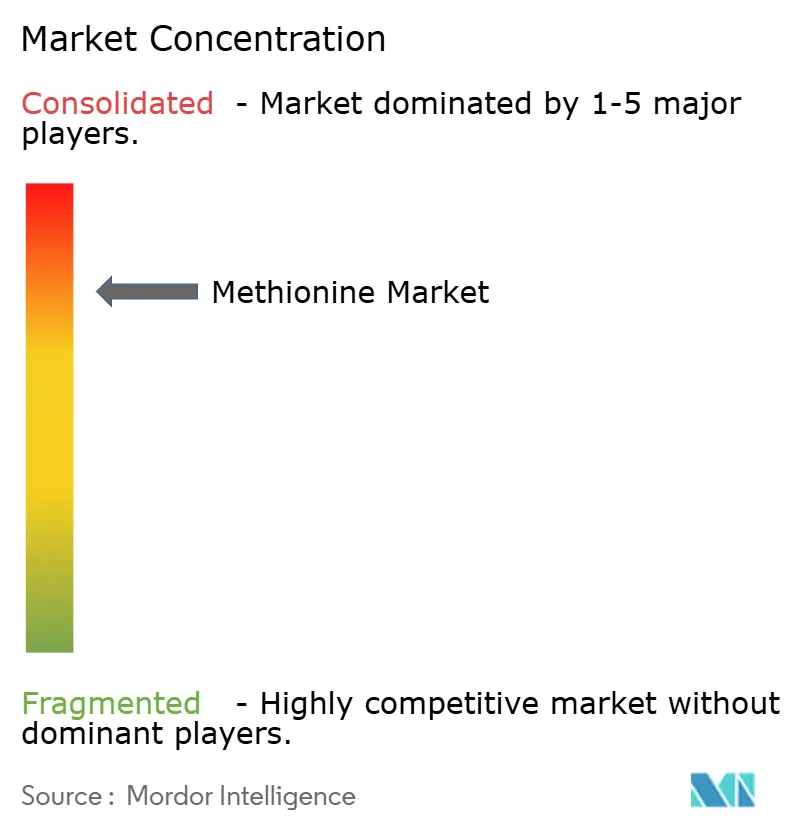
| Market Concentration | High |
Major Players *Disclaimer: Major Players sorted in no particular order Image © Mordor Intelligence. Reuse requires attribution under CC BY 4.0. | |
Methionine Market Analysis by Mordor Intelligence
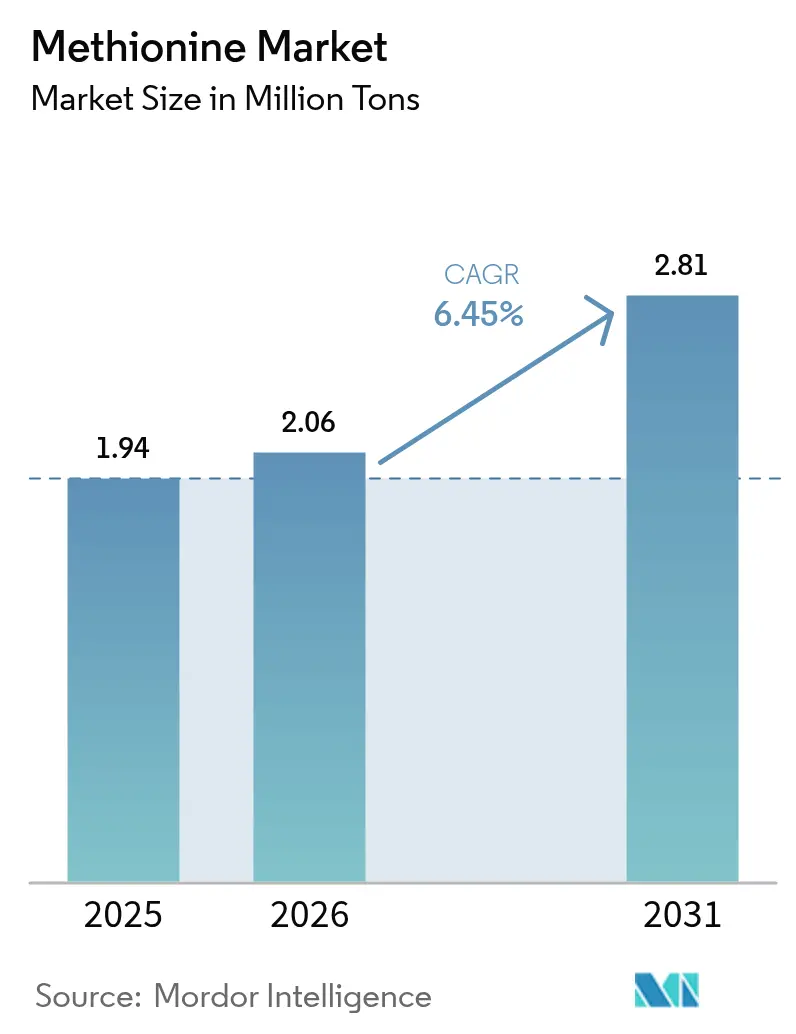
The Methionine Market size is projected to grow from 1.94 million tons in 2025 to 2.06 million tons in 2026, and reach 2.81 million tons by 2031, growing at a CAGR of 6.45% from 2026 to 2031. Surging demand for methionine-enriched poultry and aquaculture feeds, rising adoption of liquid formulations in automated mills, and fast-advancing bio-fermentation technologies are reshaping competitive dynamics. China’s pivot from net importer to net exporter in 2024 has tightened margins for North American and European producers, while Southeast Asian integrators now benefit from shorter supply chains and lower logistics costs. Investment in green-hydrogen integration, as completed by Evonik in Singapore, underlines the importance of carbon-footprint reduction as a cost and reputational lever. Finally, functional substitutes such as crystalline lysine and threonine temper upside in non-feed segments, although pharmaceutical applications still record the fastest volume growth.
Key Report Takeaways
- By type, powder methionine held 58.22% of the 2025 methionine market share, whereas liquid methionine is forecast to grow at an 8.24% CAGR through 2031.
- By grade, feed-grade products captured 89.19% of 2025 volume, while pharmaceutical-grade products are projected to expand at an 8.61% CAGR to 2031.
- By production technology, petrochemical-based synthesis accounted for 85.12% of 2025 capacity, yet the bio-based production technology segment is advancing at an 8.91% CAGR through 2031.
- By end-user industry, animal feed accounted for 95.84% of consumption in 2025 and is anticipated to growth at a 7.18% CAGR through 2031.
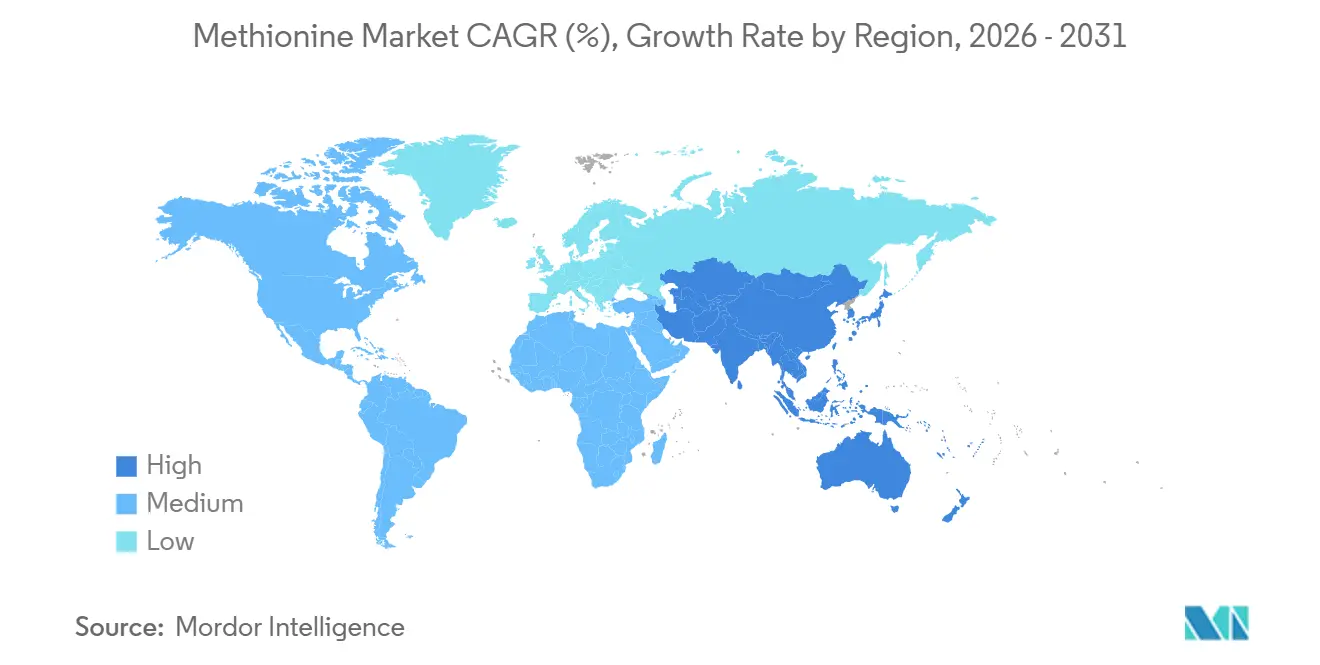
- Asia-Pacific led with 45.31% volume in 2025 and is poised to grow at 7.52% through 2031, anchored by China, Vietnam, Indonesia, and Thailand.
Note: Market size and forecast figures in this report are generated using Mordor Intelligence’s proprietary estimation framework, updated with the latest available data and insights as of 2026.
Market Trends and Insights
Drivers Impact Analysis of Methionine Market*
| Drivers | (~) % Impact on CAGR Forecast | Geographic Relevance | Impact Timeline |
|---|---|---|---|
| Surge in demand for methionine-enriched poultry feed | +1.8% | Global; 60% of incremental volume from Asia-Pacific | Medium term (2-4 years) |
| Rapid expansion of intensive aquaculture | +1.2% | China, Vietnam, Indonesia; spill-over to Brazil and Ecuador | Medium term (2-4 years) |
| Adoption of rumen-protected methionine in dairy cattle | +0.9% | North America, EU, New Zealand, Australia | Long term (≥4 years) |
| Commercialization of low-cost bio-fermentation | +1.5% | Malaysia, China; pilot plants in North America | Long term (≥4 years) |
| Accelerating shift toward liquid methionine | +1.1% | North America, Middle East, Southeast Asia | Short term (≤2 years) |
| Source: Mordor Intelligence | |||
Surge in Demand for Methionine-Enriched Poultry Feed
Poultry producers are intensifying methionine supplementation to hit protein-conversion targets amid elevated feed prices. As the first limiting amino acid in corn-soybean diets, small deficits curb muscle accretion and egg output. CJ CheilJedang’s 180,000 ton/year plant in Malaysia, live since 2024, now serves Southeast Asian integrators, trimming logistics costs by up to 20%. Liquid methionine penetration reached 50%-90% of usage in the United States and Mexico by 2025, powered by automated dosing systems that improve flock uniformity. China’s broiler output exceeded 15 million tons in 2024, yet surplus domestic capacity redirected 380,000 tons of exports into Vietnam, Thailand, and the Philippines in 2024.
Rapid Expansion of Intensive Aquaculture
Recirculating aquaculture systems and offshore cages demand precise amino-acid balancing to reduce nitrogen discharge. Methionine is now standard in soy-based fishmeal-free diets for Atlantic salmon, tilapia, and shrimp. Norwegian salmon farmers, who produced 1.4 million tons in 2024, specify liquid methionine for homogeneous pellet dispersion[1]Norwegian Seafood Council, “Annual Report 2024,” seafood.no. Vietnam’s pangasius exports recovered to 1.8 million tons in 2025 after feeds enriched with methionine cut grow-out cycles by ten days. EU nutrient-loss targets catalyze crystalline amino-acid adoption to meet discharge limits without hitting growth rates.
Adoption of Rumen-Protected Methionine in Dairy Cattle
High-yield cows producing up to 15,000 kg of milk each lactation exceed ruminal methionine supply. Lipid-encapsulated products deliver bioavailable methionine post-rumen, boosting true milk protein by 27 g/day according to a 2024 meta-analysis[2]Journal of Dairy Science, “Meta-Analysis on Rumen-Protected Methionine,” journalofdairyscience.org. U.S. adoption reached 18% in 2024, up six points from 2020, as volatile milk prices pushed farms toward component maximization. Adisseo’s Smartamine M line posted 24% sales growth in fiscal 2024, underscoring traction in premium dairy segments.
Commercialization of Low-Cost Bio-Fermentation Routes
Bio-fermentation decouples supply from petro-feedstock swings and cuts greenhouse-gas emissions by roughly 35%. CJ CheilJedang’s Malaysian plant, using engineered E. coli, reaches titers of 21.28 g/L—parity with industrial lysine—while Metabolic Explorer licensing shortens fermentation runs to 48 hours. China amassed 150,000 tons/year of bio-capacity by 2025, clustered in corn-rich Shandong and Jiangsu provinces. Yet high-purity crystallization and non-GMO certification costs delay mass European penetration.
Restraints Impact Analysis of Methionine Market*
| Restraints | (~) % Impact on CAGR Forecast | Geographic Relevance | Impact Timeline |
|---|---|---|---|
| Volatility in petrochemical feedstock prices | -0.8% | Europe, North America, global spot markets | Short term (≤2 years) |
| Availability of functional amino-acid substitutes | -0.5% | Global, especially low-protein diet formulations | Medium term (2-4 years) |
| Limited GMP-grade capacity for clinical uses | -0.2% | North America, EU, Japan | Long term (≥4 years) |
| Source: Mordor Intelligence | |||
Volatility in Petrochemical Feedstock Prices
The Degussa route relies on propylene, methyl mercaptan, and acrolein—commodities exposed to oil and gas swings. Chinese acrolein prices fell from CNY 7,800/ton in Q4 2024 to CNY 6,500/ton in Q1 2025, then rebounded to CNY 7,200/ton in Q3, compressing non-integrated margins by up to 15%. European propylene contracts peaked at EUR 1,150/ton in early 2025 after refinery outages. Evonik’s Singapore green-hydrogen project hedges against fossil volatility and delivers a 6% carbon cut.
Availability of Functional Amino-Acid Substitutes
Low-protein diets supplemented with lysine, threonine, valine, and isoleucine can trim methionine inclusion. EU anti-dumping duties of up to 84.8% on Chinese valine and lysine in 2024 temporarily propped up methionine demand. Brazil later added 13.9%-36.5% duties on Chinese lysine, signaling broader protectionist trends. Novel proteins, such as insect meal, contain higher baseline methionine and could cut supplementation needs 10%-15% longer term.
*Our forecasts treat driver/restraint impacts as directional, not additive. The impact forecasts reflect baseline growth, mix effects, and variable interactions.
Methionine Market Segment Analysis
By Type:
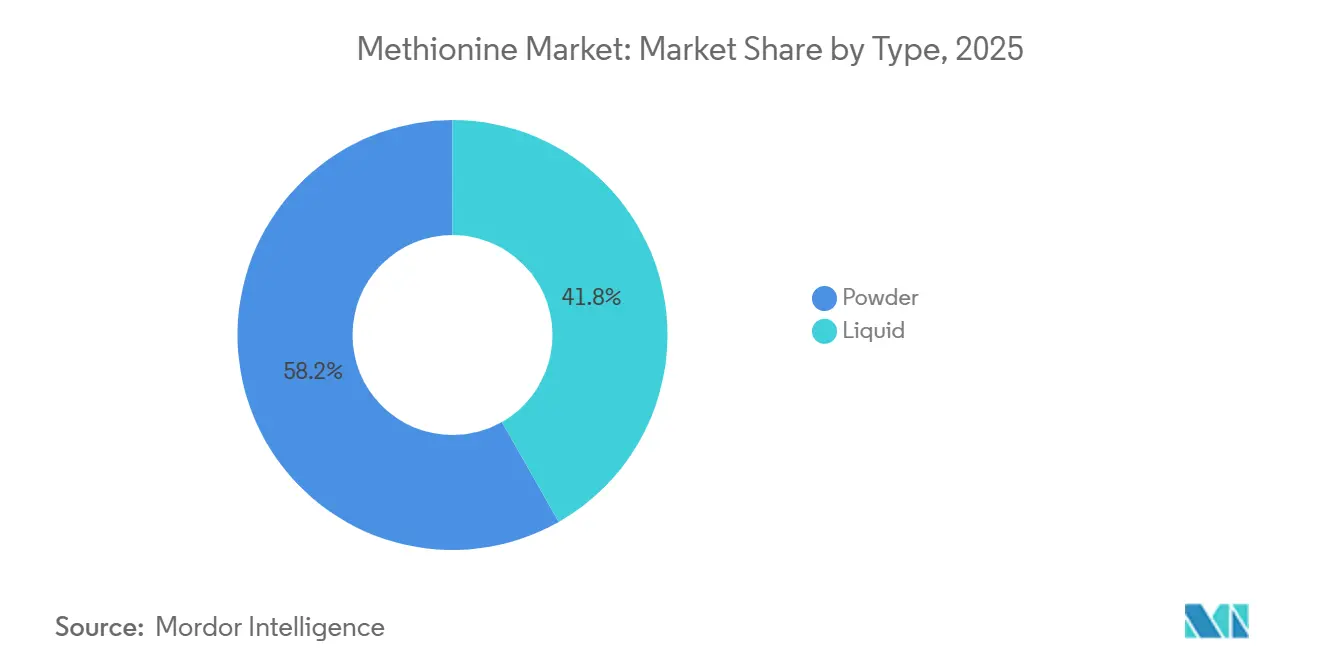
Powder Dominates while Liquid is Growing FasterPowder methionine accounted for 58.22% of the 2025 volume, while liquid methionine is projected to post an 8.24% CAGR, the fastest among all formats. In the Middle East, ISO 22000 enforcement accelerates the switch, and Saudi integrators retrofitted lines in 2025 to curb particulate emissions. Powder remains entrenched in fragmented Asian and Latin American mills where capital outlays for liquid systems approach USD 200,000-300,000 per line.
Powder methionine nevertheless retains logistics resilience and ambient stability. Evonik’s Singapore plant offers both formats, hedging against sudden regulatory or customer shifts. The combined effect anchors the methionine market, and the liquid’s share is forecast to exceed 50% by 2031 as Southeast Asian consolidation continues.



By Grade:
Feed Dominates, Pharma AcceleratesFeed-grade material captured 89.19% of the 2025 volume, reflecting poultry, swine, and aquaculture primacy. The highest demand for animal feed grade methionine can be attributed to animal protein demand in the Asia-Pacific region. Rumen-protected variants lift milk protein yields by 27 g/day and have spread to 18% of U.S. dairy herds.
Pharmaceutical grade products are expanding at an 8.61% CAGR on the back of aging populations requiring parenteral nutrition. Supply, however, remains tight because GMP upgrades cost >USD 50 million per line and require multi-year validation. Food-and-beverage grade holds under 1% share but commands 40%-60% price premiums thanks to infant-formula and supplement purity standards.
By Production Technology:
Bio-Fermentation Challenges Petrochemical HegemonyPetrochemical synthesis controlled 85.12% of 2025 nameplate capacity, while bio-based output is projected to grow with an 8.91% CAGR by 2031 as titers now match lysine economics. CJ CheilJedang’s Malaysian unit posts a 35% lower carbon footprint via corn-based glucose and renewable power. Zhejiang NHU’s 180,000 tons/year continuous liquid process cuts acrolein use 8% and lowers variable costs by up to USD 70/ton.
Crystallization energy still weighs on fermentation economics, and non-GMO certification is mandatory for European feed uptake. Nonetheless, sustained crude volatility favors fermentation, while methane-rich Middle Eastern hubs keep petrochemical incumbents cost-competitive.
By End-User Industry:
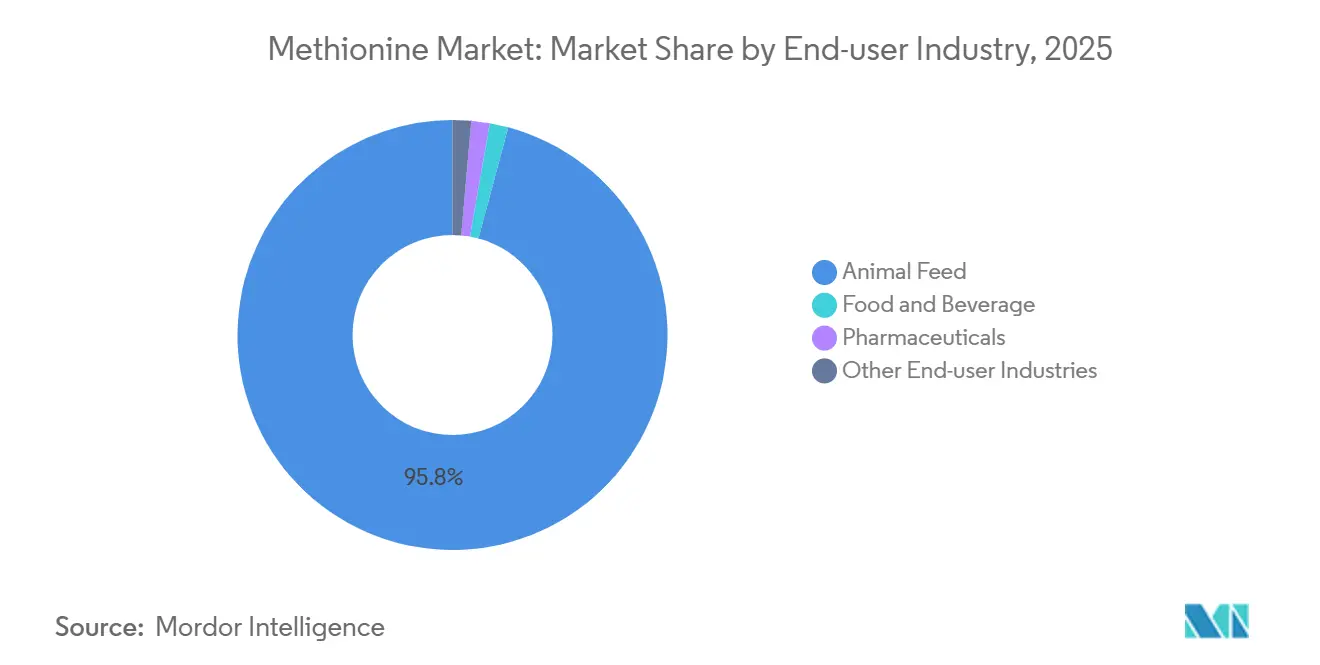
Animal Feed Dominates, Niche Segments EmergeAnimal feed absorbed 95.84% of consumption in 2025 and is set to maintain a 7.18% CAGR, led by poultry’s 70% share of feed demand. Methionine market size for aquaculture feeds is projected to climb from 190,000 tons in 2026 to 290,000 tons by 2031.
Pharmaceutical and food-and-beverage uses together remain under 5% but record higher growth rates. Hospitals in Japan, South Korea, and Germany standardize PROSOL 20% in intensive-care units yet face rationing risk until new GMP capacity arrives. Sports-nutrition and infant-formula blends leverage food-grade methionine’s antioxidant properties, though the methionine industry sees new entrants deterred by dedicated-line requirements.
Geography Analysis
APAC Methionine Market
Asia-Pacific commanded 45.31% of the 2025 volume and will advance at 7.52% a year to 2031. China flipped to a net exporter in 2024, shipping 380,000 tons and trimming imports to 156,000 tons, a shift that compressed European and North American margins. Two Chinese plants coming online in 2025-26 add 380,000 tons/year, while Evonik’s 340,000 tons/year Singapore expansion shores up incumbent relevance. Japan and South Korea focus on GMP-grade supply, with Ajinomoto commissioning 1,200 tons/year by 2027 to ease hospital shortages.
North America and Europe Methionine Market
North America held a significant market share in 2025. The methionine market size for liquid formulations is witnessing significant demand as automated mills dominate. Dairy adoption of rumen-protected variants hit 18% in 2024, buoying value-added sales. Europe, at 18% share, grapples with protectionist probes into amino-acid imports and may extend duties to methionine if import surges persist.
South America and MEA Methionine Market
South America and the Middle East and Africa remain import-dependent yet post strong poultry and aquaculture growth. Brazil’s anti-dumping action on lysine signals readiness to shield local producers, while Saudi Arabia’s new air-quality rules spur liquid format upgrades. Argentina and South Africa deploy precision-nutrition strategies to improve export competitiveness, incrementally boosting regional methionine uptake.

Value Chain Analysis
The methionine value chain starts with upstream petrochemical and sulfur-based inputs used to make key intermediates, with most industrial DL-methionine produced via chemical synthesis using acrolein, methyl mercaptan, and hydrogen cyanide (HCN) as primary precursors. Feedstock exposure concentrates risk around propylene (acrolein), methanol (often linked to methyl mercaptan chemistry), and sulfur availability, which makes producers sensitive to energy-market swings and seaborne chemical logistics.
In the midstream, a small group of integrated global producers, including Evonik, Adisseo, NHU, and Novus International, convert intermediates into powder and liquid methionine and manage quality specs aligned to feed versus GMP-type uses. Downstream, volumes largely flow into animal nutrition channels via premix companies and feed mills, where liquid formats connect to automated dosing systems and powder remains common where handling infrastructure is simpler. Delivered cost is shaped by distribution reliability and bulk logistics (bagging, storage, and regional warehousing), particularly in import-dependent markets.
Competitive Landscape
The methionine market is moderately consolidated. Chinese players, led by Zhejiang NHU and Inner Mongolia Lingsheng, expand aggressively through both petrochemical and fermentation routes. Evonik’s green-hydrogen-integrated Singapore complex cuts carbon intensity 6% and positions the firm for low-emission procurement mandates.
White-space opportunities lie in rumen-protected blends and multi-nutrient encapsulations. Yet mid-tier producers without petro integration or fermentation IP face shrinking margins.
Methionine Industry Leaders
Evonik Industries AG
Adisseo
Novus International, Inc.
CJ CHEILJEDANG CORP
Sumitomo Chemical Co., Ltd.
- *Disclaimer: Major Players sorted in no particular order
Methionine Market Companies Covered in this Report
- Adisseo
- Ajinomoto Co., Inc.
- Chongqing Unisplendour Chemical Co., Ltd.
- CJ CHEILJEDANG CORP
- Evonik Industries AG
- Guangxi Nanning Junwei Feed Co.,Ltd.
- Meihua Holdings Group Co., Ltd.
- Novus International, Inc.
- Sichuan Hebang Biotechnology Co., Ltd.
- Sumitomo Chemical Co., Ltd.
- Volzhsky Orgsynthese, JSC
- Zhejiang NHU Co., Ltd.

Market Opportunities and Future Outlook
Low-carbon and supply-secure production setups create a visible whitespace as buyers and producers respond to feedstock volatility and carbon constraints. Evonik putting into operation a long-distance methanol pipeline between Lulsdorf and Wesseling in June 2026 points to investment aimed at locking in critical raw materials for methionine production, while also targeting transport-related emissions reductions, a model that could be replicated at other large European sites.
Capacity and technology choices are also generating opportunity pockets by geography and product form. China remains the focus for large-scale expansion, including Hebang Biotechnology announcing a CNY 7.75 billion investment for a 600,000-ton per year methionine project (construction completion targeted for 2029), which supports regional self-sufficiency and export capability. At the same time, debottlenecking and modernization in established hubs open room for higher-value formats and service-led offerings. This includes Adisseo expanding capacity for Rhodimet AT88 by 40,000 tons at Burgos, Spain (operational in 2026 per company disclosures), and logistics-led upgrades such as Evonik completing improvements at Antwerp in 2025 to strengthen packaging and storage throughput for global shipments.
Recent Industry Developments in Methionine Market
- June 2026: Evonik put into operation a new long-distance methanol pipeline connecting Lulsdorf and Wesseling in Germany to optimize methanol supply for methionine production. The move strengthens raw-material security for a key precursor stream and supports lower logistics-related emissions versus truck-based supply, reinforcing competitiveness of its European methionine footprint.
- November 2025: Evonik completed upgrades at its Antwerp, Belgium, methionine facility, including an automated filling system for 1,000-kilogram bags and expanded storage. These changes improve outbound logistics efficiency and shipment flexibility, which is important for servicing large integrators and managing volatility in global trade flows.
- August 2024: Evonik completed the expansion of its MetAMINO production facility in Singapore, increasing annual capacity by 40,000 metric tons to 340,000 metric tons. The added volume supports Asia-Pacific demand growth and provides a stronger regional supply base as China shifted toward higher exports in the period.


Methionine Market Report Scope and Research Methodology
Market Definition and Coverage
For this study, the methionine market covers global demand and supply of methionine used across animal nutrition and selected human-use applications, measured as product volume sold into end-use channels during the study period.
Scope exclusions: We do not count downstream animal feed revenue, premix or compound feed sales, or broader amino acid blends where methionine cannot be cleanly separated.
Segments Covered in This Report
- By Type
- Powder
- Liquid
- By Grade
- Feed Grade
- Food and Beverage Grade
- Pharmaceutical Grade
- Production Technology
- Petrochemical-based Synthesis
- Bio-based Fermentation
- By End-user Industry
- Food and Beverage
- Pharmaceuticals
- Animal Feed
- Other End-user Industries
- By Geography
- Asia-Pacific
- China
- India
- Japan
- South Korea
- Rest of Asia-Pacific
- North America
- United States
- Canada
- Mexico
- Europe
- Germany
- United Kingdom
- France
- Italy
- Rest of Europe
- South America
- Brazil
- Argentina
- Rest of South America
- Middle East and Africa
- Saudi Arabia
- South Africa
- Rest of Middle East and Africa
- Asia-Pacific
Data Sources, Market Sizing, and Validation
Desk Research
Desk research was used to build the market structure and to set realistic boundaries for volumes by region and end use. We relied on public trade and production signals, such as UN Comtrade import-export statistics, FAOSTAT livestock and feed-use indicators, USDA and other agriculture ministry releases, and OECD-FAO outlook notes that describe animal protein demand and feed efficiency trends. We also reviewed peer-reviewed animal nutrition papers to understand typical inclusion ranges, and how methionine demand tracks poultry and swine cycles.
On top of that, we reviewed company annual reports, investor presentations, association websites, and reputable press to capture capacity additions, technology shifts, and supply chain constraints. Where available, an import-export shipment-level database and a patent database were used to sanity-check trade direction changes and to flag process innovation that can affect effective supply. The sources listed above are illustrative only and are not exhaustive, and we also referred to many other public documents to support data collection, validation, and research clarification.
Primary Interviews and Surveys
Primary inputs were collected through structured expert interviews and short surveys with producers, distributors, feed formulators, and subject specialists who track amino acid usage in animal diets. We used these discussions to validate regional demand drivers, confirm operating rate assumptions and debottlenecking timelines, and pressure-test the grade mix and application split across APAC, EMEA, and the Americas.
Distribution of primary research fieldwork respondents
| Company type | Respondent position | Region |
|---|---|---|
| Top tier: 29% | CXOs: 17% | APAC: 40% |
| Mid tier: 54% | Functional/Unit leaders: 32% | EMEA: 37% |
| Smaller Players: 17% | Managers: 51% | Americas: 23% |
Market-Sizing & Forecasting
Market sizing starts with a top-down demand pool build-up where livestock output and feed production indicators are translated into methionine requirements, and then adjusted for formulation practices and the penetration of supplemental amino acids by region. To keep the totals grounded, we corroborated results using selective bottom-up approximations, such as sampled producer capacity by region, trade-linked availability, and channel checks that reconcile implied consumption with observable inflows.
Inputs used in the model include poultry and swine production trends, compound feed output growth, typical methionine inclusion rates for major diets, regional import dependency, and announced capacity and commissioning timing that affects supply availability. In practice, trade flow shifts and short-term availability tightness were also used as reasonableness checks, since they often explain substitution behavior and delayed buying in feed applications.
For forecasting, scenario analysis was used with a base case anchored to consensus views from primary respondents on animal protein growth and realistic operating rates, followed by sensitivity checks for raw material cost swings and supply additions. Where bottom-up visibility was incomplete, gaps were handled using conservative utilization ranges, and then cross-checked against trade balances and regional consumption indicators before finalizing yearly volumes.
Data Validation & Update Cycle
Outputs are validated through several checks so outliers are caught early and corrected with evidence. We compare the model with independent signals like net trade position changes, feed output movements, and utilization direction, and then review any large variances at region and application level before sign-off.
Analyst reviews are completed in layers, where key assumptions are challenged, recalculated, and rerun to confirm the totals behave logically across years. Reports are refreshed annually, with interim updates triggered by material events such as major plant outages, new capacity starts, or sharp shifts in trade policy. Before delivery, a final pass is completed so clients receive the most current view available at that time.
Mordor Intelligence's Methionine Market Sizing Compared With Other Published Estimates
Published methionine market sizes can look far apart even when the same product is being discussed, because the counting rules and units are not always aligned. Differences usually come from whether value or volume is used, what gets counted around feed usage, and how pricing and currency assumptions are treated.
Trade-balance checks, capacity and utilization signals, and feed production indicators are the evidence that keeps Mordor Intelligence's estimate tied to physical consumption in tons, instead of converting into revenue using blended prices that can shift by region and quarter.
Benchmark comparison
| Source | Market Size | Gaps in Research Methodology |
|---|---|---|
| Mordor Intelligence | USD 1.94 M (2025) | |
| Global Consultancy A | USD 4.16 B (2025) | This figure is value-based, so it depends on average selling price and currency timing assumptions, and it may also treat some feed-related mixes differently when mapping product to end use. |
| Industry Publisher B | USD 7.00 B (2025) | A higher value estimate can result when broader application baskets and source categories are included, and when global ASP progressions are applied without tight reconciliation to regional trade flows and operating rate constraints. |
The spread in the table is mainly explained by unit choice and by how pricing, grade mix, and adjacent application coverage are handled in the model. By keeping assumptions traceable to demand indicators and then validating them through interviews, the final output stays repeatable and easy to recheck during annual refresh cycles.


Key Questions Answered in the Report
What is the projected volume of the methionine market in 2031?
Global demand is forecast to reach 2.81 million tons by 2031, growing at a 6.45% CAGR from 2026 to 2031.
Which segment shows the fastest growth within the methionine market?
Liquid methionine leads with an 8.24% CAGR through 2031 as automated feed-mill dosing expands.
Why is bio-fermentation important for methionine supply?
It reduces greenhouse gas emissions by roughly 35% and decouples costs from volatile petrochemical feedstocks.
How dominant is animal feed in methionine consumption?
Animal feed accounted for 95.84% of the 2025 volume and will keep above 90% through 2031.
Which region will add the most new methionine capacity by 2027?
China is adding 380,000 tons/year across two projects and remains the largest contributor to new global capacity.
What keeps the pharmaceutical-grade methionine supply tight?
Only about 8,000 tons/year meets GMP standards, and new lines require multi-year validation and >USD 50 million investments.
Page last updated on:


 Your data is secure and never sold or shared.


