
Marine Acoustic Sensors Market Size and Share
Market Overview
| Study Period | 2020 - 2031 |
|---|---|
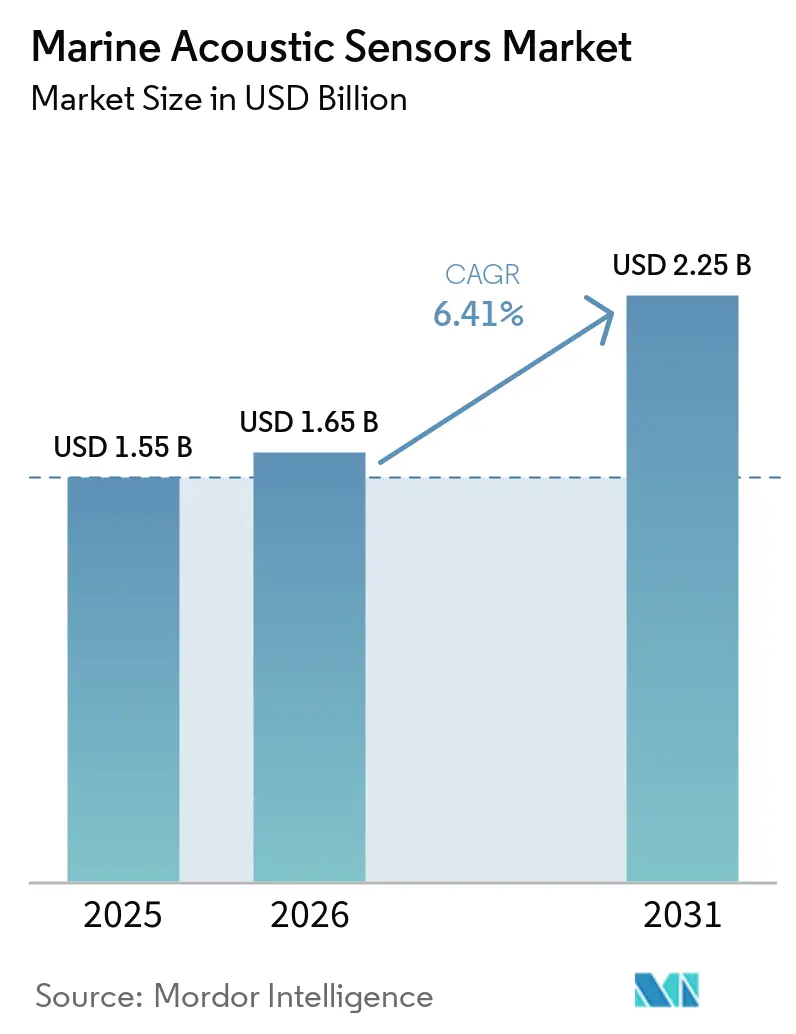
| Market Size (2026) | USD 1.65 Billion |
| Market Size (2031) | USD 2.25 Billion |
| Growth Rate (2026 - 2031) | 6.41 % |
| Fastest Growing Market | Asia Pacific |
| Largest Market | North America |
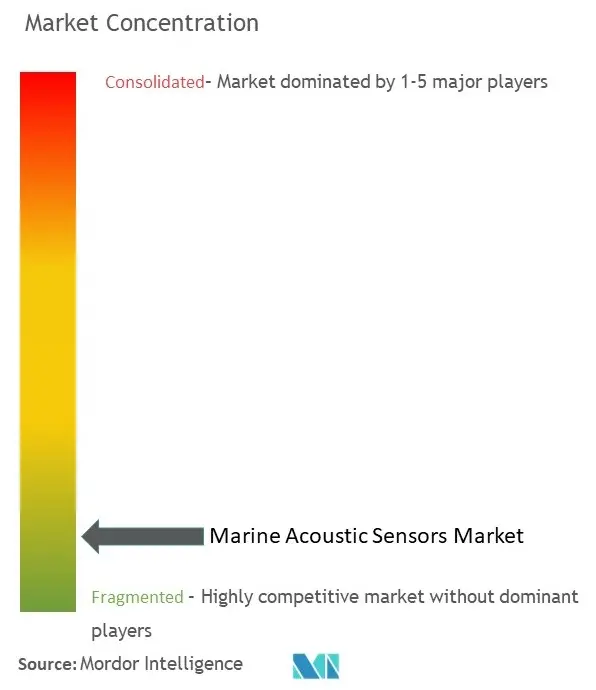
| Market Concentration | Low |
Major Players *Disclaimer: Major Players sorted in no particular order Image © Mordor Intelligence. Reuse requires attribution under CC BY 4.0. | |
Marine Acoustic Sensors Market Analysis by Mordor Intelligence
The Marine Acoustic Sensors Market size is projected to be USD 1.55 billion in 2025, USD 1.65 billion in 2026, and reach USD 2.25 billion by 2031, growing at a CAGR of 6.41% from 2026 to 2031. The marine acoustic sensors industry is experiencing significant transformation driven by technological advancement and digitalization. The integration of Internet of Things (IoT) technology has emerged as a revolutionary concept in the marine sector, enabling smart ports and automated operations through interconnected sensor networks. Modern ports are increasingly adopting cloud-based IoT infrastructure, incorporating intelligent marine sensors and wireless devices to create fully automated smart port ecosystems. This digital transformation is particularly evident in the development of autonomous ships and vessels, where advanced underwater acoustic sensors technologies play a crucial role in ensuring safe and efficient operations.
The industry is witnessing substantial investments in research and development, particularly in autonomous vessel technology and smart maritime infrastructure. According to recent industry data, the shipbuilding industry in Germany alone is projected to reach USD 6.847 billion by 2025, highlighting the growing emphasis on modernizing maritime capabilities. Major shipbuilders and system developers are focusing on developing fully autonomous ships that promise to revolutionize maritime operations through enhanced safety, sustainability, and operational efficiency. These developments are accompanied by innovations in marine instrumentation, including advanced sonar systems and underwater acoustics monitoring solutions.
The military and defense sector continues to be a significant influence on market dynamics, with North American military spending reaching approximately USD 900 billion in 2022. This substantial investment has led to increased development of sophisticated underwater surveillance systems and advanced sonar technologies. Naval forces worldwide are modernizing their fleets with state-of-the-art underwater communication systems for enhanced submarine detection, underwater communication, and maritime security operations. The US Navy's budget increase to USD 202.5 billion for the fiscal year 2024 further demonstrates the growing emphasis on naval technological advancement.
Environmental monitoring and marine research applications are gaining prominence in the market landscape. Recent developments include the deployment of advanced underwater acoustic sensors for marine mammal detection, underwater mapping, and ocean environmental monitoring. In 2023, significant advancements were made in underwater acoustic communication technology, with companies like Subnero launching a fourth-generation Wireless Networked Communication series of underwater acoustic modems. These innovations are crucial for various applications, from marine life protection to underwater exploration and scientific research, reflecting the industry's growing focus on sustainable ocean management and environmental protection.
Note: Market size and forecast figures in this report are generated using Mordor Intelligence’s proprietary estimation framework, updated with the latest available data and insights as of January 2026.
Market Trends and Insights
Growing Deployment of Acoustic Navigation for Underwater Positioning
Acoustic navigation systems are experiencing widespread adoption across various marine applications, driven by technological advancements in underwater positioning capabilities. These systems utilize sophisticated acoustic sensors for underwater navigation, positioning, and monitoring, with deployments categorized into long-baseline systems (LBL), short-baseline systems (SBL), and ultra-short baseline systems (USBL). The technology has evolved significantly, as demonstrated by innovations like Kongsberg's HiPAP series of acoustic positioning devices, which can operate at depths exceeding 7,000 meters with an accuracy of 0.02 meters, while offering the flexibility to switch between LBL and USBL modes depending on operational requirements. These advancements are integral to the functionality of sonar systems and underwater detection systems.
Recent technological developments have further accelerated the deployment of acoustic navigation systems. In April 2023, Exail launched the Gaps M3, a new compact and cost-effective subsea acoustic USBL positioning system designed for permanent vessel installation. The system offers two versions - an export-free version with a maximum operating range of 995 meters and an extended-range version capable of operations at depths exceeding 4,000 meters. Additionally, in March 2023, Singapore-based Subnero introduced its fourth-generation Wireless Networked Communication series of underwater acoustic modems, featuring advanced networking and localization capabilities, alongside developer tools to simplify the development and deployment of underwater wireless networks. These innovations enhance the efficiency of submarine detection systems and underwater surveillance.
Rising Defense Spending in Several Countries
Global defense expenditure continues to rise significantly, with the United States leading military spending at 37% of global military expenditure in 2023, according to SIPRI data. This substantial investment is reflected in the US Congressional Budget Office's projection of defense spending reaching USD 1.1 trillion by 2033, indicating a strong commitment to military modernization and technological advancement. The increased defense spending has directly contributed to the development and acquisition of advanced marine acoustic sensor technologies, as evidenced by recent major defense contracts and initiatives focused on underwater surveillance and detection capabilities, including naval sonar systems.
The growing defense investments are translating into concrete developments in naval and underwater defense capabilities. In May 2023, the US State Department approved a USD 207 million foreign military sale of acoustic towed array equipment for the Australian government, including Surveillance Towed Array Sensor System Expeditionary mission systems. Furthermore, in June 2023, the commander of Iran's navy announced plans to form a joint naval alliance with several Middle Eastern nations, including Saudi Arabia, United Arab Emirates, Qatar, Bahrain, and Iraq, demonstrating the increasing focus on maritime defense capabilities. These developments are complemented by technological innovations, such as the successful completion of the first-ever undersea glider deployment from a helicopter by Teledyne Marine in collaboration with the US Navy in 2023, marking a significant advancement in autonomous underwater vehicle capabilities. These initiatives underscore the importance of maritime surveillance in modern defense strategies.
Marine Acoustic Sensors Market Segment Analysis
Underwater Transducer Segment in Marine Acoustic Sensors Market
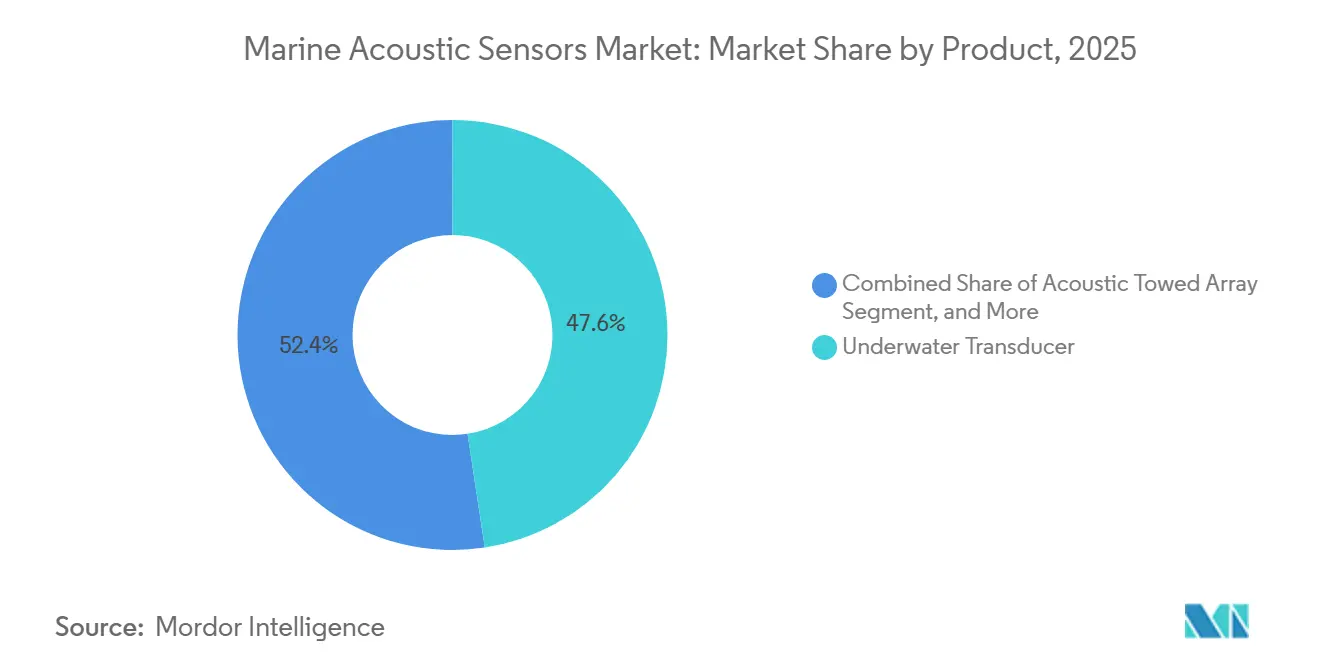
The underwater transducer segment continues to dominate the marine sensors market, commanding approximately 48% market share in 2025. This significant market position is driven by the segment's crucial role in converting electrical signals into sound waves and vice versa in underwater environments. The segment's prominence is further reinforced by its widespread applications in naval operations, research vessels, underwater surveillance, and submarine detection. Recent technological advancements, such as the development of new-generation solutions for radar surveillance and electronic support, have strengthened this segment's position. The integration of machine learning and artificial intelligence capabilities into underwater transducers has enhanced their performance in automated tasks, data analysis, and real-time monitoring.

Hydrophones Segment in Marine Acoustic Sensors Market
The marine hydrophone segment is emerging as the fastest-growing segment in the marine acoustic sensors market, projected to grow at approximately 8% during 2026-2031. This remarkable growth is attributed to increasing adoption in marine research, underwater communication, and oceanography applications. The segment's growth is being fueled by technological innovations such as the development of miniature digital hydrophones for educational purposes and advanced digital hydrophones for Passive Acoustic Monitoring (PAM). The integration of artificial intelligence and machine learning capabilities in hydrophone systems has significantly enhanced their ability to detect and monitor marine life with improved selectivity and sensitivity. Recent developments in automated robotics projects and underwater surveillance systems have further accelerated the adoption of marine hydrophones across various applications.
Remaining Segments in Marine Acoustic Sensors Market
The acoustic towed array and side-scan sonar segments complete the marine acoustic sensors market landscape, each serving distinct yet crucial functions. Acoustic towed arrays are essential for naval operations, particularly in submarine detection and underwater surveillance, offering superior resolution and range compared to hull-mounted sonar systems. The side-scan sonar segment has carved its niche in underwater imaging and mapping applications, providing detailed high-resolution images of the seafloor and underwater structures. Both segments continue to evolve with technological advancements, particularly in areas such as autonomous underwater vehicle integration and enhanced imaging capabilities.
Segment Analysis: By Application
Military Segment in Marine Acoustic Sensors Market
The military segment dominates the marine acoustic sensors market, driven by extensive applications in naval defense operations including submarine detection, underwater surveillance, and maritime security. These sensors are critical components in warfighter vessels and ships, being used for reconnaissance, intelligence gathering, and surveillance of battle spaces. The integration of acoustic sensors in modern naval warfare has become increasingly sophisticated, with applications ranging from sonar systems market to towed arrays for detecting and tracking underwater threats. Recent developments include advanced beamforming technologies that combine outputs from spatially distributed acoustic sensors to enhance detection capabilities and improve signal-to-noise ratios. The segment's strength is further reinforced by significant defense spending worldwide, with countries like the United States allocating substantial budgets for naval modernization and underwater detection capabilities.
Marine Life Detection Segment in Marine Acoustic Sensors Market
The marine life detection segment is experiencing rapid growth in the marine acoustic sensors market, fueled by increasing environmental awareness and marine conservation efforts. This growth is supported by technological advancements in acoustic sensing capabilities, particularly in the development of AI-integrated systems for species identification and tracking. Recent innovations include the deployment of smart hydrophones for real-time marine mammal monitoring and the implementation of advanced detection algorithms for marine biodiversity assessment. The segment's expansion is further driven by various international initiatives focused on ocean conservation and marine life protection, including projects utilizing distributed acoustic sensing networks for comprehensive ecosystem monitoring. The integration of machine learning technologies with acoustic sensors has significantly enhanced the accuracy and efficiency of marine detection systems.
Remaining Segments in Marine Acoustic Sensors Market Applications
The marine acoustic sensors market encompasses several other crucial application segments including water depth and bathymetry, marine imaging, and marine research and monitoring. The water depth and bathymetry segment utilizes acoustic sensors for precise underwater mapping and depth measurement, essential for both commercial and research applications. Marine imaging applications leverage acoustic sensor technology for underwater visualization and inspection, particularly in offshore infrastructure maintenance and underwater archaeology. The marine research and monitoring segment employs these sensors for oceanographic studies, environmental monitoring, and climate change research, contributing to our understanding of marine ecosystems and ocean dynamics. Each of these segments plays a vital role in advancing maritime operations and scientific understanding of marine environments.
Geography Analysis
Marine Acoustic Sensors Market in North America
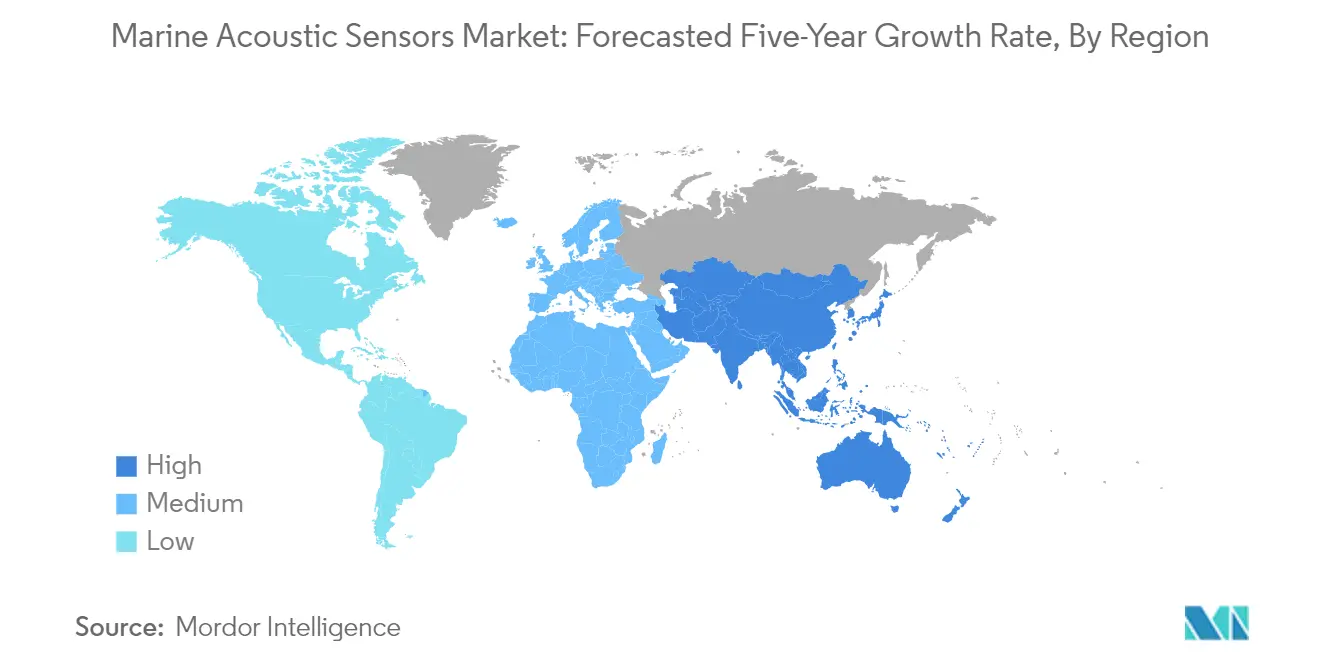
North America dominates the global marine acoustic sensors market, commanding approximately 36% market share in 2024. The region's leadership position is primarily driven by extensive naval defense activities and significant investments in underwater communication technologies. The United States Navy's continued modernization efforts and focus on advanced sonar systems have created substantial demand for marine monitoring systems and marine security systems. The region benefits from the presence of major marine technology companies and research institutions that are actively developing innovative underwater acoustic solutions. Additionally, the increasing adoption of autonomous underwater vehicles for both military and commercial applications has further strengthened the market. The region's strong focus on marine research and environmental monitoring, particularly in coastal areas and deep-sea exploration, continues to drive demand for sophisticated acoustic sensing technologies. Furthermore, the growing emphasis on maritime surveillance has led to increased deployment of underwater acoustic sensor networks across North American waters.
Marine Acoustic Sensors Market in Europe
The European marine acoustic sensors market has demonstrated robust growth, with an estimated growth rate of approximately 7% during 2019-2024. The region's market is characterized by strong technological innovation and research activities in underwater acoustics. European nations have been particularly focused on developing advanced sonar systems for both military and commercial applications. The presence of established shipbuilding industries and major marine equipment manufacturers has created a strong ecosystem for marine acoustic sensor development. The region's commitment to ocean conservation and marine research has driven significant investments in underwater monitoring systems. European countries have also been at the forefront of developing autonomous maritime systems, which heavily rely on acoustic sensing technologies. The market has benefited from various EU-funded research initiatives and collaborative projects aimed at advancing underwater acoustic technology. Additionally, the increasing focus on offshore renewable energy projects has created new opportunities for acoustic sensor applications in environmental monitoring and infrastructure maintenance.
Marine Acoustic Sensors Market in APAC
The Asia-Pacific marine acoustic sensors market is projected to experience the highest growth rate among all regions, with an anticipated CAGR of approximately 8% during 2024-2029. The region's rapid market expansion is driven by increasing maritime security concerns and growing investments in naval defense capabilities. Countries across the region are actively modernizing their naval fleets and underwater surveillance systems, creating substantial opportunities for marine acoustic sensor deployments. The growing focus on maritime trade security and port surveillance has led to increased adoption of underwater monitoring systems. The region's expanding offshore energy sector, particularly in countries like China, Japan, and Australia, has created additional demand for marine acoustic sensors in infrastructure monitoring and maintenance applications. Furthermore, the increasing emphasis on marine research and environmental protection has led to greater deployment of acoustic monitoring systems in coastal waters. The region's robust shipbuilding industry and growing investments in autonomous underwater vehicles have also contributed to market growth.
Marine Acoustic Sensors Market in Latin America
The Latin American marine acoustic sensors market continues to evolve, driven by increasing investments in maritime security and offshore resource exploration. The region's extensive coastline and rich marine resources have necessitated advanced underwater monitoring solutions. Countries in the region are increasingly focusing on modernizing their naval capabilities and maritime surveillance systems. The growing emphasis on protecting marine ecosystems and monitoring marine life has led to increased adoption of acoustic sensing technologies. The region's offshore oil and gas industry has been a significant driver for marine acoustic sensor deployment, particularly in Brazil and Mexico. Additionally, the increasing focus on scientific research and marine biodiversity studies has created new opportunities for acoustic sensor applications. The market is also benefiting from regional cooperation initiatives aimed at enhancing maritime security and environmental monitoring capabilities.
Marine Acoustic Sensors Market in MEA
The Middle East & Africa marine acoustic sensors market is experiencing steady growth, driven by increasing investments in maritime security and offshore infrastructure development. The region's strategic importance in global maritime trade has led to growing emphasis on underwater surveillance and monitoring systems. Countries in the region are actively modernizing their naval capabilities and investing in advanced maritime security solutions. The growing focus on protecting offshore oil and gas infrastructure has created significant demand for underwater acoustic monitoring systems. The Red Sea and Persian Gulf regions have seen increased deployment of marine acoustic sensors for environmental monitoring and marine life protection. The market is also benefiting from growing investments in port security and coastal surveillance systems. Additionally, the increasing focus on marine research and underwater archaeology has created new applications for oceanographic sensors and underwater imaging technologies in the region.
Competitive Landscape
Top Companies in Marine Acoustic Sensors Market
The marine acoustic sensors market is characterized by companies focusing heavily on technological advancement and product innovation, particularly in developing more sophisticated sonar systems industry and underwater acoustic communication devices. Companies are investing significantly in research and development to create sensors with enhanced detection capabilities, improved range, and better integration with modern naval systems. Strategic partnerships, especially between defense contractors and technology firms, have become increasingly common to combine expertise and accelerate development cycles. Market leaders are expanding their geographical presence through both direct operations and distributor networks while simultaneously diversifying their product portfolios to serve multiple applications from military surveillance to marine research. Operational agility is demonstrated through customized solutions for specific customer requirements, rapid prototyping capabilities, and flexible manufacturing processes that can adapt to changing market demands.
Defense Conglomerates Dominate Global Sensor Market
The marine acoustic sensors market structure is predominantly controlled by large defense conglomerates and established electronics manufacturers with significant military contracts. These major players possess extensive research capabilities, established relationships with defense agencies, and the financial resources to sustain long-term development programs. The market shows moderate consolidation, with a mix of global players like BAE Systems, Thales Group, and L3Harris Technologies commanding substantial market share alongside specialized manufacturers like Ocean Sonics and GeoSpectrum Technologies focusing on niche applications.
The industry has witnessed strategic acquisitions aimed at expanding technological capabilities and market reach, particularly in emerging segments like underwater drone technology and advanced sonar systems industry. Regional players maintain their presence through specialized expertise in local maritime requirements and strong relationships with domestic naval forces. The barrier to entry remains high due to the complex nature of technology, stringent quality requirements, and the need for extensive certification and testing processes, which favors established players with proven track records.
Innovation and Integration Drive Market Success
Success in the marine acoustic sensors market increasingly depends on the ability to integrate advanced technologies like artificial intelligence and machine learning into sensor systems while maintaining reliability and performance under harsh marine conditions. Companies need to develop comprehensive solution packages that include not just hardware but also software and analytics capabilities to process and interpret acoustic data effectively. Building strong relationships with defense agencies and research institutions while maintaining compliance with evolving environmental regulations and international maritime standards has become crucial for sustained market presence.
Market contenders can gain ground by focusing on specialized applications or regional markets where they can build expertise and reputation before expanding. The increasing emphasis on environmental monitoring and marine conservation creates opportunities for companies to develop specialized sensors for these applications. Success also depends on the ability to navigate complex procurement processes, particularly in defense applications, while maintaining cost competitiveness through efficient manufacturing and supply chain management. Companies must also consider the growing importance of cybersecurity in underwater acoustic systems and the need for interoperability with existing maritime infrastructure. The marine technology sector is also seeing a rise in demand for advanced marine navigation systems market solutions, which further drives innovation and integration efforts.
Marine Acoustic Sensors Industry Leaders
-
BAE Systems PLC
-
Garmin Ltd
-
Teledyne Marine Technologies (Teledyne Technologies Incorporated)
-
Ocean Sonics Ltd
-
Geospectrum Technologies Inc.
- *Disclaimer: Major Players sorted in no particular order
Marine Acoustic Sensors Market Companies Covered in this Report
- BAE Systems PLC
- Garmin Ltd
- Teledyne Marine Technologies (Teledyne Technologies Incorporated)
- Ocean Sonics Ltd
- Geospectrum Technologies Inc.
- L3harris Technologies Inc.
- Hottinger Brüel & Kjær (Spectris PLC)
- Cobham Ultra Seniorco S.à R.l.
- Thales Group
- CTS Corporation
Recent Industry Developments in Marine Acoustic Sensors Market
- June 2023: RPS presented Neptune, the predictive algorithm for accurately and reliably detecting marine mammal vocalizations. The sub-sea sound emitted during the in-field development of offshore wind and oil and gas exploration efforts can potentially negatively impact marine mammals, causing temporary and permanent hearing loss, disrupted feeding and breeding cycles, and even physical injury.
- January 2023: H.H. Sheikh Hamdan bin Zayed Al Nahyan, Ruler's Representative in the Al Dhafra Region and Chairman of the Board of Directors of the Environment Agency, Abu Dhabi (EAD), launched the marine research vessel 'Jaywun,' developed by EAD, considered the UAE's first and the most advanced in the Middle East. The vessel is expected to strengthen national and global marine science capabilities and enable the Agency to implement its 'Ocean World Discovery' project.
Global Marine Acoustic Sensors Market Report Scope
Acoustic sensors are a division of micro-electromechanical systems that work on the theory of modulating surface acoustic waves that sense physical phenomena. They are used to convert electrical signals into mechanical waves. They are used in various fields, such as signal processing and sensing in marine applications.
The market size is evaluated by analyzing various products, such as hydrophones, underwater transducers, acoustic towed arrays, and side-scan sonar, considered in regions such as North America, Europe, Asia Pacific, Latin America, the Middle East, and Africa. The market sizes and forecasts are provided in terms of value in USD for all the above segments. The competitive landscape has been considered to calculate the penetration of marine acoustic sensors and how players involve themselves in organic and inorganic growth strategies. Companies continuously innovate products to increase their market share and profitability. The market study also focuses on the impact of key macro trends on the market ecosystem.
Segmentation Overview
| Hydrophones |
| Underwater Transducer |
| Acoustic Towed Array |
| Side-scan Sonar |
| North America |
| Europe |
| Asia |
| Australia and New Zealand |
| Latin America |
| By Product | Hydrophones |
| Underwater Transducer | |
| Acoustic Towed Array | |
| Side-scan Sonar | |
| By Geography*** | North America |
| Europe | |
| Asia | |
| Australia and New Zealand | |
| Latin America |
Key Questions Answered in the Report
How big is the Marine Acoustic Sensors Market?
The Marine Acoustic Sensors Market size is expected to reach USD 1.55 billion in 2025 and grow at a CAGR of 6.41% to reach USD 2.25 billion by 2031.
What is the current Marine Acoustic Sensors Market size?
In 2026, the Marine Acoustic Sensors Market size is expected to reach USD 1.65 billion.
Who are the key players in Marine Acoustic Sensors Market?
BAE Systems PLC, Garmin Ltd, Teledyne Marine Technologies (Teledyne Technologies Incorporated), Ocean Sonics Ltd and Geospectrum Technologies Inc. are the major companies operating in the Marine Acoustic Sensors Market.
Which is the fastest growing region in Marine Acoustic Sensors Market?
Asia Pacific is estimated to grow at the highest CAGR over the forecast period (2026-2031).
Which region has the biggest share in Marine Acoustic Sensors Market?
In 2025, the North America accounts for the largest market share in Marine Acoustic Sensors Market.
What years does this Marine Acoustic Sensors Market cover, and what was the market size in 2025?
In 2025, the Marine Acoustic Sensors Market size was estimated at USD 1.55 billion. The report covers the historical market size of the Marine Acoustic Sensors Market for the years 2020-2031. The report also forecasts the Marine Acoustic Sensors Market size for the years: 2026-2031