
Market Overview
| Study Period | 2020 - 2031 |
|---|---|
| Forecast Data Period | 2026 - 2031 |
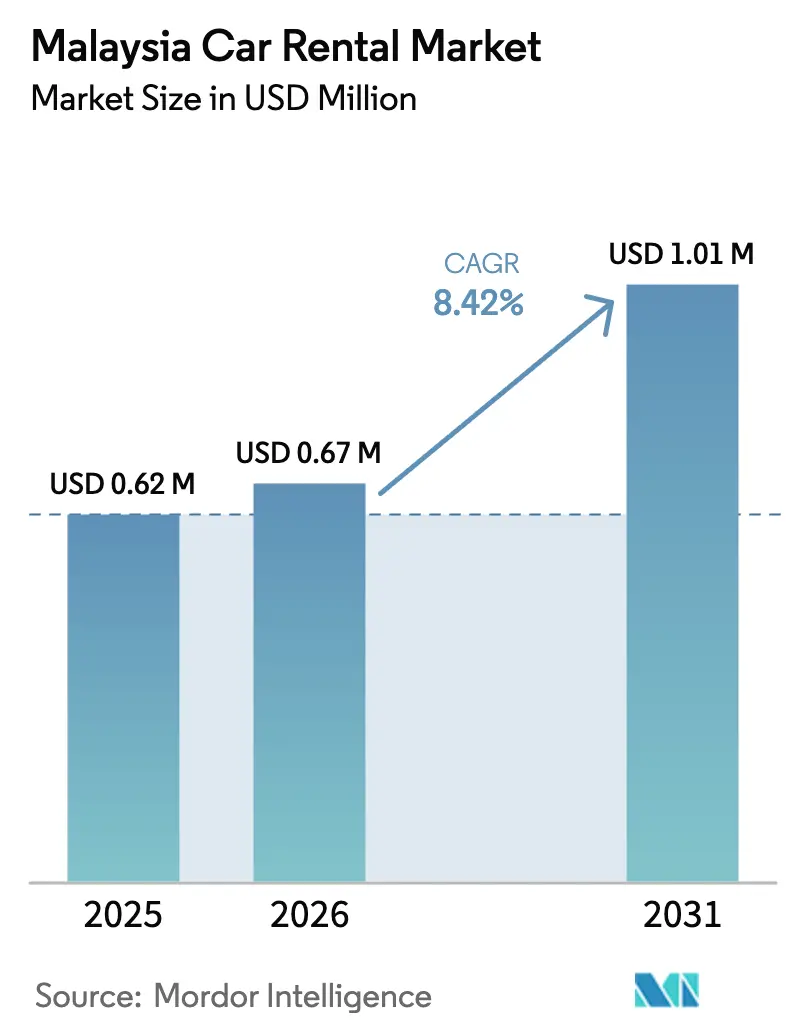
| Base Year Market Size (2025) | USD 0.62 Million |
| Market Size (2026) | USD 0.67 Million |
| Market Size (2031) | USD 1.01 Million |
| Growth Rate (2026 - 2031) | 8.42 % |
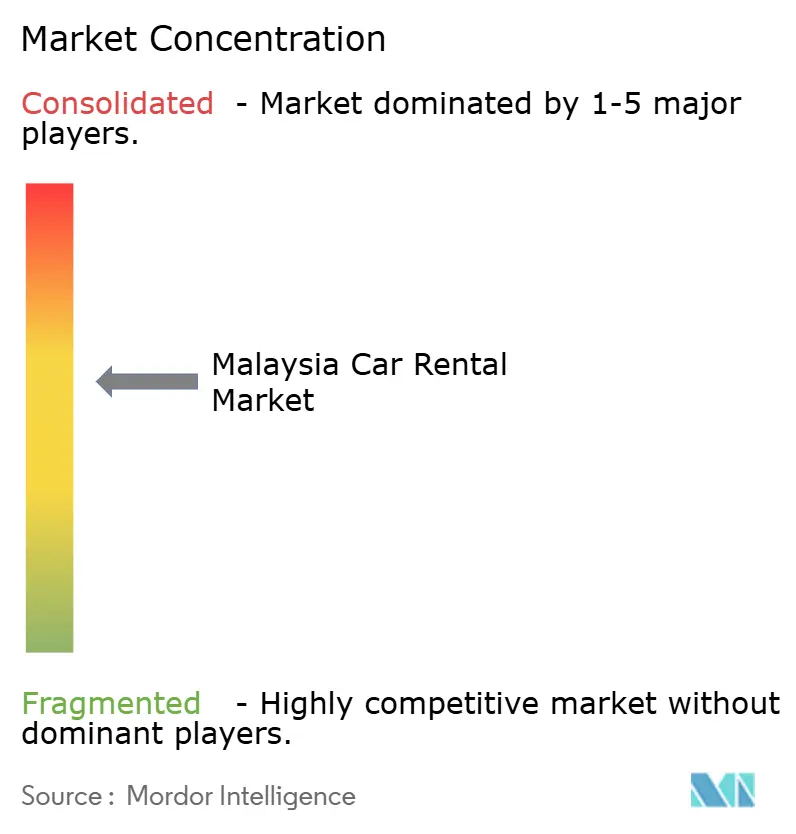
| Market Concentration | Medium |
Major Players *Disclaimer: Major Players sorted in no particular order Image © Mordor Intelligence. Reuse requires attribution under CC BY 4.0. | |
Malaysia Car Rental Market Analysis by Mordor Intelligence
The Malaysian car rental market size is expected to grow from USD 0.62 billion in 2025 to USD 0.67 billion in 2026 and is forecast to reach USD 1.01 billion by 2031 at 8.42% CAGR over 2026-2031. This expansion aligns with the post-pandemic rebound in international tourism, robust domestic demand, and the country’s positioning as a regional logistics and services hub. Inbound arrivals climbed to 38 million in 2024, eclipsing earlier government targets and feeding sustained demand for flexible mobility solutions. Operators are also benefiting from policy support for electric vehicles, improved digital road-tax compliance, and infrastructure upgrades across airports and highways. Competitive dynamics remain intense as global brands, local incumbents, and digital-native platforms race to deepen fleet capabilities, enhance customer experience, and hedge against volatile fuel costs.
Key Report Takeaways
- By booking type, offline channels led with 56.48% of the Malaysian car rental market share in 2025, while the online segment is projected to post a 11.68% CAGR to 2031.
- By rental duration, short-term rentals captured a 69.62% of the Malaysian car rental market share in 2025, while long-term leasing is poised for a 9.31% CAGR through 2031.
- By vehicle type, economy/hatchbacks accounted for 42.75% of the Malaysian car rental market share in 2025; SUVs are projected to grow at an 11.12% CAGR.
- By rental channel, off-airport locations held a 63.52% of the Malaysian car rental market share in 2025, whereas on-airport outlets are set to expand at a 9.98% CAGR.
- By application, tourism and leisure represented 67.55% of the Malaysian car rental market share in 2025; business/commuting demand is advancing at an 10.78% CAGR.
- By customer type, individual users dominated with a 72.41% of the Malaysian car rental market share in 2025; corporate/fleet customers are heading for a 10.34% CAGR.
Note: Market size and forecast figures in this report are generated using Mordor Intelligence’s proprietary estimation framework, updated with the latest available data and insights as of 2026.
Malaysia Car Rental Market Trends and Insights
Drivers Impact Analysis*
| Driver | (~) % Impact on CAGR Forecast | Geographic Relevance | Impact Timeline |
|---|---|---|---|
| Rising Inbound and Domestic Tourism | +2.1% | Kuala Lumpur, Penang, Langkawi | Medium term (2-4 years) |
| SUV Preference Boosts Fleet Mix | +1.8% | Nationwide urban and tourist areas | Medium term (2-4 years) |
| Shift to Online Booking Platforms | +1.3% | Major urban centers | Short term (≤ 2 years) |
| Corporate Gig-Mobility Demand | +1.1% | Kuala Lumpur and Selangor | Short term (≤ 2 years) |
| EV Incentives Catalyze Electric Fleets | +0.9% | Klang Valley, Penang, Johor Bahru | Long term (≥ 4 years) |
| Subscription Plans for Digital Nomads | +0.7% | Kuala Lumpur, Cyberjaya, Penang | Medium term (2-4 years) |
| Source: Mordor Intelligence | |||
Rising Inbound and Domestic Tourism Rebound
Malaysia welcomed 38 million visitors in 2024, a 31% jump over earlier targets and a clear signal of pent-up travel demand[1]“Tourist Arrivals & Receipts 2024,” Tourism Malaysia, tourism.gov.my. The government’s Visit Malaysia 2026 campaign now targets 35.6 million arrivals, underpinning a solid pipeline for mobility services. Passenger throughput across Malaysia Airports Holdings Berhad assets reached 77.8% of 2019 levels in 2023, with new routes from Shanghai and Phnom Penh restoring international connectivity. These trends reinforce the Malaysian car rental market as tourists extend stays into secondary cities where public transport density remains thin. Off-airport outlets that already command the majority of rental transactions stand to harvest additional volumes as travelers search for cost-efficient options outside terminals.
SUV Preference Boosting Higher-Margin Fleet Mix
SUVs' share in Malaysia’s new-car sales accounts for nearly one-third of total sales, reflecting consumer appetite for higher seating positions and multipurpose cargo space. Rental agencies benefit because SUVs yield 40 to 60% higher daily rates yet sustain strong utilization. Proton and Perodua plan several budget SUVs for 2025, including an electric crossover priced between RM50,000 and RM90,000 (USD 10,700–19,300), allowing operators to offer greener options without sacrificing the SUV flavor. Superior profit margins should keep this body style growing through 2030.
Accelerating Shift to Online-First Booking Platforms
Rapid smartphone penetration and nationwide 4G coverage have helped digital-native brands such as SOCAR and TREVO scale quickly, yet traditional agencies still secure the bulk of reservations. Offline channels illustrate how brick-and-mortar players migrate legacy clients onto proprietary apps and self-service kiosks. SOCAR’s 1,000-location network leverages real-time data streaming to right-size fleet allocation and pricing, demonstrating the operational upside of digital convergence. As Malaysia issues digital driving licenses and e-road-tax tags, identity verification and check-out times fall, widening the gap between tech-savvy operators and laggards.
Corporate Gig-Mobility Demand (Ride-Hailing Driver Leasing)
Ride-hailing incumbents such as Grab generated USD 673 million in Malaysia revenue during 2023, underscoring a vast pool of professional drivers that require leased vehicles [2]“Form 20-F 2024,” Grab Holdings, grab.com. Corporate delivery fleets and employee shuttle providers are also switching from outright purchase to usage-based contracts. Low subscription offers help to bundle maintenance, insurance, and telematics, yielding predictable cash flows for lessors.
Restraints Impact Analysis*
| Restraint | (~) % Impact on CAGR Forecast | Geographic Relevance | Impact Timeline |
|---|---|---|---|
| Intensifying Ride-Hailing Competition | -1.8% | Kuala Lumpur and Penang | Medium term (2-4 years) |
| Persistent Fuel-Price Volatility | -1.4% | Nationwide, stronger on long-distance routes | Short term (≤ 2 years) |
| Rising Insurance Cost Burden | -0.9% | Nationwide | Medium term (2-4 years) |
| Urban Parking Inflates Operating Costs | -0.6% | Klang Valley, Penang, Johor Bahru | Long term (≥ 4 years) |
| Source: Mordor Intelligence | |||
Intensifying Competition from Ride-Hailing and E-Hailing
Grab’s ubiquity in urban corridors removes many friction points of self-drive rentals, such as parking and insurance. Price bundling with hotels and airlines lets platforms siphon spontaneous demand. Traditional agencies now focus on multi-day leisure trips, family tours, and specialty vehicles where ride-hailing is less cost-effective, yet the competitive overhang trims near-term pricing power.
Persistent Fuel-Price Volatility
Malaysia maintains a capped RON95 gasoline price at MYR 2.05 (~USD 0.48) per liter but plans to begin subsidy rationalization from mid-2025, following the June 2024 diesel subsidy rollback [3]“Fuel Subsidy Rationalisation Statement 2025,” Prime Minister’s Office of Malaysia, pmo.gov.my. Rental companies face margin pressure as pump prices float with global crude benchmarks. Operators with older fleets or long-distance itineraries feel a sharper squeeze, prompting a pivot toward hybrid and EV acquisitions.
*Our forecasts treat driver/restraint impacts as directional, not additive. The impact forecasts reflect baseline growth, mix effects, and variable interactions.
Segment Analysis
By Booking Type: Digital transformation reshapes legacy leadership
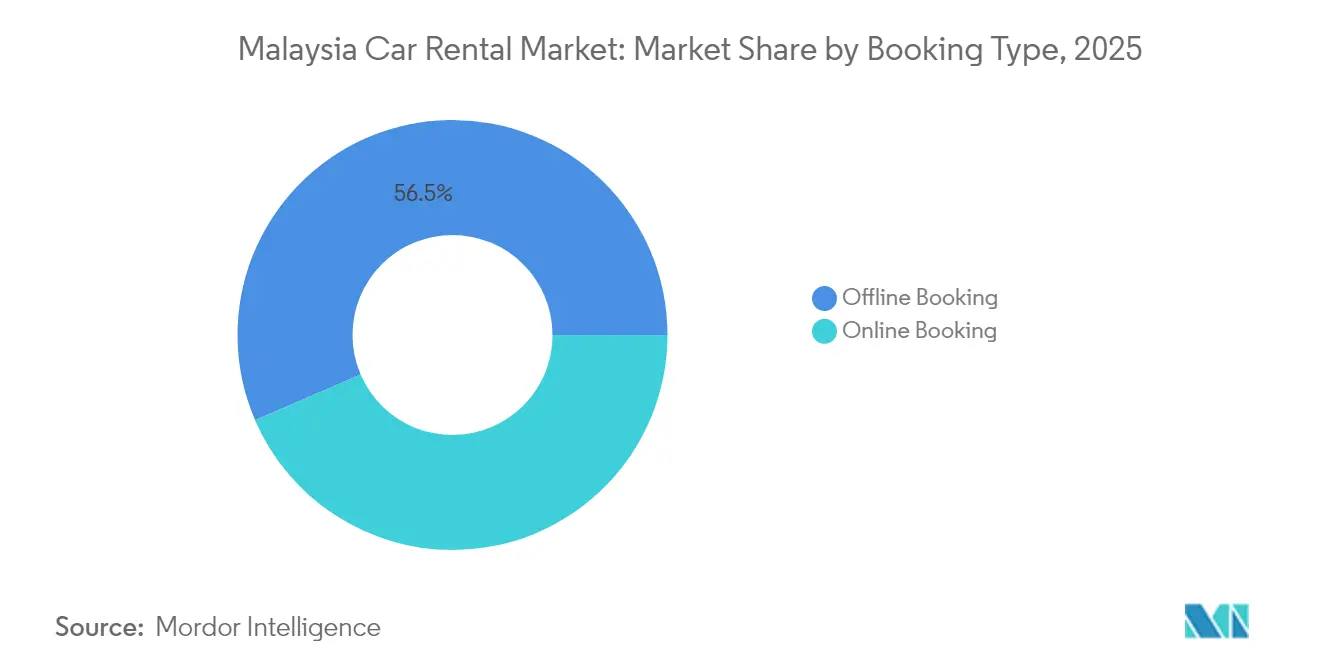
Offline channels controlled 56.48% of the Malaysian car rental market share in 2025 due to entrenched travel-agency relationships and walk-in hotel counters. Investments in mobile booking engines and contactless kiosks let these incumbents keep clients inside proprietary ecosystems while boosting upsell rates. The Malaysian car rental market size for online reservations is projected to expand at a 11.68% CAGR as operators integrate QR-code payments and real-time fleet tracking. Purely online portals face rising acquisition costs as search advertising grows crowded. Operators converge on omnichannel models, blending physical touchpoints with cloud-native inventory so customers can toggle seamlessly between app, call center, and counter.
Digital-first brands retain a data advantage because granular telematics feed dynamic-pricing engines that maximize yield per vehicle. Indoor-mapping APIs also shorten pick-up times at malls and airports, improving user satisfaction. Over the forecast horizon, online portals will deepen ties with airlines and travel-super-apps to widen funnel reach, yet mature growth curves suggest incremental share gains will be moderate. Offline operators that finish their digital overhaul could erode the perceived edge of pure-play platforms, especially among repeat domestic travelers.



By Rental Duration: Short-term strength meets long-term momentum
Short-term hires under 30 days generated 69.62% of the Malaysian car rental market share in 2025, leveraging the tourism upswing and spontaneous domestic weekend trips. Peak-season daily rates can climb 30% above shoulder months, giving agencies a revenue hedge. The Malaysian car rental market size for short-term contracts will grow in line with inbound traffic, though its CAGR trails the long-term segment. Corporations and expatriates now view leasing as an OPEX lever, pushing long-term and subscription models toward a 9.31% CAGR. These plans trim paperwork and bundle maintenance, making them attractive for HR departments managing rotating project teams.
Subscription customers show lower churn than day-to-day renters, yielding predictable fleet-utilization ratios that support financing agreements with banks. Long-term demand is also linked to the gig-mobility boom as ride-hailing drivers prefer hassle-free leases over vehicle ownership. Operators diversifying into 3-to-24-month contracts can smooth seasonality and shield against tourism shocks, anchoring a balanced portfolio across tenure buckets.
By Vehicle Type: Economy backbone with SUV margin accelerator
Economy/hatchbacks retained 42.75% of the Malaysian car rental market share in 2025, favored by budget travelers and domestic commuters seeking low fuel consumption. High resale values for Proton Saga and Perodua Axia models further protect fleet depreciation. However, the Malaysian car rental market share for SUVs is expanding rapidly as consumers opt for added comfort and cargo capacity. The SUV slice is climbing at an 11.12% CAGR due to affordable local nameplates and better highway infrastructure. Each SUV unit can yield more daily revenue, yet fill-rate discipline remains crucial because capital outlays are higher.
Sedans cater to corporate airport transfers where luggage and rear-seat space outweigh price, while MPVs serve extended families. Electric SUV launches for 2025 will let operators satisfy sustainability-minded visitors and hedge against fuel uncertainty. Agencies continuously rebalance purchase pipelines, steering 5-10 percentage points of fleet renewal toward SUV variants each year to protect margin lift.
By Rental Channel: Off-airport scale with airport speed
Off-airport counters located near city hotels, rail hubs, and residential neighborhoods delivered 63.52% of the Malaysian car rental market share in 2025. Lower concession fees and flexible lease terms at commercial buildings underpin competitive pricing pitched at domestic travelers. The Malaysian car rental market size derived from off-airport operations is expected to post steady mid-single-digit growth as local tourism and weekend getaways rise. Airport outlets are recovering quickly with a 9.98% CAGR as cross-border air seats are reinstated. Immediate access to arriving passengers lets operators command premium rates that offset higher royalty fees to airport landlords.
KLIA, Penang International, and Langkawi airports together host a significant number of rental brands, intensifying service-quality competition. Self-service lockers, digital key pick-ups, and facial-recognition check-outs are rolling out to shorten dwell time, crucial for high-value corporate travelers. A dual-channel footprint that streams vehicles between downtown and airport pools will be the optimal route to maximize utilization.
By Application: Leisure base with business expansion
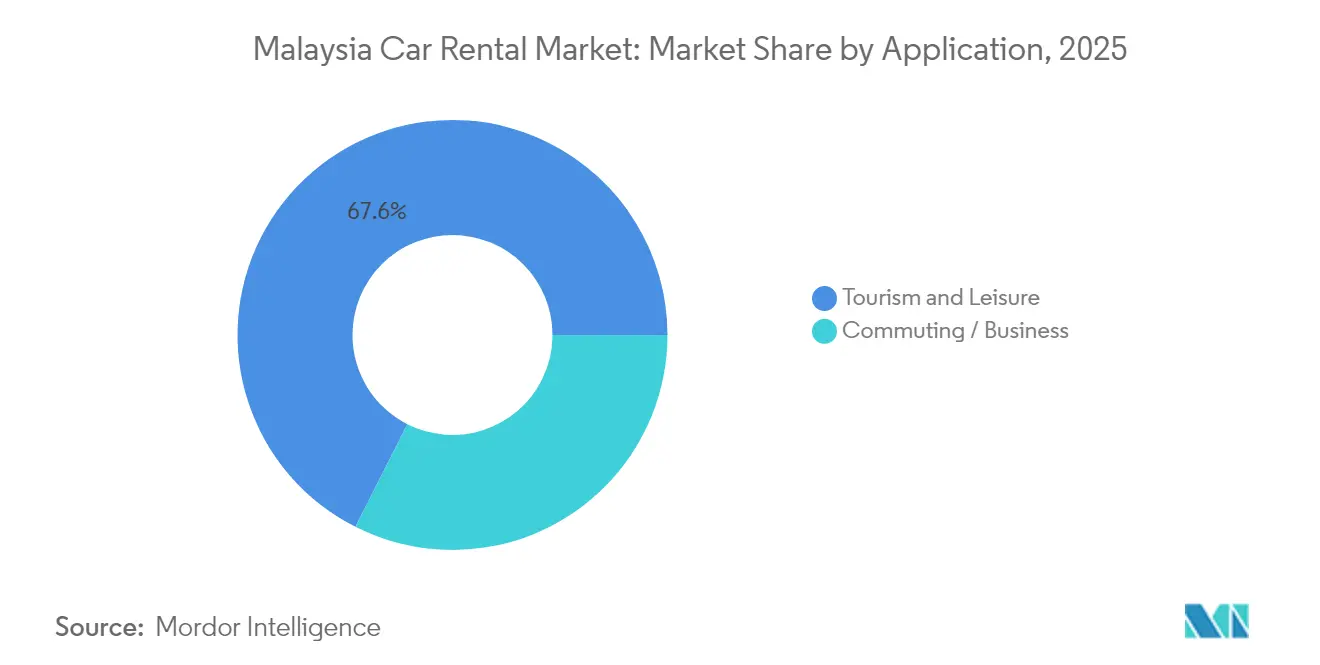
Tourism and leisure still held 67.55% of the Malaysian car rental market share in 2025, anchored by sightseeing itineraries that cover Cameron Highlands, Melaka, and beach resorts. Operators calibrate pricing calendars around school vacations and religious holidays when vehicle shortages spark surge rates. Business and commuting use cases are forecast for an 10.78% CAGR as companies embrace flexible mobility allowances in place of fleet ownership. The Malaysian car rental market tied to corporate accounts is expanding faster than the leisure core.
Gig-platform drivers tap multi-month leases to eliminate upfront capital, and delivery firms like e-grocers contract van fleets during seasonal peaks. Multi-purpose solutions such as bundled fuel and toll packages add stickiness. Agencies that diversify into corporate sales pipelines reduce exposure to tourism swings and create upsell avenues for telematics and insurance add-ons.
By Customer Type: Individual dominance with corporate acceleration
Individuals constituted 72.41% of the Malaysian car rental market share in 2025, fueled by the return of international visitors and growth in domestic staycations. The Malaysian car rental market benefits from locals postponing car ownership due to rising living costs and urban congestion fees. Still, corporate clients are gaining share at a 10.34% CAGR, drawn by business-process outsourcing strategies that favor asset-light mobility contracts. Subscription bundles, telematics dashboards, and consolidated invoicing are particularly appealing to multinationals managing regional workforces.
For rental agencies, corporate accounts deliver twice the average revenue per user compared with ad-hoc leisure bookings. Negotiated volumes help secure favorable financing on fleet purchases, encouraging wider adoption of EVs where tax breaks further enhance cost competitiveness.
Geography Analysis
Klang Valley anchored a significant share of nationwide rental revenues in 2025, underpinned by KLIA’s role as the main aviation gateway and the region’s high concentration of expatriates and corporate headquarters. Penang contributed significant growth, buoyed by medical tourism and semiconductor supply-chain traffic that creates year-round bookings. Johor Bahru rental grows, as cross-border commuters from Singapore resumed daily travel after pandemic restrictions eased. The Malaysian car rental market size connected to these three corridors is forecast to expand at a high pace as highway upgrades and the Johor Bahru–Singapore Rapid Transit System elevate visitor flows.
Secondary tourism nodes such as Langkawi, Kota Kinabalu, and Kuching account for a notable share of rental services. These islands and East Malaysian cities have limited public transport coverage; hence, car hire remains the dominant mobility option for multi-stop excursions. Langkawi Airport achieved a high service-quality rating that lifts passenger confidence and supports premium rental tariffs. Emerging eco-tourism circuits in Sabah and Sarawak, combined with the government’s Borneo highway initiative, will gradually widen geographic diversification for operators.
Border regions with Thailand and inland highways through Perlis and Kedah log notable growth as self-drive overland tourism gains popularity among ASEAN residents. Cross-border entry-permit harmonization and upgrades to Bukit Kayu Hitam and Padang Besar checkpoints reduce administrative bottlenecks, making one-way international rentals viable. Operators looking to penetrate these corridors must navigate differing insurance regimes and vehicle-tracking requirements but stand to capture first-mover advantages.
Regulatory Landscape
Malaysia car-rental and tourism vehicle operators operate under a dual framework led by the Ministry of Tourism, Arts and Culture (MOTAC) and the Land Public Transport Agency (APAD). Tourism-facing operators must hold relevant licenses under the Tourism Industry Act 1992 (Act 482), while vehicle and service licensing requirements are administered under the Land Public Transport Act 2010 (Act 715), together with roadworthiness and operating compliance under the Road Transport Act 1987 (Act 333).
Operational compliance is anchored by periodic vehicle inspection certification via PUSPAKOM, GPS monitoring requirements for regulated services, and entity registration with Suruhanjaya Syarikat Malaysia (SSM) or Suruhanjaya Koperasi Malaysia (SKM). APAD introduced updated service-level requirements for tourist vehicles effective 15 August 2025, and MOTAC has formalized licensing workflows through the TOURLIST system for applications and renewals, increasing the weight of digital documentation, audit readiness, and standardized service delivery across rental and chauffeur-driven tourism segments.
Value Chain Analysis
The Malaysia car rental value chain starts with upstream vehicle supply (local OEMs and importers, plus financiers and fleet-leasing providers) and moves into fleet acquisition, registration, and licensing activities, which are shaped by MOTAC and APAD requirements. Inspection and readiness processes, including PUSPAKOM certification and mandated monitoring practices such as GPS for regulated services, act as gatekeepers before vehicles are deployed into short-term rentals, subscription/leasing, and tourism-use channels.
On the downstream side, operators run fleet operations (maintenance networks, tires and parts, accident repair, and telematics), manage distribution through airport counters, off-airport branches, and app-based platforms, and handle customer servicing such as KYC and identity verification, deposits, claims, and roadside assistance. Digital-first players such as SOCAR, GoCar, and peer-to-peer marketplace TREVO increasingly sit across distribution and operations through app booking, pricing, and telematics-enabled utilization management. In practice, partnerships with service providers and mobility ecosystem players are used to improve uptime, reduce turnaround time, and expand coverage beyond airport-centric demand.
Competitive Landscape
The competitive field is moderately fragmented. Global majors like Hertz, Avis, Europcar, and SIXT operate alongside regional players like SOCAR, GoCar, Mayflower, and Hawk. International brands leverage corporate contracts and standardized loyalty programs while local firms exploit deeper city-center networks and cultural affinity.
Technology remains the decisive battleground. SOCAR and GoCar rely on AI-powered dynamic-pricing engines to calibrate rates by micro-location and time slot. Peer-to-peer marketplace TREVO lists many privately-owned cars, expanding inventory without capex and giving owners supplemental income. Traditional agencies respond by adding subscription services, white-label EV fleets, and partnerships with hotel chains for bundled stay-and-drive packages.
Strategic moves since 2024 confirm a pivot to electrification and premium positioning. Sime Darby Rent-A-Car teamed with BMW distributor Auto Bavaria to pilot an all-EV rental fleet, capturing early-adopter tourists and corporate executives seeking sustainable options. Avis Malaysia opened a flagship outlet inside Kuala Lumpur’s Sheraton Imperial Hotel to tap into demand from upscale travelers and conference delegates. Over the forecast period, scale economics, insurance bargaining power, and data-science proficiency will likely trigger selective consolidation among mid-sized operators.
Malaysia Car Rental Industry Leaders
SOCAR Malaysia
Mayflower Car Rental Sdn. Bhd.
Hawk Rent A Car
The Hertz Corporation
GoCar Malaysia
- *Disclaimer: Major Players sorted in no particular order

Market Opportunities and Future Outlook
A key whitespace is scaling compliant tourism-oriented rentals and chauffeur-driven offerings that meet the APAD service-level requirements introduced on 15 August 2025, especially outside the primary airport nodes where off-airport locations already drive most transactions. With Tourism Malaysia tracking 38 million visitors in 2024 and the government running the Visit Malaysia 2026 campaign, operators have a clear demand signal to expand multi-day leisure products, hotel-stay bundles, and secondary-city coverage in corridors such as Penang, Langkawi, Johor Bahru, and East Malaysia, where public transport density is thinner.
Electrification and subscription formats also create an opportunity cluster tied to operating-cost control and a more differentiated customer experience. EV rental pilots such as Sime Darby Rent-A-Car working with BMW distributor Auto Bavaria, along with EV car-sharing expansion moves like GoCar with drivEV in Johor Bahru, show active pathways for commercialization through charging-linked partnerships, corporate accounts, and premium tourism use cases. At the same time, subsidy rationalization actions referenced by the government, including the June 2024 diesel subsidy rollback and plans to begin rationalization from mid-2025, increase the business value of newer, more efficient fleets (hybrids and EVs) and data-driven pricing to protect utilization and margins.
Recent Industry Developments
- February 2026: SOCAR Malaysia rolled out a nationwide Hari Raya campaign tied to March 2026 drive periods and minimum multi-day bookings. The push concentrated demand into peak travel weeks, helping improve fleet utilization and reinforcing the importance of promotion-led yield management for short-term rentals.
- March 2025: Mayflower Car Rental partnered with Bateriku.com to strengthen operational support for its rental activity. The tie-up highlights how roadside assistance and maintenance ecosystems are being used to reduce downtime and improve service consistency across dispersed off-airport networks.
- December 2024: GoCar expanded EV car-sharing to Johor Bahru through a collaboration with Yinson GreenTech subsidiary, drivEV, introducing models such as the GAC Aion Y Plus and GWM Ora Good Cat. Extending EV access beyond Klang Valley supports broader geographic adoption and positions car-sharing platforms to capture both commuter and leisure demand with differentiated vehicle types.


Research Methodology Framework and Report Scope
Market Definition and Coverage
For this study, the market covers revenue earned from renting passenger vehicles in Malaysia, across self drive and chauffeur options, counted at the point the rental service is delivered.
Scope exclusions: We exclude ride hailing trips, informal peer to peer lending between individuals, and revenue from vehicle sales, insurance, and repairs that are not billed as part of a rental contract.
Segmentation Overview
- By Booking Type
- Online Booking
- Offline Booking
- By Rental Duration
- Short-Term (Less than 30 days)
- Long-Term/Leasing (≥30 days)
- By Vehicle Type
- Hatchback/Economy
- Sedan
- Sport-Utility Vehicles (SUV)
- Multi-Purpose Vehicles (MPV)
- By Rental Channel
- On-Airport
- Off-Airport
- By Application
- Tourism and Leisure
- Commuting / Business
- By Customer Type
- Individual
- Corporate / Fleet
Data Sources, Market Sizing, and Validation
Desk Research
Desk research was used to set the demand context and to anchor the model with Malaysia specific travel and mobility indicators. We leaned on public tourism arrival statistics and airport throughput releases, along with transport and road safety publications that help explain where rentals are typically used and when demand spikes (holiday peaks and school breaks).
We also reviewed official and public sources such as Department of Statistics Malaysia releases, tourism board publications, airport operator traffic updates, and road transport department summaries, followed by central bank or ministry macro indicators that influence discretionary spend. These were complemented with company filings where available, investor decks, association websites, and reputed press coverage on fleet additions, pricing moves, and airport counter presence. For data gaps, we used paid subscriptions for company financials and intelligence and for news and financials to verify corporate activity signals. The sources listed here are illustrative only, and many other references were used during data collection, validation, and clarification.
Primary Interviews and Surveys
Primary work focused on validating what drives rental revenue in Malaysia and what is counted as billable value in common contracts. We spoke with a mix of operators, fleet partners, travel intermediaries, and corporate mobility buyers, and then cross checked assumptions on utilization, daily rates, and seasonal surcharges across key demand pockets such as major airports and city centers.
Feedback was also used to reconcile differences between short term leisure rentals and longer corporate rentals, and to confirm how online booking penetration is changing effective pricing and cancellation behavior.
Distribution of primary research fieldwork respondents
| Company type | Respondent position |
|---|---|
| Top tier: 34% | CXOs: 19% |
| Mid tier: 47% | Functional/Unit leaders: 22% |
| Smaller Players: 19% | Managers: 59% |
Market-Sizing & Forecasting
Sizing starts from a top-down demand pool view where travel flows and vehicle availability signals are translated into a realistic annual rental days base, and then converted into revenue using observed price points. To keep this practical, we tied the build to a few measurable fingerprints, such as inbound and domestic travel intensity, airport related rental demand, fleet size direction, utilization ranges, average daily rates (including weekend and peak season uplift), and the mix shift toward online booking.
Those totals were then corroborated with selective bottom-up approximations, mainly by sampling operator price cards, checking booking channel fees, and applying an ASP times volume logic on a small set of representative rental patterns. Where operator disclosures were limited, gaps were handled by using ranges from interviews, followed by a conservative midpoint selection that was re-tested against the demand indicators.
For forecasting, we used scenario analysis supported by a light multivariate regression check, where the independent variables were travel recovery, consumer spend direction, and fleet additions, and then the near term slope was adjusted using operator commentary on pricing discipline and utilization expectations. Assumptions were re-run under higher fuel cost and weaker tourism scenarios so the final curve stayed believable year to year.
Data Validation & Update Cycle
Model outputs were checked against independent signals, such as tourism and airport traffic direction, observed rate movements, and the pace of fleet expansion announcements. When results moved outside expected bands, the underlying drivers were reviewed, followed by re-contacting selected experts to confirm whether the variance was real or caused by an input error.
Before sign-off, the file goes through multi-step analyst reviews that look for unit consistency, currency timing, and growth logic across years. The report is refreshed annually, with interim updates when material events occur, such as policy changes, sharp demand shocks, or major supply shifts. Prior to delivery, we perform a fresh pass so clients receive the latest updated view.
Mordor Intelligence's Malaysia Car Rental Market Size Compared With Other Published Estimates
Published market values for Malaysia car rental can look different because the scope counted is not always the same, and the conversion from activity metrics into revenue also varies across studies. Differences usually come from what is treated as a rental transaction, how online fees and insurance add-ons are handled, and whether the numbers reflect a steady year or a peak season influenced run rate.
The main gap comes from whether long-term corporate contracts and chauffeur driven bookings are counted together with short-term leisure self drive rentals, and in Mordor Intelligence's model, revenue is counted only when the rental service is delivered in Malaysia and priced in USD with consistent currency timing.
Benchmark comparison
| Source | Market Size | Gaps in Research Methodology |
|---|---|---|
| Mordor Intelligence | USD 0.62 B (2025) | |
| Regional Consultancy A | USD 0.58 B (2024) | Uses a prior-year snapshot and applies a flatter ADR assumption that does not fully reflect peak season and airport surcharge behavior, which can pull the value down even when trips are rising. |
| Industry Research Desk B | USD 0.70 B (2025) | Appears to bundle adjacent mobility revenues (such as driver services and broader leasing style contracts) and applies a more aggressive utilization uplift, which can push totals above a rental-only scope. |
The spread across the table is largely explained by scope decisions and how pricing and utilization are normalized across the year. By tying the model to observable travel signals and then stress-testing rates and rental days with operator feedback, the final estimate stays traceable to clear inputs and can be repeated when new data arrives.


Key Questions Answered in the Report
How large is the Malaysia car rental market in 2026?
The market is valued at USD 0.67 billion in 2026 and is projected to reach USD 1.01 billion by 2031.
What is driving growth in Malaysia’s car rental sector?
Surging inbound tourism, wider adoption of digital booking platforms, and consumer preference for SUVs are the primary growth catalysts.
Which customer segment is expanding fastest?
Corporate and fleet customers are forecast to grow at a 10.34% CAGR as businesses shift toward subscription-based mobility.
How significant are electric vehicles for rental fleets?
Government tax incentives and charging-infrastructure build-out are lowering entry barriers, prompting agencies to trial dedicated EV fleets from 2024 onward.
Page last updated on:


 Your data is secure and never sold or shared.


