
Magnesium Oxide Nanopowder Market Size and Share
Market Overview
| Study Period | 2020 - 2031 |
|---|---|
| Market Size (2026) | USD 59.35 Million |
| Market Size (2031) | USD 87.14 Million |
| Growth Rate (2026 - 2031) | 7.96 % |
| Fastest Growing Market | Asia Pacific |
| Largest Market | Asia Pacific |
| Market Concentration | Medium |
Major Players *Disclaimer: Major Players sorted in no particular order Image © Mordor Intelligence. Reuse requires attribution under CC BY 4.0. | |
Magnesium Oxide Nanopowder Market Analysis by Mordor Intelligence
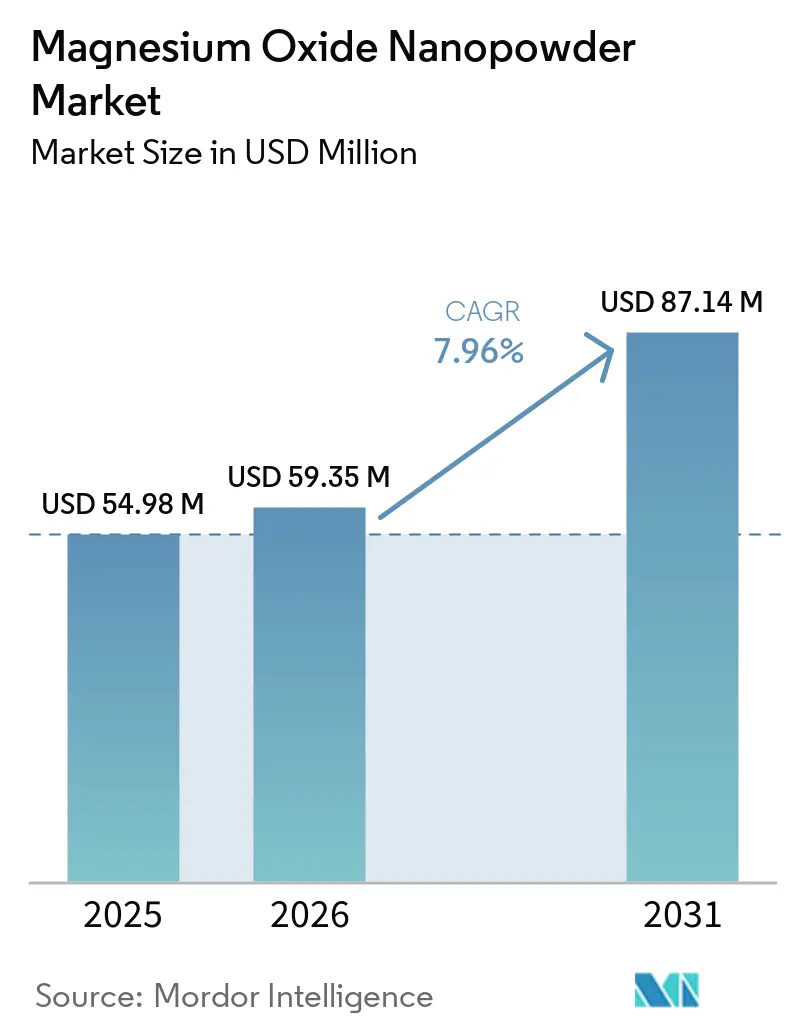
The Magnesium Oxide Nanopowder Market size was valued at USD 54.98 million in 2025 and estimated to grow from USD 59.35 million in 2026 to reach USD 87.14 million by 2031, at a CAGR of 7.96% during the forecast period (2026-2031). Most revenue still flows from legacy refractory demand, yet momentum is clearly shifting toward high-value applications in fuel additives, electrical insulation, flame-retardant polymer compounds and early solid-state battery prototypes. Supply security is shaped by China’s 52% share of primary magnesium production in 2024, which delivers cost advantages for Asian processors but exposes global buyers to policy-driven volatility. Competitive positioning increasingly depends on proprietary synthesis routes that deliver narrow particle-size distributions and functionalized surfaces needed in advanced composites and electrolytes. Finally, tightening workplace-exposure limits for engineered nanomaterials in North America and the EU are raising compliance costs, but they also favour established producers with certified quality systems.
Key Report Takeaways
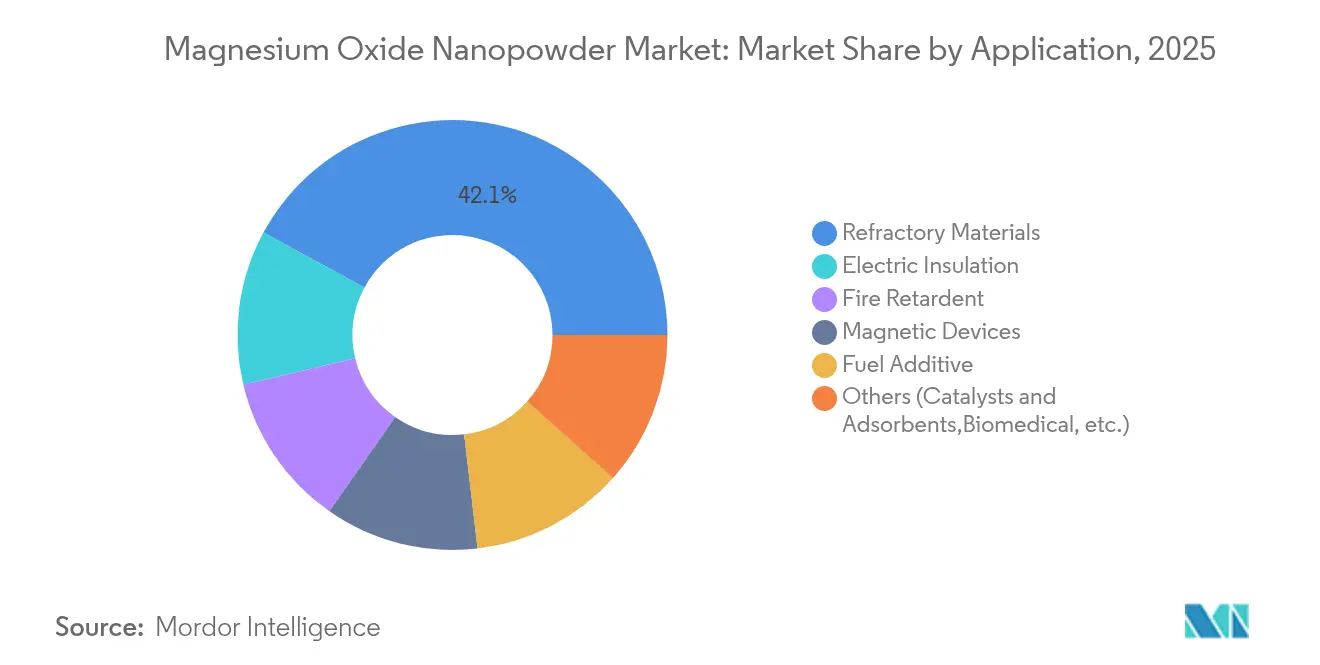
- By application, refractory materials led with 42.10% revenue share in 2025; fuel additives are forecast to expand at an 8.63% CAGR to 2031.
- By synthesis method, physical methods held 41.75% of the magnesium oxide nanopowder market size in 2025; chemical precipitation techniques are advancing at a 8.78% CAGR to 2031.
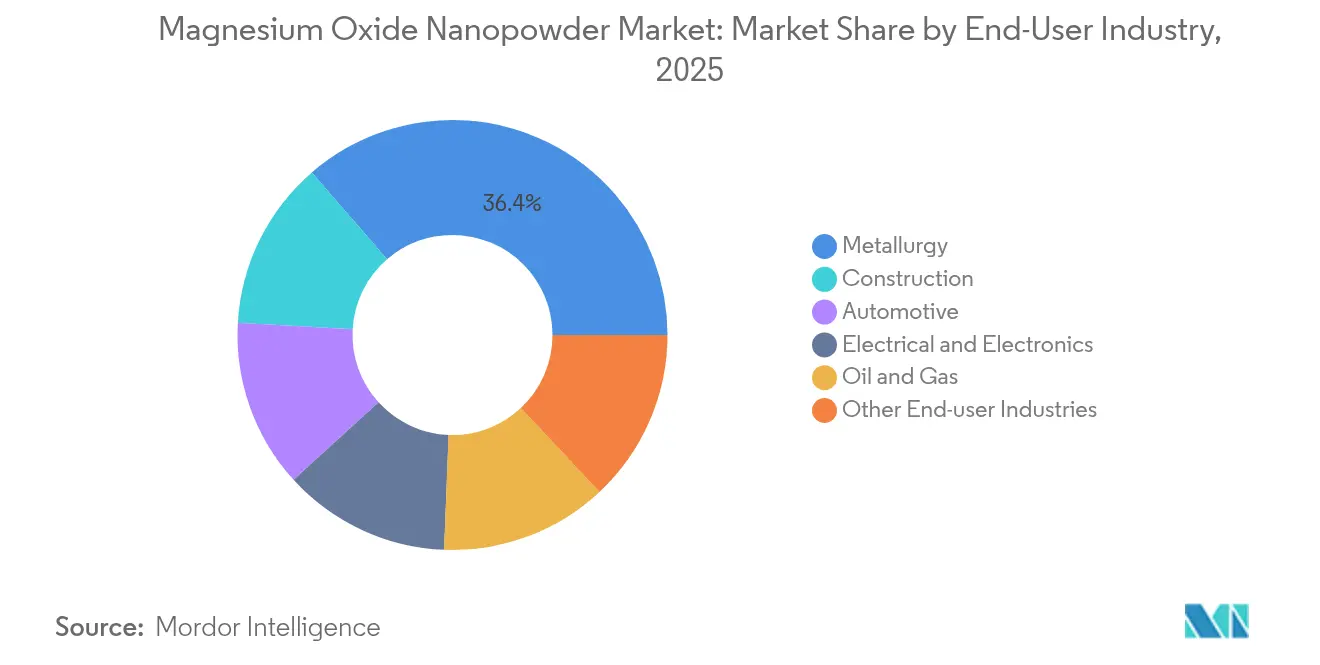
- By end-user industry, metallurgy accounted for 36.35% of the magnesium oxide nanopowder market share in 2025, while other end-user industries are projected to post the highest CAGR at 8.25% through 2031.
- By geography, Asia-Pacific commanded 51.72% share of the magnesium oxide nanopowder market size in 2025 and remains the fastest-growing region with an 8.55% CAGR forecast to 2031.
Note: Market size and forecast figures in this report are generated using Mordor Intelligence’s proprietary estimation framework, updated with the latest available data and insights as of 2026.
Market Trends and Insights
Drivers Impact Analysis of Magnesium Oxide Nanopowder Market*
| Driver | (~) % Impact on CAGR Forecast | Geographic Relevance | Impact Timeline |
|---|---|---|---|
| Rising demand from refractory industry | +1.8% | Global, concentrated in Asia-Pacific steel hubs | Medium term (2-4 years) |
| Growth in electrical insulation applications | +1.5% | North America and EU electronics manufacturing, APAC expansion | Long term (≥4 years) |
| Increasing use as fuel additive | +1.2% | Global automotive markets, early adoption in Asia-Pacific | Short term (≤2 years) |
| Expanding adoption in flame-retardant polymer composites | +1.0% | North America and EU construction, automotive safety regulations | Medium term (2-4 years) |
| Emergent role in solid-state battery electrolytes | +0.8% | Asia-Pacific battery manufacturing, spill-over to North America | Long term (≥4 years) |
| Source: Mordor Intelligence | |||
Rising Demand from Refractory Industry
Magnesia-carbon bricks incorporating nanoscale magnesium oxide show higher densification that lowers porosity-induced failure in basic oxygen and electric arc furnaces. Steelmakers in China, Japan and South Korea have standardised nanopowder grades in ladle, tundish and continuous-caster linings to withstand rapid thermal cycling. Consolidation among integrated steel producers means fewer buyers wield greater purchasing power, but they pay premiums for reliability that avoids unplanned shutdowns. As electric arc furnace capacity expands across Asia-Pacific, magnesium oxide nanopowder market demand remains closely correlated with rising scrap-based steel output. Suppliers with vertically integrated production and refractory formulation expertise can capture long-term contracts anchored in joint R&D agreements.
Growth in Electrical Insulation Applications
Epoxy systems loaded with 1 wt% magnesium oxide nanoparticles maintain a dielectric constant of 13 at 230 °C and double the thermal conductivity versus neat resin. These attributes solve the chronic trade-off between heat dissipation and electrical resistivity in silicon carbide power modules and traction inverters. Electric-vehicle drive-train voltages above 800 V, combined with miniaturised form factors, amplify the need for high-temperature insulation fillers that stay chemically inert under partial discharge. Asia-Pacific cable makers are scaling polyethylene compounds filled with freeze-dried magnesium oxide foams that suppress space-charge accumulation. As wind-turbine inverters grow in capacity, European utilities are also specifying nanoparticle-filled potting compounds for offshore substations.
Increasing Use as Fuel Additive
Diesel blends doped with magnesium oxide nanoparticles cut unburned hydrocarbons and reduce particulate matter without adding heavy-metal residues[1]ScienceDirect, “Nanomagnesia as Diesel Additive,” sciencedirect.com. Engine-bench trials show viscosity reductions that improve injector spray patterns and raise brake-thermal efficiency. Euro 7 emissions rules set for 2027 create a regulatory push in the EU, mirrored by China VII standards, both favouring combustion-improvement additives. Commercial-scale trials in India demonstrate dosing concentrations below 20 ppm, which keeps additive cost per litre within automaker targets. This window of opportunity supports differential pricing that offsets the premium cost of high-purity powders.
Expanding Adoption in Flame-Retardant Polymer Composites
Polypropylene loaded with 30 wt% magnesium hydroxide nanoparticles reached a 29.3% limiting-oxygen index, passing UL-94 V-0 without halogenated additives. Construction panels and automotive interior trims use these mineral additives to comply with EU Construction Products Regulation fire-classification standards. Magnesium oxide’s high specific-heat capacity absorbs significant energy during endothermic decomposition, while released water vapour dilutes flame-zone oxygen. Unlike aluminium trihydrate, magnesium-based systems maintain mechanical strength at elevated temperatures, which suits electric-vehicle battery casings that face stringent fire-penetration tests. North American property insurers have started offering premium discounts for buildings specified with halogen-free flame-retardant composites.
Restraints Impact Analysis of Magnesium Oxide Nanopowder Market*
| Restraint | (~) % Impact on CAGR Forecast | Geographic Relevance | Impact Timeline |
|---|---|---|---|
| High production and purification costs | -2.1% | Global, particularly affecting North America and EU manufacturers | Short term (≤2 years) |
| Aggregation and agglomeration issues | -1.4% | Global manufacturing, critical for Asia-Pacific volume production | Medium term (2-4 years) |
| Tightening workplace exposure regulations for nanoparticles | -1.0% | North America and EU regulatory frameworks, expanding globally | Long term (≥4 years) |
| Volatile magnesium feedstock supply | -0.8% | Global supply chains, concentrated risk from China dependency | Short term (≤2 years) |
| Source: Mordor Intelligence | |||
High Production and Purification Costs
Sol-gel plants capable of 1,425 kg day⁻¹ output require capital spending above USD 45,000 and return on investment stretches beyond three years under today’s price structure. Energy-intensive hydrothermal and calcination steps heighten sensitivity to carbon-pricing trajectories in the EU and selected US states. Purity specifications tighter than 99.8 wt% raise reagent and filtration costs that cannot be amortised across commodity volumes. Smaller producers outside Asia-Pacific face scale disadvantages, which limits their ability to bid for large refractory tenders or automotive additive supply contracts.
Aggregation and Agglomeration Issues
Magnesium oxide nanoparticles carry high surface energies that drive agglomeration, eroding dispersion quality in polymer matrices and fluid suspensions. Chemical surfactants alleviate clustering but introduce impurities disallowed in battery electrolytes or biomedical products. Low-temperature freeze-drying yields porous lattices that re-disperse more readily, yet the extra processing adds cost and lengthens lead times. End-users often require tailor-made surface treatments, creating inventory fragmentation and complex quality-assurance regimes.
*Our forecasts treat driver/restraint impacts as directional, not additive. The impact forecasts reflect baseline growth, mix effects, and variable interactions.
Magnesium Oxide Nanopowder Market Segment Analysis
By Application:
Refractory Materials Lead While Fuel Additives AccelerateRefractory materials generated 42.10% of the magnesium oxide nanopowder market size in 2025, anchored in magnesia-carbon bricks and tundish linings for steel and aluminium melt processing. Technical upgrades in electric arc furnaces favour finer particle distributions that densify brick microstructures. As scrap-based steel makes deeper inroads across Asia, energy-efficient linings remain critical for productivity. Market leadership is expected to persist through 2030, though its proportional share will slip as newer uses scale.
The fuel-additive category shows an 8.63% CAGR to 2031, reflecting unprecedented regulatory pressure to cut particulate and NOx emissions in both on-road and off-road fleets. Nanoparticle dispersions improve atomisation, raise flame temperature uniformity and reduce soot precursors without compromising engine hardware warranties. Pilot fleet tests in the EU and China report fuel-economy gains above 2%. Although the segment starts from a small baseline, its growth pace makes it a focal point for producers targeting automotive clients seeking drop-in solutions.



By Synthesis Method:
Chemical Precipitation Gains on Physical MethodsPhysical routes such as flame spray pyrolysis and vacuum vapour deposition held 41.75% of 2025 revenue, benefiting from amortised equipment and throughput suited to refractory grades. The downside remains broad particle-size ranges that do not meet premium electronics or biomedical specs. Producers with legacy physical assets face upgrade decisions as demand migrates upslope on the value chain.
Chemical precipitation displays a 8.78% CAGR to 2031, supported by superior control over stoichiometry, morphology and surface hydroxyl concentration. Closed-loop reactors coupled with inline particle-size analysers now run continuous-flow regimes that improve yield and cut solvent loss. Life-cycle assessments show lower greenhouse-gas intensity when using renewable electricity, which aligns with buyer procurement policies targeting net-zero supply chains. Green or bio-based synthesis is emerging from lab to pilot scale, though unit cost remains higher and capacity limited.
By End-User Industry:
Metallurgy Dominance Faces Diversification PressureMetallurgy accounted for 36.35% of the magnesium oxide nanopowder market share in 2025 as integrated mills continue to absorb the bulk of refractory-grade demand. Knowledge transfer between suppliers and mill research centres helps sustain higher absorption rates compared with other sectors. Yet the share is projected to decline gradually as downstream diversification accelerates.
Other end-user industries, a bucket that includes chemicals, healthcare and energy storage, will expand at an 8.25% CAGR between 2026 and 2031. Biocompatible coatings, antimicrobial textiles and photothermal cancer therapies are early-stage but attract venture funding and academic collaboration. In grid-scale batteries, magnesium oxide serves as a sintering aid in solid electrolytes, dovetailing with renewable-integration policies in China and the United States. Such breadth enables suppliers to spread risk beyond cyclic metals demand cycles.
Geography Analysis
APAC Magnesium Oxide Nanopowder Market
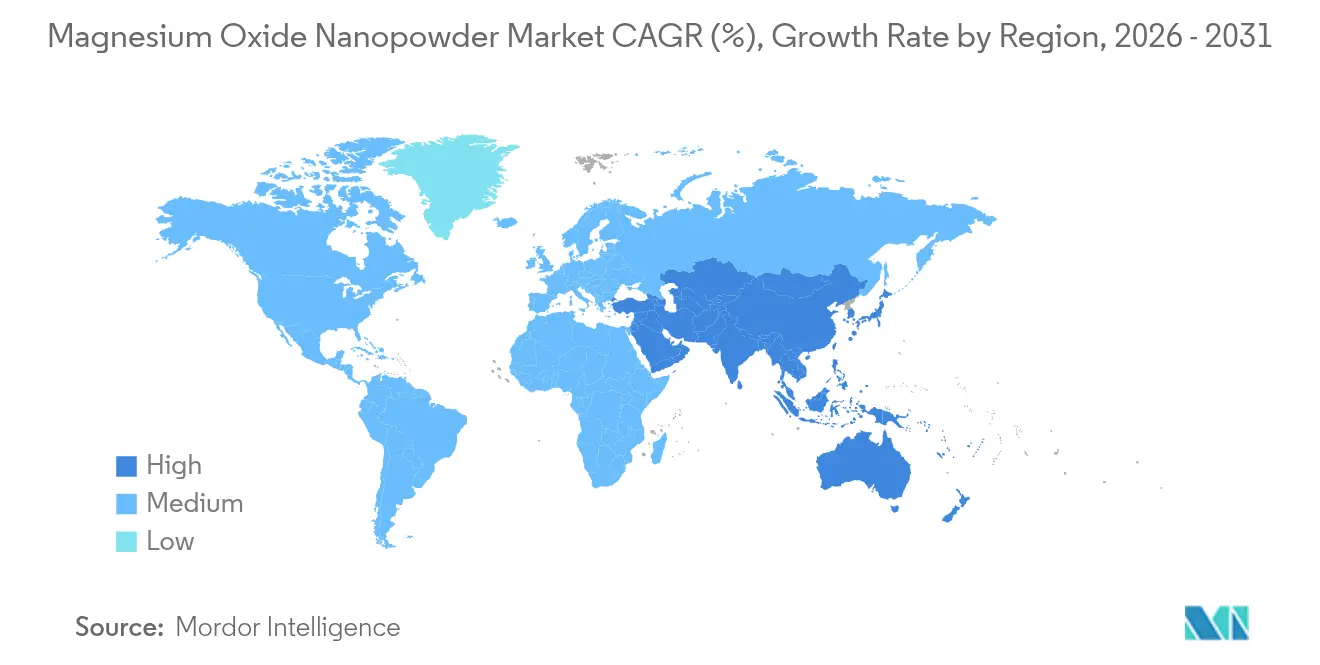
Asia-Pacific owned 51.72% of 2025 revenue in the magnesium oxide nanopowder market and is forecast to advance at an 8.55% CAGR through 2031, underpinned by integrated supply chains, cost-advantaged feedstock and dense clusters of steel, electronics and battery manufacturers. China anchors regional demand, yet Japan’s ceramics expertise and South Korea’s semiconductor ecosystem provide incremental pull for ultra-high-purity grades. Government stimulus aimed at energy-transition hardware drives additional volume in electric-vehicle thermal management and solid-state battery pilot lines.
North America Magnesium Oxide Nanopowder Market
North America is a smaller but technologically rich arena in which aerospace, defence and advanced power electronics consume high-spec powders. The United States requisitioned domestic supply security measures, and start-ups such as Magrathea are piloting carbon-neutral magnesium extraction from seawater, which could de-risk feedstock procurement and reinforce local value chains by the late 2020s. Canada’s critical-minerals strategy includes grants that lower capital hurdles for nanopowder finishing lines, potentially repositioning the region as an exporter of specialty grades rather than an importer.
Europe Magnesium Oxide Nanopowder Market
Europe maintains steady growth as building codes tighten flame-retardancy thresholds and automakers adopt magnesium-rich e-mobility components. Germany leads consumption due to its automotive and chemical base, whereas the United Kingdom taps aerospace and defence projects requiring high-temperature insulation. EU circular-economy regulations encourage mineral-based fire-retardant fillers over halogenated alternatives, offering regulatory tailwinds for magnesium oxide nanopowder market expansion. The bloc’s energy-strategy directives also channel funds into solid-state battery consortia where MgO plays a critical interface role.

Regulatory Landscape
Regulation for magnesium oxide nanopowder is increasingly handled through broader frameworks for manufactured nanomaterials, with emphasis on nanoform-specific characterization, exposure control, and hazard communication. In the European Union, REACH (Regulation (EC) No 1907/2006) requires registration and chemical safety assessment for nanoforms of substances manufactured or imported above 1 tonne per year, and the explicit REACH nanoform information requirements (in force since January 2020 under Commission Regulation (EU) 2018/1881) push suppliers to document particle-size distribution, morphology, surface treatment, and related nano-specific endpoints.
In Canada, Health Canada published a Framework for the Risk Assessment of Manufactured Nanomaterials under the Canadian Environmental Protection Act, 1999 (March 2026), reinforcing the need for consistent identification, characterization, and risk assessment for engineered nanoforms in commerce. Across regions, tighter workplace exposure expectations for engineered nanomaterials increase the compliance premium for producers and distributors that can provide verified specifications, safety documentation, and traceable quality systems for ultra-fine MgO grades.
Value Chain Analysis
The value chain starts with upstream magnesia supply (mined and processed magnesia and related precursors) and moves through nanopowder synthesis, purification, packaging, distribution, and application-specific formulation. Upstream feedstock security and purity are central differentiators, with integrated suppliers such as Premier Magnesia operating mining and processing assets (Gabbs, Nevada) that can support consistent high-purity precursor streams. Midstream production converts precursors into MgO nanopowder using physical methods (for higher-throughput grades) and bottom-up chemistries such as co-precipitation, sol-gel, hydrothermal, and combustion synthesis, which offer tighter control over stoichiometry and nanoform characteristics for advanced applications.
Downstream, nanopowder is sold directly to refractory and metallurgy users, or routed through compounders and formulators into electric-insulation systems, polymer flame-retardant compounds, catalysts, and fuel-additive dispersions. Specialized logistics and handling (vacuum-sealed containers, sealed pails or drums, and contamination-controlled packaging for higher-purity grades) help protect delivered quality, while value-added steps such as surface functionalization and ready-to-use dispersions reduce agglomeration and limit customer-side processing burden. Commercial activity spans branded specialty suppliers and catalog distributors, including American Elements, SkySpring Nanomaterials, SAT NANO, AD-NANO Technologies, and MilliporeSigma, alongside regional processors supplying refractory-oriented grades.
Competitive Landscape
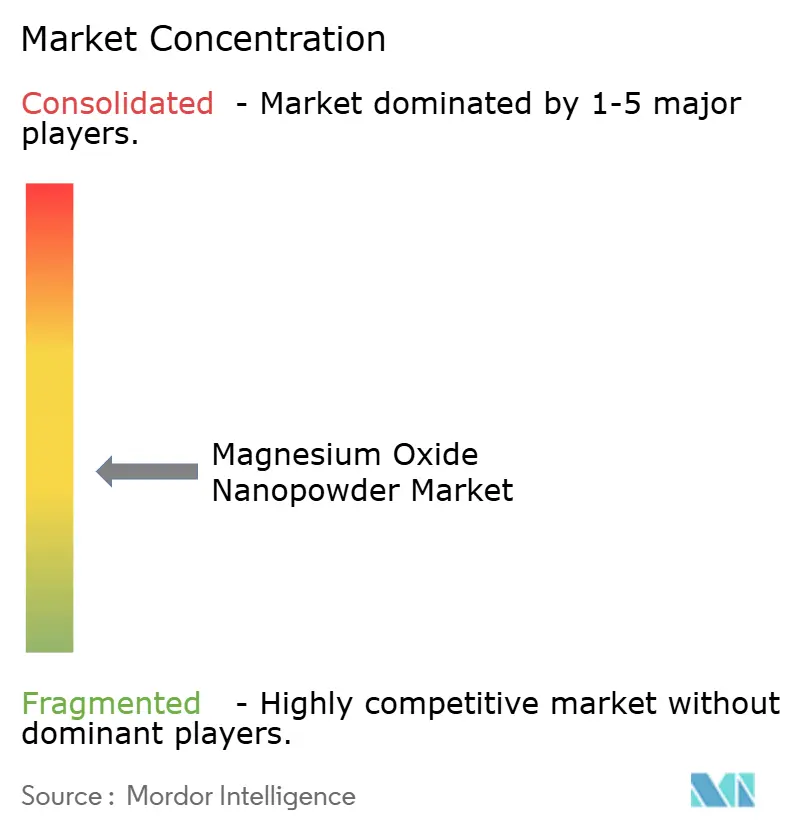
Competitive intensity is moderate because high-purity nanomaterial production requires specialised reactors, controlled atmospheres and robust quality-assurance frameworks that act as entry barriers. American Elements, Nanoshel, and Hongwu International anchor the premium tier, leveraging vertical integration from feedstock to custom dispersions. Mid-tier players in China supply refractory and fuel-additive grades at scale, and some are moving up the value chain by licensing precipitation patents from academic institutes.
Technology leadership rests on process know-how that narrows particle-size distribution below 30 nm with tight control over agglomeration. Producers have introduced surface-functionalised powders bearing silane or phosphate groups that boost compatibility with polymer matrices, opening lucrative channels in electric-vehicle battery casings. Intellectual-property data show a rising share of filings linked to green synthesis, continuous processing and MgO-coated battery anodes, signalling strategic pivots toward energy-storage end-markets.
Collaborative models are strengthening as end-users invest in joint pilot lines to co-engineer formulations. A Japanese semiconductor maker recently signed a multi-year supply and development agreement with a US nanopowder firm focused on ultra-low-chloride MgO for GaN power devices. Similar alliances in Europe pair magnet producers with nanopowder suppliers to refine MgO intermediates for sintered Nd-Fe-B magnets, capitalising on the region’s re-shoring of permanent-magnet supply.
Magnesium Oxide Nanopowder Industry Leaders
Merck KGaA
US Research Nanomaterials
American Elements
Sigma-Aldrich (MilliporeSigma)
SkySpring Nanomaterials
- *Disclaimer: Major Players sorted in no particular order
Magnesium Oxide Nanopowder Market Companies Covered in this Report
- Alfa Aesar (Thermo Fisher)
- American Elements
- Ascensus
- Grecian Magnesite
- High Purity Laboratory Chemicals Pvt. Ltd.
- Hongwu International Group Ltd
- Inframat Advanced Materials
- Martin Marietta Magnesia Specialties
- Merck KGaA
- Nanografi Advanced Materials.
- Nanoshel LLC
- Nanostructured & Amorphous Materials, Inc.
- Platonic Nanotech
- Sigma-Aldrich (MilliporeSigma)
- SkySpring Nanomaterials, Inc.
- Tateho Chemical Industries Co.,Ltd.
- US Research Nanomaterials, Inc.

Market Opportunities and Future Outlook
Opportunities are most visible in higher-value MgO nanopowder formats where customers pay for reproducible nanoform control rather than bulk volume, particularly in electrical insulation fillers, polymer flame-retardant systems, fuel-additive dispersions, and early-stage solid-state battery interface materials. The market has a clear whitespace in scaling consistent, application-ready forms, including surface-treated powders and stable dispersions that reduce agglomeration and simplify integration into resins, polyolefins, and liquid fuel additive packages. This direction aligns with the reported shift from legacy refractory demand toward advanced composites and energy-related use cases.
Control over upstream inputs and logistics also supports new supply configurations. Premier Magnesia (Nevada) illustrates how domestic, mine-to-chemical operations can improve precursor quality assurance and continuity for North American specialty producers, while producers positioned near export infrastructure such as Pak-Magnesia (near the Port of Karachi) point to how port proximity can streamline cross-border magnesia-based shipments and shorten lead times for international buyers. These supply-side structures align with buyer requirements that increasingly link powder qualification to documented nanoform characterization and traceable quality systems under frameworks such as EU REACH nanoform requirements and Health Canada guidance for manufactured nanomaterials.
Recent Industry Developments in Magnesium Oxide Nanopowder Market
- July 2026: SAT NANO highlighted broader industrial adoption pathways for magnesium oxide nanopowder across advanced applications, emphasizing performance attributes that drive selection in higher-spec use cases. The communication reinforces supplier focus on positioning MgO nanopowder beyond commodity refractory roles and into formulation-led demand where dispersion quality and specification control influence purchasing decisions.
- October 2024: The US Environmental Protection Agency updated 40 CFR 721 to introduce new significant-use restrictions and require respirators when handling magnesium oxide nanopowder. The change elevates compliance requirements for US supply chains, tightening expectations around workplace controls, customer documentation, and downstream user stewardship.
- February 2024: The University of Texas at Austin published updated safety guidelines for working with nanomaterials, including handling practices and exposure monitoring relevant to magnesium oxide nanopowder. Such institutional protocols shape lab and pilot-line procurement behavior by increasing scrutiny on supplier-provided safety data, packaging integrity, and guidance for safe use.


Magnesium Oxide Nanopowder Market Report Scope and Research Methodology
Market Definition and Coverage
This market covers revenue generated from magnesium oxide (MgO) nanopowder that is produced and sold for downstream use across industrial and advanced-material applications, where the material is purchased based on nano-scale performance needs.
Scope exclusions: Micron-sized MgO powders and bulk magnesium oxide used as a general-purpose commodity input are excluded.
Segments Covered in This Report
- By Application
- Refractory Materials
- Electric Insulation
- Fuel Additive
- Fire Retardent
- Magnetic Devices
- Others (Catalysts & Adsorbents,Biomedical, etc.)
- By Synthesis Method
- Physical Methods
- Chemical Precipitation
- Green/Bio-based Synthesis
- By End-user Industry
- Metallurgy
- Construction
- Oil & Gas
- Automotive
- Electrical & Electronics
- Other End-user Industries (Chemical & Petrochemical,Healthcare & Pharmaceuticals, etc.)
- By Geography (Value)
- Asia-Pacific
- China
- Japan
- India
- South Korea
- ASEAN Countries
- Rest of Asia-Pacific
- North America
- United States
- Canada
- Mexico
- Europe
- Germany
- United Kingdom
- France
- Italy
- Spain
- Russia
- NORDIC Countries
- Rest of Europe
- South America
- Brazil
- Argentina
- Rest of South America
- Middle-East and Africa
- Saudi Arabia
- South Africa
- Rest of Middle-East and Africa
- Asia-Pacific
Data Sources, Market Sizing, and Validation
Desk Research
For the model starting point, we rely on public references that explain how MgO is produced, traded, and consumed, then narrow the view to nano-grade use cases where particle-size and performance specifications are part of procurement.
Common inputs include USGS mineral statistics, UN Comtrade trade flows, national customs and tariff schedules, and occupational exposure guidance published by agencies such as OSHA and NIOSH. We also review peer-reviewed journal articles on nano metal oxides (synthesis routes, typical purity ranges, and application performance requirements) so the market definition stays aligned with what is actually manufactured and specified.
On the commercial side, the desk phase is supported with company annual reports, investor decks, product catalogs, and reputable press coverage to capture announced capacity moves and end-use demand signals. Where needed, paid subscriptions for company financials and intelligence, patent databases, and an import-export shipment-level database are used to cross-check activity in specialty powders. The sources listed here are not exhaustive, and many other public and paid references are used for data collection, validation, and clarification.
Primary Interviews and Surveys
Primary work is used to convert desk assumptions into inputs that reflect buyer language, especially what buyers mean by nano-grade MgO, typical order sizes, and how pricing changes with purity and particle size. Interviews cover manufacturers, distributors, and downstream users in major consuming regions, so gaps in trade data and product labeling can be corrected using real procurement terms.
Respondent feedback is also used to validate application splits, adoption timing, and realistic substitution limits versus other nano oxides.
Distribution of primary research fieldwork respondents
| Company type | Respondent position | Region |
|---|---|---|
| Top tier: 25% | CXOs: 13% | APAC: 38% |
| Mid tier: 58% | Functional/Unit leaders: 39% | EMEA: 36% |
| Smaller Players: 17% | Managers: 48% | Americas: 26% |
Market-Sizing & Forecasting
Sizing is built using a top-down and bottom-up combination. The top-down side starts from nano metal oxide demand pools and then reconstructs MgO nanopowder share using application-level penetration rates and specification checks.
To keep estimates grounded, totals are corroborated with selective bottom-up approximations, including sampled supplier revenue signals, distributor channel checks, and an ASP x volume build for a limited set of commonly traded purity and particle-size bands.
Key inputs that shape the model include purity mix trends (for example, 99% versus higher-purity grades), synthesis method split (chemical precipitation versus physical and green routes), and application indicators such as refractory additive usage, polymer flame-retardant demand, and electronics and insulation material activity. Regional trade signals for magnesium compounds, regulatory and workplace handling requirements that affect adoption costs, and observed price ranges for nano powders are also incorporated to keep the outputs consistent with market behavior. For forecasting, scenario analysis is applied and then anchored to expert expectations on adoption speed in electronics, construction ceramics, and specialty coatings, with explicit handling of data gaps by using conservative ranges that are tightened during callbacks.
Data Validation & Update Cycle
Model outputs are checked against independent signals, including regional demand proxies, trade movements for related magnesium compounds, and the implied price-volume relationship by grade. When a variance becomes too wide, the underlying drivers are re-checked, unit conversions and currency timing are reviewed, and select respondents are re-contacted to confirm whether the shift reflects a real change or a definitional mismatch.
Before sign-off, the work goes through multiple analyst reviews so outliers in assumptions, growth rates, and regional splits can be challenged and corrected. The report is refreshed annually, and interim updates are added when material events occur, such as capacity changes, policy shifts, or major end-use slowdowns. Right before delivery, a final pass is completed so clients receive the most current view available.
Mordor Intelligence's Magnesium Oxide Nanopowder Market Size Compared With Other Published Estimates
Published numbers for magnesium oxide nanopowder often do not match because studies draw the line differently on what counts as nano-grade material, which end uses are counted, and which year is treated as the current market point. Differences also come from how prices are normalized across regions and how quickly assumptions are updated when demand signals move.
Bulk and micron-sized magnesium oxide used for conventional refractory or construction inputs sits outside Mordor Intelligence's scope, which is a key reason our 2026 value looks far lower than figures that blend nano powders with broader MgO markets. Some published estimates also rely on aggressive adoption curves for advanced electronics and coatings without enough checks on feasible production volumes, and then apply uniform global ASP escalation even when grade mix changes by region.
Benchmark comparison
| Source | Market Size | Gaps in Research Methodology |
|---|---|---|
| Mordor Intelligence | USD 59.35 M (2026) | |
| Global Consultancy A | USD 441.00 M (2025) | Appears to count a wider material set by purity and applications, and the much larger starting value suggests inclusion of non-nano MgO or broader magnesium oxide powder revenue that is not strictly tied to nano-grade specifications. |
| Industry Publisher B | USD 408.00 M (2024) | Uses revenue and volume framing with broad particle-size buckets, which can overstate nano-only demand if sub-100 nm categories are mixed with fine powders that are sold and priced differently across regions. |
Taken together, the spread is mainly explained by product-definition tightness and how each study converts grade and size mix into an average selling price. Our method stays traceable because totals are built from clear demand indicators and then stress-tested with supplier and channel checks, so the final number can be repeated and updated without relying on one oversized assumption.


Key Questions Answered in the Report
What factors drive the rapid growth of the magnesium oxide nanopowder market?
Stringent emissions rules, rising demand for halogen-free flame-retardant polymers, and progress in solid-state batteries are pushing the market toward an 7.96% CAGR through 2031.
How large is the magnesium oxide nanopowder market today?
The market size is USD 59.35 million in 2026 and is expected to climb to USD 87.14 million by 2031.
Which application segment is growing the fastest?
Fuel additives exhibit the highest growth rate at 8.63% CAGR owing to vehicle-emissions legislation that favors combustion-efficiency enhancers.
Why does Asia-Pacific dominate the market?
The region combines abundant magnesium feedstock, integrated electronics and automotive manufacturing hubs, and strong policy support for new-energy technologies, resulting in 51.72% revenue share in 2025.
What challenges could slow market expansion?
High production costs, nanoparticle agglomeration, stricter workplace-safety regulations and dependence on Chinese magnesium feedstock weigh on growth potential even as demand rises globally.
Page last updated on:


 Your data is secure and never sold or shared.


