
Market Overview
| Study Period | 2020 - 2031 |
|---|---|
| Forecast Data Period | 2026 - 2031 |
| Base Year Market Size (2025) | USD 12.03 Billion |
| Market Size (2026) | USD 12.54 Billion |
| Market Size (2031) | USD 15.39 Billion |
| Growth Rate (2026 - 2031) | 4.20 % |
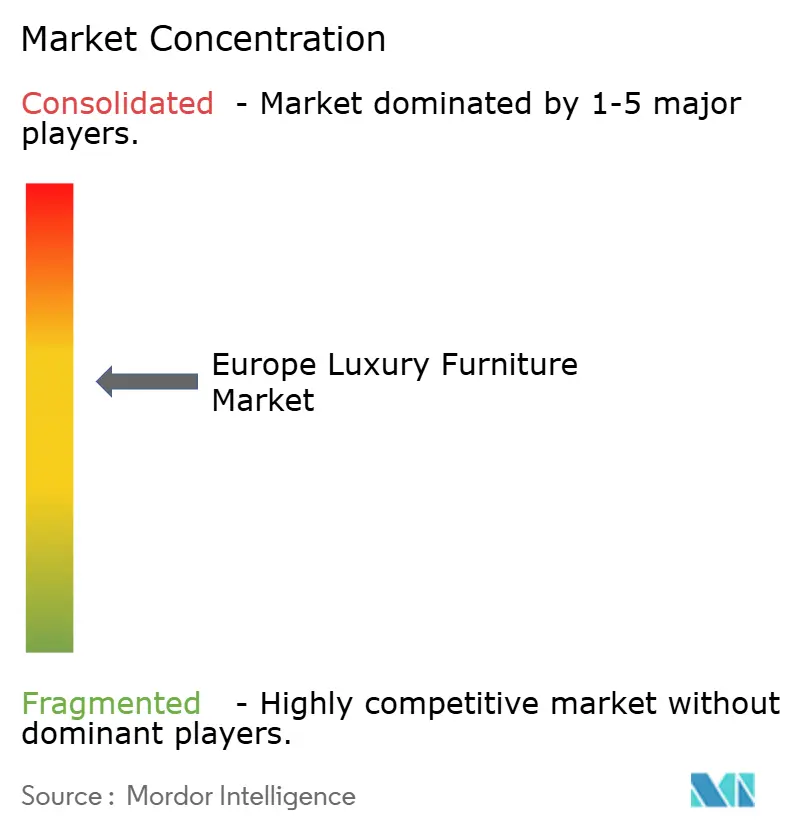
| Market Concentration | Medium |
Major Players *Disclaimer: Major Players sorted in no particular order Image © Mordor Intelligence. Reuse requires attribution under CC BY 4.0. | |
Europe Luxury Furniture Market Analysis by Mordor Intelligence
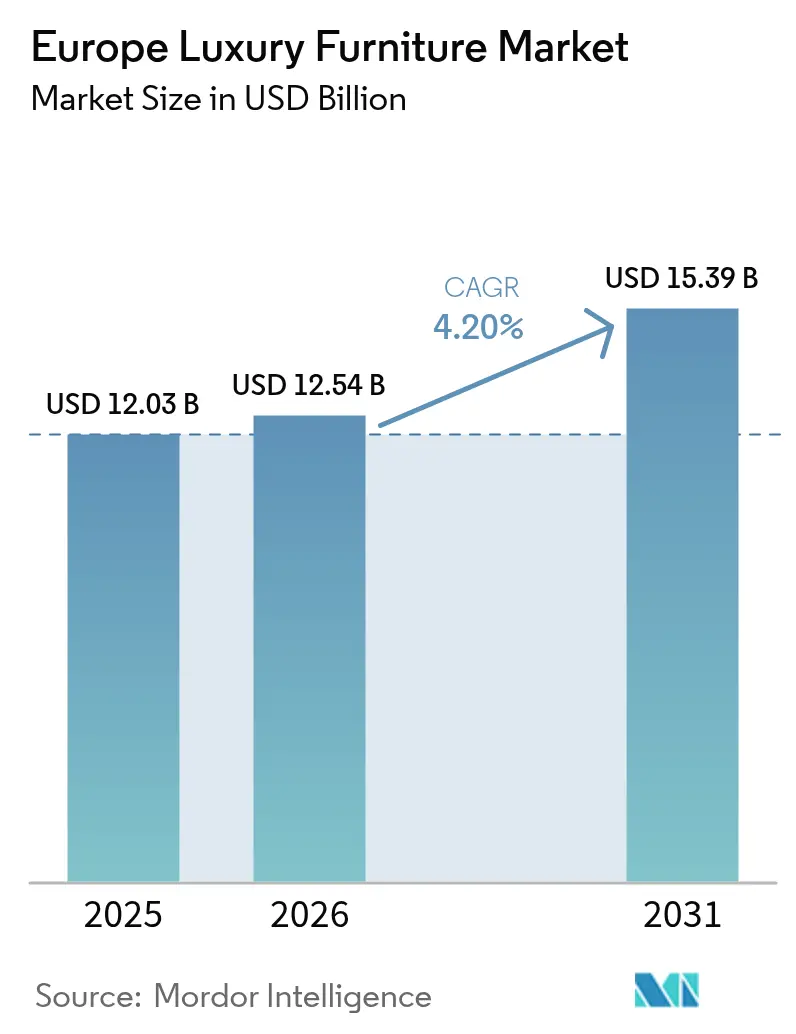
Europe luxury furniture market size in 2026 is estimated at USD 12.54 billion, growing from 2025 value of USD 12.03 billion with 2031 projections showing USD 15.39 billion, growing at 4.2% CAGR over 2026-2031. The market’s expansion is steered by affluent millennials’ growing purchasing power, a durable “home-as-sanctuary” mindset, and continuing migration of high-net-worth individuals into EU capitals[1]Henley & Partners, “WEXIT: Wealthy Brits Exit UK for EU Ahead of Budget,” henleyglobal.com. Robust digital engagement underpinned by 3D configurators, virtual showrooms, and white-glove delivery shortens the consideration cycle for five- and six-figure purchases, stimulating incremental revenue across the luxury furniture market. At the same time, the EU Deforestation Regulation and related due diligence rules push suppliers toward certified inputs, giving first-movers with transparent sourcing a defensible edge. Competitive dynamics remain moderately fragmented; yet merger activity such as Design Holding’s consolidation of Flos and B&B Italia manifests an unmistakable gravitation toward larger portfolios capable of financing omnichannel infrastructure and compliance systems. Key demand clusters remain concentrated in Germany, France, and Italy, but Spain delivers the fastest trajectory as tourism and second-home acquisitions rebound. Opportunistic strategies that fuse circular-economy models with understated “quiet luxury” aesthetics position brands to defend margins and loyalty amid rising operational complexity.
Key Report Takeaways
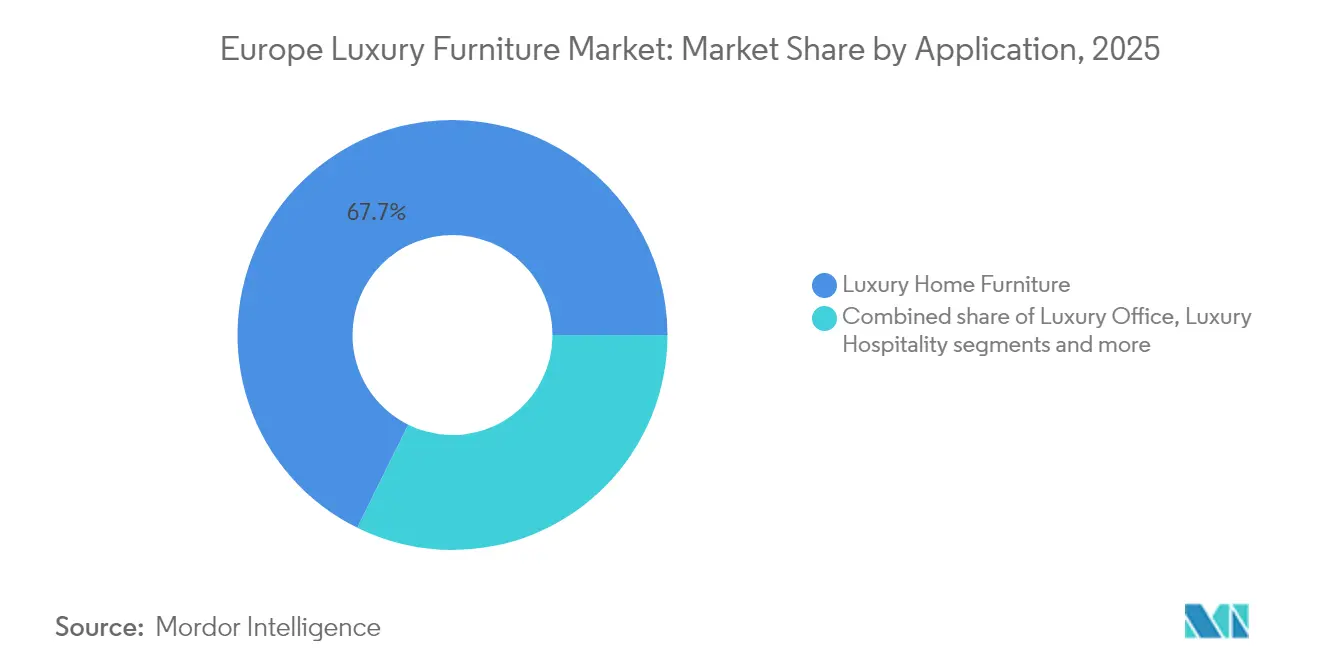
- By application, luxury home furniture held 67.70% of the Europe luxury furniture market share in 2025, while hospitality furniture is projected to advance at a 5.46% CAGR through 2031.
- By material, wood commanded a 42.75% share of the Europe luxury furniture market size in 2025; sustainable and green materials are expected to expand at a 5.85% CAGR between 2026-2031.
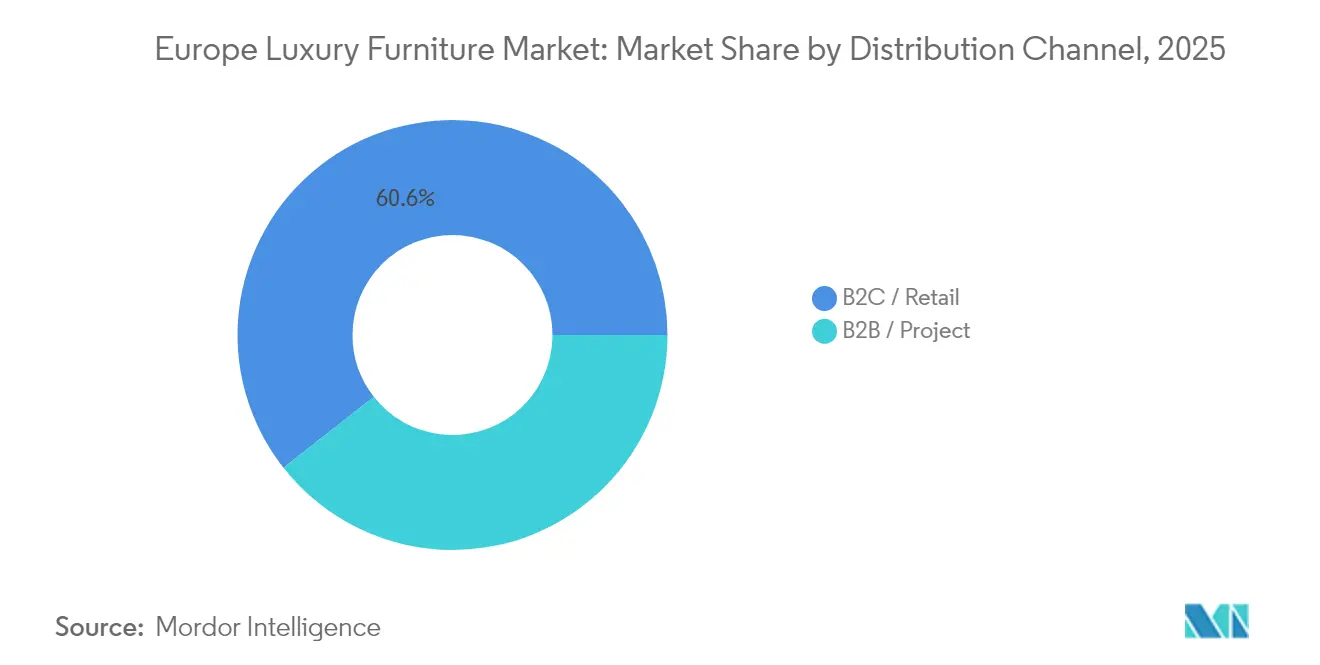
- By distribution channel, B2C retail captured 60.60% share of the Europe luxury furniture market size in 2025 and is set to grow at a 6.10% CAGR to 2031.
- By geography, Germany led with 27.55% revenue share in 2025, whereas Spain is expected to achieve the fastest 5.05% CAGR through 2031.
Note: Market size and forecast figures in this report are generated using Mordor Intelligence’s proprietary estimation framework, updated with the latest available data and insights as of 2026.
Europe Luxury Furniture Market Trends and Insights
Drivers Impact Analysis*
| Driver | (~) % Impact on CAGR Forecast | Geographic Relevance | Impact Timeline |
|---|---|---|---|
| Rising disposable income of affluent millennials | +0.8% | Germany, France, Netherlands, Switzerland | Medium term (2-4 years) |
| Post-pandemic “home as a sanctuary” renovation boom | +1.2% | Germany, UK, France | Short term (≤2 years) |
| Surge in high-net-worth immigration to EU capitals | +0.6% | Germany, France, Italy, Spain, Netherlands | Medium term (2-4 years) |
| Growing e-commerce adoption for high-ticket décor | +0.9% | Germany, Netherlands, Nordics | Long term (≥4 years) |
| Premium demand for “quiet luxury” artisanal pieces | +0.7% | Italy, France, Switzerland, Germany | Long term (≥4 years) |
| Circular-economy certified luxury refurbishment programs | +0.5% | EU-wide | Long term (≥4 years) |
| Source: Mordor Intelligence | |||
Rising Disposable Income of Affluent Millennials
Affluent Millennials are now entering the peak household-formation stage, lifting per-capita spending on premium sofas, modular tables, and bespoke cabinetry. Brands report that millennial clients allocate bigger shares of renovation budgets to sustainably sourced, design-led furniture that doubles as a lifestyle statement. Unlike previous generations, these buyers scrutinize transparency credentials—FSC labels, traceable leathers, and carbon disclosures—before committing. Social-media curation accelerates trend adoption as influencers present high-end living spaces, creating copycat demand across the Europe luxury furniture market. Retail conversion data indicate millennials drive more than one-third of omnichannel revenue, validating investments in AR-powered configurators and virtual consultations. This cohort also exhibits higher tolerance for extended lead times if craftsmanship stories resonate, offering cushion to artisans managing limited production runs.
Post-Pandemic “Home as a Sanctuary” Renovation Boom
Remote-work norms remain sticky, anchoring incremental expenditure on home offices, outdoor lounges, and wellness-focused bedroom suites. Consumers channel vacation savings into high-spec renovations, a behavior that persists even after travel restrictions are eased. European builders report that turnkey packages frequently incorporate premium Italian or Spanish furniture brands, boosting factory order backlogs. Secondary markets emerge in countryside estates and alpine chalets, widening the geographic dispersion of demand within the Europe luxury furniture market. Hospitality developers replicate residential aesthetics to justify higher ADR, funneling contract orders toward bespoke pieces. Suppliers hedge renovation-cycle risk by offering modular collections that facilitate later reconfiguration without full replacement, sustaining revenue through accessory sales.
Surge in High-Net-Worth Immigration to EU Capitals
An estimated 9,500 UK-based millionaires plan relocation to EU hubs such as Paris, Milan, and Madrid in 2024, shifting immediate furnishing budgets exceeding USD 300,000 per household. Luxury retailers respond with concierge design teams capable of delivering fully staged properties within 45 days. Interior architects prefer established European brands for rapid compliance with local fire-safety and sustainability codes, enhancing domestic manufacturers’ pipeline visibility. Banking advisers bundle relocation finance with furniture procurement services, embedding convenience and driving volume. This inflow of liquid wealth stabilizes top-line growth even when domestic sentiment softens, buffering cyclical volatility in the Europe luxury furniture market. The trend’s durability hinges on competitive tax regimes; however, Switzerland’s population passing 9 million suggests continued attractiveness of EU residency [2]The Federal Council, “Swiss Resident Population Exceeds 9 Million in 2024,” admin.ch.
Growing E-Commerce Adoption for High-Ticket Décor
Seamless integration of 8K visualization, AI-driven style advisors, and blockchain-verified authenticity is normalizing online purchases above USD 20,000. German platforms record cart-to-checkout rates surpassing 12% when live chat with certified interior designers is available. Hybrid service models deliver physical fabric swatches within 24 hours, countering tactile hesitations without undermining digital convenience. White-glove providers guarantee two-person delivery, assembly, and debris removal, converting logistics into a brand experience that fuels positive reviews [3]Ryder System, “White Glove Delivery,” ryder.com. Data analytics guide localized warehousing to curb last-mile emissions and costs, aligning with ESG mandates. Over time, online performance marketing outpaces print catalog ROI, further tipping budget allocation toward digital in the Europe luxury furniture market.
Restraints Impact Analysis*
| Restraint | (~) % Impact on CAGR Forecast | Geographic Relevance | Impact Timeline |
|---|---|---|---|
| Volatile hardwood & leather input costs | -0.9% | Germany, Italy, France | Short term (≤2 years) |
| Counterfeit designer furniture online | -0.4% | EU-wide | Medium term (2-4 years) |
| Luxury-tax expansion in Southern Europe | -0.6% | Spain, Italy, France | Medium term (2-4 years) |
| High last-mile white-glove logistics costs | -0.7% | Global | Long term (≥4 years) |
| Source: Mordor Intelligence | |||
Volatile Hardwood & Leather Input Costs
Market prices for American walnut and European oak jumped 18-24% YOY in 2024 amid supply bottlenecks and phytosanitary restrictions. Italian tanneries also faced bovine-hide shortages, intensifying cost pressure across upholstered categories. Contract pricing lags impede immediate pass-through, eroding EBIT margins by up to 300 basis points for mid-sized manufacturers. Some brands forward-purchase FSC-certified logs and store them for seasoning, but carrying costs strain balance sheets. Alternative materials, engineered veneers, lab-grown leather mitigate exposure yet require investment and consumer education. Elevated costs influence SKU rationalization, nudging makers to trim fringe colorways and focus on volume drivers within the Europe luxury furniture market.
Luxury-Tax Expansion in Southern Europe
Fiscal pressures spur Spain and Italy to contemplate broader luxury levies, including higher transfer taxes on prime real estate and potential surcharges on premium interiors[4]Livingstone Estates, “Spain Property Tax Could Impact Non-EU Buyers in 2025,” livingstone-estates.com. Early drafts exempt sustainable products, but uncertainty already delays some overseas purchases. Developers hedge by bundling furniture into overall property pricing, seeking to reduce separate tax exposure. Luxury brands intensify outreach in tax-neutral hubs such as Monaco and Andorra, redistributing marketing spend. A two-tier demand profile emerges: domestic buyers postpone, while foreign ultra-high-net-worth individuals absorb extra cost. Policy clarity will shape whether near-term softness morphs into structural restraint for the Europe luxury furniture market.
*Our forecasts treat driver/restraint impacts as directional, not additive. The impact forecasts reflect baseline growth, mix effects, and variable interactions.
Segment Analysis
By Application: Residential Dominance and Hospitality Tailwind
Europe's luxury furniture market size for home application stood at USD 8.14 billion in 2025, equal to 67.70% share, driven by persistent home-improvement cycles. Living-room seating commands the highest value, buoyed by modular sectional designs that accommodate flexible layouts. Dining sets featuring extendable mechanisms satisfy hybrid entertainment preferences, while premium wardrobes integrate IoT humidity control to protect couture garments. Luxury kitchen cabinetry shows 14% YOY growth as cooking remains a lifestyle hobby among affluent households. Importantly, resale values of branded pieces sustain high upgrade frequency; auction data reveal some limited-edition sofas retain 85% of original retail after five years, strengthening perception of furniture as a capital asset inside the Europe luxury furniture market.
Hospitality furniture is projected to grow at a 5.46% CAGR, widening its 2025 base of USD 1.34 billion as RevPAR in Europe capitals rebounds and pipeline additions accelerate. Operators of boutique hotels demand residential-grade comfort, commissioning bespoke headboards, marble-clad nightstands, and sustainably sourced lounge chairs to differentiate. Procurement cycles compress as design-and-build firms rely on digital libraries for faster approval, favoring suppliers with robust BIM resources. Restoration projects, such as The Dylan Amsterdam’s phased upgrade, illustrate multi-year revenue streams where suppliers refresh suites in rotations, ensuring steady order visibility. Cruise-ship refurbishment and luxury senior living complexes add adjacency opportunities, further diversifying the Europe luxury furniture market.



By Material: Wood Heritage and Sustainable Innovation
Wood retained 42.75% of Europe's luxury furniture market share in 2025, underpinned by continental reverence for natural patina and tactile warmth. German studios highlight end-grain joinery and hand-rubbed oil finishes that accentuate walnut grain, communications that resonate with collectors. Scandinavian brands popularize ash and birch variants treated with water-based lacquers, appealing to eco-minded buyers. Supply-chain transparency—chain-of-custody certificates, GPS-tagged logging sites—now features prominently in marketing collateral, turning compliance into storytelling. Cross-material integrations—wood with brushed brass caps or smoked-glass inlays—extend design vocabulary, sustaining relevance across style cycles.
Sustainable and green materials, though only 9.95% share, pursue a 5.85% CAGR led by recycled plastics and plant-based resins in structural frames. Mater’s “Waste Craft” collection transforms industrial offcuts into terrazzo-style table surfaces that meet scratch-resistance specs while reducing embodied carbon by 30%. Bio-leather derived from mycelium gains traction for headboards and wall panels after passing flammability tests. Circular composites allow disassembly at the component level, facilitating end-of-life recycling and aligning with EU Ecodesign rules effective 2027. Early adoption unlocks BREEAM credits, positioning products for commercial projects seeking green-building certification and propelling volume within the Europe luxury furniture market.
By Distribution Channel: Omnichannel Retail Supremacy
B2C retail captured 60.60% of the Europe luxury furniture market size in 2025, reflecting consumer preference for brand-controlled experiences. Flagship stores now incorporate maker studios where artisans demonstrate joinery or leather tooling, deepening shopper immersion. Digital augmentation—handheld tablets offering AR placement views—shortens decision cycles on the showroom floor. Brands monetize data from loyalty apps to push personalized after-sales offers such as care-kit subscriptions and matching accessories. High-street rents in Tier 1 cities remain elevated, but incremental revenue from experiential events recoups costs, displaying the resilience of brick-and-mortar in an omnichannel paradigm.
E-commerce underpins the channel’s 6.10% CAGR, with average order values above USD 7,500 on desktop and USD 5,800 on mobile. Return rates stay below 2% due to accurate dimensional visualizations, far outperforming mass-furniture averages. Retailers pilot remote virtual-reality trunk shows that stream directly from Milan Design Week, letting VIP clients book limited editions instantly. Project-based B2B remains relevant; hospitality buyers value factory tours and prototyping labs that reassure on durability standards. Yet B2B digital portals emerge, allowing architects to configure volume orders and track production milestones, a capability that promises future share gains in the Europe luxury furniture market.
Geography Analysis
Germany held 27.55% of Europe's luxury furniture market share in 2025. The market benefits from robust household wealth median net assets exceeding USD 250,000, and cultural appreciation of engineered craftsmanship. Domestic manufacturers exploit Industry 4.0 facilities that enable mass-customization without compromising artisanal detailing, shortening lead times to six weeks versus the nine-week European average. Federal subsidies for energy-efficient refurbishments further stimulate premium window seats, built-in libraries, and custom cabinetry demand. ESG-driven consumers reward brands that publish life-cycle assessments, evidenced by a 20% sales uplift for ranges carrying PEFC certifications.
France also holds a significant position, anchored by Parisian residential refurbishments where turnkey interior packages command USD 1,000 per square foot. Luxury apartments in the Golden Triangle increasingly come pre-furnished to expedite occupancy, simplifying procurement for overseas buyers. Provincial châteaux conversions into boutique hotels spur contract orders for reproduction Louis XVI case goods blended with contemporary upholstery. The French luxury furniture sector leverages fashion-house adjacency Hermès, Dior to co-launch home lines, creating cross-category halo effects within the Europe luxury furniture market.
Italy effortlessly marries heritage ateliers with design-led industrial producers concentrated in Brianza and Veneto. Milan Design Week 2025 drew record footfall, with export orders up 11% YOY as international specifiers sought authentic “Made in Italy” provenance. Tax incentives on energy-efficient home upgrades and a cultural predisposition for family heirlooms to buy domestic demand. Italian firms double down on vertical integration from sawmills to showrooms, insulating margins against raw-material volatility. Partnerships with automotive marque Maserati underscore lifestyle convergence that propagates Italian influence across the Europe luxury furniture market.
Spain rises fastest and is projected to post a 5.05% CAGR to 2031. Luxury coastal developments in Marbella and Ibiza specify turnkey interiors before title transfer, accelerating demand bursts. Proposed 100% property taxes on non-EU buyers triggered lobbying that led to moderated thresholds, reducing immediate risk yet leaving investors cautious. Still, robust tourism recovery, foreign arrivals surpassed 93 million in 2024, drives hospitality refurbishments that prioritize locally sourced, sustainable timber to meet Balearic environmental mandates. Catalonian upholstery clusters capitalize on shorter lead times to service both domestic and French buyers, reinforcing Spain’s strategic role inside the Europe luxury furniture market.
Value Chain Analysis
Europe's luxury furniture value chain begins with premium inputs, including FSC/PEFC-certified hardwoods, specialty veneers, metals, glass, and high-grade hides sourced from established tanning clusters, before moving into design development and prototyping led by brand studios and contract specifiers. Production relies on both vertically integrated groups and a dense network of specialist workshops handling joinery, upholstery, finishing, and metalwork, with concentrated supplier ecosystems across Italy's heritage districts. With high customization and low tolerance for defects, upstream variability in hardwood and leather availability is a practical bottleneck, which pushes brands toward long-term sourcing agreements and selected backward integration.
On the downstream side, luxury brands sell through directly operated mono-brand flagships, shop-in-shop placements, and project business for hospitality and premium residential developers. White-glove logistics, installation partners, and after-sales care support delivery and retention, while omnichannel tooling (3D configurators, virtual consultations, and digital libraries for architects) links demand to made-to-order capacity. As compliance and traceability requirements expand across tiers, the documentation bar rises, increasing the need for structured provenance data. Industry bodies such as EFIC have also highlighted harmonized circular-economy approaches (including EPR alignment), and the ESPR framework effective July 2024 accelerates preparation for Digital Product Passports that connect material provenance, care instructions, and end-of-life pathways to each product.
Competitive Landscape
Europe's luxury furniture market, while moderately fragmented, is witnessing a surge in consolidation, driven by both private-equity and strategic acquisitions. Design Holding’s rebranding to Flos B&B Italia Group seamlessly merges lighting and furniture, capitalizing on cross-selling opportunities and streamlining the procurement of premium metals. This strategic move has resulted in an 80 basis point reduction in material costs. Meanwhile, Minotti, Poltrona Frau, and Molteni are rolling out mono-brand flagships in global hotspots like Miami, Shanghai, and Dubai, bolstering their order pipelines and mitigating European macroeconomic risks. In a bold move, private equity firm Trilantic Europe has taken a majority stake in Sklum, aiming to expand its digitally native model beyond Spain. They have also invested in a sprawling 160,000 m² logistics hub, poised to slash shipping times by 40%.
In the digital realm, Vitra and Walter Knoll are pioneering investments in VR and NFT authentication. This innovation allows customers to register ownership on the blockchain, facilitating rights transfer during resale and acting as a deterrent against counterfeiting. Sustainability is a key focus: Mater and TAKT's cradle-to-cradle assessments are drawing in institutional buyers keen on reducing scope-3 emissions. Artisanal studios like Giorgetti are blending tradition with technology, preserving hand-finished details while adopting CNC milling for structural components. The competition is heating up in the circular niche, with refurbished lines now accounting for up to 25% of total revenue for leading brands.
Strategic partnerships are amplifying brand equity: Giorgetti collaborates with Maserati for a bespoke Grecale interior kit, and Flokk's acquisition of U.S. office-furniture maker Stylex bolsters its contract capabilities. Fashion and furniture are increasingly intertwined; Trussardi Casa, rejuvenated by Miroglio Group, is harmonizing its collections with apparel color palettes for enhanced merchandising. However, as EU regulatory compliance tightens, mandating audited chain-of-custody and CSRD reporting, smaller workshops may find the costs burdensome. It could lead to a market shake-out, potentially elevating the concentration score of Europe's luxury furniture market over time.
Europe Luxury Furniture Industry Leaders
Roche Bobois
Poltrona Frau
B&B Italia
Minotti
Ligne Roset
- *Disclaimer: Major Players sorted in no particular order

Market Opportunities and Future Outlook
Compliance-led differentiation is creating room in verified sustainable luxury, particularly for brands that can operationalize traceability and product-level data ahead of furniture-specific ecodesign requirements under the ESPR framework (effective July 2024). The extension of EU Ecolabel furniture criteria through 31 December 2029 (EU Decision 2026/66) supports planning for labeled collections and procurement specifications, which can be a practical advantage in hospitality and institutional projects where documentation reduces buying friction. This setup also supports service layers that translate sustainability into measurable value, including take-back, refurbishment, authenticated resale, and spare-part programs built into premium SKUs.
Across leading players, capital allocation points to two active opportunity lanes: retail network upgrades and manufacturing modernization. Roche Bobois has pointed to 2026 store openings and relocations, including Aix-en-Provence, Luxembourg, and Porto, as well as moves to premium sites, reinforcing direct retail as a channel for capturing high-ticket purchases and supporting clienteling. On the supply side, Molteni Group communicated a EUR 50 million investment program for Molteni&C over five years starting in 2026, focused on digitalization, product development, and plant renewal, which supports shorter lead times, higher customization throughput, and readiness for data-rich compliance (including Digital Product Passport enablement). Restructuring can also open margin-defense opportunities through footprint optimization, as reflected in Natuzzi shifting part of low-margin Italian production to Romania while pursuing a broader 2026-2028 industrial plan.
Recent Industry Developments
- June 2026: Flos B&B Italia Group announced the sale of Danish lighting brand Louis Poulsen to Chr. Augustinus Fabrikker for an enterprise value of about USD 541 million. The divestment supports debt reduction and refocuses the portfolio, affecting how the group allocates capital across luxury design categories that overlap in both retail and specifier channels.
- October 2025: Poltrona Frau opened a new monobrand store in Beijing's Chaoyang District, bringing its total points of sale in China to 29. The expansion strengthens control over brand presentation and clienteling in a major luxury consumption hub, supporting cross-regional demand capture alongside European cyclicality.
- April 2024: Roche Bobois signed a letter of intent to acquire a 51% majority stake in Shanghai Rock Castle Furniture, its long-standing franchisee in China. Moving toward a more directly operated footprint improves pricing discipline and service consistency while also tightening execution of omnichannel delivery and after-sales standards for luxury furniture purchases.


Research Methodology Framework and Report Scope
Market Definition and Coverage
For this report, the market covers spending on luxury furniture sold and used across Europe, counted as manufacturer and brand level revenues from premium priced furniture products purchased by residential and non-residential buyers.
Scope exclusions: We exclude mass-market furniture, DIY raw materials (wood panels, fabrics, hardware), and standalone interior design or installation services when they are billed separately from furniture.
Segmentation Overview
- By Application
- Luxury Home Furniture
- Chairs and Sofas
- Tables (Side, Coffee, Dressing, etc.)
- Beds
- Wardrobes
- Dining Tables / Dining Sets
- Kitchen Cabinets
- Other Home Furniture (Bathroom, Outdoor, etc.)
- Luxury Office Furniture
- Chairs
- Tables
- Storage Cabinets
- Desks
- Sofas and Other Soft Seating
- Other Office Furniture
- Luxury Hospitality Furniture
- Other Applications (Educational, Healthcare, Retail Malls, Government Offices, etc.)
- Luxury Home Furniture
- By Material
- Wood
- Metal
- Glass
- Leather
- Plastic and Other Synthetics
- Sustainable / Green Materials
- By Distribution Channel
- B2C / Retail
- Home Centers
- Specialty Furniture Stores
- Online Flagship Store
- Other Distribution Channels
- B2B / Project
- B2C / Retail
- By Geography
- Germany
- France
- United Kingdom
- Italy
- Spain
- Netherlands
- Belgium
- Switzerland
- Nordics
- Rest of Europe
Data Sources, Market Sizing, and Validation
Desk Research
Desk research helped set the market boundaries and build the first set of inputs for Europe using public, repeatable data series. We referenced sources such as Eurostat for household consumption and construction indicators, UN Comtrade for trade flows of furniture categories, and national statistics offices for housing completions and renovation activity. To keep the product and material context grounded, we also used sources such as the European Commission for policy updates (including sustainability and due diligence topics) and customs and tariff schedules that help map product groupings.
On the supply side, we reviewed annual reports, investor presentations, and press releases of listed furniture groups to understand revenue mix cues, geography exposure, and pricing commentary. Patents and design registrations were also checked through a paid patent database to confirm innovation intensity in areas like finishes, lighting integration, and modular systems, which then supported our premiumization assumptions. Where needed, we used paid company financials and intelligence databases to standardize company revenue snapshots and ownership changes, particularly for private entities. The desk sources mentioned here are illustrative rather than exhaustive, and additional public materials were also used for data collection, validation, and clarification during the study.
Primary Interviews and Surveys
Primary work was used to pressure-test what luxury means in real buying and selling situations, and to confirm how pricing moves by product type and channel. We spoke with a mix of manufacturers, brand managers, distributors, and retailers, along with architects, hospitality procurement teams, and contract furniture specialists across major European countries to validate assumptions and fill data gaps that desk research cannot fully resolve.
Distribution of primary research fieldwork respondents
| Company type | Respondent position |
|---|---|
| Top tier: 39% | CXOs: 13% |
| Mid tier: 47% | Functional/Unit leaders: 42% |
| Smaller Players: 14% | Managers: 45% |
Market-Sizing & Forecasting
Sizing starts with a top-down build where Europe furniture demand is reconstructed through consumption and housing activity signals, then narrowed to the luxury-priced share using channel mix and premiumization indicators. To keep the model grounded, we corroborated totals with selective bottom-up approximations such as sampled brand revenue roll-ups, channel checks across flagship and specialty retail, and ASP times volume spot-checks for high-ticket categories.
Key inputs that shape the model include new housing completions and renovation intensity, the share of spending tied to affluent households and premium discretionary demand, import and export movements for furniture groupings, and observed price progression for premium materials and finishes. We also track shifts in distribution, especially the mix between flagship stores, specialty stores, and online, because it changes conversion and average ticket size. Where country coverage data was thin, gaps were handled by using peer-country ratios aligned to housing stock and income bands, followed by interview checks before finalizing.
For forecasting, we used scenario analysis with a light multivariate regression layer to connect demand to renovation cycles, consumer confidence, and price inflation signals that affect high-end purchases. The scenarios were tuned using expert feedback on lead times, contract pipeline visibility in hospitality and offices, and how quickly premium brands pass through input costs to end prices.
Data Validation & Update Cycle
Outputs are validated through triangulation across multiple independent signals, then checked for unusual jumps by country, channel, or product group before the figures are signed off. When a variance is found, analysts revisit the drivers, rerun sensitivity checks on key assumptions, and re-contact relevant interviewees if the gap cannot be explained using public indicators.
Each report is refreshed annually, and interim updates are triggered when material events occur, such as major regulatory changes, sharp pricing swings, or notable capacity and ownership moves. Before delivery, a final analyst pass is completed to ensure the model, narratives, and tables reflect the latest available information and a consistent set of assumptions.
Mordor Intelligence's Europe Luxury Furniture Market Size Compared With Other Published Estimates
Published market sizes for luxury furniture in Europe often do not match because the underlying scope is not the same, and the pricing logic can vary across channels and countries. Differences show up quickly when one estimate counts only home furniture, while another adds contract-led demand from hospitality, offices, and other non-residential settings.
The benchmark table highlights a spread that mainly comes from what is treated as luxury and how cross-border sales are handled. In Mordor Intelligence's model, the value includes luxury furniture demand across residential plus commercial use cases, while filtering out mass-market categories and excluding billed-as-a-service design work. Some published figures also apply aggressive price uplift assumptions without re-checking them against flagship and specialty store mix, and they may not refresh currency timing and inflation inputs at the same cadence.
Benchmark comparison
| Source | Market Size | Gaps in Research Methodology |
|---|---|---|
| Mordor Intelligence | USD 12.03 B (2025) | |
| Industry Association A | USD 10.90 B (2025) | Narrower coverage that mainly reflects residential luxury furnishings and tends to omit contract furniture demand tied to hospitality and offices, which reduces the addressable value pool. |
| Trade Journal B | USD 13.60 B (2025) | Broader boundary that blends premium and luxury tiers and applies faster assumed ASP uplift, often without consistent channel weighting between flagship, specialty, and online sales across countries. |
Looking across the three figures, most of the variance comes from scope and pricing mechanics rather than forecast math. By tying the estimate to clear demand signals (housing and renovation activity, channel mix, and trade movements) and validating assumptions with interviews, our number stays traceable and easier to replicate year after year.


Key Questions Answered in the Report
What is the 2026 value of the European luxury furniture market?
The market stands at USD 12.54 billion in 2026.
How fast will the European luxury furniture market grow through 2031?
It is projected to record a 4.20% CAGR, reaching USD 15.39 billion.
Which application dominates spending?
Luxury home furniture leads with 67.70% share in 2025.
Which geography grows fastest?
Spain, at a projected 5.05% CAGR between 2026-2031.
What material segment is expanding quickest?
Sustainable and green materials, set for a 5.85% CAGR.
Which channel shows top growth?
B2C retail is poised for a 6.10% CAGR as omnichannel models mature.
Page last updated on:





