
Market Overview
| Study Period | 2021 - 2031 |
|---|---|
| Forecast Data Period | 2026 - 2031 |
| Historical Data Period | 2021 - 2024 |
| Growth Rate | 0.44 % |
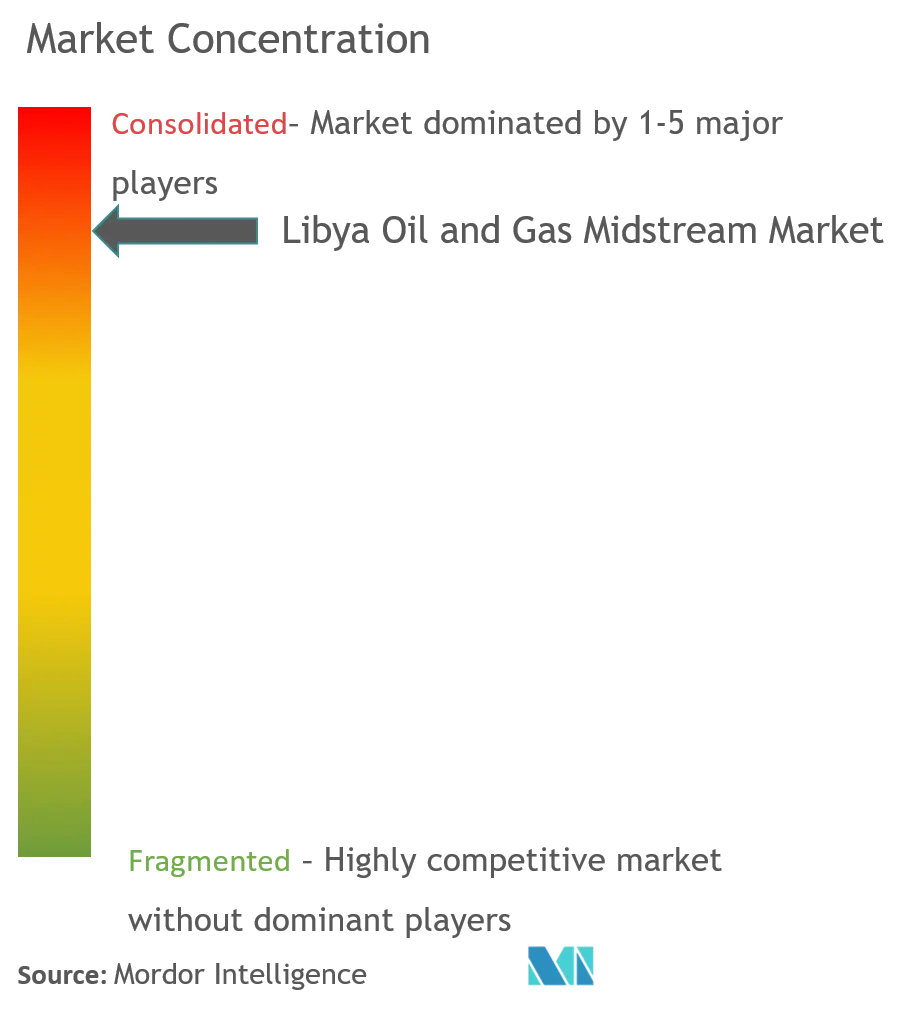
| Market Concentration | High |
Major Players *Disclaimer: Major Players sorted in no particular order Image © Mordor Intelligence. Reuse requires attribution under CC BY 4.0. | |
Libya Oil And Gas Midstream Market Analysis by Mordor Intelligence
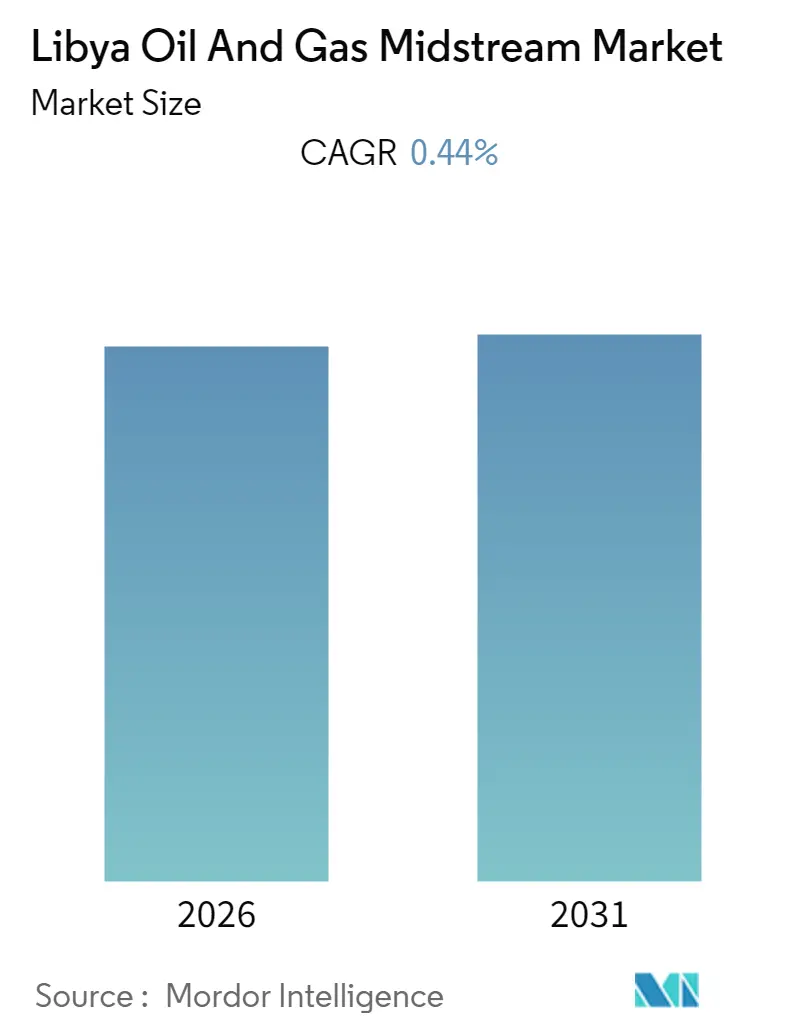
The Libya Oil and Gas Midstream Market size is expected to register a CAGR of 0.44% during the forecast period (2026-2031).
- Libya has a pipeline network that is spread all over the country. The capacity of the pipelines is expected to remain stagnant in the forecast period, due to a lack of investment in the sector.
- The growth in the oil and gas midstream sector has been severely impeded due to the ongoing civil war in the country. However, in 2019, as most of the country had come under the military coalition, the prospects of the civil war ending in the forecast period have increased. It can become an opportunity for companies in the market.
- Increase in oil and gas production is expected to be the driver for the market in the forecast period. The country has a lot of potential in the sector, as it has high quality oil and is nearer to the prosperous European countries, with high oil and gas consumption requirements.
Note: Market size and forecast figures in this report are generated using Mordor Intelligence’s proprietary estimation framework, updated with the latest available data and insights as of 2026.
Libya Oil And Gas Midstream Market Trends and Insights
Growth of the Pipeline Sector to Remain Stagnant
- The pipeline sector is quite developed in the country. Most of the pipelines connect the oil and gas fields to different parts of the country, where oil and gas can be further refined and exported. Most of the exports from the country go toward the countries in Europe.
- As of 2019, the Libya Coastal Gas Pipeline was the largest gas pipeline in the country, with a capacity of 370 million cubic feet per day. The pipeline provides natural gas in one of the densest parts of the country.
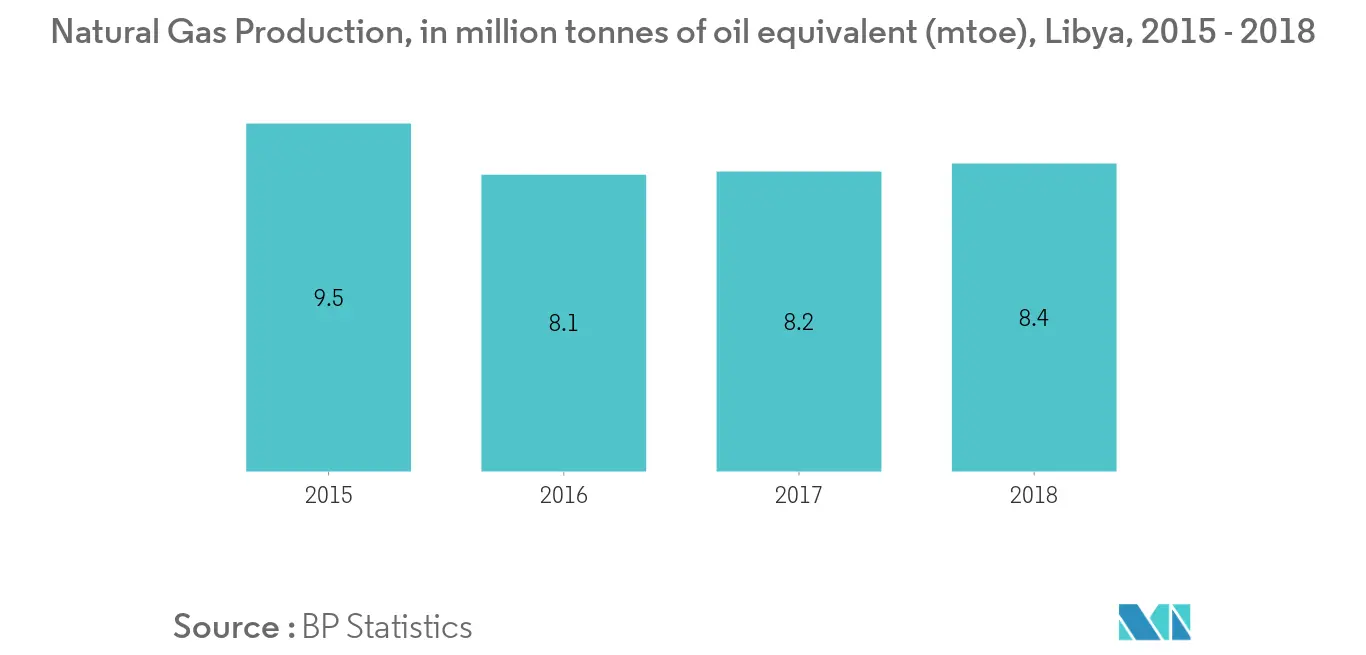
- Production of natural gas increased in the country, by 2.2%, from 8.2 million metric ton of oil equivalent in 2017 to 8.4 million metric ton of oil equivalent, in 2018. The value of petroleum exports is approximately USD 17,141 million. The increase in the production of natural gas positively affects the midstream industry.
- Hence, the growth in pipeline capacity is expected to remain stagnant in the forecast period, due to little investment in the sector.


Increasing Production of Oil and Gas to Drive the Market
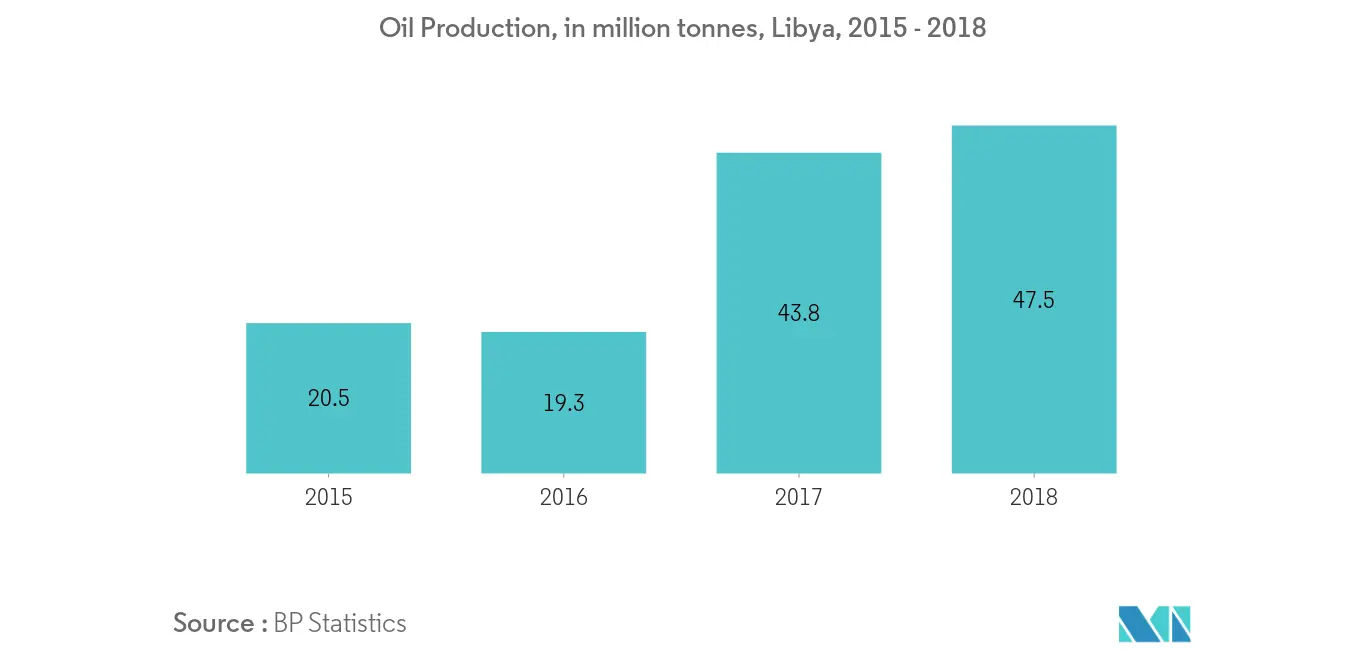
- The oil production increased in the country, by 8.7%, from 43.8 million metric ton in 2017 to 47.5 million metric ton in 2018. The increase in oil production in the country is expected to provide some growth in the sector.
- One of the most essential Libya's crude oil blends is the Amna, with an API gravity of 37.0, high quality and low sulfur 0.17% crude oil. The oil grade is of excellent quality and requires a low level of refining maintenance and equipment.
- The Wafa-Mellitah oil pipeline is an oil and condensate pipeline, with a capacity of at least 120,000 barrels per day. The pipeline is one of the largest oil pipelines, by capacity, in the country.
- The Libyan oil and gas midstream industry is expected to grow slightly in the forecast period, due to an anticipated increase in the production of oil and gas.
Regulatory Landscape
Libya's hydrocarbons framework is anchored by the Petroleum Law No. 25 of 1955 (state ownership of subsurface petroleum) and Law No. 24 of 1970 establishing the National Oil Corporation (NOC). The Ministry of Oil and Gas provides sovereign policy direction and oversight, including licensing approvals, while NOC acts as the state counterparty and operational executor across production, refining, and exports. For major contractual actions, approvals also involve the Council of Ministers.
A notable regulatory-commercial signal came in February 2026, when NOC announced the awarding of five exploration blocks following a public bidding round launched in March 2025, the first such round since 2007. At the same time, the contracting model has been discussed as shifting from the historical EPSA structure toward a new PSA model aimed at improving contractor economics. This has implications for bankability and for long-tenor midstream-linked developments tied to upstream awards.
Value Chain Analysis
Libya's midstream value chain starts with upstream field gathering systems in the Sirte and Murzuq basins, then moves into a national trunk pipeline network (reported around 4,000 km) that links inland production to coastal processing, storage, and export nodes. Key coastal interfaces include terminals such as Ras Lanuf and Es Sider, as well as the Mellitah complex, which is central for gas handling and the Greenstream export route to Italy. Operational performance is closely tied to compression availability at Mellitah and associated offshore feed.
Core midstream activities include crude and gas transportation via trunk lines, intermediate storage at coastal hubs, and gas conditioning and compression to maintain throughput into domestic power supply and export pipelines. Recent project execution has emphasized reliability and debottlenecking. In April 2026, NOC commissioned a 130 km, 42-inch gas pipeline connecting Zueitina Oil Company Field 103 to Sirte Oil Company Line 36B (about 150 million cubic feet per day). In June 2026, Eni and NOC launched the Sabratha offshore compression project (about 440 million standard cubic feet per day of compression capacity) to sustain gas output from the Bahr Essalam field.
Competitive Landscape
The Libyan oil and gas midstream market is moderately consolidated. Some of the major companies include National Oil Corporation, ConocoPhillips Corporation, Eni SpA, Total SA, and Suncor Energy Inc.
Libya Oil And Gas Midstream Industry Leaders
National Oil Corporation
ConocoPhillips Corporation
Eni S.P.A.
Total SA
Suncor Energy Inc.
- *Disclaimer: Major Players sorted in no particular order

Market Opportunities and Future Outlook
In Libya, the most immediate opportunities in the midstream market center on rehabilitation, integrity management, and debottlenecking of the existing crude and gas pipeline system, along with the related compression and terminal interfaces, rather than greenfield buildout. The 2026 execution pattern supports this focus, with NOC completing the 130 km, 42-inch Zueitina-Sirte gas pipeline and moving it into trial runs (around 150 million cubic feet per day), and with Eni and NOC advancing gas sustainment through the Sabratha offshore compression project (1,600-tonne module, about 440 million standard cubic feet per day of compression capacity). Together, these projects expand usable throughput on the existing networks.
Operational continuity and export reliability also create room for maintenance-led contracting across key crude corridors and coastal assets. In April 2026, NOC reported the return to full production at Sharara and El Feel after emergency maintenance on a crude export pipeline damaged by fire, highlighting the commercial value of rapid-response pipeline services, spares, and valve and station refurbishment. Over the longer horizon, longer-tenor upstream agreements and concession activity, including major IOC participation through NOC structures, raise demand for assured evacuation, storage, and gas-handling capacity at the coastal network, which reinforces opportunities for midstream upgrades tied to field development and compression-linked gas supply to domestic power and export routes such as Greenstream.
Recent Industry Developments
- June 2026: Eni and the National Oil Corporation (NOC), through Mellitah Oil and Gas, started operations at the Sabratha Compression Project, installing a 1,600-tonne offshore compression module. The project adds around 440 million standard cubic feet per day of compression capacity to sustain gas output from the Bahr Essalam field, strengthening throughput resilience for domestic supply and export-linked infrastructure.
- April 2026: National Oil Corporation (NOC) completed a 130 km, 42-inch gas pipeline linking Zueitina Oil Company Field 103 to Sirte Oil Company Line 36B and initiated trial operations. Designed to move about 150 million cubic feet per day into the coastal network, the line supports gas system connectivity and reduces reliance on constrained routing for moving associated gas.
- July 2024: Nafusa Oil Operations Company began operating a new pipeline from the North Hamada oil field. Bringing additional field connectivity into the transportation network improves evacuation reliability and reinforces the role of incremental tie-ins and pipeline refurbishment in Libya's midstream build cycle.


Research Methodology Framework and Report Scope
Market Definition and Coverage
For this study, the Libya oil and gas midstream market covers the value of services and activities that move and store crude oil and natural gas inside Libya, and prepare volumes for domestic delivery or export through terminals.
Scope exclusions: Downstream refining, retail fuel marketing, and upstream exploration and production activities are excluded from this sizing.
Segmentation Overview
- Transportation
- Overview
- Existing Infrastructure
- Projects in Pipeline
- Upcoming Projects
- Overview
- Storage
- Overview
- Existing Infrastructure
- Projects in Pipeline
- Upcoming Projects
- Overview
- LNG Terminals
- Overview
- Existing Infrastructure
- Projects in Pipeline
- Upcoming Projects
- Overview
Data Sources, Market Sizing, and Validation
Desk Research
Desk work started with building a fact base on Libya hydrocarbons flows and infrastructure, then mapping what can realistically be monetized as midstream activity each year. We used public sources such as the Organization of the Petroleum Exporting Countries (OPEC) annual statistical publications, International Energy Agency (IEA) energy balances, United Nations Comtrade trade statistics, World Bank macro indicators, and US Energy Information Administration (EIA) country briefs to anchor production, exports, and price context.
To avoid relying only on high-level volumes, we also reviewed operator and regulator releases, project notes from national energy authorities, port and terminal updates reported in reputable press, and company filings and investor presentations where available. Where public data was thin, a paid subscription covering company financials and intelligence, and a separate paid dataset for shipment-level import export signals, were used mainly for cross-checking patterns rather than filling every gap. The sources listed here are illustrative only, and many other public documents were reviewed for collection, validation, and clarification.
Primary Interviews and Surveys
We conduct interviews and surveys with Libyan oil and gas operators, infrastructure managers, service providers, shippers, regulators, and finance or procurement specialists. Within Libya, respondents help clarify utilization, maintenance timing, project delays, service rates, and how stoppages affect reported volumes. Their input is used to address gaps in secondary data and triangulate assumptions before final analysis.
Distribution of primary research fieldwork respondents
| Company type | Respondent position |
|---|---|
| Top tier: 31% | CXOs: 15% |
| Mid tier: 49% | Functional/Unit leaders: 34% |
| Smaller Players: 20% | Managers: 51% |
Market-Sizing & Forecasting
Sizing was built using a top-down and bottom-up approach, where national oil and gas throughput signals were first reconstructed and then filtered into midstream-addressable activity. In practice, we start from crude and gas production and export movements, then apply utilization and routing assumptions to link volumes to pipelines, storage, and terminal handling that create billable services.
Key inputs that shaped the model include crude oil production levels, gas output and processing availability, export and domestic supply splits, terminal operating days, pipeline downtime patterns, and average service charge ranges (tariffs and handling fees) by asset type. When a price series was not clear, we used a simple blended ASP logic that reflects a mix of contracted charges and spot-like service adjustments, and then tested it through interview feedback. The forecast uses scenario analysis with a base case that rolls forward expected operating stability, project restarts, and gradual utilization changes, followed by sensitivity checks on volume recovery pace and fee realization.
To keep the totals realistic, selective bottom-up approximations were run, such as sampled throughput multiplied by typical handling fees and cross-checks against known capacity and utilization bands. Where company-level disclosure was missing, gaps were handled using proxy assets of similar type and a conservative utilization factor, which was then reviewed again during validation.
Data Validation & Update Cycle
Outputs were checked through triangulation across independent signals, including whether implied throughput per asset stayed within capacity limits and whether unit revenues stayed consistent with discussed tariff behavior in Libya. Outliers were flagged, worked back to their drivers, and then re-tested with alternate assumptions before internal review.
We refresh the report on an annual cycle, and we trigger interim checks when material events occur, such as major outages, sanctions-related trade changes, or a large project restart. Before delivery, a final analyst pass is completed so the market view reflects the latest available public releases and any updated interview confirmations.
Mordor Intelligence's Libya Oil and Gas Midstream Market Size Compared With Other Published Estimates
Published numbers for Libya midstream do not always match because the market boundary is not uniform, and the pricing base can shift with currency timing and what is treated as a midstream service versus an upstream or downstream cost. Differences also come from how firms treat utilization in disrupted years, and whether the estimate is anchored on assets, flows, or broader infrastructure spending.
The biggest gaps usually show up when one study includes gas processing or broader infrastructure work, or when tariffs are applied as a flat rate without checking realized charges during outages and restarts. When exchange rates and oil-linked price inputs are refreshed close to the cut-off date, and then reconciled to throughput signals and capacity constraints, the estimate tends to stay more stable. This refresh-led check sequence is used in Mordor Intelligence.
Benchmark comparison
| Source | Market Size | Gaps in Research Methodology |
|---|---|---|
| Mordor Intelligence | USD 0.00 B (2024) | |
| Global Consultancy A | USD 1.55 B (2024) | Uses a broad midstream definition with multiple segmentation lenses, which likely brings in adjacent infrastructure and service lines beyond transport, storage, and terminal handling, and it is less explicit on utilization and realized tariff checks for the same year. |
| Industry Publisher B | USD 1.80 B (2026) | Uses a different base year and a longer forecast window, which can embed a stronger recovery path in volume and pricing, and it appears to treat midstream as a wider bridge including processing and related infrastructure activity. |
Overall, the spread is mainly explained by scope breadth and year alignment, then amplified by how fees are blended when operations are uneven. A repeatable model tied to throughput, operating days, and validated service charges helps keep the final number traceable to clear drivers rather than broad infrastructure narratives.


Key Questions Answered in the Report
What is the current Libya Oil and Gas Midstream Market size?
The Libya Oil and Gas Midstream Market is projected to register a CAGR of 0.44% during the forecast period (2026-2031)
Who are the key players in Libya Oil and Gas Midstream Market?
National Oil Corporation, ConocoPhillips Corporation, Eni S.P.A., Total SA and Suncor Energy Inc. are the major companies operating in the Libya Oil and Gas Midstream Market.
What years does this Libya Oil and Gas Midstream Market cover?
The report covers the Libya Oil and Gas Midstream Market historical market size for years: 2020, 2021, 2022, 2023 and 2024. The report also forecasts the Libya Oil and Gas Midstream Market size for years: 2026, 2027, 2028, 2029, 2030 and 2031.
Page last updated on:


 Your data is secure and never sold or shared.


