
LED Encapsulation Market Size and Share
Market Overview
| Study Period | 2020 - 2031 |
|---|---|
| Market Size (2026) | USD 3.79 Billion |
| Market Size (2031) | USD 5.22 Billion |
| Growth Rate (2026 - 2031) | 6.65 % |
| Fastest Growing Market | Asia Pacific |
| Largest Market | North America |
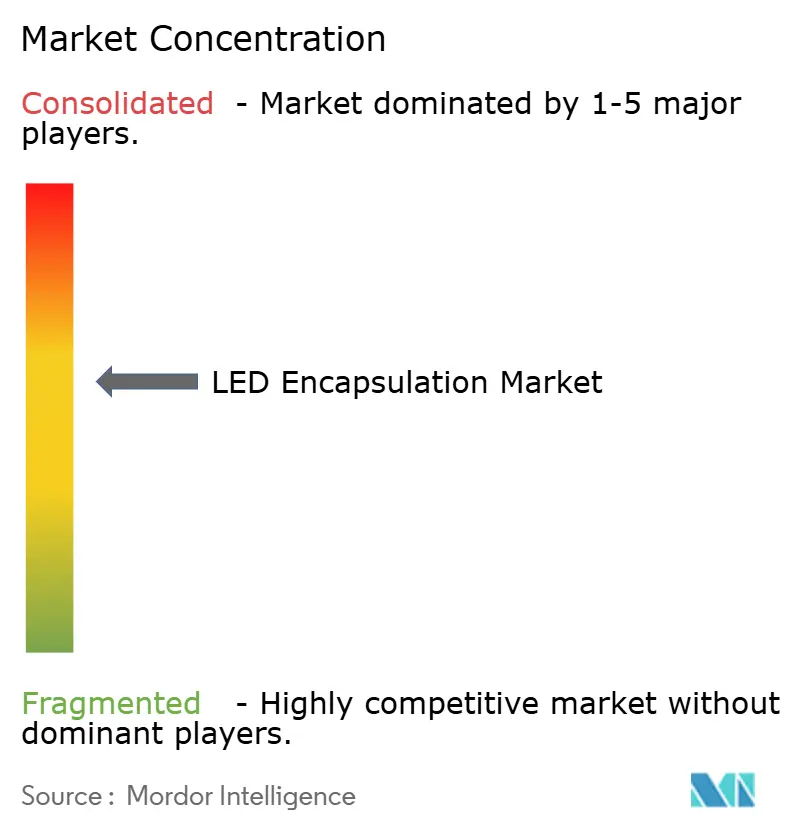
| Market Concentration | Medium |
Major Players *Disclaimer: Major Players sorted in no particular order Image © Mordor Intelligence. Reuse requires attribution under CC BY 4.0. | |
LED Encapsulation Market Analysis by Mordor Intelligence
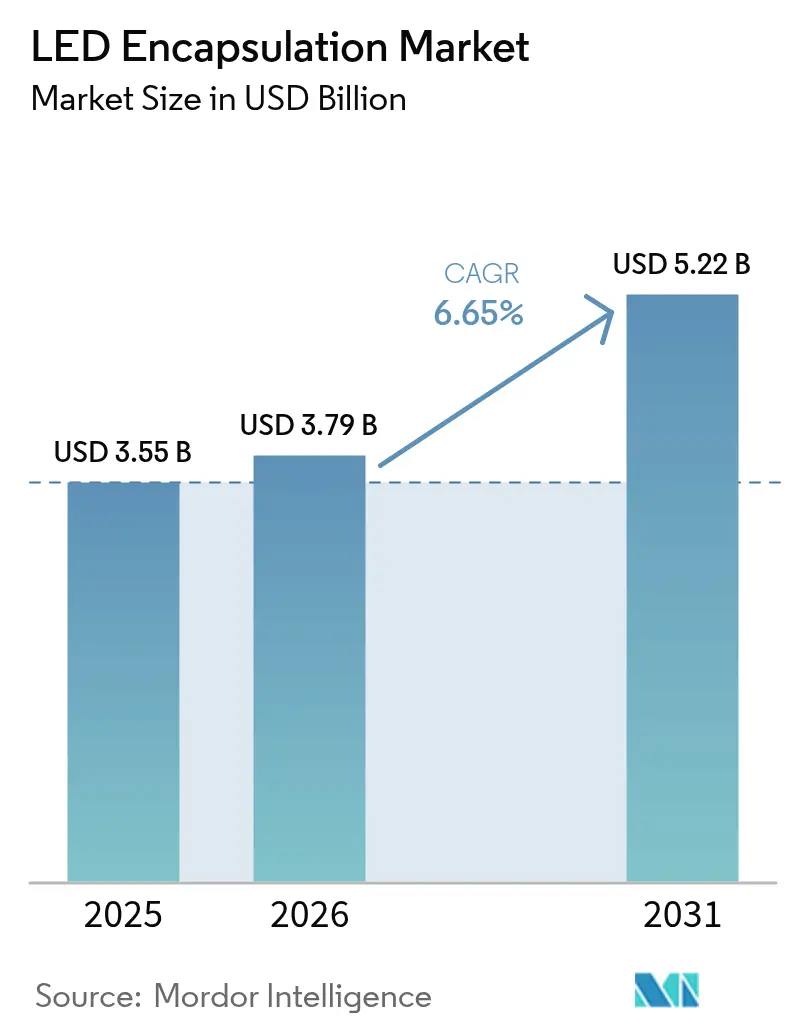
LED encapsulation market size in 2026 is estimated at USD 3.79 billion, growing from 2025 value of USD 3.55 billion with 2031 projections showing USD 5.22 billion, growing at 6.65% CAGR over 2026-2031. Growth is propelled by three structural shifts: the mainstreaming of adaptive driving-beam and matrix headlamps in mid-tier vehicles, the rapid uptake of UV-C and UV-B LED modules for disinfection, and the escalating deployment of horticultural fixtures that demand encapsulants tolerant of sustained junction temperatures above 90 °C. Silicone encapsulants continue to gain market share due to their superior thermal endurance and photoresistance under high-power operation. Automotive OEMs are doubling down on micro-LED adaptive headlamps, reinforcing demand for low-outgassing, high-clarity encapsulants that pass AEC-Q102 reliability tests. North American near-shoring, supported by the CHIPS and Science Act and looming tariff regimes, is resetting supply-chain footprints, while Asia-Pacific growth remains led by China’s 70% share of global LED fabrication capacity.
Key Report Takeaways
- By encapsulant material, silicone captured 55.30% of LED encapsulation market share in 2025 and is projected to grow at 7.52% CAGR through 2031.
- By application, automotive lighting held 41.50% revenue share of the LED encapsulation market size in 2025 and is expected to expand at a 7.21% CAGR to 2031.
- By package type, Chip-on-Board commanded 38.10% of the LED encapsulation market size in 2025, while Chip-Scale Packages are advancing at a 7.05% CAGR through 2031.
- By curing technology, UV and LED light-cure systems are growing at 7.18% CAGR, outpacing heat-cure thermosets which still accounted for 47.20% of demand in 2025.
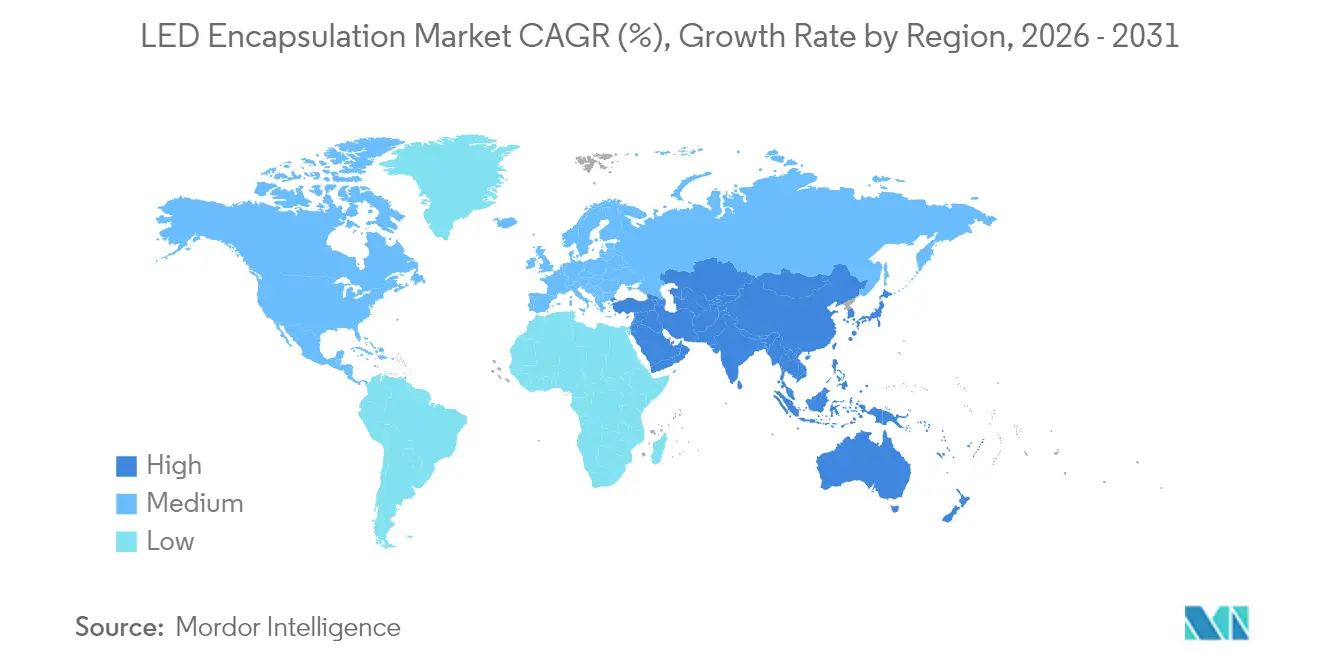
- By region, North America led with 38.30% revenue share in 2025; Asia-Pacific is forecast to post the fastest 7.16% CAGR between 2026 and 2031.
Note: Market size and forecast figures in this report are generated using Mordor Intelligence’s proprietary estimation framework, updated with the latest available data and insights as of 2026.
Market Trends and Insights
Drivers Impact Analysis of LED Encapsulation Market*
| Driver | (~) % Impact on CAGR Forecast | Geographic Relevance | Impact Timeline |
|---|---|---|---|
| Rising penetration of high-power LEDs across general illumination | +1.2% | Global, with concentration in North America and Europe | Medium term (2-4 years) |
| Accelerating adoption of automotive LED lighting systems | +1.8% | Europe, North America, and Asia-Pacific (China, Japan, South Korea) | Medium term (2-4 years) |
| Expansion of consumer electronics back-lighting demand | +0.9% | Asia-Pacific core, spill-over to North America | Short term (≤ 2 years) |
| Surge in UV-C/UV-B LED modules requiring high-clarity encapsulants | +1.1% | Global, early adoption in North America, Europe, and Japan | Medium term (2-4 years) |
| Near-shoring of encapsulant supply chains due to 2025 tariff regimes | +0.7% | North America and Europe | Short term (≤ 2 years) |
| Growth of horticultural and agri-tech lighting with 90°C continuous junction temps | +0.6% | Europe (Central and Eastern), Asia-Pacific (high-latitude regions), North America | Long term (≥ 4 years) |
| Source: Mordor Intelligence | |||
Rising Penetration of High-Power LEDs Across General Illumination
Commercial luminaires replacing metal-halide fixtures now exceed 150 lumens per watt, which requires encapsulant formulations to retain optical clarity for over 50,000 hours at die temperatures exceeding 120 °C. DesignLights Consortium rules require lumen maintenance above 90% at 36,000 hours, effectively sidelining epoxy systems prone to yellowing. Dow’s primerless DOWSIL EI-2888 meets UL 94 and cures at room temperature, helping fixture makers hit tight assembly takt times.[1]Dow, “Electronics,” dow.com Energy codes in the United States and Europe that reward high-efficacy, tunable-white installations continue to drive silicone volume. Phosphor-converted white LEDs also need matrices that do not leach sulfur, maintaining chromatic stability demanded in circadian lighting programs.[2]Nichia Corporation, “About Nichia – Discoloration of LEDs,” nichia.co.jp
Accelerating Adoption of Automotive LED Lighting Systems
Adaptive driving-beam and matrix headlamps have become standard on many mid-tier models in Europe and Asia, exemplified by ams OSRAM’s 25,600-pixel EVIYOS 2.0 module deployed in VW and Opel platforms. Nichia’s µPLS integrates 16,384 micro-LEDs onto ASIC drivers chosen by Forvia Hella, requiring encapsulants with thermal conductivity above 1.0 W/m·K to manage cycles from −40 °C to +125 °C. Seoul Semiconductor’s WICOP no-wire LEDs increase system efficacy to 240 lm/W, reducing taillight assemblies and encapsulant volume per lumen. Regulatory requirements under UN R-123 for glare-free beams and SAE J2650 photometry reinforce uptake, sustaining the LED encapsulation market through 2030.
Surge in UV-C and UV-B LED Modules Requiring High-Clarity Encapsulants
UV-C LEDs operating at 265–280 nm are now being incorporated into HVAC systems and point-of-use water purifiers, with automotive OEMs adopting in-cabin sterilization modules. Epoxy or acrylic encapsulants lose more than half their transmittance within 1,000 hours, whereas phenyl-siloxane silicones keep above 90% after 10,000 hours. EPA recognition of UV-C devices as disinfectant alternatives eases market entry. Certification under NSF/ANSI 55 and IEC 62471, therefore, hinges on encapsulant optical stability, directing demand toward high-purity silicones offered by Shin-Etsu and Dow.[3]Shin-Etsu Chemical Co., Ltd., “Annual Report 2024,” shinetsu.co.jp
Growth of Horticultural and Agri-Tech Lighting with 90 °C Continuous Junction Temps
Vertical farms in Czechia, Poland, and northern Asia deploy LED fixtures that run 24/7 at junction temperatures between 85 °C and 105 °C, requiring encapsulants with glass-transition temperatures exceeding 150 °C and that emit negligible VOCs. Wacker Chemie’s 2025 silicone expansions in Japan and South Korea will add capacity for high-thermal-conductivity grades, targeting horticultural modules. Government subsidies that promote controlled-environment agriculture are shortening paybacks to below three years, providing a secular boost for the LED encapsulation market.
Restraints Impact Analysis of LED Encapsulation Market*
| Restraint | (~) % Impact on CAGR Forecast | Geographic Relevance | Impact Timeline |
|---|---|---|---|
| Volatile silicone and epoxy feedstock pricing | -0.9% | Global, acute in Asia-Pacific and Europe | Short term (≤ 2 years) |
| Increasing OLED penetration in premium displays | -0.6% | Asia-Pacific and North America consumer electronics segments | Medium term (2-4 years) |
| Reliability concerns amid rising blue-light output densities | -0.4% | Global, regulatory focus in EU and California | Medium term (2-4 years) |
| Stringent VOC and micro-siloxane outgassing regulations in EU and California | -0.5% | Europe and California | Long term (≥ 4 years) |
| Source: Mordor Intelligence | |||
Volatile Silicone and Epoxy Feedstock Pricing
Shin-Etsu raised silicone prices by at least 10% from July 2024 and Hexion lifted epoxy resin prices by USD 0.10 per lb from January 2024, compressing margins for mid-tier encapsulant producers. Dow’s Performance Materials and Coatings segment saw 2023 net sales slide 21% to USD 8.497 billion, reflecting oversupply and soft demand. Formulators are blending lower-cost polyurethane or acrylic chemistries in non-critical applications and negotiating pass-through clauses with LED packagers to cushion volatility.
Stringent VOC and Micro-Siloxane Outgassing Regulations in EU and California
Title 17 §94507 in California and EU RoHS restrict diphenylamine, nonylphenol, and low-molecular-weight siloxanes. Nichia reported lumen falloff linked to these contaminants, urging customers to specify encapsulants with residual monomers below 100 ppm. EU Ecodesign rules require removable LED modules, prompting suppliers to shift toward primerless, low-outgassing silicones that retain adhesion while allowing for recyclability. Smaller firms lacking analytical labs face higher compliance costs, consolidating share with Dow, Shin-Etsu, and Wacker Chemie.
*Our forecasts treat driver/restraint impacts as directional, not additive. The impact forecasts reflect baseline growth, mix effects, and variable interactions.
LED Encapsulation Market Segment Analysis
By Encapsulant Material:
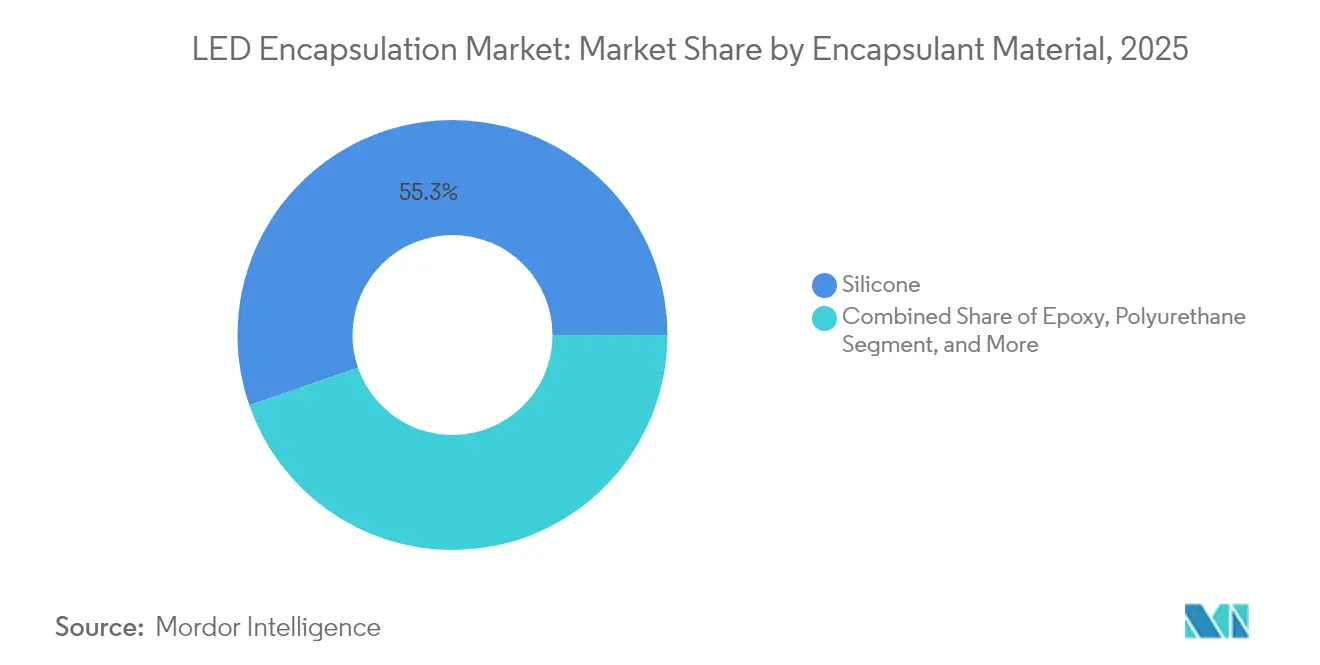
Silicone Dominance Anchored by Thermal and UV ResilienceSilicone encapsulants held a 55.30% market share in the LED encapsulation market in 2025 and are forecast to register a 7.52% CAGR, outperforming epoxy and polyurethane due to their endurance above 180 °C and UV transmittance surpassing 90% over 50,000 hours. Shin-Etsu has earmarked JPY 180 billion (USD 1.24 billion) for domestic and Thai silicone expansions, focusing on LED packaging and environmentally friendly grades. Epoxy retains a foothold in low-power signage but continues to cede ground where blue-rich spectra accelerate photo-oxidation. Polyurethane grows in cost-sensitive strips yet is constrained by moisture sensitivity. Acrylics occupy a niche in flexible-strip uses thanks to their fast UV cure.
Dow’s 2025 launch of DOWSIL EG-4175 gel underscores a shift toward ultra-high-temperature silicones with self-healing and primerless adhesion, reducing assembly steps and ensuring dielectric reliability at 180 °C. Elkem’s Shanghai line adds 1,500 t/y of thermal-conductive silicone to capture electronics and battery modules that increasingly overlap with high-power LEDs



By LED Package Type:
CSP Acceleration Driven by Smartphone and Automotive BacklightingChip-on-Board dominated with 38.10% of LED encapsulation market size in 2025, prized in high-lumen luminaires for cost-per-watt efficiency. Yet, Chip-Scale Packages are surging at a 7.05% CAGR, as Samsung shipped 1.5 billion CSP units in Q3 2024, meeting demand for smartphones and ambient lighting. CSP removes lead frames and wire bonds, lowering package height to under 0.5 mm and slimming bezel designs. Mini- and micro-LED penetration in adaptive headlamps and tablet backlights is also lifting encapsulant requirements for low CTE and minimal outgassing to protect quantum-dot color converters.
Seoul Semiconductor’s WICOP architecture boosts efficacy and slices encapsulant volume per lumen. ams OSRAM’s pixel-dense EVIYOS 2.0 and Nichia’s µPLS need encapsulants aligned with GaN silicon CTE to avert delamination across −40 °C to +125 °C cycles.
By End-Use Application:
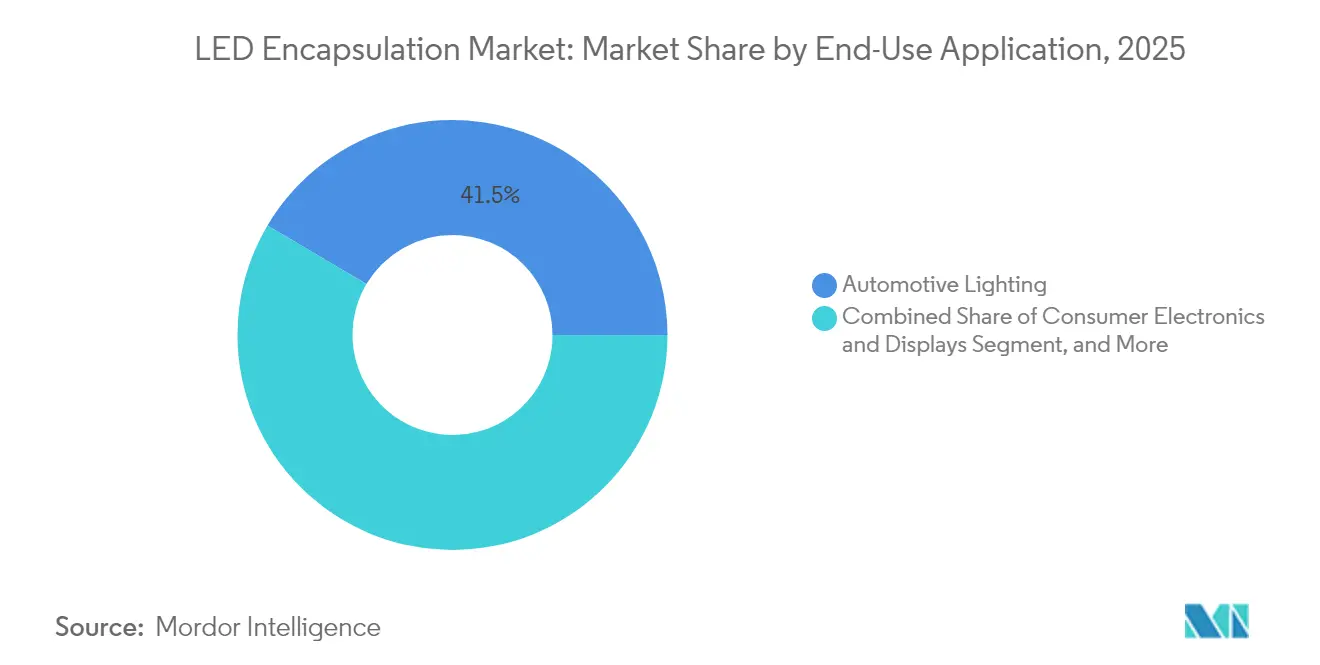
Automotive Lighting Sustains Leadership Amid EV ProliferationAutomotive lighting is expected to seize a 41.50% revenue share in 2025 and is projected to grow at a 7.21% CAGR, as UN R-123 mandates adaptive front lighting and EV platforms increase LED content. Full-width OLED-hybrid taillights and micro-LED headlamps intensify specification for low-volatility, high-thermal-conductivity encapsulants. Consumer electronics back-lighting faces erosion as OLED panels gain 14.11% CAGR, nudging encapsulant suppliers to pivot toward industrial, horticultural, and automotive niches.
Industrial and outdoor lighting remains resilient, especially in smart-city projects, while horticulture expands through vertical farms, demanding 24/7 operation at high humidity. Encapsulants must satisfy OSHA VOC limits within enclosed grow rooms, further differentiating silicone grades with ultra-low volatile profiles.
By Curing Technology:
UV and LED Light-Cure Gains Share on Cycle-Time and Sustainability AdvantagesHeat-cure thermosets still comprised 47.20% of the demand in 2025, yet UV and LED light-cure formulations are growing at a 7.18% CAGR, trimming cure cycles from hours to seconds and slashing energy consumption. LED-based UV sources offer longer lamp life than mercury-arc, aligning with global efforts to reduce hazardous waste.
Dual-cure chemistries combine fast UV skin-cure with deep moisture or thermal cure for shaded areas, making them a suitable fit for dense COB modules. California’s VOC caps and EU RoHS further tilt preference to solvent-free UV systems. Equipment manufacturers now offer 365-nm and 395-nm LED flood units tuned to silicone photoinitiators, enabling inline curing within SMT lines without oven bottlenecks.
Geography Analysis
North America LED Encapsulation Market
North America accounted for 38.30% of LED encapsulation market revenue in 2025, buoyed by the CHIPS and Science Act’s USD 231 billion stimulus that pulls supply chains back onshore. Prospective 60% tariffs on Chinese imports are prompting LED packagers to establish capacity in Mexico and Canada under USMCA terms. Automotive LED demand accelerates as U.S. OEMs embed adaptive beams into mainstream models, while near-shored encapsulant manufacturing mitigates freight and tariff costs.
APAC LED Encapsulation Market
Asia-Pacific is projected to post a 7.16% CAGR, retaining its manufacturing stronghold. China accounts for 70% of global LED chip output, while Indonesia and Vietnam benefit from supply-chain diversification. Additionally, India’s PLI incentives are spurring domestic component lines. Japan and South Korea are at the forefront of R&D advances, as reflected in Wacker Chemie’s specialty silicone investments.
EMEA and the Americas LED Encapsulation Market
Europe enforces strict energy-efficiency and recyclability mandates under Ecodesign 2019/2020, steering demand toward primerless, low-VOC silicones. Germany champions high-pixelated headlamps, while Central and Eastern Europe scale horticultural fixtures requiring high-temp encapsulants. South America’s market remains smaller but growing, led by Brazilian retrofits and Mexican automotive lines. Middle East and Africa adopt high-efficacy luminaires within smart-city and off-grid solar programs, creating niches for encapsulants that handle desert temperatures and high UV.

Regulatory Landscape
Safety and performance compliance in LED modules and equipment continues to be shaped by harmonized standards that affect encapsulant choices for optical stability, outgassing, and long-life reliability. In February 2026, IEC published IEC 62031:2026 for LED module safety, resetting reference requirements for global suppliers serving multinational luminaire and module platforms.
Regional conformity pathways also add testing overhead and design constraints for package makers and material formulators. In North America, UL Solutions published the second edition of ANSI/CAN/UL 8753 in May 2024 for field-replaceable LED light engines, with UL 8750 updates taking effect in July 2026, reinforcing documentation, material flammability, and construction compliance. India tightened market access via BIS IS 16103 (Part 1):2025 implemented January 2026, and China issued GB/T 30117.7-2026 in February 2026 for photobiological safety, with an effective date of September 1, 2026. That timing elevates scrutiny of optical characteristics that can be affected by encapsulant yellowing and contamination control.
Value Chain Analysis
The LED encapsulation value chain starts upstream with silicon metal and chlorosilanes for silicone intermediates, petrochemical feedstocks for epoxy, polyurethane, and acrylic systems, and specialty additives such as fillers, adhesion promoters, catalysts, photoinitiators, and optical-grade curing agents. Formulators convert these inputs into gels, resins, and films aligned to package types including COB, SMD, CSP, and mini/micro-LED modules, then supply LED chip and package manufacturers, module integrators, and luminaire OEMs across automotive, consumer electronics, general lighting, UV disinfection, and horticulture.
Midstream processing and downstream qualification create the main bottlenecks, particularly reliability testing, low-outgassing analytics, and tight optical tolerances under high-flux blue and UV exposure. Localization is emerging as a resilience lever, with SP Samhwa in April 2026 completing development and mass production of localized, high-performance optical-grade curing agents to reduce dependence on Japanese imports for LED and display applications. On the demand side, faster takt times and sustainability programs are increasing adoption of UV and LED light-cure lines, where curing equipment and photoinitiator availability become critical links between encapsulant suppliers and high-volume packaging operations.
Competitive Landscape
Dow, Shin-Etsu, Wacker Chemie, and Momentive anchor the LED encapsulation market through vertically integrated silicone operations and global tech-service teams. Shin-Etsu’s cumulative JPY 180 billion investment in advanced silicones signals a long-term commitment. Smaller specialists, such as NuSil and Epic Resins, carve out high-reliability niches, including space-grade or dual-cure flexible strips.
The technology edge now rests on primerless adhesion, self-healing gels, and refractive-index-raising additives, as showcased by Dow’s EG-4175 and Henkel’s investment in Pixelligent high-RI nanocomposites. LED makers also develop in-house encapsulants. Nichia and Seoul Semiconductor protect their micro-LED platforms through proprietary chemistries, tightening the value chain. Compliance capability under California and EU VOC rules functions as a de facto barrier, favoring suppliers with ISO 14001 plants and in-house analytical labs
LED Encapsulation Industry Leaders
Dow Corning Corporation
NuSil Technology LLC
H.B. Fuller Company
Shin-Etsu Chemical Co., Ltd.
Henkel AG & Co. KGaA
- *Disclaimer: Major Players sorted in no particular order
LED Encapsulation Market Companies Covered in this Report
- Dow Inc.
- DuPont de Nemours, Inc.
- Wacker Chemie AG
- Shin-Etsu Chemical Co., Ltd.
- Momentive Performance Materials Inc.
- Henkel AG and Co. KGaA
- H.B. Fuller Company
- Panasonic Holdings Corporation
- Elkem ASA
- Nagase and Co., Ltd.
- NuSil Technology LLC
- Epic Resins
- Intertronics Ltd.
- Momentive Performance Materials Inc.
- Citizen Electronics Co., Ltd.
- OSRAM Licht AG
- Nichia Corporation
- Seoul Semiconductor Co., Ltd.
- Cree LED (SG Hldg.)
- Everlight Electronics Co., Ltd.
- Sumitomo Bakelite Co., Ltd.
- 3M Company

Market Opportunities and Future Outlook
Opportunities are concentrated in applications where encapsulation performance drives qualification outcomes rather than acting as a commodity coating, especially in high-power automotive lighting, UV-C/UV-B modules, and 24/7 horticultural fixtures operating at elevated junction temperatures. The publication of IEC 62031:2026 in February 2026 and the effective timeline of GB/T 30117.7-2026 (effective September 1, 2026) increase the value of encapsulant portfolios that can be validated across safety and photobiological compliance regimes, supporting demand for low-contaminant, high-clarity silicones and advanced hybrid chemistries.
Mini/micro-LED architectures are also widening the addressable space for wafer-level and film-based encapsulation approaches, where process compatibility and yield protection matter alongside optical transmission. The MicroLED Industry Association’s 2026 MicroLED roadmap offers an industry reference point for technology bottlenecks, including yields and integration, that affect encapsulation process windows. In China, Wuyuan Semiconductor’s filing for a 2.167 billion yuan heterogeneous bonding Micro LED production line project in Qingdao, with construction planned across 2026-2028, points to ongoing capacity build-out targeting automotive lighting and AR micro-displays. Regional supply-chain localization in enabling chemistries, such as SP Samhwa’s April 2026 mass production of optical-grade curing agents, further supports partnering pathways for encapsulant formulators and packaging lines seeking shorter lead times and reduced single-country input dependency.
Recent Industry Developments in LED Encapsulation Market
- June 2026: A leading encapsulation supplier disclosed a recommended cash offer to acquire Advanced Medical Solutions Group plc, as reflected in its June 2026 SEC filing. The move indicates portfolio reshaping and potential expansion of encapsulation-related chemistries and regional manufacturing footprints.
- March 2026: A technical study on blue-light photothermal aging was published by a Dow-led team, comparing thermoplastic and silicone lens cluster performance in high-power LED lighting. The findings support silicone-based optical materials for premiumizing encapsulant formulations tied to lumen maintenance.
- October 2024: A strategic collaboration for encapsulation film formulations and manufacturing technologies for the U.S. market was established, supported by production at an Ohio facility. The arrangement strengthens domestic supply options and enables faster customer qualification cycles in North America.


LED Encapsulation Market Report Scope and Research Methodology
Market Definition and Coverage
For this study, the LED encapsulation market covers the materials and related processing used to protect LED packages and modules, and to manage optical clarity, heat, and long term reliability in end use lighting and electronics.
Scope exclusions: This sizing excludes the LED chip die itself, driver electronics, and finished luminaires where encapsulation is not sold or priced as a distinct material or processing step.
Segments Covered in This Report
- By Encapsulant Material
- Epoxy
- Silicone
- Polyurethane
- Acrylic and Other Encapsulant Material
- By LED Package Type
- Chip-on-Board (COB)
- Surface-Mount Device (SMD)
- Chip-Scale Package (CSP)
- Mini/Micro-LED Modules
- By End-Use Application
- Automotive Lighting
- Consumer Electronics and Displays
- Architectural and Commercial Lighting
- Industrial and Outdoor / Horticulture
- By Curing Technology
- Heat-Cure Thermoset
- UV / LED Light-Cure
- Dual-Cure Systems
- Room-Temperature Vulcanization (RTV)
- By Geography
- North America
- United States
- Canada
- South America
- Brazil
- Mexico
- Argentina
- Rest of South America
- Europe
- Germany
- United Kingdom
- France
- Italy
- Rest of Europe
- Asia-Pacific
- China
- Japan
- India
- South Korea
- Rest of Asia-Pacific
- Middle East and Africa
- Middle East
- United Arab Emirates
- Saudi Arabia
- Rest of Middle East
- Africa
- South Africa
- Nigeria
- Rest of Africa
- Middle East
- North America
Data Sources, Market Sizing, and Validation
Desk Research
Desk research was used to set the initial boundaries and to collect reference indicators that can be checked year over year. We relied on public sources such as US DOE lighting publications, USGS materials statistics, UN Comtrade trade data for relevant chemicals and polymers, and standards bodies like IEC and JEDEC for packaging and reliability references. Patent databases were also reviewed to understand material direction, such as higher thermal stability and UV resistance requirements.
In addition, we screened company annual reports, investor presentations, and press releases to map capacity expansions, product launches, and end market exposure. For cross checks, we used paid subscriptions for company financials and news tracking, plus patent databases and shipment level trade datasets where available. These sources are not exhaustive, and many other public documents were used to fill gaps and validate assumptions during the work.
Primary Interviews and Surveys
Primary work focused on confirming how encapsulant demand moves with LED package mix and with application shifts like automotive lighting, displays, and UV modules. We spoke with a balanced set of material suppliers, packaging ecosystem participants, and downstream OEM and design side contacts across APAC, EMEA, and the Americas, and then used their feedback to validate prices, adoption timing, and practical substitution limits between epoxy and silicone.
Distribution of primary research fieldwork respondents
| Company type | Respondent position | Region |
|---|---|---|
| Top tier: 38% | CXOs: 14% | APAC: 45% |
| Mid tier: 40% | Functional/Unit leaders: 35% | EMEA: 29% |
| Smaller Players: 22% | Managers: 51% | Americas: 26% |
Market-Sizing & Forecasting
Sizing started with a top-down build that reconstructs the demand pool from LED packaging output and end use adoption patterns, then converts it into encapsulation value using material intensity and typical pricing ranges. The model was organized around market signals such as the mix shift across SMD, CSP, and COB formats, the share of silicone used in higher temperature designs, and the pace of mini and micro LED module adoption. Where public series were thin, we treated the missing parts through conservative ranges and then narrowed them using interview checks.
Results were then corroborated using selective bottom-up approximations, mainly sampled ASP ranges for key encapsulant chemistries multiplied by inferred volumes tied to package output, plus channel checks on how much value is captured at material versus processing stages. Forecasting used scenario analysis, since demand is influenced by application cycles that do not move in a straight line, including automotive lighting content per vehicle, UV LED module penetration, and general lighting replacement rates. The final path was chosen only after the assumptions were aligned with what practitioners said is realistic for qualification cycles and pricing progression.
Data Validation & Update Cycle
Validation was done through several passes of consistency checks so totals match what the industry can reasonably supply and consume. We compared outputs against independent signals such as packaging activity, material substitution trends, and reported expansions or constraints, then reviewed any large variances before sign off. When a major gap showed up, respondents were re contacted to clarify whether it came from scope, pricing, or timing.
Reports are refreshed annually, and interim updates are made when material events occur, such as major capacity moves or regulation driven demand changes. Before delivery, a final review pass is completed so the published numbers reflect the latest available data and discussions.
Mordor Intelligence's Led Encapsulation Market Sizing Compared With Other Published Estimates
Published market sizes for LED encapsulation often do not line up because the boundary can shift between raw encapsulant materials, packaging services, and broader LED packaging value. Differences also come from the year chosen as the base, how prices are converted across currencies and time, and whether smaller applications like UV and horticulture are treated as meaningful value pools.
Packaging type mix (SMD, CSP, COB, and mini or micro LED modules) and material trends like silicone share in high temperature designs are used as evidence checks to keep Mordor Intelligence tied to a defined encapsulation value pool, rather than drifting into adjacent LED packaging content. In addition, some published figures appear to use a single blended ASP curve for multiple years, which can miss step changes driven by qualification cycles and by application specific requirements like low outgassing and optical clarity.
Benchmark comparison
| Source | Market Size | Gaps in Research Methodology |
|---|---|---|
| Mordor Intelligence | USD 3.79 B (2026) | |
| Industry Publisher A | USD 2.80 B (2024) | Uses an earlier base year and a broader end use framing that does not clearly separate encapsulation material value from other LED packaging and lighting value elements, which can compress the defined demand pool. |
| Industry Publisher B | USD 2.29 B (2025) | Relies heavily on shipment and production framing with limited clarity on application coverage and on the treatment of higher value package formats, which can undercount value when silicone heavy designs expand. |
Overall, the spread is explained mainly by boundary choices and by how pricing and package mix are handled across years. Our approach stays traceable to practical signals like package format mix, application demand shifts, and realistic material pricing ranges, which makes the final market value easier to reproduce and update.


Key Questions Answered in the Report
What is the forecasted value of the LED encapsulation market by 2031?
The LED encapsulation market is projected to reach USD 5.22 billion by 2031.
Which encapsulant material leads in share and growth?
Silicone holds 55.30% share and is growing at a 7.52% CAGR due to superior thermal and UV stability.
Why is automotive lighting a key growth segment?
Regulatory mandates for adaptive driving beams and the rise of micro-LED headlamps push automotive lighting to a 7.21% CAGR.
How are UV-curable technologies impacting production?
UV and LED light-cure encapsulants cut cure time from hours to seconds and lower VOC emissions, expanding at 7.18% CAGR.
Which region will see the fastest growth through 2031?
Asia-Pacific is expected to post the highest 7.16% CAGR, anchored by China’s dominant LED manufacturing base.
Page last updated on:





