
Latex Medical Gloves Market Size and Share
Market Overview
| Study Period | 2020 - 2031 |
|---|---|
| Market Size (2026) | USD 2.91 Billion |
| Market Size (2031) | USD 4.07 Billion |
| Growth Rate (2026 - 2031) | 6.94 % |
| Fastest Growing Market | Asia Pacific |
| Largest Market | North America |
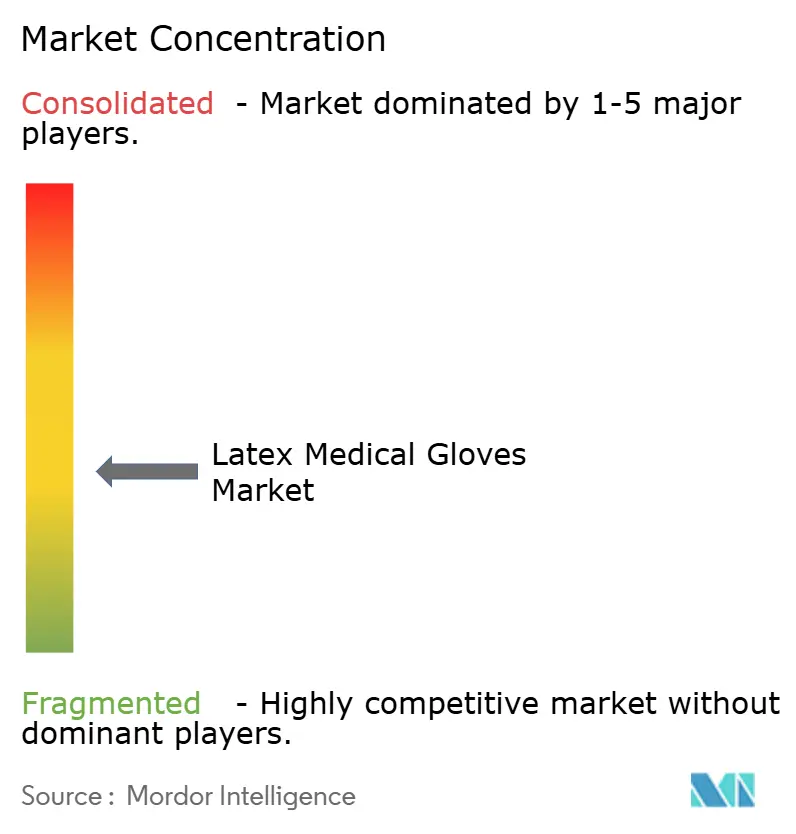
| Market Concentration | Medium |
Major Players *Disclaimer: Major Players sorted in no particular order Image © Mordor Intelligence. Reuse requires attribution under CC BY 4.0. | |
Latex Medical Gloves Market Analysis by Mordor Intelligence
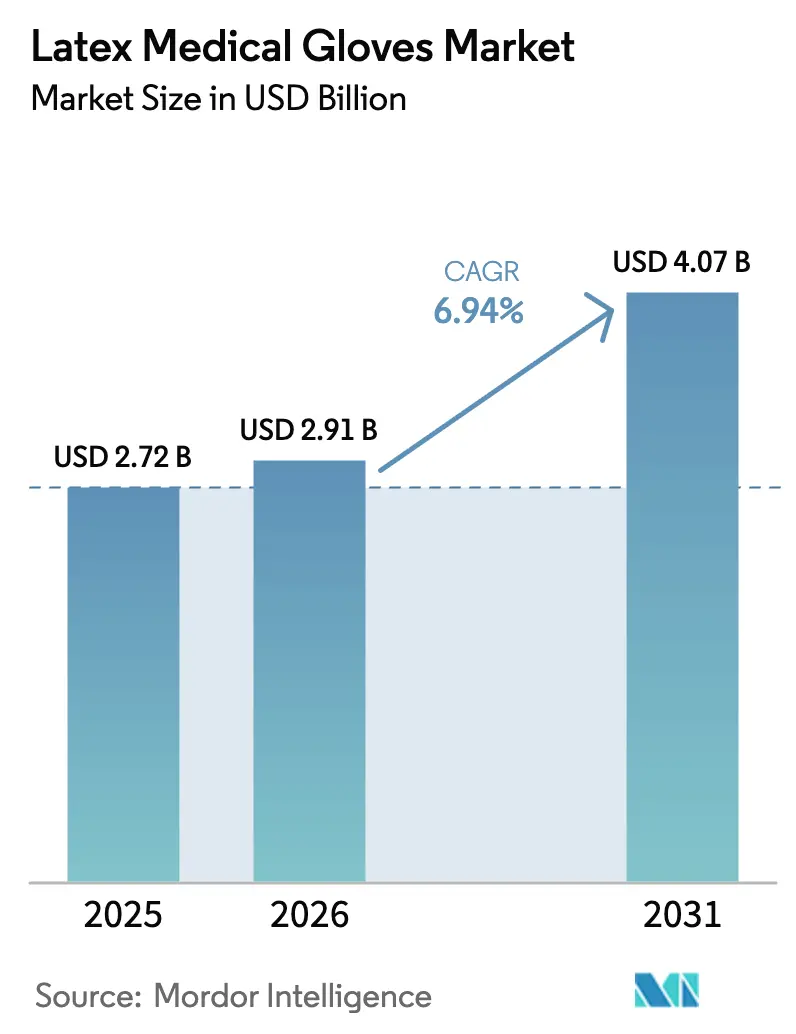
The latex medical gloves market size is expected to grow from USD 2.72 billion in 2025 to USD 2.91 billion in 2026 and is forecast to reach USD 4.07 billion by 2031 at 6.94% CAGR over 2026-2031. Accelerated adoption of powder-free, accelerator-free formulations, widening use of double-gloving in high-risk surgeries, and the rapid build-out of ambulatory surgery centers across emerging Asia are the dominant demand catalysts. On the supply side, Malaysia’s Big Four remain volume leaders, yet Chinese entrants building plants in Vietnam and Indonesia keep average selling prices muted, compelling incumbents to focus on production efficiency and sustainable sourcing. Tariff escalations in the United States, EUDR traceability requirements in Europe, and OSHA guidance favoring nitrile alternatives shape a regulatory landscape that alternately supports and restrains latex consumption. Investment in biodegradable low-protein lines and AI-enabled distribution platforms illustrates how manufacturers and distributors alike respond to cost pressure, sustainability scoring, and hospital demands for continuity.
Key Report Takeaways
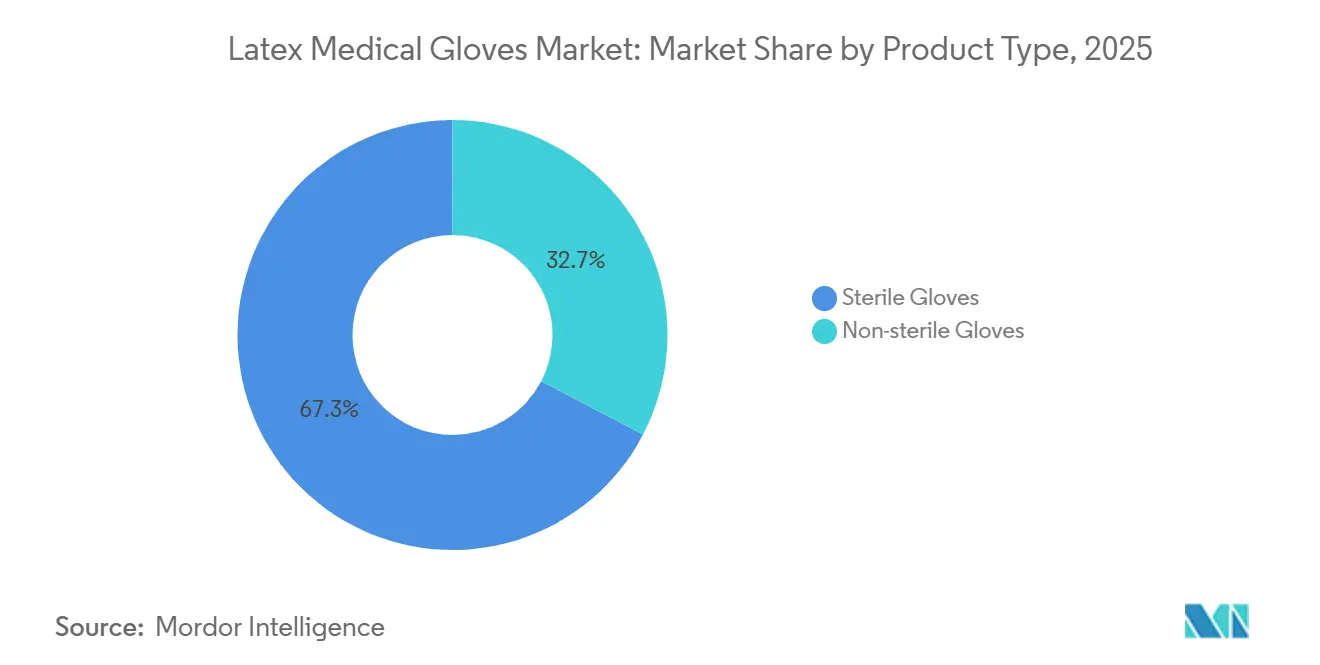
- By product type, sterile gloves captured 67.34% of the latex medical gloves market share in 2025; non-sterile gloves are forecast to rise at a 7.87% CAGR through 2031.
- By form, powder-free gloves held 70.12% of revenue in 2025, while powdered variants will shrink as powder-free products advance at a 7.91% CAGR through 2031.
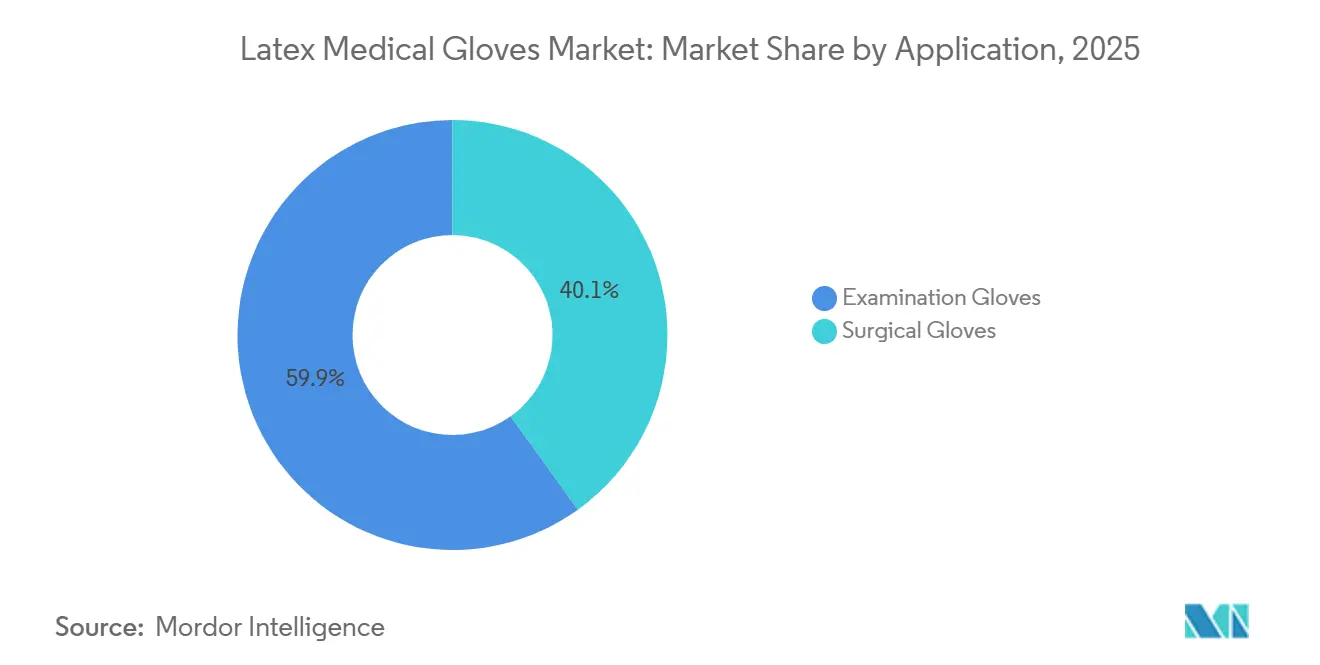
- By application, examination gloves accounted for a 59.91% share of the latex medical gloves market size in 2025, yet surgical gloves are expanding at a 7.98% CAGR through 2031.
- By end user, hospitals dominated with 56.66% of demand in 2025; clinics are set to record the fastest growth at 7.83% CAGR on the back of ambulatory surgery center expansion.
Note: Market size and forecast figures in this report are generated using Mordor Intelligence’s proprietary estimation framework, updated with the latest available data and insights as of January 2026.
Global Latex Medical Gloves Market Trends and Insights
Drivers Impact Analysis*
| Driver | (~) % Impact on CAGR Forecast | Geographic Relevance | Impact Timeline |
|---|---|---|---|
| Rising post-pandemic institutional demand for single-use PPE | +1.8% | Global, with concentration in North America and Europe | Medium term (2-4 years) |
| Mandatory double-gloving protocols in high-risk surgeries | +1.2% | North America, Europe, and advanced APAC markets (Japan, South Korea, Australia) | Long term (≥ 4 years) |
| Fast-growing ambulatory surgery network in emerging APAC | +1.5% | APAC core (India, Indonesia, Vietnam, Philippines), spill-over to MEA | Medium term (2-4 years) |
| Top-5 OEMs scaling biodegradable low-protein latex lines | +0.9% | Global, with early adoption in EU and North America | Long term (≥ 4 years) |
| Hospital VMI contracts lengthening to 3–5 years | +0.7% | North America, Europe, and select APAC markets | Short term (≤ 2 years) |
| Carbon-credit incentives for natural-rubber plantations | +0.5% | Southeast Asia (Thailand, Malaysia, Indonesia) | Long term (≥ 4 years) |
| Source: Mordor Intelligence | |||
Rising Post-Pandemic Institutional Demand for Single-Use PPE
Global glove consumption normalized to 357 billion pieces in 2024, only 6% below the 2021 peak, yet excess capacity from Chinese plants in Vietnam and Indonesia holds down average selling prices. Hospital groups now emphasize supply resilience, exemplified by Medline’s USD 6.26 billion IPO proceeds earmarked for domestic manufacturing and predictive logistics. The U.S. Department of Justice’s Project Airbridge precedent supports distributor-led coordination that continues to guide procurement rules. Cardinal Health disclosed USD 491 million latex exposure in 2024, confirming raw-material volatility as a margin risk. Front-loading by U.S. buyers ahead of tariff hikes boosted Hartalega’s late-2024 revenue but created a volume trough in early-2025, illustrating how policy uncertainty distorts quarterly demand.[1]U.S. Department of Justice, “Response to McKesson Corporation … Business Review Letter,” justice.gov
Mandatory Double-Gloving Protocols in High-Risk Surgeries
Surgical puncture incidence exceeds 30% under single-layer use, and although WHO guidelines stop short of mandating double-gloving, leading teaching hospitals enforce it, driving higher per-case glove consumption. Surgical-grade gloves featuring puncture-indicator systems are replacing standard white gloves and carry a 10-15% premium. Sri Trang’s 2024 patent for low-zinc-oxide latex reduces metal migration below 5 mg/kg, targeting extended-wear surgical scenarios. CMS proposals that reimburse U.S.-made nitrile but not latex gloves add policy headwinds, yet tactile sensitivity keeps latex favored among surgeons. As hospitals refine infection-control metrics, color-coded indicator gloves are emerging as a de-facto standard in orthopedics and trauma theaters.
Fast-Growing Ambulatory Surgery Network in Emerging APAC
Healthcare spend in Southeast Asia reached USD 156.3 billion in 2021 and will grow 6-10% annually, with ASCs gaining momentum because they require USD 2-5 million in capital versus USD 50-100 million for full hospitals. Single-use glove consumption per ASC procedure remains 40-50% below OECD norms, indicating upside as operating protocols converge. Ansell’s acquisitions of Primus and Kimberly-Clark PPE assets secure branded portfolios and distribution breadth crucial for ASC penetration. ASEAN medical tourism, projected to top USD 100 billion by 2029, will further lift procedure volumes and associated glove demand. Production-linked incentives in India that cut import dependence from 80% to 60% between FY 2022 and FY 2024 testify to policy alignment supporting local glove uptake.
Top-5 OEMs Scaling Biodegradable Low-Protein Latex Lines
Top Glove’s BIOGREEN line achieved 36.7% biodegradation in 513 days, proving that ecological design can coexist with barrier integrity. FSC certification differentiates suppliers in public tenders where sustainability weights reach 20% of scores. SHOWA’s FDA-cleared accelerator-free glove set a benchmark for “Low Dermatitis Potential” claims, widening the premium tier. Clinical data from Thai hospitals show symptomatic reactions dropping from 9.8% to 1.2% when low-protein powder-free gloves replace traditional latex, validating the pricing premium. ISO/TS 5462:2024 now harmonizes test methods, lowering compliance costs for exporters and accelerating roll-outs of new eco-friendly formulations.
Restraints Impact Analysis*
| Restraint | (~) % Impact on CAGR Forecast | Geographic Relevance | Impact Timeline |
|---|---|---|---|
| Natural-rubber price volatility & smallholder supply shocks | -1.1% | Global, with acute impact in Southeast Asia (Thailand, Malaysia, Indonesia) | Short term (≤ 2 years) |
| OSHA-driven switch to nitrile in U.S. outpatient clinics | -0.8% | North America, particularly U.S. outpatient and ambulatory settings | Medium term (2-4 years) |
| EU traceability rules raising compliance costs for latex importers | -0.6% | Europe, with spill-over to suppliers in Southeast Asia | Medium term (2-4 years) |
| Surging counterfeit certifications on e-commerce channels | -0.4% | Global, with concentration in unregulated online marketplaces | Short term (≤ 2 years) |
| Source: Mordor Intelligence | |||
Natural-Rubber Price Volatility & Smallholder Supply Shocks
Hartalega’s H1 2024 margins shrank even as revenue climbed 39% because a stronger Malaysian ringgit muted ASP gains and raw-material costs spiked during the wintering season. Smallholders supplying 85% of global latex suffer labor shortages, cutting tapping frequency, while aging tree stock heightens structural under-supply risk. Spot prices surged 15-20% during the May–July 2024 wintering phase, only easing after seasonal recovery. Although Maybank forecasts easing costs, replanting deficits signal recurrent volatility through 2027. Plant consolidations such as Hartalega’s exit from Bestari Jaya underscore a sector-wide pivot toward fewer, more efficient sites to absorb price shocks.[2]European Rubber Journal, “Hartalega ramping up rubber glove production amid signs of demand recovery,” european-rubber-journal.com
OSHA-Driven Switch to Nitrile in U.S. Outpatient Clinics
Latex allergy prevalence among healthcare workers stands at 8-12%, prompting OSHA guidance that favors nitrile gloves for sensitized staff. CMS plans to reimburse a USD 0.13 per-piece premium on U.S.-made nitrile starting January 2026, tilting procurement away from latex. Supermax’s North Carolina nitrile plant will reach 19.2 billion-piece capacity by 2Q 2026, capturing redirected demand. Domestic nitrile output still covers only 0.05% of U.S. needs, but policy incentives shift the growth trajectory. Malaysian suppliers may still fill gaps, yet OSHA guidance means the latex medical gloves market may lose share in U.S. outpatient niches over the forecast horizon.
*Our forecasts treat driver/restraint impacts as directional, not additive. The impact forecasts reflect baseline growth, mix effects, and variable interactions.
Segment Analysis
By Product Type: Sterile Gloves Sustain Hospital Revenue Streams
Sterile gloves accounted for 67.34% of 2025 revenue, anchoring high-value contracts across surgical suites. This dominance in the latex medical gloves market reflects regulatory mandates that demand aseptic barriers and justifies ASPs that run USD 0.02-0.05 above non-sterile equivalents. Non-sterile gloves will nonetheless post a 7.87% CAGR as outpatient clinics and diagnostic labs expand, especially in emerging Asia. Shorter 4-6-week lead times give non-sterile producers agility that proved critical during pandemic disruptions.
Sterile production requires gamma irradiation or ethylene oxide cycles, adding capital intensity that favors scale players. Sri Trang’s 2024 launch of a surgical line indicates the strategic pivot toward the 7.98% CAGR surgical segment. ISO 10282 and ISO 11193 distinctions prevent easy cross-over, preserving moats around specialist capacity. Examination of past shortages shows hospitals reluctant to trial off-brand sterile gloves because malpractice liabilities exceed USD 1 million per incident, reinforcing incumbents’ grip on the latex medical gloves market.


By Form: Powder-Free Gloves Dominate on Allergy Mitigation
Powder-free variants captured 70.12% share in 2025 and will grow at a 7.91% CAGR through 2031 as institutions phase out cornstarch-dusted alternatives banned by the FDA for surgical use in 2016. Production relies on chlorination or polymer coatings that raise costs 8-12%, yet these gloves meet low-dermatitis criteria prized by European tenders. Powdered gloves linger in veterinary and food service but will gradually cede ground.
Top Glove’s ElastiCore accelerator-free line and SHOWA’s FDA-cleared low-dermatitis glove demonstrate how product innovation supports premiums. A Thai clinical study showed symptomatic reactions falling from 9.8% to 1.2% after switching to low-protein powder-free gloves, validating hospital purchasing preferences. As procurement teams rationalize SKUs, inventory simplicity further tilts volume toward powder-free in the latex medical gloves market.
By Application: Surgical Gloves Gain Ground Through Protocol Mandates
Examination gloves represented 59.91% of sales in 2025, yet surgical gloves are forecast to outpace them at 7.98% CAGR as double-gloving proliferates. Indicator-color systems boost per-pair pricing by 10-15% but slash puncture detection time, contributing to infection-control scores that purchasing committees monitor closely. ISO performance thresholds—tensile strength ≥24 MPa and elongation ≥650%—raise manufacturing requirements, but higher ASPs of USD 0.20-0.40 make the segment attractive.
Examination gloves, with unit costs under USD 0.05 in mega-volume contracts, remain essential in basic patient contact across acute and outpatient settings. Yet OSHA-driven nitrile substitution threatens latex share in U.S. clinics, even as global preference for tactile sensitivity keeps latex dominant elsewhere. Manufacturers hedge by maintaining balanced portfolios that meet diverging regional standards within the latex medical gloves market.
By End User: Clinics Lead Growth While Hospitals Anchor Volume
Hospitals consumed 56.66% of gloves in 2025, averaging 2,000-3,000 pairs per bed annually and engaging in 3-5-year vendor-managed inventory deals that secure continuity. Clinics, including ASCs, will post a 7.83% CAGR to 2031 as emerging-market networks multiply due to lower capital barriers. Diagnostic labs supply a steady but smaller demand base, while home healthcare climbs with aging demographics.
Medline’s 98% retention rate and 2,000-truck MedTrans fleet illustrate how distribution depth cements supplier choice, raising switching costs for hospitals. ASCs focus on per-procedure cost, favoring examination-grade gloves unless surgical protocols dictate otherwise. Specialty segments such as veterinary and cleanroom applications remain niche at <5% volume but deliver 20-30% price premiums in the latex medical gloves market.
Geography Analysis
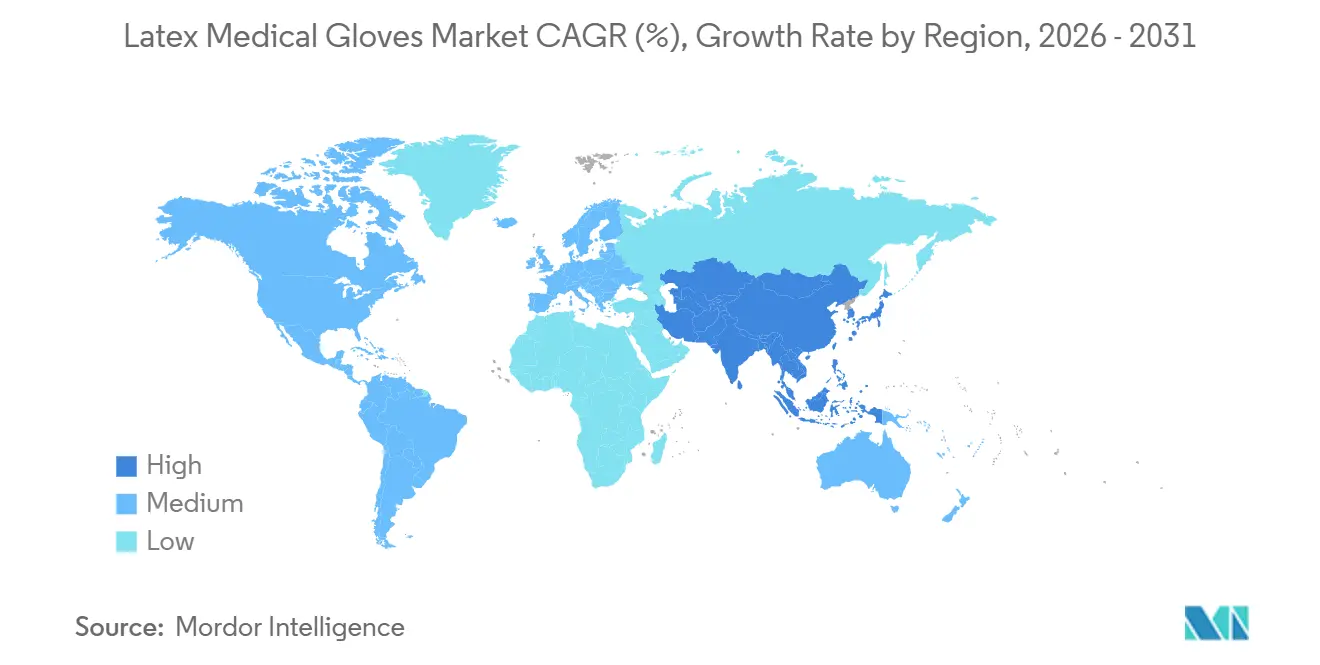
North America retained 40.01% share in 2025 as U.S. tariffs on Chinese gloves rose from 7.5% to 50% and will reach 100% in 2027, diverting orders to Malaysian and Thai producers. Hartalega captured roughly 13% of U.S. demand in FY 2026, and its sales now comprise 53% of group revenue. CMS incentives for U.S.-made nitrile cast uncertainty over latex imports, yet near-term supply gaps ensure continued inflows.
Asia-Pacific is the fastest-growing region at 8.01% CAGR, fueled by ASEAN’s 685.4 million population and medical tourism revenue that could exceed USD 100 billion by 2029. Malaysia still supplies 45% of global output, but Chinese “+1” strategies in Vietnam and Indonesia face new U.S. tariffs of 46% and 32%, respectively, announced April 2025. India’s production-linked incentives, reducing import reliance to 60% by FY 2024, signal growing domestic capacity.
Europe accounts for roughly one-fifth of demand; the EUDR adds USD 0.005-0.010 per glove for traceability, favoring vertically integrated suppliers. Middle East and Africa will expand 7.2-7.5% CAGR on over USD 50 billion GCC healthcare investment, yet fragmented logistics temper premium uptake. South America, led by Brazil, consumes 5-6% of global volume, with public tenders prioritizing low cost.

Regulatory Landscape
Latex medical gloves are regulated as medical devices across major markets, with product claims and intended use determining the conformity route. In the United States, the FDA regulates patient examination gloves under 21 CFR 880.6250 and maintains its ban on powdered patient examination gloves and powdered surgeons gloves, which reinforces the shift toward powder-free alternatives already prominent in procurement. FDA-recognized consensus standards, including ASTM specifications used for rubber examination gloves, and long-standing acceptance criteria for examination and surgeons gloves influence quality and performance expectations for both importers and domestic producers.
In Europe, market access is governed by the EU Medical Device Regulation (EU) 2017/745 (MDR). In 2026, the European Commission issued implementing rules in May 2026 affecting conformity assessment and notified-body processes, followed by an updated list of harmonized standards in June 2026. International standards also shape compliance planning, and ISO 11193-1 (single-use medical examination gloves) advanced through ballot and committee approval for its Draft International Standard as of August 2025, signaling continued alignment work for exporters selling across multiple jurisdictions.
Value Chain Analysis
The latex medical gloves value chain begins with upstream raw materials, especially natural rubber latex (with smallholders supplying a large share of global latex), alongside compounding chemicals such as zinc oxide and vulcanizing agents, plus energy for heating and drying. Midstream, high-throughput dipping operations convert latex into glove forms using ceramic formers, followed by leaching to remove protein and chemical residues, vulcanization ovens, and chlorination or polymer coatings for powder-free finishes. Sterile grades then undergo sterilization steps, such as gamma irradiation or ethylene oxide cycles, before packaging and lot-level quality release.
Downstream, global distributors and medical-surgical supply platforms route volume to hospitals, clinics, and ambulatory surgery centers through long-term contracts and vendor-managed inventory programs. Recent logistics and input volatility have kept supply continuity and diversification in focus. In March 2026, industry commentary highlighted shipping disruption risk near the Strait of Hormuz, alongside petrochemical-linked cost pressure relevant to synthetic feedstocks used across glove production. In parallel, ASEAN industry bodies increased coordination on standards and ESG practices through the MARGMA and TRGMA memorandum of understanding announced around IRC 2025. With Malaysia positioned as a key export hub (about 45% of global rubber glove supply in the report context), port-to-warehouse execution and supporting compliance documentation have become more central to competitive differentiation.
Competitive Landscape
Top Glove, Hartalega, Kossan, and Supermax held significant share in 2023, signaling moderate concentration as pandemic-era capacity swells depressed their combined dominance. Top Glove still commands about 26% of global volume but battles lower ASPs amid Chinese overcapacity. Hartalega’s decommissioning of Bestari Jaya in 2023 and land acquisition for NGC 1.5 in 2025 reflect an industry shift toward efficient mega-complexes.
Ansell’s USD 640 million purchase of Kimberly-Clark’s PPE lines adds Kimtech and KleenGuard, bolstering cleanroom penetration where margins exceed commodity gloves by up to 25 points. Medline leverages Microsoft’s AI to refine demand forecasting, embedding itself deeper in hospital workflows and squeezing smaller distributors. Intellectual-property strategies, such as Sri Trang’s low-zinc patent, illustrate how niche technical upgrades create pricing power in a price-pressured latex medical gloves market.
White-space growth resides in home healthcare and veterinary niches, where consumption per visit trails hospital norms by 30-40%, offering volume upside. Automation, predictive analytics, and sustainability certifications serve as differentiators as price competition intensifies.
Latex Medical Gloves Industry Leaders
Cardinal Health
McKesson Medical-Surgical Inc.
Valutek Inc
SHIELD Scientific
Ansell Ltd
- *Disclaimer: Major Players sorted in no particular order

Market Opportunities and Future Outlook
Opportunities are concentrated in premium surgical and specialty sub-segments where latex advantages (tactile sensitivity and fit) can be monetized through powder-free, accelerator-free, and low-protein formulations, as well as puncture-indicator systems aligned with double-gloving protocols in high-risk surgeries. In Europe, procurement scoring that explicitly weighs sustainability and traceability increases the value of FSC-linked sourcing and the documentation needed to support EUDR-style due diligence in natural rubber supply chains, creating room for suppliers that can demonstrate plantation traceability at scale.
Geographic diversification and automation-led productivity programs are also visible responses to cost pressure, labor constraints, and tariff uncertainty, and they open additional regional channels for supply. Supermaxs May 2026 announcement to invest about BRL 250 million (around USD 50 million) in a Parana, Brazil glove facility with 2.4 billion gloves per year shows a push to place capacity closer to end markets and reduce single-region reliance. Top Glove also initiated Thailand expansion planning in June 2026 with 14 double-former lines to improve efficiency under labor constraints. With global capacity still materially above demand in 2026, differentiation through compliance readiness, sustainability credentials, and higher-value medical device positioning remains a primary pathway for share gains in latex-focused portfolios.
Recent Industry Developments
- May 2026: Supermax Corporation Berhad announced an investment of about BRL 250 million (around USD 50 million) to establish a medical glove manufacturing facility in Parana, Brazil, with installed capacity of 2.4 billion gloves per year. The announcement supports geographic diversification beyond Southeast Asia and implies a shorter supply path into Latin American and potentially North American channels.
- April 2026: McKesson signed an agreement with Apollo Funds to create a strategic minority interest in its Medical-Surgical Solutions business. The transaction highlights ongoing capital reshaping in distribution, with potential knock-on effects for private-label sourcing, contract coverage, and inventory programs that influence glove purchasing at scale.
- February 2026: Ansell started the first production line at its new Tamil Nadu, India manufacturing facility, with output referenced at around 60 million pairs of surgical gloves annually. Bringing surgical glove capacity online in India supports multi-sourcing for regulated healthcare customers and improves responsiveness to regional demand growth and tender requirements.


Research Methodology Framework and Report Scope
Market Definition and Coverage
This market covers the revenue generated from latex medical gloves used in healthcare settings, where natural rubber latex is the main material and the product is meant for examination or surgical use.
Scope exclusions: Excludes non-latex medical gloves and industrial or household latex gloves that are not intended for medical use.
Segmentation Overview
- By Product Type
- Sterile Gloves
- Non-sterile Gloves
- By Form
- Powder-free Gloves
- Powdered Gloves
- By Application
- Examination Gloves
- Surgical Gloves
- By End User
- Hospitals
- Clinics
- Ambulatory Surgery Centers
- Diagnostic Laboratories
- Others
- By Geography
- North America
- United States
- Canada
- Mexico
- Europe
- Germany
- United Kingdom
- France
- Italy
- Spain
- Rest of Europe
- Asia-Pacific
- China
- Japan
- India
- Australia
- South Korea
- Rest of Asia-Pacific
- Middle East and Africa
- GCC
- South Africa
- Rest of Middle East and Africa
- South America
- Brazil
- Argentina
- Rest of South America
- North America
Data Sources, Market Sizing, and Validation
Desk Research
Desk research was used to set the market context and build volume and pricing anchors before we moved into modeling. We reviewed public health and trade signals such as Centers for Disease Control and Prevention guidance, FDA updates on medical device and glove-related requirements, and World Health Organization infection prevention material.
To quantify demand-side direction, we referenced sources such as World Bank health expenditure indicators, UN Comtrade trade statistics for rubber and medical supply flows, and peer-reviewed journals that track hospital infection control practices and glove use. We also used company filings and investor presentations to understand capacity additions, margin patterns, and regional mix, and we validated selected assumptions using paid subscriptions for company financials and a shipment-level import-export database. These sources are illustrative, and many additional public documents and datasets were also reviewed for data collection, validation, and clarification.
Primary Interviews and Surveys
Primary work focused on confirming what drives real purchasing volumes and pricing across regions, including feedback from manufacturers, distributors, hospital procurement teams, and clinicians who influence glove specifications. We used these conversations to test assumptions around powder-free switching, sterile versus non-sterile mix, and how pricing moves when raw latex costs and freight rates change, and then we rechecked outliers with follow-up calls across APAC, EMEA, and the Americas.
Distribution of primary research fieldwork respondents
| Company type | Respondent position | Region |
|---|---|---|
| Top tier: 25% | CXOs: 16% | APAC: 44% |
| Mid tier: 56% | Functional/Unit leaders: 34% | EMEA: 35% |
| Smaller Players: 19% | Managers: 50% | Americas: 21% |
Market-Sizing & Forecasting
Sizing starts from a top-down demand pool, where healthcare activity and procedure volumes are translated into glove consumption, and then adjusted for the latex share within medical gloves by region. Once that demand is formed, we corroborate totals with selective bottom-up checks such as supplier revenue sampling, distributor channel checks, and sampled average selling price times estimated shipment volumes, which helps correct any overstated utilization assumptions.
Inputs used (as examples) include surgical procedure counts and outpatient visit trends, hospital bed capacity and utilization, penetration of powder-free products, sterile versus non-sterile consumption mix, and average price movements linked to natural rubber latex costs and freight conditions. When data gaps appear in bottom-up checks, we fill them using conservative ranges from interviews and documented trade patterns, and we avoid forcing precision where reporting is thin. For the forecast, scenario analysis is applied around utilization and pricing, and the final trajectory is aligned to the most consistent expert views on infection control compliance, procurement standardization, and capacity additions.
Data Validation & Update Cycle
Outputs are validated through several checks so the final number stays tied to observable market signals. We compare modeled revenue against independent indicators like trade direction, capacity announcements, and pricing movement, then investigate any variance that is too large to be explained by mix or currency effects.
Before sign-off, assumptions and calculations are reviewed by another analyst, and flagged items are taken back to sources or interview respondents for clarification. The report is refreshed annually, and interim updates are triggered when there are material events such as major capacity shifts, regulatory changes, or sharp raw material price swings. Right before delivery, a final pass is done so clients receive the latest updated view.
Mordor Intelligence's Latex Medical Gloves Market Size Versus Other Published Estimates
Published market numbers for latex medical gloves often do not match, even when the topic name looks similar. The spread usually comes from how each publisher draws product scope, handles sterile versus non-sterile revenue, and treats price normalization across regions.
The main gap comes from scope mixing, where some estimates appear to bundle broader disposable glove categories or adjacent hospital supplies, while Mordor Intelligence counts only latex medical gloves and then applies region-specific pricing and mix checks (powder-free adoption and sterile share) before finalizing the 2025 value.
Benchmark comparison
| Source | Market Size | Gaps in Research Methodology |
|---|---|---|
| Mordor Intelligence | USD 2.72 B (2025) | |
| Trade Journal A | USD 5.06 B (2025) | Figure is presented under a broader latex medical glove framing with longer horizon assumptions, and it can overstate the addressable pool if industrial-adjacent channels or wider end-use buckets are implicitly included. |
| Industry Publisher B | USD 12.80 B (2024) | Appears to blend latex gloves with wider healthcare PPE and hospital supply spending, which inflates the total compared with a gloves-only revenue model and can also differ on currency timing. |
The table shows that differences are largely explained by what gets counted and how pricing is normalized across regions and product mix. By keeping the demand pool tied to medical-use latex gloves and stress-testing key mix and pricing levers with interviews, the resulting size stays easier to trace and replicate when assumptions are updated.


Key Questions Answered in the Report
What is the current value of the latex medical gloves market?
The market stands at USD 2.91 billion in 2026 and is projected to reach USD 4.07 billion by 2031.
How fast is global demand expected to grow?
Demand is forecast to rise at a 6.94% CAGR through 2031 driven by hospital contracts, ASC expansion, and sustainability innovation.
Which region offers the fastest growth opportunity?
Asia-Pacific leads with an 8.01% CAGR thanks to medical tourism and rapid ASC expansion across ASEAN economies.
Why are powder-free gloves gaining market share?
Institutional buyers prefer powder-free, accelerator-free latex because they minimize hypersensitivity reactions and comply with FDA bans on powdered surgical gloves.
How do U.S. tariff policies affect sourcing strategies?
Tariffs up to 100% on Chinese gloves and 24-36% on some Southeast Asian suppliers steer procurement toward Malaysian and Thai producers in the near term.
What role does sustainability play in purchasing decisions?
FSC certification, biodegradability, and EUDR compliance now influence up to 20% of tender scoring in European public procurement, favoring suppliers with robust traceability programs.
Page last updated on:





