
Market Overview
| Study Period | 2020 - 2031 |
|---|---|
| Forecast Data Period | 2026 - 2031 |
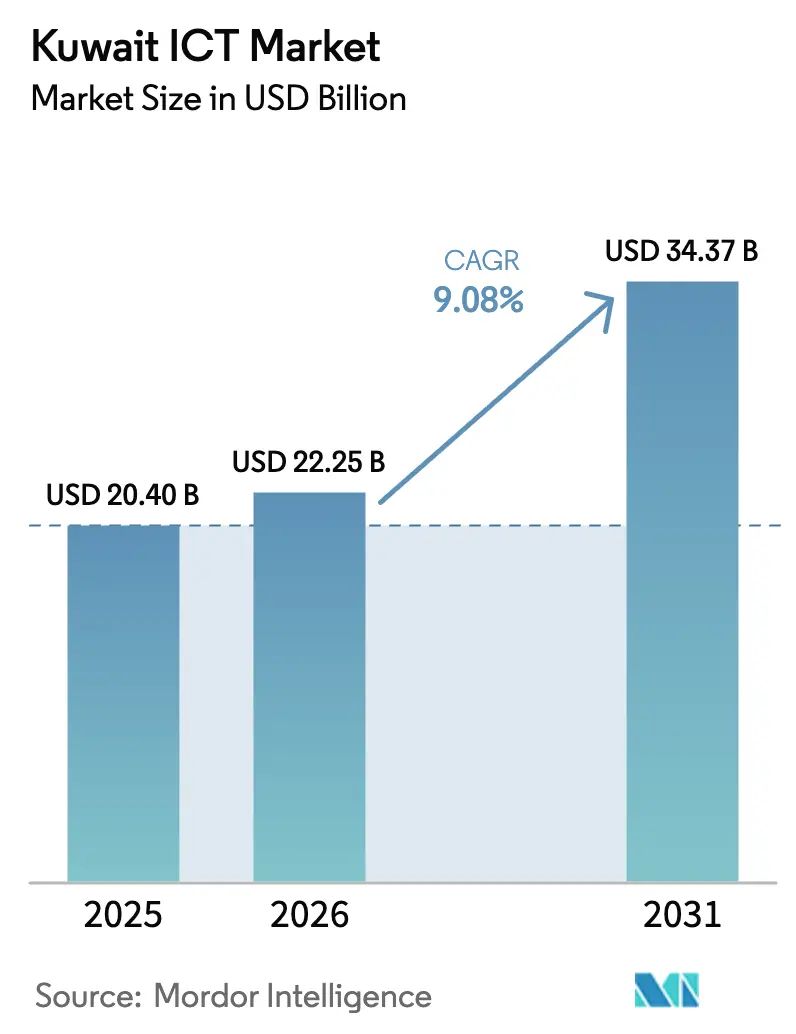
| Base Year Market Size (2025) | USD 20.4 Billion |
| Market Size (2026) | USD 22.25 Billion |
| Market Size (2031) | USD 34.37 Billion |
| Growth Rate (2026 - 2031) | 9.08 % |
| Market Concentration | Medium |
Major Players *Disclaimer: Major Players sorted in no particular order Image © Mordor Intelligence. Reuse requires attribution under CC BY 4.0. | |
Kuwait ICT Market Analysis by Mordor Intelligence
The Kuwait ICT market size was valued at USD 20.4 billion in 2025 and estimated to grow from USD 22.25 billion in 2026 to reach USD 34.37 billion by 2031, at a CAGR of 9.08% during the forecast period (2026-2031). Robust growth in the Kuwait ICT market is underpinned by the New Kuwait 2035 vision, rapid 5G deployment, and a cloud-first policy that accelerates public-sector digitalization. Early adoption of advanced mobile networks encourages investment in edge computing, while data-center free-zone incentives create a favorable environment for hyperscale providers. Government ministries mandate cloud migration, prompting enterprises to modernize legacy systems, and rising cybersecurity concerns drive a parallel surge in IT security spending. Strategic partnerships between telecom operators and global technology firms shorten time-to-market for AI-powered Arabic language solutions, positioning Kuwait as a regional development hub.
Key Report Takeaways
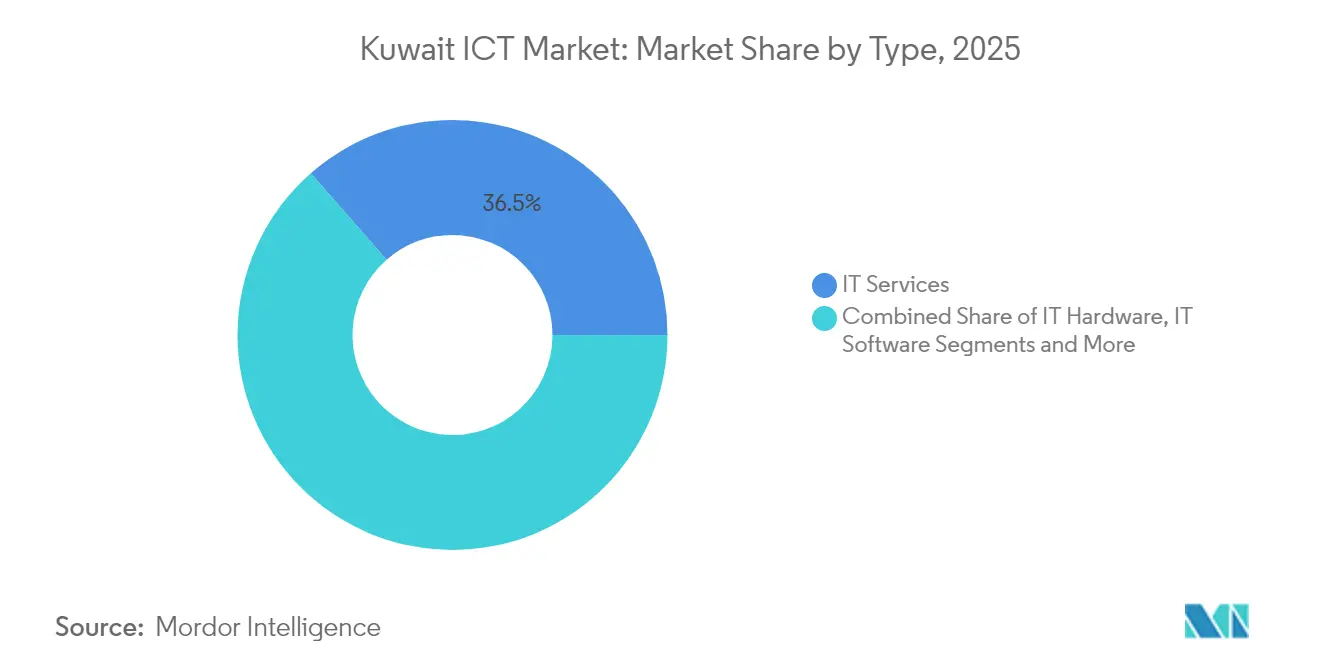
- By type, IT services led with 36.45% revenue share in 2025; IT security is advancing at a 10.02% CAGR through 2031.
- By enterprise size, large enterprises held 63.05% of the Kuwait ICT market share in 2025, while SMEs are projected to expand at a 9.55% CAGR to 2031.
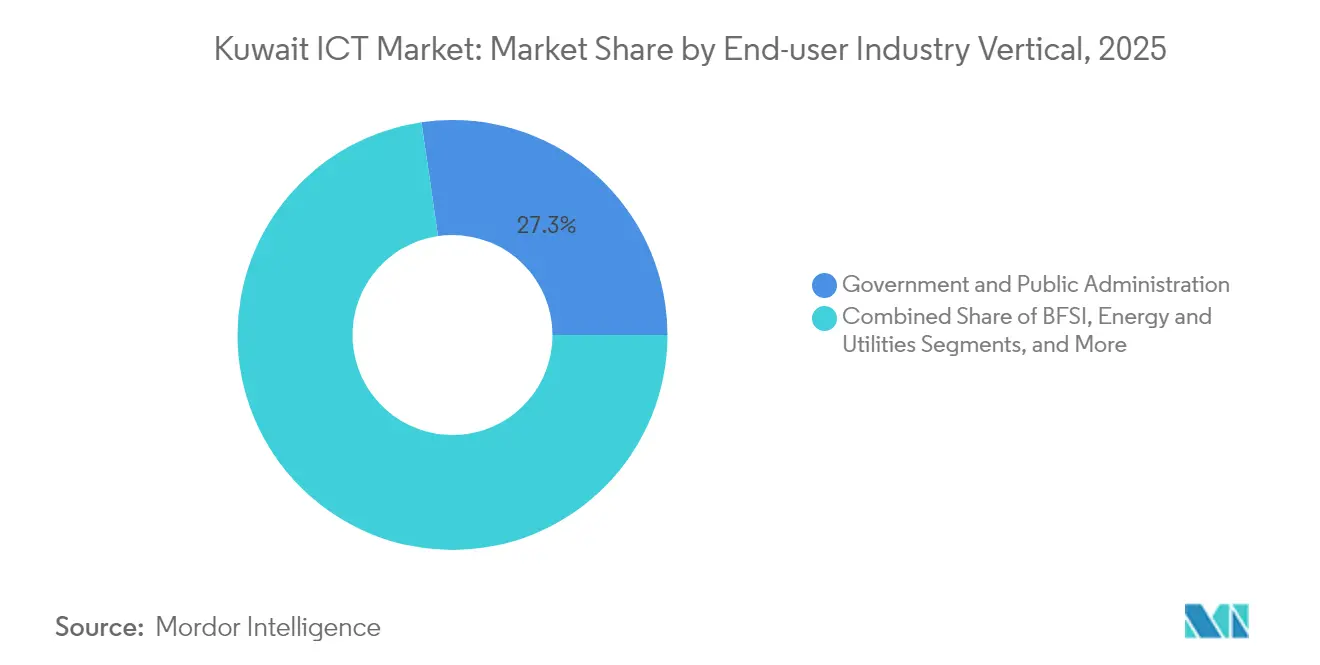
- By end-user vertical, government and public administration captured 27.31% revenue share in 2025; gaming and esports is expected to record a 10.26% CAGR through 2031.
Note: Market size and forecast figures in this report are generated using Mordor Intelligence’s proprietary estimation framework, updated with the latest available data and insights as of 2026.
Kuwait ICT Market Trends and Insights
Drivers Impact Analysis*
| Driver | (~) % Impact on CAGR Forecast | Geographic Relevance | Impact Timeline |
|---|---|---|---|
| New Kuwait 2035 digital-first agenda | +2.8% | Nationwide, strongest in Kuwait City | Medium term (2-4 years) |
| Early 5G rollout and fiber densification | +2.1% | Urban and suburban areas | Short term (≤ 2 years) |
| Cloud-first policy for ministries and SOEs | +1.9% | All government entities | Medium term (2-4 years) |
| Data-center free-zone incentives | +1.4% | Designated economic zones | Long term (≥ 4 years) |
| AI-powered Arabic LLM localization | +1.0% | Regional, Kuwait as hub | Medium term (2-4 years) |
| Regional gaming-esports ambitions | +0.8% | Nationwide | Long term (≥ 4 years) |
| Source: Mordor Intelligence | |||
New Kuwait 2035 Digital-First Agenda Drives Comprehensive ICT Transformation
Mandatory migration of ministries to cloud services, rollout of the Meta central appointment platform, and upcoming AI-ready Azure region collectively stimulate large-scale contracts across infrastructure, software, and services. The unified citizen portal improves service quality and elevates demand for identity management, integration, and analytics tools.[1]Microsoft, “Microsoft to Establish AI-Powered Azure Region in Kuwait,” microsoft.com Budget allocations earmarked for e-government accelerate vendor onboarding, and standardized broadband pricing guarantees last-mile connectivity. [2]Kuwait Government Online, “Broadband Internet Pricing,” e.gov.kw Continuous flagship events such as Digital Transformation Kuwait maintain policy momentum and foster public-private collaboration.[3]Digital Transformation Kuwait, “Conference Summary,” digitaltransformationkuwait.com
Early 5G Rollout Creates Advanced Mobile Infrastructure Foundation
Nationwide 5G coverage enables telcos to monetize home broadband, fixed-wireless access, and network slicing solutions, stimulating incremental revenue in the Kuwait ICT market. Consolidation of nearly 1,675 tower sites by Zain optimizes radio planning and speeds up 5G layer densification. Partnerships like stc Kuwait and IPification showcase identity-as-a-service models, emphasizing security and user experience in fintech and media streaming
Cloud-First Policy Accelerates Enterprise Digital Migration
Cloud adoption gains traction across oil, banking, and retail domains. Kuwait Oil Company’s embrace of DecisionSpace 365 exemplifies production-scale data ingestion and analytics in upstream operations. National Bank of Kuwait extends its digital platform to AI-enabled transaction banking, signaling regulatory comfort with SaaS for critical workloads. Local ISVs collaborate with hyperscalers to offer Arabic NLP, low-code platforms, and sectoral clouds aligned to sovereignty norms, broadening Kuwait ICT market opportunities.
Data-Center Free-Zone Incentives Attract Hyperscale Investment
Tax holidays, customs exemptions, and streamlined licensing issued by KDIPA lure global colocation and cloud operators. Edge facilities near smart-meter clusters reduce latency for utilities, while free-zone sub-tenancies encourage managed-service ecosystems. Developers integrate renewable energy and waste-heat reuse to meet green-building codes, preparing the Kuwait ICT market for ESG-compliant workloads
Restraints Impact Analysis*
| Restraint | (~) % Impact on CAGR Forecast | Geographic Relevance | Impact Timeline |
|---|---|---|---|
| Chronic ICT talent gap and visa caps | −1.8% | Concentrated in Kuwait City | Short term (≤ 2 years) |
| High oil-price correlation of public ICT budgets | −1.2% | Nationwide | Medium term (2-4 years) |
| Legacy on-premise dependency in critical sectors | −1.0% | Oil and gas, defense, banking hubs | Medium term (2-4 years) |
| Delayed e-payment regulation updates | −0.7% | Retail and fintech clusters | Short term (≤ 2 years) |
| Source: Mordor Intelligence | |||
Chronic ICT Talent Gap Constrains Market Growth
Localization targets of 66% at leading operators reveal continued reliance on expatriates for deep-tech roles, especially in cybersecurity and AI engineering. Stringent work-permit quotas lengthen hiring cycles, inflating wage bills and delaying project timelines. Upskilling programs and accelerator cohorts such as Zain Great Idea facilitate exposure to Silicon Valley practices but require several intake cycles to close systemic gaps.
High Oil-Price Correlation Creates Budget Volatility
Capital expenditure on national datacenters and smart-city pilots ebbs and flows with hydrocarbon receipts, forcing vendors to structure multiyear contracts with milestone-based payments. While peak oil prices unlock budget surpluses for transformational projects, downturns trigger spending freezes, affecting revenue visibility across the Kuwait ICT market.
*Our forecasts treat driver/restraint impacts as directional, not additive. The impact forecasts reflect baseline growth, mix effects, and variable interactions.
Segment Analysis
By Type: IT Services Remain Core as Security Accelerates
IT services contributed the largest share, buoyed by managed operations centers, help-desk outsourcing, and public-sector consulting engagements. The Kuwait ICT market size for IT services is projected to reach USD 12.58 billion by 2031. Escalating threat vectors plus enforcement of the Data Privacy Protection Regulation elevate cybersecurity outlays, propelling IT security toward double-digit CAGR. Hardware refresh cycles focus on 5G CPE, Wi-Fi 7 access points, and edge gateways, while software revenues stem from ERP modernization and analytics licenses. Incumbent integrators partner with international vendors to deliver turnkey upgrades that converge IT-OT for utilities.
The Kuwait ICT industry increasingly favors OPEX-based contracts bundled with SLA-driven performance incentives. Service providers differentiate on vertical expertise in oil, banking, and healthcare. Vendor-agnostic platforms reduce lock-in, and multicloud orchestration gains favor among enterprises balancing compliance and innovation needs.



By Enterprise Size: SME Digital Adoption Accelerates
Large organizations continue to anchor demand, purchasing advanced AI-enabled workloads and private 5G campus networks. However, governmental procurement reforms reserve up to 10% of ICT tenders for SMEs, catalyzing broader ecosystem growth. The Kuwait ICT market size captured by SMEs is expected to climb at 9.55% CAGR through 2031 as subscription-based SaaS and pay-as-you-go cloud lower entry barriers.
Entrepreneurial activity expands in e-commerce logistics, fintech gateways, and on-demand services. Incubators provide seed funding and cloud credits, while banks roll out digital lending tailored to tech startups. Cross-border venture syndicates open additional capital pools, diversifying the ownership structure of the Kuwait ICT industry.
By End-User Vertical: Gaming Emerges as Growth Leader
Public-sector entities spearhead digital ID, e-payment, and citizen-service rollouts that anchor steady ICT spend. In contrast, gaming and esports register the steepest ascent, fueled by youth demographics, high smartphone penetration, and policies promoting Kuwait as an events venue. The Kuwait ICT market share tied to gaming is small today yet forecast to expand rapidly as telcos bundle zero-rating and low-latency circuits.
Banks upgrade core systems with AI-driven fraud analytics and open-banking APIs, while oil and gas majors deploy digital twins and predictive maintenance. Healthcare providers implement telemedicine and e-pharmacy platforms, benefiting from 5G low-latency video consultations.
Geography Analysis
The capital governorate commands the bulk of datacenters, fiber interconnects, and systems-integration headquarters. Adjacent Hawalli and Farwaniya display strong consumer broadband uptake, whereas Al-Ahmadi hosts large industrial complexes that prioritize OT cybersecurity and private LTE. Northern Jahra integrates smart-grid pilots aligned with desert solar farms.
Per-capita ICT spend in Kuwait City surpasses GCC peers, reflecting high disposable income and government subsidies. Submarine cable landings enhance Kuwait’s role as a transit hub linking Saudi Arabia and Iraq to Europe and Asia. Free-zone parcels near Shuwaikh port facilitate just-in-time hardware logistics, reducing lead times for cloud-scale builds.
CITRA’s nationwide spectrum roadmap provides clear visibility for operators, and ISO-aligned data-protection rules attract foreign SaaS players comfortable with global compliance baselines. Combined, these factors strengthen the competitiveness of the Kuwait ICT market against the UAE and Saudi Arabia in selected verticals.
Regulatory Landscape
Kuwait's ICT regulatory oversight sits primarily with the Communications and Information Technology Regulatory Authority (CITRA) under its establishment law and related regulations. This covers licensing, spectrum management, and technical or type-approval requirements for ICT equipment. A key privacy development is CITRA Decision No. 26 of 2024, which amended the Data Privacy Protection Regulation to apply specifically to CITRA-licensed telecom and internet providers. The change sharpens compliance obligations for licensees while narrowing the regulation's immediate scope for other entities.
For cloud and data-driven services, CITRA enforces a Cloud Computing Regulatory Framework (v2.4) for licensed cloud service providers operating data centers in Kuwait. The framework sets security, transparency, and governance requirements that shape cloud onboarding and audit readiness. In parallel, CITRA's Cloud First Policy requires government entities to evaluate cloud services first when planning IT infrastructure, reinforcing public-sector demand for compliant cloud environments, security controls, and related managed services.
Value Chain Analysis
Kuwait's ICT value chain runs from global OEMs and software publishers supplying networking gear, compute, and enterprise applications. These offerings are supported by local distribution and delivery partners, and by systems integrators that handle consulting, implementation, and operations. Connectivity and core infrastructure are anchored by licensed telecom operators and regulated wholesale assets, with CITRA governing licensing, standards, and spectrum. Downstream, demand is shaped largely by government and large enterprises procuring cloud migration, cybersecurity, and modernization programs aligned with New Kuwait 2035.
A notable midstream shift is the May 2026 fixed telecommunications network PPP signed by the Ministry of Communications, KAPP, and Beyon Group (KD 825 million). By framing parts of the fixed-network build and modernization as a long-duration, professionally managed infrastructure platform, it supports additional opportunities for fiber construction and passive infrastructure providers, network equipment vendors, OSS/BSS and managed services players, and cybersecurity suppliers. At the same time, it reinforces bottlenecks described in the broader market context, including the availability of advanced ICT skills and the pace of SME participation in more complex delivery contracts.
Competitive Landscape
The Kuwait ICT market features moderate concentration. Zain, Ooredoo, and stc Kuwait own most mobile spectrum and fiber backhaul, anchoring connectivity revenues. Zain booked KD 2 billion (USD 2.26 billion) in 2024 revenue, a 15% YoY jump that finances 5G densification and cloud partnerships. Ooredoo reported KWD 711 million (USD 803 million) in 2024 revenue, leveraging bundled 5G and fixed offers to defend share.
Global tech leaders secure long-term framework deals: Microsoft with government, IBM on core banking modernization, and Oracle on cloud ERP for diversified conglomerates. Systems integrators collaborate rather than compete head-on; for instance, stc and Microsoft co-deliver secure cloud connectivity, while Zain and Oracle promote joint SaaS bundles.
Emerging challengers include fintechs exploiting open-banking APIs, SaaS cybersecurity specialists delivering MDR, and gaming studios that monetize Arabic IP. M&A targets comprise Tier-3 datacenters and niche ISVs, reflecting a pivot toward platform capabilities over pure infrastructure.
Kuwait ICT Industry Leaders
International Business Machines Corp.
Microsoft Gulf FZ-LLC
SAP SE
Cisco Systems Inc.
Huawei Technologies Co. Ltd.
- *Disclaimer: Major Players sorted in no particular order


Market Opportunities and Future Outlook
Large, structured infrastructure programs are creating implementation and managed-services whitespace across fixed connectivity, international capacity, and cloud-enabled modernization. The May 2026 national fixed telecommunications network PPP with Beyon (KD 825 million) establishes a long-horizon pipeline for fiber rollout, access network electronics, OSS/BSS modernization, field services, and customer-experience platforms, targeting high-speed fiber coverage across the country. Alongside terrestrial buildout, CITRA signed an administrative license agreement in June 2026 for Beyon B.S.C. (Batelco) to land a submarine cable station, which increases scope for carrier-neutral interconnect, data transport, and security services linked to international traffic growth.
On the digital services layer, CITRA's Cloud First Policy and the Cloud Computing Regulatory Framework (v2.4) support compliant cloud hosting, migration factories, and governance tooling for ministries and regulated sectors. CITRA Decision No. 26 of 2024 concentrates privacy compliance requirements for telecom and internet licensees, which expands demand for telecom-grade privacy operations, monitoring, and audit support. CITRA's July 2026 MoU with Huawei on national digital transformation also adds momentum for emerging-technology pilots and skills transfer, supporting opportunities in 5G-driven edge computing, AI enablement, and cybersecurity hardening, where delivery capacity and local talent depth remain differentiators.
Recent Industry Developments
- June 2026: CITRA signed an administrative license agreement for Beyon B.S.C. (Batelco) to land a submarine cable station in Kuwait. The agreement supports higher international capacity and route diversity, strengthening Kuwait's position for carrier, data-center, and cloud interconnect use cases.
- August 2025: CITRA signed a contract with Future Integrated Technology Company to develop an automated radio frequency spectrum monitoring system. The investment tightens national spectrum oversight and compliance, influencing network quality management and enforcement for mobile, wireless broadband, and other radio-based services.
- December 2024: Zain Group acquired full ownership of IHS Kuwait. The transaction deepened Zain's control over tower assets and site operations, supporting faster radio planning and densification decisions tied to 5G network expansion.


Research Methodology Framework and Report Scope
Market Definition and Coverage
For this report, the Kuwait ICT market is defined as spending on information and communication technology products and services used by businesses and public sector users in Kuwait, including IT hardware, software, IT services, data center related infrastructure, cybersecurity, and communication services.
Scope exclusions: We exclude consumer electronics that are not used as ICT equipment, pure media and entertainment content, and general construction work that is not specific to ICT infrastructure.
Segmentation Overview
- By Product Type
- IT Hardware
- Computer Hardware
- Networking Equipment
- Peripherals
- IT Software
- IT Services
- IT Consulting and Implementation
- IT Outsourcing (ITO)
- Business Process Outsourcing (BPO)
- Managed Security Services
- Cloud and Platform Services
- IT Infrastructure
- IT Security/Cybersecurity
- Communication Services
- IT Hardware
- By Enterprise Size
- Small and Medium-sized Enterprises
- Large Enterprises
- By End-user Industry Vertical
- Government and Public Administration
- BFSI
- IT and Telecom
- Energy and Utilities
- Retail, E-commerce, and Logistics
- Manufacturing and Industry 4.0
- Healthcare and Life Sciences
- Oil and Gas
- Other Verticals
Data Sources, Market Sizing, and Validation
Desk Research
We start by mapping Kuwait ICT demand signals and supply footprints using public, non-paywalled references that can be checked and repeated. Typical inputs include Kuwait Central Statistical Bureau releases, ITU indicators, World Bank data series, and Ministry of Communications publications, which help anchor connectivity and usage context. We also review official procurement portals and public tender notices to understand the direction of government digitization and the timing of large programs.
To translate these signals into a market model, we add company filings, audited annual reports, and investor presentations for locally active telecom and IT service providers, then follow with reputable press coverage on data center builds, cloud adoption, and cybersecurity requirements. Where needed, we validate revenue split logic and addressable scope using paid subscriptions for company financials and intelligence, and we also use a patent database to see how technology emphasis has shifted over time. These desk research sources are illustrative, and there were many other public and paid references used to collect data, validate assumptions, and clarify the final analysis.
Primary Interviews and Surveys
Primary work was used to pressure test the desk view and confirm what gets counted as ICT spend in Kuwait across enterprise and public sector buyers. We spoke with telecom executives, IT services leaders, data center and cybersecurity specialists, and also enterprise IT buyers across regulated and non-regulated industries. Where answers diverged from the desk assumptions, we ran follow-up calls to reconcile the differences. Because the study is country specific, the checks focused on Kuwait demand patterns, procurement cycles, and how connectivity, cloud, and security are typically contracted for in practice.
Distribution of primary research fieldwork respondents
| Company type | Respondent position |
|---|---|
| Top tier: 31% | CXOs: 12% |
| Mid tier: 55% | Functional/Unit leaders: 42% |
| Smaller Players: 14% | Managers: 46% |
Market-Sizing & Forecasting
Sizing was built using a top-down and bottom-up approach, where the top-down side reconstructs Kuwait ICT spend by splitting the country total across communication services, IT services, software, hardware, data center infrastructure, and cybersecurity based on observed adoption and buyer budgets. We then corroborate the totals with selective bottom-up approximations, such as sampling supplier revenues in Kuwait, using channel checks on typical contract values, and validating volume and ASP ranges for common infrastructure purchases.
A few practical drivers were used because they connect directly to how ICT is purchased in Kuwait. These include mobile and broadband adoption signals tied to 5G usage, data center footprint indicators such as colocation and server capacity buildouts, cloud migration pace in government and large enterprises, cybersecurity compliance driven spending patterns, and sector specific digitization intensity in BFSI and public services. When a sub-segment had limited visibility, the gap was handled by using proxy ratios from interview inputs and then bounding it with sensitivity checks so it stayed consistent with known Kuwait revenue pools.
Forecasts were derived using scenario analysis supported by short-run smoothing on historical spend patterns, then adjusted using primary feedback on budget cycles, project pipelines, and expected price movements in key ICT categories. The final time series was kept explainable so changes in adoption, unit pricing, and program timing can be traced year by year.
Data Validation & Update Cycle
Outputs are validated through cross-checks against independent signals, such as telecom service revenue direction, major public sector program timing, and visible data center capacity additions, so the totals do not drift away from real market activity. Variance checks are run at the segment and total levels, and any sharp step changes are reviewed to confirm whether they come from a policy shift, a project start date change, or a one-time contract.
Before sign-off, the model and assumptions go through multi-step analyst reviews, and respondents are re-contacted when the spread between sources is material or when a key input moves outside the expected range. Reports are refreshed annually, with interim updates when there are major regulatory, macro, or investment events. Right before delivery, we run a final update pass so clients receive the most current view available.
Mordor Intelligence's Kuwait Ict Market Size Versus Other Published Estimates
Published market sizes for Kuwait ICT often do not match because each publisher draws the market boundary in its own way, and then uses different proxies to move from adoption signals into revenue values. Differences also come from base year choice, currency conversion timing, and how telecom services versus IT spending are treated in the same total.
The table shows a noticeable spread, and under Mordor Intelligence's scope the total is counted only when revenue is tied to IT hardware, software, IT services (including cloud), data center infrastructure, cybersecurity, and communication services within Kuwait, which keeps adjacent consumer devices and non-ICT construction out of scope.
Benchmark comparison
| Source | Market Size | Gaps in Research Methodology |
|---|---|---|
| Mordor Intelligence | USD 20.40 B (2025) | |
| Government Trade Brief A | USD 22.48 B (2023) | Uses a broader ICT framing led by connectivity and telecom infrastructure, and the earlier base year can shift the total when later-year category mix changes are not normalized. |
| Business Publication B | USD 39.83 B (2028) | Reports a forward value for a different year, and the figure can embed fast program timing and price progression assumptions without showing how each ICT sub-bucket is built up. |
Taken together, the differences are mostly explained by year alignment and what is counted inside ICT, rather than a simple math error. By keeping scope rules explicit, checking totals against observable Kuwait demand signals, and sanity-testing with supplier and buyer feedback, the estimate stays traceable to inputs that another analyst can replicate.


Key Questions Answered in the Report
How large is the Kuwait ICT market in 2026?
The Kuwait ICT market is valued at USD 22.25 billion in 2026.
What annual growth rate is forecast for Kuwait’s ICT sector to 2031?
Market revenue is expected to rise at a 9.08% CAGR to reach USD 34.37 billion by 2031.
Which segment holds the largest share of ICT spending?
IT Services led with 36.45% of 2025 revenue.
Which deployment model is expanding the fastest?
Cloud solutions are forecast to grow at a 14.05% CAGR through 2031, fueled by government cloud-first mandates.
How is 5G influencing Kuwait’s technology adoption?
97% population coverage and 10 Gbps pilot speeds enable low-latency applications and edge-computing services.
What is the main risk to ICT investment levels?
Volatile oil prices can restrict public-sector IT budgets, although cloud pay-as-you-go models help mitigate capex pressure.
Page last updated on:


 Your data is secure and never sold or shared.


