
Kenya Automotive Engine Oil Market Size and Share
Market Overview
| Study Period | 2021 - 2031 |
|---|---|
| Forecast Data Period | 2026 - 2031 |
| Base Year Market Size (2025) | 34.22 Million liters |
| Market Volume (2026) | 35.01 Million liters |
| Market Volume (2031) | 39.05 Million liters |
| Growth Rate (2026 - 2031) | 2.21 % |
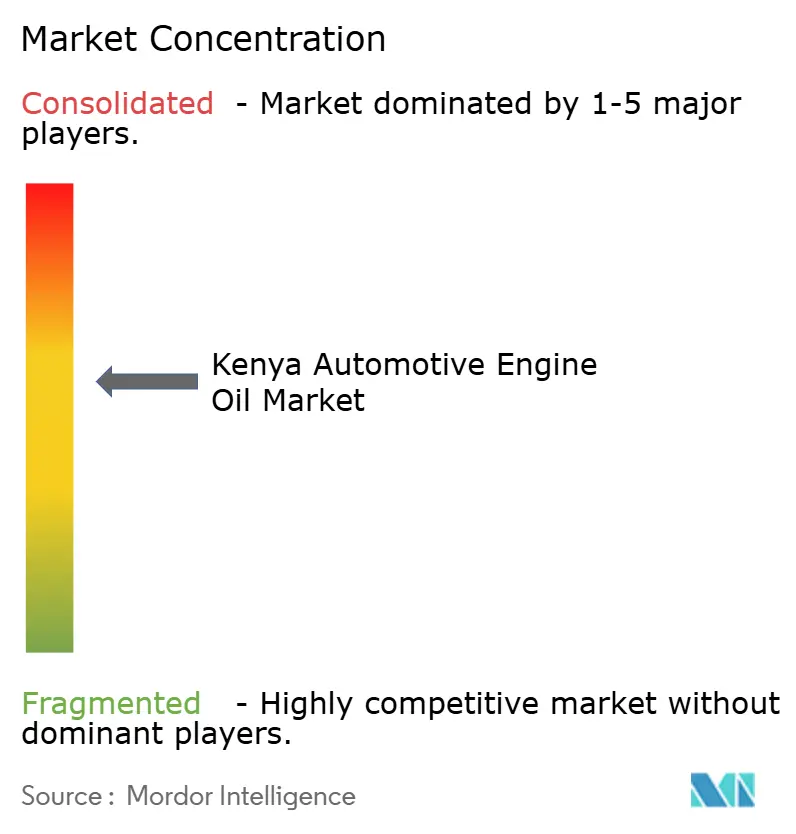
| Market Concentration | Medium |
Major Players *Disclaimer: Major Players sorted in no particular order Image © Mordor Intelligence. Reuse requires attribution under CC BY 4.0. | |
Kenya Automotive Engine Oil Market Analysis by Mordor Intelligence
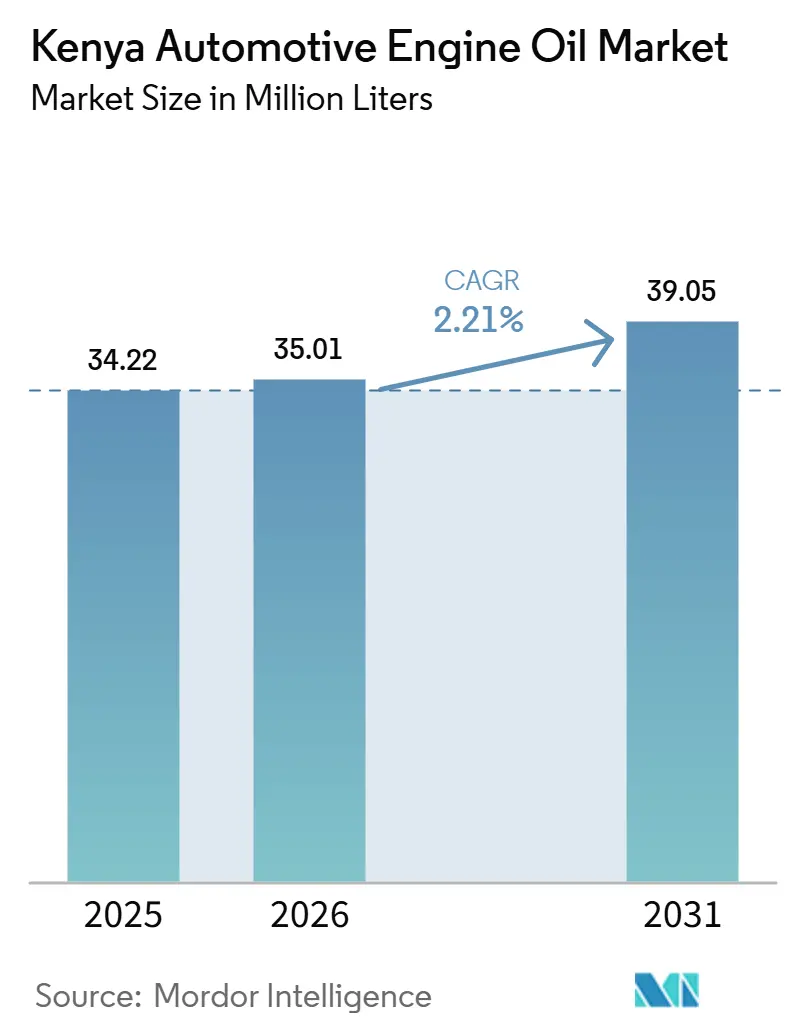
The Kenya Automotive Engine Oil Market was valued at 34.22 million liters in 2025 and is estimated to grow from 35.01 million liters in 2026 to reach 39.05 million liters by 2031, at a CAGR of 2.21% during the forecast period (2026–2031). The Kenya automotive engine oil market is supported by a registered vehicle fleet of 4.97 million units and the steady inflow of used vehicles. These factors keep the average fleet age high and continue to support regular replacement demand for engine oils. In 2025, second-hand units made up 78% of passenger car imports, which kept demand focused on shorter drain intervals and higher-viscosity mineral oils used in older vehicles and informal service channels in the Kenya automotive engine oil market. The product mix is also changing, as post-2010 imports, fleet operators, and urban workshops are using more synthetic and semi-synthetic formulations that meet original equipment manufacturer (OEM) service requirements and support longer operating cycles. Competitive positioning in the Kenya automotive engine oil market depends less on clear brand dominance and more on distribution reach, relationships with mechanics, service quality, and the ability to move buyers away from counterfeit products and toward formal retail channels. Regulation is becoming more important, but the pace of formalization will depend on how effectively brands combine compliant products, authentication tools, and affordable entry price points in mass-market outlets.
Key Report Takeaways
- By product type, Passenger Car Motor Oil held 50.94% of Kenya automotive engine oil market share in 2025, while Motorcycle Engine Oil is forecast to expand at a 2.96% CAGR through 2031.
- By base stock type, mineral oils accounted for 72.28% of the Kenya automotive engine oil market size in 2025, while synthetic oils are expected to record the highest projected CAGR at 3.08% through 2031.
- By grade, the 15W-XX segment captured 39.91% of the Kenya automotive engine oil market size in 2025, while the 5W-XX segment is expected to advance at a 3.05% CAGR through 2031.
Note: Market size and forecast figures in this report are generated using Mordor Intelligence’s proprietary estimation framework, updated with the latest available data and insights as of January 2026.
Kenya Automotive Engine Oil Market Trends and Insights
Drivers Impact Analysis*
| Drivers | (~) % Impact on CAGR Forecast | Geographic Relevance | Impact Timeline |
|---|---|---|---|
| High Average Vehicle Age and Used-Vehicle Imports | +0.7% | National, the highest intensity in Nairobi, Mombasa, and Kisumu corridors | Short term (≤ 2 years) |
| Expansion of Logistics, Ride-Hailing, and Boda-Boda Services | +0.5% | National, concentrated in Nairobi Metro, Mombasa, and secondary towns | Short term (≤ 2 years) |
| Rising Synthetic and Semi-Synthetic Adoption in Urban Centers | +0.4% | Nairobi, Mombasa, Nakuru, with spillover to peri-urban clusters | Medium term (2-4 years) |
| OEM Push for Low-Viscosity, Low-SAPS (Sulphated Ash, Phosphorus, and Sulphur) Multigrades | +0.3% | Global specification mandate with rising East Africa uptake | Medium term (2-4 years) |
| Growth of Quick-Lube Chains and Digital Aftermarket Platforms | +0.2% | Nairobi first, with early growth in Mombasa and Nakuru | Medium term (2-4 years) |
| Source: Mordor Intelligence | |||
Kenya Automotive Engine Oil Demand Remains Linked to Older Vehicle Fleet
Demand in the Kenya automotive engine oil market remains strongly linked to the age of the country’s vehicle fleet, which reached 4.97 million registered vehicles in 2024 and continued to rely heavily on used imports in 2025. The average vehicle age of 8 to 12 years keeps oil drain intervals closer to 5,000 to 7,500 km, instead of the 10,000 km intervals often stated in newer OEM manuals. This raises the need for more frequent oil replacement across passenger vehicles and commercial vehicles. As a result, the Kenya automotive engine oil market remained stable even when new vehicle registrations declined, as engine oil demand depended more on vehicle use than on first-time vehicle sales. Older vehicles also usually require higher-viscosity mineral products, which supports steady demand for common formulations in urban workshops and roadside garages. The quality standard is also becoming stronger under KS EAS 159:2024, giving compliant brands a better position in the replacement channel, although enforcement still differs by location.
Kenya Automotive Engine Oil Market Growth Driven by Boda-Boda Activity
The Kenya automotive engine oil market is growing as logistics fleets, ride-hailing services, and boda-boda activity expand across major cities and secondary towns. In 2025, the boda-boda sector contributed KES 660 billion, or USD 5.1 billion, to the economy and supported more than 2 million licensed riders, who were expected to generate KES 60 billion (USD 464.1 million) in fuel taxes annually. Motorcycle registrations rose to 241,763 units in 2025 from 118,308 units in 2024, significantly increasing the number of two-wheelers requiring regular oil changes in the Kenya automotive engine oil market. Commercial boda-boda operating cycles involve frequent starts, acceleration, heat buildup, and stop-and-go movement, so operators often change oil at intervals of 2,000 to 3,000 km, compared with longer private-use intervals. This operating pattern makes Japanese Automotive Standards Organization (JASO) MA2 10W-40 a key product battleground, especially where organized retailers can link certified quality with improved engine life and wet-clutch protection.
Synthetic and Semi-Synthetic Oils Gain Demand in Kenya Automotive Engine Oil Market
Urban demand is shifting in the Kenya automotive engine oil market as corporate fleets, ride-hailing operators, and premium car owners increasingly choose products that reduce downtime and extend service intervals. Synthetic and semi-synthetic oils meet this requirement by supporting drain intervals of 10,000 to 15,000 km, compared to 5,000 km for many mineral oils used in the mass segment. Warranty-linked service requirements for newer imported models and logistics operators’ growing focus on total operating cost, rather than first-fill price alone, further reinforce this shift. TotalEnergies has also supported this premiumization trend through its lubricant portfolio expansion and blending presence in Mombasa, enabling faster product adaptation and supply to the local market. In hot operating conditions, compliant synthetic and semi-synthetic products give organized blenders a stronger technical proposition than informal sellers, who often cannot demonstrate oxidation stability, volatility control, or full specification compliance.
Low-Viscosity Engine Oils Gain Importance in Kenya
The Kenya automotive engine oil market is slowly adjusting to the global move toward low-viscosity and low-Sulphated Ash, Phosphorus, and Sulphur (SAPS) formulations as more post-2010 vehicles enter the used-import stream[1]Mercedes-Benz AG, “Mercedes-Benz Operating Fluids, Specification Sheet MB 229.52,” Mercedes-Benz, mercedes-benz.com. Specifications such as Mercedes-Benz MB 229.52 and similar OEM requirements are moving service demand toward European Automobile Manufacturers' Association (ACEA) C3-grade 5W-30 or 0W-30 synthetic oils. These oils are very different from the 15W-40 mineral products that still dominate informal garages. ExxonMobil’s Mobil 1 ESP Formula P 5W-30 shows how global suppliers are offering approved low-viscosity products for use in hot climates and for wider aftermarket adoption over the long term. As buyers become more aware of warranty requirements, workshops that can provide records for the correct formulation and approval path are likely to gain more trust than those offering products with unclear sources. This trend explains why 5W-XX is the fastest-growing grade and why specification compliance is becoming more commercially important than basic familiarity with viscosity in the Kenya automotive engine oil market.
Restraints Impact Analysis*
| Restraints | (~) % Impact on CAGR Forecast | Geographic Relevance | Impact Timeline |
|---|---|---|---|
| High Price Sensitivity in Mass-Market Segments | -0.5% | National, with stronger pressure in rural and peri-urban markets | Short term (≤ 2 years) |
| Counterfeit and Low-Quality Lubricants in Informal Channels | -0.4% | National, concentrated in Western Kenya, Nyanza, and the Rift Valley | Short term (≤ 2 years) to medium term (2-4 years) |
| Base-Oil Import Dependence and Foreign Exchange Volatility | -0.3% | National | Medium term (2-4 years) |
| Source: Mordor Intelligence | |||
Price-Sensitive Buyers Create Pressure on Branded Suppliers
A large share of the Kenya automotive engine oil market continues to be in the price-sensitive mass segment, which is served by informal garages, roadside mechanics, and small spare-parts outlets. Low-cost mineral monograde oil is sold in 500 mL sachets for KES 200 to KES 400, or USD 1.5 to USD 3.1, keeping starting prices much lower than those of branded premium alternatives in rural and peri-urban areas. When base oil costs increase, or the Kenyan shilling becomes weaker, buyers often use engine oil for longer periods before changing it, or move to lower-grade products instead of keeping vehicles unused. The East African Community’s planned move to a harmonized USD 0.46 per-liter specific duty in 2025 reduced distributor margins and made compliance more difficult for smaller blenders that compete mainly on price. As a result, branded suppliers in the Kenya automotive engine oil market face pressure to maintain product quality while also offering affordable pack sizes and suitable price points for mainstream buyers.
Counterfeit and Low-Quality Lubricants Sold Through Informal Channels
Counterfeit products remain one of the main challenges for the Kenya automotive engine oil market, as they reduce trust in brands, lower sales of compliant products, and create unfair price competition[2]Anti-Counterfeit Authority Kenya, “ACA Seizes 399 Suspected Counterfeit Motor Lubricants in Mumias and Chavakali,” ACA Kenya, aca.go.ke. Counterfeit lubricants make up nearly 20% of lubricant volumes sold in Kenya. The Anti-Counterfeit Authority estimates annual losses from counterfeit goods across product categories at KES 800 billion, or USD 6.19 billion. In 2024, the Anti-Counterfeit Authority (ACA) seized 399 suspected counterfeit Motorol lubricants in Mumias and Chavakali, showing that the issue is not limited to Nairobi and also affects upcountry distribution points. The proposed Standards Bill 2025 and the 2025 lubricant licensing rules show a move toward stronger enforcement. However, it will take time to move from new regulations to the wider removal of counterfeit products from informal channels. Brands in the Kenya automotive engine oil market should respond by using product authentication, educating mechanics, and offering value-priced, compliant Stock Keeping Units (SKUs) to increase demand through formal channels without losing reach among mass-market customers.
*Our forecasts treat driver/restraint impacts as directional, not additive. The impact forecasts reflect baseline growth, mix effects, and variable interactions.
Segment Analysis
By Product Type: Boda-Boda Demand Supports Faster Motorcycle Engine Oil Growth
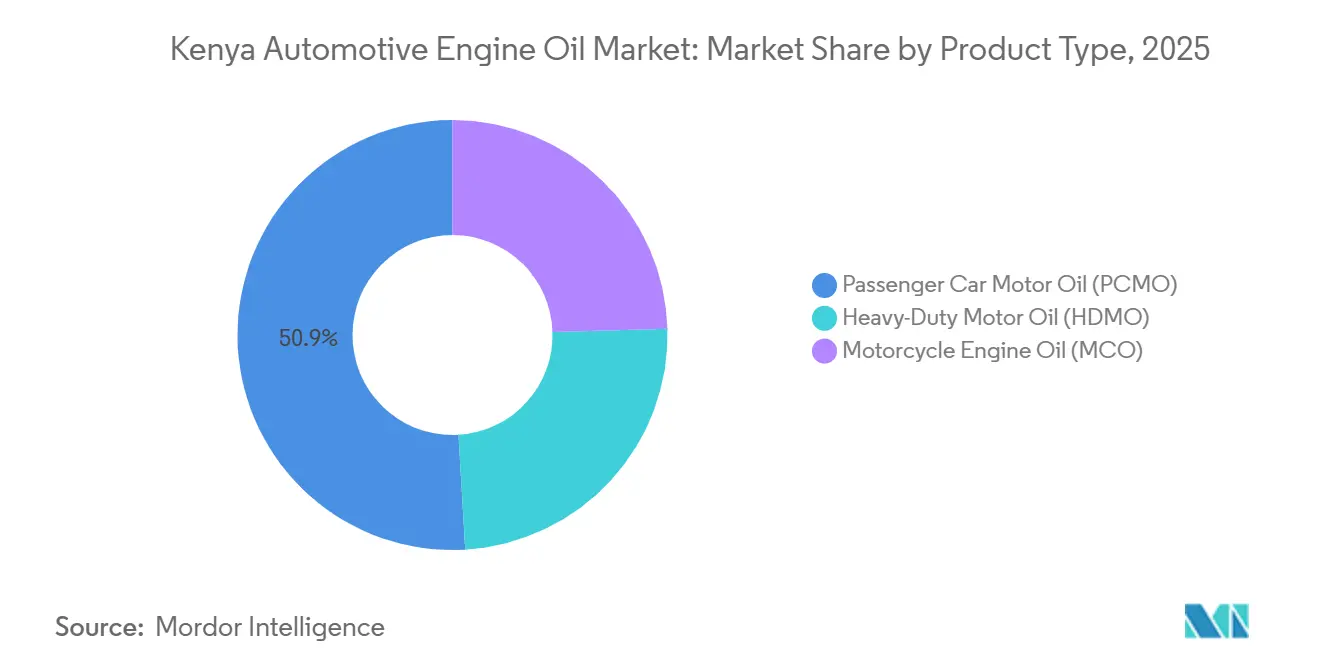
Passenger car motor oil led the Kenya automotive engine oil market with a 50.94% volume share in 2025. This position reflects the large number of passenger vehicles in the country and the strong presence of used Japanese sedans, hatchbacks, and compact SUVs on Kenyan roads. This segment remains the widest service category across organized workshops and informal garages because the passenger vehicle fleet is larger, more spread out, and serviced more often than specialized vehicle groups. Older imported passenger cars also favor mid- to higher-viscosity products, which supports steady demand for mainstream mineral and semi-synthetic Passenger Car Motor Oil (PCMO) products. Heavy-duty motor oil remains closely linked to freight transport, public transport, and corridor trucking, where vehicle replacement is slow, and many operators continue to use proven 15W-40 CI-4 mineral formulations.
Motorcycle engine oil is projected to expand at a 2.96% CAGR through 2031, making it the fastest-growing product group in the Kenya automotive engine oil market. This growth is supported by the strong rise in boda-boda activity, motorcycle registrations more than doubling in 2025, and commercial use requiring much shorter oil-drain cycles than private motorcycles. JASO MA2 10W-40 has become the main specification in this segment because wet-clutch performance is important in frequent commercial riding conditions. As the Kenya automotive engine oil market adjusts to this demand, MCO suppliers that provide certified quality, smaller packs, and wide local availability will be better positioned to gain share from low-grade informal products.


By Base Stock Type: Mineral Oils Remain Dominant While Synthetic Oils Gain Economic Appeal
Mineral oils accounted for 72.28% of the Kenya automotive engine oil market by volume in 2025, showing that price sensitivity, older vehicle fleets, and informal servicing behavior continue to shape demand. Owners of 8- to 12-year-old used vehicles often choose mineral formulations because these products match the mechanical needs of aging engines and fit within regular maintenance budgets. Semi-synthetic oils have created a practical middle category, especially among urban drivers and fleet managers who want better performance without paying the full cost of premium synthetic oils. Bio-based engine oils remain commercially limited and are still closer to pilot-stage use than to broad-volume demand in the Kenya automotive engine oil market.
Synthetic oils are projected to grow at a CAGR of 3.08% through 2031, the fastest growth rate among base stock types in the Kenya automotive engine oil market. This growth reflects a stronger business case for fleets that focus on reducing downtime, extending drain intervals, and meeting OEM service requirements more easily for newer imported models. The cost position has also improved under the specific duty framework, as higher-value synthetic products protect absolute margins better than very low-margin mineral blends. TotalEnergies’ 15.2-kiloton Mombasa blending plant gives the company a local supply and formulation advantage, helping synthetic and semi-synthetic oils scale up more effectively than an import-only approach.
By Grade: 15W-XX Holds the Largest Volume Share, While 5W-XX Gains from Specification-Led Demand
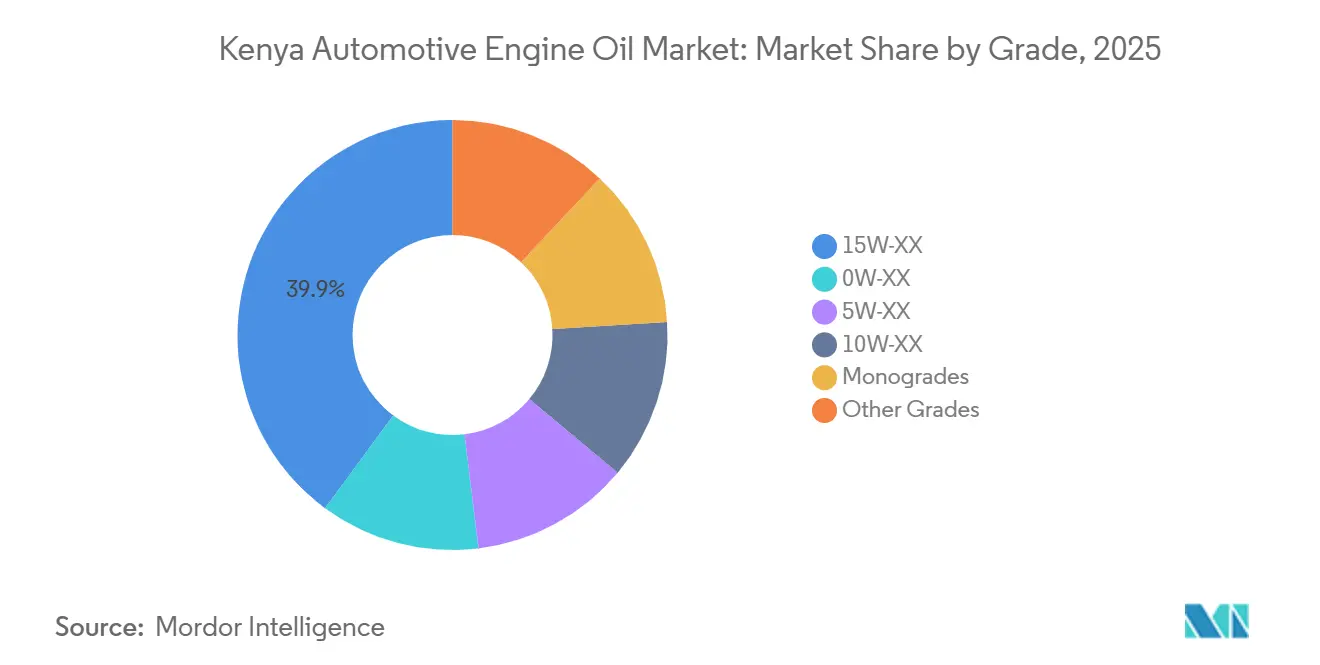
The 15W-XX segment accounted for 39.91% of the Kenya automotive engine oil market by volume in 2025, making it the largest viscosity category across commercial vehicles and many older passenger cars. This grade is still widely used in the heavy-duty fleet, as trucks running on the Northern Corridor and related freight routes continue to use SAE 15W-40 formulations that suit local operating conditions and remain familiar to operators. Monograde products still support older motorcycles and rural equipment, but their use is declining as newer engines increasingly require multigrade oils and regulation becomes more visible in formal trade. The 10W-XX range continues to serve a practical middle position for older Japanese passenger cars, where mechanics often work with a wider tolerance range than they do for newer engines that follow OEM specifications.
The 5W-XX family is forecast to grow at a CAGR of 3.05% through 2031, making it the fastest-growing grade group in the Kenya automotive engine oil market. This growth is supported by the rising number of post-2010 Korean and European imports, which need lighter and more advanced formulations under OEM maintenance schedules. Approved products, such as Mobil 1 ESP Formula P 5W-30, show this move toward demand based on product specifications rather than only on low-cost replacement behavior. The 0W-XX category remains small, but it is already setting a premium standard among urban workshops that serve warranty-conscious owners of imported European diesel and hybrid models.
Geography Analysis
The Kenya automotive engine oil market shows strong demand in urban areas, with Nairobi holding the largest share of lubricant demand through formal channels, although the source draft does not provide a precise regional volume split. Nairobi’s position is supported by its large number of ride-hailing fleets, logistics operators, organized workshops, and premium private vehicle owners, who are more likely to buy branded PCMO and synthetic products. The city also has stronger formal retail infrastructure, which makes specification-led selling and repeat servicing easier than in fragmented rural trade. As a result, Nairobi remains the most important area for pricing, brand visibility, and product mix within the Kenya automotive engine oil market.
Mombasa forms the second key demand cluster, as it acts as the import gateway for East Africa and supports the trucking base linked to port activity and inland corridor movement. Cargo throughput at the Port of Mombasa rose by 11.2% in 2025, directly supporting HDMO demand as more freight vehicles move along the Northern Corridor toward Nairobi, Kampala, and Kigali. The July 2025 logistics agreement reduced lubricant testing and port inspection turnaround time to 7 hours, also improving conditions for compliant suppliers operating through formal import channels. Kisumu, Nakuru, and Eldoret are also becoming more important, as they combine rising boda-boda density with regional transport roles that support both passenger and commercial lubricant use. In practical terms, these secondary cities help expand demand beyond the Nairobi-Mombasa axis while still following many of the same fleet and service patterns.
Rural and upcountry regions across the Rift Valley, Western Kenya, Nyanza, and the coast hinterland remain the most price-sensitive parts of the Kenya automotive engine oil market. These areas also face the highest counterfeit risk, as informal mechanics and small retail outlets often stock low-cost mineral monograde or unverified multigrade products from unlicensed channels. ACA’s seizure in Mumias and Chavakali showed that counterfeit supply has spread well beyond large city wholesale points. Over time, brands that extend authentication tools and mechanic engagement into these upcountry markets will be better positioned to convert informal demand into compliant repeat sales.
Competitive Landscape
The Kenya automotive engine oil market is moderately consolidated. Vivo Energy, TotalEnergies, and Rubis Energy Kenya together control the majority of Kenya’s petroleum retail market by volume, giving each company wide forecourt coverage and regular access to lubricant buyers. This scale is important because forecourts remain one of the most organized channels for brand visibility, customer trust, and repeat service demand in the Kenya automotive engine oil market. Specialist brands such as FUCHS and MOTUL continue to operate in smaller premium segments, while OLA Energy, Oryx Energies, Gulf Oil International, and National Oil compete more through easier access and competitive pricing outside the most organized retail outlets. This situation keeps competition active across several channels instead of limiting it only to premium branded service stations.
The strongest competitive advantages now extend beyond basic product formulation and include control over service networks, mechanic loyalty, and tools that help build customer trust and reduce buyer uncertainty in the Kenya automotive engine oil market. TotalEnergies has a clear structural advantage through its ISO 9000-certified Mombasa lube oil blending plant, which is the largest in East and Central Africa and has an annual capacity of 15.2 kilotons. This local production base helps the company make faster formulation changes, maintain a steadier local supply, and manage its product portfolio more quickly than a business model that depends only on imported finished lubricants. The company also strengthened its position in the heavy-duty segment through the November 2024 relaunch of its Rubia line with API CK-4 and ACEA E9 specifications, which directly addressed the needs of long-haul trucking fleets.
Rubis Energy Kenya and National Oil also played an important strategic role through their March 2025 partnership, which expanded Castrol-branded lubricant distribution through National Oil's network. Vivo Energy continues to use its wide Shell retail network to improve access to premium synthetic products for both private and commercial vehicle owners. At the same time, new rules under the 2025 lubricant licensing framework increased the compliance requirements for smaller informal blenders and importers, gradually favoring companies that can prove product quality and maintain traceable distribution. The main open opportunity remains in MCO distribution, where companies that combine smaller pack sizes, digital verification, and stronger outreach to boda-boda mechanics can still gain additional volume that traditional forecourt models do not fully capture.
Kenya Automotive Engine Oil Industry Leaders
Vivo Energy
TotalEnergies
Rubis Energy Kenya
BP p.l.c.
Exxon Mobil Corporation
- *Disclaimer: Major Players sorted in no particular order

Recent Industry Developments
- March 2025: The Competition Authority of Kenya approved a non-equity strategic partnership between Rubis Energy Kenya and the National Oil Corporation of Kenya. As part of this partnership, Rubis committed USD 46.4 million, or KES 6 billion, to improve and modernize the National Oil Corporation of Kenya's (NOC's) downstream operations, increase the number of retail outlets, and introduce a new Enterprise Resource Planning (ERP) system.
- July 2025: The East African Community replaced ad-valorem lubricant tariffs with a harmonized specific duty of USD 0.46 per liter across member states. This change made landed-cost benchmarks more equal across the region while reducing distributor margins by 10% for compliant importers and local blenders.


Kenya Automotive Engine Oil Market Report Scope
Automotive engine oils are liquid substances made from mineral or synthetic base oils. Their main purpose is to reduce surface friction in automotive machinery and moving parts, which helps minimize energy loss caused by friction. These oils also help clean and cool machinery parts and protect metal components from corrosion and rust.
The Kenya automotive engine oil market is segmented by product type, by base stock type, and by grade. By product type, the market is segmented into passenger car motor oil (PCMO), heavy-duty motor oil (HDMO), and motorcycle engine oil (MCO). By base stock type, the market is segmented into mineral, synthetic, semi-synthetic, and bio-based, and by grade type, the market is segmented into 0W-XX, 5W-XX, 10W-XX, 15W-XX, monogrades, and other grades. The market sizes and forecasts are provided in terms of volume (Liters).
| Passenger Car Motor Oil (PCMO) |
| Heavy-Duty Motor Oil (HDMO) |
| Motorcycle Engine Oil (MCO) |
| Mineral |
| Synthetic |
| Semi-Synthetic |
| Bio-Based |
| 0W-XX |
| 5W-XX |
| 10W-XX |
| 15W-XX |
| Monogrades |
| Other Grades |
| By Product Type | Passenger Car Motor Oil (PCMO) |
| Heavy-Duty Motor Oil (HDMO) | |
| Motorcycle Engine Oil (MCO) | |
| By Base Stock Type | Mineral |
| Synthetic | |
| Semi-Synthetic | |
| Bio-Based | |
| By Grade | 0W-XX |
| 5W-XX | |
| 10W-XX | |
| 15W-XX | |
| Monogrades | |
| Other Grades |


Key Questions Answered in the Report
What is the size of the Kenya automotive engine oil market?
The Kenya automotive engine oil market stands at 35.01 million liters in 2026 and is expected to reach 39.05 million liters by 2031.
Which product category leads demand in Kenya?
Passenger Car Motor Oil is the largest category, with a 50.94% volume share in 2025 because the country has a large used passenger vehicle fleet.
Why are motorcycle lubricants growing faster than other products?
Motorcycle Engine Oil is growing fastest at 2.96% CAGR through 2031 because boda-boda use is commercial, high-frequency, and tied to shorter oil-drain intervals.
Which viscosity grade has the strongest position today?
The 15W-XX grade led with 39.91% of volume in 2025, largely because it remains the standard choice for much of the heavy-duty fleet and many older vehicles.
Page last updated on:





