
Market Overview
| Study Period | 2020 - 2031 |
|---|---|
| Forecast Data Period | 2026 - 2031 |
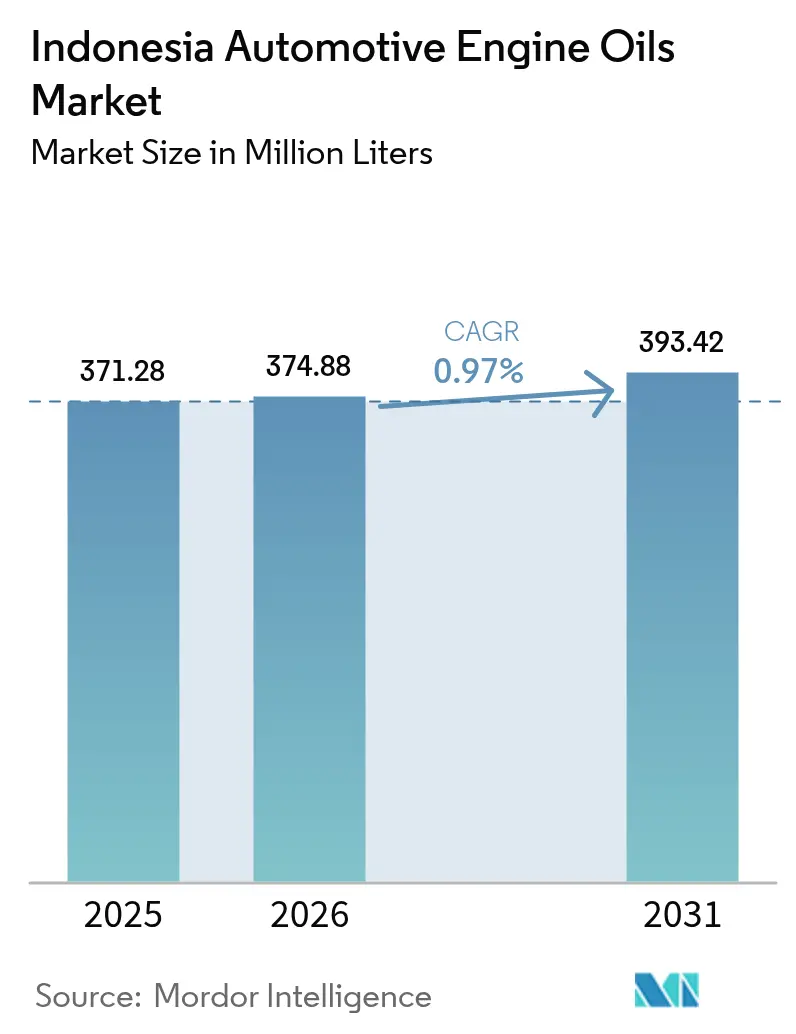
| Base Year Market Size (2025) | 371.28 Million liters |
| Market Volume (2026) | 374.88 Million liters |
| Market Volume (2031) | 393.42 Million liters |
| Growth Rate (2026 - 2031) | 0.97 % |
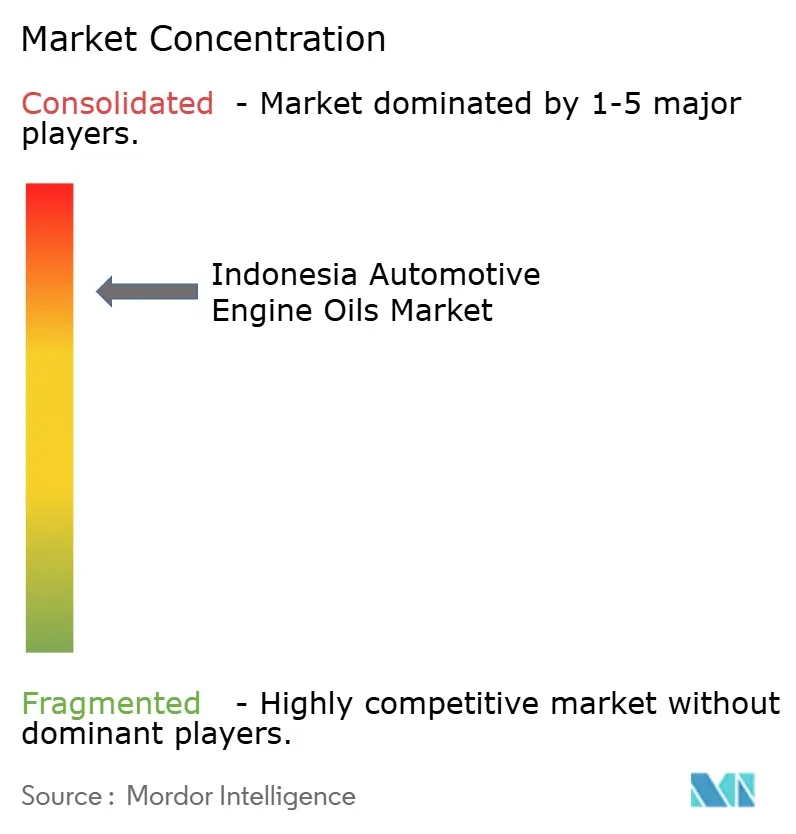
| Market Concentration | High |
Major Players *Disclaimer: Major Players sorted in no particular order Image © Mordor Intelligence. Reuse requires attribution under CC BY 4.0. | |
Indonesia Automotive Engine Oils Market Analysis by Mordor Intelligence
The Indonesian Automotive Engine Oils Market size was valued at 371.28 million liters in 2025 and estimated to grow from 374.88 million liters in 2026 to reach 393.42 million liters by 2031, at a CAGR of 0.97% during the forecast period (2026-2031). Persistent population growth, accelerating urbanization, and a vehicle parc that already exceeds 138 million units continue to underpin baseline demand despite macro-economic volatility. Motorcycles remain the backbone of personal mobility, while rising middle-class incomes foster gradual passenger-car penetration. OEM specifications are moving toward low-viscosity synthetic formulations, spurring product mix upgrades even as overall volumes advance at a measured pace. Simultaneously, mandatory Indonesian National Standard (SNI) compliance and the planned Euro 4 fuel transition are elevating the technical threshold for suppliers, rewarding firms that can deliver rapid formulation updates. Competitive intensity is shaped by Pertamina’s cost-advantaged refining base, Shell’s and ExxonMobil’s technology portfolios, and the emergence of Chinese brands that leverage price positioning.
Key Report Takeaways
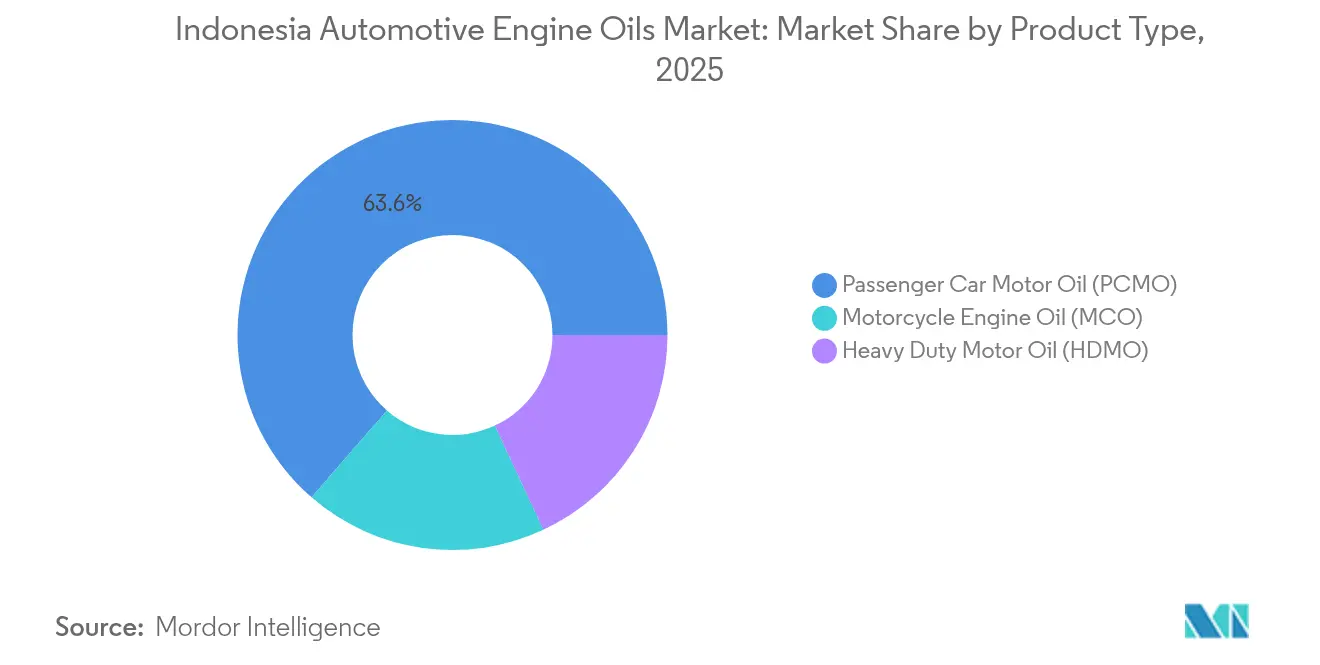
- By product type, passenger car motor oil captured 63.62% of Indonesia automotive engine oil market share in 2025, while motorcycle engine oil is set to expand at a 1.14% CAGR through 2031, the fastest among all resin segments.
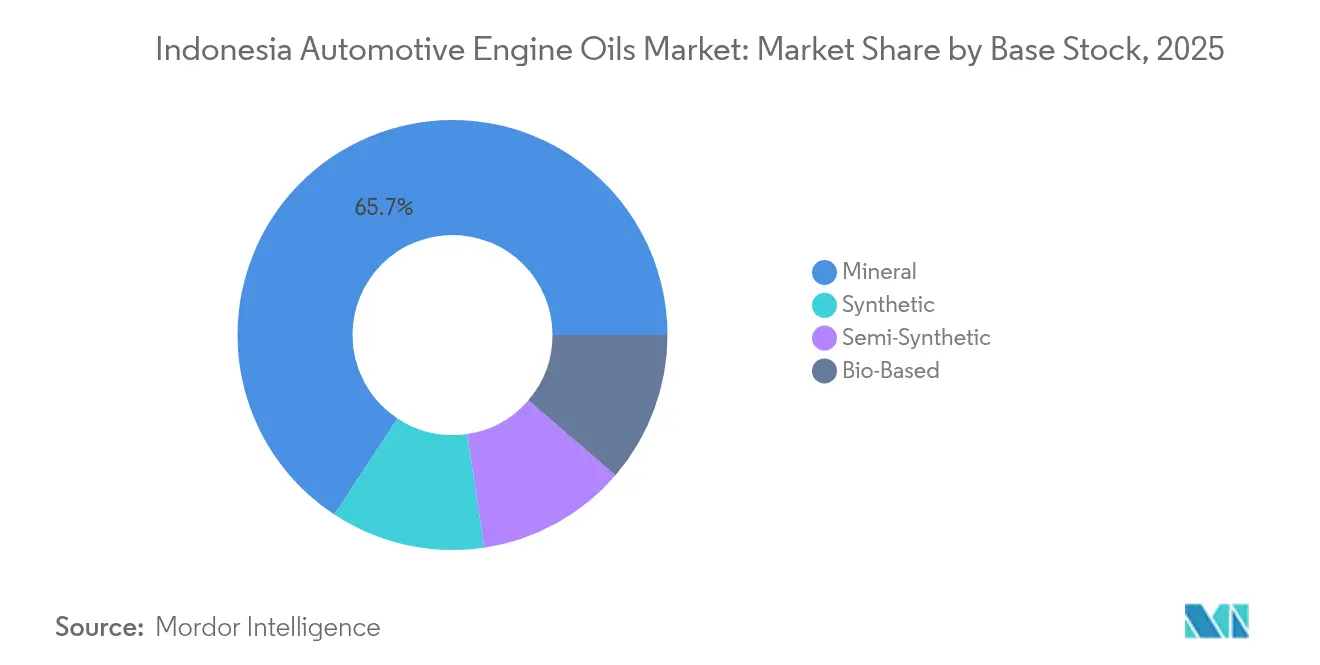
- By base stock, mineral oils commanded 65.74% share of the Indonesia automotive engine oil market size in 2025, while synthetic base stocks are forecast to grow at a 1.21% CAGR between 2026 and 2031.
Note: Market size and forecast figures in this report are generated using Mordor Intelligence’s proprietary estimation framework, updated with the latest available data and insights as of 2026.
Market Trends and Insights
Drivers Impact Analysis of Indonesia Automotive Engine Oils Market*
| Drivers | (~) % Impact on CAGR Forecast | Geographic Relevance | Impact Timeline |
|---|---|---|---|
| Rapid growth of vehicle parc | +0.4% | Java and Sumatra lead, national influence | Medium term (2-4 years) |
| OEM push toward low-viscosity oils | +0.2% | Jakarta and Surabaya concentrate early adoption | Long term (≥ 4 years) |
| Rising motorcycle ownership | +0.3% | Urban centers plus emerging cities | Short term (≤ 2 years) |
| Government incentives for cleaner engines | +0.1% | Initial uptake in major metropolitan areas | Long term (≥ 4 years) |
| Ride-hailing fleet expansion | +0.1% | Jakarta, Surabaya, Bandung and tier-2 spillovers | Medium term (2-4 years) |
| Source: Mordor Intelligence | |||
Rapid Growth of Vehicle Parc Drives Base Demand
Indonesia’s 138 million-unit vehicle population, including 113 million motorcycles, produces an unmatched aftermarket lubricant opportunity. Government tax incentives propelled car sales to 81,230 units in February 2022, a 65% year-on-year jump[1]. More cars and two-wheelers translate directly into higher lubricant change frequencies, while new toll roads lengthen average kilometers traveled. These factors shift the Indonesian automotive engine oil market from pure replacement to incremental volume expansion as new vehicle additions consistently outrun fleet retirements.
OEM Specifications Shift Toward Advanced Formulations
Global and local automakers are standardizing on API SP or higher for gasoline engines and advocating 0W or 5W grades to optimize thermal management and fuel economy[2]. Motorcycle applications lag at API SN but are expected to follow by 2027. Motul and other premium brands already promote 10W-30 and 10W-40 synthetics for future-proofing against tighter emission norms. Suppliers enjoying early-mover advantage in synthetic technology can achieve double-digit margin premiums while educating workshops on viscosity migration. Consumers gravitate toward better cold-start protection and extended service intervals, accelerating the premiumization of the Indonesia automotive engine oil market.
Rising Motorcycle Ownership Sustains Volume Growth
Two-wheelers generated 6.91 million units of domestic production and 6.33 million units of sales in 2024, reinforcing Indonesia’s status as Southeast Asia’s largest motorcycle hub. Automatic transmission bikes command over 90% of purchases, necessitating JASO MB-compliant oils engineered for CVT systems. Frequent oil-change intervals caused by high-temperature urban stop-and-go riding maintain robust baseline demand. Exports of 572,000 completely built motorcycles further drive production utilization and pull through lubricant requirements aligned with international OEM standards.
Government Incentives Accelerate Technology Adoption
The state offers 3% PPnBM DTP for hybrids and 10% VAT relief for battery electric vehicles that achieve 40% local content. Electric car sales hit 37,619 units in 2024, yet still represent just 6.25% of passenger-vehicle volume. Euro 4 fuel implementation, set for 2027–2028, will mandate lower sulfated ash formulations to safeguard catalytic converters. B40 biodiesel from January 2025 already requires oxidation-stable diesel lubricants, spurring ExxonMobil’s release of Mobil Delvac 1™ B40 variants. These regulations reward suppliers with agile research and development and certification capabilities.
Restraints Impact Analysis of Indonesia Automotive Engine Oils Market*
| Restraints | (~) % Impact on CAGR Forecast | Geographic Relevance | Impact Timeline |
|---|---|---|---|
| Lengthening drain intervals | −0.2% | Higher in urban centers with newer vehicles | Medium term (2-4 years) |
| Uptake of electric two-wheelers | −0.1% | Jakarta, Surabaya, Bandung subsidy clusters | Long term (≥ 4 years) |
| Counterfeit/adulterated lubricants | −0.1% | Price-sensitive rural markets | Short term (≤ 2 years) |
| Source: Mordor Intelligence | |||
Lengthening Drain Intervals Reduce Consumption Frequency
Synthetic oils support 10,000-kilometer service intervals versus 5,000 kilometers for conventional blends. Newer low-cost green cars employ tighter tolerances and smaller sumps that cut per-service volumes. Fleet managers favor higher-priced synthetics because lifetime cost per kilometer falls, trimming absolute liters consumed even as revenue per liter rises. Motorcycles adopt improved circulation that extends oil life, yet congestion-induced stop-start driving partly offsets the interval expansion.
Electric Two-Wheelers Introduce Long-Term Displacement Risk
Government subsidies covering 35,714 battery-electric motorcycles create early-stage momentum, but electric units still form just 0.05% of the national fleet. High upfront costs and sparse charging infrastructure impede rapid adoption, according to ITB research. Yet policy support and falling battery prices could accelerate uptake beyond conservative forecasts, posing a structural headwind to the Indonesian automotive engine oil market in the long run.
*Our forecasts treat driver/restraint impacts as directional, not additive. The impact forecasts reflect baseline growth, mix effects, and variable interactions.
Indonesia Automotive Engine Oils Market Segment Analysis
By Product Type:
Passenger cars lead while motorcycles pace growthThe Indonesia automotive engine oil market size for passenger car motor oil accounted for 63.62% of the total volume in 2025. API SP upgrades and 0W-20 viscosity adoption underpin premiumization. OEM factory-fill contracts provide early volume security and brand loyalty that extend into the aftermarket. Heavy-duty motor oil serves logistics and agriculture, with B40-ready formulations becoming a prerequisite.
Motorcycle engine oil volume is projected to climb at a 1.14% CAGR through 2031. Continuous city riding elevates lubricant stress, supporting higher change frequencies. JASO MB specifications for automatic clutch designs create differentiation opportunities, illustrated by Shell Advance City Scooter’s full-synthetic launch in June 2025. As disposable income rises, riders shift from mineral 20W-50 to semi-synthetic 10W-40, lifting average revenue per liter.

By Base Stock:
Mineral holds volume but synthetics capture valueMineral formulations accounted for 65.74% of Indonesia automotive engine oil market share in 2025, driven by state-owned Pertamina’s integrated refining economics. Large-scale depots and 5,000 fuel stations guarantee nationwide availability, reinforcing consumer trust. Semi-synthetics act as a price-performance bridge, appealing to cost-sensitive fleets that still require API SP compliance.
The synthetic segment posted a 1.21% CAGR toward 2031, supported by OEM low-viscosity mandates and extended drain-interval economics. Pertamina’s Group III base-oil JV in Dumai and Shell’s USD 12 million grease plant in Marunda localize supply chains, reducing import costs and lead times. Bio-based lubricants leveraging domestic palm oil remain nascent but align with future sustainability mandates.
Geography Analysis
Java anchors the Indonesian automotive engine oil market through dense vehicle ownership, OEM assembly hubs, and high ride-hailing penetration. Jakarta’s Jabodetabek megacity concentrates 30% of national passenger cars and 25% of motorcycles, driving workshop demand for both mineral and synthetic grades. The completed Trans-Java Toll Road has lengthened trip distances, lifting per-vehicle lubricant consumption. Pertamina’s Plumpang depot and Shell’s Marunda plant ensure same-day fulfillment across Greater Jakarta.
Sumatra is buoyed by palm-oil plantations and logistics corridors that utilize heavy-duty diesel engines. Mining expansion in South Sumatra and Riau accelerates the uptake of high-performance synthetics that can withstand abrasive particulates and B40 fuel blends. Meanwhile, Kalimantan’s coal and nickel operations present concentrated industrial demand clusters that favor suppliers offering on-site lubrication management.
Infrastructure gaps inflate logistics costs, so suppliers with regional warehouses and distributor partnerships gain a service-level edge. Government plans for new mining smelters and the planned Batang Toru hydropower project will increase heavy equipment fleets, creating additional pull for diesel engine oils.
Regulatory Landscape
Indonesia mandates Indonesian National Standard (SNI) compliance for motor-vehicle lubricating oils, overseen through the Ministry of Industry and the National Standardization Agency (BSN), with product certification evidenced via SPPT-SNI. A key 2025 update was Ministry of Industry Regulation No. 8 of 2025 (issued in July 2025), which replaced the earlier 2018 framework and tightened compliance mechanics for producers, importers, and distributors of automotive lubricants.
The 2025 regulation also shifted certification administration toward digital processing through SIINas (Sistem Informasi Industri Nasional). It shortened SPPT-SNI validity to one year and accelerated administrative processing (as summarized in the evidence pack), while keeping mandatory coverage across engine oils (two-stroke and four-stroke), diesel engine oils, and related drivetrain lubricant categories. With sanctions linked to Law No. 3 of 2014 on Industry and potential revocation of SPPT-SNI, compliance and traceability have become core operating requirements for brands and channel partners in Indonesia.
Value Chain Analysis
The value chain starts with base oils and additive packages, then moves through local blending or manufacturing, packaging, certification, and multi-tier distribution into OEM and aftermarket channels. Indonesia operates a hybrid supply model, with base stocks and additives able to be imported under the broader lubricant provision framework (including Presidential Decree No. 21 of 2001), while domestic blending and manufacturing support nationwide demand. Key participants include PT Pertamina Lubricants, PT ExxonMobil Lubricants Indonesia (PT EMLI), Shell Indonesia, PT Fuchs Lubricants Indonesia, and PT Wiraswasta Gemilang Indonesia (Evalube).
Mandatory SNI compliance under Ministry of Industry Regulation No. 8 of 2025 creates a formal gate between production or import and commercialization. Applications are handled via SIINas, with certification tied to audits and quality-system verification. Downstream, the route-to-market is anchored by fuel-retail networks, distributors, workshops, and fleet or service concepts that bundle oil-change services, which increases the value of channel control and availability in high-turnover motorcycle and passenger-car service points.
Competitive Landscape
The market is highly consolidated in nature. Shell Indonesia operates a local blending plant that produces 99% of its domestic portfolio and is completing a USD 12 million grease expansion aimed at 12 million liters per year. Digital platforms are becoming a battleground. Shell’s Value Improvement Program offers data analytics on oil condition, while Pertamina’s RFID inventory tracking enhances reseller transparency. These service extensions lock in workshops and fleets, raising switching costs and intensifying competition within the Indonesia automotive engine oil market.
Indonesia Automotive Engine Oils Industry Leaders
-
BP plc
-
Chevron Corporation
-
Exxon Mobil Corporation
-
PT Pertamina
-
Shell plc
- *Disclaimer: Major Players sorted in no particular order
Indonesia Automotive Engine Oils Market Companies Covered in this Report
- BP plc
- Chevron Corporation
- ENEOS Corporation
- Exxon Mobil Corporation
- FUCHS
- Gazpromneft-Lubricants Ltd.
- Idemitsu Kosan Co. Ltd.
- PETRONAS Lubricants International
- PT Pertamina
- PT Surganya Motor
- PT Wiraswasta Gemilang Indonesia
- Repsol
- Shell plc
- Sinopec Lubricant Co. Ltd.
- TOP 1 Oil Products Company
- TotalEnergies
Market Opportunities and Future Outlook
Compliance-driven portfolio modernization is a clear whitespace area as Indonesia enforces mandatory SNI under Ministry of Industry Regulation No. 8 of 2025 and routes certification through SIINas. Certification support capacity is anchored by designated bodies such as Balai Besar Logam dan Mesin (BBLM) as an LSPro for lubricant SNI certification. The faster administrative processing introduced in the 2025 update reduces time-to-market friction for compliant SKUs, which supports more frequent formulation refresh cycles and helps brands extend their certified product breadth across grades and applications.
Product-mix upgrading also aligns with shifts already referenced in the report context, including OEM movement toward lower-viscosity and higher-performance specifications and diesel-side requirements connected to B40 biodiesel implementation from January 2025. Localization and supply-side capacity further support structured partnerships with domestic producers and blenders. For example, Pertamina Lubricants Production Unit Gresik (120,000 KL per year) can underpin differentiated offerings for workshop and fleet channels that want verified, traceable products in a market with recurring counterfeit or adulterated lubricant concerns.
Recent Industry Developments in Indonesia Automotive Engine Oils Market
- July 2026: Pertamina Lubricants highlighted reinforcement of its Production Unit Gresik operations (120,000 KL per year) as part of maintaining national lubricant availability. The continued focus on domestic production capacity supports supply reliability for automotive engine oils and reduces execution risk tied to compliance-driven portfolio turnover under mandatory SNI.
- January 2025: Shell Indonesia launched Shell Advance City Scooter full-synthetic oil in 10W-40 and 10W-30 grades for automatic transmission scooters. The launch strengthened premium motorcycle engine-oil positioning in a market where JASO MB-oriented scooter applications dominate and workshop recommendations influence brand switching.
- March 2024: Pertamina Lubricants relaunched the Meditran Series commercial oils meeting Mercedes-Benz 228.3 and Volvo VDS-3 specifications. The update reinforced competitiveness in heavy-duty and fleet-aligned segments where international OEM specifications and durability claims affect procurement decisions.
Indonesia Automotive Engine Oils Market Report Scope and Research Methodology
Market Definition and Coverage
This market covers automotive engine oils sold and used in Indonesia for lubricating internal combustion engines across on-road vehicle activity, and it is measured across the full sales value created from product pricing and volumes in the country.
Scope exclusions: We exclude industrial engine oils used in stationary equipment, marine lubricants, and non-engine automotive fluids such as transmission oils, gear oils, brake fluids, and coolants.
Segments Covered in This Report
- By Product Type
- Passenger Car Motor Oil (PCMO)
- 0W-XX
- 5W-XX
- 10W-XX
- 15W-XX
- Monogrades
- Other Grades
- Heavy Duty Motor Oil (HDMO)
- 0W-XX
- 5W-XX
- 10W-XX
- 15W-XX
- Monogrades
- Other Grades
- Motorcycle Engine Oil (MCO)
- 0W-XX
- 5W-XX
- 10W-XX
- 15W-XX
- Monogrades
- Other Grades
- Passenger Car Motor Oil (PCMO)
- By Base Stock
- Mineral
- Synthetic
- Semi-Synthetic
- Bio-Based
Data Sources, Market Sizing, and Validation
Desk Research
Desk work starts with mapping the vehicle and lubricant demand pool, then aligning it with policy and compliance signals that influence oil choice and drain intervals. Public sources such as Statistics Indonesia (BPS), the Ministry of Energy and Mineral Resources, the Ministry of Industry, and the Ministry of Transportation help frame macro activity, fuel trends, and vehicle movement patterns that indirectly shape engine oil consumption.
On the automotive side, we also review sources such as the Indonesian Automotive Industry Association (GAIKINDO), customs and trade statistics, and technical references from standards bodies, including SNI-related documents where applicable. Company annual reports, investor presentations, and credible press coverage are used to understand product mix shifts, retail channel signals, and price positioning, and we use a paid subscription for company financials and intelligence selectively to cross-check supplier scale and operating footprint. These sources are not exhaustive, and many other references are reviewed to collect, validate, and clarify data points during the study.
Primary Interviews and Surveys
Primary work is used to pressure-test the demand logic for engine oils in Indonesia, especially around motorcycle-heavy usage, workshop behavior, and shifts toward synthetic and lower-viscosity grades. We speak with a mix of manufacturers and blenders, distributors and retailers, and service and workshop stakeholders, and then adjust assumptions when the feedback implies a different drain interval, pack size mix, or channel margin structure. For this country study, we validate inputs across major consumption pockets and route-to-market types so the final model reflects real buying and servicing patterns.
Distribution of primary research fieldwork respondents
| Company type | Respondent position |
|---|---|
| Top tier: 36% | CXOs: 16% |
| Mid tier: 44% | Functional/Unit leaders: 25% |
| Smaller Players: 20% | Managers: 59% |
Market-Sizing & Forecasting
We build the market using a top-down demand pool that reconstructs national engine oil consumption from the active vehicle parc, typical oil sump sizes, and expected drain intervals by vehicle usage patterns. We then convert volumes into value using observed retail and channel price bands.
To keep the logic grounded, we run selective bottom-up checks using sampled brand and channel price points, workshop throughput checks, and supplier scale indicators, and we use the results to tune the totals when gaps show up.
Key inputs that influence the model include the split between motorcycles and passenger vehicles, annual kilometers traveled, oil change frequency, the share of synthetic and semi-synthetic oils, and the pace of specification shifts tied to emissions and local compliance requirements. Forecasting is done using scenario analysis supported by trend smoothing, where variables such as vehicle parc growth, replacement cycles, and price progression move together in a consistent way. The final path is validated against what practitioners expect in the near term. When a data point is not available at the needed cut, we interpolate using nearby observable indicators and then re-check it during interviews so the gap handling stays transparent and practical.
Data Validation & Update Cycle
Outputs are checked through multiple steps so obvious errors and hidden double counts do not pass through. We compare results with independent signals such as parc trends, lubricant trade flows, and typical service frequency ranges, and any sharp variances trigger a re-check of assumptions and follow-up with industry participants.
Before sign-off, another analyst reviews the model logic, inputs, and year-to-year movements, and reconciles anomalies with source notes. Reports are refreshed annually, with interim updates when material events change pricing, regulations, or vehicle activity, and we do a final data pass close to delivery so clients receive an updated view.
Mordor Intelligence's Indonesia Automotive Engine Oils Market Estimate Compared With Other Published Estimates
Published market sizes for Indonesia automotive engine oils can look far apart, and authors often differ on measurement units, whether they combine nearby lubricant categories, or how they assume drain intervals and synthetic conversion. We also see gaps from how prices are treated across retail packs versus bulk channels, and from the year and exchange rate timing used in conversion.
Some external figures fold broader automotive lubricants into the engine oil total, or they lift value directly from a high retail price point without rebalancing it for the workshop and distributor mix. In Mordor Intelligence, the sizing keeps engine oils separate from other automotive fluids and ties value to the vehicle parc driven volume model, with price bands refreshed using channel checks before finalizing the year total.
Benchmark comparison
| Source | Market Size | Gaps in Research Methodology |
|---|---|---|
| Mordor Intelligence | USD 0.37 B (2025) | |
| Global Consultancy A | USD 0.60 B (2026) | This estimate appears to apply a higher blended price and a broader product scope, which can happen when premium retail packs and adjacent lubricant categories are combined into one value number. |
| Industry Portal B | USD 0.37 B (2022) | The figure is reported as a simple USD total without clear conversion logic, and it may reflect a single-year snapshot that is not aligned to consistent drain interval and channel mix assumptions. |
Overall, the spread is mainly explained by scope choices and how volume-to-value conversion is handled across pack sizes and channels. When the demand pool is built from observable vehicle activity and validated with realistic price bands, the resulting market value stays easier to trace and repeat year after year.
Key Questions Answered in the Report
What is the current volume of engine oil consumed in Indonesia?
The market reached 374.88 million liters in 2026 and is forecast to grow to 393.42 million liters by 2031.
Which resin segment accounts for the largest share?
Passenger car motor oil led with 63.62% of total volume in 2025.
Which base stock is growing fastest?
Synthetic formulations are expected to register a 1.21% CAGR through 2031 due to OEM low-viscosity mandates.
How significant is electric-vehicle impact on lubricant demand?
EVs formed just 0.05% of Indonesia's fleet in 2024, so displacement risk remains limited near term.
Who commands the largest domestic share?
State-owned Pertamina Lubricants controls 36% of national volume.
How will Euro 4 fuel standards affect formulations?
Suppliers must reduce sulfated ash and enhance oxidation stability to protect aftertreatment systems when Euro 4 is implemented by 2028.