
Jasmine Extract Market Size and Share
Market Overview
| Study Period | 2021 - 2031 |
|---|---|
| Market Size (2026) | USD 346.08 Million |
| Market Size (2031) | USD 469.95 Million |
| Growth Rate (2026 - 2031) | 6.31 % |
| Fastest Growing Market | North America |
| Largest Market | Asia-Pacific |
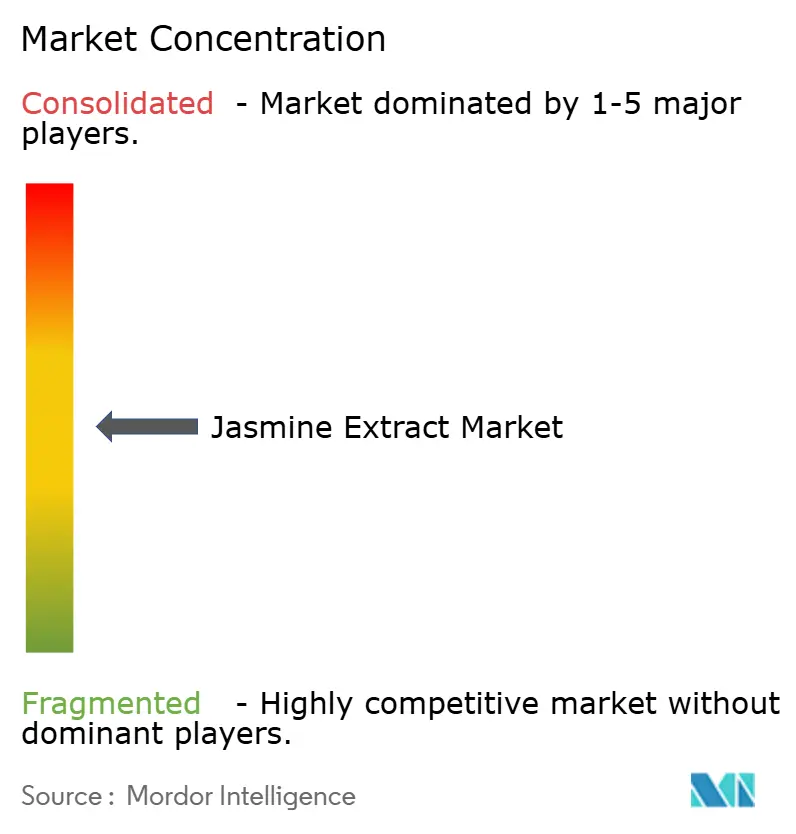
| Market Concentration | Medium |
Major Players
*Disclaimer: Major Players sorted in no particular order Image © Mordor Intelligence. Reuse requires attribution under CC BY 4.0. |
|
Jasmine Extract Market Analysis by Mordor Intelligence
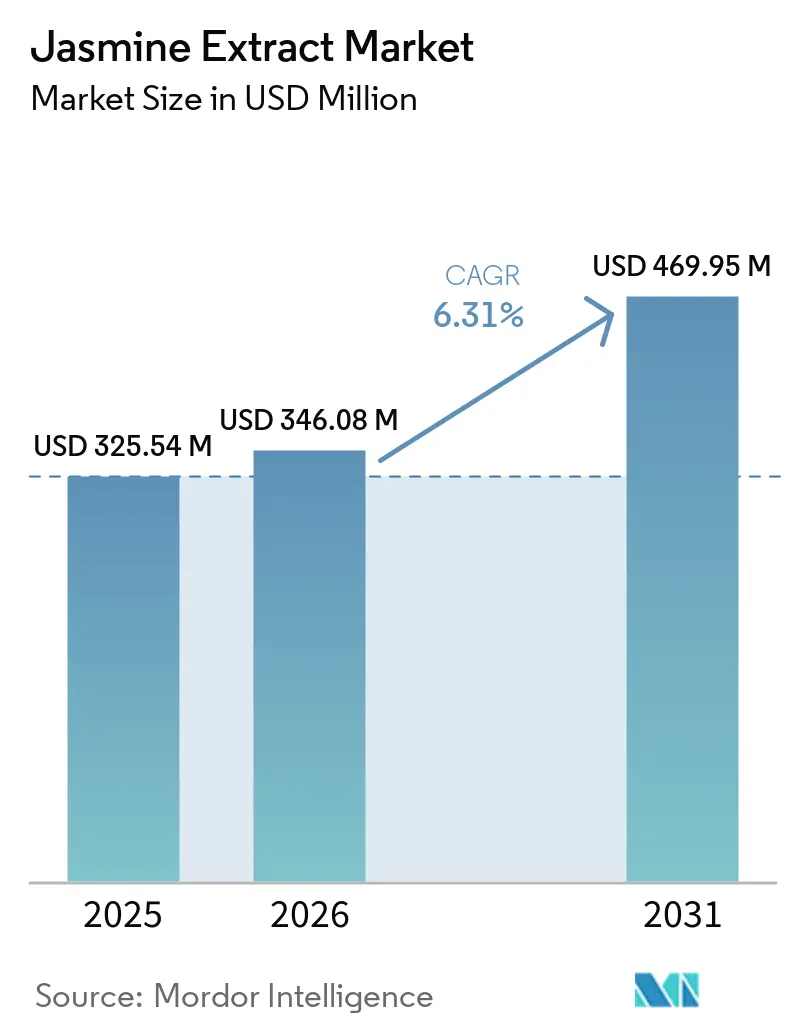
The jasmine extract market is projected to grow from USD 325.54 million in 2025 to USD 346.08 million in 2026, eventually reaching USD 469.95 million by 2031, with a CAGR of 6.31% during the forecast period of 2026-2031. This growth is driven by the increasing preference for naturally derived fragrance and flavor ingredients, which are widely used in perfumery, cosmetics, wellness products, and select food applications. Organic jasmine extracts dominate the market; however, conventional variants are witnessing a gradual revival. Liquid extracts currently lead the market, but powdered forms are gaining traction due to their shelf-stable properties. Fragrances remain the primary application segment, anchoring significant volumes, while aromatherapy is emerging as a high-value segment. Investments are being directed toward enhancing traceable supply chains, certified cultivation practices, and advanced extraction systems. This shift creates opportunities for suppliers capable of meeting stringent documentation and quality standards across fragrance, skincare, food, and wellness industries. The market remains consolidated, with key players focusing on innovation and sustainability to maintain their competitive edge.
Key Report Takeaways
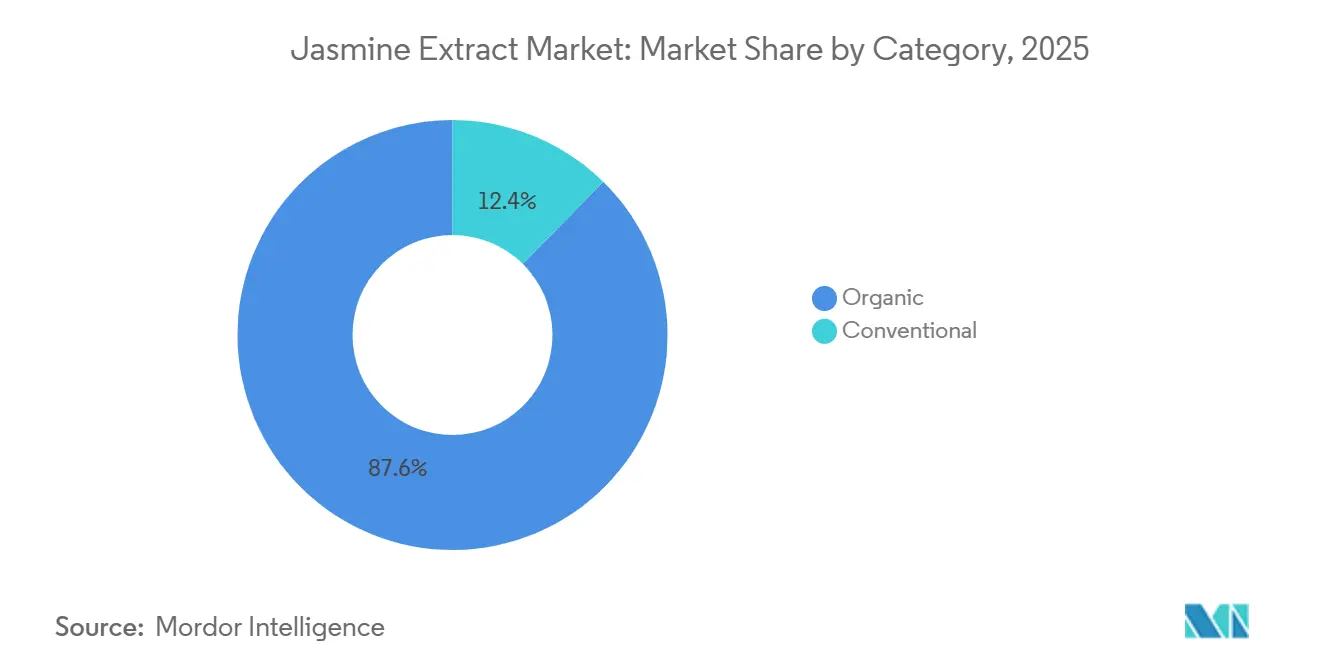
- By category, organic accounted for 87.63% of the jasmine extract market in 2025, while conventional is projected to record the fastest CAGR of 7.28% through 2031.
- By form, liquid captured 75.14% of the jasmine extract market size in 2025, while powder is projected to expand at the fastest CAGR of 7.04% through 2031.
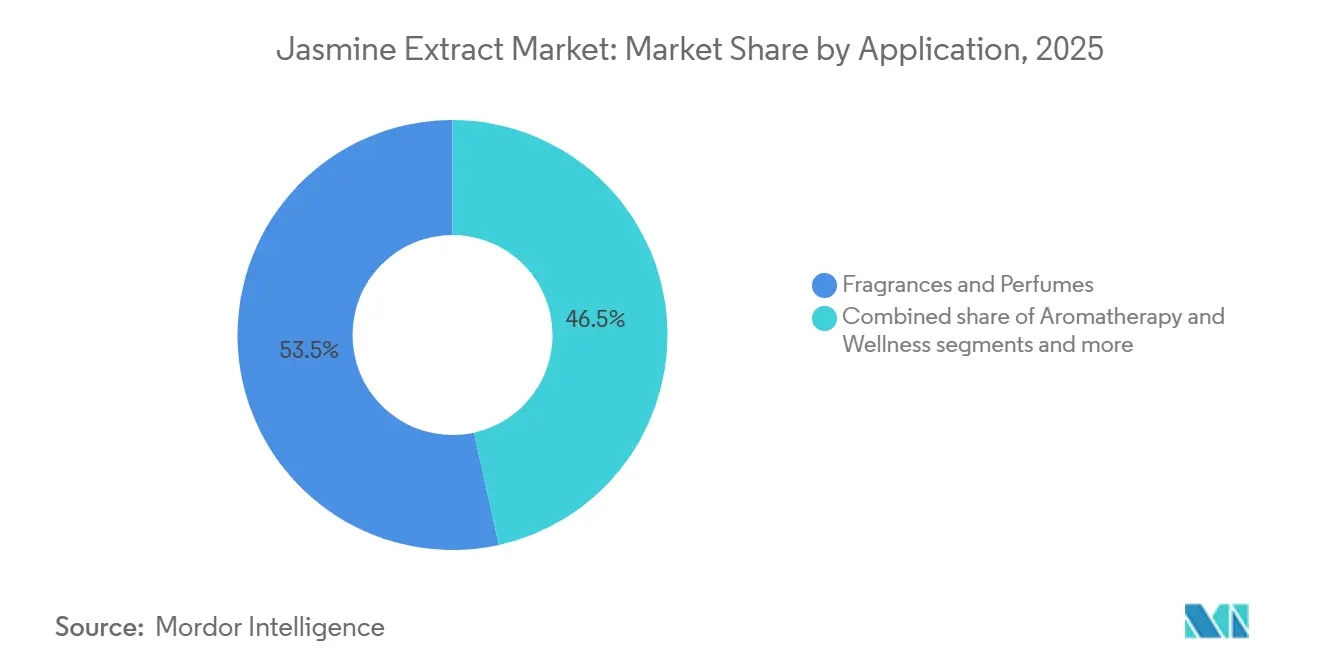
- By application, fragrances and perfumes accounted for 53.46% of the jasmine extract market share in 2025, while aromatherapy and wellness are forecast to advance at the fastest CAGR of 8.32% through 2031.
- By geography, Asia-Pacific held 43.27% of the jasmine extract market share in 2025, while North America is projected to post the fastest CAGR at 7.82% through 2031.
Note: Market size and forecast figures in this report are generated using Mordor Intelligence’s proprietary estimation framework, updated with the latest available data and insights as of January 2026.
Global Jasmine Extract Market Trends and Insights
Drivers Impact Analysis*
| Driver | (~) % Impact on CAGR Forecast | Geographic Relevance | Impact Timeline |
|---|---|---|---|
| Growing popularity of aromatherapy and wellness practices | +1.2% | Global, concentrated in North America, Europe, and urban Asia-Pacific | Medium term (2–4 years) |
| Increasing consumer preference for clean-label and botanical formulations | +1.0% | North America and Europe, spill-over to Japan, Australia, and urban China | Short term (≤ 2 years) |
| Consumer awareness of the skin-soothing and antioxidant properties of jasmine-derived ingredients | +0.8% | Global, highest intensity in East Asia and Western Europe | Medium term (2–4 years) |
| Rising popularity of jasmine tea and jasmine-flavored beverages | +0.9% | Asia-Pacific core, spill-over to North America and Middle East and Africa | Short term (≤ 2 years) |
| Cultural affinity for jasmine-based scents and products in Asian and Middle Eastern markets | +0.7% | Asia-Pacific, Gulf Cooperation Council countries, North Africa | Long term (≥ 4 years) |
| Demand for naturally derived ingredients in anti-aging and skin-rejuvenation products | +0.6% | Global, highest concentration in East Asia and North America | Medium term (2–4 years) |
| Source: Mordor Intelligence | |||
Growing popularity of aromatherapy and wellness practices
The growing demand for aromatherapy and wellness products is a key driver of the jasmine extract market. Jasmine extract is widely utilized in essential oil blends, massage oils, scented candles, diffusers, and relaxation-oriented personal care products, as consumers continue to shift toward natural and holistic wellness solutions. A study published by the Multidisciplinary Digital Publishing Institute (MDPI) in February 2025 found that 68.7% of Bulgarian adults use essential oils, underscoring the growing adoption of aromatherapy products[1]Source: Multidisciplinary Digital Publishing Institute, "Public Perception and Usage Trends of Essential Oils: Findings from a Nationwide Survey", mdpi.com. This trend is further bolstered by the rising use of essential oils in wellness centers, spas, hospitality venues, and home-care routines, which is fueling the demand for jasmine-derived ingredients. Additionally, the growing consumer preference for botanical wellness and self-care products is encouraging manufacturers to incorporate jasmine extract into a broader range of high-quality formulations, thereby driving market expansion.
Increasing consumer preference for clean-label and botanical formulations
The jasmine extract market is witnessing significant growth, driven by the increasing demand for ingredient transparency and naturally derived product formulations. Consumers are showing a strong preference for clean, sustainable products, prompting beauty and personal care brands to incorporate botanical ingredients such as jasmine extract into their offerings. According to the National Sanitation Foundation (NSF), as of March 2025, 74% of consumers considered organic ingredients crucial in personal care products, highlighting a shift toward naturally sourced alternatives[2]Source: National Sanitation Foundation (NSF), "74% of Consumers Consider Organic Ingredients Important in Personal Care Products", nsf.org . This trend has encouraged manufacturers to expand the use of jasmine extract across segments such as skincare, cosmetics, fragrances, and wellness products. Additionally, there is a growing focus on traceability, certification, and ethical sourcing practices, further boosting demand for high-quality, well-documented botanical extracts. As a result, suppliers meeting these requirements are gaining traction, particularly in premium product categories.
Consumer awareness of the skin-soothing and antioxidant properties of jasmine-derived ingredients
The jasmine extract market is witnessing significant growth, driven by rising demand for age-defying and skin-wellness products. Jasmine extract, known for its antioxidant, soothing, and skin-conditioning properties, has become a key ingredient in skincare and cosmetic formulations, catering to the needs of an aging population. The World Health Organization (WHO) projects that by 2030, one in six individuals worldwide will be aged 60 years or older, underscoring the expanding consumer base for anti-aging and skin health solutions[3]Source: World Health Organization, "Aging and Health", who.int. As consumers increasingly prioritize natural and botanical ingredients for skin protection and rejuvenation, beauty brands are leveraging jasmine extract in premium product lines. This growing preference for plant-based actives is fueling the demand for jasmine-derived ingredients across skincare, personal care, and wellness sectors, further solidifying its role in the market.
Rising popularity of jasmine tea and jasmine-flavored beverages
The growing demand for jasmine tea and jasmine-flavored beverages is driving significant expansion in the jasmine extract market. Consumers are increasingly drawn to products featuring natural ingredients and unique floral flavors, leading to a surge in the use of jasmine extract in ready-to-drink teas, specialty beverages, flavored waters, and premium café offerings. This trend is particularly prominent in the Asia-Pacific region, where leading beverage brands such as HEYTEA, Starbucks, and Nayuki's Tea have broadened their jasmine-based product portfolios to cater to evolving consumer preferences. Additionally, the rising interest in botanical and functional beverages has prompted manufacturers to innovate and incorporate jasmine-derived ingredients into new formulations. Consequently, the beverage segment is emerging as a critical driver of demand for jasmine extract, supplementing its established applications in fragrances and personal care products.
Restraints Impact Analysis*
| Restraint | (~) % Impact on CAGR Forecast | Geographic Relevance | Impact Timeline |
|---|---|---|---|
| Availability of lower-cost synthetic jasmine fragrances | -1.0% | Global, most acute in price-sensitive mass-market segments in Asia-Pacific and South America | Medium term (2–4 years) |
| Premium pricing of jasmine extract compared to synthetic fragrance alternatives | -0.8% | Global, particularly in mass-market personal care and household care segments | Short term (≤ 2 years) |
| Stringent food safety and regulatory requirements | -0.5% | North America, Europe, East Asia (China, Japan, South Korea) | Medium term (2–4 years) |
| Susceptibility of jasmine cultivation to pests and plant diseases | -0.6% | India, Egypt, China (primary production geographies) | Short term (≤ 2 years) |
| Source: Mordor Intelligence | |||
Availability of lower-cost synthetic jasmine fragrances
The jasmine extract market faces significant challenges due to the widespread availability of lower-cost synthetic jasmine alternatives. These synthetic aroma chemicals can mimic the scent profile of natural jasmine with high precision, offering advantages such as reduced production costs and consistent supply. This has led manufacturers, particularly in mass-market segments like fragrances, household care, and personal care products, to increasingly opt for synthetic substitutes to maintain competitive pricing. The impact is more pronounced in cost-sensitive applications where affordability and fragrance performance take precedence over the natural origin or botanical sourcing of ingredients. Consequently, suppliers of natural jasmine extract are under constant pressure to differentiate their offerings by emphasizing superior aroma quality, traceability, sustainability practices, and adherence to stringent regulatory standards, which are becoming critical factors in justifying the premium pricing of natural jasmine extracts.
Stringent food safety and regulatory requirements
The jasmine extract market faces significant challenges due to stringent food safety and regulatory requirements for natural ingredients. Manufacturers are required to adhere to complex regulations governing ingredient purity, contaminant limits, labeling accuracy, traceability, and approved usage levels, which vary by country and application. These compliance measures require rigorous testing, certification, and documentation, resulting in higher operational costs and longer product approval timelines. Additionally, variations in regulatory standards across regions further complicate compliance for suppliers operating in international markets. This regulatory complexity creates significant barriers to entry for smaller producers, while established manufacturers must continuously invest in robust quality assurance and regulatory compliance systems to maintain market presence and meet evolving standards. Such challenges collectively hinder the growth potential of the jasmine extract market, particularly for new entrants and smaller players.
*Our forecasts treat driver/restraint impacts as directional, not additive. The impact forecasts reflect baseline growth, mix effects, and variable interactions.
Segment Analysis
By Category: Organic Dominance Masks an Emerging Conventional Revival
In 2025, organic jasmine extract accounted for 87.63% of the jasmine extract market, securing its position as the leading segment in terms of revenue. This dominance is driven by its strong demand in premium fragrance, certified cosmetics, and specialty food applications. The growing consumer preference for natural, clean-label, and sustainably sourced ingredients has significantly boosted the adoption of organic formulations. To align with these evolving preferences, manufacturers are focusing on integrating organic jasmine extract into high-value product lines, ensuring the segment remains the largest contributor to the market's overall value.
Conventional jasmine extract is anticipated to grow at a CAGR of 7.28% during the forecast period of 2025–2031, emerging as the faster-growing segment in the market. Its growth is primarily attributed to lower production costs and greater availability compared to organic alternatives. This segment is gaining popularity in mass-market personal care, fragrance, and food applications, where cost efficiency is crucial. Additionally, its suitability for large-scale manufacturing processes enhances its commercial viability. These factors collectively position conventional jasmine extract as a key driver of market growth during the forecast period.


By Form: Liquid Extracts Lead but Powder Gains in Shelf-Stable Applications
Liquid jasmine extract dominated the jasmine extract market in 2025, contributing 75.14% of the total revenue. This form is highly favored for its wide use in fine fragrances, perfumes, and leave-on skincare products, where its strong aroma and compatibility with formulations are essential. Additionally, liquid extracts are easier to blend and incorporate into various cosmetic and personal care products, making them a preferred choice for manufacturers. The consistent demand from premium beauty and fragrance brands further solidifies the segment's leading position in the market.
Powder jasmine extract is anticipated to grow at a CAGR of 7.04% during the forecast period of 2025–2031, making it the fastest-growing segment in the market. This growth is attributed to rising demand for shelf-stable, easy-to-handle ingredient formats, particularly suitable for food, beverage, and pharmaceutical applications. Powder extracts offer a longer shelf life and ensure formulation consistency, making them ideal for diverse applications. Furthermore, advancements in processing technologies have enhanced the quality and usability of powder jasmine extracts, driving their adoption and supporting the segment's expansion over the forecast period.
By Application: Fragrances Anchor Volumes but Aromatherapy Redefines Value
In 2025, fragrances and perfumes dominated the jasmine extract market, accounting for 53.46% of the total share, making it the largest application segment. The fragrance industry highly values jasmine extract for its rich floral scent, which enhances the complexity and appeal of premium perfume formulations. The segment's growth is primarily driven by strong demand from luxury and mass-premium fragrance brands. Additionally, its extensive use in personal care and scented products further solidifies its position as the leading revenue-generating application for jasmine extract.
The aromatherapy and wellness segment is anticipated to grow at the fastest CAGR of 8.32% during the forecast period of 2025–2031. This growth is fueled by consumers' growing focus on holistic well-being, stress relief, and natural therapeutic solutions. Jasmine extract is increasingly being incorporated into essential oil blends, diffusers, massage oils, and other wellness products due to its calming and mood-enhancing properties. Furthermore, the growing awareness of self-care practices and the preference for natural remedies are driving its adoption, positioning aromatherapy and wellness as one of the most dynamic and rapidly expanding application areas in the market.

Geography Analysis
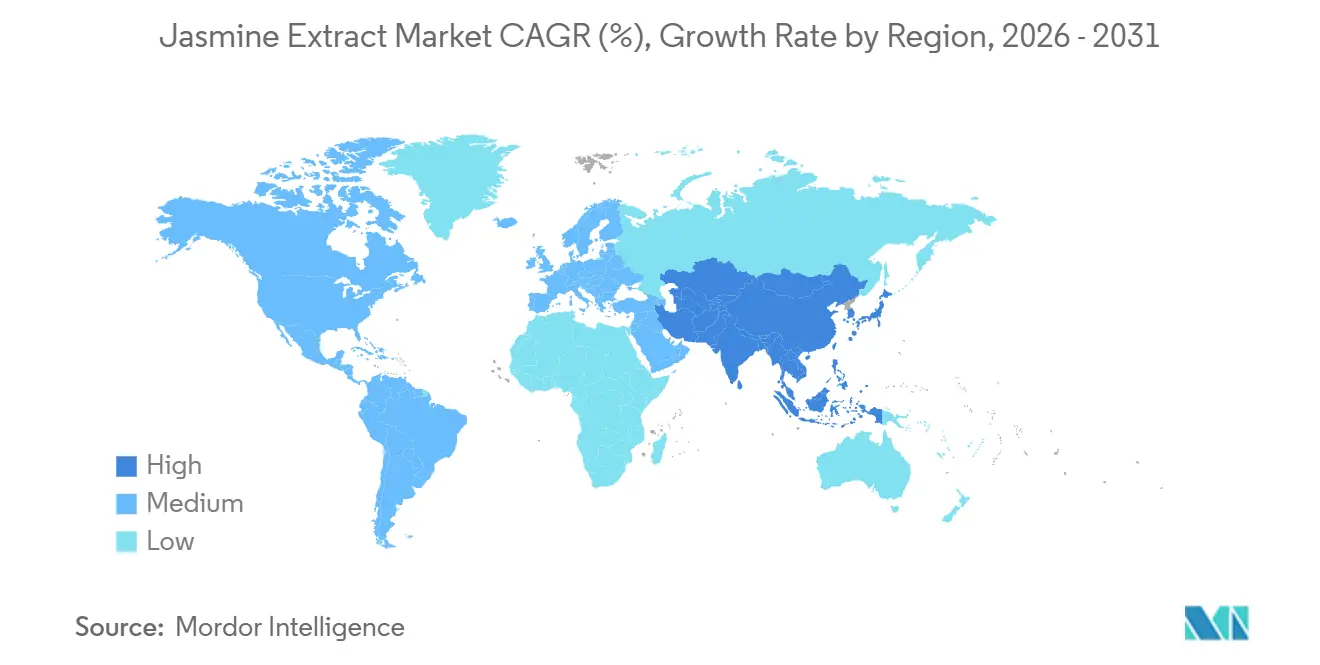
Asia-Pacific dominated the jasmine extract market in 2025, accounting for 43.27% of the market share, making it the largest regional contributor. The region's leadership stems from its vast jasmine cultivation areas, well-established processing infrastructure, and robust domestic demand across various applications, including fragrances, food, beverages, and wellness products. Key producing countries in the region are actively modernizing their supply chains, implementing traceability systems, and adopting quality certification programs to enhance their global competitiveness. Additionally, the seamless integration of jasmine cultivation, extraction processes, and end-use industries further solidifies Asia-Pacific's position as a market leader.
North America is anticipated to witness the fastest growth, with a projected CAGR of 7.82% during the forecast period of 2025–2031. The region's growth is driven by rising consumer demand for clean-label beauty products, natural wellness solutions, and botanical ingredients in food and beverages. The rising popularity of premium fragrances and aromatherapy products is also driving the growing use of jasmine extract across various industries. Meanwhile, Europe continues to hold a significant market position, supported by its advanced fragrance manufacturing capabilities, expertise in processing natural ingredients, and a strong focus on innovation in premium product offerings.
Emerging markets in South America, the Middle East, and Africa present significant growth opportunities for the jasmine extract industry. In South America, the rising demand for premium beauty, personal care, and fragrance products is fueling market expansion. The Middle East and Africa, on the other hand, benefit from jasmine's deep-rooted cultural and commercial importance, particularly in traditional and luxury perfumery applications. These regions are also focusing on improving sourcing practices, enhancing sustainability measures, and strengthening supply chain resilience. Collectively, these efforts are expected to drive long-term growth in both the production and consumption of jasmine extract in these emerging markets.

Competitive Landscape
The global jasmine extract market is dominated by key players such as Givaudan S.A., DSM-Firmenich, Symrise AG, International Flavors & Fragrances Inc., and Robertet Group, which hold significant market shares. These companies leverage their extensive sourcing networks, advanced extraction technologies, and established partnerships with global manufacturers in the fragrance and personal care industries. The competitive landscape is increasingly driven by factors such as product quality, traceability, and regulatory compliance, rather than price competition. Consequently, these leading players are continuously enhancing their presence across the value chain to maintain their market dominance.
To strengthen their market position, major companies are investing heavily in strategic sourcing partnerships, innovative processing technologies, and research platforms to differentiate their products. A key focus lies in improving the traceability of raw materials, promoting sustainable cultivation practices, and developing premium-quality extracts tailored for high-end applications. Additionally, advancements in extraction techniques and proprietary processing methods are enabling manufacturers to achieve greater consistency and preserve the unique aromatic properties of jasmine. These initiatives are critical in a market where quality assurance and sustainability are becoming top priorities for consumers and businesses alike.
Regional and mid-sized manufacturers are also playing a vital role in the jasmine extract market by offering niche products, certification-driven portfolios, and customized solutions. Many of these players are expanding into premium segments, including organic, food-grade, and wellness-oriented jasmine extracts, to cater to evolving consumer preferences. The rising demand for documented sourcing and specialized formulations is creating new opportunities for suppliers capable of meeting stringent customer requirements. As a result, competition is shifting from merely supplying large volumes to focusing on compliance, product differentiation, and expertise in specialized processing techniques.
Jasmine Extract Industry Leaders
-
Givaudan S.A.
-
DSM‑Firmenich
-
Symrise AG
-
International Flavors and Fragrances Inc.
-
Robertet Group
- *Disclaimer: Major Players sorted in no particular order

Recent Industry Developments
- January 2025: Givaudan began a comprehensive sustainability roll-out in Egypt, training 240 jasmine farmers on organic inputs and water-efficient irrigation.
- July 2024: DSM-Firmenich completed its post-merger integration, announcing accelerations in supercritical CO₂ extraction capacity for jasmine raw materials.
- July 2024: Givaudan acquired b.kolormakeup & skincare, adding CHF 77 million in annual sales and broadening downstream access to beauty brands.


Global Jasmine Extract Market Report Scope
Jasmine extract, derived from jasmine flowers, is a natural aromatic ingredient commonly used in food, beverages, cosmetics, and fragrances for its distinct floral flavor and aroma. The global jasmine extract market is classified into categories, form, application, and geography. Based on category, the market is classified into organic and conventional. Based on form, the market is classified into powder and liquid. Based on application, the market is classified into fragrances and perfumes, cosmetics and personal care, aromatherapy and wellness, food and beverages, and others. Based on geography, the market is classified into North America, Europe, Asia-Pacific, South America, and the Middle East and Africa. The market forecasts are provided in terms of value (USD).
| Organic |
| Conventional |
| Powder |
| Liquid |
| Fragrances and Perfumes |
| Cosmetics and Personal Care |
| Aromatherapy and Wellness |
| Food and Beverages |
| Others |
| North America | United States |
| Canada | |
| Mexico | |
| Rest of North America | |
| Europe | Germany |
| United Kingdom | |
| Italy | |
| France | |
| Spain | |
| Rest of Europe | |
| Asia-Pacific | China |
| Japan | |
| India | |
| Australia | |
| Indonesia | |
| South Korea | |
| Rest of Asia-Pacific | |
| South America | Brazil |
| Argentina | |
| Colombia | |
| Rest of South America | |
| Middle East and Africa | South Africa |
| Saudi Arabia | |
| United Arab Emirates | |
| Nigeria | |
| Rest of Middle East and Africa |
| By Category | Organic | |
| Conventional | ||
| By Form | Powder | |
| Liquid | ||
| By Application | Fragrances and Perfumes | |
| Cosmetics and Personal Care | ||
| Aromatherapy and Wellness | ||
| Food and Beverages | ||
| Others | ||
| By Geography | North America | United States |
| Canada | ||
| Mexico | ||
| Rest of North America | ||
| Europe | Germany | |
| United Kingdom | ||
| Italy | ||
| France | ||
| Spain | ||
| Rest of Europe | ||
| Asia-Pacific | China | |
| Japan | ||
| India | ||
| Australia | ||
| Indonesia | ||
| South Korea | ||
| Rest of Asia-Pacific | ||
| South America | Brazil | |
| Argentina | ||
| Colombia | ||
| Rest of South America | ||
| Middle East and Africa | South Africa | |
| Saudi Arabia | ||
| United Arab Emirates | ||
| Nigeria | ||
| Rest of Middle East and Africa | ||


Key Questions Answered in the Report
What is the projected value of the jasmine extract sector by 2031?
The jasmine extract market is projected to reach USD 469.95 million by 2031 from USD 346.08 million in 2026, at a CAGR of 6.31% over 2026-2031.
Which application leads demand for jasmine extract?
Fragrances and Perfumes led demand with 53.46% share in 2025, supported by jasmine’s strong position as a core note in premium perfumery.
Which application is growing the fastest through 2031?
Aromatherapy and Wellness is projected to grow the fastest, with an 8.32% CAGR through 2031 as wellness use expands across oils, candles, and related products.
Why does Asia-Pacific lead global demand and supply?
Asia-Pacific held 43.27% of 2025 demand and also remains the largest cultivation and trading base, with China and India playing central roles in supply.
Page last updated on:


 Your data is secure and never sold or shared.


