
Market Overview
| Study Period | 2021 - 2031 |
|---|---|
| Forecast Data Period | 2026 - 2031 |
| Base Year Market Size (2025) | USD 41.71 Million |
| Market Size (2026) | USD 46.28 Million |
| Market Size (2031) | USD 63.61 Million |
| Growth Rate (2026 - 2031) | 6.57 % |
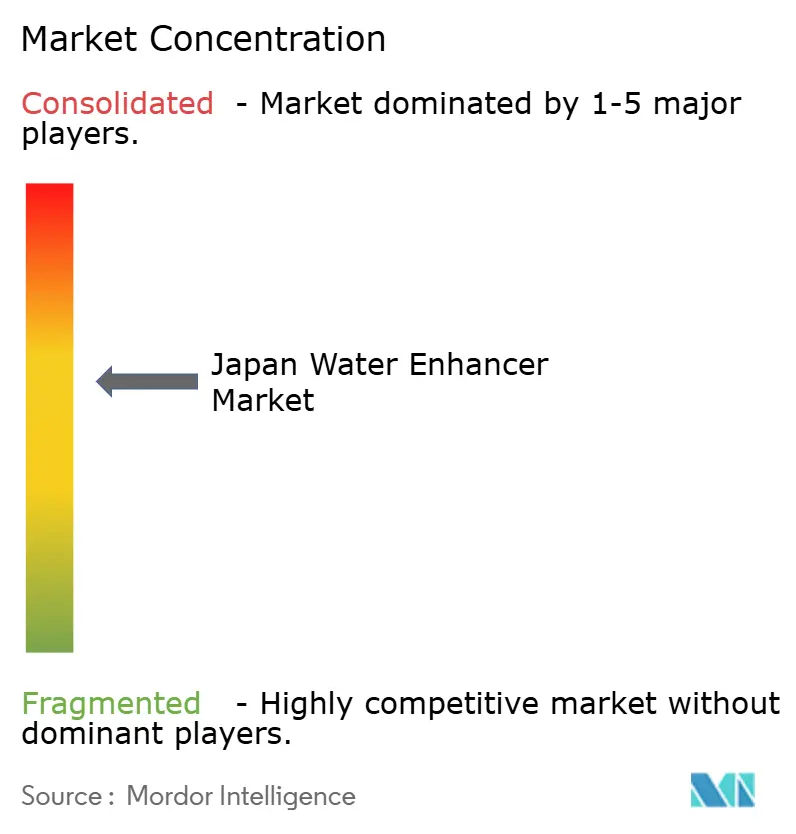
| Market Concentration | Medium |
Major Players *Disclaimer: Major Players sorted in no particular order Image © Mordor Intelligence. Reuse requires attribution under CC BY 4.0. | |
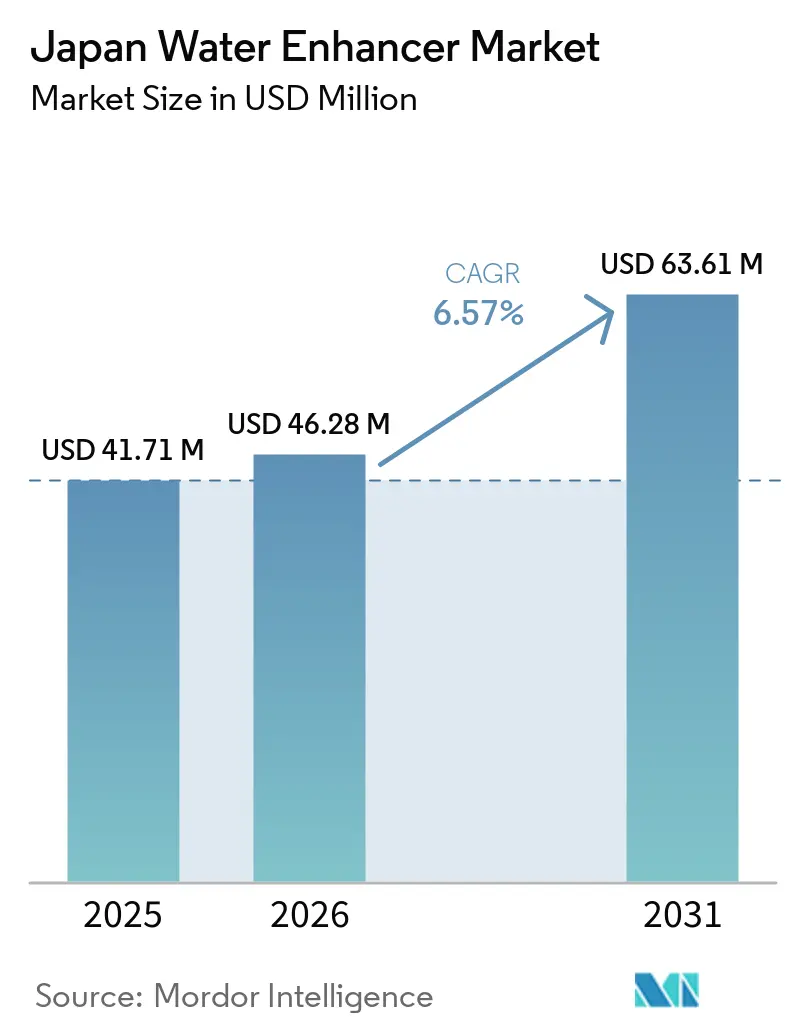
Japan Water Enhancer Market Analysis by Mordor Intelligence
The Japan water enhancer market size was valued at USD 41.71 million in 2025 and estimated to grow from USD 46.28 million in 2026 to reach USD 63.61 million by 2031, at a CAGR of 6.57% during the forecast period (2026-2031). The market is supported by demand for hydration products that combine convenience with functional ingredients in a format that consumers can adapt to their preferred level of flavor. Consumers can use drops and powders with water they already carry or buy, which can reduce the need to purchase a separate ready-to-drink beverage for every consumption occasion. Growth depends on brands making this routine simple while offering credible benefits, recognizable ingredients, suitable pack sizes, and an acceptable taste at repeated use. Established sports drinks and other ready-to-drink products remain a strong alternative because they fit existing purchase habits and provide immediate consumption without any preparation.
Key Report Takeaways
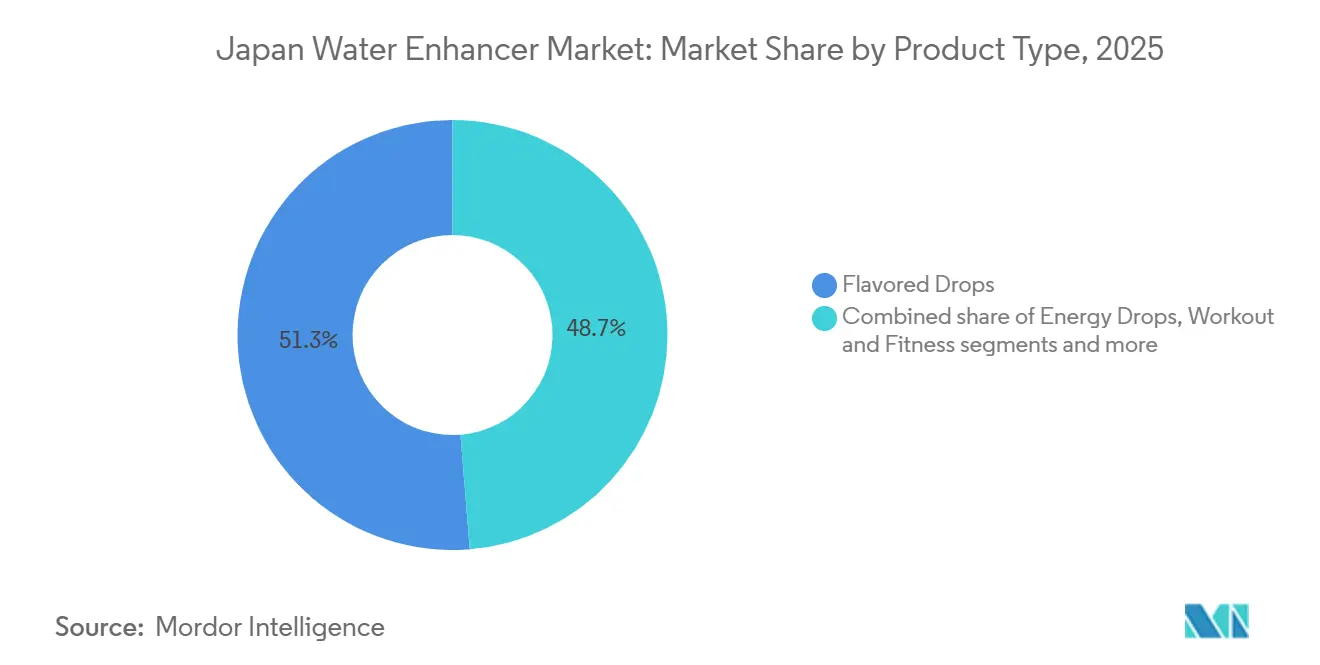
- By product type, flavored drops held 51.27% of the Japan water enhancer market share in 2025, while workout and fitness variants are projected to grow at an 8.04% CAGR through 2031.
- By form, liquid products accounted for 85.26% of category value in 2025, while powder products are forecast to expand at an 8.49% CAGR through 2031.
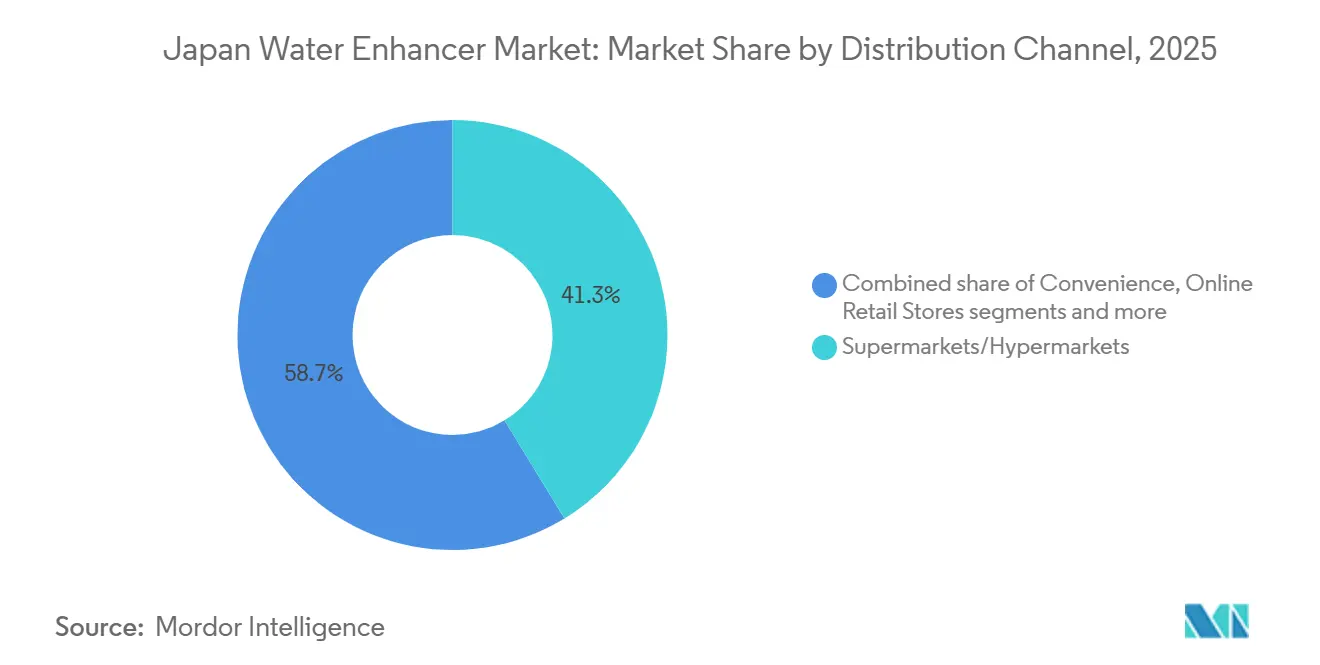
- By distribution channel, supermarkets and hypermarkets held 41.28% of category value in 2025, while online retail stores are projected to grow at an 8.67% CAGR through 2031.
Note: Market size and forecast figures in this report are generated using Mordor Intelligence’s proprietary estimation framework, updated with the latest available data and insights as of January 2026.
Japan Water Enhancer Market Trends and Insights
Drivers Impact Analysis*
| Driver | (~) % Impact on CAGR Forecast | Geographic Relevance | Impact Timeline |
|---|---|---|---|
| Growing demand for functional hydration and nutrient-enriched water enhancers | +1.8% | National; strongest in Kanto and Kansai urban corridors | Medium term (2–4 years) |
| Increasing consumer preference for low-calorie and sugar-free beverages | +1.5% | National; accelerating in urban and suburban markets | Short term (≤ 2 years) |
| Rising health and wellness awareness | +1.2% | National; amplified by Japan's ageing demography | Long term (≥ 4 years) |
| Growing demand for convenient, portable beverage solutions | +1.0% | National; concentrated in urban commuter corridors | Short term (≤ 2 years) |
| Expansion of sports and fitness participation | +0.9% | National; strongest uptake in metropolitan prefectures | Medium term (2–4 years) |
| Product innovation in flavors and formulations | +0.7% | National | Medium term (2–4 years) |
| Source: Mordor Intelligence | |||
Growing Demand for Functional Hydration and Nutrient-Enriched Water Enhancers
Japanese consumers are increasingly seeking beverages that offer benefits beyond basic hydration, including electrolyte replenishment, vitamin intake, and support for everyday wellness. This shift is creating opportunities for water enhancer manufacturers to develop products containing functional ingredients while offering convenient alternatives to conventional soft drinks. Demand for hydration products is also supported by Japan’s hot and humid summers, which increase consumer attention toward fluid and electrolyte replenishment. Powdered drink mixes and concentrated liquids allow consumers to customize beverage strength and flavor while preparing drinks at home, at work, or during outdoor activities. Manufacturers are responding by introducing products with reduced sugar content, functional ingredients, and a wider range of flavors to appeal to health-conscious consumers.
Increasing Consumer Preference for Low-Calorie and Sugar-Free Beverages
Japanese consumers are increasingly paying attention to sugar intake and calorie content when selecting beverages, supporting demand for low-calorie and sugar-free water enhancers. These products offer consumers a way to add flavor to plain water without the calorie load commonly associated with sugar-sweetened soft drinks. Manufacturers are responding by introducing powdered drink mixes and liquid concentrates that use low-calorie sweeteners or sugar-free formulations while maintaining appealing taste profiles. This trend also encourages product innovation across fruit flavors, refreshing beverages, and hydration-focused formulations. Water enhancers provide flexibility in sweetness and flavor intensity, allowing consumers to customize drinks according to their preferences.
Expansion of Sports and Fitness Participation
Participation in sports and fitness activities is supporting demand for convenient hydration solutions in Japan, including powdered drink mixes and water enhancers containing electrolytes. According to Japan’s Sports Agency, 51.7% of adults aged 20 and above participated in sports or exercise at least once a week in fiscal 2025, indicating a substantial base of regular physical activity participants[1]. Consumers engaging in activities such as running, gym workouts, cycling, and recreational sports may seek flavored hydration products that are easy to prepare and carry. Water enhancers offer a convenient option for adding flavor and, in selected formulations, electrolytes to drinking water before, during, or after exercise. Manufacturers can capitalize on this demand by developing portable sachets, low-sugar hydration mixes, and products designed for active lifestyles.
Product Innovation in Flavors and Formulations
Product innovation is encouraging manufacturers to differentiate water enhancers through new flavor profiles, improved formulations, and added functional ingredients. Japanese consumers can choose from fruit-based flavors and hydration-focused products that combine taste with benefits such as electrolyte replenishment, vitamin intake, and reduced sugar consumption. For instance, in February 2026, Kracie announced a revamp of its Sky Water powdered sports drink range, introducing a new lemon flavor alongside improvements to existing grape and grapefruit variants, with the updated products rolling out in Japan from March 9, 2026. The lemon variant features zero sugar and calories, while the grape formulation includes vitamin D and calcium, and the grapefruit variant contains citric acid. Such developments demonstrate how manufacturers are using flavor diversification and formulation enhancements to address different consumer preferences and hydration needs.
Restraints Impact Analysis*
| Restraint | (~) % Impact on CAGR Forecast | Geographic Relevance | Impact Timeline |
|---|---|---|---|
| Consumer preference for established bottled beverage formats | -1.4% | National; more pronounced in smaller cities with entrenched convenience store purchasing habits | Long term (≥ 4 years) |
| Taste and palatability challenges associated with functional ingredients | -0.8% | National | Medium term (2–4 years) |
| Regulatory requirements for food ingredients and nutritional claims | -0.6% | National, more pronouned in Tokyo | Medium term (≥ 4 years) |
| Consumer skepticism toward artificial sweeteners and flavors | -0.5% | National | Short term (≤ 2 years) |
| Source: Mordor Intelligence | |||
Consumer Preference for Established Bottled Beverage Formats
Japanese consumers’ established preference for ready-to-drink bottled beverages may constrain the adoption of water enhancers, particularly among consumers who prioritize convenience and immediate consumption. Bottled water, flavored water, sports drinks, and functional beverages are widely available through convenience stores, supermarkets, vending machines, and other retail channels across Japan. These products eliminate the need for consumers to measure concentrates, dissolve powders, or carry additional preparation ingredients. In comparison, water enhancers require access to drinking water and may involve preparation steps that some consumers perceive as inconvenient, especially when travelling or purchasing beverages on the go.
Taste and Palatability Challenges Associated with Functional Ingredients
The inclusion of functional ingredients in water enhancers can create taste and palatability challenges, potentially restraining their adoption among Japanese consumers. Ingredients such as electrolytes, vitamins, minerals, amino acids, and certain low-calorie sweeteners may introduce bitter, salty, metallic, or artificial aftertastes when used at higher concentrations. Manufacturers must balance the desired functional benefits with flavor quality, sweetness, and drinkability to ensure that products appeal to a broad consumer base. These formulation challenges can increase product development costs as companies invest in flavor masking, ingredient combinations, and repeated sensory testing.
*Our forecasts treat driver/restraint impacts as directional, not additive. The impact forecasts reflect baseline growth, mix effects, and variable interactions.
Segment Analysis
By Product Type: Flavored Drops Remain the Mainstay While Fitness Variants Lead Growth
Flavored drops held 51.27% of the Japan water enhancer market share in 2025, which made them the largest product type. Their position reflects a simple use case because consumers can add flavor to still or sparkling water without changing the broader drinking routine. Citrus, tropical, mixed-berry, and seasonally familiar flavors can encourage trial and make the product suitable for different occasions. Flavored drops are easier to position against flavored ready-to-drink beverages because the main benefit is immediate taste customization at the chosen serving strength. Energy drops appeal to students and office workers who want caffeine fortification in a portable format and who may compare the product with canned energy beverages.
Workout and fitness variants are projected to grow at an 8.04% CAGR through 2031, the strongest pace among product types. These products are positioned around hydration, exercise recovery, electrolytes, BCAA, and other amino acid ingredients that fit pre-workout, during-workout, and post-workout use. Their higher functional content can support premium pricing when the consumer understands the purpose of the ingredient and finds the flavor acceptable. Ajinomoto’s February 2025 aminoVITAL ami-katsu launch shows how amino acid delivery can be aimed at consumers building regular exercise habits rather than only elite athletes.

By Form: Liquid Leads Current Use While Powder Expands Through Portability
Liquid products accounted for 85.26% of category value in 2025, making liquid the dominant form. Drop bottles are intuitive because consumers can control the serving amount and use them without waiting for a powder to dissolve. They fit the category’s central proposition of adding flavor or functional ingredients to water in a short step. Liquid formats also align with the established beverage supply chain and with consumer familiarity with ready-to-drink functional water. The format can help brands introduce the category to buyers who have not previously used a mix-in product. The Japan water enhancer market remains weighted toward liquid because simple dosing and immediate use reduce barriers to trial, particularly for people comparing it with bottled beverages.
Powder products are forecast to grow at an 8.49% CAGR through 2031, which is faster than liquid. Sachets can be carried easily, stored for longer periods, and sold in packs that support household replenishment and repeat online purchasing. Powder also suits functional products when the formulation needs a controlled dose of amino acids, electrolytes, or citric acid. Ajinomoto markets Citric Acid Charge Water as a powder that dissolves in 500 ml of water and contains 5 amino acid types and citric acid for sports recovery. Its growth will depend on fast dissolution, a smooth mouthfeel, readable preparation instructions, and pack formats that keep the mixing step from becoming a barrier.
By Distribution Channel: Stores Deliver Discovery While Online Retail Gains Importance
Supermarkets and hypermarkets held 41.28% of category value in 2025, making them the largest distribution channel. These retailers provide a planned-purchase setting where consumers can compare enhancers with bottled water, sports drinks, flavored waters, and vitamins. Shelf adjacency matters because it can make the use case clearer to shoppers who have not previously considered a water enhancer. Larger stores can also offer multipacks and several flavors, allowing households to compare products and replenish them during routine shopping trips. Convenience stores remain useful trial locations when brands offer compact packs or single-serve products that do not require a large initial commitment.
Online retail stores are forecast to expand at an 8.67% CAGR through 2031, the fastest growth rate among distribution channels. Digital platforms can give smaller and international brands access to consumers without securing national supermarket listings or funding a broad in-store launch. Nestlé Health Science presents Nuun as a hydration brand for active lifestyles, demonstrating the relevance of specialized hydration brands that can be reached through focused digital channels. Japan’s Statistics Bureau reported that online beverage spending increased 10.8% in 2025[2]. Online shopping can support subscriptions, repeat packs, product reviews, and targeted communication to consumers interested in fitness or wellness.
Geography Analysis
Japan’s water enhancer demand is concentrated in the Kanto, Kansai, and Chubu metropolitan corridors, where dense retail access and greater engagement with convenience-oriented products support trial. The Japan Statistics Bureau reported that 51% of Japan’s population lived in urban prefectures in 2025[3]. The Tokyo area is a practical launch location for new products because it combines a large consumer base, intensive retail coverage, and exposure to new beverage formats. Companies can test flavor profiles, pack sizes, dosage instructions, and functional positioning in major cities before extending distribution. This approach can reduce the risk of a national launch that does not meet local taste expectations.
Secondary cities such as Fukuoka, Hiroshima, Sendai, and Sapporo provide further room for online-led expansion. The Japan Statistics Bureau found that people aged 70 and above recorded the strongest year-over-year growth in online spending in 2025, at 15.9%. This is relevant for vitamin and functional variants that may appeal to consumers managing daily nutrient intake. Online channels can reduce the distribution gap between large metropolitan areas and secondary urban centers. Brands can use clear information, repeat-delivery offers, and small trial packs to make the category less dependent on local shelf space.
Rural and agricultural prefectures are likely to show lower per-capita consumption because niche functional products have fewer distribution points and face stronger competition from traditional beverage choices. The preparation step can also be less appealing where consumers have a strong habit of buying a finished beverage. These areas are more likely to be a later stage of expansion than an immediate growth engine. The Japan water enhancer market will need a value proposition that overcomes both distribution limits and consumer preference for established beverages.
Competitive Landscape
The Japan water enhancer market is moderately consolidated, with competition shaped by established beverage manufacturers, functional beverage brands, and companies offering flavor-enhancing products. The competitive landscape is influenced by brand recognition, product differentiation, distribution reach, and the ability to align offerings with changing consumer preferences for convenient and flavorful hydration options. Established players benefit from existing beverage portfolios, established retail relationships, and consumer familiarity, which can support market penetration and repeat purchases.
Companies compete through product innovation, flavor diversification, and the development of products that cater to different consumption occasions and consumer preferences. The availability of diverse flavor profiles, convenient formats, and products positioned around hydration and wellness helps companies differentiate their offerings. Manufacturers also seek to strengthen their market presence through packaging improvements, marketing initiatives, and the introduction of products that appeal to consumers seeking alternatives to conventional beverages. These strategies allow companies to address evolving demand while building brand loyalty in a competitive beverage market.
Distribution capabilities and strategic partnerships remain important factors influencing competitive positioning in Japan. Access to supermarkets, convenience stores, drugstores, and e-commerce platforms can help companies improve product visibility and reach a broader consumer base. Established beverage companies may leverage their existing distribution networks and retail relationships, while smaller or specialized brands can compete through niche positioning and differentiated product offerings. Overall, competition is expected to remain centered on product differentiation, brand development, pricing strategies, and distribution expansion, with companies seeking to strengthen their positions by responding to consumer demand for convenient and personalized hydration options.
Japan Water Enhancer Industry Leaders
-
Otsuka Pharmaceutical Co., Ltd.
-
Nestlé S.A.
-
The Kraft Heinz Company
-
PepsiCo, Inc.
-
Suntory Holdings Limited
- *Disclaimer: Major Players sorted in no particular order
Recent Industry Developments
- July 2026: Otsuka Pharmaceutical launched POCARI SWEAT ION WATER Powder Stick Packets for preparing 500 ml of beverage in Japan. Priced at JPY 90 per stick before tax, the product offers a portable format designed for reusable water bottles and everyday hydration at home, work, school, or during commuting.
- February 2026: Kracie Foods announced a revamp of its Sky Water powdered sports drink series, introducing a new lemon flavor from March 2026, across supermarkets and drugstores in Japan. The company also updated existing flavors, emphasizing low-sugar or sugar-free options, electrolyte replenishment, and convenient preparation.
- September 2025: Asahi Soft Drinks announced its first dilution-type products under the PLUS Calpis health-focused beverage range: PLUS Calpis Sleep and Gut Health Care (Dilution Type) and PLUS Calpis Immune Support (Dilution Type), launched in Japan. The concentrated products can be mixed with water or carbonated water and provide approximately nine days of servings per bottle.
Japan Water Enhancer Market Report Scope
Water enhancers are concentrated liquid, powder, or tablet-based products added to drinking water to improve its taste, flavor, or functional properties. The Japan water enhancer market is segmented by product type, form, and distribution channel. Based on product type, the market is segmented into flavored drops, energy drops, workout and fitness and other product types. Based on form, the market is segmented into powder and liquid. Based on distribution channel, the market is segmented into supermarkets/hypermarkets, convenience stores, online retail stores, and other distribution channels. For each segment, the market sizing and forecasting have been done in value terms (USD million).
By Product Type
| Flavored Drops |
| Energy Drops |
| Workout and Fitness (Electrolyte/BCAA) |
| Other Products Type (Vitamin and other functional drops) |
By Form
| Powder |
| Liquid |
By Distribution Channel
| Supermarkets/Hypermarkets |
| Convenience Stores |
| Online Retail Stores |
| Other Distribution Channels |
| By Product Type | Flavored Drops |
| Energy Drops | |
| Workout and Fitness (Electrolyte/BCAA) | |
| Other Products Type (Vitamin and other functional drops) | |
| By Form | Powder |
| Liquid | |
| By Distribution Channel | Supermarkets/Hypermarkets |
| Convenience Stores | |
| Online Retail Stores | |
| Other Distribution Channels |
Key Questions Answered in the Report
What is driving demand for water enhancers in Japan?
Demand is supported by functional hydration, reduced-sugar preferences, portable formats, and use around exercise. The category is projected to grow at a 6.57% CAGR through 2031 as brands seek to combine taste customization with a recognizable functional benefit.
Which product type leads water enhancer sales in Japan?
Flavored drops lead with a 51.27% value share in 2025 because they offer a familiar and simple flavor-customization use case. Their broad appeal comes from allowing consumers to add flavor to still or sparkling water at a chosen serving strength.
Which water enhancer format is growing fastest in Japan?
Powder products are forecast to grow at an 8.49% CAGR through 2031, helped by portable sachets, controlled functional dosing, longer storage, and easier shipment in repeat-purchase packs.
Which sales channel is expanding fastest for water enhancers in Japan?
Online retail stores are projected to grow at an 8.67% CAGR through 2031. The channel supports subscriptions, repeat packs, product education, and access for smaller brands that do not yet have broad physical retail placement.
Why do ready-to-drink beverages constrain water enhancer adoption?
Ready-to-drink products require no preparation and fit established purchase habits. Enhancers need to offer compelling flavor, portability, functional value, or serving flexibility to justify the extra step of adding the product to water.