
Japan HBM Market Size and Share
Market Overview
| Study Period | 2020 - 2031 |
|---|---|
| Forecast Data Period | 2026 - 2031 |
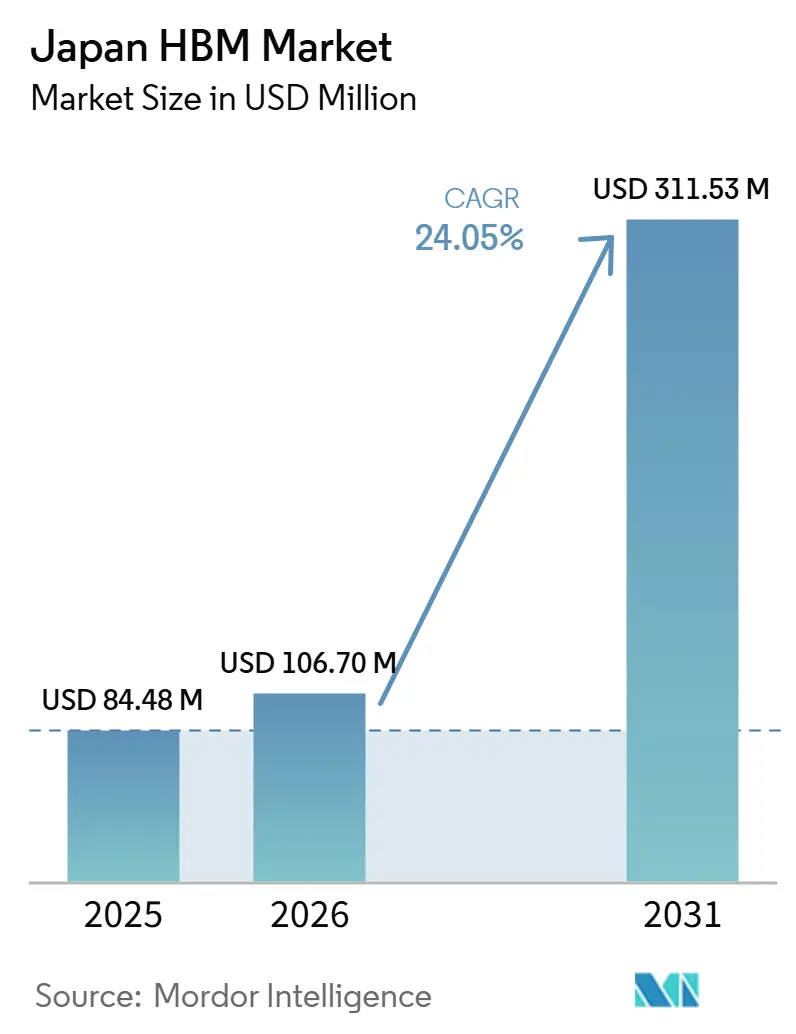
| Base Year Market Size (2025) | USD 84.48 Million |
| Market Size (2026) | USD 106.70 Million |
| Market Size (2031) | USD 311.53 Million |
| Growth Rate (2026 - 2031) | 24.05 % |
| Market Concentration | High |
Major Players *Disclaimer: Major Players sorted in no particular order Image © Mordor Intelligence. Reuse requires attribution under CC BY 4.0. | |
Japan HBM Market Analysis by Mordor Intelligence
The Japan high bandwidth memory market size is expected to increase from USD 84.48 million in 2025 to USD 106.07 million in 2026 and reach USD 311.53 million by 2031, growing at a CAGR of 24.05% over 2026-2031. Growth is being supported by Japan’s rapid AI infrastructure buildout, a broad semiconductor policy push, and a faster upgrade cycle from HBM3E toward HBM4 and later generations. Large capital commitments to domestic compute capacity are advancing memory procurement because operators are trying to secure supply before facilities are fully commissioned. Demand is also shifting over the forecast period because the first wave of spending was tied to model training, while later demand will increasingly come from inference deployment and wider enterprise use. Japan remains important even before large-scale local stack output begins, as the country supplies key materials, testing systems, packaging substrates, and precision tools used across the global HBM chain. This combination gives Japan a high-bandwidth memory market, with both near-term demand momentum and a longer runway linked to domestic capacity building and upstream supply chain strength.
Key Report Takeaways
- By HBM type, HBM3E held 68.53% of the Japan HBM market share in 2025, while HBM4E and later-generation HBM are projected to expand at a 24.98% CAGR through 2031.
- By technology node, advanced nodes below 1Z accounted for 49.18% of the Japan HBM market in 2025 and are projected to grow at a 24.84% CAGR through 2031.
- By end-use industry, cloud service providers and hyperscalers commanded 48.39% of demand in 2025, while internet platforms and AI model developers are projected to record the highest CAGR at 25.23% through 2031 in the Japan HBM market.
- By application, AI model training represented 59.73% of demand in 2025, while AI model inference is projected to expand at a 25.18% CAGR through 2031 in the Japan HBM market.
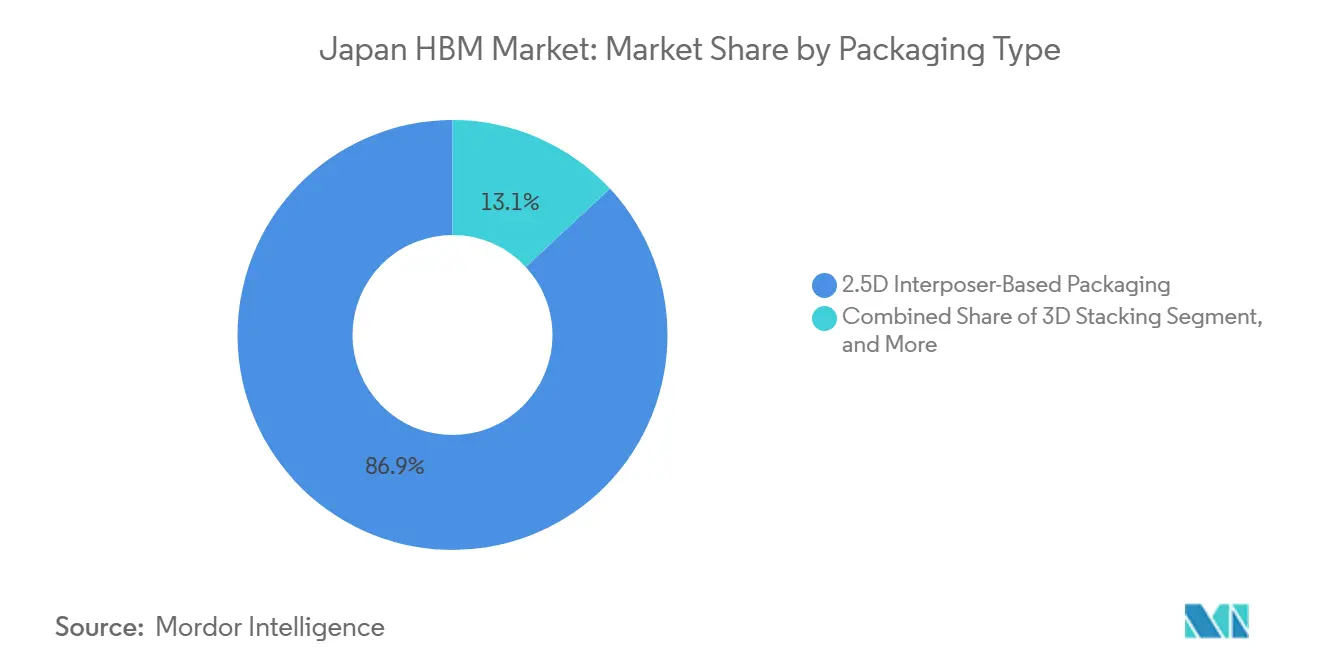
- By packaging type, 2.5D interposer-based packaging held 86.92% of demand in 2025, while 3D stacking and hybrid-bonded integration are projected to grow at a 24.62% CAGR through 2031 in the Japan HBM market.
Note: Market size and forecast figures in this report are generated using Mordor Intelligence’s proprietary estimation framework, updated with the latest available data and insights as of January 2026.
Japan HBM Market Trends and Insights
Drivers Impact Analysis*
| Driver | (~) % Impact on CAGR Forecast | Geographic Relevance | Impact Timeline |
|---|---|---|---|
| Rapid AI Accelerator Deployment in Japan's Data Centers | +5.8% | Greater Tokyo, Osaka, Hokkaido | Short term (≤ 2 years) |
| Shift Toward HBM3E and HBM4 for Advanced Compute | +4.7% | National | Medium term (2-4 years) |
| Government Backing for Domestic Semiconductor Capacity | +3.9% | Hiroshima, Hokkaido, National | Medium term (2-4 years) |
| Advanced Packaging Capacity Constraints Favor Premium HBM Supply | +3.4% | APAC core, spill-over to Japan | Short term (≤ 2 years) |
| Rising Need for Precision Materials, Testing, and Thermal Control | +2.6% | National, with early gains in Ibaraki, Chiba, Osaka | Medium term (2-4 years) |
| Weak Yen Supporting Semiconductor Investment and Procurement | +1.8% | National | Short term (≤ 2 years) |
| Source: Mordor Intelligence | |||
Rapid AI Accelerator Deployment In Japan's Data Centers
The Japan high bandwidth memory market is being pushed by one of the most concentrated AI compute build cycles in the region, because new GPU clusters convert directly into higher HBM consumption per system. Microsoft announced a USD 10 billion investment in Japan through 2029, focused on data centers and AI infrastructure, underscoring the scale of upcoming compute demand in the country. GMI Cloud also unveiled a USD 12 billion sovereign AI initiative in Kagoshima with an initial 350MW plan and a long-term 1GW target, adding another large demand anchor for accelerator memory.[1]GMI Cloud, “GMI Cloud Unveils USD 12 Billion, 1GW Sovereign AI Infrastructure Initiative in Japan, www.gmicloud.ai/en/blog/ SoftBank followed with its October 2026 launch plan for an AI Data Center GPU Cloud service based on NVIDIA GB200 NVL72 systems and Inference-as-a-Service capabilities for domestic users. These commitments matter because buyers are no longer waiting for each facility to open before planning memory procurement, and that is shortening lead-time expectations across the Japanese high-bandwidth memory market. The result is a demand pattern in which supply commitments are negotiated earlier, with operators placing greater value on vendors that can guarantee volume for both initial training systems and later inference clusters.
Shift Toward HBM3E And HBM4 For Advanced Compute
The generation transition is moving quickly in the Japan high bandwidth memory market because the performance requirements of AI accelerators are increasing faster than the usual memory replacement cycle. JEDEC released the JESD270-4 HBM4 standard in April 2025, introducing a 2048-bit interface and a bandwidth of up to 2.048 TB/s per stack, which raised the performance baseline for new accelerator platforms. SK hynix shipped 12-layer HBM4 samples in March 2025 and then moved ahead with 12-layer HBM4E sample shipments in June 2026, reporting 48GB capacity per stack, lower heat resistance, and better power efficiency than HBM4.[2]SK hynix Inc., “SK Hynix Ships World's First 12-Layer HBM4 Samples to Customers,” SK hynix Newsroom, news.skhynix.com That sequence is changing buyer behavior because platform owners are now preparing for HBM4 and HBM4E earlier in the qualification cycle, even as HBM3E remains the main-volume product. Micron’s Hiroshima program also matters to this shift because the site deployed EUV lithography for mass chip production in Japan, creating a local path to participate in later HBM generations once production begins. As a result, the Japan high bandwidth memory market is moving from a simple capacity race into a generation race where early qualification, thermal performance, and power efficiency increasingly shape commercial value.
Government Backing For Domestic Semiconductor Capacity
Public policy is reinforcing the growth path of the Japan high-bandwidth memory market by supporting both advanced logic and memory-related capacity. METI approved an additional JPY 631.5 billion (USD 4 billion) for Rapidus in April 2026, which brought cumulative government support for the 2nm program to JPY 2.35 trillion (USD 14.89 billion). The same policy direction is evident in memory, as METI backed Micron’s Hiroshima expansion with subsidy support tied to production lines and next-generation DRAM development. Rapidus later completed a June 2026 funding round totaling JPY 424.95 billion (USD 2.7 billion), which showed that public backing was also helping crowd in private capital from major Japanese companies. This support matters beyond a single project because it strengthens the domestic base for packaging, materials, testing, and integration work that feed into future HBM demand and supply. It also reduces strategic risk for the Japanese high-bandwidth memory market because more of the value chain is anchored in Japan rather than left entirely exposed to imported finished stacks.
Advanced Packaging Capacity Constraints Favor Premium HBM Supply
Packaging remains a decisive growth driver because the Japan high-bandwidth memory market relies on integration methods that are becoming increasingly complex as stack heights increase and thermal limits tighten. The current installed base still leans heavily on 2.5D interposer integration, which means supply tightness in advanced packaging continues to support premium pricing for qualified HBM products. JEDEC’s HBM4 standard raised the technical bar for bandwidth and capacity, underscoring the importance of advanced packaging precision, substrate quality, and thermal management in later system deployments. Japanese suppliers are well placed in this environment because the country already has strong positions in substrates, specialty chemicals, bonding materials, and high-accuracy processing tools used around HBM integration. As the product mix shifts toward HBM4 and HBM4E, procurement decisions in the Japanese high-bandwidth memory market are likely to favor suppliers that can align memory availability with reliable packaging and thermal performance. That keeps the supply backdrop tight in the near term and supports continued value capture for companies serving the packaging layer of the HBM chain.
Restraints Impact Analysis*
| Restraint | (~) % Impact on CAGR Forecast | Geographic Relevance | Impact Timeline |
|---|---|---|---|
| Heavy Dependence on Imported Finished HBM Stacks | -3.8% | National | Short term (≤ 2 years) |
| Extremely High Capital Intensity of HBM Fabrication | -2.9% | National | Medium term (2-4 years) |
| Yield Loss Risk in 12-Hi and 16-Hi Stack Production | -1.7% | Global, with impact on Japan import pricing | Medium term (2-4 years) |
| Domestic Volume Manufacturing and Qualification Bottlenecks | -1.4% | Hiroshima, Hokkaido | Long term (≥ 4 years) |
| Source: Mordor Intelligence | |||
Heavy Dependence On Imported Finished HBM Stacks
The Japan high bandwidth memory market still carries a structural risk because finished HBM stacks are sourced from a very small group of overseas producers, while Japan’s strongest role remains upstream in materials, equipment, and integration support. This means domestic buyers benefit from Japan’s deep supply chain but still face pricing and availability risks as global stack output tightens. METI’s subsidy approach clearly recognizes this weakness, as support for Micron in Hiroshima was framed around securing advanced memory capacity within Japan over time. Even so, that local hedge will not fully solve near-term procurement exposure because domestic finished stack production is still in the build phase rather than in commercial volume. The issue is more important in AI clusters because deployment schedules are closely tied to memory availability, not only to server or facility readiness. Until local supply expands, the Japanese high-bandwidth memory market will remain vulnerable to disruptions originating outside Japan, even when domestic demand conditions remain strong.
Extremely High Capital Intensity Of HBM Fabrication
The cost of entering HBM production remains a major restraint, as the Japanese high-bandwidth memory market requires participation in one of the most capital-intensive parts of the semiconductor chain. Micron’s Hiroshima project alone was planned at JPY 1.5 trillion, USD 9.6 billion, which shows the level of financial commitment needed for a single advanced memory site. The burden extends beyond fab shell construction, as TSV formation, wafer thinning, advanced bonding, yield learning, and test infrastructure all require sustained investment across multiple node transitions. Even large incumbents are spending at elevated levels to stay competitive, which limits the chance of rapid new entry by domestic players that do not already have scale in memory production. For Japan, this means policy support can accelerate capability building, but it cannot quickly erase the funding gap between an emerging domestic base and the established global suppliers. The result is that the Japanese high-bandwidth memory market can grow quickly in response to demand, while supply-side localization moves forward at a slower, more expensive pace.
*Our forecasts treat driver/restraint impacts as directional, not additive. The impact forecasts reflect baseline growth, mix effects, and variable interactions.
Segment Analysis
By HBM Type: Next-Generation Stacks Accelerate Japan's Memory Upgrade Cycle
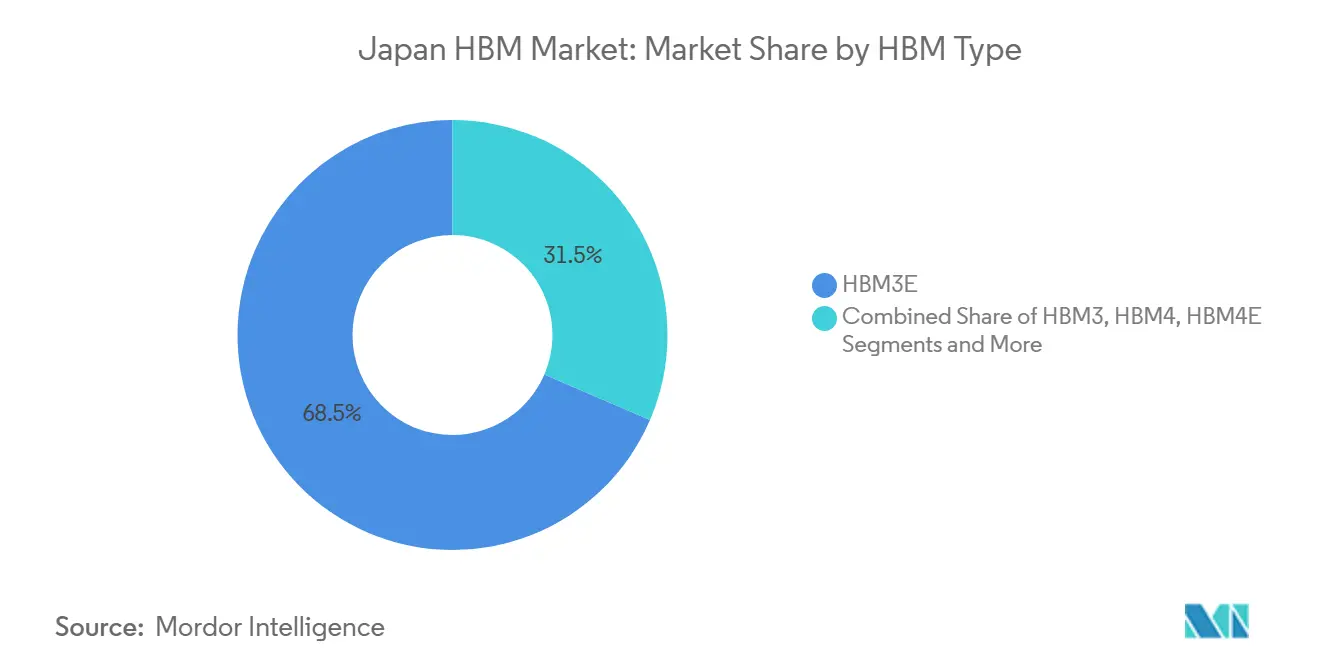
HBM3E held 68.53% of the Japanese high-bandwidth memory market share by HBM type in 2025, indicating it remained the default choice for the first large wave of AI training system deployments in Japan. Its lead was supported by the fact that it was the only high-volume option broadly available for advanced accelerator clusters during that period. HBM4E and later-generation HBM are projected to grow at a 24.98% CAGR through 2031, making them the fastest-growing segment of the HBM type mix in the Japanese high-bandwidth memory market. JEDEC’s HBM4 standard formalized a higher-performance baseline in 2025, providing buyers with a clearer path for qualification and future procurement planning. SK hynix then strengthened the transition by shipping 12-layer HBM4 samples in March 2025 and 12-layer HBM4E samples in June 2026, which helped move later generations from roadmap status into practical customer evaluation.[3]SK hynix Inc., “SK Hynix Ships World's First 12-Layer HBM4 Samples to Customers,” SK hynix Newsroom, news.skhynix.com
The segment is not shifting all at once because Japanese buyers still need a mix of price, availability, thermal stability, and platform timing when they choose between active HBM generations. HBM4 and HBM4E are attracting interest ahead of full-volume availability because next-generation accelerator programs are already being planned around their higher-performance envelope. HBM3 remains relevant in cost-sensitive deployments, but its role is narrowing as HBM3E becomes more established across buyer tiers. HBM2E and earlier generations are moving into maintenance and legacy support rather than new large-scale procurement. This layering of products keeps the Japan high-bandwidth memory industry broad enough to support both premium and mid-tier demand, even as the spending center of gravity shifts toward later nodes and generations.



By Technology Node: Sub-1Z Architectures Drive Both Volume And Advanced Performance
Advanced nodes below 1Z accounted for 49.18% of the Japan high-bandwidth memory market in 2025 and are projected to expand at a 24.84% CAGR through 2031, giving this segment the unusual position of being both the largest and the fastest-growing technology node category. That pattern reflects the fact that later HBM products are extending the life of these nodes rather than replacing them, resulting in a short plateau. The segment’s strength was supported by production shifts linked to newer DRAM architectures and by the need for more advanced process control in high-performance memory stacks. JX Advanced Metals completed a new mass production line for high-purity CVD and ALD materials at its Ibaraki site in March 2026, and the company explicitly linked the expansion to advanced semiconductors, including HBM. That move matters because Japan’s share of value in advanced nodes often comes from materials quality and process support rather than from final stack assembly alone.
The 1Z node remained the second-largest position in 2025 because it continued to support earlier HBM3E products that were still active in procurement cycles across enterprise and telecom-related deployments. The 1Y node retained a role in legacy HBM3 supply, while older 1X and higher nodes continued in a managed decline tied to longer-cycle public and research demand. Suppliers in Japan are also preparing for what comes after the current wave, not only for the present node mix. Toto announced a USD 495 million investment in semiconductor materials for the 1nm era in June 2026, which showed that local materials players were already positioning for the next set of process requirements. This gives the Japanese high-bandwidth memory market a durable upstream advantage, as Japanese firms can capture value from future node transitions even before domestic high-volume HBM stack production reaches scale.
By End Use Industry: Hyperscalers Anchor Today's Demand, Internet Platforms Define Tomorrow's
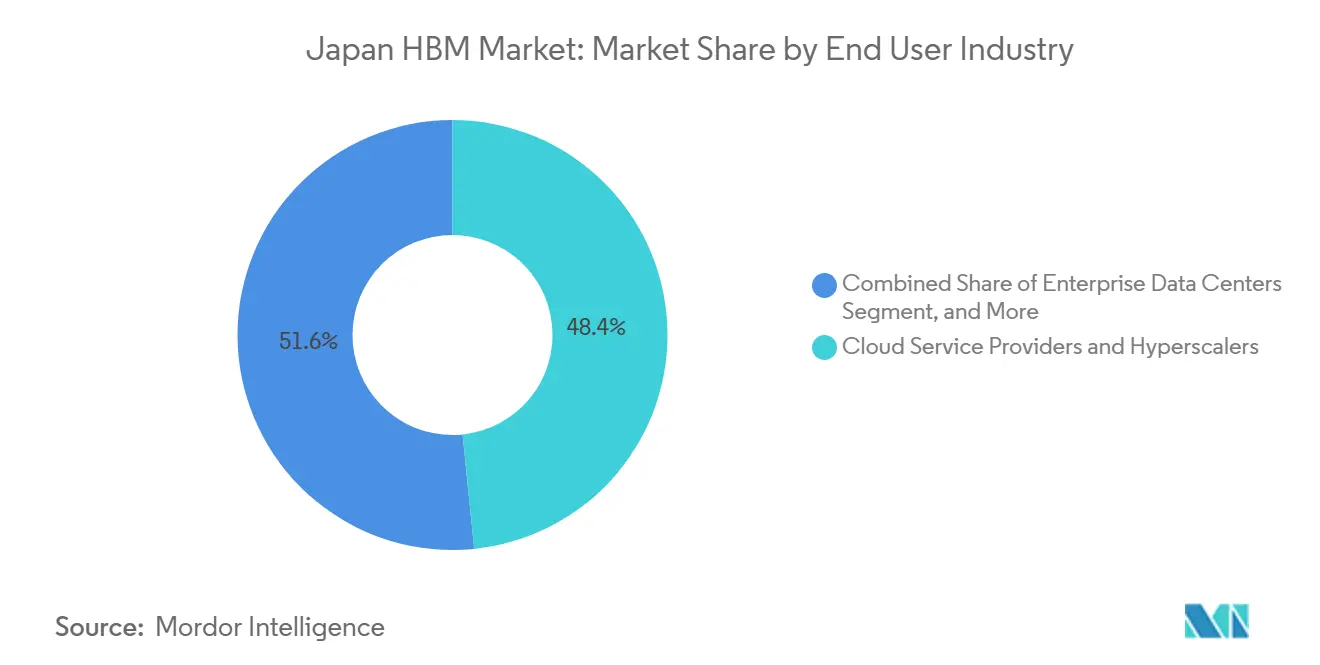
Cloud service providers and hyperscalers accounted for 48.39% of demand in 2025, making them the largest end-use group in the Japanese high-bandwidth memory market during the first major AI capacity buildout. Internet platforms and AI model developers are projected to record the fastest growth at a 25.23% CAGR through 2031, signaling that the buyer base will broaden as deployments shift from foundational model development to commercial service delivery. Hyperscalers led the first phase because they had the balance sheets, power access, and technical integration capacity needed to bring large clusters online early. Microsoft’s multiyear investment program and SoftBank’s GPU cloud launch plan both show how large operators are still shaping early procurement activity in Japan. GMI Cloud’s sovereign AI plan in Kagoshima adds another route for demand growth by expanding the set of entities willing to anchor dedicated AI compute at scale.
Government, defense, research, and academic institutions remain a steady part of demand because their procurement follows multiyear public priorities rather than short procurement cycles. Enterprise data centers occupy an important middle ground as they move into database acceleration and inference serving, even if they are not yet matching hyperscaler volumes. Telecommunications operators remain smaller in absolute terms, but their interest is growing as AI-native functions are adopted across more network workloads. Other verticals, including automotive simulation, drug discovery, and financial modeling, represent slower but widening adoption areas that can support demand later in the period. This change in buyer mix should make the Japan high bandwidth memory market less concentrated on hyperscalers over time, while still preserving strong demand from the operators that built the first wave of capacity.
By Application: Training Volume Gives Way To Inference Scale
AI model training accounted for 59.73% of the Japan high-bandwidth memory market size in 2025, underscoring how closely the first investment cycle was tied to large-scale foundational model development and early sovereign AI priorities. AI model inference is projected to grow at a 25.18% CAGR through 2031, which makes it the fastest-growing application as deployments spread across more enterprise and service environments. Training led first because high-performance clusters for model creation need very high memory bandwidth and dense accelerator configurations. Japan’s sovereign AI push and sustained near-term interest in training-oriented infrastructure in the input draft. The transition toward inference does not diminish HBM's importance, but it does begin to shift value toward latency, efficiency, concurrency, and deployment scale in the Japanese high-bandwidth memory market.
HPC and scientific computing remain durable applications because Japan continues to support research workloads that depend on very high memory throughput. Graphics, rendering, and visualization form a smaller but defensible demand base because real-time creative workloads are moving beyond what conventional graphics memory can comfortably support. Network and telecom processing are also relevant, especially where AI inference is being pushed closer to the edge or into core acceleration functions. Other high-bandwidth workloads will continue to appear in selective enterprise settings as HBM-enabled systems become easier to justify over the forecast period. Taken together, these shifts mean the Japanese high-bandwidth memory market is moving from a narrow, training-led profile toward a more balanced application mix that can support steadier procurement throughout the full period.
By Packaging Type: 2.5D Interposer Dominates As Hybrid Bonding Approaches Critical Adoption
2.5D interposer-based packaging held 86.92% of the Japanese high-bandwidth memory market share by packaging type in 2025, making it the clear dominant integration format for deployed HBM systems. Its lead came from installed manufacturing maturity, stable yield behavior, and the broad use of CoWoS-linked architectures in large AI deployments. At the same time, 3D stacking and hybrid-bonded integration are projected to grow at a 24.62% CAGR through 2031, making them the fastest-growing packaging paths in the Japanese high-bandwidth memory market. The shift is being driven by the need to support later HBM generations with tighter integration, better thermal performance, and more efficient signal paths. JEDEC’s HBM4 standard and SK hynix’s HBM4 and HBM4E sample milestones both point in this direction because they raise practical requirements for later packaging generations.
Fan-out advanced packaging remains smaller, but it has room to grow as edge AI and tighter form factors become more important. Japan’s role is especially strong in the supporting layers of this segment, as domestic companies supply substrates, bonding materials, specialty chemicals, and process equipment rather than just finished memory products. Advantest’s M5241 memory handler launch in December 2025 shows how the testing side of the ecosystem is scaling alongside more demanding HBM products. That dynamic gives Japan a high-bandwidth memory industry a meaningful position in packaging evolution, even before local stack production reaches large scale. As hybrid bonding moves closer to wider adoption, the country’s precision-tooling and materials capabilities should capture a larger share of value tied to integration difficulty rather than only to memory volume.
Geography Analysis
The Japan high bandwidth memory market remained concentrated across 3 industrial zones in 2025 and 2026, with Greater Tokyo leading demand formation, western Japan anchoring future domestic stack capacity, and Hokkaido building a longer-cycle semiconductor platform. Greater Tokyo, including the wider Kanto corridor, remains the main center for hyperscale data center activity, semiconductor equipment development, and advanced materials supply. Microsoft’s multiyear AI and data center investment plan reinforced the region’s importance by linking cloud expansion directly to domestic compute infrastructure. The Osaka area also strengthened its role when KDDI and Hewlett Packard Enterprise moved ahead with AI data center operations using NVIDIA GB200 NVL72 infrastructure for training and large language model development.[4]Hewlett Packard Enterprise, “KDDI and HPE Join Forces to Launch AI Data Center Operations by Early 2026,” Hewlett Packard Enterprise, hpe.com JX Advanced Metals’ Ibaraki expansion further showed how this zone connects Japanese materials strength to global HBM economics.
Western Japan, especially Hiroshima and the wider Chugoku region, is becoming the most visible center of Japan’s domestic ambition to produce HBM. METI’s support for Micron’s Hiroshima operations and next-generation DRAM work gave the region a direct role in Japan’s effort to localize more advanced memory capacity. This matters because Hiroshima shifts the Japan high bandwidth memory market from an upstream materials position toward a more integrated manufacturing role. It also creates a future demand pull for local equipment, materials, testing, and packaging providers that can serve production closer to the point of stack output.
Hokkaido is emerging as the country’s longer-horizon growth zone because it combines advanced chip manufacturing plans with space and energy conditions that suit large compute infrastructure. Rapidus’ Chitose project, backed by cumulative government support gives the region a strategic role in next-generation semiconductor integration. While Rapidus is not an HBM stack producer, the project still matters because later chiplet and advanced packaging activity can shape future HBM-adjacent demand in Japan. Hokkaido’s lower land costs and more favorable power profile also improve its appeal for compute-intensive facilities that could translate into later memory procurement. Across these 3 zones, the geographic pattern of the Japan high bandwidth memory market shows that demand, policy, and upstream supply capabilities are becoming more regionally specialized rather than spreading evenly across the country.
Competitive Landscape
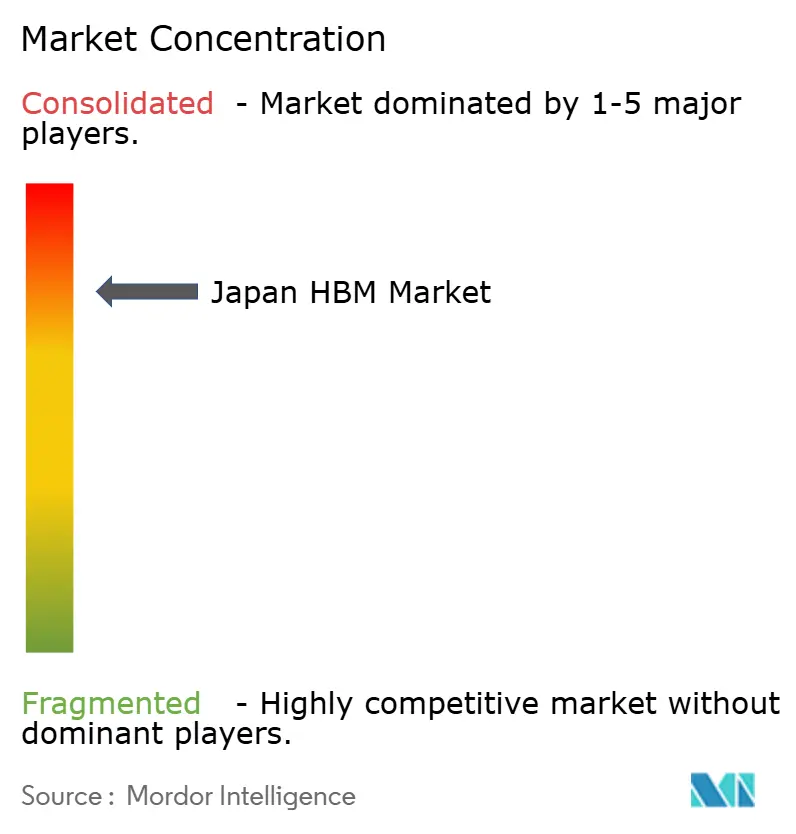
The competitive structure of the Japan high bandwidth memory market remains highly concentrated because finished HBM stack supply is effectively controlled by SK hynix, Samsung Electronics, and Micron Technology, while Japanese firms are more active in materials, tooling, testing, and packaging support than in current stack output. This creates a dual structure in which global memory suppliers shape stack availability and qualification, while Japanese companies capture value in the enabling layers surrounding production and deployment. The practical effect is that procurement power still sits with a very small number of memory vendors, especially for leading-edge products tied to AI accelerators. At the same time, Japan’s domestic ecosystem remains commercially important because no advanced HBM program can scale smoothly without high-quality materials, equipment, and test support. That balance keeps the Japan high bandwidth memory market concentrated at the finished-product level but distributed across a broader upstream participant base.
SK hynix remains one of the most influential companies in the current cycle because it moved early on HBM4 and HBM4E sample shipments, setting the pace for later-generation qualification. Micron’s Hiroshima investment is another major strategic move because it is intended to bring advanced HBM-related production into Japan and reduce long-run dependence on imported finished stacks. Advantest also made a timely move with the M5241 memory handler, which was built for HBM and next-generation DRAM testing and aligned with rising test intensity in AI memory devices. These moves show that leadership in this space is being built through both direct memory production and control of the surrounding process chain. They also show why the Japan high bandwidth memory market is unlikely to open quickly to many new stack suppliers, even though the broader ecosystem has room for more participants.
Japanese companies are particularly well positioned where HBM complexity is rising fastest, including specialty chemicals, advanced materials, precision cutting, testing throughput, and packaging support. JX Advanced Metals expanded production for high-purity CVD and ALD materials in 2026, which directly strengthened Japan’s position in advanced semiconductor processing inputs. Rapidus also deepened the long-term competitive picture because government-backed integration and chiplet programs can create adjacent capabilities that support future HBM-related system architectures. Overall, competition in the Japan high bandwidth memory market is best understood as a concentrated finished-memory segment sitting on top of a wider and strategically valuable Japanese upstream base.
Japan HBM Industry Leaders
SK hynix Inc.
Samsung Electronics Co., Ltd.
Micron Technology, Inc.
- *Disclaimer: Major Players sorted in no particular order

Recent Industry Developments
- June 2026: SK hynix shipped 12-layer HBM4E samples to major customers, achieving 48GB capacity, 16Gbps pin speed, and 17% lower heat resistance versus HBM4 using Advanced MR-MUF technology. The milestone establishes the performance baseline for next-generation AI accelerator platforms expected to enter Japan's data center procurement cycle from 2027 onward.
- June 2026: Rapidus completed a funding round totaling JPY 424.95 billion (USD 2.7 billion), including a JPY 150 billion capital injection from Japan's Information-Technology Promotion Agency, alongside earlier investment from 32 private-sector companies, including Canon, Fujitsu, NTT, SoftBank, and Sony Group. The funding covers the 2nm-generation semiconductor integration and chiplet packaging development program.
- May 2026: Micron Technology broke ground on its USD 9.6 billion HBM fabrication facility within its existing Hiroshima campus. The plant uses EUV lithography tools and aims to ship HBM4 and HBM4E products by 2028, with METI supporting the project with subsidies of up to JPY 500 billion (USD 3.17 billion).
- April 2026: Japan's METI approved an additional JPY 631.5 billion (USD 4 billion) for Rapidus, bringing total cumulative government support to JPY 2.35 trillion (USD 14.89 billion). The funding covers R&D for 2nm-generation semiconductor integration and chiplet package design for AI applications.
- April 2026: METI approved up to JPY 3.8 billion (USD 24.1 million) in early-stage development support through NEDO for SAIMEMORY's ZAM project, a SoftBank and Intel-backed alternative memory architecture targeting 40-50% lower power consumption than HBM, with commercialization targeted around 2029.


Japan HBM Market Report Scope
The Japan HBM Market Report is segmented by HBM type (HBM2E and Earlier Generations, HBM3, HBM3E, HBM4, HBM4E), Technology Node (1X and Above Legacy Nodes, 1Y Node, 1Z Node, Advanced Nodes Below 1Z) End Use Industry (Cloud Service Providers and Hyperscalers, Internet Platforms and AI Model Developers, Government, Defense, Research, and Academic Institutions, Enterprise Data Centers, Telecommunications Operators and Network, Equipment Providers, Other Enterprise Verticals), Application (AI Model Training, AI Model Inference, HPC and Scientific Computing, Professional Graphics, Rendering, and Visualization, Network and Telecom Processing, Other High-Bandwidth Compute Workloads, ) and Packaging Type (2.5D Interposer-Based Packaging, 3D Stacking, Fan-Out Advanced Packaging). The Market Forecasts are Provided in Terms of Value (USD).
| HBM2E and Earlier Generations |
| HBM3 |
| HBM3E |
| HBM4 |
| HBM4E |
| 1X And Above Legacy Nodes |
| 1Y Node |
| 1Z Node |
| Advanced Nodes Below 1Z |
| Cloud Service Providers and Hyperscalers |
| Internet Platforms and AI Model Developers |
| Government, Defense, Research, and Academic Institutions |
| Enterprise Data Centers |
| Telecommunications Operators and Network Equipment Providers |
| Other Enterprise Verticals |
| AI Model Training |
| AI Model Inference |
| HPC and Scientific Computing |
| Professional Graphics, Rendering, and Visualization |
| Network and Telecom Processing |
| Other High-Bandwidth Compute Workloads |
| 2.5D Interposer-Based Packaging |
| 3D Stacking |
| Fan-Out Advanced Packaging |
| By HBM Type | HBM2E and Earlier Generations |
| HBM3 | |
| HBM3E | |
| HBM4 | |
| HBM4E | |
| By Technology Node | 1X And Above Legacy Nodes |
| 1Y Node | |
| 1Z Node | |
| Advanced Nodes Below 1Z | |
| By End Use Industry | Cloud Service Providers and Hyperscalers |
| Internet Platforms and AI Model Developers | |
| Government, Defense, Research, and Academic Institutions | |
| Enterprise Data Centers | |
| Telecommunications Operators and Network Equipment Providers | |
| Other Enterprise Verticals | |
| By Application | AI Model Training |
| AI Model Inference | |
| HPC and Scientific Computing | |
| Professional Graphics, Rendering, and Visualization | |
| Network and Telecom Processing | |
| Other High-Bandwidth Compute Workloads | |
| By Packaging Type | 2.5D Interposer-Based Packaging |
| 3D Stacking | |
| Fan-Out Advanced Packaging |


Key Questions Answered in the Report
What is the current and forecast value of Japan high bandwidth memory demand?
The Japan high bandwidth memory market size stood at USD 84.48 million in 2025, reached USD 106.07 million in 2026, and is forecast to reach USD 311.53 million by 2031 at a 24.05% CAGR.
Which HBM type leads demand in Japan today?
HBM3E led the country in 2025 with a 68.53% share because it was the main volume-ready option for large AI training clusters and accelerator deployments.
Which product generation is expected to grow the fastest through 2031?
HBM4E is projected to grow at a 24.98% CAGR as buyers prepare for next-generation accelerator platforms and higher performance requirements.
Which end users are driving the strongest spending?
Cloud service providers and hyperscalers led demand in 2025 with a 48.39% share, while internet platforms and AI model developers are expected to post the fastest CAGR at 25.23% through 2031.
How is application demand shifting over the forecast period?
AI model training accounted for 59.73% of demand in 2025, but inference is projected to grow faster at a 25.18% CAGR as AI services move into broader deployment.
Why is Japan strategically important in this space even before local stack output scales?
Japan has a strong position in materials, testing, packaging support, and precision tools, so it captures value from rising HBM complexity even while finished stack supply remains concentrated among a few overseas producers.
Page last updated on:





